1 INTRODUCTION
What inflation measure should central banks target? This question arises when a New-Keynesian model is extended to include more than one sector. In fact, with only one instrument available, the central bank has to choose how to weight sectoral inflation rates. The literature has studied this important issue from many angles, but has so far overlooked the role of the degree of sectoral labor mobility for optimal monetary policy. Many constraints create barriers to perfect labor mobility, including the regulation of labor markets, namely hiring and firing laws and unemployment benefits (as shown by Botero et al. (Reference Botero, Djankov, Porta, de Silanes and Shleifer2004)), specific human capital skills (Ashournia (Reference Ashournia2018)), psychological costs and preference for the status quo (Dix-Carneiro (Reference Dix-Carneiro2014)), the capital and energy intensity in production and durability of final goods (Davis and Haltiwanger (Reference Davis and Haltiwanger2001)), among others. In this paper, we show that the extent to which labor can move across sectors is crucial in the determination of the optimal inflation composite, especially in the presence of durable goods.
Central banks generally target a measure of inflation constructed by weighting sectors according to their economic size. In particular, the US Federal Reserve targets the Price Index for Personal Consumption Expenditure (PCE), in which sectors are weighted by their consumption expenditure shares. Footnote 1 This practice, however, stands in contrast to the prescription of optimal monetary policy, which suggests that sectoral weights should reflect the relative degree of price stickiness and goods durability, besides economic size (see, e.g., Aoki (Reference Aoki2001), Benigno (Reference Benigno2004), Erceg and Levin (Reference Erceg and Levin2006), Bragoli et al. (Reference Bragoli, Rigon and Zanetti2016), Petrella et al. (Reference Petrella, Rossi and Santoro2019), and the literature we discuss below).
This paper shows that the degree of sectoral labor mobility should also be included because, first, micro- and macroeconometric evidence suggests that sectoral labor mobility is limited (see Horvath (Reference Horvath2000), Davis and Haltiwanger (Reference Davis and Haltiwanger2001), Lee and Wolpin (Reference Lee and Wolpin2006), Iacoviello and Neri (Reference Iacoviello and Neri2010), Caliendo et al. (Reference Caliendo, Dvorkin and Parro2019), Cardi and Restout (Reference Cardi and Restout2015), Cantelmo and Melina (Reference Cantelmo and Melina2018), Katayama and Kim (Reference Katayama and Kim2018), among others) Footnote 2 and, second, because sectoral shocks have become relatively more important than aggregate shocks since the Great Moderation (see Foerster et al. (Reference Foerster, Sarte and Watson2011) for evidence on the USA). If labor was perfectly mobile, it could immediately switch sectors to allow the economy to absorb asymmetric shocks. Conversely, with limited labor mobility, the adjustment to these shocks cannot fully occur through the reallocation of labor. This puts more pressure on wages, which in turn triggers inefficient movements in relative prices, generating scope for central bank’s intervention.
We illustrate this point by computing optimized simple rules in a two-sector New-Keynesian model. We start from a small perfectly symmetric model, in which the two sectors are subject to the same shocks, share the same price stickiness, the same economic size, and both produce nondurable goods. Then, we introduce sectoral heterogeneity along these three dimensions, one at a time. Although other forms of heterogeneity are possible, we consider the most common in the literature because of their empirical and theoretical relevance.
The importance of asymmetric price stickiness is well established both in normative and positive analyses of multi-sector models (see, e.g., Bils and Klenow (Reference Bils and Klenow2004), Nakamura and Steinsson (Reference Nakamura and Steinsson2008), and Bouakez et al. (Reference Bouakez, Cardia and Ruge-Murcia2014) for positive analyses, and Aoki (Reference Aoki2001), Benigno (Reference Benigno2004), and Bragoli et al. (Reference Bragoli, Rigon and Zanetti2016) for normative prescriptions). Emphasis on heterogeneity in sectoral size has highlighted a contrast between the standard practice of central banks to weigh sectors by their expenditure share and the theoretical prescriptions suggesting that price stickiness is the most important feature to consider (see, e.g., Aoki (Reference Aoki2001) and Benigno (Reference Benigno2004)). Finally, the importance of durable goods also deserves some discussion. Empirical evidence reported by Bernanke and Gertler (Reference Bernanke and Gertler1995), Erceg and Levin (Reference Erceg and Levin2006), Monacelli (Reference Monacelli2009), and Sterk and Tenreyro (Reference Sterk and Tenreyro2018) suggests that durables goods are important for the transmission of monetary policy. Moreover, given their inherent characteristics as investment goods, their relevance arises both in positive (see, e.g., Barsky et al. (Reference Barsky, House and Kimball2007), Monacelli (Reference Monacelli2009), Iacoviello and Neri (Reference Iacoviello and Neri2010), Bouakez et al. (Reference Bouakez, Cardia and Ruge-Murcia2011), among many others) and normative (see, e.g., Erceg and Levin (Reference Erceg and Levin2006), Barsky et al. (Reference Barsky, Boehm, House and Kimball2016), Petrella et al. (Reference Petrella, Rossi and Santoro2019)) analyses of monetary policy. In particular, the fact that durable goods are more sensitive to interest rate movements than nondurables (see Erceg and Levin (Reference Erceg and Levin2006)) makes them react much more to macroeconomic shocks.
As expected, in the benchmark hypothetical symmetric economy, the degree of labor mobility does not play any role and the central bank optimally places an equal weight to inflation in each sector. When we allow for sectoral heterogeneity, in accordance with previous studies (discussed below), the central bank optimally assigns less weight to inflation in the sector with (i) lower degree of price stickiness; or (ii) smaller economic size; or (iii) producing durable goods. Our contribution shows that, in each of the three cases, a lower degree of sectoral labor mobility, ceteris paribus, increases the optimal weight of the sector that would otherwise receive less weight. This property relies on the fact that lower degrees of labor mobility amplify the volatility of wage differentials, which translates on the volatility of the relative price, a result for which we provide a simple analytical intuition. We furthermore note that the effect of the degree of sectoral labor mobility is stronger when the two sectors differ in their goods’ durability, given that durability amplifies relative price fluctuations, and would call for a larger reallocation of labor across sectors in response to asymmetric shocks.
An important conclusion that can be drawn from these results is that, in general, the optimal weights assigned to sectoral inflation rates differ from the shares of the sectors in total expenditures, the usual suboptimal criterion adopted by central banks. A natural question is then: What is the welfare loss suffered by the economy because of the adoption of suboptimal weights? To answer this question, we employ an estimated fully fledged two-sector New-Keynesian model of the US economy with durable and nondurable goods, imperfect sectoral labor mobility, and the customary real and nominal frictions. Estimating the model prior to designing optimized monetary policy rules is important because such rules heavily depend on the persistence and the variance of shocks (see, e.g., Cantore et al. (Reference Cantore, Levine, Melina and Yang2012) and Melina and Villa (Reference Melina and Villa2018), among others). The two sectors differ in size, goods’ durability, and in the degree of wage and price stickiness, although the latter turns out not to be significantly different across the two sectors, in line with our prior macroeconometric estimates (Cantelmo and Melina (Reference Cantelmo and Melina2018)) and other microeconometric studies (see Bils and Klenow (Reference Bils and Klenow2004) and Nakamura and Steinsson (Reference Nakamura and Steinsson2008), among others). The estimation, inter alia, confirms a limited degree of labor mobility across sectors. Consistent with the findings obtained in the smaller calibrated model, the central bank optimally assigns a lower weight to inflation in the durables sector. Importantly, we also confirm that in the fully fledged model this weight increases the more limited labor mobility is across sectors. The analysis unveils that the observed inflation weights imply a decrease in welfare of up to 10% relative to the case of optimal weights. The results survive a number of robustness checks involving alternative calibrations and monetary policy rules, including those that entail a feedback on wages.
Our study is related to a number of key contributions in literature. In a seminal paper, Aoki (Reference Aoki2001) studies a two-sector economy with sticky- and flexible-price sectors, but no wage stickiness or limited labor mobility, and finds that the central bank should assign zero weight to the flexible-price sector. A similar result is attained by Benigno (Reference Benigno2004) in a two-country New-Keynesian model of a currency union. Here, more weight is attached to inflation in the region displaying a higher degree of price stickiness. Mankiw and Reis (Reference Mankiw and Reis2003) enrich these results by showing that, in order to construct a price index that—if kept on target—stabilizes economic activity, the sectoral weights should depend on the degree of price stickiness, the responsiveness to business cycles, and the tendency to experience idiosyncratic shocks. Furthermore, Bragoli et al. (Reference Bragoli, Rigon and Zanetti2016) study a multi-country and a multi-sector model of the Euro Area with price stickiness heterogeneity across regions (or sectors). They conclude that the optimal weight to assign to inflation in each country (sector) depends on the interaction of country’s (sector’s) price stickiness, economic size, and distribution of the relative price shock. Erceg and Levin (Reference Erceg and Levin2006), Barsky et al. (Reference Barsky, Boehm, House and Kimball2016), and Petrella et al. (Reference Petrella, Rossi and Santoro2019) characterize the sectors by their durability. Abstracting from heterogeneity in price and wage stickiness, Erceg and Levin (Reference Erceg and Levin2006) show that the degree of durability of goods plays an important role for the conduct of monetary policy. Indeed, as durable goods are more sensitive to the interest rate than nondurables, the central bank faces a severe trade-off in stabilizing output and prices across the two sectors. Finally, Huang and Liu (Reference Huang and Liu2005), Petrella and Santoro (Reference Petrella and Santoro2011), and Petrella et al. (Reference Petrella, Rossi and Santoro2019) explore the role of input–output interactions (I-O) between intermediate and final goods firms, a feature we leave aside in the interest of parsimony. Footnote 3 Petrella et al. (Reference Petrella, Rossi and Santoro2019) also assume limited sectoral labor mobility and compute the optimal weight attached to durables inflation, but do not isolate the impact that the degree of labor mobility has on the weight itself.
The bottom line of our analysis is similar in spirit to that of Bragoli et al. (Reference Bragoli, Rigon and Zanetti2016) because it highlights that it is a combination of elements that the central bank has to take into account to determine the optimal inflation weights. The novel perspective we add to the debate is that the degree of sectoral labor mobility should also be part of the central bank’s decision factors, given the observed sector heterogeneity and the increased importance of sector-specific shocks.
The remainder of the paper is organized as follows. Section 2 presents the two-sector New-Keynesian model. Section 3 shows the results of the optimal monetary policy analysis. Section 4 describes the extensions needed to obtain the fully fledged two-sector model and discusses the results of the Bayesian estimation and optimal monetary policy. Finally, Section 5 concludes. More details about the model’s equilibrium conditions, the data, the Bayesian estimation, the Ramsey problem, the role of durable goods, and robustness checks are provided in the online Appendix. Footnote 4
2 THE TWO-SECTORS MODEL
We start our analysis by constructing a simple two-sector New-Keynesian model in the spirit of Aoki (Reference Aoki2001), with the addition of imperfect labor mobility across sectors. First, we lay out a framework in which both sectors produce nondurables goods and asymmetries in price stickiness and size of each sector are achieved by an appropriate calibration. Then, Section 2.5 describes what modifications are needed to allow for heterogeneity in goods’ durability.
2.1 Households
There is a continuum
 $i\in\left[0,1\right]$
of identical and infinitely lived households consuming goods produced in the two sectors
 $j=\left\{ C,D\right\} $
and supplying labor, whose lifetime utility is
 \begin{equation}E_{0}\sum_{t=0}^{\infty}e_{t}^{B}\beta^{t}U\left(X_{i,t},N{}_{i,t}\right)\!,\end{equation}
where
 $\beta\in\left[0,1\right]$
is the subjective discount factor,
 $e_{t}^{B}$
is a preference shock,
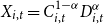
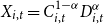 $X_{i,t}=C_{i,t}^{1-\alpha}D_{i,t}^{\alpha}$
is a Cobb–Douglas consumption aggregator of the goods produced in sectors C and D, respectively, with
 $\alpha\in\left[0,1\right]$
representing the share of good D consumption on total expenditure (as in Aoki (Reference Aoki2001), Benigno (Reference Benigno2004), and Bragoli et al. (Reference Bragoli, Rigon and Zanetti2016), among others), and
 $N_{i,t}$
being the household’s labor supply. We assume that the utility function is additively separable and logarithmic in consumption:
 $U\left(X_{t},N{}_{t}\right)=\log\left(X_{t}\right)-\nu\frac{N_{t}^{1+\varphi}}{1+\varphi}$
, where
 $\nu$
is a scaling parameter and
 $\varphi$
is the inverse of the Frisch elasticity of labor supply.
Members of each household supply labor to firms in both sectors according to:
 \begin{equation}N_{i,t}=\left[\left(\chi^{C}\right)^{-\frac{1}{\lambda}}\left(N_{i,t}^{C}\right)^{\frac{1+\lambda}{\lambda}}+\left(1-\chi^{C}\right)^{-\frac{1}{\lambda}}\left(N_{i,t}^{D}\right)^{\frac{1+\lambda}{\lambda}}\right]^{\frac{\lambda}{1+\lambda}},\end{equation}
where
 $\chi^{C}\equiv N^{C}/N$
represents the steady-state share of labor supply in sector C. Following Horvath (Reference Horvath2000) and a growing literature,
Footnote 5
this constant-elasticity-of-substitution (CES) specification of aggregate labor allows us to capture the degree of labor market mobility without deviating from the representative agent assumption; it is a reduced-form way to model imperfect labor mobility regardless of its root causes; it is useful to derive analytical results; and it allows for different degrees of sectoral labor mobility by means of just one parameter:
 $\lambda>0$
, that is, the intratemporal elasticity of substitution of labor across sectors (on this, see also Cardi and Restout (Reference Cardi and Restout2015)). Moreover, as noted by Petrella and Santoro (Reference Petrella and Santoro2011), equation (2) implies that the labor market friction is neutralized at the steady state. Perfect labor mobility is achieved for
 $\lambda\rightarrow\infty$
. In this case, sectoral labor services are perfect substitutes. If
 $\lambda<\infty$
, the economy displays a limited degree of labor mobility. Finally, as
 $\lambda\rightarrow0$
, labor becomes virtually not substitutable across sectors.
Footnote 6
Each household consumes
 $C_{i,t}$
, purchases nominal bonds
 $B_{i,t}$
, earns nominal wages
 $W_{i,t}^{j}$
from working in each sector, receives profits
 $\Omega_{t}$
from firms, and pays a lump-sum tax
 $T_{t}$
. We assume sector C to be the numeraire of the economy; hence,
 $Q_{t}\equiv\frac{P_{D,t}}{P_{C,t}}$
denotes the relative price of sector D, while
 $w_{i,t}^{j}=\frac{W_{i,t}^{j}}{P_{t}^{C}}$
is the real wage in sector j. The period-by-period real budget constraint reads as follows:
 \begin{align}C_{i,t}+Q_{t}D_{i,t}+\frac{B_{i,t}}{P_{t}^{C}}=\sum_{j=\left\{ C,D\right\} }\frac{W_{i,t}^{j}}{P_{t}^{C}}N_{i,t}^{j}+R_{t-1}\frac{B_{i,t-1}}{P_{t}^{C}}+\Omega_{t}-T_{t}.\end{align}
Households choose
 $C_{i,t}$
,
 $B_{i,t}$
,
 $D_{i,t}$
,
 $N_{i,t}^{C}$
,
 $N_{i,t}^{D}$
to maximize (1) subject to (2) and (3). At the symmetric equilibrium, the household’s optimality conditions are
 \begin{eqnarray}1 & = & E_{t}\left[\Lambda_{t,t+1}\frac{R_{t}}{\Pi_{t+1}^{C}}\right]\!,\end{eqnarray}
 \begin{eqnarray}Q_{t} & = & U_{D,t}\setminus U_{C,t},\end{eqnarray}
 \begin{eqnarray}w_{t}^{C} & = & \nu\left(\chi^{C}\right)^{-\frac{1}{\lambda}}\left(N_{t}^{C}\right)^{\frac{1}{\lambda}}N_{t}^{\varphi-\frac{1}{\lambda}}\setminus U_{C,t},\end{eqnarray}
 \begin{eqnarray}w_{t}^{D} & = & \nu\left(1-\chi^{C}\right)^{-\frac{1}{\lambda}}\left(N_{t}^{D}\right)^{\frac{1}{\lambda}}N_{t}^{\varphi-\frac{1}{\lambda}}\setminus U_{C,t}.\end{eqnarray}
Equation (4) is a standard Euler equation with
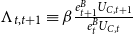 $\Lambda_{t,t+1}\equiv\beta\frac{e_{t+1}^{B}U_{C,t+1}}{e_{t}^{B}U_{C,t}}$
representing the stochastic discount factor.
 $U_{C,t}=\frac{1-\alpha}{C_{i,t}}$
and
 $U_{D,t}=\frac{\alpha}{D_{i,t}}$
denote the marginal utilities of consumption of goods produced in each sector. Equation (5) indicates that the relative demand of the two goods depends on the relative price
 $Q_{t}$
. Finally, equations (6) and (7) define the sectoral labor supply schedules that, combined, yield an intuitive relationship between sectoral labor supplies and relative wages:
 \begin{equation}\frac{w_{t}^{C}}{w_{t}^{D}}=\left(\frac{\chi^{C}}{1-\chi^{C}}\right)^{-\frac{1}{\lambda}}\left(\frac{N_{t}^{C}}{N_{t}^{D}}\right)^{\frac{1}{\lambda}}.\end{equation}
According to (8), higher substitutability of sectoral hours (larger
 $\lambda)$
reduces sectoral wage differentials. Conversely, lower substitutability (smaller
 $\lambda)$
implies larger wage differentials.
2.2 Firms
A continuum
 $\omega\in\left[0,1\right]$
of firms in each sector
 $j=\left\{ C,D\right\} $
operates in monopolistic competition and faces quadratic costs of changing prices
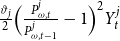 $\frac{\vartheta_{j}}{2}\Big(\frac{P_{\omega,t}^{j}}{P_{\omega,t-1}^{j}}-1\Big)^{2}Y_{t}^{j}$
, where
 $\vartheta_{j}$
is the parameter of sectoral price stickiness. Each firm produces differentiated goods according to a linear production function,
 \begin{equation}Y_{\omega,t}^{j}=e_{t}^{A}e_{t}^{A,j}N_{\omega,t}^{j},\end{equation}
where
 $e_{t}^{A}$
and
 $e_{t}^{A,j}$
are aggregate and sector-specific labor-augmenting productivity shocks, respectively. Firms maximize the present discounted value of profits,
 \begin{equation}E_{t}\left\{ \sum_{t=0}^{\infty}\Lambda_{t,t+1}\left[\frac{P_{\omega,t}^{j}}{P_{t}^{j}}Y_{\omega,t}^{j}-\frac{W_{\omega t}^{j}}{P_{t}^{j}}N_{\omega,t}^{j}-\frac{\vartheta_{j}}{2}\left(\frac{P_{\omega,t}^{j}}{P_{\omega,t-1}^{j}}-1\right)^{2}Y_{t}^{j}\right]\right\} ,\end{equation}
subject to production function (9) and a standard Dixit–Stiglitz demand equation
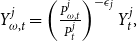 $Y_{\omega,t}^{j}=\left(\frac{P_{\omega,t}^{j}}{P_{t}^{j}}\right)^{-\epsilon_{j}}Y_{t}^{j},$
where
 $\epsilon_{j}$
is the sectoral intratemporal elasticity of substitution across goods. At the symmetric equilibrium, the price setting equations for the two sectors read as
 \begin{align}\left(1-\epsilon_{c}\right)+\epsilon_{c}MC_{t}^{C} & =\vartheta_{c}\left(\Pi_{t}^{C}-\Pi^{C}\right)\Pi_{t}^{C}\nonumber \\[3pt] &\quad -\vartheta_{c}E_{t}\left[\Lambda_{t,t+1}\frac{Y_{t+1}^{C}}{Y_{t}^{C}}\left(\Pi_{t+1}^{C}-\Pi^{C}\right)\Pi_{t+1}^{C}\right]\!,\\[3pt]\end{align}
 \begin{align}\left(1-\epsilon_{d}\right)+\epsilon_{d}MC_{t}^{D} & =\vartheta_{d}\left(\Pi_{t}^{D}-\Pi^{D}\right)\Pi_{t}^{D}\nonumber \\[3pt] &\quad -\vartheta_{d}E_{t}\left[\Lambda_{t,t+1}\frac{Q_{t+1}Y_{t+1}^{D}}{Q_{t}Y_{t}^{D}}\left(\Pi_{t+1}^{D}-\Pi^{D}\right)\Pi_{t+1}^{D}\right]\!,\end{align}
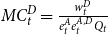
where
 $MC_{t}^{C}=\frac{w_{t}^{C}}{e_{t}^{A}e_{t}^{A,C}}$
and
 $MC_{t}^{D}=\frac{w_{t}^{D}}{e_{t}^{A}e_{t}^{A,D}Q_{t}}$
are the sectoral marginal costs. When
 $\vartheta_{j}=0$
, prices are fully flexible and are set as constant markups over the marginal costs.
2.3 Monetary Policy
Monetary policy is conducted by an independent central bank via the following interest rate rule:
 \begin{align}\log\left(\frac{R_{t}}{\bar{R}}\right) & = \rho_{r}\log\left(\frac{R_{t-1}}{\bar{R}}\right)+\alpha_{\pi}\log\left(\frac{\tilde{\Pi}_{t}}{\tilde{\Pi}}\right)\nonumber \\[3pt] &\quad + \alpha_{y}\log\left(\frac{Y_{t}}{Y_{t}^{f}}\right)+\alpha_{\Delta y}\left[\log\left(\frac{Y_{t}}{Y_{t}^{f}}\right)-\log\left(\frac{Y_{t-1}}{Y_{t-1}^{f}}\right)\right]\!,\end{align}
which has been popularized by Smets and Wouters (Reference Smets and Wouters2007) and implies that the central bank reacts to inflation, the output gap, and the output gap growth to an extent determined by parameters
 $\alpha_{\pi},\alpha_{y}$
, and
 $\alpha_{\Delta y}$
, respectively. The output gap is defined as the deviation of output from the level that would prevail with flexible prices,
 $Y_{t}^{f}$
, and
 $\rho_{r}$
is the degree of interest rate smoothing. The flexible-price equilibrium features the same degree of sectoral labor mobility as the sticky price equilibrium. This rule is flexible in that it also includes the case of a price-level rule when
 $\rho_{r}=1$
or a superinertial rule when
 $\rho_{r}>1$
(see, e.g., Woodford (Reference Woodford2003), Cantore et al. (Reference Cantore, Levine, Melina and Yang2012), Giannoni (Reference Giannoni2014), Melina and Villa (Reference Melina and Villa2018), and Cantore et al. (Reference Cantore, Levine, Melina and Pearlman2019), among others).
The aggregator of the gross rates of sectoral inflation is
 \begin{equation}\widetilde{\Pi}_{t}\equiv\left(\Pi_{t}^{C}\right)^{1-\tau}\left(\Pi_{t}^{D}\right)^{\tau},\end{equation}
where
 $\tau\in\left[0,1\right]$
represents the weight assigned by the central bank to sector D’s inflation in the composite.
2.4 Market Clearing Conditions and Exogenous Processes
In equilibrium, all markets clear and the model is closed by the following identities:
 \begin{align}Y_{t}^{C} & =C_{t}+\frac{\vartheta_{c}}{2}\left(\Pi_{t}^{C}-\Pi^{C}\right)^{2}Y_{t}^{C},\end{align}
 \begin{align}Y_{t}^{D} & =D_{t}+\frac{\vartheta_{d}}{2}\left(\Pi_{t}^{D}-\Pi^{D}\right)^{2}Y_{t}^{D},\end{align}
 \begin{align}Y_{t} & =Y_{t}^{C}+Q_{t}Y_{t}^{D}.\end{align}
We let the shocks follow an AR(1) process:
 \begin{equation}\log\left(\frac{\kappa_{t}}{\bar{\kappa}}\right)=\rho_{\kappa}\log\left(\frac{\kappa_{t-1}}{\bar{\kappa}}\right)+\epsilon_{t}^{\kappa},\end{equation}
where
 $\kappa=\left[e^{B},e^{A},e^{A,C},e^{A,D}\right]$
is a vector of exogenous variables,
 $\rho_{\kappa}$
are the autoregressive parameters, and
 $\epsilon_{t}^{\kappa}$
are i.i.d shocks with zero mean and standard deviations
 $\sigma_{\kappa}$
.
2.5 Extension of the Two-Sector Model to Account for Durable Goods
One of the popular dimensions of heterogeneity in a two-sector model that turns out to be very relevant for optimal monetary policy consists of allowing one sector to produce durable goods (see, e.g., Erceg and Levin (Reference Erceg and Levin2006)). In some of our exercises, we therefore extend the model and define sector D to be the durable goods sector while sector C continues to produce nondurable goods, approximating the models of Barsky et al. (Reference Barsky, House and Kimball2007) and Petrella et al. (Reference Petrella, Rossi and Santoro2019). While the supply side remains unchanged, introducing durable goods requires a slight modification of the demand side of the economy. In particular, household i demands and consumes the stock of durables,
 $D_{i,t}$
, which evolves according to the following law of motion:
 \begin{equation}D_{i,t+1}=(1-\delta)D_{i,t}+I_{i,t}^{D},\end{equation}
where
 $\delta$
is the depreciation rate and
 $I_{i,t}^{D}$
is the investment in durable goods. Each period the household decides the stock of durables to hold and therefore determines the required investment. Thus, the budget constraint (3) now reads as
 \begin{align}C_{i,t}+Q_{t}I_{i,t}^{D}+\frac{B_{i,t}}{P_{t}^{C}}=\sum_{j=\left\{ C,D\right\} }\frac{W_{i,t}^{j}}{P_{t}^{C}}N_{i,t}^{j}+R_{t-1}\frac{B_{i,t-1}}{P_{t}^{C}}+\Omega_{t}-T_{t}.\end{align}
Maximizing utility (1) subject to (2), (19), and (20) implies that (at the symmetric equilibrium) the first-order condition (5) becomes
 \begin{equation}Q_{t}=\frac{U_{D,t}}{U_{C,t}}+\left(1-\delta\right)E_{t}\left[\Lambda_{t,t+1}Q_{t+1}\right]\!.\end{equation}
Equation (21), whose right-hand side is usually referred to as the shadow value of durable goods, exhibits an additional term accounting for the discounted expected value of the undepreciated stock of durables. In particular, it represents the future utility stemming from selling the durable goods the following period, that is, the capital gain. Note that as the depreciation rate of durables increases (higher
 $\delta$
), durability of goods produced in sector D decreases. The model collapses to the model outlined in the previous section in case of full depreciation (
 $\delta=1$
).
While the equations defining the problem of the firms in sector D are unaffected by the presence of durable goods, the market clearing condition (16) now implies that the period expenditure in sector D is determined by the flow of durables
 $I_{t}^{D}$
:
 \begin{equation}Y_{t}^{D}=I_{t}^{D}+\frac{\vartheta_{d}}{2}\left(\Pi_{t}^{D}-\Pi^{D}\right)^{2}Y_{t}^{D}.\end{equation}
All the remaining equations of the model, including the monetary policy rule and the inflation aggregator, remain unaltered.
2.6 Analytical Intuition of the Impact of the Degree of Sectoral Labor Mobility on Fluctuations of the Relative Price
We already anticipated in Section 1 that lower degrees of sectoral labor mobility amplify the volatility of the relative price, especially in the presence of durable goods. To provide an analytical intuition of the mechanism, we log-linearize and combine the relative labor supply schedule (8), the definition of inflation in sector D
 $(\Pi_{t}^{D}=\Pi_{t}^{C}Q_{t}\setminus Q_{t-1})$
, and the sectoral pricing equations (11) and (12) around the steady state (variables with denote percent deviations from their respective steady state). This procedure is convenient as the algebraic expressions will exhibit cyclical fluctuations of the relevant macroeconomic variables, and larger cyclical fluctuations imply higher volatilities of the underlying variables at business cycle frequencies. The log-linearized expressions of the above-mentioned equations read as follows:
 \begin{align}\hat{w}_{t}^{C}-\hat{w}_{t}^{D} & =\frac{1}{\lambda}\left(\hat{N}_{t}^{C}-\hat{N}_{t}^{D}\right)\!,\end{align}
 \begin{align}\hat{Q_{t}} & =\hat{\Pi}_{t}^{D}-\hat{\Pi}_{t}^{C}+\hat{Q}_{t-1},\end{align}
 \begin{align}\hat{\Pi}_{t}^{D} & =\frac{1-\epsilon_{d}}{\vartheta_{d}}\left(\hat{w}_{t}^{D}-\hat{Q}_{t}-\hat{e}_{t}^{A,D}\right)+\beta E_{t}\hat{\Pi}_{t+1}^{D},\end{align}
 \begin{align}\hat{\Pi}_{t}^{C} & =\frac{1-\epsilon_{c}}{\vartheta_{c}}\left(\hat{w}_{t}^{C}-\hat{e}_{t}^{A,C}\right)+\beta E_{t}\hat{\Pi}_{t+1}^{C}.\end{align}
For ease of exposition, and without loss of generality, assume that price stickiness and monopolistic competition are equal across sectors (i.e.,
 $\vartheta_{c}=\vartheta_{d}=\vartheta$
and
 $\epsilon_{c}=\epsilon_{d}=\epsilon$
), it is then possible to show that combining equations (23)–(26) yields:
 \begin{align}\hat{Q_{t}} & =\varpi_{1}\frac{1}{\lambda}\left(\hat{N}_{t}^{D}-\hat{N}_{t}^{C}\right)-\varpi_{1}\left(\hat{e}_{t}^{A,D}-\hat{e}_{t}^{A,C}\right)+\varpi_{2}\beta E_{t}\left[\hat{\Pi}_{t+1}^{D}-\hat{\Pi}_{t+1}^{C}\right]+\varpi_{2}\hat{Q}_{t-1},\end{align}
where
 $\varpi_{1}=\frac{1-\epsilon}{\vartheta+1-\epsilon},\varpi_{2}=\frac{\vartheta}{\vartheta+1-\epsilon}$
. Equation (27) shows that for
 $\lambda\rightarrow\infty$
, the first summand on the right-hand side
 $(\varpi_{1}\frac{1}{\lambda}[\hat{N}_{t}^{D}-\hat{N}_{t}^{C}])$
approaches zero, that is, perfect labor mobility removes a source of volatility in the cyclical fluctuations of the relative price. Conversely, lower degrees of labor mobility (lower
 $\lambda$
) imply a higher impact of fluctuations of sectoral wage differentials on relative price fluctuations (note that, via equation (23),
 $\hat{w}_{t}^{C}-\hat{w}_{t}^{D}=\frac{1}{\lambda}[\hat{N}_{t}^{C}-\hat{N}_{t}^{D}]$
). In the sticky price equilibrium, imperfect labor mobility thus adds a further source of inefficiency in addition to price stickiness. Intuitively, when prices cannot immediately adjust, the limited ability of workers to switch sectors in response to sectoral shocks exerts pressure on wages and hence on firms’ marginal costs. Since firms cannot fully reset their prices, the response of the relative price is larger than what would be with perfect labor mobility, inducing the central bank to put relatively more weight on inflation in the sector that would otherwise receive a lower weight.
To see the role of goods’ durability, as detailed in online Appendix F, we log-linearize equation (21) around the steady state and obtain:
 \begin{equation}\hat{Q}_{t}=\left(\hat{C}_{t}-\hat{D}_{t}\right)\left[1-\left(1-\delta\right)\beta\right]+\left(1-\delta\right)\beta E_{t}\left[\hat{R}_{r,t}-\hat{Q}_{t+1}\right]\!.\end{equation}
Equation (28) shows that, for any positive discount factor (
 $\beta$
), lower values of
 $\delta$
(i.e., higher good’s durability) decrease the effect of the first summand of the right-hand side of the equation
 $([\hat{C}_{t}-\hat{D}_{t}][1-\left(1-\delta\right)\beta])$
, that is, the marginal rate of substitution between goods produced in sectors C and D, and increase the importance of the second summand
 $([1-\delta]\beta E_{t}[\hat{R}_{r,t}-\hat{Q}_{t+1}])$
, which depends on the fluctuations of next period’s relative price
 $\hat{Q}_{t+1}$
. Iterating (27) one period forward shows that
 $\hat{Q}_{t+1}$
is also more volatile when the degree of labor mobility declines. Putting it differently, the degree of sectoral labor
 $\lambda$
affects the period-t volatility of the relative price also through its next period’s value, which enters the picture when
 $\delta<1$
. Durables add further variability to the relative price because, as explained by Erceg and Levin (Reference Erceg and Levin2006), being an investment good, small adjustments in their stock imply large changes in their flows, making them more responsive to shocks than nondurables. It follows that, in a model with durables, labor tends to adjust more in response to shocks than in a model without durables. Limited labor mobility makes this adjustment harder, generating larger inefficient fluctuations in the relative price. In sum, the durability of final goods produced in sector D amplifies the effects of the degree of sectoral labor mobility on the volatility of the relative price
 $Q_{t}$
. Clearly, if goods in sector D are nondurables (
 $\delta=1$
) the second summand on the right-hand side of (28) disappears and the degree of sectoral labor mobility affects the volatility of the relative price only via its current value.
2.7 Parametrization
The model is parametrized at a quarterly frequency. The discount factor
 $\beta$
is equal to the conventional value of
 $0.99$
, implying an annual steady-state gross interest rate of 4%. The baseline calibration of the model implies perfect symmetry across sectors and that both sector C and sector D produce nondurables (
 $\delta=1$
). Therefore, we set
 $\alpha=0.50$
. The inverse Frisch elasticity of labor supply,
 $\varphi$
, is set at a standard value of 0.5. The preference parameter
 $\nu$
is set to target steady-state labor to a conventional
 $0.33$
. This assumption is, however, innocuous as results are robust to any reasonable normalization of steady-state labor. The sectoral elasticities of substitution across different varieties
 $\epsilon_{c}$
and
 $\epsilon_{d}$
equal 6 in order to target a steady-state gross markup of
 $1.20$
in both sectors, while we assume that prices last four quarters as in Erceg and Levin (Reference Erceg and Levin2006), and thus set
 $\vartheta_{c}=\vartheta_{d}=60$
, following Woodford (Reference Woodford2003) and Monacelli (Reference Monacelli2009) to convert the Rotemberg parameters to Calvo equivalents. To isolate the role of sectoral labor mobility, we consider three relevant cases: (i) quasi-immobile labor by setting
 $\lambda=0.10$
; (ii) limited labor mobility by setting
 $\lambda=1$
; and (iii) a case of perfect mobility as
 $\lambda\rightarrow\infty$
.Footnote 7 Finally, given that the results for the first part of the paper are purely illustrative, we set the persistence and standard deviation of the shocks to
 $\rho_{\kappa}=0.90$
and
 $\sigma_{\kappa}=0.01$
, respectively. In the fully fledged model (Section 4), we estimate shock processes together with the rest of structural parameters.
From the baseline parametrization, we achieve sectoral heterogeneity in three dimensions by means of calibration, one at a time. First, we allow sectors to differ in the degree of price stickiness. For sector D, we assume flexible prices (
 $\vartheta_{d}=0$
). For sector C, in one exercise, we keep the same price stickiness (
 $\vartheta_{c}=60$
); in another exercise, we double it (
 $\vartheta_{c}=120$
) to keep the average price stickiness in the economy constant, relative to the symmetric case. Then, we assume that sector D is smaller than sector C by setting
 $\alpha=0.30$
. Finally, we allow sector D to produce durable goods, while keeping the same price stickiness across the two sectors. Following Monacelli (Reference Monacelli2009), in the this last case, we calibrate the depreciation rate
 $\delta$
at
 $0.010$
, amounting to an annual depreciation of 4%.
2.8 Dynamic Impact of Sectoral Labor Mobility
While various macroeconomic models embed limited labor mobility (see, e.g., Bouakez et al. (Reference Bouakez, Cardia and Ruge-Murcia2009), Petrella and Santoro (Reference Petrella and Santoro2011), and Petrella et al. (Reference Petrella, Rossi and Santoro2019), among others), there is no systematic investigation of its role on the dynamic behavior of macroeconomic variables. Therefore, in this section, we show how sectoral labor mobility alters the responses of the output gap, the interest rate, and sectoral inflation rates to both aggregate and sectoral shocks. We use the model with heterogenous price stickiness by setting
 $\vartheta_{d}=0$
, to allow both aggregate and sectoral shocks to generate asymmetric responses. Clearly, in the symmetric model, sectoral labor mobility plays a role only in response to sectoral disturbances. In addition to the parametrization discussed in Section 2.7, we set a simple Taylor rule with standard values (
 $\rho_{r}=0.80,\rho_{\pi}=1.50,\rho_{y}=0.125,\rho_{\Delta y}\,{=}\,0$
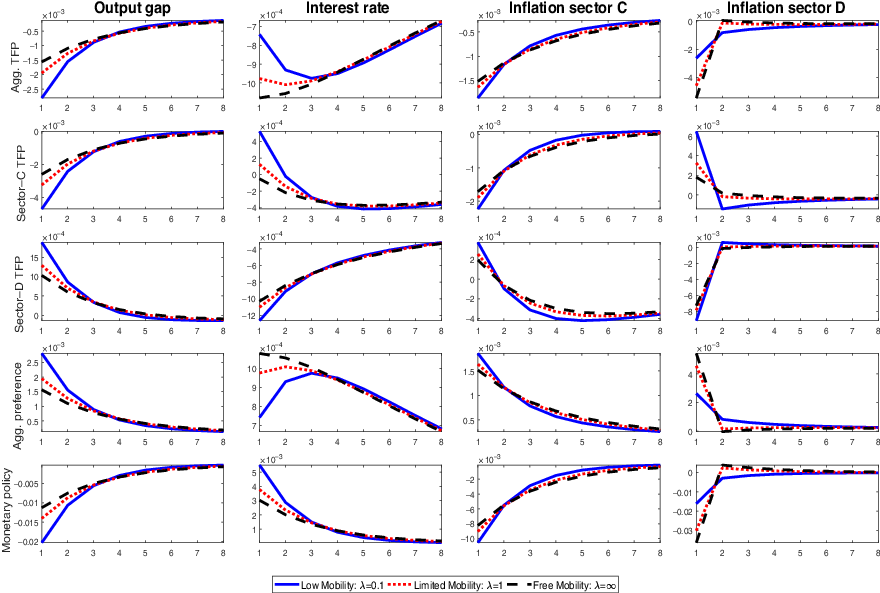
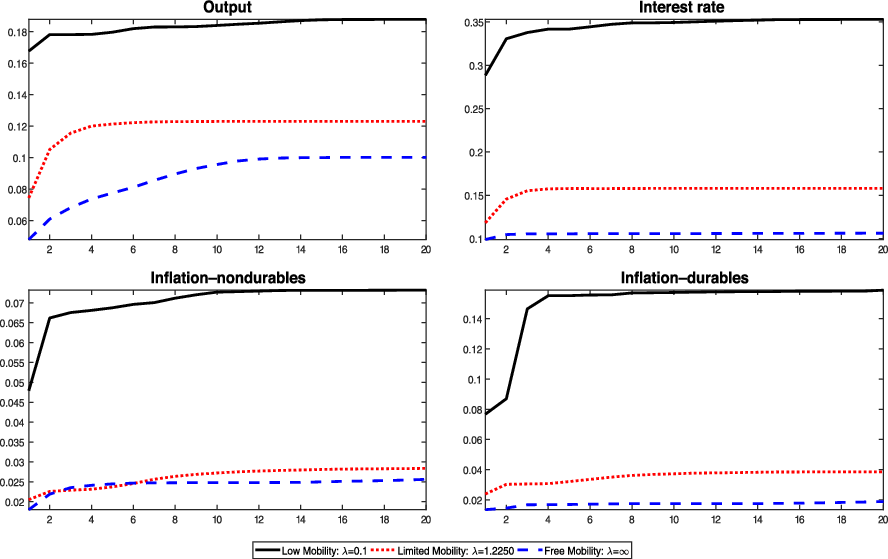
). Figure 1 plots the impulse responses to the shocks in the model. It is clear that lower degrees of labor mobility entail larger output gaps and clearly different responses of the interest rate and sectoral inflation rates. Given the simplicity of the model and the absence of many frictions that typically make responses more persistent (e.g., habit in consumption), most of the differences across the impulse responses are visible on impact. Responses then converge toward one another after about 1 year. All in all, larger deviations of output from the constrained efficient allocation generate scope for the central bank to take limited labor mobility into account.
Impulse responses to one standard deviation shocks in the stylized model with heterogenous price stickiness (
 $\vartheta_{c}=60,\vartheta_{d}=0$
).

3 OPTIMAL MONETARY POLICY
3.1 Welfare Measure
The optimal monetary policy analysis serves two purposes: (i) determining the optimal weights the central bank should assign to sectoral inflations subject to given degrees of labor mobility, and (ii) seeking parameter values for interest rate rule (13) to minimize the welfare loss with respect to the Ramsey policy. The flexible-price equilibrium features the same degree of sectoral labor mobility as the sticky price equilibrium. Monetary policy therefore tries to reach the constrained efficient equilibrium, that is, the equilibrium with flexible prices under the same degree of labor mobility. While in the stylized model of Section 2, the constrained efficient allocation is characterized by flexible prices (given that wages are always flexible), in the fully fledged model of Section 4, it requires a flexible-price and flexible-wage equilibrium (given the presence of sticky wages). The social planner maximizes the present value of households’ utility adjusted for a penalty term to account for the zero-lower-bound constraint,
 \begin{equation}\Upsilon_{t}=E_{t}\left[\sum_{s=0}^{\infty}e_{s}^{B}\beta^{s}U\left(X_{t+s},N_{t+s}\right)-w_{r}\left(R_{t+s}-R\right)^{2}\right]\!,\end{equation}
subject to the equilibrium conditions of the model. This specification, discussed below, allows avoiding the zero-lower-bound with high probability. In the analysis, however, welfare losses in consumption-equivalent terms are calculated excluding the penalty term. Following Schmitt-Grohe and Uribe (Reference Schmitt-Grohe and Uribe2007), we take a second-order approximation both of the mean of
 $\Upsilon_{t}$
and of the model’s equilibrium conditions around the deterministic steady state. In particular, we take the approximation around the steady state of the Ramsey equilibrium. Similarly to many other NK models in the literature (see, e.g., Schmitt-Grohe and Uribe (Reference Schmitt-Grohe and Uribe2007), Levine et al. (Reference Levine, McAdam and Pearlman2008), Cantore et al. (Reference Cantore, Levine, Melina and Pearlman2019), among others), the steady-state value of the gross inflation rate in the Ramsey equilibrium turns out to be very close to unity, which implies an almost zero-inflation steady state.
Footnote 8
As anticipated above, since it is not straightforward to account for the zero-lower-bound (ZLB, henceforth) on the nominal interest rate when using perturbation methods, we follow Schmitt-Grohe and Uribe (Reference Schmitt-Grohe and Uribe2007) and Levine et al. (Reference Levine, McAdam and Pearlman2008) and introduce a term in (29) that penalizes large deviations of the nominal interest rate from its steady state. Hence, the imposition of this approximate ZLB constraint translates into appropriately choosing the weight
 $w_{r}$
to achieve an arbitrarily low per-period probability of hitting the ZLB,
 $Pr\left(ZLB\right)\equiv Pr\left(R_{t}^{n}<1\right)$
, which we set at less than
 $0.01$
for each calibration.Footnote 9 We optimize the interest rate rule (13) by numerically searching for the combination of the policy parameters and the weight on sector D’s inflation
 $\tau\in\left[0,1\right]$
that maximizes the present value of households’ utility (29). In doing so, we follow Schmitt-Grohe and Uribe (Reference Schmitt-Grohe and Uribe2007) and Petrella et al. (Reference Petrella, Rossi and Santoro2019) and define the support of
 $\rho_{r}$
 $\left[0,1\right]$
and the support of
 $\alpha_{\pi},\alpha_{y}$
and
 $\alpha_{\Delta y}$
is
 $\left[0,5\right]$
. Parameter ranges are defined to preserve implementability of the policy rule. As explained by Schmitt-Grohe and Uribe (Reference Schmitt-Grohe and Uribe2007), for example, negative or too large positive coefficients would be difficult to communicate to policymakers or the public. Our ultimate goal is to unveil how the optimal weight placed on sector D’s inflation (
 $\tau)$
is affected by the degree of sectoral labor mobility. We therefore consider three cases of sectoral labor mobility (
 $\lambda=\left\{ 0.10,1,\infty\right\} )$
and compare the welfare losses in terms of steady-state consumption-equivalent,
 $\omega$
, with respect to the Ramsey policy, as in Schmitt-Grohe and Uribe (Reference Schmitt-Grohe and Uribe2007). In particular, for a regime associated with a given Taylor-type interest rate rule A, the welfare loss is implicitly defined as
 \begin{equation}E_{0}\left\{ \sum_{t=0}^{\infty}\beta^{t}\left[U\left(\left(1-\omega\right)X_{t}^{R},N_{t}^{R}\right)\right]\right\} =E_{0}\left\{ \sum_{t=0}^{\infty}\beta^{t}\left[U\left(X_{t}^{A},N_{t}^{A}\right)\right]\right\} ,\end{equation}
where
 $\omega\times100$
represents the percent permanent loss in consumption that should occur in the Ramsey regime (R) in order for agents to be as well off in regime R as they are in regime A.
3.2 The Impact of the Degree of Labor Mobility
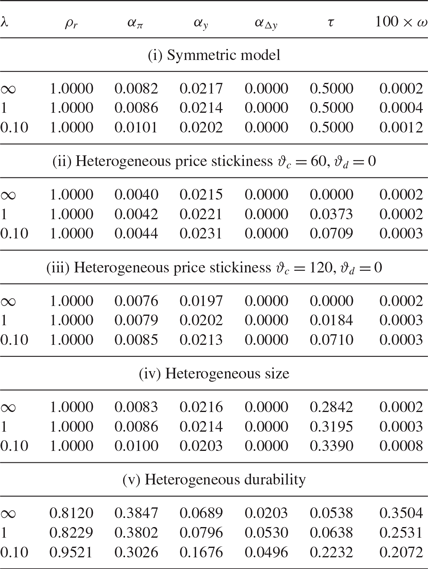
To discuss the welfare properties of the interest rate rule (13), Table 1 reports its optimized parameters together with the associated welfare costs
 $\omega$
.
Optimized monetary policy rule in symmetric and asymmetric models

The primary novel finding of this analysis concerns the inverse relationship that arises between the optimal weight placed on inflation in sector D, that is
 $\tau$
, and the degree of sectoral labor mobility
 $\lambda$
. The top panel of Table 1 shows that obviously
 $\lambda$
does not alter
 $\tau$
in a symmetric model (case (i)). Indeed, the two sectors feature the same price stickiness, size, and durability of the final good produced (both goods are nondurable) and are subject to symmetric shocks; hence, the central bank finds it optimal to place an equal weight to inflation in each sector (
 $\tau=0.50$
). To be precise, the two sectors are subject to sectoral disturbances, but the model’s perfect symmetry and the fact that sectoral shocks are extracted from the same distribution imply that, on average, sector-specific shocks cancel each other out. In contrast, the remaining panels show that the degree of sectoral labor mobility affects the optimal weight placed on inflation in sector D whenever the model accounts for one of the three types of heterogeneity considered. Crucially, we unveil an inverse relationship between
 $\lambda$
—the degree of labor mobility—and
 $\tau$
—the optimal weight on inflation in sector D. If sector D has more flexible prices (cases (ii) and (iii)), or if it is smaller (case (iv)), or if it produces durable goods (case (v)), lower labor mobility implies an increase in the optimal weight on inflation in sector D.
Under perfect labor mobility, when prices in sector D are flexible, the central bank devotes its attention almost entirely to inflation in (the sticky-price) sector C, which is consistent with previous findings in Aoki (Reference Aoki2001) and Benigno (Reference Benigno2004). However, as sectoral labor mobility decreases, the central bank places some weight on sector D’s inflation and
 $\tau$
rises, regardless of whether the average price stickiness is halved (by keeping
 $\vartheta_{c}=60$
, case (ii)) or kept constant (by setting
 $\vartheta_{c}=120$
, case (iii)). Interestingly, when the overall price stickiness is kept constant (
 $\vartheta_{c}=120,\vartheta_{d}=0$
), the optimized parameters in response to inflation and output gap are very similar to the symmetric case. In essence, relative to the symmetric model, the central bank finds it optimal to adjust the measure of inflation to target (by adjusting
 $\tau$
) while keeping the responses to overall inflation and output gap virtually unchanged. Table C.1 in online Appendix C shows that this holds true also for an alternative sectoral distribution of the overall price stickiness (
 $\vartheta_{c}=90,\vartheta_{d}=30$
) and for two additional (intermediate) degrees of labor mobility (e.g.,
 $\lambda=0.5$
and
 $\lambda=3$
).
Qualitatively, the same conclusions apply to a model in which sector D holds, as an illustration, a share of 30% of total consumption expenditures. In this regard, as labor mobility decreases, the central bank optimally assigns a higher weight to sector D’s inflation, which exceeds the sector’s share in total consumption expenditures. Intuitively, ceteris paribus, the central bank places a smaller weight on inflation of a smaller sector (as previously shown by Benigno (Reference Benigno2004)). However, as labor becomes less mobile, the volatilities of sectoral inflation rates and of the relative price increase (as already explained in Section 2.6). Under limited labor mobility, optimal monetary policy, by aiming at stabilizing the relative price, increases the optimal inflation weight associated with the smaller sector (relative to the weight that would otherwise be placed under perfect labor mobility).
Finally, when sector D produces durable goods (as outlined in Section 2.5), while keeping the same sectoral price stickiness, we detect the same inverse relationship between
 $\lambda$
and
 $\tau$
, and the effects are magnified relative to the other cases.
Footnote 10
Besides adjusting the optimal weight on inflation in sector D, optimal monetary policy becomes overall more responsive as labor mobility decreases. In all cases we find that, for lower degrees of labor mobility, either both the responsiveness to inflation and output gap are larger (the two cases of heterogenous price stickiness and the model with durables after accounting for the interest rate inertia) or the increase in the responsiveness to inflation is larger than the decrease in the responsiveness to output (symmetric model and case of heterogenous size). This finding extends also to the case where
 $\rho_{r}<1$
, once the reparametrization
 $\gamma_{i}\equiv\frac{\alpha_{i}}{1-\rho_{r}}$
, for
 $i=\pi,y,\Delta_{y}$
is taken into account. As demonstrated by the analytical discussion in Section 2.6 and the impulse responses reported in Section 2.8, the increasing severity of limited labor mobility generates larger fluctuations in relative prices and output gaps, which require stronger responses of the central bank.
As analytically shown in Section 2.6, the intuition behind our findings is that, with less mobile labor, adjustments to sectoral shocks cannot easily occur through quantities (via the reallocation of labor itself) hence wages need to adjust more. Fluctuations in wage differentials induce higher volatility of the relative price of goods produced in sector D, and the central bank finds it optimal to place relatively more weight on sector D’s inflation than it would otherwise do. Indeed, the standard deviation of the relative price
 $Q_{t}$
, under quasi labor immobility, in all cases, is larger than under limited and perfect labor mobility. As shown analytically in Section 2.6, in the presence of durable goods, the effect of the degree of labor mobility on the volatility of the relative price is amplified. To give a quantitative idea, in the illustrative numerical exercises with durable goods, under quasi labor immobility, the relative price is 1.3 and 1.8 times more volatile than under limited and perfect mobility, respectively. We also find that in almost all cases (except when we introduce durable goods), the interest rate smoothing parameter hits the upper bound of one, thus characterizing equation (13) as a price-level rule.
Footnote 11
All in all, our results reveal that the extent to which labor is able to reallocate across sectors, by impacting the volatility of the relative price of goods produced in sector D, is important for the optimal design of monetary policy, whenever sectors display sources of heterogeneity. In accordance with previous studies, the central bank optimally assigns less weight to inflation in the sector (D) with lower degree of price stickiness; or smaller economic size; or producing durable goods. Importantly, our results shows that a lower degree of sectoral labor mobility, ceteris paribus, increases this optimal weight because it magnifies the volatility of relative prices, especially in the presence of durable goods. These findings add another reason to challenge standard central banks’ practice of computing sectoral inflation weights based solely on economic size and unveil a significant role for the degree of sectoral labor mobility in the optimal computation.
3.3 Determinacy
In all cases considered, whether the optimal policy is characterized by a price-level rule or not, indeterminacy is not an issue. First, Giannoni (Reference Giannoni2014) demonstrates that any price-level rule with positive coefficients yields a determinate equilibrium. In addition, Bauducco and Caputo (Reference Bauducco and Caputo2020) show that price-level targeting rules do not require the Taylor principle to be satisfied for determinacy to hold. Whenever we find that the optimal monetary policy is characterized by an inertial rule (with
 $\rho_{r}<1$
), we find that the Taylor principle is satisfied. Indeed, following Schmitt-Grohe and Uribe (Reference Schmitt-Grohe and Uribe2007), Taylor rule (13) can be reparametrized noting that
 $\alpha_{i}=\left(1-\rho_{r}\right)\gamma_{i}$
, for
 $i=\pi,y,\Delta_{y}$
. It is therefore possible to recover the feedback parameters
 $\gamma_{i}$
given the optimal values of each
 $\alpha_{i}$
and
 $\rho_{r}$
. In all cases, we find that
 $\gamma_{\pi}=\frac{\alpha_{\pi}}{1-\rho_{r}}>1$
, which satisfies the Taylor principle. This is in line with previous contributions on determinacy. Carlstrom et al. (Reference Carlstrom, Fuerst and Ghironi2006) show that
 $\gamma_{\pi}>1$
is a sufficient and necessary condition for determinacy to hold in a two-sector model with both perfect or no sectoral labor mobility, and both with symmetric price stickiness and when one sector displays flexible prices. More generally, if the two sectors display different (non zero) degrees of price stickiness, determinacy depends also on restrictions about relative price stickiness and preference parameters; hence
 $\gamma_{\pi}>1$
, is only a sufficient condition. They conclude that the restriction on the reaction parameter to inflation holds regardless of whether the central bank targets aggregate or sectoral inflation rates. While Carlstrom et al. (Reference Carlstrom, Fuerst and Ghironi2006) focus on a Taylor rule that responds only to inflation, Ascari and Ropele (Reference Ascari and Ropele2009) build on Woodford (Reference Woodford2003) and consider a Taylor rule that responds to both inflation and the output gap. They first demonstrate that under zero trend inflation,
 $\gamma_{\pi}>1$
ensures determinacy regardless of the value of the reaction parameter to the output gap. Moreover, they show that including interest rate inertia makes the determinacy region larger. We likewise find determinacy in the analysis of the fully fledged model reported in Section 4.3 and online Appendix G.
4 THE FULLY FLEDGED TWO-SECTORS MODEL
The next step is to extend our analysis to a fully fledged two-sectors New-Keynesian model, featuring a rich set of real and nominal frictions and structural shocks and, crucially, the three sources of heterogeneity studied above. The aim of using this medium-scale model is twofold. First, we want to verify that our main result, namely the inverse relationship between labor mobility and the optimal weight
 $\tau$
, does not hinge on the simplicity of the model presented in Section 2. Second, we want to provide a quantitative assessment of the welfare loss caused by not accounting for labor mobility. To do so it is necessary to add real and nominal frictions that help the model fit the data well (see, e.g., Christiano et al. (Reference Christiano, Eichenbaum and Evans2005) and Smets and Wouters (Reference Smets and Wouters2007)). Fitting the data is crucial also for obtaining a plausible estimate of the degree of labor mobility, which turns out to be close to the estimates of Horvath (Reference Horvath2000) and Iacoviello and Neri (Reference Iacoviello and Neri2010).
Footnote 12
As shown in seminal contributions by Fuhrer (Reference Fuhrer2000), Christiano et al. (Reference Christiano, Eichenbaum and Evans2005), and Smets and Wouters (Reference Smets and Wouters2007), habit formation in consumption of nondurable goods allows the model to generate hump-shaped responses of consumption, in line with empirical evidence. The importance of accounting for investment adjustment costs is stressed by Smets and Wouters (Reference Smets and Wouters2007), who show that it is the most relevant real friction of their model. Moreover, Iacoviello and Neri (Reference Iacoviello and Neri2010), to which our model is very close, report that removing real and nominal frictions worsens the ability of the model to match the standard deviations and cross-correlations of model’s variables with the data. In addition, they show that their estimates of sectoral labor mobility are the most affected parameter.
As far as nominal rigidities are concerned, both papers employing one sector (e.g., Christiano et al. (Reference Christiano, Eichenbaum and Evans2005) and Smets and Wouters (Reference Smets and Wouters2007)) and two-sector models (e.g., Iacoviello and Neri (Reference Iacoviello and Neri2010) and Cantelmo and Melina (Reference Cantelmo and Melina2018)) show their empirical relevance.
Moreover, the addition of the three forms of heterogeneity studied in the stylized model of Section 2 (regarding the degree of nominal rigidities, size, and durability of the final goods produced) is relevant for the design of optimal monetary policy in a two-sector economy. Erceg and Levin (Reference Erceg and Levin2006) demonstrate how different durability of the final goods produced makes the central bank’s trade-off between stabilizing inflation and output more severe than in a model without durables. In a similar context, Petrella et al. (Reference Petrella, Rossi and Santoro2019) show that it is optimal to attach less weight to inflation in the durables sector. Finally, nominal rigidities and sectoral size matter for the conduct of optimal monetary policy, as demonstrated by Aoki (Reference Aoki2001), Benigno (Reference Benigno2004), and Bragoli et al. (Reference Bragoli, Rigon and Zanetti2016), with the general prescription that the sector with lower nominal rigidities and/or smaller in size should receive less weight in the inflation aggregator to target, but the weight does not necessarily coincide with the sector’s size. We next lay out the extensions to the model described in Section 2 with durable goods. Then, we bring the model to the data and finally we analyze optimal monetary policy.
4.1 Model Extensions
Households still aggregate nondurables and durables consumption according to
 $X_{i,t}=C_{i,t}^{1-\alpha}D_{i,t}^{\alpha}$
, but we allow for external habit formation (with persistence, as in Fuhrer (Reference Fuhrer2000)) in the former and investment adjustment costs in the latter (as in Christiano et al. (Reference Christiano, Eichenbaum and Evans2005)). In particular, we add the following equations:
 \begin{align}C_{i,t} & =Z_{i,t}-\zeta S_{t-1},\end{align}
 \begin{align}S_{t} & =\rho_{c}S_{t-1}+(1-\rho_{c})Z_{t},\end{align}
where
 $Z_{i,t}$
is the level of the household’s nondurable consumption;
 $S_{t}$
,
 $\zeta\in\left(0,1\right)$
and
 $\rho_{c}\in\left(0,1\right)$
are the stock, the degree, and the persistence of habit formation, respectively, while
 $Z_{t}$
represents average consumption across all households. Investment adjustment costs in durables imply that the law of motion of durable goods (19) now reads as
 \begin{equation}D_{i,t+1}=(1-\delta)D_{i,t}+e_{t}^{I}I_{i,t}^{D}\left[1-S\left(\frac{I_{i,t}^{D}}{I_{i,t-1}^{D}}\right)\right]\!,\end{equation}
where
 $e_{t}^{I}$
represents an investment-specific shock. The adjustment costs function
 $S(\cdot)$
satisfies
 $S(1)=S^{'}(1)=0$
and
 $S^{''}(1)>0$
, which we assume to be quadratic:
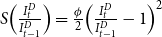 $S\Big(\frac{I_{t}^{D}}{I_{t-1}^{D}}\Big)=\frac{\phi}{2}\Big(\frac{I_{t}^{D}}{I_{t-1}^{D}}-1\Big)^{2}$
,
 $\phi>0$
(Christiano et al. (Reference Christiano, Eichenbaum and Evans2005)). We also introduce nominal wage stickiness at the sectoral level in the form of quadratic adjustment costs
 $\Phi_{t}^{j}=\frac{\vartheta_{j}^{w}}{2}\Big(\frac{w_{i,t}^{j}}{w_{i,t-1}^{j}}\Pi_{t}^{C}-\Pi^{C}\Big)^{2}w_{t}^{j}N_{t}^{j}$
as in Rotemberg (Reference Rotemberg1982), where
 $w_{i,t}^{j}$
is the aggregate real wage earned by the household in sector
 $j=C,D$
. Therefore, the left-hand side of the budget constraint (20) features the additional terms
 $\Phi_{t}^{j}$
, while we add the following first-order conditions with respect to investment in durables
 $I_{i,t}^{D}$
and the real wages
 $w_{i,t}^{j}$
:
 \begin{align}1 & =\psi_{t}e_{t}^{I}\left[1-S\left(\frac{I_{t}^{D}}{I_{t-1}^{D}}\right)-S^{'}\left(\frac{I_{t}^{D}}{I_{t-1}^{D}}\right)\frac{I_{t}^{D}}{I_{t-1}^{D}}\right]\nonumber \\[3pt] &\quad +E_{t}\left\{ \Lambda_{t,t+1}\psi_{t+1}\frac{Q_{t+1}}{Q_{t}}e_{t+1}^{I}\left[S^{'}\left(\frac{I_{t+1}^{D}}{I_{t}^{D}}\right)\left(\frac{I_{t+1}^{D}}{I_{t}^{D}}\right)^{2}\right]\right\} ,\end{align}
 \begin{align}0 & =\left[1-e_{t}^{w,j}\eta\right]+\frac{e_{t}^{w,j}\eta}{\tilde{\mu_{t}}^{j}}-\vartheta_{j}^{w}\left(\Pi_{t}^{w,j}-\Pi^{C}\right)\Pi_{t}^{w,j}\nonumber \\[3pt] &\quad +E_{t}\left[\Lambda_{t,t+1}\vartheta_{j}^{w}\left(\Pi_{t+1}^{w,j}-\Pi^{C}\right)\Pi_{t+1}^{w,j}\frac{w_{t+1}^{j}N_{t+1}^{j}}{w_{t}^{j}N_{t}^{j}}\right]\!,\end{align}
where
 $\psi_{t}$
is the Lagrange multiplier attached to constraint (33). Equation (35) is the wage setting equation in sector
 $j=C,D$
, in which
 $\tilde{\mu_{t}}^{j}\equiv\frac{w_{t}^{j}}{MRS_{t}^{j}}$
is the sectoral wage markup,
 $MRS_{t}^{j}\equiv-\frac{U_{N,t}^{j}}{U_{C,t}}$
is the marginal rate of substitution between consumption and leisure in sector j,
 $U_{N,t}^{j}$
is the marginal disutility of work in sector j,
 $\Pi_{t}^{w,j}$
is the gross sectoral wage inflation rate, and
 $e_{t}^{w,j}$
is a sector-specific wage markup shock.
The supply side of the economy is essentially unaltered, except for the shocks. Indeed, we add sectoral price markup (or cost-push) shocks
 $e_{t}^{j},j=C,D$
, which are shocks to the sectoral intratemporal elasticity of substitution across goods
 $\epsilon_{j}$
. Moreover, to be consistent with our observables, we remove the sectoral shocks to labor productivity.
Footnote 13
Therefore, the sectoral production functions (9) are replaced by
 \begin{align}Y_{\omega,t}^{j} & =e_{t}^{A}N_{\omega,t}^{j},\end{align}
while in the sectoral price setting equations (11) and (12), the parameters
 $\epsilon_{j}$
are multiplied by the exogenous disturbances
 $e_{t}^{j}$
. Moreover, following Erceg and Levin (Reference Erceg and Levin2006) we assume that the government purchases nondurable goods. By allowing also for sectoral wage stickiness, the sectoral market clearing conditions (15) and (22) now read as
 \begin{align}Y_{t}^{C} & =C_{t}+e_{t}^{G}+\frac{\vartheta_{c}}{2}\left(\Pi_{t}^{C}-\Pi^{C}\right)^{2}Y_{t}^{C}+\Phi_{t}^{C},\end{align}
 \begin{align}Y_{t}^{D} & =I_{t}^{D}+\frac{\vartheta_{d}}{2}\left(\Pi_{t}^{D}-\Pi^{D}\right)^{2}Y_{t}^{D}+\Phi_{t}^{D}.\end{align}
We still employ the monetary policy rule (13); however, now
 $Y_{t}^{f}$
is the output that would prevail without nominal rigidities and markup shocks. Finally, as in Smets and Wouters (Reference Smets and Wouters2007), the wage markup and the price markup shocks follow ARMA (1,1) processes, while the remaining shocks move according to an AR (1) process.
4.2 Bayesian Estimation
The model is estimated with Bayesian methods. The Kalman filter is used to evaluate the likelihood function that, combined with the prior distribution of the parameters, yields the posterior distribution. Then, the Monte-Carlo-Markov-Chain Metropolis-Hastings algorithm with two parallel chains of 150,000 draws each is used to generate a sample from the posterior distribution in order to perform inference. We estimate the model over the sample 1969Q2–2007Q4, leaving aside the Great Recession and the zero-lower-bound regime, by using US data on: GDP, consumption of durable goods, consumption of nondurable goods, sectoral real wages and hours worked, inflation in the nondurables sector, inflation in the durables sector, and the nominal interest rate. Given the importance of the sectoral price stickiness parameters in our analysis, we choose the same sample and observables (except for sectoral wages) as in Cantelmo and Melina (Reference Cantelmo and Melina2018), so that we can verify that our results are in line with their evidence.
The following measurement equations link the data to the endogenous variables of the model:
 \begin{align}\Delta Y_{t}^{o} & =\gamma+\hat{Y}_{t}-\hat{Y}_{t-1},\end{align}
 \begin{align}\Delta I_{D,t}^{o} & =\gamma+\hat{I}_{D,t}-\hat{I}_{D,t-1},\end{align}
 \begin{align}\Delta C_{t}^{o} & =\gamma+\hat{C}_{t}-\hat{C}_{t-1},\end{align}
 \begin{align}\Delta W_{t}^{C,o} & =\gamma+\hat{W}_{t}^{C}-\hat{W}_{t-1}^{C},\end{align}
 \begin{align}\Delta W_{t}^{D,o} & =\gamma+\hat{W}_{t}^{D}-\hat{W}_{t-1}^{D},\end{align}
 \begin{align}N_{t}^{C,o} & =\hat{N}_{t}^{C},\end{align}
 \begin{align}N_{t}^{D,o} & =\hat{N}_{t}^{D},\end{align}
 \begin{align}\Pi_{C,t}^{o} & =\bar{\pi}_{C}+\hat{\Pi}_{t}^{C},\end{align}
 \begin{align}\Pi_{D,t}^{o} & =\bar{\pi}_{D}+\hat{\Pi}_{t}^{D},\end{align}
 \begin{align}R_{t}^{o} & =\bar{r}+\hat{R}_{t},\end{align}
where
 $\gamma$
is the common quarterly trend growth rate of GDP, consumption of durables, consumption of nondurables, and the real wage;
 $\bar{\pi}_{C}$
and
 $\bar{\pi}_{D}$
are the average quarterly inflation rates in nondurable and durable sectors, respectively;
 $\bar{r}$
is the average quarterly Federal funds rate. Hours worked are demeaned so no constant is required in the corresponding measurement equations (44) and (45). Variables with a are in log-deviations from their own steady state.
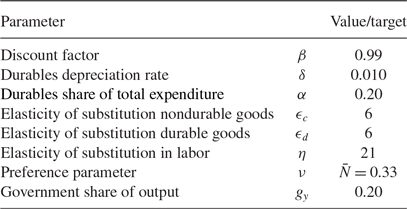
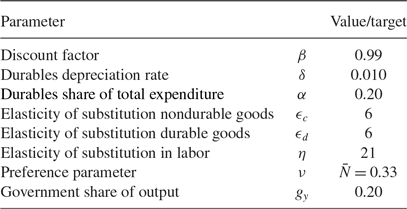
Calibration and priors. Table 2 presents the structural parameters calibrated at a quarterly frequency. The discount factor
 $\beta$
is equal to the conventional value of
 $0.99$
, implying an annual steady-state gross interest rate of 4%. Following Monacelli (Reference Monacelli2009), we calibrate the depreciation rate of durable goods
 $\delta$
at
 $0.010$
amounting to an annual depreciation of 4%, and the durables share of total expenditure
 $\alpha$
is set at
 $0.20$
. The sectoral elasticities of substitution across different varieties
 $\epsilon_{c}$
and
 $\epsilon_{d}$
equal 6 in order to target a steady-state gross markup of
 $1.20$
in both sectors. We target a 5% steady-state gross wage mark-up; hence, we set the elasticity of substitution in the labor market
 $\eta$
equal to 21 as in Zubairy (Reference Zubairy2014). The preference parameter
 $\nu$
is set to target steady-state total hours of work of
 $0.33$
. The government-output ratio
 $g_{y}$
is calibrated at
 $0.20$
, in line with the data.
Calibrated parameters
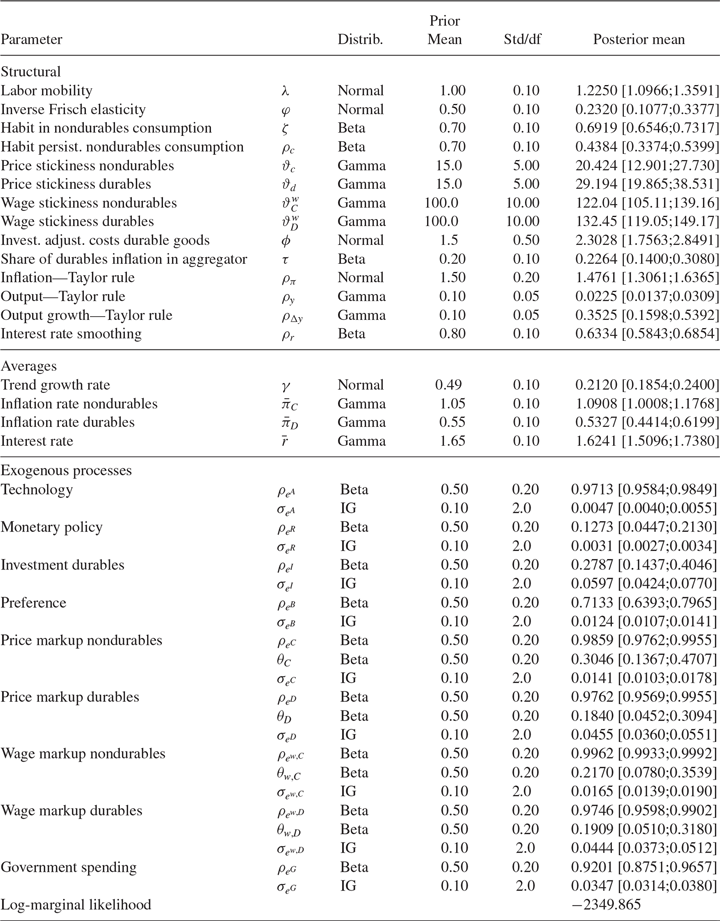
Prior and posterior distributions of the parameters and the shocks are reported in Table 3. We set the prior mean of the inverse Frisch elasticity
 $\varphi$
to 0.5, broadly in line with Smets and Wouters (Reference Smets and Wouters2007, SW henceforth) who estimate a Frisch elasticity of 1.92. We also follow SW in setting the prior means of the habit parameter,
 $\zeta$
, to 0.7, the interest rate smoothing parameter,
 $\rho_{r}$
, to 0.80 and in assuming a stronger response of the central bank to inflation than output. We set the prior means of the constants in the measurement equations equal to the average values in the dataset. In general, we use the Beta distribution for all parameters bounded between 0 and 1. We use the Inverse Gamma (IG) distribution for the standard deviation of the shocks for which we set a loose prior with two degrees of freedom. We choose a Gamma distribution for the Rotemberg parameters for both prices and wages, given that these are non-negative. The price stickiness parameters are assigned the same prior distribution corresponding to firms resetting prices around 1.5 quarters on average in a Calvo world. Finally, we follow Iacoviello and Neri (Reference Iacoviello and Neri2010) who choose a Normal distribution for the intratemporal elasticity of substitution in labor supply
 $\lambda$
, with a prior mean of 1 which implies a limited degree of labor mobility, and a standard deviation of 0.1.
Prior and posterior distributions of estimated parameters (90% confidence bands in square brackets)
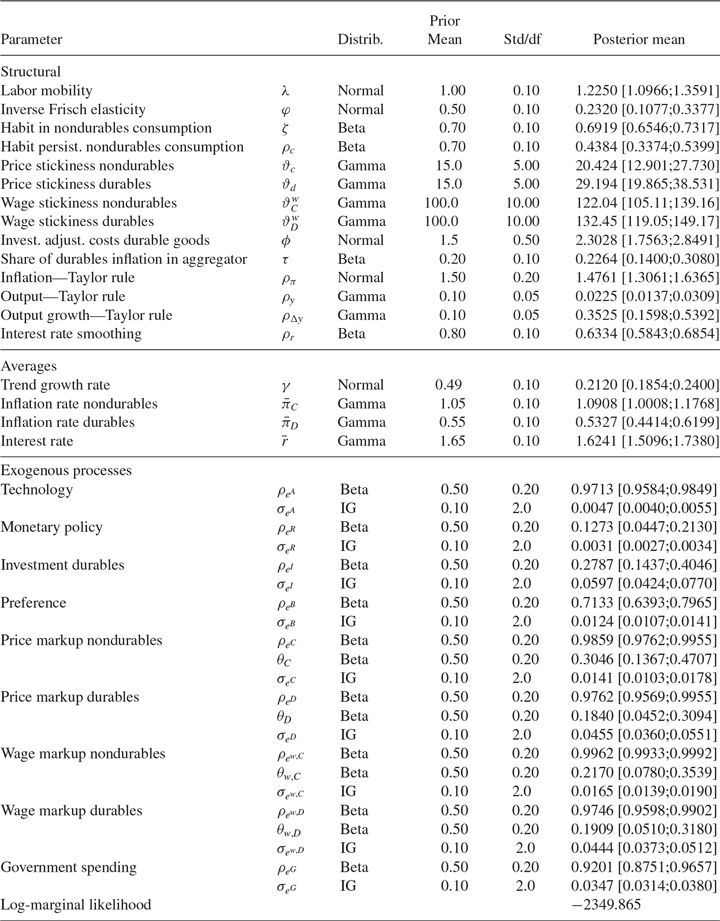
Estimation results. We report the posterior mean of the parameters together with the 90% probability intervals in square brackets in Table 3. In line with the literature, the labor mobility parameter
 $\lambda$
is estimated to be 1.2250 implying a non-negligible degree of friction in the labor market. Indeed, Horvath (Reference Horvath2000) estimates a regression equation to find a value of 0.999, whereas Iacoviello and Neri (Reference Iacoviello and Neri2010) estimate values of 1.51 and 1.03 for savers and borrowers, respectively.
Footnote 14
The estimated low sectoral labor mobility is also in line with the microeconometric evidence reported by Jovanovic and Moffitt (Reference Jovanovic and Moffitt1990) and Lee and Wolpin (Reference Lee and Wolpin2006), who estimate a high cost of switching sectors in the USA. Moreover, in calibrated models, limited labor mobility is typically set at a value of
 $\lambda=1$
(see Bouakez et al. (Reference Bouakez, Cardia and Ruge-Murcia2009), Petrella and Santoro (Reference Petrella and Santoro2011), and Petrella et al. (Reference Petrella, Rossi and Santoro2019), among others) except Bouakez et al. (Reference Bouakez, Cardia and Ruge-Murcia2011) who explore values between 0.5 and 1.5. Our estimate is remarkably close to values estimated by Horvath (Reference Horvath2000) and Iacoviello and Neri (Reference Iacoviello and Neri2010) and to those employed in calibrated models.
Prices are estimated to be slightly stickier in the durables sector, with no statistically significant difference between the two sectors, as already implied by the macroeconometric estimates of Cantelmo and Melina (Reference Cantelmo and Melina2018). However, also in the microeconometric literature there is no decisive evidence that prices of nondurable goods are much stickier than those of many durables (see Bils and Klenow (Reference Bils and Klenow2004) and Nakamura and Steinsson (Reference Nakamura and Steinsson2008), among others). Wage stickiness is also not significantly different across the two sectors, with wages in the durables sector exhibiting a higher point estimate. Having said this, it is true that prices of new houses are generally rather flexible, as usually assumed in the literature (see Barsky et al. (Reference Barsky, House and Kimball2007), Iacoviello and Neri (Reference Iacoviello and Neri2010), and our estimates in Cantelmo and Melina (Reference Cantelmo and Melina2018), among many others). Therefore, given the sensitivity of the optimal monetary policy results to the degree of price stickiness of durable goods, in the remainder of the paper we use both the estimated value of durables price stickiness and an alternative calibration, implying completely flexible durables prices. Similarly, although wages in the durables sector are estimated to be sticky, we also explore the counterfactual of flexible wages.
The remaining parameters are broadly in line with the literature and suggest a relevance of the real frictions (IAC in durable goods and habits in consumption of nondurables) and a stronger response of monetary policy to inflation with respect to output, with a high degree of policy inertia as, for example, in the estimates of Smets and Wouters (Reference Smets and Wouters2007) and Smets and Villa (Reference Smets and Villa2016), which we follow in setting the monetary policy rule, the latter covering a similar sample.
In sum, our estimation delivers results consistent with a wide range of New-Keynesian models estimated with Bayesian methods and serves as the starting point for our analysis of optimal monetary policy. The estimated model exhibits well-behaved macroeconomic dynamics (see, e.g., the Bayesian impulse responses to a technology shock reported in Figure E.1 in online Appendix E). In the remainder of the paper, parameters are set according to the calibration of Table 2 and the posterior means reported in Table 3, unless otherwise stated.
4.3 Optimal Monetary Policy
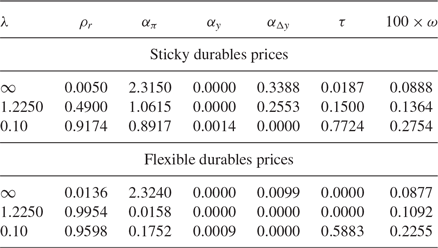
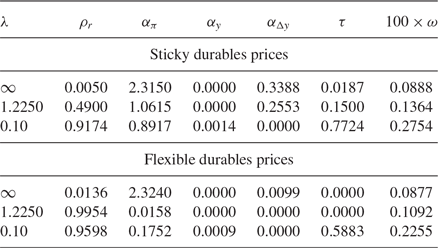
We now turn to the optimal monetary policy results in the fully fledged model (Table 4). We first notice that regardless of the degree of labor mobility, the central bank response to the output gap is almost zero and that to output gap growth is usually low, whereas a stronger reaction is devoted to inflation, a result in line with the findings of Schmitt-Grohe and Uribe (Reference Schmitt-Grohe and Uribe2007) and Cantore et al. (Reference Cantore, Levine, Melina and Pearlman2019) in one-sector models. Crucially, the primary novel finding obtained in the simple two-sectors model— namely the inverse relationship that arises between the optimal weight placed on durables inflation
 $\tau$
and sectoral labor mobility
 $\lambda$
— carries over to the fully fledged model. The intuition developed in the smaller two-sectors model still holds in this richer environment, which is useful to provide quantitative insights. The top panel of Table 4 shows that, in the range of
 $\lambda$
considered (including the estimated labor mobility parameter,
 $\lambda=1.2250$
), we highlight an inverse relationship between sectoral labor mobility and the optimal weight placed on durables inflation. As labor becomes less mobile (i.e.,
 $\lambda$
decreases) the central bank finds it optimal to place more weight on durables inflation (i.e., the optimal
 $\tau$
increases). Indeed, when
 $\lambda$
drops from the estimated value of 1.2250 to 0.10,
 $\tau$
increases from a value slightly below the sector’s share (0.1500) to a value well above it (0.7724). In contrast, when labor is perfectly mobile (
 $\lambda\rightarrow\infty$
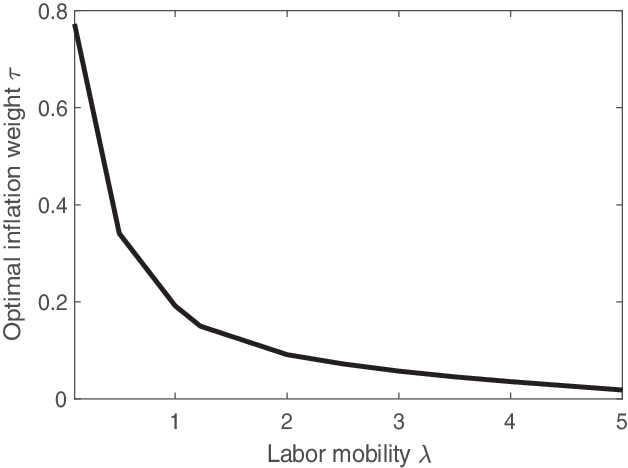
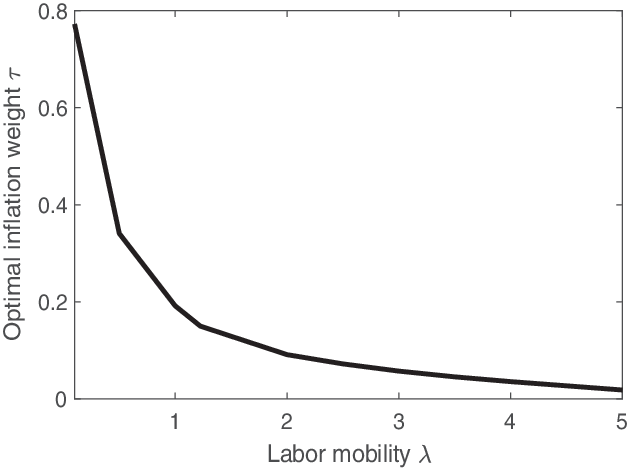
), the weight on durables inflation approaches zero. Figure 2 plots this inverse relationship for a continuum of degrees of labor mobility between 0 and 5, showing that the relationship is monotonically negative.
Optimal inflation weight
 $\tau$
for different degrees of labor mobility
 $\lambda$
.
Optimized monetary policy rule: sticky vs flexible durables prices
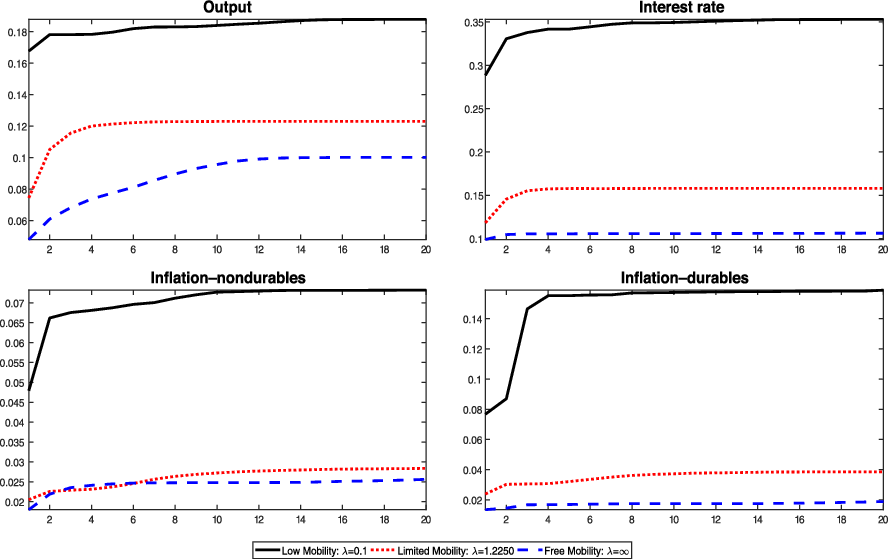
Welfare losses increase as labor becomes less mobile across sectors. This is driven by the presence of the price markup shock in the durables sector, which makes it more difficult for the central bank to replicate the Ramsey policy when labor mobility decreases (see also Table G.1 in Section G of the online Appendix). While this shock is empirically important and has a material impact on the magnitude of the welfare losses, the main result of the paper, that is, that the optimal weight on durables inflation increases as labor mobility decreases, holds regardless of its presence (on this, see online Appendix G). Figure 3 reports, for the three degrees of labor mobility under scrutiny, the root cumulated squared difference of the impulse responses of key variables to a durables price markup shock under Ramsey and the optimized Taylor rule, that is,
 $100\times\sqrt{\sum_{t=0}^{H}\left(x_{t}^{R}-x_{t}^{O}\right)^{2}}$
, where
 $H=1,2,...$
and
 $x_{t}^{R}$
and
 $x_{t}^{O}$
denote the impulse response of variable x under Ramsey and the optimized rule, respectively. In general, as labor mobility decreases, the difference between the interest rate responses under Ramsey and the optimized rules widens, causing a larger welfare loss. This is in line with Petrella et al. (Reference Petrella, Rossi and Santoro2019), who find that welfare losses are larger for lower degrees of labor mobility, in a two-sector economy subject only to sectoral technology shocks.
Impulse responses to a durables price markup shock in Ramsey policy and optimized rule.
When prices of durables are assumed to be flexible (
 $\vartheta^{d}=0$
, lower panel of Table 4), as in the case of new house prices (see Cantelmo and Melina (Reference Cantelmo and Melina2018), for a detailed discussion on sectoral price stickiness), the optimal weight the central bank attaches to durables inflation drops to a large extent. At the estimated value of the degree of labor mobility and above, the optimal weight is already zero. However,
 $\tau$
is still nonzero (
 $\tau=0.5883$
) for a sufficiently limited degree of labor mobility, this result being mainly driven by nominal wage stickiness. In fact, wage stickiness affects firms’ marginal costs and their price setting behavior. The pass-through of sticky wages to the durables sector’s marginal cost induces the central bank to place some weight on inflation in this sector despite price flexibility. We isolate the contribution of wage rigidity in Section G.2 of the online Appendix. Finally, comparing the welfare losses with respect to the Ramsey policy (Table 4), these are comparable to those calculated by Cantore et al. (Reference Cantore, Levine, Melina and Pearlman2019) in a one-sector model and Petrella et al. (Reference Petrella, Rossi and Santoro2019) in a two-sector model with limited labor mobility.
Our results survive a battery of robustness checks reported in online Appendix G. In particular, we show that they are robust to: (i) the elimination of sectoral shocks, one at a time (G1); (ii) various assumptions on nominal rigidities (G2); (iii) the elimination of real frictions, one at a time (G3); (iv) different depreciation rates of durable goods (G4); and (v) alternative interest rate rules (G5), including those that respond to wages.
4.4 The Importance of Optimizing the Weight on Sectoral Inflation
Our results challenge standard practice used in central banks that weight sectoral inflation rates only by the sectors’ shares in the economy. In this section, we ask: “what are the welfare implications of weighting or not weighting sectoral inflation optimally?” By construction, the numerical procedure implemented to reach our results (both for the simple and the fully fledged models) ensures that the value assumed by
 $\tau$
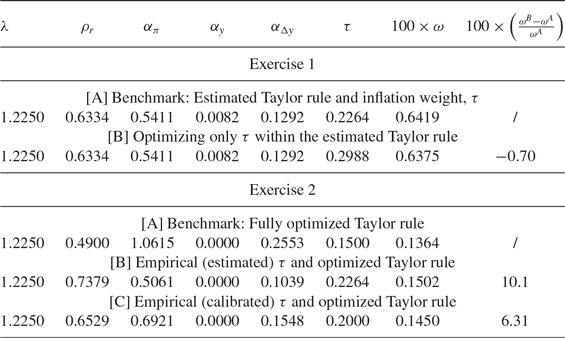
, along with the parameters of the interest rate rule, is the one that maximizes social welfare (or equivalently, minimizes the losses relative to the Ramsey policy). Although it is obvious that deviating from the optimization of all parameters would deliver higher welfare losses, it is interesting to quantify them. We perform two exercises, both under the estimated degree of labor mobility
 $(\lambda=1.2250)$
. Table 5 reports the rule parameters, the welfare losses relative to the Ramsey policy
 $\omega$
, and the percent change in the welfare loss relative to a benchmark case, that is,
 $100\times\frac{\omega^{B}-\omega^{A}}{\omega^{A}}$
.
Optimized monetary policy rules: the importance of optimizing the inflation weight
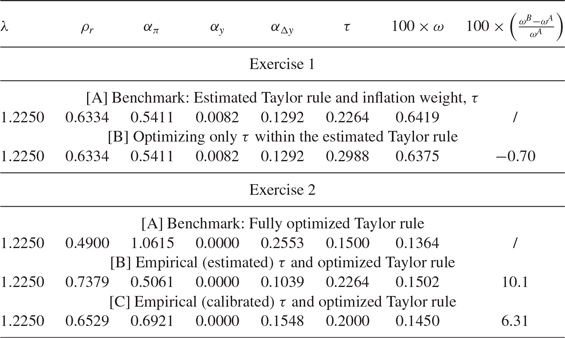
In the first exercise, we keep all the parameters of the interest rate rule (13) at their estimated values while optimizing only the weight on durables inflation
 $\tau$
(case [B]) and compare the welfare loss with that obtained under the estimated Taylor rule and the estimated inflation weight (case [A]). When all parameters of the interest rate rule are constrained at the estimated values, the central bank would optimally set
 $\tau=0.2988$
. In this case, households would experience a welfare gain of 0.7%.
The second exercise follows the opposite logic: we optimize the parameters of the interest rate rule (13) while either keeping the weight on durables inflation at the estimated value of
 $\tau=0.2264$
(case [B]) or setting the weight on durables inflation according to the sectoral expenditure share
 $\tau=0.20$
(case [C]), that is, ignoring the degree of labor mobility or any other potentially relevant feature (mirroring the common practice of central banks reported in Section 1). In both cases, the central bank optimizes the interest rate rule but does not review the inflation weight. We compare the welfare loss of cases [B] and [C] with that obtained when all parameters are optimized (case [A]). In case [B], households would suffer a welfare loss of about 10%; in case [C], the welfare loss is of about 6%, given that the imposed (calibrated) value of
 $\tau$
happens to be relatively closer to the optimal one. To sum up, both exercises show the importance of optimizing the weight on durables inflation and that failing to do so brings sizable welfare costs.
5 Conclusions
As the New-Keynesian literature on two-sector models has demonstrated, setting the optimal weights on sectoral inflation rates is a crucial task for a central bank to maximize social welfare. Importantly, these weights generally differ from the sectoral shares in total consumption expenditures. We analyze this issue from a perspective the literature has so far overlooked, that is, the extent to which labor can move across sectors.
We first look at a stylized two-sector model. Our main result is that whenever the model allows for sectoral heterogeneity (namely, in price stickiness, sector size, or goods’ durability), we unveil an inverse relationship between the degree of sectoral labor mobility and the optimal weight on inflation in the sector that would otherwise deserve less weight (that is, the sector with more flexible prices, or smaller in size, or producing durable goods). We rationalize this result by noticing that lower degrees of sectoral labor mobility are associated with a more volatile relative price. In fact, with more limited labor mobility, adjustments to asymmetric shocks do not easily occur through quantities (via the reallocation of labor itself), but rather through wages. We analytically show that the lower the degree of labor mobility, the more the volatility in wage differentials translates into higher relative price volatility. We also show that the effect of the degree of labor mobility on the computation of optimal sectoral inflation weights is magnified when one of the two sectors produces durable goods. This finding can also be rationalized via simple analytics showing that goods’ durability enhances the effect that the degree of sectoral labor mobility has on the relative price.
We then compute the welfare loss suffered by the economy because of the adoption of suboptimal weights. To do this, we construct and estimate a fully fledged two-sector New-Keynesian model with durable and nondurable goods, conventional real and nominal frictions and shocks, and imperfect sectoral labor mobility. The Bayesian estimation confirms, inter alia, the evidence of a limited sectoral labor mobility. An inflation weight set in line with either the posterior estimate or sectoral expenditure shares (which mirrors the common practice of central banks) implies a decrease in welfare up to 10% relative to the case of an optimized weight. In line with the results obtained with the stylized model, also in the fully fledged model we detect an inverse relationship between labor mobility and the weight optimally attached to inflation in the durables sector, which is also smaller in size and exhibits mildly more flexible prices relative to the nondurables sector. These results survive a large array of robustness checks.
In sum, our findings echo previous contributions in the literature that challenge standard practice of central banks, which weight sectoral inflation merely based on sectoral economic size. From a welfare-maximizing viewpoint, the central bank should take a number of features into account. Our contribution shows that, in a context of increased importance of sectoral shocks, the extent to which labor can be reallocated across sectors should be among central banks’ decision factors.
Acknowledgements
We are grateful to Michael Ben-Gad, Cristiano Cantore, Romain Duval, Davide Furceri, Paul Levine, Prakash Loungani, Chris Papageorgiou, Joseph Pearlman, Ivan Petrella, Carlo Pizzinelli, Francesco Zanetti, two anonymous referees and participants at the 2016 IMF-OCP Policy Center-Brunel University Workshop on Global Labor Markets, the
 $48^{\text{th}}$
Money Macro and Finance Annual Conference, the ASSET 2016 Annual Meeting and seminars at Banca d’Italia, Banco de
 $\mathrm{Espa}\tilde{\text{n}}\mathrm{a}$
, City, University of London and the IMF for useful comments.
Supplementary materials
To view supplementary material for this article, please visit http://dx.doi.org/10.1017/S1365100520000577.