Introduction
Political finance is a key resource that parties and candidates need to campaign and to survive between elections (Fischer and Eisenstadt, Reference Fischer and Eisenstadt2004: 620). Although there is no unanimous position among political scientists on what factors drive political finances up, the tendency for ever-increasing demands for political finance is unambiguous (Nassmacher, Reference Nassmacher2009: 173). Accepting extensive financial and in-kind donations renders political parties and candidates susceptible to the influence of affluent donors. Transparency and accountability in political finance are intended to preserve the responsiveness of political parties and candidates to their voters, not donors. Given that transparency and accountability in political finance are part and parcel of democracy, we need to understand why countries regulate this sphere differently.
Internationally agreed principles on the transparency of political finance regulation [Council of Europe (CoE), 2003; United Nations, 2003; OSCE/ODIHR and Venice Commission, 2010: 35, Article 7.3] and comprehensive projects like the ‘Group of States against Corruption’ (GRECO) allow researchers to examine countries’ attitudes towards regulation of political finance. Compliance with internationally agreed norms helps to capture these attitudes, as adherence is not assured by any coercive enforcement mechanism. My research question here is why only some countries voluntarily adopt internationally agreed standards intended to increase transparency and accountability in political finance, while others do not.
This article proposes to analyse compliance with recommendations from international organizations on the transparency of political finance, taking into account the dual nature of accountability that national authorities are exposed to: voters and international partners. I test propositions with a multiple regression on a new data set derived from the GRECO project, involving 46 member-countries of the CoE. The main finding demonstrates that countries tend to comply with international standards on the transparency of political finance when the reforms required are moderate. Following Sarigil (Reference Sarigil2015: 233), I call such reforms path following or path-dependent.Footnote 1 It means they preserve the logic of existing regulation and institutions; they thus require few resources to implement and carry little uncertainty as to their outcome. In other words, countries are more likely to introduce new standards on political finance when they already regulate political parties extensively. These findings are in line with path-dependency approaches claiming that existing institutions reduce the options available to change the policy’s direction (Olsen, Reference Olsen2009: 11). A cross-country measure of the level of party regulation helps to capture this effect.
Surprisingly, the national compliance is mediated by the political preferences of the governing coalition, with left-of-centre cabinets tending to adapt more transparency requirements for political finance than right-of-centre ones. By identifying systematic patterns in reforming party finance transparency regulation, this article contributes to the rapidly developing theory on policy change in political finance regulation (Koss, Reference Koss2011; Nwokora, Reference Nwokora2014; Norris and Abel van Es, Reference Norris and Abel van Es2016). Notably, the countries which co-founded GRECO, show more compliance than other GRECO participants.
I define political finance as both party organizational finance and party and candidate finances for electoral campaigns (Nassmacher, Reference Nassmacher2001: 10). I deliberately do not differentiate between party and campaign funding for two reasons. First, conventional financial practices make it difficult to clearly separate them (Roper, Reference Roper2007: 98; Nassmacher, Reference Nassmacher2009: 32; Norris and Abel van Es, Reference Norris and Abel van Es2016: 7). Second, according to the transparency and accountability recommendations of the CoE, political finance encompasses both funding of political parties and electoral campaigns (CoE, 2003).
Second section discusses the underlying logic of commitment to the reforms, based primarily on a rational choice approach. Third and fourth sections examine under what conditions countries tend to comply with or ignore international recommendations on reforms of political finance and set out testable hypotheses. Fifth section introduces a new data set based on the GRECO reports; the measure of party codification capturing the national level of party regulation; and further details on the data operationalization. Sixth section presents and discusses the main findings. The concluding seventh section underlines the article’s contributions to the field and suggests avenues for future research.
Policy change on foreign advice: why do countries care?
My primary interest in this article is to explain a variation in compliance with international recommendations on party finance reforms across countries. I use compliance here to mean ‘all behaviour by subjects or actors that conforms to the requirements of behavioural prescriptions or compliance systems […] noncompliance (or violation) is behaviour that fails to conform such requirements’ (Young, Reference Young1979: 4). Drawing on previous research (Thomson, Reference Thomson2007; Trachtman, Reference Trachtman2010; Abel van Es, Reference Abel van Es2016), I conclude that national authorities working within international organizations are subject to twin accountability requirements. On the one hand, they represent their national electorate and should act in the interests of their voters as they would not be re-elected otherwise (Przeworski et al., Reference Przeworski, Stokes and Manin1999: 32). On the other hand, national authorities need to remain predictable and cooperative with their international partners ‒ international organizations and foreign national authorities ‒ in order to maintain prospects for further cooperation (Guzman, Reference Guzman2008). Consequently, I argue that both foreign (Molenaar, Reference Molenaar2010; Timus, Reference Timus2010; van Biezen and Molenaar, Reference Van Biezen and Molenaar2012; Gauja, Reference Gauja2016) and domestic (Scarrow, Reference Scarrow2004; Koss, Reference Koss2011; Nwokora, Reference Nwokora2014) costs of compliance should be taken into account when analysing changes in party finance regulation that result from international recommendations. Variations in party finance regulation have been recently addressed in a cross-sectional study encompassing more than 100 countries (Abel van Es, Reference Abel van Es2016). I contribute to this field by specifically studying the evolution of party finance transparency regulation and testing new theoretical implications on the subset of reforms induced by foreign advice in Europe.
Studying foreign costs implies detecting relevant international actors who are able to influence national regulation on political finance. Addressing the European context, van Biezen and Molenaar (Reference Van Biezen and Molenaar2012: 635) identify the following institutions relevant to the development of this regulation: the CoE, the European Court of Human Rights, the Organization for Security and Co-Operation in Europe (OSCE), regional organizations and initiatives of the EU and, last but not least, international non-governmental organizations (NGOs) and quangos.Footnote 2 The CoE, through its GRECO expert pool and the Venice Commission,Footnote 3 works out the norms and recommendations for countries, establishes guidelines and benchmarks, and also monitors progress on anti-corruption reforms (Molenaar, Reference Molenaar2010: 6, 37). The GRECO mechanism plays a crucial role in ensuring that CoE member states comply with international standards. Through a comprehensive evaluation procedure, it develops tailor-made recommendations for the CoE members on how to adjust their regulation and practice to conform to the CoE’s anti-corruption standards.Footnote 4 The EU can facilitate implementation of the CoE’s recommendations with the prospect of EU membership and provision of international aid (Levitsky and Way, Reference Levitsky and Way2006; Abel van Es, Reference Abel van Es2016: 221). The OSCE Office for Democratic Institutions and Human Rights and Election Monitoring Organization of the Commonwealth of the Independent States are in charge of monitoring how existing principles of the party and electoral regulation are put into practice. Meanwhile, NGOs and quangos share their country expertise (Norris, Reference Norris2013: 565) at various stages of the reform process.
The CoE thus plays a crucial role in elaborating new norms and providing countries with recommendations on how to improve their democratic integrity. The EU can play an important part in the implementation of CoE recommendations. From this perspective, non-compliance with CoE standards imposes normative (reputational) costs on national authorities in relation to the CoE, and it can impose reputational costs with regard to other international partners, like the EU. Of course, the costs of non-compliance for a country diminish if it does not acknowledge the CoE (and GRECO specifically) as a legitimate agenda-setter (Börzel et al., Reference Börzel, Panke and Carina2010: 1371). The costs for compliance decrease, if a country can shape the GRECO standards along with its national policy goals (Börzel et al. Reference Börzel, Panke and Carina2010: 1368).
So far, I have discussed compliance costs arising from national authorities’ accountability to their international partners. Yet, compliance with international standards on party finance requires closing the gap between a recommended regulatory norm and an existing domestic rule. The CoE recommendations aim, primarily, at changing inter- and intra-institutional routines in a political system via improvements in the state regulation of political parties. So the act of compliance can change a traditionally accepted status quo in matters of acquiring, channelling, spending, reporting, and disclosure of political finance. Sarigil attributes the stability of the status quo to path dependence: ‘through the habituation [repetition of action and thought], individuals acquire or develop pro-status quo cognitive frames, which shape their awareness and interpretation of reality. Such cognitive frames constitute barriers to change’ (Reference Sarigil2015: 231). Thus, even in an attempt to comply with international recommendations on combating corruption, an abrupt change to the status quo must be costly. These reforms affect the historical tradition of party finance regulation – a long-term existing regulatory norm, practice and (if they exist) administrative units enforcing political finance regulation ‒ which I also refer to as ‘a path’.
The CoE motivates countries to reflect upon their regulation. These reflections can produce at least two types of change. The first is path-dependent, or context-bounded, reforms, which Molenaar describes as ‘within the embedded national preferences’ (Reference Molenaar2010: 6). These reforms change party regulation in minor ways ‒ lowering the threshold for disclosure of anonymous donations, for example ‒ and, hence, generate only moderate costs. They maintain the overall status quo – the core of the national policy tradition ‒ but calibrate it to meet international standards.
The second type of reform ‒ path-breaking ‒ generates discontinuities in the rules and traditions. For instance, when national law treats political parties on a par with non-governmental non-profit associations, it would hardly be possible, without defining political parties legally, to demand greater disclosure of finance used by parties. But defining political parties for the first time would inevitably restrict freedoms previously customary. Obviously, such path-breaking changes bring high adaptive costs, at least in the short run (March and Olsen, Reference March and Olsen2006: 13). And, given that domestic costs of compliance are more immediate than being shamed internationally,Footnote 5 path-breaking changes are unlikely to be implemented. Simultaneously, we need to control for whether national authorities tend to implement path-breaking recommendations if they experience domestic political demand for enhancing the legitimacy of democratic institutions.Footnote 6 Domestic political demands can be conceptualized as voters’ dissatisfaction with domestic political institutions (Easton, Reference Easton1957), which, in turn, can derive from political corruption scandals (Koss, Reference Koss2011: 50).
Domestic compliance costs may have different effects on political parties and their complementary institutions. International recommendations for reform can be treated as an exogenous shock which separates the political community essentially into two domestic political coalitions (Trachtman, Reference Trachtman2010; Nzelibe, Reference Nzelibe2011): those who will benefit from the state’s compliance with these recommendations and those who risk losing from it. These coalitions are prone to crystallize along the left and right dimensions of party competition (Nzelibe, Reference Nzelibe2011: 648), with right-of-centre parties, in general, supporting less transparency than their left-of-centre counterparts. These preferences may be traced back to the socio-economic inequalities historically clustered around labour and capital and reflected in party support (Cioffi and Höpner, Reference Cioffi and Höpner2006: 486), as well as to the established party finance regime (Nwokora, Reference Nwokora2014). Centre-right parties are traditionally closely related to the corporate elite, and centre-left parties accordingly are traditionally willing to delegitimize and undermine that relationship (Cioffi and Höpner, Reference Cioffi and Höpner2006: 488). Transparency in political finance can be a tool to make the relationship between right-of-centre political parties and business groups visible to a broad public, and thus vulnerable to attack.
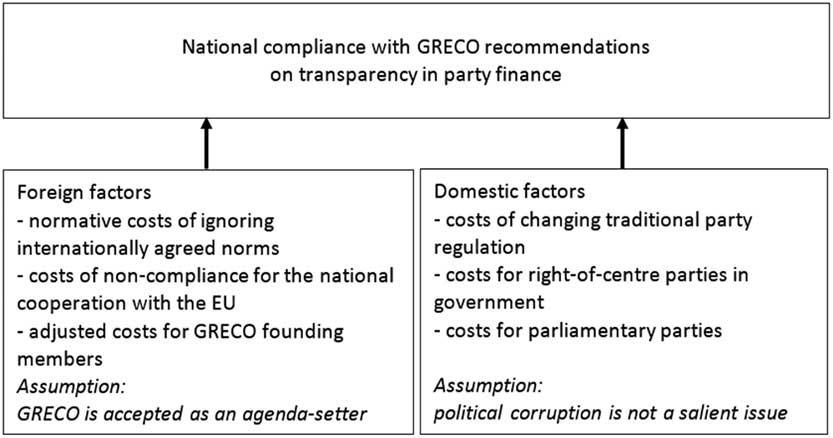
Finally, we need to consider an interaction effect between foreign and domestic costs. Given that failure to implement new standards may entail unbearable normative costs in the international arena, while the domestic costs of reform are substantial, national authorities may opt for selective compliance (Börzel and Pamuk, Reference Börzel and Pamuk2012: 91) and, driven by rational choice, intentionally ignore recommendations that disadvantage parties in parliament. Compliance with CoE recommendations often requires amending legislation. Given that parliamentary parties have direct access to the law-making process, they generally have greater opportunity to protect their interests than non-parliamentary parties. Figure 1 summarizes factors that affect compliance. Third and fourth sections develop testable hypotheses.
Factors diminishing country’s compliance. The total cost of compliance is the difference between, on the one hand, all resources and losses required to comply with the recommendations, and, on the other, all losses resulting from non-compliance with these recommendations. GRECO=Group of States against Corruption.

Variation in compliance: foreign costs
High non-compliance costs for relations with the CoE
Why would countries change their regulations on such an intrinsically sensitive political issue as party finance? The CoE cannot impose any material sanctions for non-compliance (CoE, 2012: Rule 32), so retaliation cannot explain the logic of compliance with GRECO. Neither does reciprocity ensure compliance in this type of multilateral agreement: low compliance in one country does not undermine the whole agreement and mean that other countries would want to limit their compliance. Rational choice theory suggests that, rather than retaliation or reciprocity, it is a concern for the reputation that fosters compliance with multilateral agreements. Countries care about their reputation: it reflects the beliefs of other international actors about their credibility (Guzman, Reference Guzman2008: 69).
Evidence from GRECO statutory documents confirms this logic. GRECO monitors compliance and can publicly ‘censure’ a non-complier.Footnote 7 Normative costs are accrued as a country ignores mutual political targets which an overwhelming majority of European countries has already agreed upon – in the third GRECO round the set of principles underpinning a transparent, accountable, and democratic political finance system. Adherence to democratic rule and transparency in democratic procedures are cornerstones of European political values (CoE, 2003). So countries participating in GRECO should generally comply with international recommendations, lest international actors cease to consider their commitment to anti-corruption reforms and transparency credible.
Some authors argue that acceptance of international organizations as legitimate agenda-setters is a primary condition for the imposition of normative costs for non-compliance (Beach, Reference Beach2005: 125; Börzel et al., Reference Börzel, Panke and Carina2010: 1371). I assume that a country’s relation to the international organization is systematic. Hence ‘repeated cycles of interactions’ (Koh, Reference Koh1997: 2655) between a country and a particular international organization would reflect the extent to which that country recognizes the organization as a relevant agenda-setter and is willing to compromise its national regulation. A country with a weak commitment to GRECO as an agenda-setter may consider normative costs for non-compliance with GRECO recommendations to be low and domestic costs for reforms necessary to comply high. Compliance with GRECO recommendations in previous evaluation rounds is, therefore, a reasonable proxy for capturing the readiness of countries to compromise their national regulation on GRECO’s advice and, thus, to understand progress on compliance in the GRECO political finance round.Footnote 8
Hypothesis 1 Levels of compliance in previous GRECO evaluation rounds are positively associated with progress in compliance with recommendations on political finance.
Low compliance costs for the co-founders of GRECO
Should a country be one of the co-authors of the GRECO project, it not only acknowledges GRECO’s legitimacy but is also able to shape international norms according to its preferences (Börzel et al., Reference Börzel, Panke and Carina2010: 1368), thus minimizing the costs of compliance. Being a founding member of the anti-corruption standards body may additionally indicate a country’s deep commitment to the fight against corruption and, therefore, its readiness for reform in this field. In contrast, if a country becomes a GRECO member ex officio (on joining international conventions), it may, unlike a founding member, be less interested in pursuing reform in such an intrinsic area as political finance or in deferring to the norms some other countries have agreed upon.
Hypothesis 2 Countries which are founding members of GRECO should comply better with GRECO recommendations than other GRECO members.
High non-compliance costs for EU candidates
Additional international obligations may increase the costs of compliance. Whereas the CoE pushes all member-countries equally to implement common principles for anti-corruption regulation, the EU’s power to promote political finance reforms may vary considerably by country. In particular, countries experiencing democratic transformations may have higher incentives to show their commitment to the rule of law and demonstrate their progress in anti-corruption reforms than old democracies with a stronger reputation in this respect (Guzman, Reference Guzman2008: 91). At the same time, the EU seems irrelevant to political finance reforms in its member states because political finance does not belong to the aquis communitare. Renwick postulates that ‘significant power for external actors is antithetical to the principle of democracy, and stable democracies are unlikely to interfere with each other’s particular electoral institutions. But involvement of transnational actors in transitions is widespread’ (Reference Renwick2011: 461).
EU compliance research explains this phenomenon in terms of ‘the power of obstinacy’ displayed during the enforcement stage. Powerful countries do not depend on a particular partner’s good will for future co-operation because they have alternatives. Hence they are more resistant to reputational costs and thus to external pressure (Börzel et al., Reference Börzel, Panke and Carina2010: 1368). Unlike them, however, weaker countries cannot cover reputational costs easily. So I conclude that countries with EU membership in prospect ‒ but not those already members, nor those not desirous of joining ‒ should have higher incentives to comply with the CoE recommendations. Previous findings strengthen this argument: both the CoE and the EU contributed to political finance reforms in ten European non-EU countries in the period 2000–06 (Walecki, Reference Walecki2007). While the CoE developed a set of best-practice recommendations for anti-corruption regulation, the EU facilitated implementation of these recommendations by making it a political condition for EU enlargement.
Hypothesis 3a Countries applying to join the EU are more likely to comply with GRECO recommendations than EU members and non-EU countries.
Following the same logic and benefiting from the seminal contribution of Levitsky and Way (Reference Levitsky and Way2006: 386), I control for whether countries with low obstinacy power (high vulnerability to external pressure) and close links (high density of ties and cross-border flows) with the international community comply with GRECO recommendations better than others. Here I treat confirmed status of EU candidacy as an indication of the high density of ties between the EU candidates and established democracies. And, like Abel van Es (Reference Abel van Es2016: 223), I consider countries which receive international aid to be highly vulnerable to external pressure to improve the quality of democracy. All in all, low obstinacy power and close links with the international community should be associated with a high compliance level.
Hypothesis 3b Countries applying to join the EU and receiving international aid are more likely to comply with the GRECO recommendations than EU members and non-EU countries.
Variation in compliance: domestic costs
High costs of changing traditional party codification
Even if international conditions are favourable, high domestic costs for national authorities can prevent successful compliance (Börzel and Risse, Reference Börzel and Risse2003; Schimmelfennig et al., Reference Schimmelfennig, Engert and Knobel2003). By forcing a country to introduce transparency regulation into political finance, GRECO can indirectly challenge its tradition of party codification. In line with the definitions introduced above, path-breaking reforms are high-cost decisions: they may fundamentally alter ‘national policy goals, regulatory standards, the instruments or techniques used to achieve policy goals, and/or the underlying problem‐solving’ (Börzel and Risse, Reference Börzel and Risse2003: 61). They may seriously affect the mechanisms of power distribution, challenge domestic procedures and the collective understandings attached to them, even change the entire political regime in a particular country. Thus, by challenging domestic procedures and the collective understandings attached to them, as well as by introducing uncertainty over policy outcomes, path-breaking reforms make compliance difficult.
Path-dependent changes, on the contrary, evoke low-cost solutions that, as a rule, preserve the core logic of existing policy and polity structures, and allow for further moderate changes (Kaiser, Reference Kaiser2002: 104). High compatibility of domestic norms and internationally proposed recommendations means that path-dependent reforms do not induce severe compliance problems. They demand no redistribution of resources on the domestic level and go along with the logic of national preferences.
It is adaptation of pressure that determines the costs of a change. As most international inter-governmental organizations cannot exert adaptational pressure in the field of political finance (Börzel and Risse, Reference Börzel and Risse2003: 61), the higher the domestic costs of compliance with recommendations, the lower the level of compliance. Alongside this rationale, in order to understand cross-sectional variations in compliance, I follow Steunenberg and Toshkov (Reference Steunenberg and Toshkov2009), who suggest measuring the national legal architecture and comparing it to compliance obligations. Compliance with the CoE regulation differs from compliance with EU policies, where countries are often free to change an existing or adopt a new regulative norm. To avoid any bias, I compare countries’ compliance rates to the level of intensiveness of party codification on the national level.
To measure the intensiveness of existing party regulation, I suggest utilizing a proxy for party codification.Footnote 9 In a broad sense, intensive party codification means a wide range of official legal norms guiding the behaviour of political parties. Van Biezen (Reference Van Biezen2008) detects three sources of party codification: (1) mentioning political parties in the constitution; (2) statutory regulation of the finance of political parties; and (3) the law on political parties.Footnote 10 These three types of state-based law do not encompass all the regulation affecting political parties, but they ‘most directly affect the activities, organisation and behaviour of political parties’ (van Biezen and Casal Bértoa, Reference Van Biezen and Molenaar2014: 72). We can differentiate between these three types of law according to the amount of detail they involve – their scope.
Typically, constitutions have fewest provisions for political parties, even though they can refer to different domains of regulation (van Biezen, Reference Van Biezen2012: 207; van Biezen and Casal Bértoa, Reference Van Biezen and Molenaar2014: 76). Constitutions reflect the nature of democracy and the role political parties play in it. Party finance laws are more detailed: they can, for instance, require financial reports, fix limits to donations, and introduce sanctions for violating party or campaign funding rules (van Biezen and Casal Bértoa, Reference Van Biezen and Molenaar2014: 82). Party laws score as the most intensive regulation: they may include finance standards, requirements for intra-party democracy or rules relating to party registration (van Biezen, Reference Van Biezen2008: 343; van Biezen and Casal Bértoa, Reference Van Biezen and Molenaar2014: 78). And the more laws regulating political parties a country has, the higher is the intensiveness of party codification. Countries with the less intensive codification of political parties would need to invest more effort in regulating political finances in a transparent way and complying with international recommendations than countries with a high intensiveness of party codification.
Hypothesis 4 The more intensive the party codification in a country, the higher that country’s compliance with international recommendations on transparency in political finance.
High compliance costs for centre-right political parties in government
Both legal and political science literature on compliance stresses the importance of domestic political coalitions in the decision to comply or defy (Trachtman, Reference Trachtman2010). Given that governing political parties are prone to use compliance with international agreements to realize their policy preferences (Nzelibe, Reference Nzelibe2011) and increase their chances of re-election (Trachtman, Reference Trachtman2010: 135), I expect political parties in government to have clear preferences on compliance with international recommendations on transparency in political finance. Scarrow (Reference Scarrow2004) suggests differentiating between the revenue- and the vote-maximizing goals that political parties pursue when reforming political finance regulation. I argue that, to maximize their revenues, right-of-centre parties should tend to oppose strict transparency regulation, whereas left-of-centre parties should tend to support these reforms to maximize their vote-share.
I prove this in two steps. First, transparent party finance makes individual and groups’ political preferences identifiable (Casas-Zamora, Reference Casas-Zamora2005: 23), which can, in turn, limit their freedom and willingness to express these preferences ‒ a similar argument to that used to defend the secret ballot (Teorell et al., Reference Teorell, Ziblatt and Lehoucq2016). Given that the more transparent party finance is, the more constrained are political finance activities and relationships between right-of-centre political actors and their traditional supporters ‒ corporate donors ‒ right-of-centre parties stand to lose from strict transparency obligations. Consequently, they are likely to oppose them in order to realize their policy preferences (Nwokora, Reference Nwokora2014: 923) and maximize their revenues, thus decreasing compliance. In contrast, the egalitarian approach, commonly used by the left-of-centre parties, suggests that governments have to reassure members of the polity that the collective good outweighs individual rights to anonymity (Casas-Zamora, Reference Casas-Zamora2005: 23).
Second, the disclosure of information on party support may discredit right-of-centre parties with their close links to affluent donors and business groups and thus benefit left-of-centre parties which stress their relations with the grass-roots. So, to maximize their votes, left-leaning parties should support stricter party finance regulation; right-leaning parties, for the same reason, should tend to oppose it. As both these arguments relate primarily to the economic (and not cultural) dimension of party competition, I expect them to hold across most European countries.
Hypothesis 5 The longer the government coalition (party) stays in power and the more to the right of the political centre it is, the less likely the country is to comply with international recommendations on transparency in political finance.
High compliance costs for parliamentary parties
Policy change creates winners and losers in the political landscape conditional on the consequences of the reform (Kaiser, Reference Kaiser1997: 438). Given that the normative costs of ignoring international recommendations are high, and domestic costs of reforms are substantial, national authorities may opt for selective compliance. Parliamentary parties would then be unlikely to adopt new rules demanding more transparency of them and reducing their privileges. Börzel and Pamuk (Reference Börzel and Pamuk2012) illustrate this argument with the introduction of anti-corruption regulation in Azerbaijan and Georgia. They show that parliamentary parties systematically implement those anti-corruption standards which are most unfavourable to their political opponents, whereas those that threaten their own practices are systematically excluded or delayed. In consequence, these reforms not only secure illegal private gains but, worse still, may restrict access to power (Börzel and Pamuk, Reference Börzel and Pamuk2012: 83). To address this mechanism, I differentiate between parliamentary political parties, which can directly affect the legislative process and protect their interests, and political parties not represented in the parliament.
Hypothesis 6 Compliance with recommendations on party finance transparency is less likely the more recommendations address only parliamentary parties.
Data and operationalization
The most recent international project to provide countries with recommendations on improving the transparency of political finance regulation is the third GRECO evaluation round. I have created a new data set from the 46 participants of that project for which at least one compliance report was available by July 2017. The compliance process has not been finalized for at least 30% of countries, which is the main reason why I do not treat the sample as a finite population. Nevertheless, I argue that we can rely on the findings from this sample as GRECO has already stopped monitoring compliance in 70% of countries, while others are at an advanced stage.
Operationalization of the dependent variable
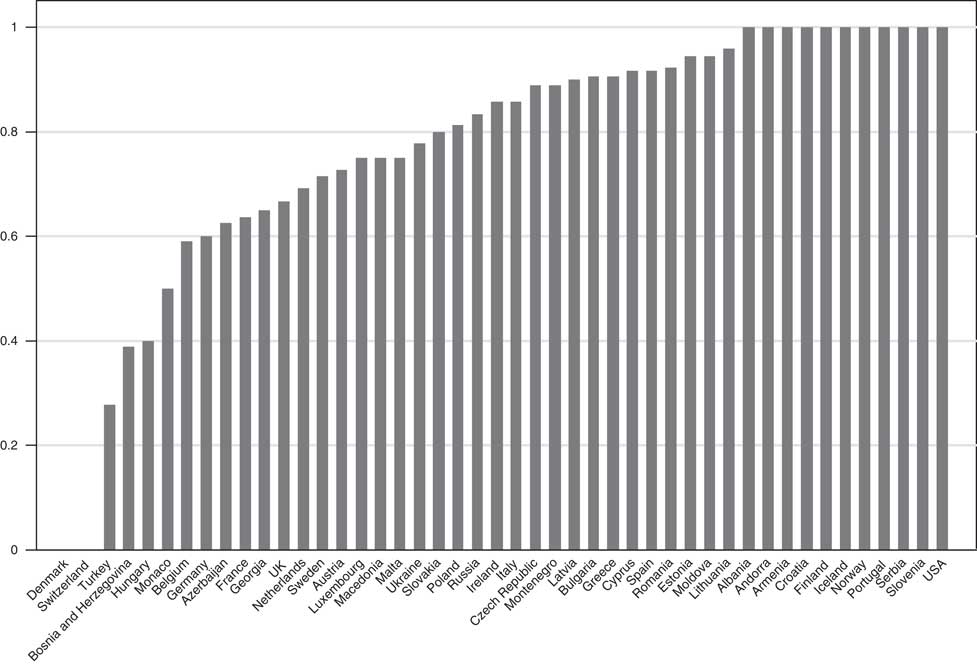
To estimate my dependent variable, I address the latest available country compliance report from the third GRECO evaluation round on ‘Transparency of political parties’.Footnote 11 To start with, each recommendation is awarded a score reflecting the country’s compliance with it. A score of 1 indicates that GRECO regards the recommendation as fully implemented or dealt with in a satisfactory manner; 0.5 that it has been only partially implemented; non-compliance is scored 0. Finally, I calculate a proportion of the fulfilled and partially fulfilled recommendations for each country, standardizing the compliance score by its total number of recommendations in the evaluation round. Thus, the dependent variable ranges from 0 to 1, and is widely distributed across countries (Figure 2).
Compliance with Group of States against Corruption (GRECO) recommendations on political finance reforms, proportions. Proportions indicate fully partly implemented GRECO recommendations. Countries with no bars have a zero compliance level. Source: own estimations, July 2017.

Operationalization of independent variables
Compliance in previous GRECO rounds
Information on countries’ compliance in the previous two evaluation rounds is coded using the same approach as coding the dependent variable. Further, I add implemented and partially implemented recommendations from the first and second rounds and divide them by the overall number of recommendations issued during the same period.Footnote 12 This procedure allows me to include those countries which experienced the first and second GRECO rounds as a single operation.
GRECO founding members
If a country is a GRECO founding member it scores 1, otherwise 0. The founding members are Belgium, Bulgaria, Cyprus, Estonia, Finland, France, Germany, Greece, Iceland, Ireland, Lithuania, Luxembourg, Romania, Slovakia, Slovenia, Spain, and Sweden.Footnote 13
Candidates for EU membership
This is a binary variable, coded as 1 if a country is a potential or an official candidate for EU membership, as defined by the EU Commission, while participating in the third GRECO evaluation round; otherwise 0.
International aid
Following Abel van Es (Reference Abel van Es2016), I use the average percentage of official development assistance in gross national income during the period of GRECO compliance procedure as an indicator of dependence on international aid.
Party codification
The intensiveness of party codification is a dummy variable. Countries are ranked 1 if they address political parties in the national constitution and a law on political parties. They can also have a separate law on party finance which refers to regular and/or campaign finance. Otherwise, countries are ranked 0. These are countries only mentioning political parties in the national constitution; countries with only a law on party finance; countries with only a party law; or countries that address political parties in the national constitution and a law on political finance. Overall, the high position of the country’s ranking indicates the great scope and detail of the regulation political parties are subject to – the high intensiveness of party codification. I make use of the information on laws and constitutions provided in the GRECO evaluation reports, Piccio (2012) and van Biezen (Reference Van Biezen2008). Finally, I ensure that the coding captures the regulation in place immediately before countries started the compliance procedure within the third GRECO round.Footnote 14
Left-right cabinet positions
The position of the cabinet on the left-right dimension is measured as a mean position of parties in the cabinet during the compliance procedure weighed by the years that they stayed in power. Party positions may take values from −5 (very left) to 5 (very right). Original data are taken from the ParlGov.org data set which is based on the mean values of party positions provided by expert surveys.Footnote 15
Changes for parliamentary parties
This is a variable indicating the proportion of a country’s quasi-sentences, denoted with i-indices in the text of recommendations in the original GRECO evaluation reports, addressing only parliamentary parties. Parliamentary parties are operationalized as political groups whose representatives are elected to parliament. This continuous variable may take values from 0 to 1.
Explaining variation in compliance: controls
To isolate the effects of interests, the model controls for (1) unintentional delays in compliance; (2) substantive differences in the recommendations resulting from the different policy aspects they address; and (3) level of domestic demands to enhance the legitimacy of political institutions.
Explaining compliance cross-sectionally presumes awareness of differences between deliberate recalcitrance and unintentional delay. The latter results from different interpretations of the standards set by the recommendation, political instability within a country, poor administrative capacities, or other similar reasons, and only postpones compliance (Falkner et al., Reference Falkner, Treib, Hartlapp and Leiber2005: 13; Mendez and Bachtler, Reference Mendez and Bachtler2017: 583). Over time these factors should lose their power. In contrast, deliberate recalcitrance is resistant to the passage of time. As countries enter the third evaluation round at different time points, I measure time in years from when the country received its recommendations up until the monitoring of compliance was officially terminated or July 2017 if it was still continuing then. Additional variation in compliance across countries can result from the different scope of change that countries are expected to attain (Steunenberg and Toshkov, Reference Steunenberg and Toshkov2009: 960). Countries do not necessarily receive the same number of recommendations.Footnote 16 The more change proposed by the recommendations, the less leeway supporters of reform have to logroll within the national legislative process (Kaiser, Reference Kaiser2002: 106; Thomson, Reference Thomson2007: 995). Consequently, I expect a negative relationship between the scope of recommendations and a country’s progress on compliance.
Compliance levels across countries may differ as recommendations address substantively different aspects of party finance regulation. To capture this, I disaggregate country recommendations on party finance regulation into more than 590 quasi-sentences, denoted by i-indices in the original evaluation reports. I code each of the quasi-sentences, differentiating between issues on reporting and publishing of information on political finance, accounting procedures, sanctions for violations of political finance regulation, changes to the monitoring institutions, and issues relevant solely to regional parties and elections.Footnote 17 All the codes are mutually exclusive.Footnote 18 The last category should hinder compliance: some countries have a high level of regional autonomy over electoral regulation, so that complying with recommendations may engender conflict between federal and regional competences. This is commonly controlled for in the compliance literature (Mendez and Bachtler, Reference Mendez and Bachtler2017: 571). I estimate a proportion of quasi-sentences in recommendations within each of the policy areas for each country. Each of these controls can vary from 0 to 1.
Third, I expect national authorities to comply with the GRECO recommendations more systematically when domestic political demand for the legitimacy of political institutions in their country is high. Demand can result from a gradual decrease in confidence in institutional arrangements or from a ‘sudden performance failure’ (Easton, Reference Easton1957: 388; Olsen, Reference Olsen2009: 15). Given that enhancing trust in and accountability of democratic institutions were the underlying motivations for recommendations on political finance expressed by the CoE (Molenaar, Reference Molenaar2010: 19), I control for the level of satisfaction with democracy and a lack of confidence in political parties. Satisfaction with democracy is the proportion of respondents indicating if they are very or fairly satisfied with democracy developing in their country [European Values Study (EVS), 2008]. Lack of confidence in political parties is the proportion of respondents saying that they have no or not very much confidence in political parties (EVS, 2008). Measures of confidence in political parties for Andorra (2005) and the United States (average for 2006 and 2011) are taken from the World Values Survey (WVS).Footnote 19 Missing answers are excluded from the population at the earliest stage of analysis.
Results
With a country as a unit of analysis and a continuous dependent variable, I fit the model with a multiple linear regression.Footnote 20 Hypotheses to be tested state that high costs in the international and domestic arenas are negatively associated with progress on compliance with GRECO recommendations. The logic of the estimated models can be also formulated as follows:
 $$\eqalignno{ & Country's\,compliance{\equals}\beta _{0} {\plus}controls{\plus}\beta _{1} compliance\,in\,previous\,\cr&GRECO\,rounds{\plus}\beta _{{2}} GRECO \,founding\,member{\plus}\beta _{{3a}} candidacy\,for\,the\,EU\cr & {\plus}\beta _{{3b}} candidacy\,for\,the\,EU{\times}dependence\,on \,{\mathop{int}} ernational\,aid{\plus}\beta _{4} party\,codification\cr &{\plus}\beta _{5} left{\rm {\minus}}right\,cabinet\,position{\plus}\beta _{6} demands\,on \,parliamentary{\rm }\,parties{\plus}{\varepsilon}_{{i{\rm }}} $$
where ε i is an error term and β indicates the effects of interest.
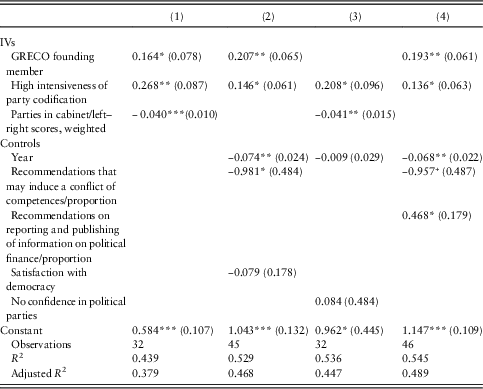
Table 1 presents the most interesting, significant, and robust results of a series of multiple regression chains. I first discuss the overall trends in the data, then focus on the effects of interest. Model 1 presents the main findings, which include indicators for GRECO founding members, intensiveness of party codification and the left-right affiliations of the cabinets. Models 2, 3, and 4 test the robustness of the findings for the full sample, including the different controls.Footnote 21
Ordinary least squares regression on compliance with the Group of States against Corruption (GRECO) recommendations on the country level

IVs=independent variables.
Dependent variable is the proportion of fully and partly implemented recommendations. Unstandardized coefficients. Robust standard errors are in parentheses.
Residual diagnostic and robust regressions were performed to check the sensitivity of results to the outliers. No problems were detected. Additional model specifications are listed in the Online Appendix B.
+ P<0.10, *P<0.05, **P<0.01, ***P<0.001.
The positive and significant values of the constant across all the models indicate that, in general, countries tend to comply with the GRECO recommendations. We can also clearly identify those factors that strengthen or limit GRECO’s success in the national reform process. Model 1 demonstrates that GRECO founder-members, on average, comply by 16 percentage points more than countries which joined GRECO later (Hypothesis 2). Models 1 and 3 show that countries with cabinets more to the right-of-centre and longer in power during the compliance procedure show significantly less compliance (Hypothesis 5). At the same time, all the models indicate that intensive party codification is associated with a high level of compliance (Hypothesis 4). This effect is stable, even controlling for different regulatory areas. For illustrative purposes, Model 2 includes an indicator for potential conflict between regional and national levels over competences on regulation of political finance. Model 4 additionally controls for a proportion of recommendations that aim at facilitating the public availability of data on political finance.Footnote 22 The effect of high intensiveness of party codification remains robust even controlling for satisfaction with democracy and the lack of confidence in political parties (Models 2 and 3).
The compliance level from the previous GRECO rounds does not necessarily predict that for the third round (Hypothesis 1), although it seems to do so reasonably well for some countries, including Croatia, Estonia, Italy, Latvia, Norway, Romania, and Russia. The cases of Denmark and Switzerland are puzzling. In the first two rounds, both had high compliance rates: 90 and 96%, respectively. Yet, in the third round they did not comply at all. The quantitative analysis suggests that their low compliance is associated with low levels of national party codification. Their compliance behaviour may be an interesting case for an in-depth investigation, but it is beyond the scope of this article.
The hypothesis that prospective EU membership should be positively related to compliance in the third GRECO evaluation round in the time period covered was not confirmed (Hypothesis 3a).Footnote 23 Nor does dependence on international aid make any difference to the compliance level (Hypothesis 3b). The compliance levels of EU candidates vary greatly. Croatia (the only country in the sample which became an EU member during the third evaluation round), Albania and Serbia complied with the recommendations 100%. The compliance level of Macedonia and Montenegro lies around the sample average. Surprisingly, Turkey’s level is below 40%, as is Bosnia and Herzegovina’s. One could argue that the latter had no realistic prospects of joining the EU during the period of analysis, hence the prospect of EU membership turned out to be systematically irrelevant. This finding echoes Walecki (Reference Walecki2007), who identifies substantive EU power with regard to political finance reforms within the EU-enlargement procedures in 2004 and 2007, when membership prospects were clear. In brief, the current quantitative analysis contradicts the proposition that, on average, EU candidates will be more compliant than other countries.
My findings do not support the argument that a coincidence of the subject and object of reform leads to blocking recommendations intended to reduce privileges of parliamentary parties. So I conclude that there is no empirical evidence of discrimination against recommendations that require more transparency from parliamentary parties (Hypothesis 6).
Regarding the controls, additional recommendations, distinct regulatory areas, and government efficiency (not shown here) neither systematically hinder, nor support compliance. Only the time variable suggests a relationship in the opposite direction to that I expected. This demonstrates that at the final stage, where the GRECO third round is now, those countries willing to comply have already been proven to have done so in the earlier monitoring rounds. And ‒ holding all the other factors constant ‒ giving countries more time does not substantively change compliance rates.
To explore the size of the effects of domestic factors, I focus on Model 1, which has a very good explanatory power, capturing over 40% of the data variation (R 2=43.9) and is quite parsimonious. On average, countries with a high level of party codification comply 26.8 percentage points better as compared to the countries with a low intensity of party codification. This indicates that the less intense a country’s party regulation, the poorer its compliance with GRECO recommendations. Predictive margins suggest that countries with the high level of party codification would comply with the GRECO recommendations, on average, at a rate of 87.1%. In countries with a low party codification, the compliance with their GRECO recommendations drops to approximately 60.3%.
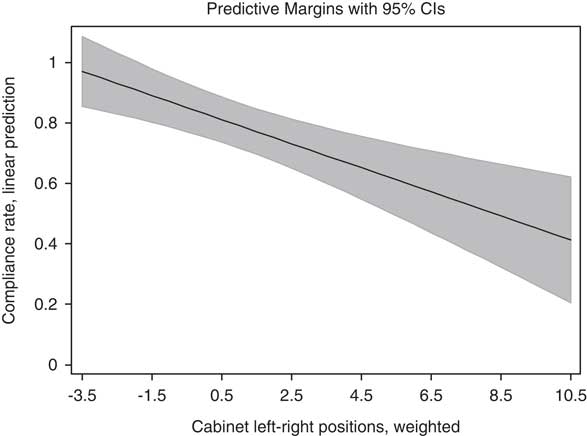
Based on the current sample, predictive margins suggest that changes in the variable capturing the left-right position of the governing parties and the time this coalition has been in government are associated with an almost 56% difference in compliance rates (Figure 3). This variable best explains the 60 percentage points difference in compliance between Norway and Iceland to the left-of-centre and right-of-centre Hungary. Overall, the R2 indicates that about 43.9% of the variability in compliance with international norms is due to the type of reforms countries need to pursue, the political constellation of national government, and whether the country is a founding member of GRECO [F(3, 28)=7.72, P<0.001].
Predictive margins for the effects of parties in cabinet. CI=confidence interval.

In a nutshell, the empirical analysis demonstrates that changes to the regulation of political finance are most likely to be implemented if they are moderate and in line with national conventions. Those countries which have already established a detailed regulatory framework for political parties tend to comply with international standards on political finance. Left-of-centre cabinets tend to introduce more transparency regulation in accordance with foreign advice than their right-of-centre counterparts. High domestic costs for reform and governing parties to the right-of-centre are likely to impede compliance with international standards. As theoretically expected, GRECO founding members show greater commitment than other GRECO members.
Conclusion
Addressing reforms to party finance launched by the CoE, this article bridges two research traditions. It brings together foreign and domestic factors affecting the evolution of political regulation, thus contributing to the emerging theory of political finance reforms (Fischer and Eisenstadt, Reference Fischer and Eisenstadt2004; Koss, Reference Koss2011; Nwokora, Reference Nwokora2014; Norris and Abel van Es, Reference Norris and Abel van Es2016) and extending the literature on the impact of international organizations on reforming political finance regulation (Haughton, Reference Haughton2007; Walecki, Reference Walecki2007; Molenaar, Reference Molenaar2010; Timus, Reference Timus2010; van Biezen and Molenaar, Reference Van Biezen and Molenaar2012; Gauja, Reference Gauja2016). In addition, by analysing policy changes on foreign advice in such a highly intrinsic matter as political finance policy, the article contributes to the compliance literature (Koh, Reference Koh1997; Beach, Reference Beach2005; Guzman, Reference Guzman2008; Börzel et al., Reference Börzel, Panke and Carina2010; Trachtman, Reference Trachtman2010; Nzelibe, Reference Nzelibe2011), testing the external validity of available theoretical approaches on a new policy field.
Substantively, the article confirms that changes to political finance regulation are a function not only of what is appropriate but also of what is feasible. The analysis shows that a potential policy change triggered at the international level is shaped by domestic factors. Although party finance regimes tend to converge worldwide, with state funding of political parties becoming an ordinary source of party finance (Koss, Reference Koss2011: Introduction), as this article demonstrates, we still lack empirical evidence that most countries implement identical principles on transparency and accountability in party finance. The introduction of equal standards on political finance in Europe may interfere with ‘different and competing conceptions of party democracy’ (van Biezen, Reference Van Biezen2012: 207; Gauja, Reference Gauja2016: 12). Resistance to the implementation of internationally agreed standards is especially to be expected, as these standards are derived from a particular conception of party democracy – participatory democracy, rather than a procedural democracy where parties are, primarily, understood as public utilities (van Biezen and Molenaar, Reference Van Biezen and Molenaar2012: 644). This conclusion echoes Gauja (Reference Gauja2016), who finds an international consensus on considering a political party an important mechanism for citizens to exercise their rights to freedom of political expression, while the acceptability of intensive party regulation nevertheless varies enormously across countries.
This article delivers empirical evidence of the conflict between concepts of party democracies. It shows that even if countries receive tailor-made recommendations to promote transparency and accountability in party finance, they remain constrained in the implementation of these recommendations by their tradition of party regulation. This conclusion is in line with Abel van Es (Reference Abel van Es2016), who identifies the relevance of legal tradition for explaining the cross-sectional variation in party finance regulation globally. It is, too, in line with findings from compliance studies on environmental issues (Bernhagen, Reference Bernhagen2008) and human rights (Powell and Staton, Reference Powell and Staton2009). Comparative political science needs, therefore, to identify those causal mechanisms ensuring competitive elections without corruption which are successful in different regulatory regimes. Further, and directly related to the previous suggestion, the variety of party democracies demands further development of cross-sectional time-series data on party finance regulation.
The article delivers systematic evidence of the relationship between the political constellation of the government and the progress of party finance reform, which supports previous findings across different policy fields and countries (Scarrow, Reference Scarrow2004; Cioffi and Höpner, Reference Cioffi and Höpner2006; Trachtman, Reference Trachtman2010; Nzelibe, Reference Nzelibe2011). This evidence contradicts the assumption that, as the importance of direct party funding by the state rises, left- and right-of-centre parties develop similar preferences for funding transparency to account for taxpayers’ money. At the same time, it sheds new light on why strict regulation of political finance corresponds with a high level of perceived corruption in parties (Casal Bertoá et al., Reference Casal Bértoa, Molenaar, Piccio and Rashkova2014). To better estimate the effect size of left-right party positions on the evolution of political finance regulation and to trace the causal relationship, further in-depth analyses are necessary. Data on compliance with GRECO presented in this article may serve as a starting point for case selection. Note that the concept of compliance I use here is that applied by GRECO itself. Future research can undoubtedly benefit from addressing the true level of compliance with the letter and spirit of these recommendations over time and from elaboration on the effects of GRECO-induced regulation.
Finally, an interesting implication of the article suggests that powerful countries being able to affect international norms deviate in their compliance preferences. Contrary to previous findings of EU compliance studies (Börzel et al., Reference Börzel, Panke and Carina2010), I find that participation in the development of the international norms is associated with more compliance. EU compliance studies in fact suggest an explanation for this phenomenon: countries which are involved in the development of international norms may shape these norms according to their own preferences, thus diminishing the costs of their compliance.
Acknowledgements
The author is grateful to Professor André Kaiser from the University of Cologne for his constant support. The author’s sincere thank goes to Professor Nicole Bolleyer, Professor Thomas Poguntke, and anonymous reviewers for their valuable comments on this paper and advice. The author thank participants of the graduate seminar at the University of Cologne in 2014, the ECPR Summer School 2015, the GESIS research colloquium 2016, where earlier versions of this article were discussed. Final thank goes to Anne Gelling for the language corrections. Any errors remain the author’s responsibility.
Funding
I express my gratitude to the Konrad Adenauer Foundation for a scholarship while working on this project.
Supplementary material
To view supplementary material for this article, please visit https://doi.org/10.1017/S1755773918000103