Introduction
Difficulties with psychosocial adjustment (i.e., emotional, behavioral, and social domains of functioning) after traumatic brain injury (TBI) can have deleterious effects on outcomes including difficulties with occupational satisfaction and well-being (Beadle et al., Reference Beadle, Ownsworth, Fleming and Shum2020), successful community reintegration (Andelic et al., Reference Andelic, Arango-Lasprilla, Perrin, Sigurdardottir, Lu, Landa, Landa, Forslund and Roe2016), and overall life satisfaction (Williams et al., Reference Williams, Rapport, Millis and Hanks2014). Rehabilitation programs often target psychosocial adjustment processes in daily therapies, yet improvements in psychosocial adjustment are variable and differ in effectiveness across individuals (Schönberger et al., Reference Schönberger, Ponsford, McKay, Wong, Spitz, Harrington and Mealings2014). Determination of baseline characteristics that predict psychosocial adjustment difficulties post-TBI could facilitate improved rehabilitation plans that optimize psychosocial adjustment outcomes.
Several factors have been posited to play a role in determining psychosocial adjustment after injury. First, impairment in several cognitive domains, particularly working memory, processing speed, and executive functioning, have been found to be associated with worse psychosocial outcomes (Spitz et al., Reference Spitz, Schönberger and Ponsford2013). Additionally, emotional disruptions such as depression have also been implicated in theoretical models of psychosocial adjustment difficulty and psychosocial outcomes postinjury (Gracey et al., Reference Gracey, Evans and Malley2009; Singh et al., Reference Singh, Mason, Lecky and Dawson2018). Depressive symptoms are a common outcome of TBI, and survivors are at an increased risk of developing depression after injury (Albrecht et al., Reference Albrecht, Barbour, Abariga, Rao and Perfetto2019). While residential rehabilitation programs are effective in reducing depression, depression may persist and has been linked to worse global disability and psychosocial outcomes even after discharge (Lewis & Horn, Reference Lewis and Horn2017).
Determination of contributing factors to psychosocial adjustment post injury is further complicated by evidence of relationships existing between depression and neuropsychological impairment in TBI survivors. Studies have shown associations between depression and domains such as working memory, attention, verbal learning and memory, processing speed, and executive functioning (Rapoport et al, Reference Rapoport, McCullagh, Shammi and Feinstein2005; Joosub et al., Reference Joosub, Cassimjee and Cramer2017). Together, these results indicate that a broad range of cognitive domains may be associated with depression after injury, but the combined effect of performance within these domains has not been well studied.
In summary, both depression and cognitive function have been posited to affect psychosocial adjustment after TBI, but the exact nature of their contributions remains unclear. Thus, the current study utilized structural equation modeling to examine depression as a mechanism through which impairments in cognitive functioning (CF) in the postacute phase of TBI predict psychosocial adjustment at discharge from a residential postacute rehabilitation program. We expected that consistent with previous findings, CF, modeled here as a single latent construct to capture the combined impact of performance across multiple cognitive domains, would predict psychosocial adjustment difficulties at discharge. Furthermore, we hypothesized that depression would mediate this relationship, such that greater impairments in CF would lead to higher depression, which in turn would lead to greater impairment in psychosocial adjustment at discharge.
Method
Participants
The sample was 172 (137 male, 37 female) adults who received rehabilitation services for a moderate/severe TBI at a midwestern residential rehabilitation facility. Survivors received daily services based on personalized, individual need(s), which may have included physical therapy, occupational therapy, speech-language therapy, cognitive rehabilitation, adaptive sports, life planning, and individual and/or family psychological counseling. Ages ranged from 19 to 77 (M = 40.38, SD = 14.91), with education ranging from 8 to 20 years (M = 13.39, SD = 2.23). Data on race and ethnicity were not consistently available in records reviewed. The mean time since injury was 212.67 days (SD = 441.45 days) and the mean length of rehabilitation program from admission to discharge was 88.76 days (SD = 78.44). The final sample of the overall prediction model (n = 169) excluded individuals without a complete record of the clinical measures listed below or a verified TBI diagnosis. This research was completed in accord with the ethical standards and approval of the Institutional Review Board at the University of Nebraska-Lincoln and with the Helsinki Declaration.
Procedure
Demographics and clinical measures were obtained through a retrospective record review. All patients completed an individualized battery of neuropsychological tests, assessment of depression, and assessment of psychosocial adjustment sequela of TBI during the admission process. The psychosocial adjustment measure alone was conducted again at discharge. All assessments were conducted by a licensed clinical neuropsychologist or internship level trainee in neuropsychology.
Measures
Neuropsychological assessment battery
Measures representing a spectrum of cognitive domains with theoretical support for associations with depression and psychosocial adjustment were specifically selected from the larger neuropsychological battery for inclusion in this study. Selection of measures was limited by overlap in data from individualized assessments to minimize missing data and adequate contribution to a single latent variable of CF. Raw scores from each measure were used to represent each available domain. Verbal fluency was assessed with the Controlled Oral Word Association Test phonetic fluency trial (COWAT; Benton et al., Reference Benton, de Hamsher and Sivan1994), cognitive flexibility, one facet of executive functioning, was assessed with the Trails B subtest from the Trail Making Test (TMT; Army Individual Test Battery, Reference Army1944), working memory abilities were assessed with the Digit Span subtest of the Wechsler Adult Intelligence Scale-4th Edition (DS WAIS-IV; Wechsler, Reference Wechsler2008), and verbal learning and memory was assessed with the 3 learning trials of the Hopkins Verbal Learning Test-Revised (HVLT-R; Brandt & Benedict, Reference Brandt and Benedict2001).
Beck Depression Inventory-II (BDI-II; Beck et al., Reference Beck, Steer and Brown1996) and Beck Depression Inventory-FastScreen (BDI-FS; Beck et al., Reference Beck, Steer and Brown2000)
The BDI-II is a 21-item self-report measure designed to assess depression. Respondents rate the severity of symptoms on a 4-point Likert scale ranging from 0 to 3. Scores on all 21 items are summed to obtain a total depression score. The BDI-FS consists of seven symptoms of depression obtained from the BDI-II. Individual item scores for the BDI-II and the BDI-FS were not available, so estimates of internal consistency within the current sample are not reported here.
To obtain a uniform measure of depression across the entire sample, depression scores were converted to a standardized z-score with a mean of 0 and a standard deviation of 1 relative to the sample distribution. This allowed for standardization of the scores to the same scale and meaningful inclusion in analysis.
The Mayo-Portland Adaptability Inventory – Adjustment Index (MPAI-4; Malec, Reference Malec2005)
The MPAI-4 provides an assessment of common sequela of TBI in a range of cognitive, emotional, behavioral, and social domains, and can be used to assess progress in a rehabilitation program. This 29-item measure is rated on a 5-point Likert scale on the degree to which an area causes problems for an individual’s daily functioning. Three indices are produced representing major domains of functioning. The current study utilized the Adjustment Index score as the impairment in psychosocial adjustment outcome variable. The internal consistency of the Adjustment Index was adequate for this sample at admission (α = .74) and at discharge (α = .81).
Data analytic strategy
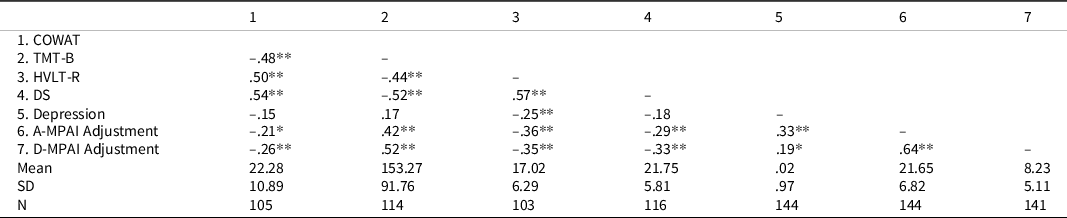
Data for the current study was analyzed using a structural equation modeling (SEM) approach with Mplus software (Muthén & Muthén, Reference Muthén and Muthén2017). Due to the individualized nature of the clinical assessment (i.e., a semi-flexible battery approach was used), there were missing data across the measures of cognition and depression (see Table 1 for n’s for each study measure). Covariance coverage (proportion of data present) for the primary mediation model ranged from .47 to .83. To address missing data in the final analyses along with non-normal distribution of variables, Maximum Likelihood estimation along with bootstrapping methods were employed. Global fit of the modal was evaluated with four commonly used indices and criteria: Chi-square Test of Model Restrictions, Comparative Fit Index (CFI), Root Mean Square Error of Approximation, and Standard Root Mean Residual (SRMR). For the CFI, values ≥ 90 reflect adequate fit. For the RMSEA and SRMR, values ≤ .05 indicate good fit. Once the model was determined to have adequate global fit, parameter estimates were examined in two phases. First, performance on the COWAT, TMT B, HVLT-R, and DS were measured as indicators of a latent variable of CF with higher scores on the latent construct associated with better CF. The second phase tested the full mediation model using a Maximum Likelihood (ML) estimation with bootstrapping. To test the mediation model, bias-corrected bootstrapping with 10,000 draws produced 95% confidence interval for indirect effects (Preacher et al., Reference Preacher, Rucker and Hayes2007).
Descriptive statistics and correlations among study variables.

Note. COWAT = Controlled Oral Word Association Test; TMT-B = Trail Making Test-B; HVLT-R = Hopkins Verbal Learning Test-Revised; DS = Digit Span; Depression = z score on Beck’s Depression Inventory-II or Beck Depression Inventory-FastScreen; A-MPAI Adjustment = Mayo-Portland Adaptability Inventory Adjustment Index at admission; D-MPAI Adjustment = Mayo-Portland Adaptability Inventory Adjustment Index at discharge.
Note. *p < .05, **p < .01 (two-tailed).
Results
Associations among measures
Correlations among study variables are reported below (see Table 1). Indicators of the CF latent variable were all significantly correlated with better performance being associated with better performance across indicators. Effect sizes among cognitive indicators ranged from medium to large (r’s = −.44 – .57). Greater psychosocial adjustment impairments at both admission and discharge were significantly correlated with worse performance on cognitive measures. Depression was positively correlated with psychosocial adjustment impairments at both admission and discharge. Notably, the only significant cognitive association with depression was a small negative association with verbal learning performance as measured by the HVLT-R (r = −.25). Psychosocial adjustment impairment significantly reduced from admission (M = 21.65, SD = 6.83) to discharge (M = 8.23, SD = 5.11), t(140) = 30.25, p < .001, d = 2.55, with a mean change score of −13.40.
Results of structural equation modeling
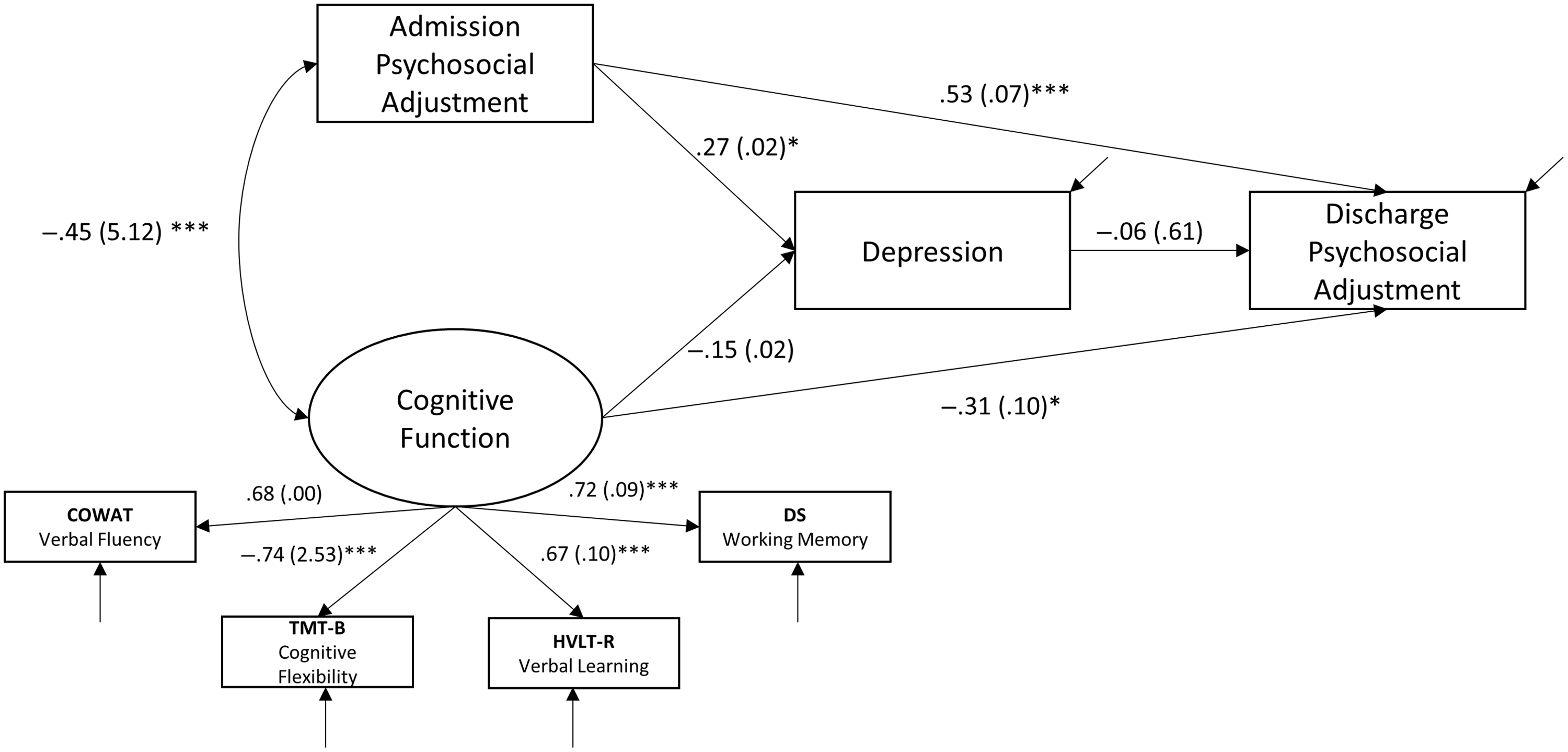
The first phase specified a measurement model of a CF latent variable to include in the overall mediation model. Four indicators of unique cognitive domains measuring verbal fluency, cognitive flexibility, verbal learning, and attention/working memory were used to construct the latent variable. The global fit was good (χ2 (6) = 80.96, p < .001; CFI = 1.00; TLI = 1.00; RMSEA < .001; SRMR = .013). CF explained a significant amount of variance in each of the observed indicators with standardized factor loadings ranging from −.68 to .74. For verbal fluency (COWAT), 54% was explained with a factor loading of .74. For cognitive flexibility (TMT-B), 46% was explained with a factor loading of −.68. For verbal learning (HVLT-R), 42% was explained with a factor loading of .65. Finally, for attention/working memory (DS), 54% was explained with a factor loading of .73.
The second phase of analysis yielded an estimation of a mediation model that included the latent variable CF with good global fit (χ2 (11) = 12.47, p = .33; CFI = .99; TLI = .99; RMSEA = .03; SRMR = .04). The results of the mediation model are reported in Figure 1 including standardized path coefficients (with unstandardized SEs). Unstandardized (B) and standardized (β) coefficients are reported here for each path in the model. A path from psychosocial adjustment impairment at admission to psychosocial adjustment impairment at discharge was included as a control to assess for the variance in psychosocial adjustment at discharge not accounted for at admission. This association when controlling for depression and CF was positive and significant (B = .39, β = .53, SE = .07, p < .001). Contrary to our hypothesis, there was no indirect effect of CF on psychosocial adjustment at discharge via depression (95% CI [−.02, .11]). CF was not associated with depression (B = −.02, β = −.15, SE = .02, p = .35). When controlling for depression, CF had a significant negative association with psychosocial adjustment impairment at discharge (B = −.21, β = −.31, SE = .10, p = .03) such that poorer CF at admission was associated with greater impairment in psychosocial adjustment at discharge. Furthermore, admission psychosocial adjustment impairment had a positive significant association with depression when controlling for CF (B = .04, β = .27, SE = .02, p = .02), however depression did not in turn predict psychosocial adjustment impairments at discharge (B = −.32, β = −.06, SE = .61, p = .61). The tested model explained 47% of the variance in verbal fluency (COWAT), 54% of the variance in cognitive flexibility (TMT-B), 44% of the variance in verbal learning (HVLT-R), 51% of the variance in attention/working memory (DS), 13% of the variance in depression, and 49% of the variance in psychosocial adjustment impairment at discharge.
Full final structural model. The link between cognitive functioning and change in psychosocial adjustment impairments after post-acute rehabilitation program is not mediated by depression. Notes: Standardized coefficients (unstandardized SEs) are reported. An indirect effect of cognitive functioning on psychosocial adjustment change via depression was not present, 95% CI [−.02, .11]. COWAT = Controlled Oral Word Association Test; TMT-B = Trail Making Test-B; HVLT-R = Hopkins Verbal Learning Test-Revised; DS = Digit Span. *p < .05, **p < .01, ***p < .001.

Discussion
Previous research has examined factors that predict difficulty in psychosocial adjustment post-TBI. The current study sought to examine depression as a potential mechanism through which cognitive impairments predict psychosocial adjustment outcomes within postacute rehabilitation programs. Though depression was positively correlated with psychosocial adjustment impairments (at admission and discharge), results did not support the hypothesis that depression mediates the relationship between CF and psychosocial adjustment outcomes. The tested model did support a direct association between CF and psychosocial adjustment impairment when accounting for change in psychosocial adjustment over the course of time. Specifically, lower overall cognitive function predicted greater impairments in psychosocial adjustment after rehabilitation above and beyond the effects of depression. Therefore, it appears that CF upon starting a postacute rehabilitation program is an important factor in predicting how well rehabilitation can address psychosocial adjustment.
Regarding absence of evidence for depression as a mechanism in this process, we have two potential explanations. First, there may be more important factors for change in psychosocial adjustment after rehabilitation than depression. Other possibilities include interpersonal communication, social support, or ability to navigate services. Self-concept and identity, constructs implicated in postbrain injury psychosocial adjustment models (Gracey et al., Reference Gracey, Evans and Malley2009) were not assessed in this study, however, may be factors driving outcomes above and beyond depression. Second, depression likely changed over the course of rehabilitation. Measuring depression changes throughout rehabilitation could reveal a concurrent pattern of depression and psychosocial adjustment change.
Implications
The results of this study contribute to the identification of CF as a predictor of psychosocial adjustment after completion of a postacute rehabilitation program. This knowledge can help guide rehabilitation professionals in tailoring more targeted individualized treatment plans. Additionally, this study supports the notion that early neuropsychological assessment is an important tool for predicting psychosocial adjustment needs and is a critical component of rehabilitation planning.
Limitations
There are notable limitations of the current study. First, there was inconsistency in the neuropsychological battery that participants received. This was unavoidable as the data were obtained from a clinical setting where individualized care was paramount to meet the patient’s needs. The four measures of CF (i.e., COWAT – FAS, Trails B, Digit Span, and HVLT-R) do not represent exhaustive coverage of all possible cognitive domains and were chosen to minimize missing data and contribution to the CF latent variable. The inclusion of different neuropsychological measures may possibly alter the results. As noted earlier, neuropsychological performance and depression were measured once at admission, limiting the ability to assess change in these domains. These limitations further highlight the need to examine other potential mediators in addition to depression.
Conclusions
In conclusion, CF at admission to a postacute rehabilitation program for TBI is an important predictor of psychosocial adjustment at discharge. Depression does not appear to be a mechanism driving this relationship. Additional research is needed to examine process variables that may help rehabilitation professionals improve the effectiveness of their treatment programs, and ultimately improve outcomes of individuals who have experienced a TBI.
Financial support
There are no sources of financial support for this work.
Conflict of interest
None.