The freeway is metonymy for the United States. It is the conduit for the transportation of people and goods across the hemisphere, and makes possible the very forms of commercial liberalism that have become synonymous with US modernity. After all, in the American imagination sites like the freeway – ports and railroads, for example – are critical to the creation of more egalitarian communities through transportation and commerce.Footnote 1 Like the ports of the eighteenth century and the railroads of the nineteenth century, the freeways are the generative sites: freeways are where novel types of persons (“Americans”, for example) and communities (the US nation-state, for example) are formed in the twentieth and twenty-first centuries. In part this is because the freeways are not simply a means of interconnecting commerce and the state, but also a means of interconnecting the individual to the state through liberal- and commercial-subject formation. The rich symbolism of the freeway as a stand-in for American economic and social progress is also central to understanding the creation of a socially and economically mobile American person. Moreover, the language of mobility is at the heart of a country relentlessly grappling with, while also persistently reinscribing, its own social, political, and economic progress and advancement. It is unsurprising, therefore, to find that road novels and road narratives have come to be understood as an archetypal American genre in the twentieth and twenty-first centuries, and novels from John Steinbeck's Grapes of Wrath (1939), to Jack Kerouac's On the Road (1957), and Cormac McCarthy's The Road (2006) have used the road and roadways to narrate, critique, and otherwise comment on the US. As Ann Brigham writes in American Road Narratives: Reimagining Mobility in Literature and Film, the road trip “reasserts mobility as an American subject.”Footnote 2
However, while the aforementioned white male-authored novels also frame journeys on the road as part of a larger search for freedom and opportunity, thereby also tapping into the archetypal American space of the frontier, this essay takes up the space of the freeway in a limited archive of works by women and persons of color. I propose reading these works not through their representations of the freeway as a site of mobility and freedom, but rather as a site for world making where communities are able upset US demands for free trade, economic progress, and social advancement. By focussing not on the journey, but on the acts of staticity, interruption, or bodily transgression that occur on the site of the freeway, one can see that the freeway is a site where marginalized persons can demand new worlds. Said differently, it is an important site of theorizable interaction. Focussing on the “misuse” of the freeway reveals how new worlds might be created and even perhaps what they might look like in works as varied as David Seals's The Powwow Highway (1979), Octavia Butler's Parable of the Sower (1993), and Hector Tobar's The Tattooed Soldier (1998). In these and other instances, habitation and occupation of the freeway constitute an important world-making action because of the occupation's staticity and its capacity to produce suspension through gridlock.
The freeway is a site taken up very explicitly in Karen Tei Yamashita's novel Tropic of Orange.Footnote 3 Published in 1997, Tropic of Orange alludes to a recent American past that includes many events of global significance: the signing of the North American Free Trade Agreement (NAFTA) in 1994, the war on drugs that began in 1971, and increasing restrictions on immigration and Latino undocumented migrants in the US – this last felt with particular intensity in southern California because of its proximity to the US–Mexico border. Yamashita's “fiercely satirical, semifantastical novel” is set primarily in Los Angeles, but also between Mazatlán, Mexico and Brazil, and features a cast of seven characters as a narrator tracks the events of their lives over the course of a calendar week.Footnote 4 This cast includes Gabriel, a Chicano reporter; his Japanese American girlfriend, Emi, a television producer critical of the promises of multiculturalism; Arcangel, a Latino performance artist loosely based on Guillermo Gómez-Peña; Bobby, a janitor who immigrated to the US while masquerading as a refugee from Vietnam; his Mexican immigrant wife Rafaela (and their son, Sol); Buzzworm, a black Vietnam veteran; and the Japanese American Manzanar Murakami, a former surgeon, a composer and conductor of freeway symphonies and traffic “jams.” Their narratives overlap in sometimes confusing ways and mimic the overlapping routes of exchange represented throughout the novel. The action of the novel is catalyzed when a drug cartel saturates innocuous oranges with a high concentration of soluble cocaine. Consumed by Angelenos during their morning commute, the oranges occasion numerous deaths at the wheel and a series of devastating car crashes that draw the city to a standstill. The remaining commuters, unable to move their cars, abandon them on the freeway, leaving them to be occupied by the homeless, who create an encampment, a new community, atop the freeway. In addition to this first contamination, there is a second contamination that happens as time and distance expand and collapse when the aged mystic Arcangel transports an orange grown in Gabriel's garden in Mazatlán across the border to California. The orange drags with it the earth's Tropic of Cancer, thereby bringing the divider of hemispheres transgressively into the global North.
Given its multiethnic cast and their transnational networks, scholarly work on Tropic of Orange is extensive and ranges from studies on the novel's curious temporal and geographic imagination to its ecocritical concerns.Footnote 5 Because of its engagement with transnational routes of exchange alongside a cast of characters that move across nation-states both legally and illegally, and who critique the US's long history of national exclusion, its exploitation of certain racialized populations, and its imperialist economic undertakings across the hemisphere, Tropic of Orange's spatial and temporal expansiveness and migration are thought to be the instruments of its critique.Footnote 6 However, even when the novel is read as being deeply concerned with the multivalent and overlapping networks and matrices of persons, as well as the “complex grid of pattern, spatial discernment, [and] body politic,” critics do not touch upon the ways in which persons inhabiting and transacting in these spaces improperly or unlawfully help to reshape the body politic as imagined by Yamashita.Footnote 7 For example, while critics look to Yamashita's cartographic imagination of Los Angeles and the freeways, these spaces are always interpreted as being in the service of Yamashita's broader transnational concerns and interests.Footnote 8 Indeed, extant work on the novel reaffirms our understanding of the freeway as a kind of artery in the hemispheric body that promotes movement between and across spaces (cities, nations, hemispheres), and thereby overlooks the site of the freeway as the center for a new social order and horizontal community building by closely examining why Yamashita imagines the most revolutionary act in the novel to be when Angelenos “clog” the freeway with encampments.Footnote 9
By turning to settlement of the freeway, Yamashita counters the assumption that the unbounded movements between nation-states in which the characters participate is the instrument of resistance to the nation-state, and to the uneven and unequal development of the global North and South. I instead look to site of the freeway alongside the persons who inhabit and transact in this space in order to reveal why certain minoritized populations are able to exist, albeit briefly, outside the limitations of and restrictions imposed by the state in radical and revolutionary ways. As this novel demonstrates, the freeway is not simply a site of mercantilist state growth, and a site where a globalized economy reaches its apogee. Rather, the freeway is also where the state is undone, and where a new social order takes its place. To my knowledge no work has examined the site of the freeway as critical in shaping and being reshaped by abject populations in the novel: populations that in some way or another exist in direct defiance, or in the shadows, of the regulatory state.Footnote 10
The freeway operates on several registers throughout the Yamashita's novel. The freeway is a site that makes visible the forms of exchange that bolster mercantilist exchange; that is, exchange which aids in the development and growth of the state. In other words, it stands in as a material representation of the crowning achievement of free trade. To make this case, I look to the LA freeway system as a specific site that is representative of economic liberalism, mobility, and exchange in the early and mid-twentieth century. And yet, not only is the LA freeway an artery for the transportation of lawful finished products, but it is also an access way for the facilitated transportation of illegal and unlawful people and goods across the border. Indeed, the “illegal orange scare” (added emphasis) turns into the “illegal alien orange scare” (original emphasis) soon after the orange contamination.Footnote 11 Thus the freeway is also the site where the state is threatened and possibly undone altogether.
As I underscore over the course of this essay, improper use of the freeway by migrants, narcotraffickers, and the homeless is significant in that it helps the reader uncover the revolutionary misappropriations, occupations, and double-crossings taking place throughout the novel. The migrants, crossing the freeway laterally by foot, for example, counter the very efficiency imagined by the architects of this mode of transportation. Moreover, in crossing the freeway in order to migrate to the US unlawfully, the migrants represent a threat to sovereignty that gets reanimated through the language of transnational trade. Indeed, the discourse of the illegal “alien” oranges mentioned above points to the dissolution of the differences between the unlawful migrants and the cocaine-saturated orange transported across state and national boundaries. As I show using the language surrounding narcotrafficking, which likens narcotrafficking to migration and terrorism, the rapid spread of the “illegal alien orange” panic reflects the anxieties occasioned by “illegal” and “alien” bodies to the nation-state, and to civil society itself.Footnote 12
Moreover, the repression of the homeless and the destruction of their encampment in the final pages of the novel must also be understood through the discourses of the public and private threat posed by both the migrant and the narcotrafficker. After all, in many ways, the homeless person, too, is a subject that exists outside the regulatory mechanisms of the state, while also being subject to its management. This helps to explain why Manzanar figures so prominently in the text as someone unsettling the regime of private property and restructuring the cartographies of the state. Though not homeless, Buzzworm, an advocate for the homeless and a figure who understands his subject position through displacement, transience, and marginalization, is also a figure who repeatedly transgresses upon and undermines the state through his willful proximity to homelessness. I posit that the destruction of the encampment at the end of the novel is necessary because occupation of the freeway is described as an act of exceptional violence that threatens to unmake the nation-state altogether. Over the course of this paper, I reveal how the populations living and transacting both above and below the LA freeway become the constitutive subjects of the utopia Yamashita imagines toward the end of the novel precisely because these subjects repurpose and ultimately dismantle this infrastructure of the state.
TROPIC OF ORANGE’S ROUTES OF EXCHANGE
The freeway is indisputably an infrastructure of the state. After all, the free movement of capital that aids in the growth of the state takes place in part on the freeway system. When representing Manzanar's conducting of traffic “jams” atop the freeway, the reader is told that
Manzanar knew the frustration of the ordinary motorist wedged between trucks – the nauseous flush of diesel exhaust and interrupted visibility – but he also understood the nature of the truck beast, whose purpose was to transport the great products of civilization: home and office appliances, steel beams and turbines, fruits, vegetables, meats, and grain, Coca-Cola and Sparkletts, Hollywood sets, this fall's fashions, military hardware, gasoline, concrete, and garbage.Footnote 13
The fashions, foods, and hardware of civilization, alongside the societal detritus (its garbage and noxious waste) being transported between global South and North (which will soon be left standing in the middle of streets and highways across the Americas) are all representative of the progress and advancement attached to commerce and mercantilism. Indeed, as the novel posits, everything and everyone moves along the freeway system. Civilization itself, Manzanar notes, is dependent on the transportation of this dizzying number of products across the hemisphere on the freeways. Manzanar's description is most notable in its representation of these goods as being enlivened by the freeway itself: the truck is transformed into a “beast” atop the freeway. In Manzanar's imagination, the “truck beasts” filled with materials, though close to being abandoned entirely, are invigorated, animated, and generated by the goods within them, as much as these beasts aid in the creation of new communities of exchange (the “ordinary motorist wedged between trucks” who is simultaneously awed and annoyed by their presence). As Manzanar sees it, the freeway is a procreative site: it creates life itself.
I begin with this moment because, as mentioned above, this representation of goods and exchange has a long history in the American political imagination. Indeed, the homologous relationship between freeways, free trade, and freedom is evidenced in the rationale for the development of the LA freeway system, more specifically. The construction of the Arroyo Seco Parkway in 1940, which alleviated the traffic congestion that characterized Los Angeles's postwar motorized society, was also the product of close to thirty years of Angeleno demands for commercial autonomy. Calls for its construction were an expression of Angeleno resistance to Southern Pacific Railroad's monopoly of trade routes and commerce in southern California. It was in this climate that Hiram Johnson ran his successful campaign for governor of California in 1910 by appealing to Californian frustration with railroad corporations, whose monopolies of trade extended into state politics and policies. In a public display of his political and commercial investments, Johnson campaigned by traveling the state by car rather than rail, which had been the convention until then.Footnote 14 Interestingly, Johnson's protectionist ideology was reflected in his position against the railroad, as well as in his position in favor of the California Alien Land Law of 1913, which prohibited aliens ineligible for citizenship from owning land.Footnote 15 This position reflected Johnson's commitment to state autonomy, as well as to protecting Anglo-Saxon property rights against immigrants.
In connecting Johnson's interest in the construction of roadways in California to economic liberalism and his desire for the protection of Anglo property rights, I also mean to underscore the ways in which the freeway can be viewed as a site of racialization. It is a space where insider and outsider communities are created, and where persons express their membership in or exclusion from the regimes of representation and national belonging.Footnote 16 This is most apparent in the violent process of freeway expansion in Los Angeles. As Sarah D. Wald writes in “Refusing to Halt,” the expansion of the freeway system in the 1940s and 1950s displaced Mexican American communities in LA, and cut off “East Los Angeles from the rest of the city, isolating the neighborhood economically and socially.”Footnote 17 In discussing the construction of freeway systems across the US in the 1950s and 1960s, Eric Ávila writes that “with explicit and implicit racial agendas, the planners and engineers who rammed freeways through cities unwittingly provoked sharper articulations of racial difference and conflict,” even hastening “violent unrest in the ghettos of American cities during the ‘long hot summers’ of the mid-1960s.”Footnote 18
Indeed, the construction of the freeway helped catalyze the gentrification of Los Angeles and destroy communities of color in the city. In the novel, Buzzworm recalls his grandmother's dispossession in the face of greedy freeway developers eager to expand routes of transit through his grandmother's neighborhood. Buzzworm recalls that she “never missed her payment day” on her house, and that she could “go without food or clothing, but not her house.”Footnote 19 Even so, finding resistance to their plans for new freeway viaducts in communities like those inhabited by Buzzworm's grandmother, developers resort to purchasing individual properties and letting these properties decay as a way to drive away the remaining homeowners. These empty homes, once symbols of belonging and of propriety, are left to perish and to be used for “illegal purposes. Pass drugs. House homeless,” Buzzworm notes.Footnote 20 In the face of the long and fraught history of property and ownership in the US, which in the antebellum period rendered black bodies as property incapable of owning property, Buzzworm's grandmother's act of ownership is a critical form of expressing membership and belonging in the nation-state. After all, the property of the home, specifically, has carried symbolic weight, for the house has always represented the apogee of privacy, protection, and liberty: in sum, the property of the home stands in for the promise of life itself. As I want to make clear, the freeway is a fraught infrastructure and instrument of the state. Underexamined, however, is how the freeway is a space where the limits of the state are also manifest.
MIGRANTS, NARCOTRAFFICKERS, TERRORISTS AND THE INFRASTRUCTURES OF THE STATE
In the novel, the very infrastructure that gives life to state and national growth (what we call mercantilism) is also being used for a variety of illegal occupations, movements, and transactions. There are human body parts, people, toilets, vacuums, and faucets being transported along the freeways, and all are seen as equally exchangeable. Indeed, it is the very efficiency of the freeway in transporting the oranges that hastens the poisoning of all the persons who happen to purchase the cocaine oranges in markets across the hemisphere. Given that this contamination occasions the immediate death of its consumer (or the commuter), the sheer number of car wrecks and crashes result in cars being abandoned on the streets and the freeway lanes. The orange, once a marker for health and prosperity, turns into an object of global terror in twenty-two minutes precisely because of the interstate freeway system. Perhaps it is the terroristic potential of the freeway that enables Yamashita's characters to stage their resistance to the extant political, economic, and social institutions through occupation of the freeway.
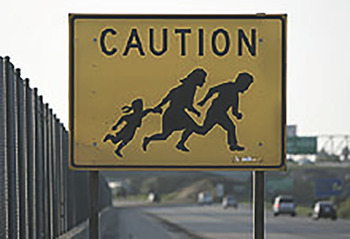
In addition to using the freeway as the commuters do, populations including the homeless, who settle below and atop the freeway, and migrants, who cross the freeway laterally by foot, point to the numerous ways in which the freeway space is used and misused. The popular freeway sign prevalent in southern California depicting a migrant nuclear family fleeing under a “Caution” sign, for example, illustrates how characters like Rafaela, Bobby, and Arcangel contest the proper modes of passage and routes of and transportation on the freeway (Figure 1).Footnote 21 Finally, the narcotraffickers illegally transporting both drugs and human organs across nation-states by land utilize the freeway in upsetting and unsettling ways. The homeless, the migrants, and the narcotraffickers in Tropic of Orange are imagined to be integral in unmaking the state, and their misuse or inappropriate occupation of the space of the freeway – itself a metonym for the economic growth, securitization, and increased powers of the state – is indicative of the danger they pose.
Freeway sign warning drivers about potential border crossers.

Thus the unlawful occupation and improper use of the freeway is at the heart of Tropic of Orange. In the epigraph, Yamashita cites Octavia Butler's Parable of the Sower:
It's against the law in California to walk on the freeways, but the law is archaic. Everyone who walks walks on the freeways sooner or later. Freeways provide the most direct routes between cities and parts of cities … Some prostitutes and peddlers of food, water, and other necessities live along the freeways in sheds or shacks or in the open air. Beggars, thieves, and murderers live here, too … the freeway crowd is a heterogeneous mass – black and white, Asian and Latin, whole families are on the move with babies on backs or perched atop loads in carts, wagons, or bicycle baskets, sometimes along with an old or handicapped person … many were armed with sheathed knives, rifles, and, of course, visible holstered handguns. The occasional passing cop paid no attention … People get killed on freeways all the time.Footnote 22
This excerpt helps to dramatize Yamashita's interest in the interplay between movement (“everyone who walks walks” and the “families on the move”) and stasis (the prostitutes and peddlers living on the freeway); between public space of the freeway and the private lives of persons living there; and between the mundane persons and transactions aboard the freeway (“families … with babies on their backs”) and their alternative (the “beggars, thieves, and murderers” who beg and thieve from, and who murder, others on the freeway). The freeway is the site of a vibrant social and political economic environment, Yamashita seems to underscore, though not in the ways in which we currently understand it to be. Rather, in staging the complex communities created below and atop the freeway in the form of persons walking, living, and transacting on the freeway in forms that differ from the atomized ways in which persons usually use the freeway, Yamashita represents the freeway as a generative site through which to understand how communities withstand and resist the state.
Yamashita, at least initially, seems to use the figure of the migrant crossing the freeways by foot to underscore his/her role in both testing and transforming hemispheric geopolitics. Rafaela and Arcangel, and other Latinx immigrant figures, cross the freeway by foot in ways that unsettle the freeway as solely an avenue of efficient transportation and commerce. Moreover, these characters traverse the space of the freeway in ways that underscore the topic of migration as a key feature of the novel: Rafaela and Sol cross the freeway laterally by foot almost daily while living in Gabriel's house in Mazatlán, Mexico, and also find themselves doing so once they are in the US in an attempt to escape the murderous narcotraffickers. The presence of migrants moving across the freeway laterally both disrupts the prescribed forms and directions of movement and transportation, and also threatens to interrupt the efficient transportation of goods across the hemisphere. This echoes Ávila's work on freeways: he writes, “Chicanos and Chicanas used the freeway to construct a discourse of resistance to its imposition upon their world, and in doing so, defied the intended meanings of city engineers, public officials, and cultural impresarios.”Footnote 23 Indeed, this movement highlights the indeterminate position of a population whose labor is wanted, but whose physical presence is not. Arcangel, a figure who migrates freely across the hemisphere without any regard for national borders or linear temporality, clearly enacts new modes of utilizing the space of the freeway. In addition to being a personification of the global South, Arcangel also represents the long history of Latinx migration (both documented and undocumented) to the US. After all, Arcangel is a man who has been traveling for “five hundred years,” and who by the novel's conclusion is transformed into the wrestling superhero, “El Gran Mojado” (the Great Wetback) staged to fight “SUPERNAFTA.”Footnote 24 His prophetic revelations depict migrants “like a great flood” taking over the freeways.Footnote 25 Arcangel's position as a migrant read alongside his prophecies of the great flood of mojados, or undocumented migrants, entering the US intersects with the unequal exchanges taking place between global North and South. By deliberately pitting the unlawful migration of Latinos (“El Gran Mojado”) against free-trade policies (“SUPERNAFTA”) in the concluding fight, Yamashita seemingly stages the immigrants taking to the freeways as a precursor to the creation of not just new and revolutionary communities.
In this view, Arcangel is not only the very embodiment of the paradox of free trade whereby the unlawful immigrant is cast as the byproduct of free-trade policies such as NAFTA, but also an embodiment of the very instrument poised to battle this system. The increasingly overwhelming number of people walking down the freeway shoulder, all calling for the defeat of SUPERNAFTA by El Gran Mojado, very clearly displays the presence and power of the undocumented migrant, and also demonstrates the defeat of free-trade policies by a population otherwise considered to be powerless. Indeed, as Arcangel crosses the border, so too do “pesos and dollars and reals” float effortlessly across this boundary – “a graceful movement of free capital, at least 45 billion dollars of it, carried across by hidden and cheap labor. Hundreds of thousands of the unemployed surged forward – the blessings of monetary devaluations.”Footnote 26 Most significantly, one of the consequences of the migrants moving atop the freeway is to also make visible those persons left out of US political economic narratives. So impactful is the migrant's economic contribution that they wipe out “those nasty international trade deficits.”Footnote 27 Thus Yamashita depicts the otherwise overlooked migrant population as the most valuable “goods” being transported across the hemisphere, even as their migration is highly restricted or impermissible.
However, Yamashita tempers any readerly tendency to look at migration too idealistically by framing unfettered migration as an extension of the free-trade policies critiqued throughout the novel. The migrant is consistently represented as a politically charged figure that both participates in and resists the commercial liberalism that typically characterizes the political economic climate in which the novel is set. After all, the “immigrant” figures in the novel are as representative of the American dream, figures of upward mobility, and social and economic aspiration (i.e. Rafaela and Bobby), as they are characters that threaten to unmake the nation-state precisely through the commercial mobility made possible by the freeway (i.e. the narcotraffickers).
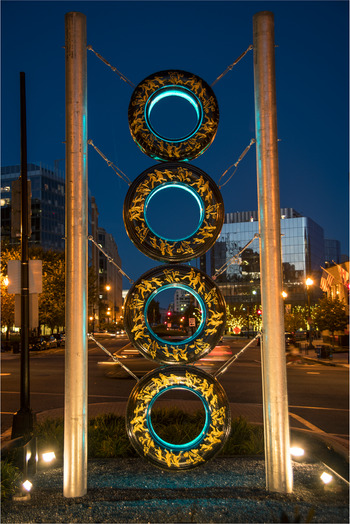
This Manichean approach to migrants as both resistors to and participants in the commercial liberalism made possible by the freeway system extends beyond the frame of the novel. The recent sculptural installation by Mexico City-based sculptor Betsabeé Romero titled Signals of a Long Road Together (2019) demonstrates the close ties between the road and the migrant. Erected in the medians of busy New York Avenue in Washington, DC, Romero creates her work by carving and painting truck tires as a means of speaking to the phenomenon of human migration. Indeed, one of these sculptures consists of four tires erected atop each other each engraved with the image of the fleeing migrant family mentioned above, and repeated to form a circle following the shape of the wheel (Figure 2).Footnote 28 Reviews of Romero's work highlight the important place of roads, automobiles, and tires in both depicting and critiquing migration, upward mobility, and even the “American Dream.” In a 2010 review, for example, Edward M. Gomez writes, “for Romero, cars, especially Volkswagen Beetles, symbolize dreams of a better life – perhaps on the other side of the border, in ‘Gringolandia.’”Footnote 29 Indeed, her use of the tire, paired with the evocative position of “Signals of a Long Road Together” in the medians of a busy DC street, is meant to evoke migration as much as it is meant to conjure images of trade, excess, and waste.
Betsabeé Romero, Signals of a Long Road Together (2019)

I turn to this recent installation to demonstrate how even as progressive artists and writers turn to roads as a symbol of critique when traversed by migrants, they also, perhaps inadvertently, reinscribe the ways in which representations of migration coincide with commercial liberalism and free trade. Romero's installation, for example, quite literally inscribes the tires with gilded engravings of the fleeing migrant family. Paired with its curious position on a busy avenue in the nation's capital, a capital that has produced some of the harshest immigration policies in recent history, these gilded tires do not solely serve as a critique of free trade and restrictions on immigration. Instead, they seem to suggest that, to some degree, the migrant is also participating and embedded in problematic narratives about the interrelationship between neoliberal trade and social, political, and economic mobility. The pattern of golden migrants on the tire is interspersed with gilded flowers, further suggesting that these tires do not function as a critique of free trade as much as they serve as representations of its promise (Figure 3).Footnote 30 After all, it is the gilded immigrant figure that stands apart from the opaque, black rubber of the tire as if to suggest immigrant success despite the bleak routes of their migration. That these tires have been placed in the shadows of the Inter-American Development Bank and the Hoover Institution seems to be either a tragic misstep or humorous, albeit pointed, critique of the policies that emerge from the offices around them. Regardless, the installation's placement seems to suggest that it cannot be disembedded from the promises of private enterprise and personal freedom that have negatively affected the global South, and that have resulted in twentieth-century patterns of Latin American migration to the US. I offer this brief “detour” into the work of one contemporary artist in order to demonstrate the numerous ways in which to interpret different forms of movement and migration across the hemisphere, especially in light of the complicated ways in which migration is sometimes complicit with social, political, and economic mobility and advancement, national development, and transnational exchange.
Romero, Signals of a Long Road Together, detail.

While some migrant figures, Arcangel, for example, seem to offer an exception to understanding the migrant through this lens, Tropic of Orange is ultimately less cheery about this possibility. After all, Arcangel tugs a stalled commercial truck along the freeway using his body, while his body is literally consumed by his fight with SUPERNAFTA. That is to say, Arcangel does not exist outside the troubling transnational networks of exchange presented throughout the novel. Instead, it would seem that Arcangel is quite literally embedded in these networks of exchange. More disturbingly, as mentioned above, Arcangel's migration across the border signals the movement of “free capital,” concealed within and indistinguishable from the migrant's body.Footnote 31
To further emphasize this point, Yamashita turns to the narcotrafficker as a figure that personifies economic liberalism even as his presence threatens the very foundations of civil society. Narcotrafficking is represented as the perverse fulfillment of a truly free trade, which in turn recasts narcotrafficking as just one more practice associated with NAFTA. As a figure named Rodriguez notes upon meeting Arcangel,
It all goes north to the gringos. If they want it so much, why don't they plant it in their own backyards? Make it in their own factories? … How many people run along this road. Every hand is greased. My first son. Such a fool. Such a big shot. He used to carry a gun and fly a plane. He used to bring things: hard liquor, cigarettes, perfumes. I made him take it all away. It was only a matter of time. They shot him in the head through the window of his car. He used to brag to me, “Drugs,” he said, “have come to kill our poverty and marry our politics. It's a very powerful marriage. Join the honeymoon while it lasts.” My first son was not a bad boy; he was only foolish – another stupid hero of a narco-corrido.Footnote 32
Rodriguez's statement does more than simply rehash the ways that narcotrafficking is perhaps the logical extension of a truly free trade. Rather, he captures the interdependence of free trade and narcotrafficking by underscoring that the flow of drugs from global South to North is nothing more than the product of the union, or marriage, between the global South and North. In echoing the language of the unequal exchanges between global North and South that result in undocumented migration, Yamashita proposes that the narcotrafficker and the figure of the undocumented migrant in the novel occupy a similar position in the racial, economic, and political imaginary of the United States. Perhaps more provocatively, the terroristic narcotrafficker is an extension of the undocumented migrant flooding the freeways in Arcangel's prophetic visions. After all, the narcotrafficker is always cast as a Latinx immigrant. Trump's recent obsession with excluding persons ranging from the amorphous “bad hombres,” members of MS-13, and Central American refugees seeking asylum in the US, as well as narcotraffickers, points to the collapsing of a range of different persons into the category of the “terrorist.”
Indeed, the architecture for this equivalence was laid out in the aftermath of 9/11. This is reflected in legislation regarding this criminal behavior, which has called for narcotrafficking to be regarded as terroristic. In 2011, for example, following a rash of particularly violent and gruesome events on the US side of the US–Mexico border, Texas Congressman Michael McCaul, took aim at the Arellano Félix organization; Los Zetas; La Familia Michoacana; and the Beltrán, Sinaloa, Juárez and Gulf cartels in order to try to curb the violence resulting from narcotrafficking.Footnote 33 Under McCaul's proposed bill, the government would have been permitted to freeze any funds found to be tied to these organizations and would have enhanced the criminal penalties for those found aiding the cartels under the US Patriot Act. McCaul is quoted as using the definition of terrorism under federal law – “to intimidate a civilian population or a government by assassination or kidnappings” – to make a case that cartels were terrorist organizations.Footnote 34 Thus the proposed bill would have used the Act to reclassify narcotrafficking as a terroristic act because McCaul's bill would have criminalized engagement in narcotrafficking not as a crime in the American criminal-justice system, but rather as a behavior that threatens the very integrity of the American state.Footnote 35 In using the Patriot Act to argue for the extrajudicial use of force against the narcotrafficker, McCaul links the narcotrafficker to the modern-day terrorist. The equivalence of immigration and the state-upsetting acts of terror (read: the narcotrafficking, as well as the unlawful occupation of the freeway) in Tropic of Orange helps to uncover the numerous ways in which the language of exceptional violence is refracted into anxieties about the migration of certain unlawful goods (drugs) and dangerous persons (migrants and narcotraffickers). It is no surprise that Mazatlán, Sinaloa, where Rafaela tends to Gabriel's house, is home to the Zetas, one of Mexico's largest and most violent drug cartels, a group responsible for some of the most horrifying massacres and attacks on civilians we have seen represented in the news in recent years. This is why I propose that Yamashita imagines a more just world that exceeds the transnational movement of persons across and in defiance of national borders, especially because these transnational movements evoke the free-trade policies that are partly to blame for the unequal development of global South and North.
However, in the next and final section, I will turn my attention to the homeless who inhabit the freeways after its destruction due to the drug-saturated oranges. I end with homeless occupation of the freeway because it is not immediately recognizable as the most destabilizing and unsettling behavior in the text. The presence of Manzanar, a homeless Japanese American doctor named after an internment camp, alongside the hundreds of homeless persons in the novel who take to the freeway, underscores the danger posed by this population to the freeway as a site of governmentality and population management; as a throughway for commerce, mercantilism, and globalized trade; and as a location at the heart of anxieties regarding sovereignty and securitization. As I show, homeless occupation of the freeway must be understood within the context of the aforementioned equivalence of migration, narcotrafficking, and terrorism, reasons why the encampment must be so violently destroyed by the novel's denouement. And yet the homeless occupation of the freeway operates in a much different register than migration and narcotrafficking in part because the homeless encampment relies on stasis, not movement, as its primary mode of critique.
FREEWAY ENCAMPMENTS AND YAMASHITA'S UTOPIA
The homeless in Tropic of Orange take advantage of the stalled cars and abandoned trucks atop these arteries of transportation in order to create a new social, political, and economic system that threatens to spill outward to spaces outside the freeway. Indeed, this population is most interesting to me because in using the freeway in yet one more unconventional way, the homeless encampment is the most significant expression of what Yamashita imagines as an alternative, or different, world than the one in which we live. The vulnerable homeless, represented in characters to include Buzzworm and Manzanar among the other figures inhabiting the abandoned vehicles, eschew the presumed promises of open borders and migration as the only avenue for social betterment. Rather, in the face of the dangerous restrictions imposed by nation-states on travel and transportation across its borders, it is this radical inhabitation of a public space with a viable political economic system that relies on recycling, repurposing, and barter, as opposed to multinational trade, private property, and the privatization of public life, that most clearly represents a truly radical break from the world represented in the text. Indeed, Yamashita's representation of the homeless encampment atop the freeway is the event that most clearly demonstrates the speculative and science-fictional quality of Tropic of Orange.
The homeless are taken up as a population critical of the creation of a new social order in the wake of the collapse of the infrastructure of the freeway. Buzzworm best describes the scene:
people living in abandoned luxury cars, creating a community out of a traffic jam. There's already names to the lanes, like streets! South Fast Lane and North Fast Lane. Limousine Way – that's the off-ramp at Fifth. There's dealing down here! There's a truck could be a Seven Eleven. Got everything – beers, Cokes, even nuke you a burrito.Footnote 36
This scene is remarkable for several reasons: first, this moment illustrates the undoing of the equivalence between property and person. While Buzzworm lists numerous items (the beers, Cokes, and burritos) that are representative of the very globalized trade that the novel interrogates, Buzzworm's focus is not on the communities created through the purchase and consumption of said items. Rather, Buzzworm's observation underscores the oddity of settling, or inhabiting, the freeway as one would do a home. This is perhaps most clearly emphasized in the unsettling presence of goods for private consumption in a public infrastructure of the state. Indeed, the beers, Cokes, and burritos connote a form of subsistence that is closely associated with the privately owned home, and not the public space of the freeway. Said differently, the divide between public and private is rendered meaningless at the moment the freeway becomes indistinguishable from the home. And yet the homeless encampment is a public settlement: it is neither the uninhabited and uninhabitable freeway, nor is it the bounded, privately owned home.
What is also remarkable about the scene is that sections of the freeway, the lanes, are named as though they were streets, signaling the complete transformation of the infrastructure of the state into a site of public settlement. And so, in Buzzworm's estimation, this society is not a replication of the problematic networks already in place, but rather something new. This novelty is best expressed in the speculative and contingent language used to describe these settlements. After all, the truck “could be” a Seven Eleven and the freeways have names “like” streets, a figurative relationship that, although approximate to the extant social, political, and economic environment, is not quite the same. This speculative approximation, and not replication, of an extant social order is how Yamashita dramatizes her critique. Indeed, in the novel this act of resemblance functions as yet another form of double-crossing, of interrupting the routes of meaning. This is reflected in Gabriel's summative observation of the homeless freeway encampment, “Looks like transportation got crossed,” to which Buzzworm responds by saying, “Looks like. Maybe even some DOUBLE-crossing.”Footnote 37 And so, I ask, what does it mean for Buzzworm to observe that transportation is crossed not once, but twice? Given the chaos occasioned by narcotrafficking, the “dealing down there” to which Buzzworm refers might allude to the “dealing” of drugs, as much as it might refer to the legitimate forms of exchange now taking place on the freeway, and not the marketplace. The double-crossings in the text also speak to the lateral and vertical crossings taking place throughout the novel. Moreover, as I have suggested, to double-cross (to betray, to thieve, to engage in a type of criminal behavior) is also to cross words, to create new meaning.
Indeed, this reappropriation of the infrastructures of the state for the purpose of creating informal and shadow economic and social configurations lends another meaning to double-crossing: that is, the complex informal economy thriving atop the freeway. That is to say that the representation of the homeless occupation of the freeway is radical precisely because it must be read alongside the presence of unlawful migrants and illegal aliens, and narcotraffickers in the novel, populations that are framed as participating in shadow or informal economies and creating new community formations. After all, the clandestine transactions taking place atop the freeway are “like” those that take place at legitimate retail spaces, though not the same. Instead, the transactions taking place on the freeway exist in the shadows of lawful exchanges having been stained by the illegitimate and illegal occupation of the cars and the freeway by the homeless. By using this lens, the freeway is recast from being a conduit for the facilitation of globalized trade, into a rather messy space where unlawful behaviors that contest the powers of the state are able to thrive. For this reason, the threat of the homeless living atop the freeway is inflected by discourses of migration and narcotrafficking.
Thus Tropic of Orange locates the homeless persons of Los Angeles at the center of the revolutionary society that supersedes and replaces the one destroyed by the circulation of drugs. They are the most upsetting double-crossers in the novel. Indeed, it is the occupation of the public property of the freeway by the dispossessed homeless person that seems unsettle the very foundations of the state. Indeed, the title of this article borrows from Tropic of Orange's first chapter, which ends with the fateful orange (and the Tropic of Cancer contained within it) falling from a tree “just beyond the frontiers of Gabriel's property to a neutral place between ownership and the highway.”Footnote 38 This quote is evocative in that it captures the promising and unsettling position of both the oranges and the homeless persons figured prominently in the novel. They are positioned between private and public domains and spaces, and this indeterminacy is precisely what makes these populations exceptionally vulnerable. As Manzanar notes, there is an “utterly violent assumption underlying everything: that the homeless were expendable, that citizens had a right to protect their property with firearms.”Footnote 39 Manzanar's statement reveals the oppositional position that he imagines for the citizen and the homeless person: one is imbued with rights and protections, while the other is dispossessed of them. Given that Manzanar, a Japanese American homeless occupier of the freeway overpass and a character named after a Japanese internment camp, is meant to point to the history of the dispossession of Japanese immigrants and Japanese American citizens, his observation about the “expendability of the homeless” is also an expression of the close relationship between the property of the home and the property of life. The case of Jones v. City of Los Angeles (2003), for example, which centered on a group of six plaintiffs who filed suit after being deprived of their property repeatedly as a result of the desire of Los Angeles to revitalize Skid Row by dislodging its homeless occupants, highlights the degree to which the homeless have been deprived of the rights to property and its protections. Ultimately, the city of Los Angeles lost this case on the basis of a “violation of the Eighth Amendment's prohibition against cruel and unusual punishment,” to mean the cruel and unusual punishment of being repeatedly dispossessed and dislocated by the LAPD.Footnote 40 And yet “police sweeps of homeless encampments have led at least one commentator to argue that the fourth amendment right to be free from unreasonable searches and seizures is implicated by these sweeps.”Footnote 41 In citing these examples, I want to underscore the legal difficulty of protecting homeless property in part because it has always been difficult to define the bounds or the terrain of the homeless. It would seem that the homeless are not entitled to certain protections of property because their property is on public land.
It is precisely because the homeless upset the tensions between public and private spaces and properties that they represent the formation of an alternative, utopic community in Tropic of Orange. By dramatizing the ways in which private property is made public and in which public property can be used for the creation of a more just system, Tropic of Orange demonstrates how new worlds can be formed through homeless double-crossings in particular. In retooling the private good of the car into public housing atop the freeway, homeless persons who are otherwise relegated to the underbelly of the freeway make themselves visible publicly. The homeless upset the distinctions between public and private space and property in ways that upset the extant systems in place. More significantly, they invert the use of public and private property, and transform the infrastructure of the freeway into a space beneficial to the public. As Manzanar notes,
even he, who knew the dense hidden community living on the no-man's-land of public property, was surprised by the numbers of people who descended the slopes. Men, women, and children, their dogs and even cats, bedding, caches of cans and bottles in great green garbage sacks and shopping carts moved into public view … A commissary truck opened for business, as did a recycling truck. A moving van was emptied of its contents: washing machines, refrigerators, ovens, chairs, tables, sofas, beds, carpets, barbecue pits, lawn mowers, etc. Watermelons, bananas, and cantaloupes were hauled off one truck, as were Wonder Bread, Cacique tortillas, and Trader Joe's fresh pasta.Footnote 42
“Wonder Bread, Cacique tortillas, and Trader Joe's fresh pasta” point to yet another “double-crossing.” By transforming the no-man's-land of the freeway into a habitable space, the freeway is transformed into a site of public exchange and community formation. The outcomes of the homeless occupation are exciting and revolutionary. As the narrator observes,
Little by little, Manzanar began to sense a new kind of grid, this one defined not by inanimate structures or other living things, but by himself and others like him. He found himself at the heart of an expanding symphony of which he was not the only conductor. On a distant overpass, he could make out the off mirror of his figure, waving a baton. And beyond that, another homeless person had also taken up the baton. And across the city on overpasses and street corners, from balconies and park benches, people held branches and pencils, toothbrushes and carrot sticks, and conducted. Strange and wonderful elements had been added as well … And of course the movement of traffic had almost altogether stopped, not only in the freeway valley below but virtually everywhere.Footnote 43
As Manzanar's prophetic vision begins to reveal, the homeless begin to occupy all scales of space, from the freeways and overpasses, to the sonic space that transcends the physical, spatial boundaries of the freeway. Indeed, Manzanar's jams do not simply expand across the entire city of Los Angeles, but the revolutionary ethos of these jams spreads across populations to include the homeless, as well as the housed. The replication or infinite reflection of Manzanar across the city of Los Angeles results in the city being at a standstill and the cessation of all movement and commerce. I find this moment particularly evocative of the stakes of the homeless occupation of the freeway in the novel: that is, it bleeds into all aspects of city life, and all its inhabitants. Homelessness, as a mode of critique and repudiation of the promises of property and citizenship, is not limited to the homeless in the novel. The rapid spread of the cocaine contamination, and the even faster replication of the homeless and their jams, threaten to dissolve civil society itself. That the traffic gridlocks become novel social and political networks is perhaps why Yamashita's depiction of the homeless living on the freeway is both so unsettling and so rife with potential for imagining worlds better than our own.
RIOTS, REVOLT, AND THE AMERICAN ROAD
As I hope to have underscored, in this treatment of the homeless populations represented in Tropic of Orange – figures that exist alongside the migrants and narcotraffickers also featured in the novel – we come to find that the space of the freeway has a range of meanings in the twentieth and twenty-first centuries, the most significant of which is that it represents both the destruction and the creation of communities. While it is certainly a space that represents economic liberalism and is therefore in part responsible for our impression of the features of the homo economicus, and the individual private property owner, it is also a public space, as well as a space of resistance. The reorganization of territories of exchange, the double-crossings taking place at various stages of the text, complicate visions of identities rooted in abstract visions of racial and/or ethnic heterogeneity, and instead make visible the importance of contesting the exclusive structures of the US nation-state through a range of different behaviors. The characters in Tropic of Orange navigate the freeway in unfamiliar ways in order to test and contest the powers of the state. In so doing, they also create new modes of belonging in the face of marginalization or erasure. More importantly, they demand recognition. And so, by living atop the freeway, the homeless populations in the novel participate in social, political, and economic behaviors that unsettle the worlds we know, and help to create new ones. In sum, the freeway is a site for world-making.
Yamashita's novel is not alone in using the freeway as a significant site of community formation in this period. Héctor Tobar's The Tattooed Soldier, for example, which dramatizes a homeless Guatemalan immigrant's vengeance for the murder of his wife and child at the hands of a member of the National Police during the Civil War, ends with Antonio taking to the streets and freeways in Los Angeles during the LA riots. This moment, which satiates both Antonio's and the reader's demand for redress against the unjust and brutal murder of his wife and son, is punctuated with an outpouring of Latinos to the streets, persons both looting and protecting property, as a signal of their discontentment with the unrealized demands for equality. This moment echoes closely the freeway takeover imagined by Yamashita. The looters Antonio initially sees on the city streets, which seemingly disrupt the regimes of lawful ownership and test the powers of the state in managing its citizenry, give way to representations of persons taking to the streets as an expression of solidarity against unjust abuses by the state. This culminating demand for recognition and redress in The Tattooed Soldier is, of course, the LA riots of 1992.
Perhaps this is why the spectre of the LA uprisings in the aftermath of the acquittal of the four LAPD officers who beat and battered Rodney King lingers in the background of Tropic of Orange as well. Indeed, it would seem that this novel imagines a world where the standstill of LA life that occurred in the days following the officers’ acquittal is expanded both in time and in space. Aggrieved, angry, and distressed by the repeated acts of violence by the LAPD on black and brown persons, the rioters and demonstrators occupied public space and destroyed private property. They did so not only to raise awareness, but also as a public expression of frustration and anger. Thus the riots are indicative, or expressions, of desires for a different world, and acts of destruction are expressions of demand for change and for redress. In sum, the uprisings and the stalled commerce that occurred in the days of the LA riots perhaps briefly signaled the creation of a new world, as well as the destruction of the old. Indeed, this is in part the logic of recent Black Lives Matter protesters who have taken to occupying freeways and interstates in an effort to make visible the demands for redress against racialized violence against black bodies through the interruption of the freeways as conduits of travel and trade. Given the tensions I am attempting to highlight between transnational trade and the forms of protest that upset the movement of goods on roads and freeways, it is devastatingly unsurprising that a tanker truck carrying fuel barreled through a group of demonstrators protesting the murder of George Floyd on the I-35W bridge in Minneapolis.Footnote 44 This moment represents the perceived tensions between globalized trade and social movements attempting to upset extant racial, social, and political orders by interrupting public routes of transit and trade. The symbol of the tanker truck, metonymy for the freeway and for mercantilist free trade by extension, therefore seemingly continues to exist in direct and violent opposition to the social movements attempting to upend the state.
Yamashita's Tropic of Orange is a text adept at dramatizing how the freeway system, at the heart of LA's commercial life, can instead be a place where new communities are formed, and not simply destroyed. It is the homeless who “surface” as a population that can most powerfully and virulently critique the extant political, economic, and social systems. Having been left out these systems and having been dispossessed of a range of properties integral to the creation of the American citizen, the homeless occupation of the freeway system generates new networks and communities. Indeed, this is why Yamashita's homeless encampment is destroyed in the final moments of the text. The upending of the distinctions between private property and public land represented in the novel is precisely what recasts the vulnerable and dispossessed homeless population as unnerving, threatening, and the potential source of dissolution of the nation-state. The presence of the whirring helicopters and the apocalyptic destruction of the encampments are precisely the actions that mark the homeless as enemies of the state.