English language policies in Tanzania
Tanzania is, like most countries in East Africa, extremely culturally and linguistically diverse. Language counts range from 125 (Lewis, Simons & Fennig, Reference Lewis, Simons and Fennig2016) to 164 living languages mentioned by the ‘Languages of Tanzania project’ (2009). Given this extreme multilingualism, institutional languages had to be chosen on a national level after independence. Kiswahili is the proclaimed national language and lingua franca of the East African region, also spoken in Kenya, Uganda and the Democratic Republic of Congo, for instance, and is used as medium of instruction (MoI) in primary education. English, the former colonial language, is the de facto national working language and medium of instruction in secondary and higher education. However, English remains a minority language, spoken by approximately 5% of the population, most of whom are members of a higher social class (Tibategeza, Reference Tibategeza2010). This leads to English being an international rather than a second language as in other former British colonies (Schmied, Reference Schmied1990, Reference Schmied1991). Rubanza (Reference Rubanza and Prah2002: 45) goes so far as to argue that ‘the society Tanzanians work and live in does not demand the use of English’. That is why it has been claimed that English will never replace the African languages in Tanzania but remain an additional language in certain spheres (Schmied, Reference Schmied1991).
Especially in education, English remained strong even after the independence of Tanganyika in 1961 and is still an object of desire rather than an unpopular ex-colonial language. In the last study on attitudes towards English about 25 years ago, these were reported to be positive (Schmied, Reference Schmied1990, Reference Schmied1991) with English being a sign of modernity, success and upward mobility. Ochieng (Reference Ochieng2015: 26) refers to this as a ‘love attitude’ towards English. In education, language usage was regulated by the Education and Training Policy of 1995 in the past 20 years. Researchers and government-commissioned studies advocated against using English, a foreign language for students and teachers alike, as MoI, given that it impairs learning outcomes (Qorro, Reference Qorro2002, Brock-Utne & Holmarsdottir, Reference Brock-Utne and Holmarsdottir2004), and code-switching in the classroom is frequent (Tibategeza, Reference Tibategeza2010). However, the government largely ignored the results of these studies and maintained English as MoI. This is similar to other African countries, where African languages have for the most part been ignored in educational settings (Tibategeza, Reference Tibategeza2010) and the choice of English as MoI is informed by the interests of the elite (Kamwangamalu, Reference Kamwangamalu2013). Moreover, three changes of government since 1990 and a change in socio-economic policy from socialism to liberalism have affected educational policies in Tanzania. In 2014, Tanzania promulgated a new Education and Training Policy, which is evasive and contradictory in that it maintains that ‘the national Kiswahili language shall be used in teaching and learning at all levels of education and training’ (statement 3.2.19), while at the same time suggesting that ‘the Government shall continue strengthening the use of the English language in teaching and learning at all levels of education and training’ (statement 3.2.20).
Against this backdrop, the aim of this article is to explore a) actual present-day language usage patterns in Tanzania and b) attitudes towards English in education. Our study is the first survey on language attitudes after the 2014 policy change. The findings reported here shed light on the possible future of English in the country and the challenges of developing African languages besides English in official spheres.
A recent study of attitudes towards English in Tanzania
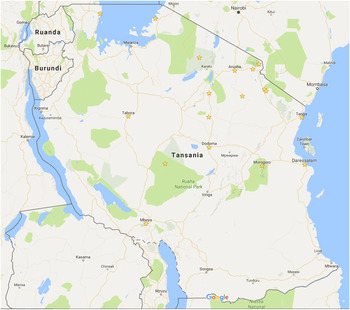
Our set of data was collected in June 2016 at the Open University of Tanzania (Arusha campus). A questionnaire in English consisting of three parts (socio-demographic questions, multiple choice questions on language usageFootnote 1 , and Likert-like rating tasks on language attitudes), modeled after Schmied (Reference Schmied1990, Reference Schmied1991) and including additional questions, was distributed to and returned by 45 participants. Of these, 34 were male, 11 were female, and their mean age was 34 (standard deviation [SD] = 9.7). For 5 of the participants the highest level of education was high school, 18 had completed college and 22 university. The participants worked in a variety of jobs, among them bank officer, computer technician, entrepreneur/business (wo)man, farmer, librarian, different kinds of office staff, police officer, sales manager, teacher, tour guide; one was still a student and two were unemployed. The average number of years of education in English was 12.5 (SD = 5.0).Footnote 2 While all participants lived in and around Arusha at the time of the study, they were originally from all over Tanzania, as is shown in Figure 1.
Places of origin of the informants (www.google.com/maps)

The mother tongues (assessed in Q13: father's native language and Q14: mother's native language) of the participants were manifold; 23 different languages were identified. Of these, 19 were Bantu languages, two Nilotic, one Cushitic and one Khoe.
Given the different places of origin and native languages of the participants’ parents, the sample can be considered relatively well balanced, i.e. representative for Tanzania. The only issue that has to be kept in mind is that all participants are relatively well educated and that the sample thus over-represents members of the higher social classes of Tanzanian society.
Language usage in everyday life
In the language usage part of the questionnaire, the participants were asked to indicate their home language, which was Kiswahili with an overwhelming majority of 73.3%. 17.8% reported using an indigenous language at home, 8.9% indicated that they use Kiswahili and another language, and only 4.4% claimed to use English and another language at home. Nobody reported using only English as their home language. This shows the dominance of African languages in the private sphere quite clearly.
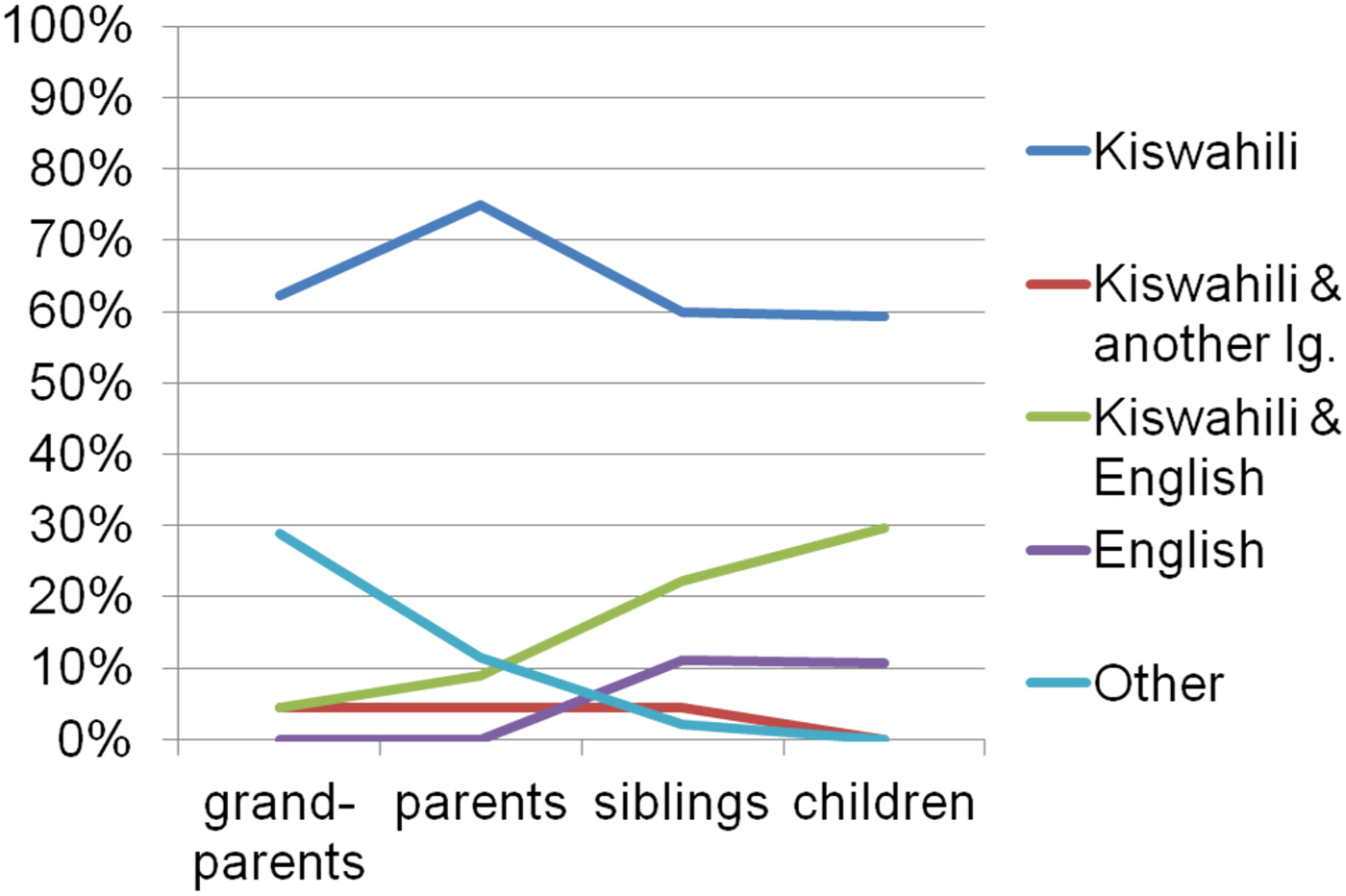
Language usage also turned out to be dependent on the age of a person's interlocutor. Thus, while indigenous languages are mainly used with grandparents and parents, they are hardly ever used with siblings or children. In contrast, English is not used with grandparents and parents, but increasingly with siblings and children (Figure 2).
Q17a-d: Which language do you speak with your grandparents/parents/siblings/children?

The same holds true for the speakers’ age, as indigenous languages are used more the older the speaker is, while English is used more the younger the speaker himself/herself is.
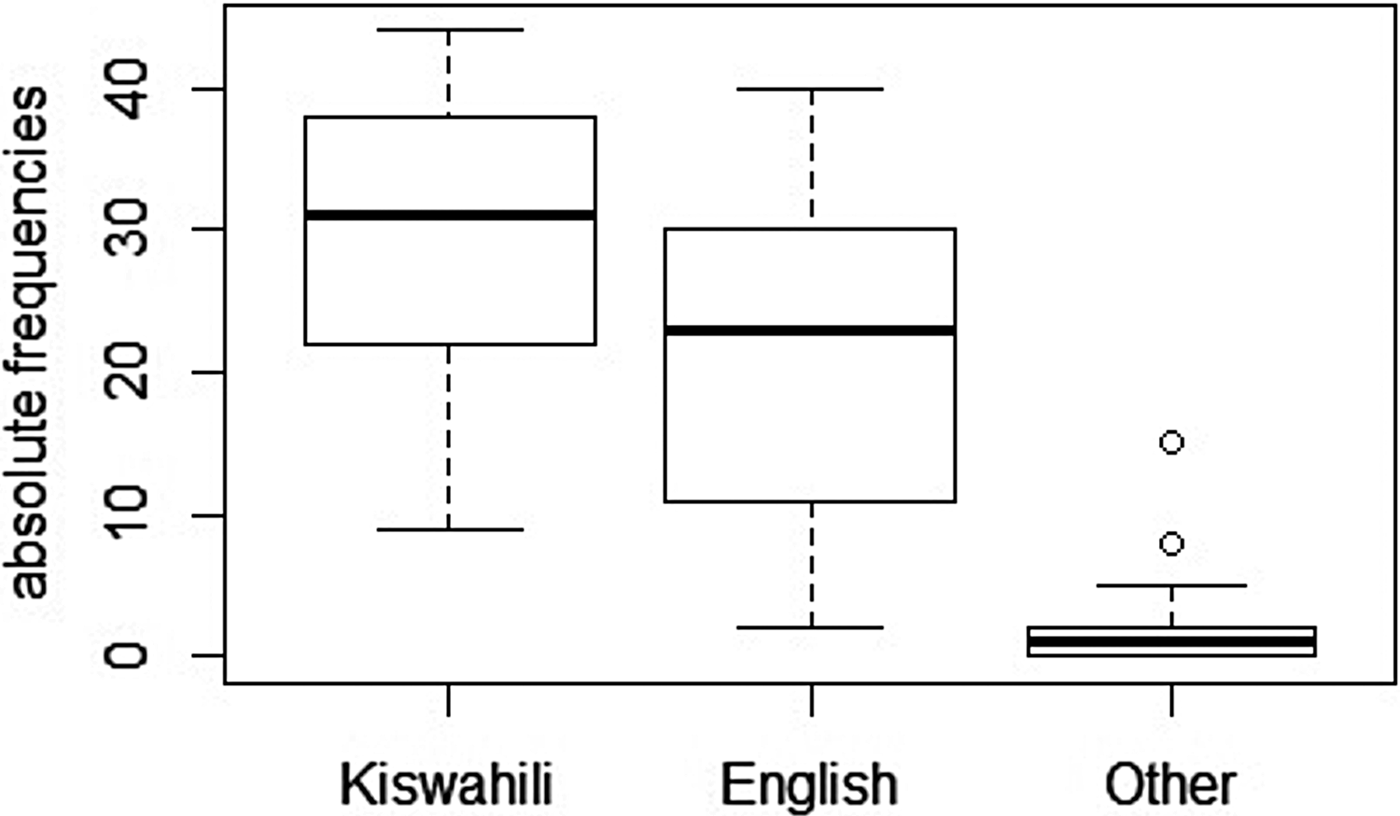
Looking at language usage in terms of the four different domains that were covered by this part of the questionnaire, i.e. spoken productive language such as Q17f: Which language do you use for communication with strangers?, spoken receptive language such as Q17m: Which language do you prefer for listening to the radio?, written productive language such as Q17s: In which language do you usually write personal letters/notes?, and written receptive language such as Q17o: In which language do you usually read for leisure?, Kiswahili turned out to be used more frequently than English, and indigenous languages are used significantly less than both (Figure 3).
Distribution of language usage across all domains

In general, the current research finds that Kiswahili is the most frequently used language. This is in line with claims by Schmied (Reference Schmied1991) that Kiswahili is the national lingua franca in Tanzania in particular, and in many East African countries in general.
Question 18, focusing on English usage in everyday lifeFootnote 3 , showed that the language is used every day in writing by a majority of 65.9% and in reading by a majority of 61.4%. In listening, it is used every day by a majority of 45.4%, which is however a considerably lower percentage than in written language use. In speaking, English is used every day by 30.2% only; most people indicated that they use English ‘often’ in speaking. This shows that English is very much a written language for the participants, and is used much less frequently in spoken form. Given the prevailing methods of English language teaching in the country (e.g. the grammar translation method), this result is not surprising, but it is considerably different from other postcolonial contexts such as Ghana. In Tanzania, many graduates leaving secondary education do not have functional mastery of English (Swilla Reference Swilla2009). Moreover, in the attitude part of the questionnaire, only 53.3%% of the participants agreed with the statement Q19f: The way English was taught at school prepared me for speaking English fluently.
Altogether, this confirms Schmied's (Reference Schmied1991) analysis of Tanzanian English as an additional rather than a second language.
Language usage in education
Turning to education, Kiswahili is the most frequently used language with fellow students (41.9%). However, 32.5% of all participants indicated that they use(d) both Kiswahili and English, 25.6% mentioned English exclusively. Indigenous languages were not used at all, which shows that in educational settings the official languages are very prominent.
Another question concerned code-switching between English and another language in class. Only 2.3% of the participants (N = 1) claimed that their teacher never switched from English into another language in class. All others stated that their teachers did do this, with ‘sometimes’ being the most frequent answer (54.4%). This corroborates the findings of Tibategeza (Reference Tibategeza2010), who reported frequent code-switching in Tanzanian classrooms.
One of the most important questions in terms of attitudes after the introduction of the new Education and Training policy of 2014 was Q17n: Which language would you prefer as medium of instruction for all subjects at school? An overwhelming majority of 76.7% of the participants said that they would favour English, while only 13.9% expressed a preference for Kiswahili, and 7% voted for both English and Kiswahili (Figure 4). Taking up the issue of MoI again in the attitude part of the questionnaire in Q19p: Kiswahili should be used as medium of instruction at all educational levels confirms these results, as only 31.1% of the participants agree with this statement. Further, a majority of 56.8% agree with the statement that ‘Switching to Kiswahili as the medium of instruction would bring down educational standards’ (Q19d).
Q17n: Which language would you prefer as medium of instruction for all subjects at school?

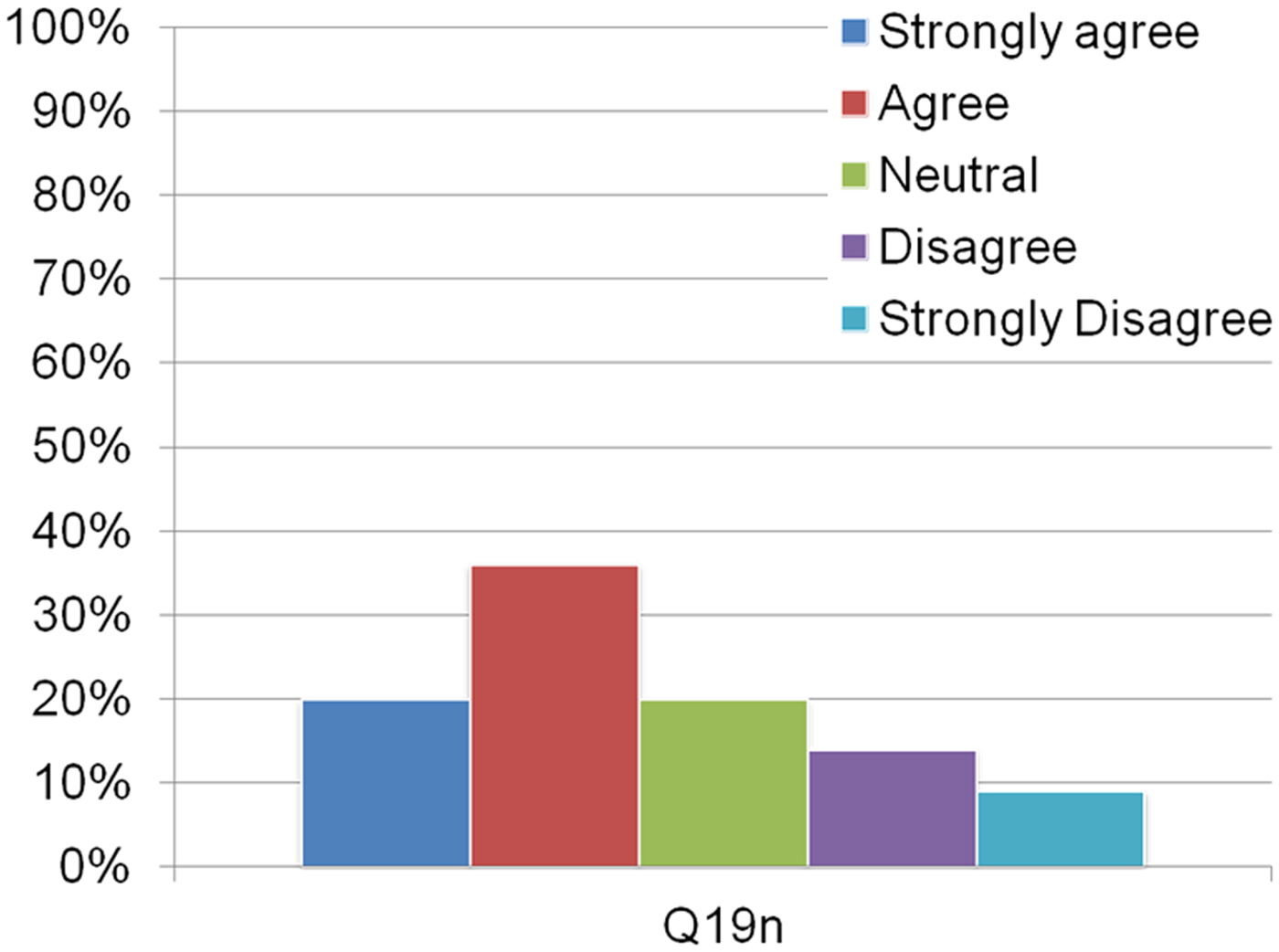
These results are interesting, given that English is used less than Kiswahili in everyday life and given that studies report Tanzanian students to perform poorly when the MoI is English (Qorro, Reference Qorro2002, Brock-Utne & Holmarsdottir, Reference Brock-Utne and Holmarsdottir2004). Further, in the attitude part of the questionnaire, 78% of the participants agreed with the statement that ‘It is easier for students to understand concepts when they are explained in Kiswahili’ (Q19n), which also contradicts the wish to introduce English as MoI at all levels. However, English is perceived as a means of assuring equality among children, as 54.5% of the participants agree that ‘English as medium of instruction means equal chances for all children in their future’ (Q19q). This might not only refer to the national level, but also to chances internationally, as suggested by the answers to Q19b: Only sufficient knowledge of English can keep science and learning in Tanzania in touch with world -wide developments: 77.8% agree with this statement, showing that English is not only seen as an important skill for each individual Tanzanian but also as important for the nation as a whole. Thus, English is very much a sign of modernity (also in terms of modern education) and worldliness, as suggested by Blommaert (Reference Blommaert1990). For most people it might hence be difficult to imagine an indigenous language being used as MoI (cf. Kamwangamalu & Tovares, Reference Kamwangamalu and Tovares2016).
Languages usage and attitudes: linguistic instrumentalism
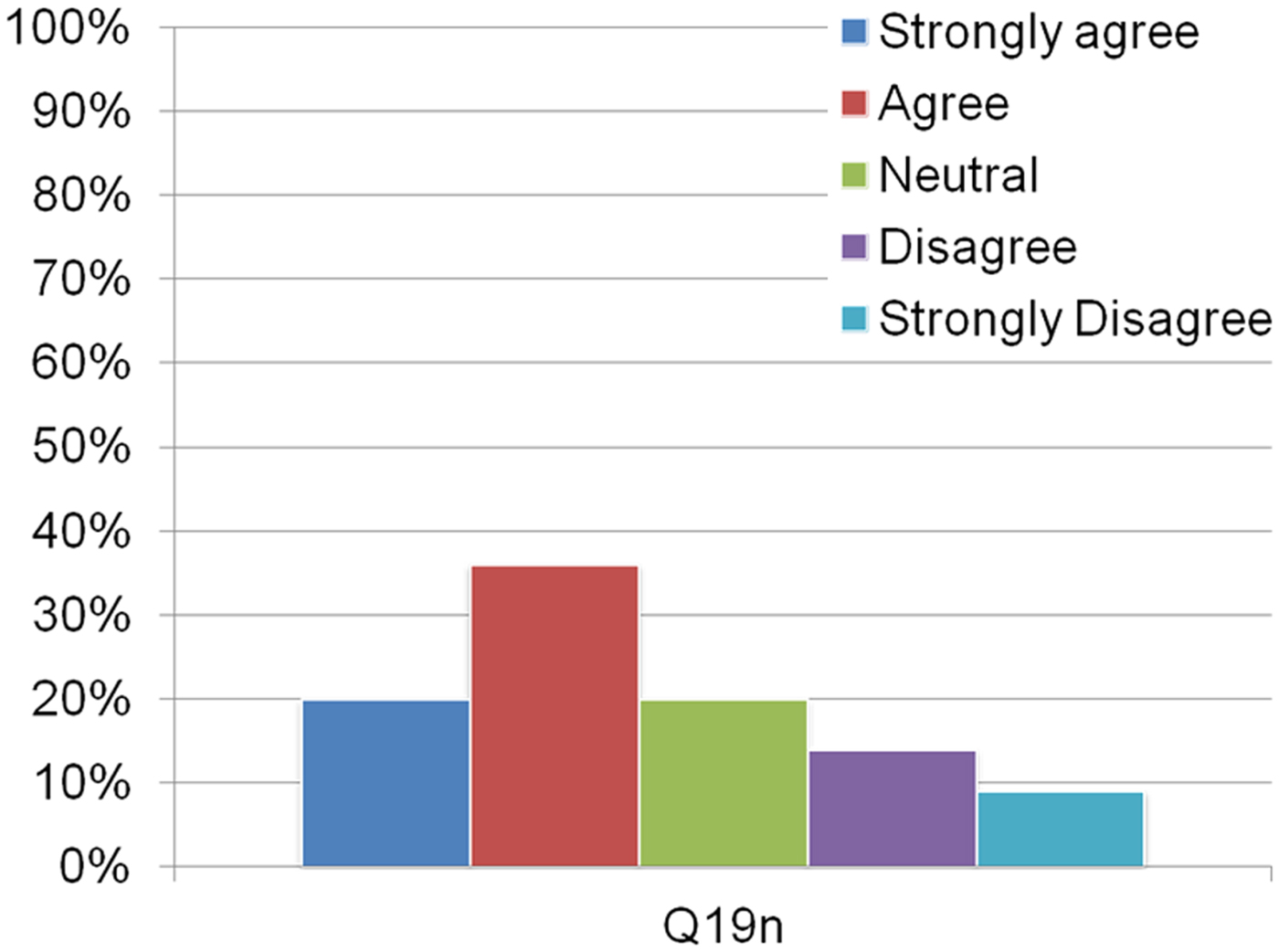
What has been shown here is that English is used infrequently at home, and with/by older people in Tanzania. The language is certainly perceived as socio-economically valuable, as shown by its perceived importance for science and learning and the positive reactions (73.3% agreement) to the statement ‘English is useful for getting a better job’ (Q19c). These show the high instrumental value of the language. Only in the civil services are Kiswahili and African languages preferred over English (Figure 5).
Q19n: For a career in the civil services it is better to use an African language like Kiswahili than English
In the private sphere, Kiswahili is dominant, as is apparent in most respondents reporting that they use it for thinking (Q17j, 75%) and praying (Q17k, 78%). This situation is similar to what Wee (Reference Wee2003) has termed ‘linguistic instrumentalism’, a phenomenon referring to a view of language that justifies its existence in a community in terms of its usefulness in achieving utilitarian goals, like access to economic development. Thus, English is important instrumentally, i.e. for getting a good job and climbing the social ladder, but not for Tanzanians personally. This is further emphasized by 64% of the participants disagreeing with the statement that ‘English is an important part of Tanzanian identity’ (Q19x). This is similar to the situation described by Coetzee-Van Rooy (Reference Coetzee-Van Rooy, Buschfeld, Hoffmann, Huber and Kautzsch2014) for South Africa, who reports that indigenous languages as opposed to English are clearly seen as identity markers. It would be interesting to investigate whether this is a phenomenon common to the African continent as a whole.
Given these results, we also agree with Schmied (Reference Schmied1991) that English will (probably) never replace African languages on the whole, and will remain an additional language in certain spheres in Tanzania. These are clearly official spheres, while privately, English is still hardly ever used.
English and Kiswahili in the Tanzanian educational system: whither hence?
As mentioned by Ochieng (Reference Ochieng2015: 30), ‘neither the advancement of Kiswahili nor its advocacy will subordinate the position of English in Tanzania today’. In terms of social prestige, English occupies the highest position in the country, and people's attitudes, as shown by our sample study, are extremely positive towards it. The question that remains is: what to do about educational language policies?
We are not advocating an ‘English out’ solution (Ochieng, Reference Ochieng2015) which would involve the substitution of English as MoI by Kiswahili. Given that the competition between English and Kiswahili in Tanzania has historically taken the form of a series of pendulum swings (Yahya-Othman & Batibo, Reference Yahya-Othman, Batibo, Fisherman, Conrad and Rubal-Lopez1996), a monolingual educational policy does not seem very fitting. Rather, a bilingual policy, including both English and Kiswahili should be considered. This approach has most recently been suggested for Kenya and South Africa by Kamwangamalu and Tovares (Reference Kamwangamalu and Tovares2016: 422), who write that ‘African languages and western languages can co-exist provided the stakeholders perceive both [ … ] as economically viable instructional mediums’. This entails raising the ‘market value’ (Coulmas, Reference Coulmas1992) of Kiswahili (and possibly other indigenous languages) in order to make it a viable choice as MoI for parents, who play an important role in this context (Swilla, Reference Swilla2009, Ochieng, Reference Ochieng2015, Kamwangamalu & Tovares, Reference Kamwangamalu and Tovares2016).
This practice, however, presupposes support from an elite which has deliberately created a linguistic gap between itself and the masses (Ochieng, Reference Ochieng2015; this is also referred to as ‘elite closure’ by Myers-Scotton, Reference Myers-Scotton1993). This support is indispensable, as the population does not trust an elite which advocates the use of an MoI for others while enrolling its own children in private English medium schools (Swilla, Reference Swilla2009).
Relating this to the Education and Training Policy mentioned in the beginning, the policy is not as contradictory as it might seem at a first glance. Using Kiswahili in education and strengthening English at the same time would be possible (and necessary) with a bilingual educational policy, representing both actual language use and Tanzanians’ attitudes towards their languages.
Outlook
While the results from our study are interesting, they are in several ways limited and raise further questions. As mentioned before, our sample is not representative in terms of educational background, as our participants were all highly educated. It would thus be useful to collect data from people with a broader range of educational backgrounds and especially those who do not speak English well enough to fill in a questionnaire of this kind (or are not literate at all). Indeed, the last question of the questionnaire asked whether the participants would have preferred to fill in the questionnaire in Kiswahili, and 37.5% replied that they would have preferred this. Translating the questionnaire into Kiswahili or conducting spoken interviews would hence be desirable ways of investigating the issue of language usage and attitudes further.
Moreover, it would be interesting to collect data in a) rural areas and b) larger urban centres in contrast to Arusha, which is a medium-sized city with approximately 340,000 inhabitants. Further data were collected in Dar es Salaam in September 2016 and remain to be analysed. In a similar vein, it would be interesting to investigate language usage and attitudes towards English in Zanzibar, which is traditionally more oriented towards Kiswahili (and Arabic) due to the presence of a large Muslim population on the island. This might influence the results of an attitude study considerably.
Finally, a classroom observation study on issues like code-switching would be interesting since this was only investigated in passing in our study and via reports by people who have long left the educational systemFootnote 4 and might no longer remember what their classes were like, even before one considers educational practices changing every so often. An in situ study might hence be more revealing in this regard.
All these measures might ultimately lead to a more detailed account of the changing nature of language usage and attitudes in a multilingual society.
 SUSANNE MOHR is a postdoctoral researcher and lecturer at the University of Bonn, Germany. Her research interests include varieties of English, especially in Africa, sign languages, multilingualism, language contact, language attitudes, language policies and morphosyntax. She is a member of several scientific networks, such as the Irish Sign Language Forum, World Englishes in NRW (WEiN) and as of 2017 a junior member of the North Rhine-Westphalian Academy of the Sciences, Humanities and the Arts. Email: susanne.mohr@uni-bonn.de.
 DUNLOP OTIENO OCHIENG holds a PhD in English Linguistics from Chemnitz University of Technology, which he obtained for his thesis on the influence of English on Kiswahili in Tanzania. At present, he is a lecturer and Postgraduate Admissions Officer at the Open University of Tanzania, as well as a member of the Tender Board of the university. He also works as a freelance editor, reviewer and interpreter. His research interests are contact linguistics, communication studies, sociolinguistics and semantics. Email: dunotis@yahoo.com