Introduction
In 2014, Varian released RapidPlan (Varian Medical Systems, Palo Alto, USA), a knowledge-based planning module for the Eclipse treatment planning system (TPS).
RapidPlan is a statistical engine that identifies the correlation between some geometric and dosimetric features. It uses the library of already calculated and clinically accepted plans (training plans) to estimate the possible dose–volume histograms (DVHs) and define the plan optimisation objectives for new patients. The choice of the training plans is crucial, since the efficacy of the knowledge-based process relies on the quality of the training plans and the consistency between the new case and the training population. Reference Fogliata, Cozzi and Reggiori1
A RapidPlan model based on the 6-MV photon beam and volumetric-modulated arc therapy (VMAT) technique is already configured and routinely used in our department for prostate cancer radiotherapy treatment planning. However, lower dose to the organs at risk (OARs) can be achieved with 10-MV photon beams, especially in the case of large patients. Reference Mattes, Tai, Lee, Ashamalla and Ikoro2–Reference Kleiner and Podgorsak5 A new RapidPlan model based on the 10-MV photon beam was configured using a new training set of high-quality treatment plans based on the 10-MV photon beam. However, model configuration is a time-consuming procedure because it is an iterative process of model training and validation until the RapidPlan-generated plans reach the desired quality. Reference Hussein, South and Barry6–Reference Castriconi, Fiorino and Broggi9
Studies showed that no specific training plans are necessary to obtain clinically acceptable results. Reference Cagni, Botti and Micera10–Reference Bossart, Duffy, Simpson, Abramowitz, Pollack and Dogan12 Therefore, in this work, we used the RapidPlan model trained on the 6-MV photon beam plans to create treatment plans with the 10-MV photon beam. We then evaluated the dosimetric differences with the plans generated by the new model trained on the 10-MV photon beam plans. Moreover, an iterative process of model configuration was investigated: the 6-MV RapidPlan model was used to automatically calculate a new set of training plans with the 10-MV photon beam. A new RapidPlan model was then configured based on those automatically calculated training plans. This could be a fast approach for building a new RapidPlan model that can be considered as a refinement of an already existing model.
Methods and Materials
Patient population
Seventy-five patients who received radiotherapy treatment for the prostate and lymph nodes were retrospectively selected for this study. Each patient underwent a computed tomographic (CT) scan in the supine position with a 3-mm slice thickness. The clinical target volume (CTV) was defined as prostate gland plus pelvic lymph nodes. The planning target volume (PTV) was obtained by adding a 7-mm isotropic margin to the CTV. Reference Salembier, Villeirs and De Bari13 The dose prescription to the PTV was 50 Gy in 25 fractions. Reference Parker, Castro and Fizazi14 The rectum, bladder and femoral heads were included in the structure set as OARs. The CTV, PTV and OARs were contoured by certified radiation oncologists. All the patients received a sequential boost dose of 28 Gy in 14 fractions to the prostate gland. However, this work focused on the dosimetric properties of the 50-Gy treatment plan only, since we believed it was worth studying the potential of a RapidPlan model for a complex-shaped target volume, which is the prostate plus lymph nodes volume, rather than a simpler shape, such as the prostate gland.
Model configuration
The RapidPlan model configuration is based on a library of clinically accepted treatment plans.
The first phase of the model configuration is data extraction. This is a calculation of the geometric features for each OAR, based on the patient characteristics and beam geometry. Those features include the total volume, the overlap volume with the target, the out-of-field volume, the target volume and the geometry-based expected dose (GED) histogram. The GED is a metric used to calculate the expected dose to a structure. It is based on the distance between the structure and the target volume.
The second phase of model configuration is the training, which is a combination of principal component and regression analysis. The principal component analysis is applied to the GED histograms and the DVH to find two or three principal scores. The regression model is used to correlate the principal scores of the GED histogram and the geometric features to the principal scores of the plan DVH. Reference Aviles, Marcos and Sasaki15,Reference Fogliata, Belosi and Clivio16
At the end of the training phase, the system produces a statistical summary of the model goodness and the regression plots. These parameters helps to highlight plans that differ from average dosimetrically or geometrically, the so-called outliers. Detailed descriptions of these parameters and outliers identification are provided in the literature. Reference Aviles, Marcos and Sasaki15
The final model is a set of coefficients which will be used to estimate DVHs and optimisation parameters for the new patient.
Three RapidPlan models were configured in this work. Model training was carried out on 50 of the 75 randomly selected patient plans. All the plans were created for the Varian TrueBeam linear accelerator (Varian Medical Systems, Palo Alto, CA) using the Eclipse TPS (version 15.6) with the photon optimiser (PO) engine and the AcurosXB dose calculation algorithm. The plans included two full arcs with collimator angles at 30 and 330 degrees, and they were optimised with the VMAT technique.
The first RapidPlan model, called Model6X, was trained on plans optimised with the 6-MV photon beam quality. This model is currently used in our department. The second RapidPlan model, called Model10X, was trained on plans optimised with the 10-MV photon beam quality. Both models were trained on treatment plans manually optimised by an experienced medical physicist. The third RapidPlan model, named Model6Xrefined, was trained on plans automatically optimised using the Model6X with the 10-MV photon beam quality. The optimisation cycle included all the PO optimisation multiple resolution (MR) levels from MR1 to MR4, an intermediate dose calculation and a final optimisation cycle from the MR2 to the MR4 level. Figure 1 shows a schematic view of the generation of the three models.
Outline of the generation of the three RapidPlan models.

The RapidPlan models included the following OARs: bladder, small bowel, anal canal, penile bulb, femoral heads and rectum. Four additional structures were included in the model to help with plan optimisation:
-
Bladder-PTV and rectum-PTV: bladder or rectum structure without the area overlapping the PTV;
-
Control5mm: a 5-mm expansion of the PTV. This structure was used to avoid dose hotspots around the PTV;
-
Ring_EXT: a ring around the PTV, at 5 mm distance. The thickness was 50 mm in the anterior–posterior direction, 40 mm in the cranio-caudal direction and 30 mm in the lateral direction. This structure was used together with the manual NTO (Normal Tissue Objective) tool to control the dose fall-off.
At the end of the training phase, the model goodness was evaluated using both the statistical summary generated by the RapidPlan engine and the Varian Model Analytics tool, the cloud service solution provided by Varian to analyse the RapidPlan models. The dose distribution and the anatomic features of the plans reported as outliers were visually inspected: geometrical outliers (OAR structures that showed a marked difference in the shape compared to the average of the population) were excluded from the training set; dosimetric outliers were re-planned. The outliers identification takes place only in the training phase of model building.
An open-loop and closed-loop approach was used to fine-tune the optimisation objectives and priorities. Reference Fogliata, Belosi and Clivio16 It consisted in a trial-and-error process where the RapidPlan models were used to generate automatic plans using different values of optimisation objectives and priorities, until the generated plans of both the training set and the validation set reached the following criteria:
-
PTV coverage V95% > 95%;
-
90% to 70% isodose lines conformed to the PTV;
-
Rectum-PTV mean dose around 20 Gy;
-
Bladder-PTV mean dose below 25 Gy.
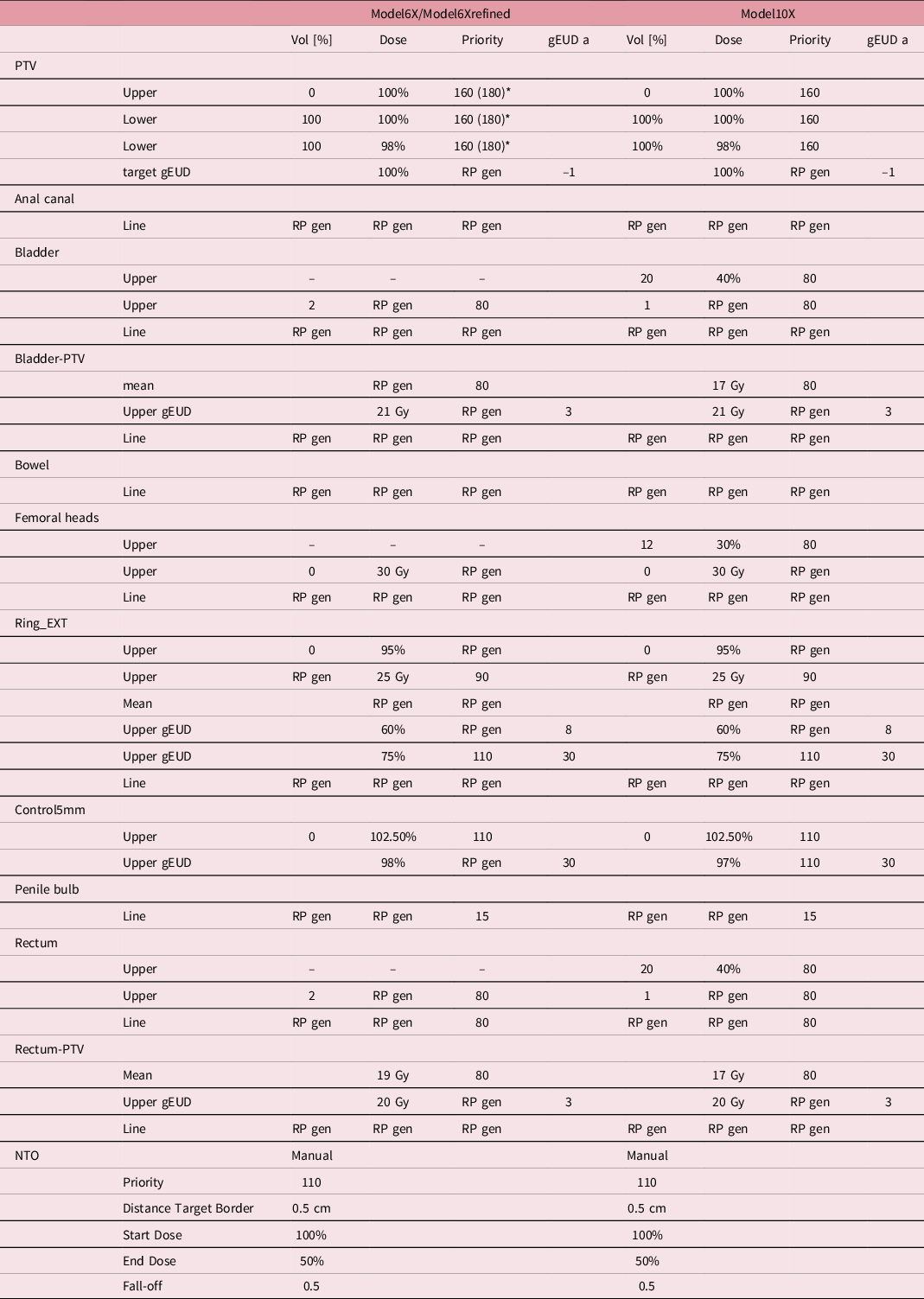
The optimisation objectives used in each model are summarised in Table 1. Model6X and Model6Xrefined share the same priorities and objectives. An additional upper objective was needed in the Model10X for the rectum, bladder and femoral heads structures to increase conformity of the medium–low dose isolines.
Optimisation objectives and priorities of the three models. RP gen means that the objective and/or the priority is automatically generated by RapidPlan. gEUD a is the parameter for the generalised equivalent uniform dose function.

* For the Model6Xrefined only.
Comparison of the model performance
The comparison of the model performance was carried out on the remaining 25 patients not included in the training set. The treatment plans were automatically generated by the three models using the 10-MV photon beam and without any interaction during optimisation.
The following DVH metrics were compared:
-
PTV coverage (V95%);
-
Maximum dose to the PTV calculated as dose at 0.03 cc (Dmax);
-
Minimum dose to the PTV (Dmin);
-
Bladder and rectum V15Gy, V25Gy and V35Gy;
-
Mean dose to rectum-PTV and bladder-PTV (Dmean);
-
Dose to 5% of the volume of femoral head right and femoral head left (D5%);
-
Body V50%;
-
Conformity index calculated at 80% and 95% isodose (CIx), as the ratio between the body volume receiving x% of the prescription dose (Vx%) and the PTV volume (VPTV):
 $$CI = {{{V_{x\%}}} \over {{V_{PTV}}}}$$
-
Total number of monitor units (MUs);
-
Homogeneity index (HI) calculated using the following formula:
$$HI = {{{D_{1\% }} - {D_{99\% }}} \over {{D_{50\% }}}}$$


where Dx% is the dose at x% of the PTV volume.
All the DVH metrics were compared with the Friedman test. The Nemenyi post hoc test was carried out to compare the difference between pairs of models. The level of significance was set to 0.05. The analyses were carried out using the R stats package.
Results
All the plans created by each model were clinically acceptable. The clinical acceptability was based on dose constraints guidelines that we internally developed together with the radiation oncologists following the literature data. More than 95% of the PTV volume received at least 95% of the prescription dose, as per protocol requirement. The 90%, 80% and 70% isodose lines were conformed to the PTV.
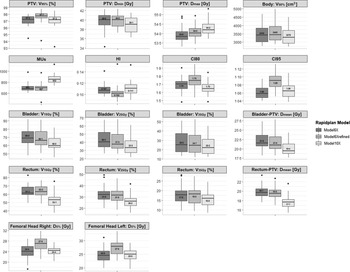
Figure 2 shows the boxplots of the DVH metrics of the test plans calculated with the three models. Median values are reported in the graphs.
Boxplots of the DVH metrics of the test plans calculated with the three models. Median values are reported in the graphs.

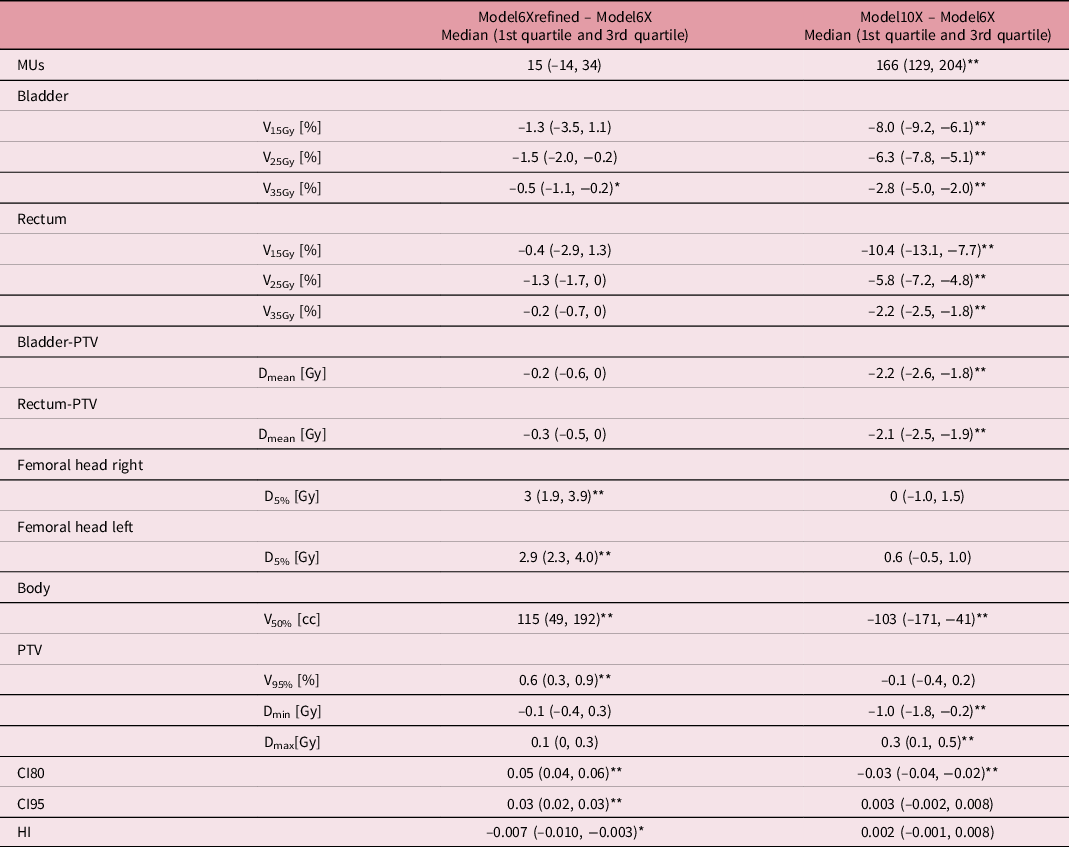
Table 2 shows the median values (with the interquartile ranges) of the paired differences between the DVH metric values obtained with the Model6Xrefined or Model10X and the DVH metric values obtained with the Model6X. Model6X was chosen as reference because it is the model currently used in our department.
Median values of the dose differences between the plans obtained with the Model6Xrefined or Model10X and the plans obtained with the Model6X

In brackets, the interquartile range is reported. The * symbol indicates the p-value of the Nemenyi post hoc test:
* p-value < 0.05;
** p-value < 0.01.
The p-value of the Friedman test was below 0.01 for all the dosimetric features. The Nemenyi post hoc test showed that the plans generated by Model10X were statistically different from the plans generated by Model6X and Model6Xrefined: Model10X generated plans with less dose to OARs and body without compromising the PTV coverage. The bladder V15Gy and the rectum V15Gy were 8% and 10% lower, respectively. The mean dose of bladder-PTV and rectum-PTV was 2 Gy lower. However, the number of MUs was 20% higher on average. The Model6Xrefined also showed a lower HI, but, at the same time, this resulted in obtaining a larger CI.
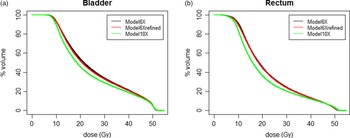
The plans generated by the Model6Xrefined were not different from the plans obtained by the Model6X in terms of dose distribution. Although some DVH metrics resulted statistically significant different, the differences were not considered clinically relevant. Figure 3 shows the average DVH plots of the bladder and rectum structures.
Average DVH plots of the bladder and rectum structures.

Discussion
This study evaluates the performance of three RapidPlan models for prostate radiotherapy treatment planning with 10-MV photon beams.
A RapidPlan model for prostate radiotherapy treatment planning with the 6-MV photon beam was previously trained and validated, and it is already clinically used in our department. Using this RapidPlan model (Model6X) with a 10-MV photon beam created clinically acceptable plans, confirming the results of previous studies that showed how RapidPlan models trained on plans with a specific beam configuration and treatment technique can be applied to different treatment arrangements. Reference Mattes, Tai, Lee, Ashamalla and Ikoro2,Reference Huang, Li and Yue17,Reference Schubert, Waletzko and Weiss18
Using the Model6X to automatically generate treatment plans with the 10-MV photon beam for training a new model (Model6Xrefined) did not improve the performance.
This finding could be explained as follows: the training plans for the Model6Xrefined were calculated using the Model6X with the 10-MV photon beam; this also is how the 25 test plans relative to Model6X were calculated for the comparison. Assuming that the patient population is well represented by the 50 patients used for model training, the dosimetric properties of the 25 test plans calculated by the Model6X are not different from the dosimetric properties of the 50 training plans for the Model6Xrefined. Since the outcome of a knowledge-based model reflects the properties of the training inputs, as demonstrated by Fogliata et al. Reference Fogliata, Cozzi and Reggiori1 for the RapidPlan system, the equivalence in the performance of Model6X and Model6Xrefined could be justified.
Our results show that OAR sparing was better achieved by the RapidPlan model trained on manually optimised plans with 10-MV photon beams (Model10X). Manually optimised plans highlighted the need for the additional optimisation objective V40% < 20% on both the bladder and rectum structures for optimal dose distribution. Lower values of bladder and rectum V15 and lower mean dose to the bladder-PTV and rectum-PTV structures could be due to this additional optimisation objective. This finding emphasises the benefit of using manually created training plans in order to fully exploit the ability of normal tissue sparing of the 10-MV photon beam. However, the higher normal tissue sparing comes at the cost of a higher number of MUs, which means longer treatment times. Furthermore, photon beam energies higher than 8 MV produce neutrons which lead to an increase of the equivalent dose Reference Howell, Hertel, Wang, Hutchinson and Fullerton19,Reference Kry, Salehpour and Followill20 that is not taken into account by the TPS. A recent study showed that the dose due to neutron contamination when using 15-MV photon beams is comparable to that due to the imaging during image-guided radiotherapy. Reference Hälg, Besserer, Boschung, Mayer, Lomax and Schneider21 In our work, we used the 10-MV photon beam. The cross section for neutron production in high atomic number materials is lower for 10-MV photons compared to 15-MV photons; Reference Oblozinský22 therefore, the dose contribution due to neutron contamination is lower than the dose measured by the authors Hälg et al.Reference Hälg, Besserer, Boschung, Mayer, Lomax and Schneider21
Conclusion
This work shows that all the RapidPlan models generate clinically acceptable plans for prostate cancer treatments with the 10-MV photon beam. We found that higher normal tissue sparing is obtained when the RapidPlan model is trained with manually optimised plans (Model10X) compared to outcomes generated by the RapidPlan model (Model6Xrefined) trained on 10-MV photon beam plans that in turn were generated by a RapidPlan model based on the 6-MV photon beam (Model6X). However, this procedure of model building is more time-consuming, and it produces plans with a higher number of MU. Therefore, a cost–benefit balance should be performed within each institute.
Acknowledgements
None.
Financial Support
This research received no specific grant from any funding agency, commercial or not-for-profit sectors.
Conflict of Interest
The authors declare none.
Ethics Standards
The Canton Ticino Ethics Committee waived the need for ethics approval and the need to obtain consent for publication of the results of this work.