Implications
Longer hours of transportation had a negative effect on the physiology and beef quality of in cattle destined for slaughter. Stress enzymes such as creatine kinase (CK) and lactate dehydrogenase (LDH) and on beef quality were negatively affected. Increased hours of stay at the lairages improved beef quality. The variation in beef quality was explained by the first three important meat quality parameters (ultimate pH, meat temperature and colour). Stress enzymes (CK and LDH) were related to each other although they were not related to beef quality.
Introduction
There is an on-going debate, discussion and re-framing of the concept of animal welfare in order to understand what is good, acceptable and/or poor as far as welfare is concerned (Buller and Roe, Reference Buller and Roe2013). However, transportation has been identified as one of the prime factors which compromise animal welfare and meat quality (Gregory, Reference Gregory2007; Ndou et al., Reference Ndou, Muchenje and Chimonyo2011). Transportation of animals to the abattoir is one of the topical issues in animal welfare because it involves a complex series of operations like handling, loading and off-loading and exposure of animals to unfamiliar environments. In some cases, transportation involves animal isolation, social disruption, confinement, loss of balance, fluctuations in environmental temperature and humidity, exposure to pollutants (e.g. truck exhaust), feed and water deprivation, and other stress inducing factors. These factors causes stress which leads to decreased health and productivity in farm animals (Probst et al., Reference Probst, Neff, Leiber, Kreuzer and Hillmann2012). Furthermore, transportation of animals especially those with decreased live weight are having the risk of producing carcases of inferior quality due to increased bruising (Wythes and Shorthose, Reference Wythes and Shorthose1984). Gregory (Reference Gregory2007) and Grandin (Reference Grandin2015) indicated that road transport becomes difficult to monitor and validate under practical conditions because of different speed limits, terrain of the road and stoppages within the process.
Transport has also been identified as one of the prime factors in the life of an animal that stimulates body responses that are aimed at re-establishing homeostatic conditions (Melesse et al., 2011). When animals experience changes in the environmental stressors that include climate, temperature and nutrition, they become stressed and this results in physiological changes such as increases in the activity of enzymes, stress hormones, body temperature and glycolysis (Wythes and Shorthose, Reference Wythes and Shorthose1984; Mader, Reference Mader2003). Examples of enzymatic secretions which are released into the serum through leakage arising from altered membrane permeability include alkaline phosphate, acid phosphate, aspartate aminotransferase, CK and LDH (Sattler and Fürll, Reference Sattler and Fürll2004).
The increased levels of CK in the blood are an indication of how stressful the handling facilities were before the animal was slaughtered and the extent of muscular damage during handling (European Food Safety Authority (EFSA), 2004; Grandin, Reference Grandin2010; Minka and Ayo, Reference Minka and Ayo2010). Moreover, the presence of this enzyme in the blood is due to breed temperament, excitability and fighting. This enzyme is mostly located in different tissues and its presence in the blood plasma serves as an indication of muscle damage (Tackett et al., Reference Tackett, Reynolds and Dickerman2008). Creatine kinase and LDH are enzymes that are released into the blood when there is muscle damage such as bruising and when there is a vigorous exercise which has a negative effect on the quality of meat (Wickham et al., Reference Wickham, Collins, Barnes, Miller, Beatty, Stockman, Blache, Wemelsfelder and Fleming2012). Stressors due to physical exertion are normally measured using CK and LDH as these are found in the muscles (sarcomere length) and muscle damage consequently affects meat colour and tenderness (EFSA, 2004; Brancaccia et al., Reference Brancaccio, Lippi and Maffulli2010; Baird et al., Reference Baird, Graham, Baker and Bickerstaff2012; Gebresenbet et al., Reference Gebresenbet, Wikner, Bobobee, Maria and Villarroel2012; Koch et al., Reference Koch, Pereira and Machado2014).
Meat quality is affected by several factors that include animal-related characteristics such as sex, age, breed and weight. Consumers of beef prefer to purchase meat that is compensated by good quality parameters despite its high price. The good quality parameters they consider include colour, freshness and tenderness, considerable fat content which will contribute to flavour and aroma during cooking. Reducing stress in slaughter animals helps to improve animal welfare and meat quality. Pre-slaughter conditions are of great importance for final meat quality, because short- and long-term stressors affect fresh meat colour, water holding capacity, shelf-life and technological yield (Ferguson and Warner, Reference Ferguson and Warner2008). Consequently, as transportation and slaughter of farm animals are the final stages of the meat production chain, any inappropriate handling procedures during this period will have a negative impact on the welfare of the animal, quality and quantity of the product. Therefore, the objective of this study was to determine the activities of CK and LDH in slaughter cattle as welfare indicators and their subsequent relationships with beef quality. The null hypothesis being tested was that CK and LDH are not indicators poor animal in slaughter cattle and they are related to beef quality.
Material and methods
Description of the study site
The study was conducted at a high-throughput commercial abattoir in the Eastern Cape Province of South Africa. The abattoir is located 120 km away from the University of Fort Hare, Alice campus at latitudes and longitudes of 32.97° S and 27.87° E and 542 m above sea level. The climate of the area is mild with an average rainfall of 850 mm per annum. The temperatures during the study ranged from 14°C to 18°C. Permission to conduct the study was reviewed and approved by the Research Ethics Committee of the University of Fort Hare, South Africa (UFH/UREC, MUC012 1SCHU01).
Animal management and experimental design
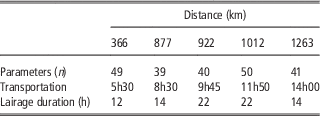
A total of 219 (n=219) cattle composed of four different breeds (85 Beefmaster, 48 Charolaise, 32 Holstein-Friesian and 54 nondescript) of different age groups and sexes brought to the abattoir for slaughter were used in the study. The animals used (selected randomly) had travelled different distances (Table 1) to the abattoir using double decker trucks. There was only one load of animals (selected from a group of animals brought for slaughter) per distance travelled and the lairage time for each load was recorded as shown in Table 1. Upon arrival at the abattoir, distance travelled by the animals was obtained from the truck driver. Ambient temperatures (low and high temperatures) at the abattoir were ranging between 14.5°C and 16.5°C during the period of data collection. Animals were allowed to rest at the lairages for 12, 14 and 22 h (Table 1) while having ad libitum access to water for the period of stay at the lairages without food. Although the animals had different lairage period, the sampling/slaughter time was between 0700 and 0830 h in the morning.
Number of animals brought to the abattoir for slaughter from different towns

Blood collection and plasma separation
The captive bolt method of stunning was used to stun the animals. The animals were slaughtered following the commercial abattoir procedures. After stunning, each cattle was hoisted and suspended by its hind leg and thereafter, a sharp knife was used to expurgate the throat to allow the animal to bleed. During exsanguinations, disposable vacutainer tubes with anticoagulant (ethylenediaminetetraacetic acid) were used to collect 4 ml of blood samples from the jugular vein immediately after throat cutting. The animals were then bled for about 6 and 8 min while they were still hanging. Each blood sample was then kept in ice until plasma was separated within 2 h after collection as the half-life of these enzymes lasts for about 36 h after blood collection. All the blood samples were centrifuged at the laboratory using a Model 5403 Centrifuge (Gatenbay Eppendorf GmbH, Engelsdorp, Germany) at 21°C for 10 min at 3550 rpm and were then stored at −20°C.
Creatine kinase and lactate dehydrogenase determination
The samples of stored plasma were analysed for CK and LDH at National Health Laboratory Services using a spectrophotometer (Model DXC 600; Beckman Coulter, Ireland) with reactive ingredients for SYNCHRON Systems (CK 2×200 and LD-P 2×200) with a commercial kit (Kit re-order #442 635: 200 tests/cartridge) was used. The activity of plasma CK was analysed by adding reactive ingredients which included 2×61 ml CK reagent, one preparation insert and the reactive ingredients included creatine phosphate 53 mmol/l, disodium salt 461 mmol/l, nadide 30:0 mmol/l, adenosine-5-diphosphate 2.9 mmol/l, monopotassium salt, dihydrate 36.0 mmol/l, glucose 18 mmol/l, glucose-6-phosphate dehydrogenase >3.8 kIU/l and hexokinase >11 kU/l. The activity of LDH was analysed by adding the following reagents; 1.4 mmol/l of pyruvate and 0.23 mmol/l of NADH. All the ingredients were added for the quantitative determination of CK and LDH activities of units per litre (U/l) in plasma.
Beef quality measurements
Determination of ultimate pH, meat temperature and colour
The carcasses were split, weighed and chilled at 0°C to 3°C before being processed at 48 h after slaughter. Representative samples (100 mm thick) of the m. longissimuss thoracis et lumborum (LTL) were sampled from the 10th rib to the third lumbar vertebra at 48 h after slaughter. The measurements of pHu and colour coordinates (L*, a* and b*) were carried out at 48 h after slaughter. A portable fibre-optic pH and Tm meter probe with a sharp metal sheath to prevent damage from raw meat (CRISON pH 25 Instruments S.A., Alella, Spain) was used to measure the ultimate pH and temperature of the carcasses 48 h post mortem. The pH meter was calibrated before taking measurements using pH 4, pH 7 and pH 9 standard solutions (CRISON Instruments, SA, Spain). Both pHu and Tm were recorded accordingly.
The colour of meat (L*=lightness, a*=redness and b*=yellowness) was determined at 48 h after slaughter using a Minolta colour guide 45/0 BYK-Gardener GmbH machine with a 20 mm diameter measurements area and illuminant D65-day light, 10° standard observer. The machine was calibrated each day before taking measurements using the green, black and white colour standard samples provided for this purpose. The readings were taken by rotating the colour guide 90° between measurements so as to obtain the average value for the colour. The colour values were recorded and compared with pHu of the same meat samples.
Warner–Bratzler Shear Force
The m. longissimuss thoracis et lumborum samples were weighed 1 week after freezing, thawed for 10 h and weighed again. They were placed in a plastic bag and cooked using a water bath at 85°C for 45 min. The results were expressed as the thawing and cooking loss. Thawing and cooking losses were calculated as described below:
 $$\eqalignno{ & {\rm Thawing}\,\left( {{\rm thaw}} \right)\,{\rm loss}\,\,\%\,\cr\;\;\;{\equals}\left[ {{{\left( {{\rm weight}\,{\rm from}\,{\rm freezer-weight}\,{\rm after}\,{\rm thawing}} \right)} \over {{\rm weight}\,{\rm from}\,{\rm freezer}}}} \right]{\times}100\,\%\, \cr & {\rm Cooking}\,{\rm Loss}\, ({\rm CL})\, \,\%\,\cr\;\;{\equals}\left[ {{{{\rm weight }\,{\rm before}\,{\rm cooking-weight}\,{\rm after}\,{\rm cooking}} \over {{\rm weight}\, {\rm before}\,{\rm cooking}}}} \right]{\times}100\,\%\, $$
Tenderness of beef was determined using the Instron – Warner–Bratzler Shear Force (WBSF) machine. Following cooking, sub-samples of specified core diameter were cored parallel to the grain of the meat. The samples were sheared perpendicular to the fibre direction using a Warner–Bratzler shear device mounted on an Instron 3344 Universal Testing (cross head speed at 400 mm/min, one shear in the centre of each core). The mean maximum load for the three cores were recorded which represented the average peak force for each meat sample in Newtons (N).
Statistical analysis
The mixed model procedure (PROC MIXED) of Statistical Analysis System (SAS, 2003) was used to determine any relationship between distance travelled, pHu, Tm, L*, a*, b*, WBSF, CK and LDH (P<0.05) where genotype was used as a random variable. As all the cattle were slaughter in the morning between 0700 and 0830 h, the sampling time was therefore not included in the analysis. Therefore, the following model was used:
 $$Y_{{ij}} \,{\equals}\,\beta _{0} {\plus}\beta _{1} {\rm X}_{1} {\plus}\beta _{2} {\rm X}_{2} {\plus}{\varepsilon}_{{ij}} $$
where Ү ij is the dependent variables (pHu, L*, a*, b*, WBSF, CK and LDH), β 0 the overall intercept, β 1 and β 2 the multiple regressions associated with distance travelled and lairage duration, X1 and X2 the random effects of distance travelled, lairage duration and ambient temperature, ε ij the random error term.
Principal component analysis (PCA) of JMP 9.0 SAS (2010) was also performed to determine the relationship between pHu, L*, a*, b* and WBSF, CK and LDH.
Results
Distance travelled and lairage duration on creatine kinase and lactate dehydrogenase
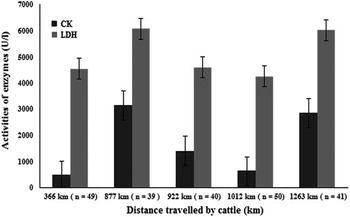
Figure 1 and Table 1 shows the activities of CK and LDH from cattle that travelled from different distances to the abattoir and kept at the lairages for different duration (hours). In Figure 1, the error bars were inserted to indicate some differences between the activities of CK and LDH during the pre-slaughter period. Animals that travelled for 877 (14 h lairage rest), 922 (22 h lairage rest) and 1263 (14 h lairage rest) km had significantly (P<0.001) higher CK levels (>1400 to 3000) whereas those that travelled for 366 (12 h lairage rest) and 1012 (22 h lairage rest) km had significantly lower (P<0.05) CK activities (<700). However, there were significantly elevated (P<0.001) CK (>3000) and LDH (>6000) activities for animals that travelled for 877 km than animals that travelled for 922 and 1012 km. Cattle that travelled for 922 and 1012 km rested for 22 h at the lairages while those that travelled 877 and 1263 km rested for 14 h at the lairages.
The relationship between distance travelled and the activities of creatine kinase and lactate dehydrogenase at P<0.05. CK=creatine kinase; LDH=lactate dehydrogenase; U/l=units per litre.

Distance travelled and lairage duration on meat quality characteristics
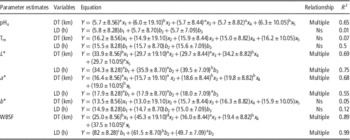
The relationships between distances travelled by cattle, lairage duration and beef quality characteristics are presented in Table 2. Distance travelled had a significant effect on pHu (P<0.01), L* (P<0.001), a* (P<0.05) and WBSF (P<0.001). The pHu of animals that travelled for 877 and 1263 km was higher (>5.9) leading to darker meat (L*=29.7) and tougher meat (WBSF=45.3). The amount of time given to animals on arrival at the abattoir until slaughter was 12, 14 and 22 h (lairage duration). Lairage duration had a significant (P<0.001) effect on L* (34.3, 35.9 and 39.5), WBSF (82, 61.5 and 49.7) and significant effect (P<0.05) on a* (17.9, 17.9 and 18, respectively) values. Animals kept in lairages for 22 h had significantly (P<0.001) improved WBSF values from 82 N down to 49.7 N).
Parameter estimates of beef quality characteristics as affected by distance travelled and lairage duration

pHu=ultimate pH; Tm=meat temperature; L*=lightness; a*=redness; b*=yellowness; WBSF=Warner–Bratzler Shear Force.
Distance travelled (DT): x 1–366 km, x 2–877 km, x 3–922 km, x 4–1012 km, x 5–1263 km.
Lairage duration (LD): b 1–12 h, b 2–14 h, b 3–22 h.
abcdMeans in the same row with different superscripts are significantly different at P<0.05.
Creatine kinase, lactate dehydrogenase and physico-chemical attributes of beef
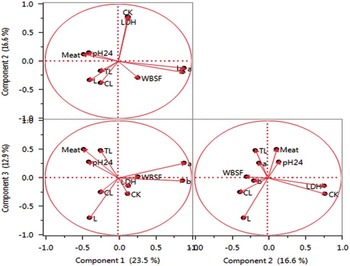
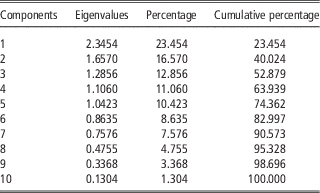
The PCA was done to illustrate the relationship between CK, LDH and physico-chemical attributes of beef. The results of eigenvalues and cumulative percentages that were shown by PCA are presented in Table 3. The eigenvalues are used to determine the linear combinations of the principal components (PCs) that have a greater variance. The first PC had the highest eigenvalue of 2.3 while the 2nd (1.6), 3rd (1.2) 4th (1.0) and 5th (1.0) PCs were <2. The first five PCs contributed about 74% (23.5, 16.6, 12.9, 11.1 and 10.4%, respectively) of the total variance which can be used to assess the acceptance of beef by consumers. As highlighted in Figure 2, a two-dimensional relationship of the loadings for PC 1, 2 and 3, contributed to 23.5, 16.6 and 12.9% which represent parameters that determined the eating quality of beef. The first principal component was strongly correlated with four variables (pHu, Tm, a*, b*). Ultimate pH was positively correlated with meat temperature, but negatively with a* and b* values. The second PC was correlated with WBSF. The third PC was defined by three meat quality parameters, L* value, thawing loss (TL) and cooking loss (CL).
A two-dimensional relationships of the loadings for principal component 1, 2 and 3. pHu=ultimate pH; L*=lightness; a*=redness; b*=yellowness; Meat=meat temperature; TL%=thawing loss percentage; CL%=cooking loss percentage; WBSF=Warner–Bratzler Shear Force; CK=creatine kinase; LDH=lactate dehydrogenase.

The eigenvalues and cumulative percentages of beef quality characteristics, creatine kinase and lactate dehydrogenase from cattle at slaughter

Discussion
The effect of distance and lairage on creatine kinase and lactate dehydrogenase
Longer transportation increased the activity of enzymes which were elevated for several days (Broom, Reference Broom2000; Sahin et al., Reference Sahin, Gurgoze, Cmkerten and Yuksek2009). Contrastingly, Marenčić et al. (Reference Marenčić, Ivanković, Pintić, Horvat-Marković, Horvat, Konjačić and Kelava2009) reported that, cattle that travelled shorter distances normally suffer additional stress. However, the lower levels of CK for animals that travelled for 1012 km could be that these animals were treated well so they did not suffer much stress as the others (Warriss, Reference Warriss1990; Grandin, Reference Grandin2000; Broom, Reference Broom2005). An elevated activity of these enzymes in the blood is an indication of muscle damage from disruption in muscle cell membrane and permeability during transportation (Baird et al., Reference Baird, Graham, Baker and Bickerstaff2012). The activities of CK in the blood are an indication of how stressful the handling facilities and transport distance were before the animal was slaughtered and the extent of muscular damage during handling (Minka and Ayo, Reference Minka and Ayo2010).
It has been reported that LDH increases due to excess heat or cold, starvation, dehydration, injury, exposure to bacterial toxins, after ingestion of certain drugs, and from chemical poisonings (Drent et al., Reference Drent, Cobben, Henderson, Wouters and Dieijen-Visser1996). Increased levels of CK and LDH are not only affected by transportation but also by feed deprivation, lairage duration and adverse environmental conditions (Baird et al., Reference Baird, Graham, Baker and Bickerstaff2012; Teke et al., Reference Teke, Akdag, Ekiz and Ugurlu2014). Creatine kinase was used in cows as a screening parameter in the diagnosis of endometritis. It was observed that pregnant cows had higher activities of CK than non-pregnant cows (Sattler and Fϋrll, Reference Sattler and Fürll2004). This implied that any change in the muscle as a result of stress led to the production of stress enzymes.
In addition, factors such as poor handling during loading and unloading (slip and fall), lack of water and food at the market and poor handling during transportation affected the activity of enzymes in cattle. This is because the physiology of the animal was affected due to adverse conditions such that there was reduced immunity and the muscles deteriorated especially after long journeys (Wythes and Shorthose, Reference Wythes and Shorthose1984). It has been observed that cattle of different classes react differently to the external stimuli due to temperament, hormonal effect and calpastatin activity (Marenčić et al., Reference Marenčić, Ivanković, Pintić, Horvat-Marković, Horvat, Konjačić and Kelava2009). Furthermore, the condition of the truck, truck density may lead to subsequent falls which affects the physiology of cattle resulting in poor beef quality (Gregory, Reference Gregory2007; Stockman et al., Reference Stockman, Collins, Barnes, Miller, Wickham, Beatty, Blache, Wemelsfelder and Fleming2013). It was noted that long hours of transportation with inappropriate lairage period caused physiological stress, reduced muscle glycogen dark and firm dry meat and ultimately increased pH (Tarrant et al., Reference Tarrant, Kenny and Harrington1992; Grandin Reference Grandin2000).
The resting periods applied in the current study was a daily routine done at the abattoir which ranged between 12, 14 and 22 h, respectively? Although animals travelled different distances (922 and 1012 km) to the abattoir, the average time given to them at the abattoir was optimal (22 h) to reduce the activities of CK and LDH. Contrastingly, Gebresenbet et al. (Reference Gebresenbet, Ljunberg, Geers and van de Water2004) reported an increase in lactate and CK production with increasing transport time. However, in the current study, longer hours of transportation were accompanied by long hours or lairage period resulting in reduced CK and LDH production. According to Frimpong et al. (Reference Frimpong, Bebresenbet, Bobobee, Aklaku and Hamdu2014) and Teke et al. (Reference Teke, Akdag, Ekiz and Ugurlu2014), lairage period brings about several positive benefits; that reduces the negative effects of transport on the physiology and biochemical parameters of the animal, carcass bruising and makes the evisceration process easier. The reduced production of stress enzymes in animals that rested for 22 h implies that there was enough time at the lairages in order to eliminate the fatigue arising from transportation (Mounier et al., Reference Mounier, Dubroeucq, Andanson and Veissier2006). However, there is no specific time suggested for animals to spent at the abattoir, this is determined by the arrival time as long as it is not more than 24 h with water provided at ad libitum.
The effect of distance travelled and lairage duration on meat quality characteristics
The energy reserves in the muscles were drained during transportation, which in turn led to higher lactic acid production. An increased pHu led to darker meat (Muchenje et al., Reference Muchenje, Dzama, Chimonyo, Raats and Strydom2008 and Reference Muchenje, Dzama, Chimonyo, Strydom and Raats2009). The quality of beef (pHu, L* and WBSF) was affected by long journeys because animals suffered due to fasting and exhaustion (Van der Water et al., 2003). However, there was a reduction of glycogen reserves at this point because of long hours of standing and balancing in the truck during transportation, which resulted to an increased pHu and tougher meat (Grandin, Reference Grandin2010 and Reference Grandin2015). Muscle fatigue or activity caused a reduction in muscle energy reserves (glycogen depletion) hence high pHu (>5.8) (Ferguson et al., Reference Ferguson, Jiang, Hearnshaw, Rymill and Thompson2000; Minka and Ayo, Reference Minka and Ayo2010).
The results reported by Muchenje et al. (Reference Muchenje, Dzama, Chimonyo, Strydom and Raats2009) indicated that tenderness increased with decreased pHu. As the animals stood on the truck for more than 1263 km, the connective tissues became tougher. Collagen content, its types and cross linking depended on age where older animals produced tougher meat. Furthermore, post mortem tenderisation led to degradation of actomyosin complex and factors such as pH, temperature and tenderness (Bailey, Reference Bailey2002; Fiems, Reference Fiems2012). In addition, during transportation, animals show a progressive decline performance of muscles which can recover after a period of rest. At this stage, transportation becomes of paramount importance because the management practices for livestock production are generally inherently stressful leading to reduced carcass weights, increased bruises and dark cutting beef (Werner et al., Reference Werner, Hepp, Soto, Gallardo, Bustamante and Gallo2013).
It was observed that dark firm dry (DFD) beef was reduced in animals that were kept in the lairages for about 22 h as compared with those that were kept for 12 and 14 h. According to Ferguson and Warner (Reference Ferguson and Warner2008), lairage period increased the incidence of DFD beef although the length of stay was not specified. Mounier et al. (Reference Mounier, Dubroeucq, Andanson and Veissier2006) reported that longer lairage period reduced higher pH to normal values (5.5 to 5.8) thereby reducing the DFD’s. Dark firm dry meat is a serious problem in beef production. Cattle normally regain their energy reserves with suitable lairage period (20 to 24 h) without any feed supplementation but water supplied at ad libitum (EFSA, 2004; Huertas et al., Reference Huertas, Gil, Piaggio and Eerdenburg2010). Contrasting results (Liotta et al., Reference Liotta, Nanni Costa, Chiofalo, Rvarottor and Chiofalo2007; Dokmanović et al., 2014) indicated that cattle rested over 16 and 28 h might not have recovered from stress instead their pHu levels increased. However, when cattle especially bulls were mixed with unfamiliar individuals, unnecessary stress due to commotion and intensified physical activity resulted (Ferguson and Warner, Reference Ferguson and Warner2008; Marenčić et al., Reference Marenčić, Ivanković, Pintić, Horvat-Marković, Horvat, Konjačić and Kelava2009). Enough resting at the lairages for animals was beneficial in the sense that their glycogen reserves were regained. The reduction during transport was aggravated by the release of catecholamines (Muchenje et al., Reference Muchenje, Dzama, Chimonyo, Strydom and Raats2009).
Similar results were reported where longer hours of lairages had an improvement on the tenderness meat (Liotta et al., Reference Liotta, Nanni Costa, Chiofalo, Rvarottor and Chiofalo2007). Shorter lairage duration led to higher WBSF values. This had an influence on glycogen reserves and pHu. During transportation, muscles became active, muscle temperature increased above 30°C causing a reduction in the ATP. When ATP was hydrolysed, pH did not decline, this led to the formation of cross-ridges between thin and thick filaments. Due to the actomyosin effect of myofibrillar proteins, background effect of connective tissue and the bulk density of fat, tenderness is still a complex multi-factorial trait that requires more attention (Joo et al., Reference Joo, Kim, Hwang and Ryu2013).
Principal component analysis between creatine kinase, lactate dehydrogenase and physico-chemical attributes of beef
As observed, the PCs had decreasing variances to predict those with great significance in the total variance. Literature indicates that pHu is the key to quality beef and is the standard measurement that determines colour and tenderness of beef (Li et al., 2014). According to Muchenje et al. (Reference Muchenje, Dzama, Chimonyo, Strydom and Raats2009), pHu higher (>5.8) than normal values led to an undesirable beef colour. Consumers use colour and tenderness to judge the quality of beef (Peña et al., Reference Peña, Bonvillani, Freire, Juárez and Gómez2009; Guzek et al., Reference Guzek, Gląbska, Pogorzelski, Kozań, Pietras, Konarska, Skowaska, Gląbski, Pogorzeska, Barszczewski and Wierzbicka2013). Principal components 5, 6, 7, 8 and 9 were <1.0 and the observed differences could imply that these components were least important when understanding the combinations of beef quality.
From the mentioned eigenvalues, further PCA was computed where the first three PCs were condensed as they made 53% of the variance of the cumulative percentage. The results reported by Destefanis et al. (Reference Destefanis, Barge, Brugiapaglia and Tassone2000) in beef quality measurements that included chemical analysis of meat, about 62.5% that was explained by the first three components. The other parameters such as TL%, CL% and WBSF were not the first parameters to be considered as far as meat quality was concerned. This is explained by Guzek et al. (Reference Guzek, Gląbska, Pogorzelski, Kozań, Pietras, Konarska, Skowaska, Gląbski, Pogorzeska, Barszczewski and Wierzbicka2013) who indicated that colour is the first meat quality attribute in meat acceptance by consumers. There is a strong relationship between pHu, muscle temperature and colour due to the levels of glycogen in the muscles (Hopkins et al., Reference Hopkins, Ponnampalam, van de Ven and Warner2014). Glycogen levels may vary widely without any effect on pH and meat colour, provided they are above a critical level that will produce a bright cherry meat (Grandin, Reference Grandin2015). Nonetheless, once the level is below the critical point, glycolysis increased which led to more lactic acid production and hence pH declined.
The relationship between PC 1 is that a*, b* and WBSF were positively related but were negatively related to CL, CK and LDH. The same relationship between meat quality attributes was observed in buffaloes by Kandeepan et al. (Reference Kandeepan, Mendiratta, Shukla and Vishnuraj2013) explaining that tenderness is associated with the bright and attractive colour of meat. This is because of the low amount of collagen responsible for retaining a reasonable amount of water. In addition, nutrition, genetics, intramuscular fat, marbling score, myoglobin content and scattering proteins had a bigger role to play in improving the colour, tenderness and flavour of meat. Meat with the bright red colour indicated a longer shelf-life and good eating quality meat (Kandeepan et al., Reference Kandeepan, Mendiratta, Shukla and Vishnuraj2013). The second PC was characterized by CK and LDH activity, showing that similar conditions predict their activity. Creatine kinase and LDH are both released when an animal is experiencing stress in its environment. Therefore, PCA proved to be a very useful method to identify the most effective variables and to point out quickly the relationships among the variables themselves.
Conclusion
It could be inferred from the current study that the longer hours of transportation and reduced lairage duration negatively affected the activities of plasma CK and LDH. However, with increased period of transportation and longer hours of lairage duration, there was a reduction in the production of these enzymes. Distance travelled by cattle resulted in increased ultimate pH, darker and tougher beef. Although, the activities of CK and LDH were related as they are both released when an animal is experiencing stress in its environment, they were not related to beef quality. Increased lairage duration improved the quality of beef such that the first three PCs explained about 53% of the total variability. The first PC was correlated with meat quality attributes (pHu, Tm, a* and b* values), where pHu and Tm were positively correlated, but negatively with a* and b* values. The third PC was defined by three meat quality parameters, L* value, TL and CL.
Acknowledgements
The authors are immensely grateful to the National Research Foundation Technology and Human Resources for Industry Programme and the Red Meat Research and Development of South Africa for providing financial support to conduct this research. Views expressed in this article are those of the authors. There were no potential conflicts of interest including financial, personal or other relationship with other people or organizations reported by the authors.