I. INTRODUCTION
Diamond-like carbon (DLC) films can be prepared by a variety of methods, usually plasma- or ion-based, with the properties of the DLC films depending on the preparation technique and the specific preparation parameters.Reference Sridharan, Sundaram and Wei1 Hardness, friction coefficient, and adhesion, for example, depend on the structure of the films and the existence of internal stress within the film.Reference Grill, Patel and Meyerson2, Reference Deng and Braun3 This can be influenced by the hydrogen content of the films; usually, a hydrogen-free DLC film exhibits a higher hardness, but suffers from internal stress, whereas hydrogen-containing DLC films have a smoother surface, less internal stress, lower friction coefficients but also lower hardness.Reference Ronkainen, Varjus, Koskinen and Holmberg4–Reference Erdemir7 One way to control the hydrogen content is to add a hydrogen source to a method, such as unbalanced magnetron sputtering (UBMS), that is used to prepare nominally hydrogen-free layers. The latter technique has been used to prepare DLC films, with the resulting hardness and tribological properties depending on parameters such as the substrate bias voltage and ion-current density.Reference Ahmad, Roy, Maguire, Papakonstantinou and McLaughlin8–Reference Akari and Iwamura11
The adhesion of DLC films on certain types of substrates is problematic, however, and to improve adhesion one or several interlayers can be added.Reference Sridharan, Sundaram and Wei1, Reference Monaghan, Teer, Logan, Efeoglu and Arnell10, Reference Anttila, Lappalainen, Tiainen and Hakovirta12 Another approach is the pretreatment of the substrate by implantation of carbon-containing species.Reference Ensinger and Wei13 Because of the resulting gradient layer of carbon and hydrogen within the substrate surface, a better adhesion can be ensured.Reference Walter, Nastasi and Munson14 In the experimental setup discussed here, the possibility of an added flow of a hydrocarbon gas can be exploited for the pretreatment. Application of a pulsed high voltage to the substrate in an atmosphere of hydrocarbon gas results in implantation of hydrogen and carbon.
II. EXPERIMENTAL
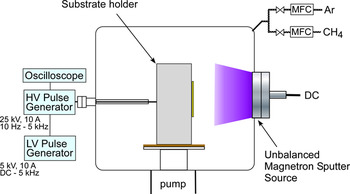
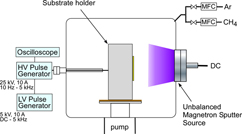
The samples were prepared in a chamber as shown in Fig. 1. The substrate was placed vertically onto a holder that can be connected to a pulsed high-voltage source as well as to a direct current (DC) voltage source. The pretreatment of the substrates, either stainless steel of type SUS316L in mirror-polished condition or silicon wafers of (100) orientation, was done with methane (CH4) as working gas at a pressure of 1 Pa. The pulse voltage was set to −18 kV with a repetition rate of 100 Hz and a pulse duration of 100 μs. The duration of the pretreatment was 3 h. The distribution with depth of the implanted carbon after the pretreatment was checked by Auger electron spectroscopy using 3 kV argon sputtering for depth profiling.
Schematic of the experimental setup.

An unbalanced magnetron sputter source (Kobe Steel UBMS202, Kobe, Japan) with a carbon sputtering target of 6 inches (150 mm) diameter with a distance of 160 mm from the substrate was used for the deposition of the DLC films. The working gas was argon with a flow rate of 200 ccm, controlled by a mass flow controller, resulting in a pressure of about 1 Pa. The DC power of the sputtering source was 3 kW, the substrate was held at a temperature of 200 °C, and a substrate bias of −100 V was applied. A flow of methane was added with values of 0, 1, 2, 3, 4, 5, 10, and 20 ccm, respectively. The deposition time was 42 min in all cases.
The surface morphology was checked by scanning electron microscopy, which was also applied to determine the film thicknesses from cross sections of the films. The hydrogen content of the DLC films is difficult to quantify as most analytical techniques are not able to register hydrogen. An at least qualitative solution is the use of secondary-ion mass spectrometry (SIMS); the intensities of an ion in this technique are not solely proportional to the concentration of the corresponding element but also to the ionization probability, which depends on the matrix composition (matrix effect). A large variation of the ionization probability with composition can usually be avoided by recording cesium clusters.Reference Gnaser and Oechsner15, Reference Gao, Marie, Saldi and Migeon16 Depth profiles were performed by SIMS with a Cameca ims 5f (Cameca, Gennevilliers Cedex, France), using cesium as primary ions with an energy of 5.5 keV and recording positive secondary ions out of the inner 60 μm (diameter) of a sputter crater of 150 × 150 μm2. The chemical structure was investigated by Raman spectroscopy with an excitation wavelength of 514 nm (Ar laser). The adhesion was evaluated by a stud pull-off test with prior epoxy bonding of the stud to the film. The hardness was tested by a nanoindenter with a Berkovich tip and a maximum load of 200 μN. The friction coefficient was checked by a ball-on-disk test of a tungsten carbide (WC) ball with 6-mm diameter and a load of 2 N, recording 10,000 rotations.
III. RESULTS AND DISCUSSION
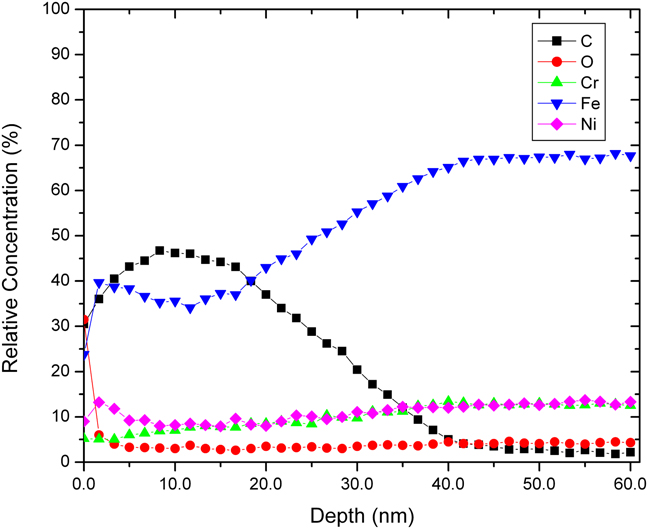
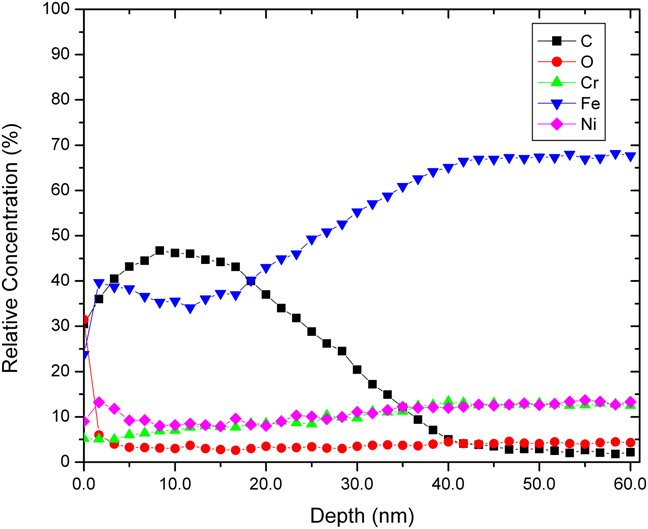
After the pretreatment, a carbon distribution with a maximum concentration of around 45 at.% was found (as measured with Auger electron spectroscopy, i.e., neglecting the hydrogen) which extended some 30 nm into the steel substrate, see Fig. 2. Some profile distortion due to the surface roughness of the steel samples has to be considered. Nevertheless, the effectiveness of the pretreatment in creating a gradual layer that contains carbon is obvious.
Auger electron spectroscopy depth profile of a steel sample treated by methane plasma source ion implantation.
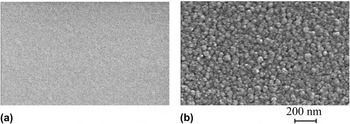
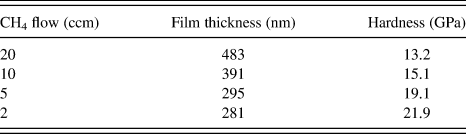
The DLC films that were subsequently deposited onto the pretreated substrates had a thickness between nearly 300 and 500 nm, depending on the methane flow rate, see Table I. The morphology of the surface was considerably influenced by the addition of methane to the sputter gas: while the nominally hydrogen-free DLC film, prepared with no additional methane flow, exhibited a rough surface with distinct grains of several tens of nanometers in diameter, the hydrogen-containing films were much smoother with no visible structure, see Fig. 3 for the difference between the maximum CH4 flow [Fig. 3(a)] and no CH4 flow [Fig. 3(b)].
Scanning electron microscope images of the surfaces of diamond-like carbon (DLC) films prepared (a) with 20 ccm additional methane flow and (b) without additional methane flow.

Film thickness and hardness of several samples with different values of CH4 gas flow during preparation.
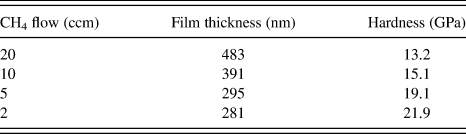
The direct current power was 3 kW, the temperature 200 °C, the sample bias −100 V, Ar flow 200 ccm, the deposition time 42 min for all samples.
The pull-off values in the stud pull test for a DLC film with no methane added during preparation on a steel substrate increased from 487 kg/cm2 for a sample without any pretreatment to 770 kg/cm2 for a sample with the additional plasma source ion implantation (PSII) treatment, proving the effectiveness of the pretreatment. The DLC film with added methane and PSII treatment exceeded the maximum value that was measurable with our experimental setup.
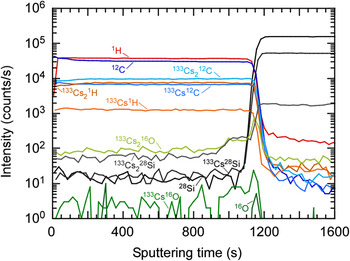
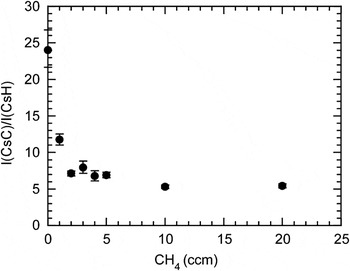
Figure 4 shows a SIMS depth profile of a DLC film on a silicon substrate. Single atomic ions as well as Cs clusters of the type CsM and Cs2M were recorded. The profiles show no large variations of signal intensities with depth within the DLC film. Hydrogen and carbon are clearly visible throughout the film. The higher intensity of hydrogen as compared to carbon cannot be interpreted as a higher concentration because of the different ionization probabilities. For a qualitative estimation of the hydrogen content, the ratios of the average values of the CsC and the CsH signals in the middle of the film, i.e., areas that were not affected by either surface transitions or the interface, were determined and plotted versus the CH4 flow rate, see Fig. 5. There is a clear trend of a decreasing intensity ratio, i.e., more hydrogen, with increasing methane flow rate, as could be expected. The indicated error bars only take into account the error in determining the average values, not a possible change of ionization probability with composition. The analyzed data from the clusters of the type Cs2M (not shown here) exhibit the same trend. Figure 5 indicates that there is also some hydrogen in the nominally hydrogen-free DLC film. This can be explained by the influence of contaminations (from the residual gas, the working gas, and the sputter target) during the preparation or analysis. With larger methane flow rates, the hydrogen apparently reaches a saturation value.
Depth profile of a DLC film, prepared with 10 ccm CH4, as recorded by secondary-ion mass spectrometry.

Intensity ratio of cesium clusters versus methane flow.

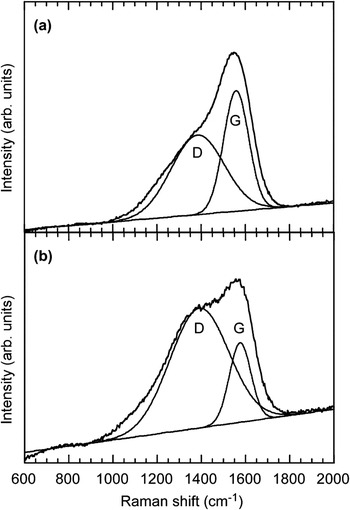
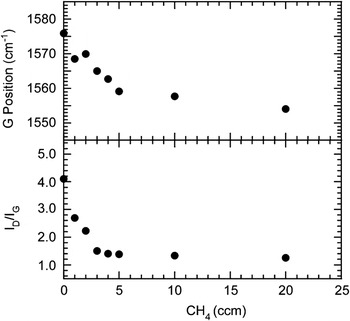
In Fig. 6, two Raman spectra are presented; both exhibit a broad peak between 1000 and 1700 cm−1, consisting of the D peak around 1330 cm−1 and the G peak around 1560 cm−1. There is an obvious difference in the peak heights of the D and G peaks as well as a slight shift of the position of the G peak. Plotting the integrated intensity ratios I D/I G (both peaks fitted with a Gaussian distribution) versus the methane flow rate, a dependence on the methane flow rate, and thus the hydrogen content, is visible: the position of the G peak shifts to lower values and the I D/I G ratio decreases with increasing hydrogen content, see Fig. 7. This is correlated with the change of structure within the DLC film: the hydrogen-free DLC film mainly consists of sp2-bonded clusters, i.e., both, the G peak position and the I D/I G ratio, possess relatively high values, e.g., 1576 cm−1 and 4.1, respectively. With increasing hydrogen content, the sp2 clusters are reduced in size; from the downshifted G peak an increased disorder in the sp2 network can be deduced, and the rising full width at half maximum of the G peak [e.g., 138.2 cm−1 for the film without CH4 from Fig. 6(b) and 166.8 cm−1 from the film with 5 ccm CH4 from Fig. 6(a)] is a sign of sp2 clusters with a reduced size. This implies that the formation of sp3-type bonds (H-bonded carbon) is promoted as demonstrated by the higher intensity ratio I D/I G.Reference Robertson17–Reference Schwarz, Thorwarth and Stritzker20
Raman spectra of the samples (a) with 5 ccm CH4 and (b) without CH4.

G position and I D/I G ratio of the DLC films as a function of methane flow rate.

The hardness of the films decreased with hydrogen content or CH4 flow rate, respectively, see Table I. [The value for the hydrogen-free sample was difficult to measure due to the surface roughness, Fig. 3(b).] It is a common observation that films with higher internal stress, such as those prepared by a sputtering process, possess a higher hardness.Reference Grill, Patel and Meyerson2–Reference Erdemir7, Reference Ikeyama, Nakao, Miyagawa and Miyagawa21 It was argued that in the presence of hydrogen a polymeric sp3 structure is formed, thus changing the bonding constraints of sp3 bonded carbon, which results in more H-bonded carbon.Reference Bendavid, Martin, Comte, Preston, Haq, Magdon Ismail and Singh22 Hereby the stress is reduced as well as the hardness. This argument is corroborated by the Raman results mentioned above.
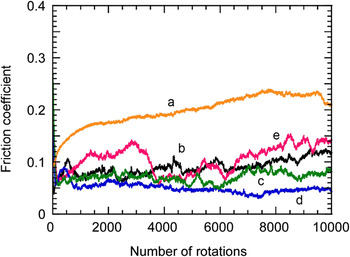
The friction coefficient in relation to the methane flow rate is shown in Fig. 8. The hydrogen-free film possesses a relatively high friction coefficient of 0.2, whereas a small amount of added methane (5 ccm) leads to a minimum value of around 0.05 with a following increase for higher methane flow rates. There are two factors that influence the friction coefficient: the surface roughness and the hardness. The much smoother surface of the hydrogen-containing samples, as presented in Fig. 3, is responsible for the lower friction coefficient as compared to the hydrogen-free film. The increase of the friction coefficient with higher methane flow rates can be related to the hardness, which decreases with increasing methane flow, see Table I.
Friction coefficient versus the number of rotations for DLC films prepared with different methane flow rates (a) 0, (b) 1, (c) 2, (d) 5, and (e) 10 ccm.

IV. CONCLUSIONS
It could be shown that this experimental setup is effective for a pretreatment procedure by PSII that led to the implantation of a carbon gradient into the substrate and ensured sufficient adhesion of the films. There is also a correlation between the hydrogen content during preparation with an unbalanced magnetron sputter method and the properties of the produced DLC films. The hydrogen content could be varied by setting the flow rate of an additional methane supply which was mixed into the working gas (argon). The addition of the hydrogen led to a smoother surface, a change of the integrated intensity ratio I D/I G, and the G-position of the Raman spectra—and hence a change in the chemical structure toward a typical hydrogen-containing DLC film—and altered hardness and friction coefficient. The latter obtained lowest values with the addition of 5 ccm methane flow rate, whereas the hardness decreased with increasing methane flow rate.