Introduction
Unions of individuals who share a common ancestor (often called consanguinity) increase homozygosity (Cavalli-Sforza et al., Reference Cavalli-Sforza, Moroni and Zei2004). In animals, the word ‘inbreeding’ is frequently used and is generally associated with loss of biological fitness (Bittles, Reference Bittles2001), to a point of seriously decreasing fertility and individual survival, making prolonged inbreeding incompatible with the continuation of life (Cavalli-Sforza et al., Reference Cavalli-Sforza, Moroni and Zei2004).
In human populations, consanguineous unions are common, and increased levels of morbidity and mortality in offspring can thus be predicted (Bittles, Reference Bittles2001). The adverse health consequences of close consanguinity must have become known to early humans fairly soon, since practically every society has rules that tend to avoid close consanguineous marriages (Cavalli-Sforza et al., Reference Cavalli-Sforza, Moroni and Zei2004). There are, however, social exceptions to the rule of avoidance of consanguineous marriages, other than brother–sister unions (Cavalli-Sforza et al., Reference Cavalli-Sforza, Moroni and Zei2004). In fact, in some social groups, such marriages may be much more common than would be expected by chance, undoubtedly because of a social preference (Bittles, Reference Bittles2001).
Globally, the most common form of consanguineous union contracted is between first cousins, in which the spouses share 1/8 of their genes inherited from a common ancestor, and so their progeny are homozygous (or more correctly autozygous) at 1/16 of all loci. In some large human populations, genetically closer marriages also are favoured, in particular uncle–niece and double first cousin unions where the level of homozygosity in the progeny is double that of first cousins (Bittles, Reference Bittles2001). The specific types of consanguineous marriage that are favoured can vary quite widely between and within different countries, with inter-religious, ethnic or tribal variations.
Within different religions, there are differences in attitudes towards consanguineous marriages (Bittles, Reference Bittles2001). Thus in Christianity, the Orthodox churches prohibit consanguineous marriage, the Roman Catholic church currently requires special permission for marriages between first cousins, and the Protestant denominations permit marriages up to and including first cousin unions (Bittles et al., Reference Bittles, Grant, Sullivan and Hussain2002). In general, Muslim regulations forbid uncle–niece unions, even though double first cousin marriages are recognized (Bittles, Reference Bittles2001).
In 2001, Bittles found that irrespective of prevailing legislation, a future decline in the prevalence of consanguineous unions can be predicted, accompanying the expected reduction in family sizes (Bittles, Reference Bittles2001). It is true that in some countries, recently introduced legislation may be exerting a marked effect on traditional patterns of marriage preference. One example is Japan, which has undergone rapid industrialization and urbanization since World War II. However, the recorded numbers of consanguineous unions appear to have grown at least in step with increasing populations (Bittles, Reference Bittles2001), and in some economically less developed countries the proportion of marriages contracted between close biological kin has expanded. The simplest explanation for this observation is that as greater numbers of children survive to marriageable age, the traditional social preference for consanguineous unions can be more readily accommodated (Bittles, Reference Bittles2001).
Among the major populations so far studied, the highest rates of consanguineous marriage have been associated with low socioeconomic status, illiteracy and rural residence. In some populations, a high prevalence of marital unions between close relatives has, however, been reported among land-owning families, and in traditional ruling groups and the highest socioeconomic strata (Bittles, Reference Bittles1994, Reference Bittles1995). The reasons most commonly given for the popularity of consanguineous marriage are a strong family tradition of consanguineous unions, the maintenance of family structure and property, and the strengthening of family ties, financial advantages relating to dowry or bride-wealth payments, the ease of marital arrangements, a closer relationship between the wife and her in-laws, and greater marriage stability and durability (Bittles, Reference Bittles1994; Hussain, Reference Hussain1999). The degree of social compatibility, and the close involvement of the entire family in consanguineous unions, may explain both the claimed greater stability, with lower divorce rates, and enhanced female autonomy (Bittles, Reference Bittles2001).
Consanguineous marriages reach 50% or more in many Middle Eastern ethnic groups (Arabs, North Africans and some Jewish groups) (Cavalli-Sforza et al., Reference Cavalli-Sforza, Moroni and Zei2004; Saadallah & Rashed, Reference Saadallah and Rashed2007); several studies performed in Middle Eastern countries have shown figures such as 50·5% in the United Arab Emirates (Abdulrazzak et al., Reference Abdulrazzak, Bener, Al-Ghazali, Al-Khayat, Micallef and Gaber1997), 51·52% in Jordan (Khoury & Massad, Reference Khoury and Massad1992), 52·0% in Saudi Arabia (Al-Abdulkareem & Ballal, Reference Al-Abdulkareem and Ballal1998) and 56·3% in the Sultanate of Oman (Rajab & Patton, Reference Rajab and Patton2000). In Lebanon, two studies have been carried out in Beirut, but none has been performed throughout all the Lebanese regions. The first was done on obstetric outpatients in 1981, and found a 26% prevalence of consanguineous marriages (Khlat & Khudr, Reference Khlat and Khudr1984). The other found consanguineous marriage rates to be 16·5% in Christians and 29·6% in Muslims, with an overall prevalence of 25% in Beirut (Khlat, Reference Khlat1988). Since then, the war in Lebanon ended (in 1990), and urbanization has been continuously taking place, particularly around the big cities; this is expected to increase population amalgamation and affect behaviour in several ways, including conformism to traditional consanguinity in some social groups.
The objective of the current study is to determine the prevalence of consanguinity in Beirut and other Lebanese regions, in addition to its associated factors in different subgroups.
Methods
Study design and population
The study has a cross-sectional design, aiming at evaluating consanguinity and its associated factors in Lebanese regions. It was performed on a convenience sample of 1556 married women, chosen in Lebanese regions. The numbers of women to interview within every region were determined according to a quota taken from the distribution of Lebanese residents reported by the Central Administration of Statistics (CAS, 2005).
Procedure
Women were then face-to-face interviewed by independent enquirers. Women were approached in private or public areas, such as their front doors, the market or in the street. They gave an oral consent to participate to the study, after a brief explanation about a ‘study done by university researchers that had an extreme importance for their health’. They were, however, kept unaware of the exact objective of the study. Enquirers had recommendations not to give any additional clarifications for non-understood questions, except for the standard explanations already given to the respondent during the interview, in order not to influence the respondent.
Questionnaire
A questionnaire was designed and tested in local Arabic language on ten women from different socioeconomic statuses to ensure question clarity, and non-clear questions were amended accordingly until these women were able to understand them adequately. A final standardized questionnaire was used and administered to the study sample.
Closed- and open-ended questions regarding marital, health and family status, social, geographic and demographic characteristics, detailed description of live and possible dead children and their chronic diseases, if any, pregnancies and miscarriages, parents' and present couple degree of relationship, opinion regarding consanguineous marriages and their consequences were asked. Education was divided into low (less than 8 years of education), intermediate (more than 8 years of education, without university studies) and high level (university studies). Women with no children were considered and referred to as nulliparous.
In the analysis, the southern suburb of Beirut was considered separately from other regions because of its special characteristics: this region is administratively considered as a part of Mount Lebanon, and is inhabited by newly coming individuals from the Shiite community (1975 and onwards), immigrating from Southern Lebanon and the Bekaa Plain; it is known to be highly crowded and of low socioeconomic status.
Inbreeding coefficients were calculated individually and for groups. Individual values (F) were assigned according to simple relationships between parents: 1/8 for uncle–niece or aunt–nephew marriages, 1/16 for full first cousins, 1/64 for full second cousins, and 1/256 for full third cousins. In the case of half cousins, coefficients were divided by 2. ‘Full’ and ‘half’ refer to the two sibs starting the chains of descent, who are the two top individuals in each pedigree. Full sibs have both parents in common, and half-sibs only one parent (Cavalli-Sforza et al., Reference Cavalli-Sforza, Moroni and Zei2004). As a working definition, unions contracted between persons biologically related as first (F=0·0625) and second cousins (F=0·0156) were categorized as consanguineous. This arbitrary limit has been chosen because the genetic influence in marriages between couples related to a lesser degree would usually be expected to differ only slightly from that observed in the general population (Bittles, Reference Bittles2001). For groups, mean inbreeding αcoefficients were also calculated, where α is the sum of the products of individual coefficients by its frequency (α=ΣpiFi) (Cavalli-Sforza et al., Reference Cavalli-Sforza, Moroni and Zei2004).
Statistical analysis
Questionnaires were coded and data entered using Statistical Package for Social Sciences (SPSS) software, version 12·0, by independent lay persons. Data analysis was then performed by the same SPSS software. A p value <0·05 was considered significant. The χ2 test was used for comparison between categorical variables, and 95% confidence intervals were calculated for total frequencies. The ANOVA was used to compare continuous variable means, because all had a normal distribution and similar variances. For multivariate analysis, a stepwise backward likelihood ratio logistic regression was performed for child mortality and morbidity, couple nulliparity and miscarriages, and consanguinity as dependent variables, taking into account the studied sociodemographic and geographic factors. Adjusted odds ratios (ORa) were calculated.
Missing data were overall inferior to 1% for all variables, even in subgroups. Missing values were not replaced and were included in the denominators for the univariate analysis; this generated sums of actual percentages slightly lower than 100% in some tables.
Results
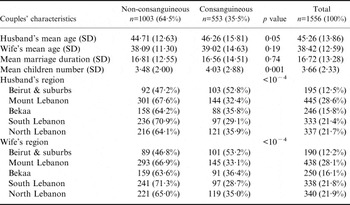
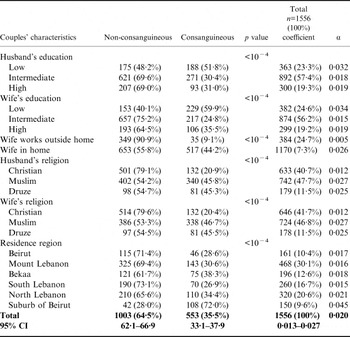
Table 1 shows the demographic and geographic characteristics of couples. Consanguinity was related to region of origin (p<10−4) and number of children, for those couples with children (p=0·001). Table 2 shows social factors: lower education of both man and woman, non-Christian religion, woman working in the home, and residing in the Beirut suburb are correlated with higher consanguinity frequency and mean inbreeding coefficients (p<10−4). Overall, there is consanguinity frequency of 35·5%, and an α coefficient of 0·02. Consanguinity degree distribution is as follows: 968 (62·2%) were not consanguineous, 492 (31·6%) were first cousins, 61 (3·9%) were second cousins and 36 (2·3%) had lower degrees of consanguinity. In Beirut, the consanguinity rate for Muslims was 2·2 times higher than for Christians.
Demographic and geographic characteristics versus consanguinity in Lebanon

Social characteristics and residence versus consanguinity in Lebanon

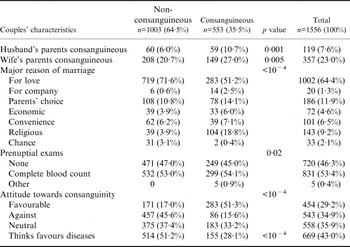
Table 3 shows factors that could affect attitude towards consanguinity. Having consanguineous parents, the woman choosing her partner for religious reasons, having an opinion in favour of consanguinity, and thinking that consanguinity does not necessarily cause serious diseases are all associated with higher frequencies of consanguinity (p<0·05).
Factors affecting attitude towards consanguinity in comparison groups

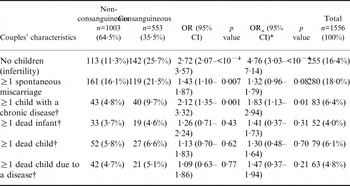
Consanguineous marriages in this sample were strongly associated with nulliparity (OR=5), and moderately associated with spontaneous miscarriages and child chronic morbidity (OR=1–2). However, there was no demonstrated association with infant or child mortality (p value not significant) (Table 4). For parents whose children had a chronic disease, mental retardation (42·3%), thalassaemia (38·5%) and psychological problems (7·7%) were cited by the group of consanguineous couples. For non-consanguineous couples, thalassaemia (25%), asthma (25%) and heart disease (12·5%) were cited (p<0·006) (results not shown).
Child morbidity and mortality in the sample

* ORa=Adjusted Odds Ratio; adjustment was done over age of the wife, age of the husband, wife's parents' consanguinity, husband's parents' consanguinity, number of children, wife's religion, husband's religion, wife's education, husband's education, wife's work, marriage duration.
† In women with one or more children.
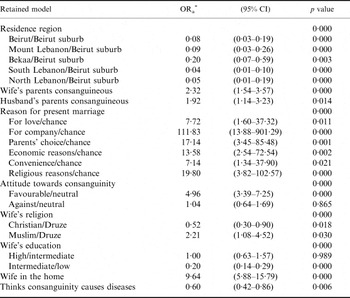
Factors associated with consanguinity were numerous in the retained model of multivariate analysis: the obtained results confirm those of bivariate analysis. Having consanguineous parents (ORa=2), choosing a spouse for religious reasons (ORa=20), having an opinion in favour of consanguinity (ORa=5), thinking that consanguinity does not necessarily cause serious diseases (ORa=2), woman having a low education (ORa=5) or working in the home (ORa=10) and Druze religion (ORa=2) or Muslim religion (ORa=4) versus Christianity are all associated with higher frequencies of consanguinity (Table 5).
Multivariate analysis of factors associated with consanguinity

* ORa=Adjusted Odds Ratio; adjustment was made over age of the wife, age of the husband, residence region, husband's region of origin, wife's region of origin, wife's parents' consanguinity, husband's parents' consanguinity, number of children, wife's religion, husband's religion, wife's education, husband's education, wife's work, marriage duration, reason for marrying the conjoint, attitude towards consanguinity.
Discussion
In this study, it was found that Beirut suburb dwelling, low educational status subgroups, women working in the home and non-Christian religion presented the highest rates of consanguinity. Factors that could affect consanguinity are having consanguineous parents, having a favourable opinion towards consanguinity, choosing a spouse for religious reasons, particularly in Islam, woman having a low education, woman working in the home and thinking that consanguinity would not lead to serious diseases. These results are similar to those obtained by other researchers, and thus confirm theories about distribution and main reasons for consanguinity (Khoury & Massad, Reference Khoury and Massad1992; Jurdi & Saxena, Reference Jurdi and Saxena2003; Raz & Atar, Reference Raz and Atar2004).
In previous studies in 1984 and 1988, Khlat et al. found the consanguinity frequency in Beirut to be 25–26%, while this study found it to be 28·6%. In addition, they found a consanguinity rate in Muslims 1·8 times higher than in Christians (Khlat & Khudr, Reference Khlat and Khudr1984; Khlat, Reference Khlat1988), while the ratio found in Beirut in this study is 2·2. Thus, in a period extending over 20 years, consanguinity rates did not decrease, even with urbanization of several Lebanese regions, and in Beirut in particular. Consanguinity is still affected by religion, education and social status. This is in line with the opinion of Bittles, who stated: ‘it seems probable that the decline in the prevalence of consanguineous unions will not be uniform in effect across populations but will be mainly observed in urbanized populations and among couples who share higher educational standards and later ages at marriage’ (Bittles, Reference Bittles2001). Thus, Lebanese society does not seem to be affected by urban lifestyle regarding consanguinity, and still behaves under the influence of traditional cultural and religious beliefs. This study's results are also in line with those found in the Middle East region Arab population (for example, Jordan, Iraq, Israel, Bahrain), where consanguinity ranged from 30 to 50%, except in Christian subpopulations (Hafez et al., Reference Hafez, El-Tahan, Awadalla, El-Khayat, Abdel-Gafar and Ghoneim1983; Freundlich & Hino, Reference Freundlich and Hino1984; Al-Hamamy et al., Reference Al-Hamamy, Al-Bayati and Al-Kubaisy1986; Al-Salem & Al Rawashdeh, Reference Al-Salem and Al-Rawashdeh1993; Al Arrayed, Reference Al Arrayed and El-Hazmi1994; El-Hazmi et al., Reference El-Hazmi, Al-Swailem, Warsy, Al-Swailem, Sulaimani and Al-Meshari1995; Al-Gazali et al., Reference Al-Gazali, Bener, Abdulrazzaq, Micallef, Al-Khayat and Gaber1997; Al-Abdulkareem & Ballal, Reference Al-Abdulkareem and Ballal1998; Jaber et al., Reference Jaber, Halpern and Shohat2000; Vardi-Saliternik et al., Reference Vardi-Saliternik, Friedlander and Cohen2002).
The expected consequences of consanguinity were found in this study. The decrease in fertility, estimated by nulliparity, was mostly marked, despite some discrepancy regarding this issue in the literature. It has been proposed that fertility may be lower in consanguineous couples due to a failure to initiate pregnancy when the couple share specific HLA haplotypes (Ober et al., Reference Ober, Elias, Kostyu and Hauck1992), or because of the expression of deleterious genes acting during early embryonic or fetal development that result in periconceptual losses (Ober et al., Reference Ober, Hyslop and Hauck1999). In Lebanon, consanguinity has been reported to be a factor in male infertility (Kobeissi & Inhorn, Reference Kobeissi and Inhorn2007). Conversely, it has also been argued that the greater genetic compatibility between the mother and developing fetus in a consanguineous pregnancy would lead to reduced rates of involuntary sterility and prenatal losses. However, there is a strong possibility that greater fertility may be observed in consanguineous unions as a compensatory mechanism for infant and childhood losses (Bittles et al., Reference Bittles, Grant, Sullivan and Hussain2002). In addition, there are social variables that exert a significant positive influence on the fertility of consanguineous couples (early marriage, less use of contraceptives), resulting in optimization of the maternal reproductive span and, to a lesser extent, concentration of childbearing in the mothers' most fertile years (Bittles, Reference Bittles2001). The present results further confirm these findings, with higher risk of miscarriage in consanguineous couples, and a higher number of children in fertile consanguineous couples. Factors other than consanguinity could also be involved in the last issue, such as socioeconomic status and education, which were lower in consanguineous couples.
Empirical studies on the progeny of first cousins indicate morbidity levels to be some 1% to 4% higher than in the offspring of unrelated couples (Bittles, Reference Bittles2001). In the present study, consanguineous couples had more children with chronic diseases, particularly thalassaemia, mental retardation and psychological problems. Further specific studies are required to evaluate the effect of consanguinity on genetic diseases – case-control studies in particular.
A thorough meta-analysis by Grant and Bittles proved that there is considerable heterogeneity among populations regarding the effect of consanguinity on mortality. However, even though mortality was not perfectly linear with F there was a clear deleterious effect of consanguinity, which was qualitatively in the expected direction (Grant & Bittles, Reference Grant and Bittles1997). Nevertheless, consanguinity interacts with a range of sociodemographic variables in determining rates of mortality during infancy and early childhood. The major determinants of early death are maternal illiteracy, maternal age at birth of less than 20 years, and a birth interval of less than 18 months. However, even after controlling for these factors, first cousin progeny have statistically significant odds ratios for neonatal, postneonatal and infant mortality of 1·36, 1·28 and 1·32, respectively (Grant & Bittles, Reference Grant and Bittles1997). In the present study, similar odds ratios were found for infant and child mortality, but there was a lack of power to demonstrate the increase in mortality in consanguineous couples; this is probably due to the low number of dead children in both groups of comparison, which led to non-significant results. Further research is necessary to corroborate these findings.
There is the possibility of selection bias in this study since the sample was a quota sample and not a random one. In fact, for political reasons, there is no official individual sampling base, there are no official distribution numbers per governate of different religious groups, and there are no official total numbers of residents per subgovernate. This is why the sampling method used seemed the best within the cited conditions.
On another hand, an information bias is possible since there was a reliance on direct interviews of women who could sometimes be illiterate or might misunderstand the question, especially regarding disease reporting. This is why the morbidity issue should be further studied in more specifically designed studies. Some confidence intervals were very large and showed non-precise estimates, in the logistic regression in particular; this is probably due to the small percentages for some variables. However, these drawbacks should not seriously affect the results, which are in line with the majority of published studies regarding consanguinity.
Specific education, premarital screening and genetic counselling are proposed, according to the recommendations of the National Society of Genetic Counselors (Bennett et al., Reference Bennett, Motulsky, Bittles, Hudgins, Uhrich and Lochner Doyle2002). This will help couples to make informed decisions about options for choosing a partner. In addition, genetic screening for consanguineous couples and their offspring is also suggested, especially for diseases that can be prevented or treated, given the high rate of consanguinity in the Lebanese population. The details of these interventions need to be carefully studied by relevant authorities, such as the Ministry of Health, for an adaptation to different groups' cultural and ethical issues (Carmi et al., Reference Carmi, Elbedour, Wietzman, Sheffield and Shoham-Vardi1998; Albar, Reference Albar2002; Raz & Atar, Reference Raz and Atar2004).
Conclusion
This study found that Beirut suburb dwelling, low educational status, women working in the home and non-Christian religion presented the highest rates of consanguinity. Factors that could affect consanguinity were having consanguineous parents, having a favourable opinion towards consanguinity, choosing a partner for religious reasons (Islam in particular) and the woman having a low education, working in the home and thinking that consanguinity would not lead to serious diseases. Genetic counselling is necessary to help couples make informed choices, and genetic screening of consanguineous couples for preventable or treatable diseases would be particularly useful.