Implications
Poor nutrition during pregnancy can result in long-lasting negative effects on the cow and offspring. Our data suggest that cows and fetuses have the ability to adapt to restriction and realimentation by altering mass or energy use in an attempt to increase the digestion and utilization of feed or to alter maintenance requirements to maintain fetal growth and development. Maternal realimentation and length of realimentation has the potential to change the effects observed in cows and fetuses by mid or late gestation. These effects may influence whole animal energetic efficiency and future productivity of the cow and offspring.
Introduction
Pregnancy results in a 20% to 50% increase in maternal metabolic rate, measured via O2 consumption, in most mammals (Stock and Metcalfe, Reference Stock and Metcalfe1994). Around 50% of the metabolic increase in dairy cows is related to the gravid uterus, while the other portion is related to metabolic changes in the dam’s tissues such as the heart, muscles related to the respiratory system and the kidney (Bauman and Currie, Reference Bauman and Currie1980). In addition to the increased energy use with the progression of gestation, a large proportion of the total energy expenditure occurs in the small intestine and liver along with other organs that form the gastrointestinal tract (GIT), even though these organs only represent around 10% of total body mass in several mammalian species (Koong et al., Reference Koong, Ferrell and Nienaber1985; Reynolds et al., Reference Reynolds, Tyrrell and Reynolds1991).
Variations in gestational nutritional status result in effects on the cow (Hess et al., Reference Hess, Lake, Scholljegerdes, Weston, Nayigihugu, Molle and Moss2005) and on the offspring in human, sheep and pig (Godfrey and Barker, Reference Godfrey and Barker2000; Wu et al., Reference Wu, Bazer, Wallace and Spencer2006). Nutrient restriction results in a decrease in sheep visceral organ mass (Scheaffer et al., Reference Scheaffer, Caton, Redmer and Reynolds2004) and impacts maintenance energy expenditure in cattle (Ferrell and Oltjen, Reference Ferrell and Oltjen2008). Researchers have suggested that when gestating sheep are nutrient restricted, fetal intestinal mass increases (Osgerby et al., Reference Osgerby, Wathes, Howard and Gadd2002) and hepatic mass decreases (Bell, Reference Bell1993); however, other research has reported an increase in hepatic mass in sheep (Vonnahme et al., Reference Vonnahme, Hess, Hansen, McCormick, Rule, Moss, Murdoch, Nijland, Skinner, Nathanielsz and Ford2003). The maternal system may respond to alterations in nutrient intake by programming nutrient partitioning and consequently changing growth and development rate, as well as function of the major fetal organs (Godfrey and Barker, Reference Godfrey and Barker2000; Wu et al., Reference Wu, Bazer, Wallace and Spencer2006). In the pig fetus, nutrient restriction during mid to late gestation reduces growth and alters differentiation of the intestine, and consequently reduces body growth (Sangild et al., Reference Sangild2002).
Fetuses from sheep that were realimented during mid-gestation were able to increase their weight to what was observed in control animals (Dandrea et al., Reference Dandrea, Heasman, Stephenson and Symonds1999). Maternal glucose and fat metabolism, and fetal tissue weights, were not affected by early to mid-gestation nutrient restriction followed by re-feeding to a well-fed level of intake in sheep (Brameld et al., Reference Brameld, Mostyn, Dandrea, Stephenson, Dawson, Buttery and Symonds2000). Realimentation during late gestation in rabbits appears to promote GIT growth in intra-uterine growth restriction fetuses (Buchmiller et al., Reference Buchmiller, Fonkalsrud, Kim, Chopourian, Shaw, Lam and Diamond1992 and Reference Buchmiller, Kim, Chopourian and Fonkalsrud1994). The development and differentiation of cells in the liver and intestine occurs in the fetus during different stages of gestation (Zaret, Reference Zaret2002; de Santa Barbara et al., Reference de Santa Barbara, van den Brink and Roberts2003) and nutrient restriction at different stages potentially could result in different effects on fetal tissue development and function. Some data suggests that nutrient restriction during early gestation affects small intestinal vascularity (Meyer et al., Reference Meyer, Reed, Neville, Taylor, Reynolds, Redmer, Vonnahme and Caton2010) but less is known about the effects of nutrient restriction for differing time periods followed by realimentation on the energetics of fetal liver and intestine. Therefore, our objectives were to determine how nutrient restriction and realimentation during different times during gestation influences maternal and fetal hepatic and small intestinal mass and energy use. We hypothesized that maternal realimentation during early or mid-gestation would increase small intestinal and hepatic mass and decrease O2 consumption caused by nutrient restriction, in both dam and fetus.
Material and methods
Animals, housing and diet
All procedures involving animals were approved by the North Dakota State University (NDSU) Animal Care and Use Committee. A total of 46 cross-bred (predominately of Angus breeding) multiparous, gestating and non-lactating cows were managed as previously described (Camacho et al., Reference Camacho, Lemley, Van Emon, Caton, Swanson and Vonnahme2014). Before the start of the experimental period, cows were adapted to the Calan gate feeding system for individual feeding in a temperature-controlled facility and were fed a common hay diet to meet or exceed the National Research Council (NRC) recommendations for net energy (NE), metabolizable protein, minerals and vitamins (NRC, 2000) until day 30 of gestation. Cows were assigned to one of the six breeding groups (n=4 to 11 cows per breeding group with all treatments being represented in each breeding group) with breeding dates ranging from 13 July to 24 October 2011. Cows were synchronized, monitored for estrous behavior and bred using semen from one Angus bull. Pregnancy was confirmed via transrectal ultrasonography on day 28 or day 29 post-insemination. Pregnant cows (day 30 of gestation; initial BW=620±11.3 kg and body condition score (BCS)=5.1±0.1) were grouped by day of insemination (breeding group) and BW, and randomly assigned to treatment groups: control (CON; 100% NRC; n=18) and nutrient restriction (R; 60% NRC; n=28). On day 85, cows were slaughtered (CON, n=6 and R, n=6), remained on control (CC; n=12) and restricted (RR; n=12) treatments, or were realimented to control (RC; n=11). On day 140, cows were slaughtered (CC, n=6; RC, n=5; RR, n=6), remained on control (CCC, n=6; RCC, n=5), or were realimented to control (RRC, n=6). On day 254, all remaining cows were slaughtered (CCC, n=6; RCC, n=5; RRC, n=6).
Cows were fed chopped grass/legume hay (86.1% dry matter (DM), 8.1% CP, 57.9% total digestible nutrients, 69.2% NDF and 41.5% ADF) at 60% or 100% of their dietary NE requirements (NRC, 2000), and a mineral and vitamin supplement (12% Ca; 5% Mg; 5% K; 180 ppm Co; 5100 mg/kg Cu; 375 mg/kg I; 1.2% Fe; 2.7% Mn; 132 mg/kg Se; 2.7% Zn; 570 000 IU/kg vitamin A; 160 000 IU/kg vitamin D3; 2700 IU/kg vitamin E) was top-dressed to meet or exceed mineral and vitamin requirements for all cows relative to NE intake (i.e. all cows received the same percentage of mineral/vitamin of the total intake; NRC, 2000). The diet also provided excess metabolizable protein to exceed requirements for the specific level of BW change as predicted by NRC (2000). Dietary intake (of the same hay and mineral/vitamin supplement) was adjusted relative to BW weekly and to NE requirements for the specific period of gestation (average requirements for periods from day 30 to 85, day 86 to 140, day 141 to 197 and day 198 to 254). Intake for the control cows was 1.33%, 1.34%, 1.41% and 1.57% of BW (DM basis) for periods of day 30 to 85, day 86 to 140, day 141 to 197 and day 198 to 254 with restricted groups receiving 60% of the control cows relative to BW. There were no feed refusals over the experimental period.
Visceral organ measurements, tissue collection and analysis
Cows were weighed, slaughtered and federally inspected at the NDSU meat laboratory. Fetuses and viscera (including digesta) were removed and weighed. The liver (without the gall bladder) and the jejunum (150 cm section for maternal and 15 to 20 cm for fetal) were removed for further analyses. The liver sample was collected from the lobe opposite the gall bladder. The landmarks utilized to define the correct portion of the jejunum to be collected began at a point adjacent to the third vascular branch caudal to the mesenteric-ileocecal vein junction and then proceeded caudally down the small intestine. A second 150 cm segment was taken following the first section for measurement of stripped weight. Demarcations of the three sections of the small intestine were made using similar methods as previously reported (Soto-Navarro et al., Reference Soto-Navarro, Lawler, Taylor, Reynolds, Reed, Finley and Caton2004). The intestine was dissected, gently stripped of fat and digesta and weighed. However, for fetuses at day 85 of gestation, the whole small intestine was collected because it was not possible to collect just a portion of the jejunum due to the small size of the small intestine.
Within 45 min after exsanguination, a portion of each sample (~10 g) was snap-frozen in liquid N super-cooled with isopentane and stored at −80°C until protein analyses. The remaining liver and jejunum samples (~10 g) were collected and placed in room temperature Krebs-Ringer bicarbonate buffer (118.1 mM NaCl, 25.0 mM NaHCO3, 4.7 mM KCl, 2.5 mM CaCl2, 1.2 mM KH2PO4 and 1.2 mM MgSO4), and transported to the laboratory for in vitro O2 consumption analysis (see below).
Hepatic and jejunal in vitro O2 consumption
Within 15 min of tissue collection, tissues were sliced (0.5 mm thick) with a Stadie-Riggs microtome (Thomas, Philadelphia, PA, USA) as previously described by Scheaffer et al. (Reference Scheaffer, Caton, Bauer, Redmer and Reynolds2003) and Prezotto et al. (Reference Prezotto, Lemley, Camacho, Doscher, Meyer, Caton, Awda, Vonnahme and Swanson2014). Tissues were placed into Petri dishes containing Krebs-Ringer buffer fortified with sodium pyruvate (5.0 mM), sodium glutamate (5.0 mM), sodium acetate (4.5 mM), glucose (25.0 mM) and malic acid (4.5 mM) buffer at 37°C. Subsamples (200±10 mg; Reynolds et al., 1990) of the sliced tissues were placed into test chambers of the YSI Model 5300 Biological Oxygen Monitor (YSI Inc., Yellow Springs, OH, USA) containing 3 ml of the same buffer and a Clarke polariographic electrode (model 5300; Yellow Springs Instruments, Yellow Springs) to analyze for in vitro O2 consumption for 5 min. Samples were analyzed in duplicate and the slope of the line created by the chart recorder was utilized to calculate O2 consumption per test chamber.
Hepatic and jejunal protein
Protein concentrations in maternal and fetal frozen tissues were analyzed using the colorimetric bicinchoninic acid method (Smith et al., 1985; Pierce BCA Protein Assay Kit; Thermo Scientific, Rockford, IL, USA) using a micro plate reader (SPECTRAmaxTM 340; Molecular Devices Corporation, Sunnyvale, CA, USA).
Calculations and statistical analysis
Oxygen consumption (mmol/min per g) was calculated from the data obtained from the analyses of duplicate samples and then extrapolated per gram of protein (mmol/min per g protein), per total tissue weight (mmol/min per tissue) and relative to BW (mmol/min per kg BW). Data were analyzed as a completely randomized design with treatment included in the model statement for the dams and treatment and sex for the fetuses using the mixed procedure of SAS (version 9.4). Differences between means were determined using contrast statements analyzing linear and quadratic effects in the control group (CON, CC and CCC) over time to determine effects of advancing gestation. Contrast statement coefficients were based on unequal spacing of days of gestation for linear and quadratic effects and determined using the interactive matrix language procedure of SAS. Effects of dietary treatments were determined using contrast statements within slaughter days (day 85, day 140 or day 254 of gestation) to determine the effect of nutrient restriction on day 85 (CON v. R), nutrient restriction on day 140 (CC v. RR and RC), nutrient restriction v. realimention on day 140 (RC v. RR), nutrient realimentation on day 254 (CCC v. RCC and RRC) and the effect of length of restriction and realimentation (RCC v. RRC) on day 254. The overall treatment P-value was significant for all variables with significant contrast statement P-values except for maternal relative jejunal weight (g/kg) where the overall treatment P=0.32. Significance was declared at P⩽0.05 and tendency was reported if 0.05<P⩽0.10.
Results
Maternal
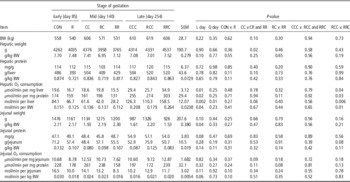
BW was not influenced by day of gestation or dietary treatment except for a tendency (P=0.10) for CC cows to be heavier than CR and RR cows (Table 1). When comparing CC to RR cows, RR cows had decreased BW (P=0.05) compared with CC cows (data not shown; Camacho et al., Reference Camacho, Lemley, Van Emon, Caton, Swanson and Vonnahme2014).
Influence of stage of gestation and dietary restriction and realimentation on maternal hepatic and jejunal weights and O2 consumption

CON or C=control, fed at 100% of NRC (2000) recommendations, R=restricted, fed at 60% of NRC (2000) recommendations starting at day 30 and continuing until day 85 (R) or 140 (RR); L=linear effects of stage of gestation with CON, CC and CCC treatments; Q=quadratic effects of stage of gestation with CON, CC and CCC treatments; CON v. R; CC v. RC and RR; RC v. RR; CCC v. RCC and RRC; RCC v. RRC=contrast statements within slaughter days (day 85, day 140 or day 254 of gestation).
n=6, 6, 6, 5, 6, 6, 5, 6 for CON, R, CC, RC, RR, CCC, RCC and RRC treatments, respectively.
Hepatic weight (g) did not differ as gestation advanced or between treatments on day 85 and day 254. However, on day 140 hepatic weight (g) was greater (P=0.02) in CC v. RC and RR. Relative hepatic weight (g/kg BW) tended (P=0.10) to linearly decrease as gestation advanced. There were no effects of treatment on relative hepatic weight. Hepatic protein concentration (mg/g) or content (g/liver or g/kg BW) was not influenced by day of gestation or treatment. Maternal hepatic O2 consumption (μmol/min per mg liver, μmol/min per mg protein, mol/min per kg BW) linearly increased (P⩽0.04) with advancing gestation. A quadratic effect was observed (P=0.01) for total hepatic O2 consumption (mol/min per liver) with consumption decreasing from day 85 until day 140 and then increasing from day 140 until day 254. When analyzing the data between the treatment groups, no differences were observed for hepatic O2 consumption on day 85 or day 140. All measures of hepatic O2 consumption were greater (P⩽0.04) in RRC than in RCC on day 254.
Total O2 consumption per liver tended (P=0.06) to be greater in CC than in CR and RR cows on day 140. Jejunal weight (g) tended to linearly decrease (P=0.10) and linearly decreased (P=0.04) when analyzed relative to BW (g/kg BW) as gestation advanced. Jejunal weight was not influenced by treatment. Jejunal protein concentration (mg/g) tended (P=0.08) to linearly increase and jejunal protein content (g/jejunum or g/kg BW) was not influenced by advancing gestation. Treatment did not influence protein concentration (mg/g) or content (g/jejunum and g/kg BW) in the jejunum on day 85 and day 140. Jejunal protein content (g/jejunum) tended to decrease (P=0.08) in RRC when compared with RCC cows although protein concentration and protein content relative to BW did not differ. Jejunal O2 consumption per milligram of tissue was not influenced by advancing gestation. Jejunal O2 consumption per milligram tissue did not differ between treatments on day 85 or day 254 and tended (P=0.09) to be greater in CC than CR and RR cows on day 140. Total O2 consumption relative to BW (mol/min per kg BW) in the jejunum tended to linearly decrease (P=0.06) with advancing gestation. Jejunal O2 consumption per milligram protein was not influenced by advancing gestation or by treatment on day 85 and day 254 but tended to be greater (P=0.08) in RC than RR cows on day 140. Total O2 consumption per jejunum was not influenced by advancing gestation. Total O2 consumption per kilogram BW tended (P=0.06) to linearly decrease with advancing gestation. Total O2 consumption (mol/min per jejunum and mol/min per kg BW) in the jejunum was not influenced by treatment on day 140 or day 254 and tended to be greater (P=0.10) in CON than R cows on day 85.
Fetal
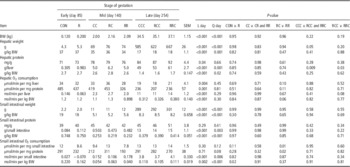
A quadratic effect (P<0.001) was observed with advancing gestation in fetal BW since BW weight increased to a greater extent over mid to late-gestation than during early gestation (Table 2). There were no differences in BW between treatments.
Influence of stage of gestation and dietary restriction and realimentation on fetal hepatic and small intestinal weights and O2 consumption

CON or C=control, fed at 100% of NRC (2000) recommendations, R=restricted, fed at 60% of NRC (2000) recommendations starting at day 30 and continuing until day 85 (R) or 140 (RR); L=linear effects of stage of gestation with CON, CC and CCC treatments; Q=quadratic effects of stage of gestation with CON, CC and CCC treatments; CON v. R; CC v. CR and RR; RC v. RR; CCC v. RCC and RRC; RCC v. RRC=contrast statements within slaughter days (day 85, day 140 or day 254 of gestation).
n=6, 6, 6, 5, 6, 6, 5, 6 for CON, R, CC, RC, RR, CCC, RCC and RRC treatments, respectively.
Hepatic weight (g and g/kg BW) was affected quadratically (P<0.001) as absolute hepatic weight (g) increased and relative hepatic weight (g/kg BW) decreased to a greater extent from mid to late-gestation than during early gestation. Hepatic weight (g) did not differ between treatments on day 85 or day 140 and was greater in RCC and RRC than CCC fetuses on day 254. Relative hepatic weight (g/kg BW) was not influenced by treatment. Hepatic protein concentration (mg/g) increased linearly (P=0.04) with advancing gestation and did not differ between treatments. Hepatic protein content (mg/g and g/liver) responded quadratically (P<0.001) as absolute protein content (mg/g) increased and relative protein content (g/kg BW) decreased to a greater extent from mid to late-gestation than during early gestation. Total hepatic protein content (g/liver) was not influenced by treatment on day 85 and day 140, and on day 254 protein content was greater (P⩽0.03) in RRC and RRC than in CCC fetuses and in RRC than in RCC fetuses. Fetal hepatic O2 consumption (μmol/min per mg liver) decreased (P=0.004) with advancing gestation. Hepatic O2 consumption (μmol/min per mg liver) was not influenced by treatment on day 85 and day 254 and tended (P=0.10) to be greater in RC v. RR fetuses on day 140. Hepatic O2 consumption (μmol/min per mg protein) linearly decreased (P=0.001) with advancing gestation and did not differ between treatments. Total hepatic O2 consumption increased (P=0.001) with advancing gestation, did not differ between treatments on day 85 and day 140, and tended to be greater in RRC than RCC cows on day 254. Total hepatic O2 consumption relative to BW (mol/min kg BW) decreased (P<0.001) with advancing gestation, did not differ between treatments on day 85 and day 254, and tended (P=0.06) to be greater in RC than RR cows on day 140.
Fetal small intestinal weight responded quadratically (P<0.001) as absolute small intestinal weight (g) increased and relative proportional weight (g/kg BW) decreased to a greater extent from mid to late-gestation than during early gestation. Small intestinal weight and protein concentration (mg/g) was not influenced by treatment. Total small intestinal protein content (g/small intestine) responded quadratically (P=0.003) as protein content increased to a greater extent from mid to late-gestation than during early gestation. Total small intestinal protein content relative to BW (g/kg BW) responded quadratically with the lowest protein content observed on day 140. Dietary treatment did not influence fetal small intestinal protein content (g/small intestine). Fetal small intestinal O2 consumption (μmol/min per mg small intestine) was not influenced by advancing gestation, was not influenced by treatment on day 85 and day 254, and was greater (P=0.01) in RC than RR fetuses on day 140. Small intestinal O2 consumption per milligram protein tended (P=0.08) to respond quadratically with the lowest O2 consumption observed on day 140, was not influenced by treatment on day 85 and day 254, and was greater (P=0.02) in RC than in RR fetuses on day 140. Total fetal O2 consumption (mol/min per small intestine) responded quadratically (P=0.006) as total O2 consumption increased to a greater extent from mid to late-gestation than during early gestation and was not influenced by treatment. Total O2 consumption relative to BW (mol/min per kg BW) in the small intestine responded quadratically with the lowest relative O2 consumption observed for fetal small intestine from day 140. Total O2 consumption relative to BW (mol/min per kg BW) was greater (P=0.02) in CON than R fetuses on day 85 and no differences were observed on day 140 or day 254.
Discussion
Maternal
Tissue mass and metabolic activity influence energy use by tissues in ruminants (Goetsch, Reference Graham1998). Previous research using pregnant sheep as a model (Scheaffer et al., Reference Scheaffer, Caton, Bauer, Redmer and Reynolds2003 and 2004) have demonstrated that changes in the GIT of the dam occur with the advance of pregnancy, which can also be influenced by changes in nutrient intake (Carlson et al., Reference Carlson, Reed, Borowicz, Taylor, Reynolds, Neville, Redmer, Vonnahme and Caton2009). The current study shows the alterations in maternal hepatic O2 consumption and jejunal mass and O2 consumption over different stages of gestation in the cow. Oxygen consumption (as an indirect indicator of energy expenditure) in rat visceral tissues accounts for a large proportion of whole body O2 consumption and it has been observed to vary depending on level of intake (Dumas et al., Reference Dumas, Roussel, Simard, Douay, Foussard, Malthiery and Ritz2004), physiological status of steers (Reynolds and Huntington, Reference Reynolds and Huntington1988) and livestock animal age (Verstegen, Reference Verstegen1989). In our study, maternal hepatic O2 consumption was increased as pregnancy advanced, while tissue mass was maintained.
Adaptation of metabolism and physiology are required for the cow to respond to nutrient restriction during gestation (Rosso and Streeter, Reference Rosso and Streeter1979). The tendency in decreased maternal BW during mid-gestation (day 140) observed in the groups exposed to restricted nutrient intake (RC and RR) from either day 30 to 85 or day 30 to 140 of gestation might occur in response to the increased nutrient demand in response to pregnancy. Although the results reported in this manuscript report only minor changes in BW resulting from nutrient restriction, results from a companion study (Camacho et al., Reference Camacho, Lemley, Van Emon, Caton, Swanson and Vonnahme2014) utilizing the same dietary treatments concluded that percentage of BW change at day 85 increased when compared with the other groups. Although cows in the control group did not increase in BW as gestation advanced, increased BW on day 140 and increased BW change in the CC v. RR cows suggested differences in plane of nutrition. The results also indicate that NRC (2000) under-predicted NE requirements during gestation in this experiment. This may be because of limited data available on nutrient requirements of non-lactating mature pregnant cows in early to mid-gestation. We chose to utilize non-lactating cows in an attempt to separate potential effects resulting from stage of lactation v. gestation. More research is needed on the effects of nutrition on tissue energy use in lactating pregnant cows during early to mid-gestation.
Our results agree with the suggestions made by Freetly and Ferrell (Reference Freetly and Ferrell1997) that hepatic O2 consumption increases throughout gestation when measured using catheterized ewes. The increased O2 consumption occurs as a response to the increased energy requirements by the dam as pregnancy advances (Graham, Reference Goetsch1964). Scheaffer et al. (Reference Scheaffer, Caton, Bauer, Redmer and Reynolds2003), however, reported no differences in in vitro O2 consumption per gram of liver at different stages of gestation in heifers. The decreased mass of the jejunum resulting in a tendency for reduced O2 consumption that we observed contradicts previous research that demonstrated that mass either remained unchanged or increased in response to pregnancy in heifers (Scheaffer et al., Reference Scheaffer, Caton, Bauer, Redmer and Reynolds2003 and Reference Scheaffer, Caton, Redmer and Reynolds2004). The differences in results may be because of physiological differences between heifers with mature cows and the necessity to partition nutrients and energy to both growth and gestation (Scheaffer et al., Reference Scheaffer, Caton, Bauer, Redmer and Reynolds2003). It appears that mass of the jejunum was decreased as an adaptation mechanism in order for the dam to support fetal growth throughout gestation, because intestinal cell turnover and function are known to have a high energy requirement in the sheep (Scheaffer et al., Reference Scheaffer, Caton, Redmer and Reynolds2004). The decreased O2 consumption may also be an indicator of this adaptation as gestation advanced. Perhaps, the energy obtained from absorption and metabolism is being directed more towards the support for fetal development, rather than to support tissue maintenance. These results can be supported by data published by Camacho et al. (Reference Camacho, Lemley, Van Emon, Caton, Swanson and Vonnahme2014) which reported a decrease in maternal BW and BCS throughout gestation. An increase in BW and BCS was observed when cows were realimented. Dietary restriction or realimentation did not influence jejunal oxygen consumption, which is in agreement with data from Carlson et al. (Reference Carlson, Reed, Borowicz, Taylor, Reynolds, Neville, Redmer, Vonnahme and Caton2009) in sheep.
Dietary changes appear to modulate how the maternal GIT adapts to both luminal nutrient supply and physiological state (Meyer et al., Reference Meyer, Reed, Vonnahme, Soto-Navarro, Reynolds, Ford, Hess and Caton2012). Timing of nutrient restriction during pregnancy could impact how tissues respond in terms of mass and energy use. In our study, no difference was observed with diet restriction in maternal tissue mass during early gestation. Past work has suggested that hepatic O2 consumption decreases with nutrient restriction in growing lambs (Ferrell et al., Reference Ferrell, Koong and Nienaber1986; Burrin et al., Reference Burrin, Ferrell, Eisemann, Britton and Nienaber1989). Changes in mass and O2 consumption have been previously attributed to occur in response to decreased DM intake and consequently metabolizable energy by nutrient-restricted animals (Ferrell et al., Reference Ferrell, Koong and Nienaber1986). Perhaps, these changes occur to adjust to the restricted amount of available nutrients to maintain BW (Ferrell et al., Reference Ferrell, Koong and Nienaber1986; Burrin et al., Reference Burrin, Ferrell, Eisemann, Britton and Nienaber1989). Research in pregnant cows fed at either 85% or 140% of NE requirments indicated that cows fed at the lower NE intake level from mid-gestation until day 250 had decreased hepatic in vitro O2 consumption per gram protein or relative to BW but hepatic weight did not differ between treatments (Wood et al., Reference Wood, Awda, Fitzsimmons, Miller, McBride and Swanson2013). This may indicate nutrient restriction later in gestation may have different effects than during early or mid-gestation.
The effects of restriction on the dam were also observed on maternal hepatic weight (g), which decreased in the groups exposed to nutrient restriction. Perhaps, this is occurring as a response to decreased nutrient intake combined with the high tissue energy requirement of this organ. The mass data are in agreement with a previous study showing that hepatic mass decreased in response to nutrient restriction in pregnant ewes (Scheaffer et al., Reference Scheaffer, Caton, Redmer and Reynolds2004). Moreover, the tendency for maternal jejunal O2 consumption to be lower in RR and RC cows suggests that the tissue was adapting to reduced nutrients available by decreasing energy use while maintaining tissue mass possibly in an attempt to improve energetic efficiency. This is also supported by the tendency for decreased O2 consumption per milligram protein in RR v. RC at day 140. At day 254, maternal hepatic O2 consumption was decreased in RCC when compared with RRC, which may be occurring in response to increased feed intake after restriction during early gestation. However, the majority of the mass and O2 consumption measures were not different between treatments at day 254 suggesting that cows were able to compensate in response to different lengths of nutrient restriction and realimentation.
Fetal
Changes in maternal nutrition also can impact the development of the fetus (Wu et al., Reference Wu, Bazer, Wallace and Spencer2006). Previous research has indicated that nutrient restriction in pregnant ewes can impact intestinal development (Meyer et al., Reference Meyer, Reed, Neville, Taylor, Reynolds, Redmer, Vonnahme and Caton2010; Yunusova et al., Reference Yunusova, Neville, Vonnahme, Hammer, Reed, Taylor, Redmer, Reynolds and Caton2013). Less is known about the timing of restriction and also of realimentation on development of visceral tissues in the fetus.
The quadratic effects on fetal BW and organ mass as pregnancy advanced were expected with greater growth occurring in late gestation. Furthermore, hepatic O2 consumption per milligram tissue or per milligram protein decreased as mass increased; while small intestinal O2 consumption per small intestine and relative to BW responded quadratically decreasing until mid-gestation and increasing during the last period of gestation. The result observed in the intestinal tissue may be an indication that the energy requirement per gram of tissue is increased in the last third of gestation when fetal body growth is occurring at a greater rate. Perhaps, it may also be linked to the fact that during mid-gestation enteral amniotic fluid starts to be ingested by the fetus and serves as a source of nutrients required by the fetus (Underwood et al., Reference Underwood, Gilbert and Sherman2005; Sangild, Reference Sangild, Schmidt, Elnif, Bjornvad and Buddington2006). To our knowledge, limited information has been reported on changes of fetal tissue mass and tissue specific energy use in response to different stages of gestation in ruminants.
In response to changes in maternal nutritional intake, a decrease in fetal small intestinal O2 consumption per kilogram BW was observed in the restricted group at day 85. This decreased O2 consumption was not because of decreased tissue mass and was mostly driven by the numerical decrease (P=0.11) in O2 consumption per milligram tissue. Differences in fetal small intestinal mass in response to changes in the amount of nutrients consumed by the dam was not observed during the entire gestational period. The lack of an effect on small intestinal mass does not agree with previous literature which reported that nutrient restriction during early to mid-gestation in ewes caused alterations in fetal organ growth that were permanent and not influenced by supplementation later in gestation (Thomas and Kott, Reference Thomas and Kott1995). Lower absolute O2 consumption in fetal small intestine persisted until mid-gestation in the restricted group. However, the increase observed in the group that was realimented at day 85 suggests that increased available nutrients promote increased metabolism in the small intestine; which perhaps, is utilized to support development that may have been delayed due to previous nutrient restriction. Interestingly, Meyer et al. (Reference Meyer, Reed, Neville, Taylor, Reynolds, Redmer, Vonnahme and Caton2010) reported increased cellular proliferation in fetuses from cows undergoing nutrient restriction. Perhaps cellular proliferation is upregulated in preparation for potential increased nutrient supply whereby allowing for decreased cellular turnover and increased growth. Interestingly, at day 254 of gestation, the difference in fetal small intestinal O2 consumption was not observed in the groups that had been previously restricted and then realimented possibly because the restriction occurred during early or mid-gestation. The results suggest that changes in maternal small intestinal mass and O2 consumption during gestation might have improved the efficiency of the small intestine of fetuses developing in a nutrient-restricted environment. The possible improvement in fetal efficiency may be explained by the fact that fetuses were exposed to a restricted environment during angiogenesis and vascularization at the fetal and maternal portion of placentation and organogenesis. In a similar study using the same maternal nutrient restriction followed by realimentation model (Camacho et al., Reference Camacho, Lemley, Van Emon, Caton, Swanson and Vonnahme2014), blood flow to the pregnant uterine horn was increased after cows that were restricted during early and mid-gestation were realimented. Perhaps, a fetus developing in an uterine environment during late gestation that is receiving increased blood flow and consequently more nutrients, might be programmed to better respond to changes in nutrient availability during the growth period. These metabolic changes during early and mid-gestation could potentially contribute to adaptations of the fetus to become more efficient later in life in the utilization of nutrients as gestation advances (Camacho et al., Reference Camacho, Lemley, Van Emon, Caton, Swanson and Vonnahme2014). The greater fetal hepatic mass observed in the restricted groups (RCC and RRC v. CCC) on day 254 is in agreement with previous studies (Vonnahme et al., Reference Vonnahme, Hess, Hansen, McCormick, Rule, Moss, Murdoch, Nijland, Skinner, Nathanielsz and Ford2003). Perhaps the restriction earlier in gestation followed by realimentation resulted in a shift in the growth of the liver because of increased needs for metabolism to support rapid growth of the fetus in late gestation. This can be supported by our observation that O2 consumption by the liver tended to be reduced in the group that was realimented for a longer period (RCC v. RRC).
Conclusion
Maternal and fetal tissue mass and O2 consumption change as gestation advances. Our data indicate that longer periods of restriction (day 85 until day 140) followed by realimentation up until late-pregnancy (day 254) increases hepatic O2 consumption in the cow. Nutrient restriction in early pregnancy reduces O2 consumption and realimentation up until mid-pregnancy increases O2 consumption in the fetal small intestine. This may indicate that cows and fetuses have the ability to adapt to restriction and realimentation by altering mass or energy use in an attempt to increase the digestion and utilization of feed or to alter maintenance requirements to maintain fetal growth and development. However, maternal realimentation and length of realimentation has the potential to change the effects observed in cows and fetuses by mid or late-gestation. Dams may alter their metabolism to be more efficient during nutrient restriction to help maintain desirable fetal development of the liver and small intestine; although, more research is necessary to determine how this impacts future productivity of the cow or development of the offspring after birth.
Acknowledgments
The authors thank the employees of the North Dakota State University (NDSU) Animal Nutrition and Physiology Center, Meat Laboratory and Nutrition Laboratory. The authors would also like to thank NDSU Animal Sciences faculty, staff, graduate students and undergraduate students for their assistance with the project. This project has been funded in part by Agriculture and Food Research Initiative Competitive Grant no. 2009-65203-05812 from the USDA National Institute of Food and Agriculture to K. A. Vonnahme and K. C. Swanson.