

INTRODUCTION
One of the most important issues when considering subsurface ice deposits and their potential use as paleoclimate archives is their age (Luetscher et al. Reference Luetscher2013). There might be plenty of options for dating near-surface cave ice deposits (Luetscher et al. Reference Luetscher, Bolius, Schwikowski, Schotterer and Smart2007; Kern Reference Kern2018). Radiocarbon (14C) analysis has became the most frequently used option, allowing the direct dating of cave ice sequences, at least when sufficient organic remnants are to be found (e.g., Hercmann et al. Reference Hercman, Gąsiorowski, Gradziński and Kicińska2010; Perşoiu and Pazdur Reference Perşoiu and Pazdur2011; Sancho et al. Reference Sancho, Belmonte, López-Martínez, Moreno, Bartolomé, Calle and Santolaria2012, Reference Sancho, Belmonte, Bartolomé, Moreno, Leunda and López-Martínez2018; Spötl et al. Reference Spötl, Reimer and Luetscher2014; Gradziński et al. Reference Gradziński, Hercman, Peresviet-Soltan, Zelinka and Jelonek2016; Munroe et al. Reference Munroe, O’Keefe and Gorin2018; Perşoiu et al. Reference Perșoiu, Onac, Wynn, Blaauw, Ionita and Hansson2017). However, the dating of cave ice bodies settled deep in the high mountain karstic environment is often a great challenge due to the relative scarcity of embedded organic materials (e.g. May et al. Reference May, Spötl, Wagenbach, Dublyansky and Liebl2011).
A novel dating approach was introduced a decade ago, targeting glacier ice cores, and based on extracting at the microgram level organic carbon fractions embedded in the ice matrix for 14C dating (Jenk et al. Reference Jenk, Szidat, Schwikowski, Gäggeler, Brütsch, Wacker, Synal and Saurer2006, Reference Jenk, Szidat, Schwikowski, Gäggeler, Wacker, Synal and Saurer2007). The approach was first tested on samples derived from cave ice core from Eisriesenwelt (May et al. Reference May, Spötl, Wagenbach, Dublyansky and Liebl2011). Although radiocarbon dating performed on small particulate organic matter separated from the cave ice samples proved inconclusive, probably due to a background contamination introduced by the antifreeze drilling liquid applied, a crude estimate giving a basal ice age in the order of several thousand years could be achieved. The method for surface ice cores has since been further improved (Uglietti et al. Reference Uglietti, Zapf, Jenk, Sigl, Szidat, Salazar and Schwikowski2016; Hoffmann et al. Reference Hoffmann, Preunkert, Legrand, Leinfelder, Bohleber, Friedrich and Wagenbach2017) and cave ice also reconsidered as potential targets in the Alpine cryosphere (Hoffmann et al. Reference Hoffmann, Bohleber and Wagenbach2015; Colucci et al. Reference Colucci, Luetscher, Festi, Mosley, Schwikowski and Edwards2018).
The age of meteoric waters originating from modern (i.e. post mid-20th century) precipitation can be estimated based on their tritium (3H) activity. Tritium is a valuable tool in the determination of the age of a cave ice deposits formed from meteoric waters over the past 60–70 years (Borsato et al. Reference Borsato, Miorandi and Flora2006; Kern et al. Reference Kern, Molnár, Svingor, Perşoiu and Nagy2009).
In the research presented here, the 14C analysis of carbonaceous particulate matter was tested on archived ice samples available from a cave ice core extracted without the use of antifreeze drilling liquid. The samples were taken from the Saarhalle ice block in the Dachstein-Mammoth cave (Mammuthöhle), Austria. Tritium activity has already been measured in eight water samples from the melted ice core of the Saarhalle Dachstein-Mammoth Cave using the liquid scintillation counting (LSC) technique (Kern et al. Reference Kern, Fórizs, Pavuza, Molnár and Nagy2011). None of those samples, however, provided detectable tritium activity. In this study a more sensitive method was applied to measure the 3H activity of additional samples from the upper part of the ice core. The new radiometric ages allowed the placing of chronological constraints on the 5.8 m long profile and supported a substantial revision of previous opinion concerning the age of the ice block.
SITE DESCRIPTION
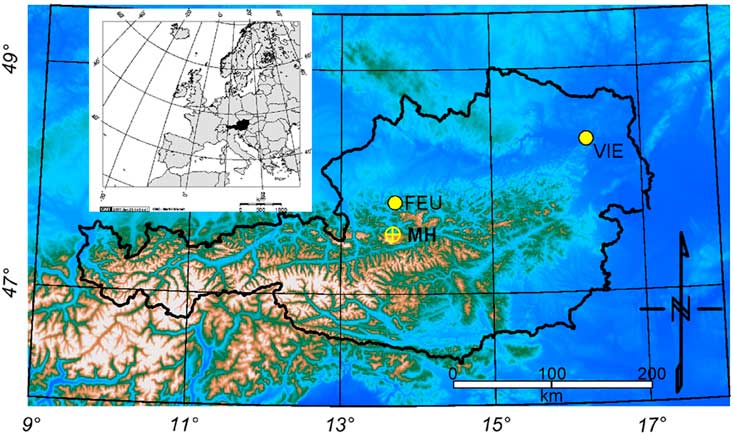
The cave system is located in the Dachstein Mountains of the Northern Calcareous Alps (Figure 1). The total length of all passages in Dachstein-Mammoth Cave amounts to 67.5 km, and the vertical extension is 1.2 km making it the fourth longest and fifth deepest cave in Austria (Spötl et al. Reference Spötl, Plan and Christian2016). Perennial ice is present in two huge chambers, Feenpalast and Saarhalle, not far from the western entrance (Spötl et al. Reference Spötl, Wimmer, Pavuza and Plan2018). These glaciated chambers have been targets of annual ice level measurements in combination with cave air monitoring since the 1990s (Mais and Pavuza Reference Mais and Pavuza2000). The monitoring data revealed that the air temperature in the Saarhalle follows the temperature fluctuations of the Feenpalast with a reduced amplitude during the winter ventilation regime (~from November to early May; Mais and Pavuza Reference Mais and Pavuza2000) suggesting that the cold outside air flows in the Saarhalle chamber via the Feenpalast. While, air temperature rises slightly above the freezing point (0.1–0.2°C) during the rest of the year. The mean annual air temperature in the Saarhalle ranged from –0.46°C to –0.10°C in the period 1996–2000, and the long-term average was –0.30°C (Mais and Pavuza Reference Mais and Pavuza2000). Dripping water entering to the Saarhalle chamber passes through a ~60-m-thick rock overburden. This type of water supply has probably fed the ice accumulation in historical times. However, no current ice accumulation was observed in this chamber; rather, the ice level shows a steady decline since 1996 at a nearly constant rate of –7 cm/yr (Mais and Pavuza Reference Mais and Pavuza2000, unpublished data until 2014).
Relief map of Austria with the location of Dachstein-Mammoth Cave (MH) and the reference stations (Feuerkogel: FEU and Vienna: VIE). The inset map shows the location of Austria within Europe in black.
The lateral extension of the Saarhalle ice body is 40×15 m (Behm and Hausmann Reference Behm and Hausmann2008) and the estimated maximum ice thickness, determined by ground penetrating radar, was ~6 m in 2008 (Hausmann and Behm Reference Hausmann and Behm2011).
METHODS
Ice Drilling and Sample Selection
A 5.28-m-long ice core was extracted from the Saarhalle ice block in September 2009 and sectioned into 105 subsamples on the spot, each subsample’s length being ~5 cm (Kern et al. Reference Kern, Fórizs, Pavuza, Molnár and Nagy2011). The melted samples not used in the first stage of the analysis were stored in well-sealed centrifuge tubes at room temperature. Five samples were selected from the stored ice core samples in 2015 to test the accelerator mass spectrometry (AMS) 14C analysis of the water-insoluble carbonaceous matter embedded in the ice, and 11 samples were selected from the upper 2 m section in 2012 for 3He-ingrowth analysis using noble gas mass spectrometry.
Radiocarbon Analysis by Stepped Combustion
A standard pre-treatment with 1–2 mL C-free hydrochloric-acid (1N) was added to the melted samples (1–2 mL liquid) and reacted at 75°C for 2 hr in order to remove inorganic carbon (Molnár et al. Reference Molnár, Janovics, Major, Orsovszki, Gönczi, Veres, Leonard, Castle, Lange, Wacker, Hajdas and Jull2013a). Pretreated samples were then freeze-dried into quartz combustion tubes and subjected to stepped combustion in pure O2 gas atmosphere first at 400°C (Step 1), then at 800°C (Step 2) (Újvári et al. Reference Újvári, Molnár and Páll-Gergely2016). In Step 1 (400°C combustion) the easy-burning non-charred organic carbon is released from the ice samples, while afterward in Step 2 all the rest of the charred carbon fraction is mobilized, including elemental sources. The developed CO2 of the two fractions were graphitized by a sealed-tube graphitization method (Rinyu et al Reference Rinyu, Orsovszki, Futó, Veres and Molnár2015); and measured separately by the EnvironMICADAS AMS system in Debrecen, Hungary (Molnár et al. Reference Molnár, Rinyu, Veres, Seiler, Wacker and Synal2013b).
The conventional 14C ages were calculated according to the method to be found in Stuiver and Polach (Reference Stuiver and Polach1977), using the Libby half-life (5568 yr), and corrected for isotope fractionation using the AMS measured 13C/12C ratio, which accounts for both natural and machine fractionation. The calibration of conventional 14C dates to calendar years were performed using the OxCal 4.2.4 (Bronk Ramsey Reference Bronk Ramsey2009) program in conjunction with the Northern Hemisphere IntCal13 (Reimer et al. Reference Reimer, Bard, Bayliss, Beck, Blackwell, Bronk Ramsey, Grootes, Guilderson, Haflidason, Hajdas, Hatte, Heaton, Hoffmann, Hogg, Hughen, Kaiser, Kromer, Manning, Niu, Reimer, Richards, Scott, Southon, Staff, Turney and van der Plicht2013) dataset.
Tritium Activity Determined by the 3He-Ingrowth Method
The water samples were first distilled and filled into metal canisters. After degassing, the metal container was closed and stored for several months to allow 3He ingrowth from tritium decay. Finally, the sample containers were connected to the inlet line of the noble gas mass spectrometer and the He fraction was allowed to enter a dual collector noble gas mass spectrometer (VG 5400), and 3He and 4He were measured simultaneously, applying the peak height method. During the sample intake, an ultrapure 4He spike was added to each sample (Palcsu et al. Reference Palcsu, Major, Köllő and Papp2010). Tritium activity is expressed in tritium units, (1 TU= 0.119 Bq/L=6.68×107 3H atoms/L). The overall precision of the tritium measurements was better than 2.4% above 1 TU, if sample size was larger than 500 mL. For samples of 30–40 mL, the detection limit is about 0.8 TU, roughly one tenth that of the previously applied LSC method.
The ice core derived tritium activity record was then compared to the regionally available historical inventories. The monthly mean tritium concentration of past precipitation was obtained for Feuerkogel from the Austrian Network of Isotopes in Precipitation (Kralik et al. Reference Kralik, Papesch and Stichler2003), and for Vienna from the Global Network of Isotopes in Precipitation (IAEA 2010). The decay-corrected tritium activity both of past precipitation and ice core samples were calculated for 01.09.2009 using a half-life of 12.32 yr (Lucas and Unterweger Reference Lucas and Unterweger2000).
RESULTS AND DISCUSSION
Most of the samples yielded sufficient carbon (>0.1 mg; Uglietti et al. Reference Uglietti, Zapf, Jenk, Sigl, Szidat, Salazar and Schwikowski2016) for the applied sealed-tube graphitization method and AMS 14C analysis. The exceptions were the Step 2 fraction of MH24 and both fractions of the MH26 sample. The obtained conventional 14C results for the Step 2 fraction gave significantly older ages than those of the Step 1 fraction (Table 1). These results send an immediate methodological warning message, because the applied slight acidification and single step combustion at 800°C combustion of the total carbon content is a standard protocol in many AMS Labs. However, in the case of single step combustion one would get a “mixed” result from the different carbon-pools, which can then in turn result in a false age estimate.
Radiocarbon age results of particulate organic matter separated from the Saarhalle cave ice core.

a Depth of the midpoint of the represented interval below the September 2009 ice surface.
b Fractions of the two-step combustion Step 1: 400°C and Step 2: 800°C.
c Propagated error estimated from the analytical uncertainty and the assigned uncertainty of the reservoir bias.
In addition, the ages obtained for the 800°C fractions from stepped combustion stand in contradiction to the stratigraphic position of the samples, while the 400°C fractions conform to stratigraphy (Table 1). The 400°C results can provide only maximum age estimates (the ice layer cannot be older than this age) because the water frozen in the ice layer might have already been carrying aged organic carbon (e.g. derived from the aged soil carbon at the surface during infiltration). These findings provide a plausible explanation for the older-than-expected age obtained in single step 14C analysis as reported from a cave ice deposit in the Southern Alps (Colucci et al. Reference Colucci, Forte, Maggi, Stenni, Barbante, Bertò, Dreossi, Filipazzi, Gabrieli, Hoffmann and Lenaz2016).
A potential explanation for the much lower activity of the Step 2 fraction could be that carbon bearing mineral species lacking detectable 14C and partially resistant to the applied slight acidification remained in the sample and combusted at 800°C. The observation that small angular limestone fragments were observed in MH98 (Kern et al. Reference Kern, Fórizs, Pavuza, Molnár and Nagy2011) which yielded the largest amount of carbon in Step 2 fraction and presented the oldest apparent age (Table 1) supports this potential explanation.
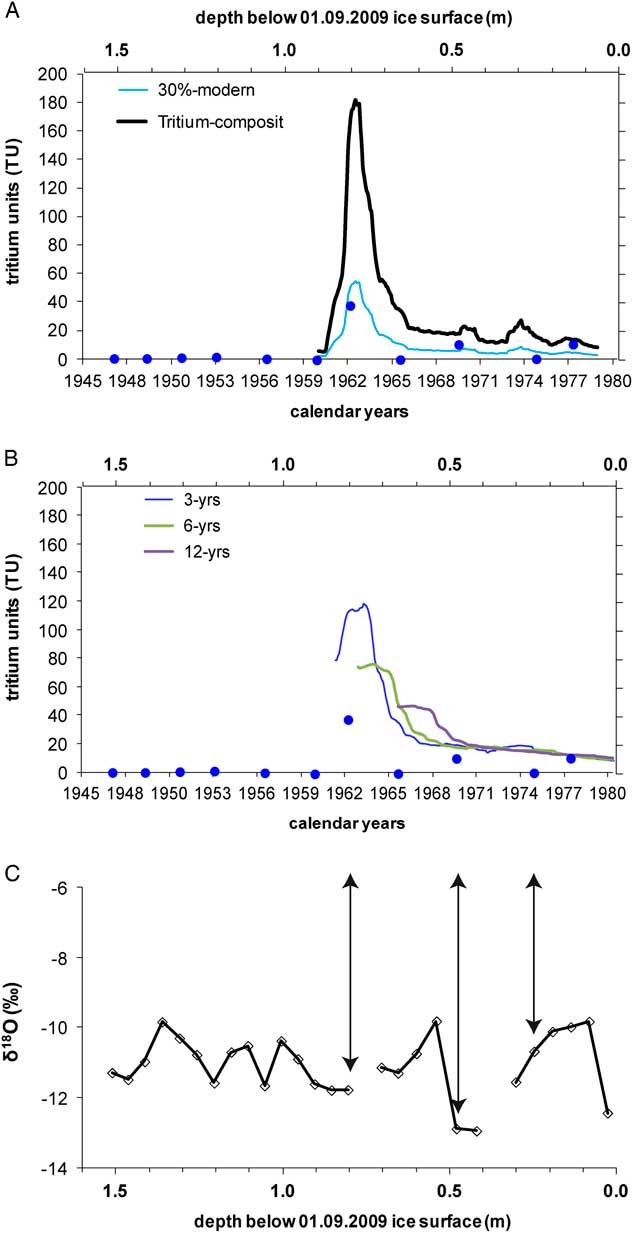
Four out of the 11 analyzed samples produced detectable tritium activity (Table 2, Figure 2) despite the fact that in a previous pilot study none of eight test samples provided detectable tritium activity using the less sensitive liquid scintillation counting (LSC) technique (Kern et al. Reference Kern, Fórizs, Pavuza, Molnár and Nagy2011). A technical explanation could be that the detection limit at the LSC method was ten times higher because it was not possible to apply electrolytic enrichment due to the small size of the sample. The ice core derived tritium record was compared to the regionally available historical inventories (Figure 2).
3H activity in regional precipitation (composite of monthly data from Feuerkogel and Vienna and decay corrected to 01.09.2009) and Saarhalle ice core obtained using the 3He-ingrowth method (blue dots). A: decay corrected annual mean 3H activities of precipitation (black) and the dampened signal assuming constant mixing of 30% modern precipitation and 70% tritium-free old water. B: decay corrected monthly 3H activities of precipitation smoothed with 3-yr (blue), 6-yr (green), and 12-yr (purple) moving averages simulating multiannual mixing in the karstic reservoir during the infiltration process. C: stable oxygen isotope composition of the cave ice samples in the upper 1.5 m section of the Saarhalle ice core (Kern et al. Reference Kern, Fórizs, Pavuza, Molnár and Nagy2011). (See online version for colors.)
Tritium activity with the uncertainty obtained using the 3He-ingrowth method of eleven selected samples of the Saarhalle cave ice core.

a Depth of the midpoint of the represented interval below the September 2009 ice surface.
The peak (37.2±1.2 TU) argues that the cave ice layer from the –0.76 to –0.86 depth range enclosed the atmospheric precipitation which fell in the mid-1960s period. Keeping in mind that the Saarhalle ice body has shown a continuously negative mass balance at least since 1996 (average surface ice loss rate: 7 cm yr−1; Mais and Pavuza Reference Mais and Pavuza2000) and documented until 2014. This fact not only excludes the existence of recent ice at the surface but also corresponds with 91 cm of cumulative ice loss before 2009. Hence 0.91 m can be added to the depth measured beneath the September 2009 ice surface to obtain a corrected depth scale for 1996. Consequently, the 3H-peak might be within the depth range represented by the MH14 or MH15 samples and the estimated ice accumulation for the pre-1996 period is in fact 5.06–5.2 cm/yr. Using this average ice accumulation rate, the age of the ice layer sampled at the top of the ice block in 2009 was estimated to ~1978 AD.
However, the magnitude of the 3H-peak is obviously far below the decay-corrected activity of the precipitation of the mid-1960s (Figure 2a). Two simple hypotheses were tested as potential explanations of the dampened signal found in the cave ice. The first one simulated the effect of constant and uniform dilution with a tritium-free water source (e.g. old karst water). The result obtained was that a mixture of ~30% modern precipitation and 70% old infiltrated water might produce activity comparable to that of mid-1960s infiltration as observed in the ice core (Figure 2a). In this case, however, the simulated infiltration from the later precipitation should be dampened to a level of ~1 TU, while in contrast, relatively high (>10 TU) activity levels have also been found at depths of 0.14 m and 0.48 m. In testing the second hypothesis, multiannual mixing in the karstic reservoir during the infiltration process was simulated, simply smoothing decay-corrected regional monthly precipitation 3H. The results showed that ~12 yr mixing could bring the peak down to the level measured in the ice core (Figure 2b). However, the 3H activity of the water supplied from such a well-mixed reservoir would be continuously at the >10 TU level after the mid-1960s. So, in this case we are again faced with a contradiction, seeing the ~0 TU samples measured at depths of 0.25 and 0.65 m.
The pattern suggests that an “old” tritium-free component may be mixed with the “modern” meteoric component, resulting in the observed intermediate levels of 3H. This mixed water sources scheme conforms to the earlier explanation offered for the stable isotope characteristics of the Saarhalle ice core (Kern et al. Reference Kern, Fórizs, Pavuza, Molnár and Nagy2011). Since the amount weighted δ18O value of the surface precipitation (−12.79‰) especially the winter season precipitation (−14.05‰) (Kern et al. Reference Kern, Fórizs, Pavuza, Molnár and Nagy2011), which is the main contribution to infiltration, is significantly more depleted compared to the average δ18O value of three local karst springs (−12.16‰; Scheidleder et al. Reference Scheidleder, Boroviczeny, Graf, Hofmann, Mandl, Schubert, Stichler, Trimborn and Kralik2001) a correspondence between the tritium-free points (MH05 and MH12) to less depleted stable isotope compositions compared to δ18O values of the samples (MH03, MH09, and MH15) with elevated 3H activity might further support this theory. However, the correspondence, unfortunately, is not fully conclusive. Stable oxygen isotope compositions of MH05 and MH12 are less depleted compared to MH15 or MH09, however MH03 does not show similarly negative value (Figure 2c).
Finally, we note that smaller ice deposits could be abundant in similar high Alpine karstic system approaching the vicinity of, or even penetrating into the periglacial zone. These smaller ice patches probably might also act as temporary reservoir for formerly infiltrated meteoric waters. Refreezing of meltwater released from this kind of ice patches or frozen conduits might further complicate the genesis of larger ice deposits in similar Alpine system. Extrapolating the estimated late-20th century ice accumulation rate (5.06–5.2 cm/yr) to the depths of MH21 and MH24 gave dates of ~1957 and ~1953, respectively, indicating a remarkable discrepancy between the age of the particulate organic matter (Table 1) and its host water/ice. The reliability of these extrapolated dates at the onset of the era of anthropogenic tritium contamination are supported by the fact that consistent 3H activity measured in the deeper samples are in close agreement with the expected decayed value (~0.2 TU) from the ~5 TU natural 3H of precipitation in Central Europe (Roether Reference Roether1967).
The obvious contrast between the deposition date estimated by the accumulation rate and obtained from the 14C analysis of the water-insoluble organic carbon can be explained by the fact that water frozen into the ice layer might have already been carrying an aged organic carbon (e.g. aged soil carbon) during infiltration. This is quite plausible, since soil organic matter with a 14C age exceeding 2000 yr has frequently been reported in Central Europe (Molnár et al. Reference Molnár, Joó, Barczi, Szántó, Futó, Palcsu and Rinyu2004), and the 14C age of organic matter in subsoils (>1 m depth) in all studied soil types worldwide exceeded 1,000 years (Rumpel and Kögel-Knabner Reference Rumpel and Kögel-Knabner2011). In extreme cases, mean 14C ages of >6800 yr have been reported for certain organic fractions of soils in the subalpine range of the Italian Alps (Egli et al. Reference Egli, Sartori, Mirabella, Favilli, Giaccai and Delbos2009).
The reservoir age bias (ΔR) of the 400°C fractions for MH21 and MH24 were estimated and rounded to the nearest integer as
 $${\rm \Delta R}_{{{\rm MH21}}} {\rm {\equals}CRA}_{{{\rm MH21}}} {\rm -exCRA}_{{{\rm MH21}}} {\rm {\equals} 1180-}\left( {{\rm -269}{\rm .2}} \right){\rm {\equals}1449}$$
and
 $${\rm \Delta R}_{{{\rm MH24}}} {\rm {\equals}CRA}_{{{\rm MH24}}} {\rm -exCRA}_{{{\rm MH24}}} {\rm {\equals}1790-}\left( {{\rm 201}{\rm .8}} \right){\rm {\equals}1588}$$
where CRA stands for “conventional radiocarbon age” of the sample (Table 1) and exCRA is the expected conventional age corresponding to the 3H based extrapolated ages of MH21 and MH24 drawn from the pentennial mean values of the calibration curve of the NH1 zone for Modern Time (Bomb13NH1.14c available in OxCal 4.2.4; Bronk Ramsey Reference Bronk Ramsey2013).
For the mean reservoir bias 1519±70 BP can be calculated from the individual estimates presented above. Assuming a constant average reservoir bias for the entire dated history of the cave ice, the raw 14C ages of the 400°C fractions of the deeper samples were corrected using the estimated mean ΔR (Table 1). The uncertainty of the bias corrected conventional dates was estimated from the analytical uncertainty and the uncertainty of the estimated mean ΔR following a Gaussian error propagation. The most likely age range of the calibrated age distribution of the deepest analyzed sample (MH98) is 2060–1608 cal BC accounting for 91.7% probability. Linear extrapolation to the bottom ice layer (5.28 m) based on the depths and median calibrated dates obtained for MH92 and MH98 gave 2590 cal BC.
The recent comprehensive compilation of 14C dates of organic remains in East Alpine ice caves (Spötl et al. Reference Spötl, Wimmer, Pavuza and Plan2018) presented three data from the Feenpalast deposit. A wood remain found at the base at the retreating cliff in the highest part of the Feenpalast, the second largest ice block in the Dachstein-Mammoth Cave, gave a conventional age of 695 ± 35 BP (Mais and Pavuza Reference Mais and Pavuza2000) while two wood samples collected at deeper layers are slightly older (851±45 BP and 1133±40 BP; Plan and Pavuza, unpublished). The new radiometric ages argue for a much older cave ice deposit of the Saarhalle chamber compared to the Feenpalast chamber of the Dachstein-Mammoth Cave.
The earliest date presented in the wood record from the Hundsalm Ice Cave—providing the largest currently available 14C dataset (n = 19) for an Alpine ice cave—was 2664±32 BP (895–796 cal BC) while the estimated age of four other samples was also ~1400 yr (Spötl et al. Reference Spötl, Reimer and Luetscher2014). Spötl et al. (Reference Spötl, Wimmer, Pavuza and Plan2018) compiled the 14C dates on other vegetal remains recovered occasionally from cave ice deposits in the Austrian Alps and recalibrated them using the current calibration dataset. Two wood samples from the basal ice of Eisgruben Eishöhle (Sarstein, Upper Austria) yielded 2210 ± 70 BP (400–65 cal BC) and 4520 ± 50 BP (3366–3030 cal BC), respectively (Achleitner Reference Achleitner1995; R Pavuza 2012, unpublished). A tree trunk released by the melting ice in Schneeloch, an ice-hosting shaft in the Schneealpe (Styria), was dated to 4360 ±30 BP (3085–2904 cal BC; Herrmann et al. Reference Herrmann, Pucher and Nicolussi2010). A single date was presented for Kraterschacht (Sengsengebirge) with 886±45 BP (1032–1242 cal AD; Weißmair Reference Weißmair2011).
In light of these data the Saarhalle ice block is among the oldest ice deposits of the Alps. The preserved ~4000-yr-long cave ice record definitely requires further research in the future.
CONCLUSIONS
The stepped combustion technique revealed a remarkable difference between the 14C activity of insoluble carbon fractions of the studied cave ice samples from the Saarhalle Dachstein-Mammoth Cave combusted at 400°C and 800°C. The age-relation obtained for the 800°C fractions contradicted the stratigraphic position of the samples; while the ages obtained for the 400°C fractions conformed to the stratigraphy. However, the 400°C conventional 14C age results still provided only maximum age estimates (the ice layer cannot be older than this age) because the water frozen the ice layer might have already carried aged organic carbon (e.g. transported from the aged soil carbon at the surface during infiltration). Tritium activities analyzed using the 3He-ingrowth method clearly indicated the contribution of modern water at least down to a depth of 1.21 m. Comparing the 3H based extrapolated ages of samples at 1.11 m (MH21) and 1.26 m (MH24) to the expected atmospheric signal of the calibration curve of NH1 zone, an average 14C reservoir age bias of ∼1500 BP was obtained. Assuming that the reservoir bias in the 14C signal was continuous and constant over the deposition history of the Saarhalle ice block, the corrected deposition date for the deepest analyzed sample could be estimated to ~1830 cal BC (2134–2081 [2.9%] 2060–1608 [91.7%] 1581–1562 [0.8%]) while a linear extrapolation based on the depths and median calibrated dates obtained for MH92 and MH98 to the bottom ice layer gave 2590 cal BC.
ACKNOWLEDGMENTS
The research was supported by the European Union and the State of Hungary, co-financed by the European Regional Development Fund in the project of GINOP-2.3.2.-15-2016-00009 “ICER” and LP2012-27/2012. The authors acknowledge Dachsteinhöhlen Cave Management (Stephan Höll) for permission to study the cave ice. This is contribution No. 61 of 2ka Palæoclimatology Research Group.



