Introduction
When young adults in sub-Saharan Africa are asked why they do not use condoms consistently, the most common response is ‘I trust my partner’ (Agha et al., Reference Agha, Kusanthan, Longfield, Klein and Berman2002; Plummer et al., Reference Plummer, Wight, Wamoyi, Mshana, Hayes and Ross2006; Chimbiri Reference Chimbiri2007; Tavory & Swidler, Reference Tavory and Swidler2009). However, while most surveys on condom use can identify respondents who did not use condoms because they trust their partners, these surveys rarely gather information on whether respondents who used condoms also trust their partners. As previous research has not gathered information as to whether people who use condoms trust their partners, the extent to which young adults in the on-going HIV epidemic trust their partners, the extent to which trust influences condom use, and whether certain relationship characteristics influence the relationship between trust and condom use has not yet been able to be assessed. Trust is ‘expectations that a … partner will behave benignly, based on the attribution of positive dispositions and intentions to the partner in a situation of uncertainty and risk,’ (Molm et al., Reference Molm, Takahashi and Peterson2000, p. 1402). Trust increases when partners have the opportunity to violate their partner's trust yet do not, or appear to not. Most often, trust begins to develop after individuals have been exposed to a small amount of risk. Over time, as partners repeatedly behave benignly towards each other, they increase both the trust they have for each other and the risk they are willing to take with each other.
Trust within sexual relationships has an added layer of complexity for individuals managing the risks of the AIDS epidemic in sub-Saharan Africa. In 2003 and 2004, the Dar se Salaam region of Tanzania had a generalized HIV epidemic with an estimated prevalence of 10.9% (TACAIDS et al., 2005). In a generalized epidemic, individuals can no longer identify ‘risky’ partners as those in the traditional high-risk groups and must consider the possibility that any partner could be risky. However, despite the generalized epidemic, condom use is not universal among young adults in Tanzania: 41.7% of females and 47.1% of males reported using a condom in their last sexual encounter with a non-marital partner (TACAIDS et al., 2005).
Understanding the relationship between trust and condom use among young adults is particularly important as they initiate sexual activity and begin to navigate sexual risk. Analysis of data from eight countries in sub-Saharan Africa (Agha et al., Reference Agha, Kusanthan, Longfield, Klein and Berman2002; all of the studies included young adults aged 15–24; three of the eight studies only interviewed young adults) shows that trust was the most frequent reason male respondents cited for not using a condom with their spouse (ranging from 47% in urban Cameroon to 73% in Eritrea). A dislike of condoms was the second most frequently cited reason. Male respondents rarely cited price, availability or partner objection as reasons for not using a condom with their spouse. The reasons males reported not using condoms with a regular, non-marital partner were similar to those for not using condoms with a spouse: trust was the most commonly cited reason for not using a condom in seven of the eight study sites, with the exception of urban Angola where 29% reported trust and 31% reported a dislike of condoms (Agha et al., Reference Agha, Kusanthan, Longfield, Klein and Berman2002).
While trust is the main reason for men not using condoms, women offer somewhat different frequencies of reporting trust, a dislike of condoms and partner objection than men. Among females, trust was the most or second most frequently cited reason for not using condoms with a husband (ranging from 28% in urban Angola to 54% in Eritrea). However, partner objection, cited by 10–20% of females, appears to play a non-negligible role in female respondents' reasons for not using condoms with their husbands. Additionally, trust was often the main reason female respondents cited for not using condoms with a regular, non-marital partner.
Focus group discussions on trust among young adults in various urban centres in sub-Saharan Africa, including Dar es Salaam, suggest that commitment, love and fidelity are essential to trusting a partner (Longfield et al., Reference Longfield, Klein and Berman2002). A generalized trust in one's partner appears to reduce the sense of risk associated with unprotected sex, despite not knowing a partner's sexual history or HIV status (Longfield et al., Reference Longfield, Klein and Berman2002). Individuals appear to feel safe from infection because they generally trust their partner, believing that the partner would not intentionally infect them. However, taken together with the low rate of HIV testing among young adults (for example 5.3% of young women and 5.9% of young men had been tested in the year prior to a 2003–2004 survey in Tanzania; TACAIDS et al., 2005), individuals possessing all the characteristics of generally trustworthy partners may unknowingly be HIV positive or expose their partner to other sexually transmitted infections.
Ultimately, the relationship between trust and condom use is not unidirectional: using or not using a condom probably influences feelings of trust in a partner just as trust in a partner probably influences condom use. Requesting condom use often implies that one of the partners has previously or is currently engaged in risk behaviours (MacPhail & Campbell, Reference MacPhail and Campbell2001; Longfield et al., Reference Longfield, Klein and Berman2002; Maharaj & Cleland, Reference Maharaj and Cleland2004; Thomsen et al., Reference Thomsen, Stalker and Toroitich-Ruto2004; Watkins, Reference Watkins2004; Haram, Reference Haram2005; Hattori, Reference Hattori2008; Tavory & Swidler, Reference Tavory and Swidler2009). While the implication that either partner may have been promiscuous in the past may erode feelings of trust in a partner, the implication that either partner is currently promiscuous may have more damaging and perhaps irreparable effects on feelings of trust, leading to the termination of the relationship. Further, the very act of not using condoms may be required to support the positive beliefs individuals have about their relationships and their desires for the future (Sobo, Reference Sobo1995). Additionally, not using condoms may subsequently be rationalized by thoughts of trusting the partner. Ultimately, when partners do not use condoms and neither partner becomes ill, their feelings of trust are likely to be reinforced.
Theories explaining condom use have long focused on the role of individuals' opportunities to use condoms, the availability of condoms, their motivation to use condoms, the perceived severity of the reproductive health problem they could incur if they do not use condoms, the likelihood of successfully using condoms, perceptions of condoms, and social support for condom use by family and peers, among other indicators (see, for example: Bond & Dover, Reference Bond and Dover1997; Adih & Alexander, Reference Adih and Alexander1999; MacPhail & Campbell, Reference MacPhail and Campbell2001; Meekers & Klein, Reference Meekers and Klein2002; Ao et al., Reference Ao, Sam, Manongi, Seage and Kapiga2003; Luke, Reference Luke2003; Plummer et al., Reference Plummer, Wight, Wamoyi, Mshana, Hayes and Ross2006; Meekers et al., Reference Meekers, Silva and Klein2006; Hattori et al., Reference Hattori, Richter and Greene2010). Recently, however, there has been an increased focus on the role of interpersonal factors, such as felt closeness (e.g. Santelli et al., Reference Santelli, Kouzis, Hoover, Polacsek, Burwell and Celentano1996) and trust, which may influence motivations to use condoms.
Compared with the relatively little research into interpersonal factors and trust, it is widely recognized that condoms are less likely to be used with spouses than with non-marital partners (Kapiga & Lugalla, 1996). Lower levels of condom use among married Tanzanians probably reflect less concern about preventing pregnancy as well as a perception that sex with a spouse does not put one at risk for HIV. Taken together Tanzanian young women's median age at first marriage of 19.3 years (among women aged 20–24 years) and the fact that 12.2% of married couples in urban areas of the country have a discordant HIV status (TACAIDS et al., 2005), understanding the interpersonal dynamics related to condom use and risk prevention during marriage remains critical.
This paper focuses on one of the many factors related to condom use: trust in a partner. Given the literature discussed above, there are many aspects related to trust in a sexual partner that are likely to influence condom use. An individual's general feeling of trust in a partner is likely to be associated with lower levels of condom use in many relationships. However, the association between trust and condom use may be explained by other characteristics, such as feeling that the relationship is on the path to marriage. For example, having met a partner's family indicates a step in the marriage process in Tanzania, and thus increases the enforceability of one's trust in a partner (Hattori, Reference Hattori2008). For these reasons, having met a partner's family will probably be associated with lower levels of condom use. Similarly, married individuals will probably report lower levels of condom use than those who are not married. As a partnership develops over time, condom use will probably decrease as time spent in the relationship increases. Additionally, respondents who believe their partner is honest and sincere may be more or less likely to use condoms depending on what their partner has disclosed. Knowledge of a partner's sexual history may lead to lower levels of condom use if a partner had limited prior sexual experiences, but higher levels of condom use if a partner had a more extensive sexual history. Young adults who feel more cautious about sex with their partner are expected to have higher levels of condom use.
This analysis is limited by a relatively small sample size and incomplete information about the respondent's partnership. For example, the age difference between the partners, the amount that a partner might be relied upon for material and financial support, the differences in emotional attachment between the partners, the similarities between partners in terms of their ethnic, religious or socioeconomic backgrounds, or how attractive the respondent finds his or her partner are not known. Ideally, many of these characteristics would be measured through couple-level data. Regardless of the limitations of the available data, an individual-oriented analysis of the relationship between trust and condom use provides a step forward in the understanding of the relationship between trust and condom use. This analysis presents a multivariate logistic regression model in which trust and relationship characteristics are important predictors of consistent condom use, controlling for HIV risk perception and socio-demographic characteristics, stratified by sex and marital status.
Methods
Data stem from the 2003 Tanzania Trust Survey collected by Population Services International (PSI), Tanzania. A total of 1534 males and females aged 15–24 living in Dar es Salaam were interviewed. The survey is representative of Dar es Salaam, Tanzania. A team of experienced interviewers aged 18–30 were trained for 2 weeks on survey methods, respondent selection, informed consent and the design of the questionnaire. Of the 1534 youth interviewed, 509 reported that they were sexually experienced, in a relationship at the time of the survey, and not avoiding condoms because they were trying to conceive (21 were). The results of the analyses are not sensitive to whether or not these 21 respondents are included in the sample. As trying to conceive and using condom consistently are incompatible, these 21 respondents were excluded from the analysis.
There are three districts in Dar es Salaam, all of which were selected for interviews. Within each district enumeration areas were selected with the probability of selection proportional to the population size. Households were selected in the final stage. Within each enumeration area, the interviewers were instructed to begin near a landmark and to spin a bottle. The interviewer walked 200 steps in the direction the bottle pointed and then turned around to face the landmark. The interviewer took note of the date and used the date as a proxy for the number of houses to count before selecting the first household. If that household had a member aged 15–24, the interview was conducted. The last-birthday method was used if more than one member of a household was eligible for participation in the survey. If the selected member of a household was not present at the time, the interviewer made an appointment to return. Informed consent was obtained from the respondent prior to administering the survey. After each interview, the interviewer walked in the same direction and stopped at the third household to inquire if there was a person aged 15–24 in the household. Interviewers returned to a location up to three times in order to interview a selected respondent.
The questionnaire gathered background information on respondents including demographic and socioeconomic data as well as information about HIV risk behaviours, HIV risk perception, a module on trust in each relationship and concluded with questions on condom use. The trust module of the survey was administered only to respondents who reported a current partner as responses that described decision-making with past partners would probably be biased by the termination of the partnership and also be subject to recall bias. However, this restriction created a sample that was not representative of the population 15–24 years of age in Dar es Salaam. In analysis not shown here, a greater proportion of young women were in the restricted sample than were in the full sample, consistent with a pattern of union formation in which young women begin to form relationships 2 to 3 years younger than their male counterparts.
All interviews were conducted in Swahili by interviewers recruited from Dar es Salaam. To reduce the effects of social desirability bias, the interviews were conducted in as private a setting as possible using interviewers under the age of 30 who were the same sex as the respondent. While following this convention probably made the respondents more comfortable discussing sensitive subjects than they would have been were they interviewed by elders or opposite-sex interviewers, social desirability bias could not be eliminated from the survey. It remains possible that individuals from certain groups or with certain characteristics reported condom use at higher rates because it is more socially desirable for them to report such behaviour.
The dependent variable is reported consistent condom use with a main partner. As consistent condom use is necessary for HIV prevention, respondents who reported that they ‘always’ use condoms with their main partner were coded as consistently using condoms. Condoms can be used to protect against HIV infection as well as an unintended pregnancy; however, consistent use is critical for HIV prevention yet is not critical for simulating periodic abstinence. Respondents who were using condoms only for contraception during the female partner's fertile period are expected to have reported either using condoms ‘sometimes’ or ‘most of the time’ and would therefore be classified as not consistently using condoms.
The trust module included items to measure trust-related characteristics developed by Larzalere & Huston (Reference Larzelere and Huston1980). Items related to trust were asked both in their original form and an adapted form that includes references to sexual relations. Additional questions included in the module were added based on the content of focus group discussions to clarify what young adults mean when they say they trust their partner (Longfield et al., Reference Longfield, Klein and Berman2002).
Factor analysis revealed four dimensions among the items in the trust module (available upon request). A single item gauged the extent to which respondents felt that they could trust their partner. Perceived candour of a partner was measured by three items: ‘[Partner] is sincere about his/her promises’, ‘[Partner] is honest with me’, and ‘If I ask [partner] a question he/she will tell the truth, even if the truth angers me’ on a scale of one to four indicating agreement with the statement (α=0.53). Respondents’ perceived knowledge of their partners’ sexual history was measured by four items including: ‘I have asked [partner] how many partners he/she has had,’ and ‘[Partner] is open with me about his/her past number of sexual partners’ (minimum value=1, maximum value=4, α=0.82). The respondents' feelings of sexual caution as it pertains to HIV transmission (minimum value=1, maximum value=4) was measured using eleven items including: ‘The fear of AIDS makes me feel nervous about engaging in sex with [partner],’ and ‘Thinking about [partner's] past sexual behaviour makes me concerned about HIV’ (α=0.85). A series of dichotomous variables indicating other milestones in the relationship, including whether the respondent has met his or her partner's parents, the year the relationship began and marital status (‘married’ includes those married or in a cohabiting union) were included in the analysis. Finally, an indicator as to whether the respondent was faithful to his or her partner in the past 3 months was included.
A number of socioeconomic characteristics were controlled including age, sex, student status, level of education and socioeconomic status (developed from an index of household assets and amenities). Dar es Salaam is a multiethnic city, but as notions of trust and the meaning of condom use may be locally constructed, the city district was controlled (Kinondoni, the control, Ilala and Temeke). Finally, five additional elements that previous research suggests are determinants of condom use were controlled: concerns about sex related to HIV/AIDS, reported motivation to use condoms, perception that serious relationships use condoms to prevent pregnancy and not HIV, having been pressured by peers into first sex and perceived risk for HIV if they were not to use condoms.
Prior to data collection, this study was reviewed and approved regarding the protection of the rights and welfare of the research participants by senior research faculty at Population Services International's headquarters in Washington, DC, as well as by the director of research in Population Services International's Tanzania office. At the time of the study, Population Services International maintained on-going approval from COSTEC (the Tanzanian Commission of Science and Technology) to conduct formative and evaluative research for health programmes in Tanzania.
Results
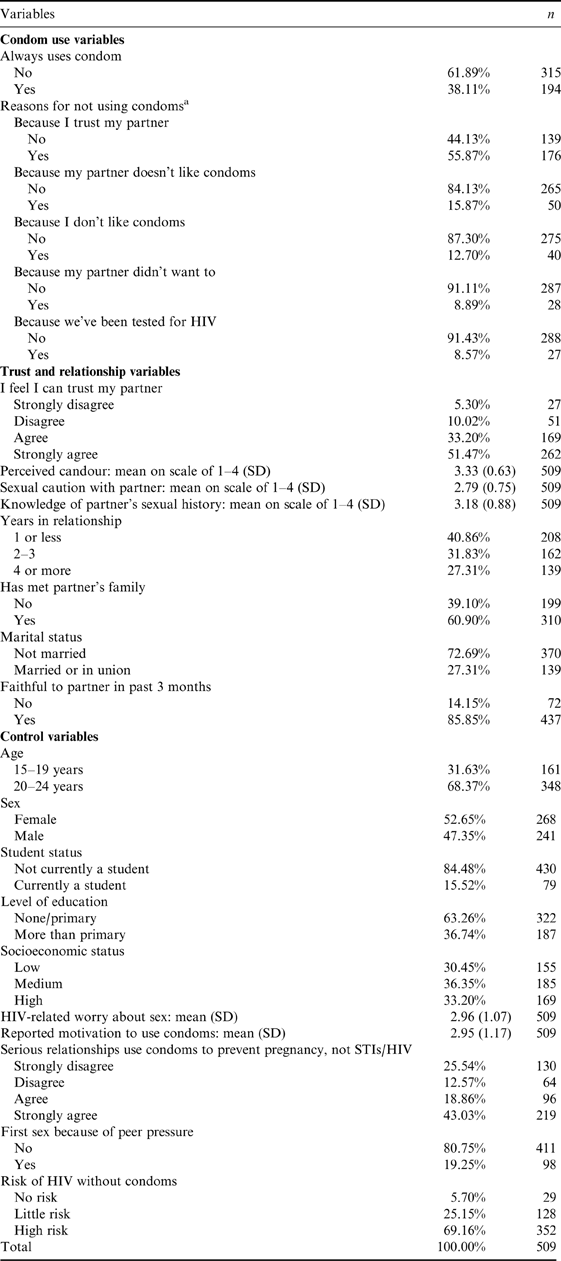
One-third (38%) of respondents reported consistently using a condom with their primary partner (Table 1). Respondents who did not consistently use condoms were asked what factors influenced their decision to not consistently use condoms. Consistent with past research, respondents who did not use condoms were likely to spontaneously cite ‘trust’ (56%) as the reason for not consistently using condoms. Other frequently reported reasons for not using condoms included that the respondent's partner does not like condoms (16%), the respondent does not like condoms (13%), because the respondent's partner did not want to (9%) and because the respondent and partner have been tested for HIV (9%). Females were more likely to report that they did not use condoms because their partner either does not like condoms or did not want to use them than were males (29% for females, 15% for males, p<0.01 not shown). There were no sex differences in not using condoms because of trust, the respondent not liking condoms or having been tested for HIV.
Distribution of condom use and socio-demographic characteristics among young adults in current romantic relationships (N=509), 2003 Tanzania Trust Survey

a Among those reporting that they do not always use condoms with their partner. Multiple responses are possible.
The majority of respondents reported that they could trust their partner: a third of respondents agreed that they could trust their partner (33%) and half of respondents strongly agreed (51%). While for females there were no differences by marital status in strongly agreeing that they could trust their partners (49% of married and 53% of not married, not shown), married males were significantly more likely to strongly agree that they could trust their partner than males who were not married (74% compared with 48%, p<0.05 not shown). The mean score for perceived candour was 3.33 on a scale of one to four. Respondents had a mean sexual caution score of 2.79 on a scale of one to four. The mean score for knowledge of a partner's sexual history was 3.18 on a scale of one to four. Many of the respondents had begun their primary relationship in the past year (41%), although a third (32%) began their relationship 2–3 years ago and a quarter (27%) began their relationship 4 or more years ago. Nearly two-thirds (60%) of respondents reported having met their partner's family. Approximately a quarter (27%) of the respondents were married. The majority reported that they were faithful to their partner in the past 3 months (86%) although this differed by sex and marital status. Nearly all (98%, not shown) married females reported that they were faithful to their partner in the past 3 months, as did a large majority of females who were not married (89%), married males (84%) and males who were not married (77%, p<0.01 for marital differences for females, p<0.01 for sex differences among those not married and p<0.001 for sex differences among those who were married).
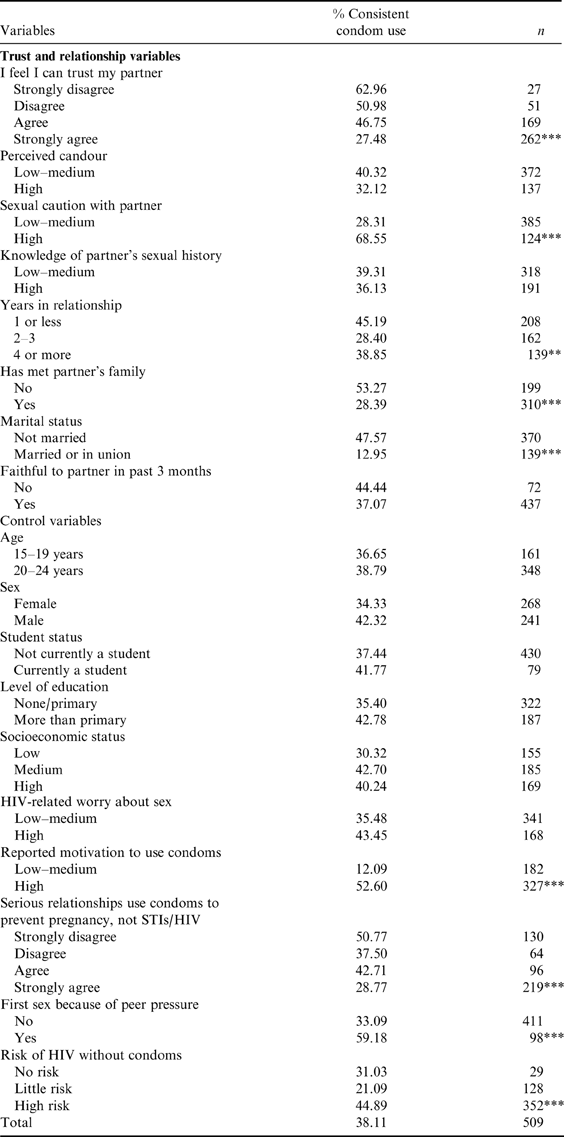
Reported trust, perceptions of one's partner and relationship characteristics were found to be strongly related to reported levels of consistent condom use (Table 2). Respondents who reported a higher level of trust in their partner were less likely to report consistent condom use. Specifically, only 27% of respondents who strongly agreed that they could trust their partner reported consistent condom use compared with 63% of young adults who strongly disagreed (p<0.001). To facilitate interpretation of the bivariate analysis, the indices of perceived candour, sexual caution and knowledge of partner's sexual history were dichotomized so that those with scores in the top 25th percentile were coded as ‘high’ on each index. Respondents with a ‘high’ degree of sexual caution were more likely than those with ‘low’ sexual caution to report consistent condom use (69% vs 28%, p<0.001). While condom use was highest among those who began their relationship in the past year (45%), condom use was lowest among those who began their relationship 2–3 years prior to the interview (28%), and was higher for those who began their relationship 4 or more years prior to the interview (39%, p<0.01). Young adults who had met their partner's family were half as likely to report consistent condom use as those who had not (28% compared with 53%, p<0.001). Similarly, respondents who were married were substantially less likely to consistently use condoms than respondents who were not married (13% compared with 48%, p<0.001). However, young adults who were not faithful to their partners in the past 3 months were no more likely to use condoms consistently with their partners than those who were faithful to their partners.
Distribution of consistently using a condom with the primary partner by trust, relationship and socio-demographic variables, 2003 Tanzania Trust Survey
p-values based on the Pearson χ 2 test: *p<0.05; **p<0.01; ***p<0.001.
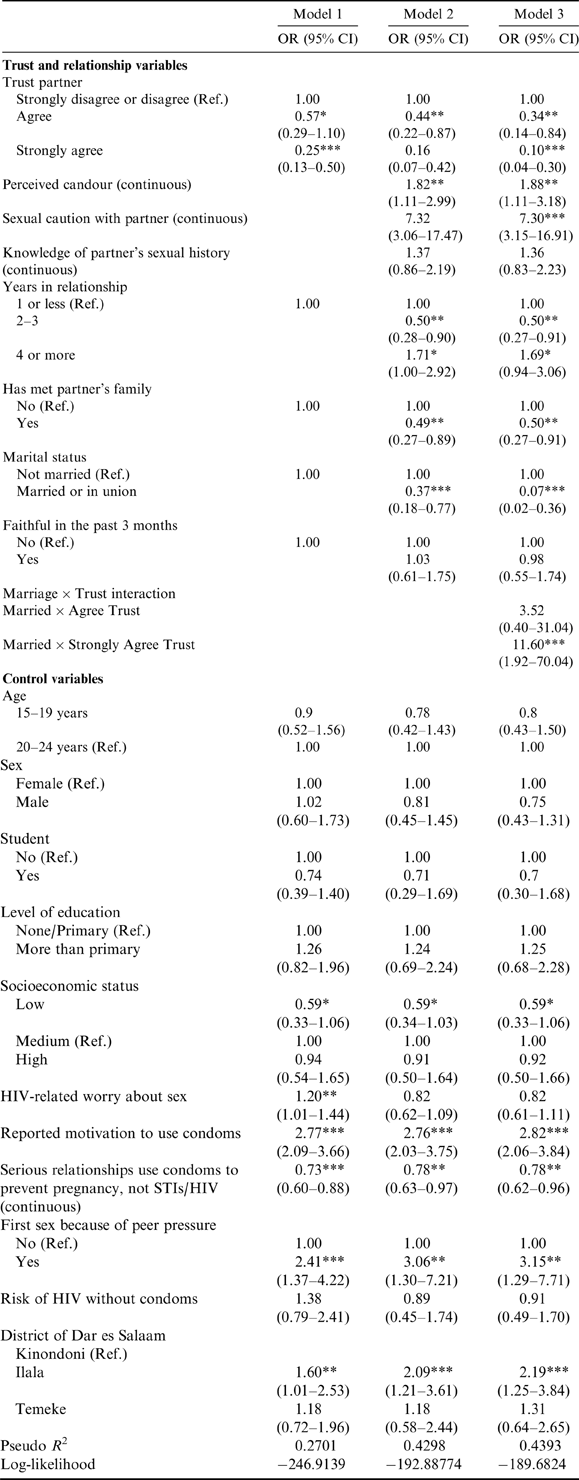
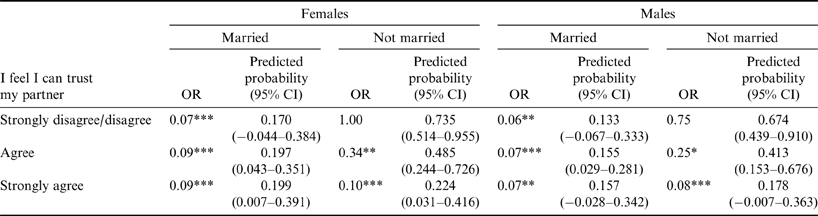
Table 3 presents three multivariate logistic regression models for the influence of trust on consistent condom use with a primary partner, controlling for socio-demographic variables and clustering within enumeration areas. The first model includes trust in one's partner and controls for the respondents' socio-demographic characteristics. The second model adds measures of relationship characteristics, specifically perceived candour, sexual caution, knowledge of a partner's sexual history, relationship duration, having met the partner's parents and marriage. Finally, a third model adding interaction terms for marriage and the level of trust was estimated. To facilitate the interpretation of the interactions, predicted probabilities of the likelihood of condom use by marital status and level of trust are presented for males and for females in Table 4 (Long & Freese, Reference Long and Freese2005).
Multivariate logistic regression models, odds ratios (OR) and robust 95% confidence intervals (CI) of the influence of trust, relationship variables and socio-demographic variables on consistently using a condom (N=509), 2003 Tanzania Trust Survey
p-values based on the Pearson χ 2 test: *p<0.05; **p<0.01; ***p<0.001.
Interaction effects, odds ratios (OR), predicted probabilities and robust 95% confidence intervals (CI) for the interaction of the level of trust in a partner and marriage on consistent condom use, by sex, 2003 Tanzania Trust Survey
Note: Model 3 is presented in Table 3.
p-values based on the Pearson χ 2 test: *p<0.05; **p<0.01; ***p<0.001.
In the model containing only trust and socio-demographic variables (Model 1), trust has the expected negative relationship with consistent condom use and the magnitude of the relationship increases with the degree of trust reported. Agreeing that one can trust one's partner is also associated with a decreased likelihood of consistently using condoms compared with those who expressed any level of disagreement with the statement, controlling for other variables in the model (OR=0.57, p<0.05). Strongly agreeing that one can trust one's partner is associated with a substantially decreased likelihood of consistently using condoms, controlling for other variables in the model (OR=0.25, p<0.001).
The magnitude of the negative relationship between strongly trusting one's partner and the likelihood of consistently using condoms is larger when relationship characteristics are added to the model (OR=0.16, p<0.001) (Model 2). Many of the indicators of relationship characteristics were associated with consistent condom use, and adding these variables to the model improved the overall fit (likelihood ratio test, p<0.001). Perceived candour was associated with an increased likelihood of condom use (OR=1.82, p<0.01), as was sexual caution (OR=7.32, p<0.001). The non-linear pattern of relationship duration remained: those who entered their relationships 2–3 years prior to the interview were about half as likely to report consistent use compared with those who entered their relationships in the year prior to the interview (OR=0.50, p<0.01). Those who entered their relationships more than 4 years prior to the interview were marginally more likely to use condoms compared with those who entered their relationships in the past year (OR=1.71, p<0.05). As expected, having met a partner's family (OR=0.49, p<0.01) and being married (OR=0.37, p<0.001) were each associated with a lower likelihood of consistent condom use. Neither fidelity nor knowledge of a partner's sexual history was associated with condom use, controlling for other variables in the model.
Model 3 adds a series of dichotomous variables to measure the interaction between the level of trust and marriage. The addition of these interaction terms further improves the fit of the model of consistent condom use (likelihood ratio test, p<0.05). The interaction between marriage and strongly agreeing that one feels they can trust their partner is significant. To facilitate the interpretation of the interaction terms in Model 3, Table 4 shows the interaction effects for the influence of trust and marriage on consistent condom use by sex, controlling for the effects of the variables in Model 3. In this table, the reference category is females who are not married and either disagree or strongly disagree with the statement ‘I feel I can trust my partner.’ Compared with females who are not married and do not trust their partners, females who agree that they can trust their partners (p<0.01) and females who strongly agree that they can trust their partners (p<0.001) were less likely to report consistent condom use. Specifically, the predicted probability of consistent condom use for females who are not married and do not trust their partners is 0.735 compared with a predicted probability of 0.485 for females who are not married who agree that they can trust their partners and 0.224 for females who are not married who strongly agree that they can trust their partners. Married females were significantly less likely to report consistent condom use than females who were not married, however there were no differences in the predicted probability of consistent condom use by level of trust among married females. Specifically, the predicted probability of consistent condom use for married females who did not trust their partners is 0.170 (robust 95% CI: −0.044 to 0.384) compared with a predicted probability of 0.197 (robust 95% CI: 0.043–0.351) for females who are married and agree that they can trust their partners and a predicted probability of 0.199 (robust 95% CI: 0.007 to 0.391) for females who are married and strongly agree that they can trust their partners. This pattern of interaction between marriage and level of trust is the same for males, although the levels of consistent condom use are slightly, yet not significantly, lower.
Discussion
With a generalized HIV epidemic in urban Tanzania and low levels of consistent condom use with a primary partner, understanding of the role of trust in condom use is critical. This analysis focused on the relationship between trust and condom use and whether this relationship could be explained by variables indicating that a relationship is on the path to marriage, marital status, that one's partner is honest, that the relationship has continued for a certain amount of time or that one is faithful. Among young adults in Dar es Salaam the negative association between trust and condom use was substantial and could not be explained by these relationship characteristics.
After determining that the relationship between trust and condom use does not diminish when controlling for relationship characteristics, the analysis turned to whether the relationship between trust and condom use depended on marital status. The relationship between trust and condom use existed only among respondents who were not married; there was no difference in condom use by level of trust among married males or married females. As respondents who were trying to conceive were excluded from the analysis, the fertility desires of married respondents did not explain why trust has no relationship with condom use for those who are married. Neither male nor female respondents appeared to be likely to use condoms with their spouses, even when they did not trust them. This raises the question, what do married individuals who do not trust their partner do? Do they have any options? How are these options gendered? Do they refuse to have sex with their partner? Do they make themselves less sexually available? And importantly, what are the consequences of using any of these possible strategies in terms of their ultimate risk of HIV or abandonment? Future research should consider the impact of challenges and turning points in relationships, such as infidelity and financial difficulties, to improve the understanding of the evolution of partnerships and risk management.
The non-linear pattern of condom use by the duration of the relationship, where those who were in relationships the longest had the highest rates of consistent condom use, followed by those newest to their relationship, was unexpected. This pattern probably reflects the non-linear progression of relationships. For example, the likelihood that a couple has ever faced a challenge increases the longer the relationship has endured. Challenges offer potential turning points in relationships where the individual may assess a partner's character and trustworthiness. If one's evaluation of a partner worsens then the relationship may end or behaviour within the relationship – such as condom use – may change. Young adults who are not married have greater freedom in terminating the relationship, while those who are married may be more likely to change their behaviour within the relationship. While the non-linear pattern is found for both married respondents and those who are not married, the higher rate of condom use among those who have known their partner the longest is more pronounced among married respondents (not shown). Alternatively, couples that are able to successfully negotiate condom use may be able to discuss other difficult relationship issues, making such relationships more likely to persist. Unfortunately the analyses of the complicated relationship between marriage, length of the relationship, trust and condom use remains constrained by the small sample size in this study. Future research should consider the impact of challenges to a relationship, such as infidelity and financial difficulties, to improve our understanding of the evolution of partnerships.
Both the descriptive statistics and the multivariate analyses suggest that trust is a quite important barrier to condom use among those who are not married. When asked why they did not consistently use condoms with their regular partner, over half of respondents spontaneously reported that they trust their partner (56%). No other reason for not using condoms approached the frequency with which trust was cited as the reason for not using condoms. This analysis builds upon these descriptive statistics by assessing the relationship between a general reported trust in the partner and condom use, finding that among females who are not married, the predicted probability of consistent condom use decreased sharply from 0.735 among those who do not trust their partners, to 0.485 for those who agree that they can trust their partners, to 0.224 for those who strongly agree that they can trust their partners. While this analysis is not able to separate the effect of trust on condom use from the effect of condom use on feelings of trust, trust and condom use are closely tied for those who are not married.
Of particular importance to AIDS prevention programmes is that trust in a partner is only a predictor of not using condoms for individuals who are not married; once individuals are married, marriage appears to trump a lack of trust in a partner in determining condom use. That marriage confers a lower rate of condom use even when one does not trust one's spouse is particularly concerning given that 16% of the married men interviewed in this survey reported having more than one partner in the past 3 months (not shown). As such, interpersonal communication campaigns working with young adults prior to marriage may help establish positive relationship skills and behavioural patterns by emphasizing how to develop and maintain the trustworthy characteristics that will protect both partners from HIV. An emphasis on positive relationship skills may have important protective effects across the life course by creating a safe space for discussing condom use prior to mutual voluntary counselling and testing as well as reducing relationship turnover and infidelity during marriage.
This analysis provides an entree into a better understanding of the importance of trust in condom use, but the analysis was constrained by data limitations. These data were collected prior to the proliferation of alternative methods for collecting data on sensitive topics. Despite the intensive training the interviewers received, response bias could not be eliminated. Respondents who have presented themselves as being in trusting, long-term relationships may feel that they could not tell an interviewer that they use condoms with their partner; conversely, those in relationships lacking trust and longevity may feel that they should report condom use. Additionally, the sample contained only those in current partnerships. The results regarding the association between trust and condom use may not be generalizable to more casual sexual partnerships than would be reported in our survey module asking about primary partners; however, as trust in a partner is a frequently cited reason for not using condoms, this sample of those currently in partnerships is comparable with an important target group for AIDS prevention campaigns.
Additionally, while this analysis found that trust is a strong barrier to condom use, the characteristics of trust remain to be explored. Are individuals less likely to trust a partner whose past behaviour may have exposed them to HIV? How does knowledge of one's HIV status and one's partner's HIV status influence trust? Does having a partner's trust influence one's behaviour? Among those who trust their partners, what leads some to use condoms while most do not? While this analysis cannot answer these questions, these will be important questions to ask to expand the understanding of trust and condom use.
Acknowledgments
This research was made possible through support provided by the Office of Health and Nutrition, Global, US Agency for International Development (USAID), under the terms of the AIDSMark program Grant No. HRN-A-00-97-00021-00. The opinions expressed herein are those of the author and do not necessarily reflect the views of USAID. The author would like to thank Yolande Coombes, Bianca Dahl, James Hull, Ulla Larsen, Kenneth Maes, Kim Nguyen, Michelle Poulin, Leila Sievanen, Kelley Alison Smith, and Sheila Walsh for their comments on an earlier version of this paper and the Population Studies and Training Center for logistic support.