In his popular Romance of London (1867), John Timbs refers to Thomas Babington Macaulay's oft-repeated metaphor of a “New Zealander sitting, like a hundredth-century Marius, on the mouldering arches of London Bridge, contemplating the colossal ruins of St Paul's” (290).Footnote 1 Originally intended as an illustration of the vigor and durability of the Roman Catholic Church despite the triumph of the Reformation, Macaulay's most famous evocation of this idea dates from 1840, the year of New Zealand's annexation; hence it is reasonable to suppose that this figure is a Maori (Bellich 297–98). For Timbs and subsequent generations, however, the image conveyed the sobering idea of the rise and fall of civilizations and in particular of England being invaded and overrun, if not by a horde of savages, then by a more robust class of Anglo-Saxons from the other side of the world.
In 1886 Macaulay's trope was again invoked by another no less renowned Victorian – J. A. Froude, author of, among other titles, the massive twelve-volume History of England from the Fall of Wolsey to the Death of Elizabeth (1856–70), and Thomas Carlyle: A History of the First Forty years of his Life (1882); he also edited Thomas Carlyle's Reminiscences (1881), and Letters and Memorials of Jane Welsh Carlyle (1883). This time, in place of a New Zealander contemplating the ruins of London, we are presented with an image of a Londoner gazing upon a picturesque, rural scene in far-off New Zealand and seeing it as a future location for the resurrection of the British Empire. Clearly, the idea that London, once the hub of a great civilization, was now in a state of decay still prevails, but what is new is the idea that it might yet be saved if England's more adventurous and poorer classes can be transplanted to a healthier soil.
This desert promontory, with its sad green lake and Maori huts and distant smoke-columns, will hereafter be an enormous cockney watering-place, and here it will be that in some sanatarian salon Macaulay's New Zealander, returning from his travels, will exhibit his sketch of the ruins of St. Paul's to groups of admiring young ladies. I have come to believe in that New Zealander since I have seen the country. (Froude, Oceana 236–37)
This passage is from Oceana, Or, England and Her Colonies (1886), the book Froude published in the twilight years of his literary career, after completing a six-month tour of South Africa, Australasia, and the United States.Footnote 2
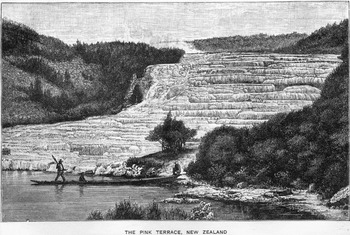
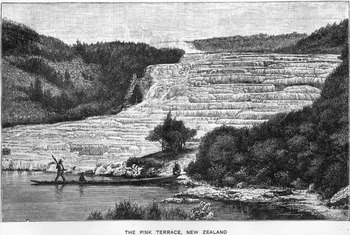
In this essay I investigate the effect that visiting New Zealand had on Froude's sanguine view of the British Empire and his idea that the centre of that empire could be transferred from London to the South Seas. Although his stay was abruptly curtailed by the prospect of war between Britain and Russia,Footnote 3 he did manage to undertake an inland journey to the famous Pink and White Terraces, or as the Maori called the Pink Terraces, the “Otukapuarangi” (cloud in the heavens), and the White Terraces, “Te Terata” (the tattooed rock), both of which stood at the north-western end of Lake Rotomahana (Figure 6).Footnote 4 I focus mainly on this portion of his journey because I believe it problematizes Froude's claim that his visit to New Zealand had confirmed his vision; indeed, there is sufficient evidence in these pages to suggest that the utopian empire of Oceana far from being a certainty was actually under threat, not just from the mundane forces of liberalism, but also the sublime forces of nature in the form of the Maori, despite the fact that along with most indigenous peoples they were widely regarded as a dying race.
S. C. Pearson, “`Te Terata' (The Pink Terrace), New Zealand.” Engraving, from James Anthony Froude, Oceana, or, England and Her Colonies (London: Longmans, Green, 1886): 251.
In the Victorian era, it was still common practice among writers to equate the sublime with wild and dangerous elements of the landscape; this was particularly the case in travel writings that made a point of describing the spectacular scenery to be found in the colonies. In a later period of settler nationalism, such Victorian renditions of the sublime would come to be replaced by romantic landscape tropes that anticipated the indigene's removal through extinction. Such tropes, as Patrick Brantlinger has recently pointed out, were based not on genuine regret about the indigenes' passing but on a desire to belong to the land in a way that buries the fact of settler violence (4). Froude was writing before these elegies were penned, but like the settlers it seems he unconsciously wished the original inhabitants of Australia and New Zealand gone. That they were not (at least not yet) set in train a series of tumultuous feelings that came to be reflected in his writing. Indeed, I want to suggest that it is through Froude's ambivalent response to the Pink and White Terraces, on the one hand seeing them as sublimely beautiful and on the other supremely and secretly treacherous, that we glimpse his mounting frustration towards the Maori and his underlying fears about the new empire's fate.
Today Froude is seldom singled out as an important writer of the Victorian era, but at the time his books commanded an impressive readership; the first edition of Oceana, for example, sold 75,000 copies. Considered a great writer on a par with Rudyard Kipling because of his exquisite prose, he was also a figure of dramatic controversy. In his History of England, he had gone against historical convention by hero-worshipping Henry VIII, castigating Elizabeth I, and openly vilifying Mary, Queen of Scots. His biography of Carlyle had created an even greater scandal by providing what many regarded as a too frank and intimate account of the Carlyles's supposedly loveless marriage. As Trev Lynn Broughton has observed, Froude's suggestion that Carlyle may have been psychologically cruel towards his wife gave rise to accusations of Froude's biographical treachery (84–91). Nor was Froude's name popular among Church reformers. His remarks concerning the decline of Protestantism had offended both Catholics and Anglo-Catholics by laying the blame for the Church of England's disintegration at the feet of those Tractarians who had labored to reform the church by privileging doctrinal truth over the practical work normally regarded as its proper vocation.Footnote 5, Footnote 6 Andrew Fish captured the atmosphere of dissonance surrounding Froude's writings when he observed,
[Froude's] course ran across most of the currents of what is usually considered to be Victorianism. Besides Roman Catholics he had against him: Anglo-Catholics; Protestants who disliked Henry VIII on moral or political grounds; advocates and practitioners of the so-called “scientific” history; lovers of democracy and parliamentarianism; admirers and apostles of nineteenth century industrial progress; Utilitarians and Economic Individualists; Little Englanders; Irish patriots and Home Rulers; Humanitarians offended by his doubts of the wisdom of freeing the slaves; Carlyle haters, and extreme Carlyle lovers for his painting of the hero with warts and all. A formidable and varied array of opponents! (179)
Even Froude's brand of imperialism was contentious. Like Carlyle and Anthony Trollope he lamented the mounting public indifference towards empire that was endemic mid-century and which had been fostered by liberal politicians who were doubtful about the economic benefits to be had from colonies.Footnote 7 However, he was no less suspicious of capitalism and its ideological counterparts – liberalism and democracy. If he decried capitalism it was because he believed it created those modern diseases – the inordinate craving for money at the expense of community and spiritual life and the public sanctioning of dishonesty, manifested most obviously in the widespread practice of using false weights and measures. If he pilloried liberalism and democracy, it was because, in his opinion, they removed those traditional figures of authority like the landlord, squire, and parson who had held communities together through the exercise of fealty and duty (Froude, “England and Her Colonies” 413–24). Moreover, according to Froude, liberalism and democracy were to blame for the growth of towns and cities, evidently one of the supreme causes of England's decline:
And besides drunkenness there are other diseases, not peculiar to towns, perhaps, but especially virulent and deadly there, which tend equally to corrupt the blood and weaken the constitution. Every great city becomes a moral cesspool, into which profligacy has a tendency to drain, and where, being shut out from light, it is amenable to no control. (169)
In the absence of a political model that preserved traditional class privileges while simultaneously destroying industrial capitalism, he looked to that school of imperialist thought that argued that salvation lay in using the colonies to resurrect the organic lifestyle that predominated at the time of the English Reformation. In the same essay he argued that it was during the sixteenth century that the values that had made the English nation great were most notably on display:
Throughout the country there was an ordered, moderate and tempered contentedness, energetic – but energetic more in doing well the work that was to be done, than in ‘bettering’ this or that person's condition in life. Something of this lingers yet among the old-fashioned people in holes and corners of England; but it is alien both to the principles and temper of the new era. (170)
According to Froude, England had had her day, and there was no reversing her downward spiral to ruin and decay. Capitalism, free enterprise, liberalism, and democracy were all becoming more entrenched. If England's legendary might was to be maintained, the only hope lay in beginning afresh elsewhere, just as the Pilgrims who settled America had done when they believed that Europe's religious leaders, both Catholic and Protestant, had succumbed to corruption. England had already forfeited its largest and most powerful settler colony – the United States – but Australia, New Zealand, and Canada remained. It was essential that they not be permitted to fall away, since strength lay in unity. However, to realize this dream would be difficult since the supporters of liberalism and democracy had already succeeded in convincing the Colonial Office that Britain's settler colonies deserved independence. At a time when the majority of the English people preferred to liberate the colonies, Froude labored to strengthen the ties that existed between the old and the new worlds. Since the resurrection of a political confederation now seemed impossible, he argued instead for a union based on “common blood, common interest and a common pride in the great position which unity can secure” (Faber 92–93).
A similar eccentricity characterized his ideas about race. Most imperialists maintained that the intellectual and moral gulf separating the black and white races would never be overcome since each belonged to a different moment or stage of evolution, but Froude argued there was no logical reason why the black races could not attain the same level as whites if they received the appropriate training. However, he was critical of the British government's decision to allow blacks to assume positions of managerial responsibility the moment colonies achieved independence. In keeping with the prevalent mood of paternalism, he believed they needed extensive periods of training and discipline. On the subject of the West Indies, for example, he wrote, “There is no original or congenital difference or capacity. . . . But it does not follow that what can be done eventually can be done immediately. . . . [I]f we give the Negroes as a body the political power which we claim for ourselves, they will use it only to their own injury” (Froude, The English in the West Indies 62). Precisely because in Froude's writings intellectual and moral differences are regarded as arising from environmental factors and are not seen as the product of heredity, some critics have preferred to use the term “racialism” to characterize his position.Footnote 8, Footnote 9
That Froude did harbor racial prejudices is clear from his decision to place his faith in only those settler colonies where whites would be able to predominate over blacks. After visiting South Africa he declared it unsuitable for the cultivation of a healthy and vigorous branch of the English race because the black population far outnumbered the white. What Australia, New Zealand, and Canada, his chosen colonies, each had in common were large tracts of seemingly unoccupied land and an indigenous population that had been dramatically reduced through exposure to the white man's diseases and systematic genocide. However, as Froude was soon to discover, the ravages inflicted on indigenous populations did not mean they were willing to be assimilated; nor did it mean they were prepared to kowtow to whites. This was particularly the case in New Zealand where even after the Land Wars Maori continued to occupy and preside over inland and rural areas, including those being opened to tourism.
* * *
Oceana is arguably Froude's most accomplished piece of writing. It is definitely, by today's standards, his most readable work. The text's appeal derives from the fact that it was composed primarily as a travel narrative; indeed, when he set out from London by steamer for the colonies, Froude was in many respects writing from the viewpoint of a modern-day tourist. For instance, he lodged almost without exception in hotels, dined on English cuisine, and never stopped long enough in one place to get to know the local population.Footnote 10
When Froude arrived in Auckland he was still bathed in the euphoric glow of his sojourn around Australia. In Adelaide, he and his son Ashley had reveled in the beauty of the public gardens and admired the grand-scale of the architecture and the streets. In Victoria they had resided with the governor, who introduced them to his ministers. They had visited the Melbourne observatory and great telescope, attended a fashion show and an organ concert, and dined in the huge mansions of businessmen, most of whom, Froude proudly noted, had started out penniless, but who – as a result of belonging to “a picked class, the seeming fittest, who had the greatest force, the greatest keenness, the greatest perseverance” – were now millionaires (Oceana 134). They had also made an excursion into the interior of Victoria, visited a gold mining town and some farms, and met Lord Elphinstone, the retired naval officer who was to accompany them around New Zealand. At only one point in their travels did they encounter Aborigines; this was at the government reserve in Corranderrk. Froude's comment, based as it was on the commonly held assumption that the Aboriginal race would soon die out, suggests he saw them as posing no threat to the empire of Oceana.
On the way home we turned aside to see a native settlement – a native school &c. – very hopeless, but the best that could be done for a dying race. The poor creatures were clothed, but not in their right minds, if minds they had ever possessed. The faces of the children were hardly superior to those of apes, and showed less life and vigour. The men threw boomerangs and lances for us but could not do it well. The manliness of the wild state had gone out of them, and nothing had come in its place or could come. (128)
The language used here reveals Froude's familiarity with Darwin's theory that only the most evolutionary advanced races will win in the competition for survival because, being the smartest and the fittest, they are also the best able to adapt to new environments; the lesser races by contrast, being less intelligent and adaptable, are doomed to fall by the wayside, eventually becoming extinct. However, the passage also reflects the popular understanding of human evolution as a progressive ladder, the top rung of which is occupied by the white race, while the second-to-bottom rung next to the apes is occupied by dark-skinned races like Australia's Aborigines.
Arriving in Auckland, Froude checked into that bastion of class and gender preserve – the Northern Club. A tour of the city ensued. This took in the work being done on laying out the harbor (it was being converted into the largest graving dock in the world and required the cutting down of half a hillside) as well as the local shops, which boasted among other things, numerous examples of the fashionable art of photography. But whereas the cities of Adelaide and Melbourne with their well-laid out, clean streets and their prosperous class of business men and landowners had thrilled Froude, Auckland, it seems, proved a bit of a disappointment. Not only were many of the buildings and houses cramped and the streets haphazardly designed, but the city was filled with people in search of work, the result of a depressed economy. Froude observed that while the city authorities were proud of their attempts to put New Zealand on the map by building for the future and embracing the modern, he thought there was a real danger that the same mistakes that had been made by the English were about to be repeated. It bothered him, for example, that the free outdoor lifestyle required to inject new vigor into the race and build a prosperous and vital nation – in short the lifestyle of the honest and hardworking farmer – was being overlooked in the settler's headlong rush to erect large cities and factories. Consequently he wrote,
The English race should not come to New Zealand to renew the town life which they leave behind them, with a hand-to-mouth subsistence as earners of wages on improved conditions. They will never grow into a new nation thus. They will grow into a nation when they are settled in their own houses and freeholds, like their forefathers who drew bow at Agincourt or trailed pike in the wars of the Commonwealth; when they own their own acres, raise their own crops, breed their own sheep and cattle, and live out their days with their children and grandchildren around them. (212)
Intent on seeing more of the country, Froude and his companions departed for the hot lakes region. Present-day readers might glimpse an irony in the fact that the first hundred miles of their journey was accomplished by that other great concession to modernization – the railroad, but Froude only regarded this as an excellent opportunity to see if the land was as suitable for farming as he had hoped. What he saw both delighted and dismayed him; much of the land appeared to be unoccupied and although the soil was rich and fertile, it was covered by tree fern and bracken. To convert it into farms would require burning-off and constant ploughing. While this had daunted most settlers, it did not prevent Froude from letting his imagination run riot:
From Cambridge to Oxford we passed through an open rolling country, with hardly an inclosure, hardly a trace of cultivation anywhere. It was not the fault of the soil, which was richer than ever. . . . The road rose steadily till we were 1,600 feet above the sea, but the soil continued of the same natural fertility. I could not but think what a country New Zealand might become, what a population it might bear, what a splendid race of Southern English might be reared in this still desert treasure-house of agricultural wealth if it were wisely ruled. (226–27)
New Zealand is here portrayed in terms of a veritable Garden of Eden that is ripe for possession and cultivation by a hardworking and deserving race. That he had in mind the spillage from the teeming masses in London and its environs seems certain from his reference to “Southern English.” Froude does not actually say that the Maori did not deserve this trophy, but the inference is there in the phrase “not the fault of the soil” to explain the dearth of agricultural productivity, for if it is not the fault of the soil, then whose fault is it? Even after the Land Wars the Maori continued to occupy fertile land that the settlers wanted for farming. The suggestion that the country might not be wisely ruled was meant as a warning to all those who supported laissez-faire capitalism and democracy, both of which Froude noted were already constitutionally ingrained. In England, Froude had attacked both capitalism and democracy because whereas the one gave rise to self-interest the other provided the conditions for social decay; if he criticized these same institutions in New Zealand it was because they awarded power to the workers – the very class of people who would halt the free-flow of British migrants for fear they would work for less pay.
Two Houses of Legislature, 160 members in all, each receiving 200 guineas a year of wages, each with an eye to his own interests, and returned by constituencies equally keen for their own; the power virtually in the hands of labourers and workmen jealous of immigration lest it should lower the rate of wages . . . is not the happiest conceivable form of government for a people not yet numbering half a million, and possessed of a country as extensive as the United Kingdom, with even larger natural resources. (227)
If Froude was beginning to have misgivings about the political ideals of the settlers, imagine his disquiet upon entering the town of Ohinemutu and observing the Maori habit of bathing all day long in the hot sulphurous springs everywhere dotted about. Clearly, the Maori lifestyle ran counter to the industrious lifestyle required to build a new empire. Froude's opinion of the Maori worsened when he observed the many half-caste children running about, for this suggested they lacked the quality of racial pride and that other essential attribute of civility – female chastity prior to marriage: “I asked if the men felt no anger about it. I was told rather that it was considered as an honour. The women were chaste after marriage: before marriage they did not know what chastity meant. Degradation could hardly be carried further” (233). According to Froude, the blame for what he called Maori “sloth and ruin” could only be partially laid at their own feet; the rest was the work of a government that was content to lease the land from the Maori rather than annex it, “They own the district as a village community. The Government rents it off them. They live on their income, like ladies and gentlemen, and having no work to do, or not caring to do any, they prefer to enjoy themselves” (232). When he reached the small town of Wairoa situated alongside the Terraces, Froude's disgust increased. The natives were in the habit of performing lewd dances for visitors allegedly so they could get drunk on the proceeds. Froude was both an abstainer and a sexual prude, but he was also a strong admirer of the Maori in what he called their uncorrupted state. If the imminent demise of the Aborigines had failed to trouble him, it was because he did not regard them as fully human. Such a view was in keeping with contemporary scientific claims that the Aborigines belonged to a more primitive stage of human evolution, indeed so primitive that British settlers were justified in murdering them to acquire land. By contrast, what he construed as the debased condition of the Maori caused him considerable grief. Here they were “the noblest of all the savage races with whom we have ever been brought in contact” doing everything they could to regress even further into the apathy and moral degradation that would ensure they vanished from the face of the earth (233). Eventually vanish they might, but, in the meantime, corrupted as they were by the worst aspects of European culture, there was much about them that constituted a powerful threat to the impending empire of Oceana.
This threat was rendered all the more imminent by the physical attractiveness and natural charm of the Maori which by placing the Anglo-Saxon in the position of reluctant admirer, had the potential to sabotage the hierarchical relations of imperialism. Froude himself fell victim to the winsome looks of the Maori when he, his son, and Lord Elphinstone undertook the daylong trip to the Terraces in the care of two female guides. The first sign that he himself was falling under the spell of these guides occurred when they arrived at the head of the lake: “Here we were joined by a native girl, Marileha by name, a bright-looking lass of eighteen, with merry eyes, and a thick but well-combed mass of raven hair (shot with orange in the sunlight) which she tossed about over her shoulders” (245). We can infer from the above passage that Miss “Mari,” as she promptly became known, evidently possessed sufficient personal charms to disconcert not just the twenty-year-old son but also the seventy-year-old father.
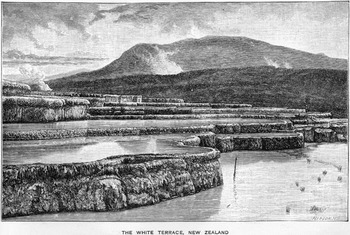
Yet if Froude felt nervous in the company of the Maori, it was not just because of the physical allure of the women. No less disturbing was the guides' prepossessing manner and their mercenary treatment of tourists – a sure sign their people were resisting assimilation to the “superior” Anglo-Saxon culture of the settlers. When in due course the small party arrived at the summit of “Te Terata,” Froude and his companions were given only a few minutes to absorb the view. They were also subjected to an unsubtle form of ridicule, which appears suspiciously like reverse racism.
A fixed number of minutes is allotted for each of the ‘sights.’ Kate was peremptory with E____and myself. Miss Marileha had charge of my son. ‘Come along, boy!’ I heard her say to him. We were dragged off the White Terrace in spite of ourselves, but soon forgot it in the many and various wonders which were waiting for us. (247)
One of these marvels was the delicious bath he and Ashley enjoyed in the hot basin at the foot of the Pink Terrace. Another was the sublime beauty of “Otukapuarangi.” Froude had earlier been witness to the majestic spectacle of “Te Terata,” the gigantic white stairway formed from crystallized silica that had been built up from the lake's currents over hundreds of years (Figure 7). Situated on the farther shore, and noticeably smaller in scale, the Pink Terrace offered a view of nature's artistry that was arguably even more breathtaking.
The crystals were even more beautiful than those which we had seen, falling like a cluster of rosy icicles, or hanging in festoons like creepers trailing from a rail. At the foot of each cascade the water lay in pools of ultra marine, their exquisite colour being due in part, I suppose, to the light of the sky refracted upwards from the bottom. (250)
S. C. Pearson, “`Otukapuarangi' (The White Terrace), New Zealand.” Engraving, from James Anthony Froude, Oceana, or, England and Her Colonies (London: Longmans, Green, 1886): 246.

Froude's delight in this wondrous structure reached a climax when he climbed to the summit and peered into the Terrace's mysterious crater. The spectral color of the water upon which his gaze alighted struck him as so gorgeous that he was momentarily transported to the realm of the sacred:
The hue of the water was something which I had never seen, and shall never again see on this side of eternity. Not the violet, not the hare-bell, nearest in its tint to heaven of all nature's flowers; not turquoise, not sapphire, not the unfathomable aether itself could convey to one who had not looked on it a sense of that supernatural loveliness. Comparison could only soil such inimitable purity. The only colour I ever saw in sky or on earth in the least resembling the aspect of this extraordinary pool was the flame of burning sulphur. Here was a bath, if mortal flesh could have borne to dive into it! Had it been Norway, we should have seen far down the floating Lorelei, inviting us to plunge and leave life and all belonging to it for such a home and such companionship. It was a bath for the gods and not for man. Artemis and her nymphs should have been swimming there, and we Actaeons daring our fate to gaze on them. (251)
A place fit for the gods was surely appropriate to the empire of Oceana. Indeed, the Pink Terrace seemed to offer everything that Froude had hoped he would find in New Zealand and more. It was the most enchanting of enchanted places, so much so that immediately afterward he felt compelled to say, “This was the end of our adventure – a unique experience. There was nothing more to see, and any more vulgar wonders would have now been too tame to interest us” (251). Froude's rapturous response to the Terraces appears in strong contrast to his perturbed reaction to the Maori people themselves; indeed, his claim that he and his companions “soon forgot the disturbing incidents of the morning in the various wonders that awaited them” is tantamount to saying that the Maori were an unfortunate blot on an otherwise perfect landscape. On the other hand, such a response was only possible if he also buried the memory of the grotesque-looking landscape both bordering on and surrounding the Terraces, a landscape of geysers, bubbling mud pools, and boiling spouts, which in direct contrast to the Pink Terrace, reminded him of the infernal fires of hell. Encountering it for the first time on his way to Wairoa, Froude's response had been one of violent repulsion:
Across the water among the trees a few miles off, a tall column of steam ascends, as if from an engine. It arises from a gorge where a sulphurous and foul smelling-liquid, black as Cocytus or Acheron, bubbles and boils and spouts its filthy mud eternally. I have no taste for horrors, and did not visit this foul place, which they call Tikiteri. A Scotchman, they say, went to look at it, gazed breathless for a moment or two, and when he found his voice exclaimed, ‘By God, I will never swear again.’ Indeed, the condition of things all about suggests the alarming nearness of the burning regions. (231–32)
Referring to the Gothic romances of the early nineteenth century, Jack Voller has argued for a special category of the sublime in which the object embodying the extra-natural is invested with daemonic potency. Unlike the conventional or natural sublime, this extra-natural sublime questions or denies the possibility of spiritual consolation (6–10). While the grotesque landscape of Tikitere would seem to embody this malevolent face of the sublime, the beautiful vista Froude encountered at the Pink Terrace would seem to exemplify its benign aspect. Just as the pleasure Froude took from experiencing the Maoris' physical beauty and learning about their culture was spoilt by his memory of their venal and insurrectionary behavior, any spiritual consolation he obtained from the Terraces' beauty was compromised by his belief in their close proximity to the realm of the demonic. Froude's growing ambivalence towards the landscape is captured most notably in his use of the word “supernatural” to describe the bewitching tincture of the Pink Terrace's waters, for this connotes a force that is divine, yes, but also faintly menacing.Footnote 11
Ian McLean has observed that in the colonial period travel writers resorted to either sublime or grotesque imagery whenever they wanted to suggest nature's extremes. He has further argued that they employed the concept of the picturesque when they wanted to transform or remake a country over to the colonizer; this was because the picturesque represented the triumph of beauty or harmony over discord, and it therefore functioned as an implicit metaphor for conquest. According to him the picturesque, because it involves a compromise between nature and culture, stood for a return to order, control, and identity, whereas the sublime, because it consisted of nature dominating culture, was seen as unstable, shifting, and dangerous, perpetually compromised as it was by its close proximity to death or annihilation (McLean n.p.).Footnote 12 McLean's is a fairly nuanced account of the political meanings that attached to conventional eighteenth-century landscape conceits when these were used in the colonial context; nonetheless it fails to explain Froude's use of the term “supernatural.” In Froude's description of the terraces and the surrounding landscape there is no reference to the “picturesque”; there are only the extremes represented by the conventional sublime and the extra-natural sublime or the supernatural, suggesting the failure of the colonizer to assume control. Moreover, because the extra-natural sublime implies a force at once alien and hard to control, it diminishes from Froude's sense of belonging and his ability to possess the landscape.
In sum, it seems that unlike in Australia where the Aboriginals were largely confined to reservations, New Zealand's indigenes continued to covet the land. If they were a dying race, they were as yet a long way from relinquishing the asset that the settlers and Froude valued most. Faced with such a reality, even the most beautiful scenic spots were bound to lose some of their appeal. Froude does not explicitly give vent to his mood of disenchantment; however, we intuit it in his portrayal of a force in the landscape that is simultaneously attractive and repellent. It is discernible also from his oscillation between delight and temerity, approval and disapproval, acceptance and rejection when describing both the Maori and the landscape. Furthermore, far from dismissing this force as the product of fantasy or projection like most writers of his generation, he judged it sufficiently real as to cast a shadow over his initial vision of the country's bright future.Footnote 13 We can perhaps summarize this by saying that the landscape, and in particular the trope of the extra-natural sublime, allowed Froude to register his tacit knowledge of the indigene's underlying resistance and resentment and, along with this, the possible impending failure of the colonial project.
When he left England for the colonies, Froude had not been planning to compose a record of his travels. His health was erratic and his enthusiasm for writing beginning to fade. Once home in London, however, he settled to the task. When his book appeared a year later, it was praised throughout Britain but deprecated in the colonies. One reviewer from Melbourne, for example, complained the book was “all uppercrust,” the author “a mere superficial skimmer of whipped syllabub” quite ignorant of the real history of Victoria (Rev. of “Froude's Oceana” 18); another coined the disrespectful term “froudacious” (Joseph 19); while the New Zealand MP Edward Wakefield wrote a scathing criticism accusing Froude of misrepresenting the colonists' views of imperialism (1886). Most of these complaints were concerned with specific detail on matters of historical and geographical accuracy. At the time, however, such things mattered, for they were construed as proof that the English visitor possessed only a superficial understanding of life in the colonies and should therefore not meddle in the country's political affairs. Geoffrey Blainey appears to have had these criticisms in mind when in 1985 he republished Froude's book in an abridged form under the new subtitle Oceana: The Tempestuous Voyage of J. A. Froude, 1884 & 1885. In this essay, I have suggested that if Froude's voyage “down under” can be described as tempestuous, it should not just be because of the book's stormy reception, but also because of the faint but nevertheless discernible shadow it cast on his dream of a new British empire situated in the South Pacific.