Traits are defined as a surrogate measure of organismal performance, a trait connects the physical characteristics of an organism with the genetic, ecological and environmental parameters that affect the trait (Violle et al. Reference Violle, Navas, Vile, Kazakou, Fortunel and Hummel2007). Dung beetles are known to display phenotypic plasticity in response to different environments; introduced populations of Onthophagus taurus in North America and Australia differ in their pronotal size, horn expression and genitalia despite only 40 years of isolation from the native Mediterranean populations (Moczek Reference Moczek2003). The thorax size of adult dung beetles is dependent on the amount of dung provisioned by their parents during the larval stage (Emlen Reference Emlen1994), which is affected by the dung availability of the ecosystem. This growth response has been documented in Onthophagus acuminatus Harold, where larval beetles supplied with more dung were larger in terms of pronotum width (Emlen Reference Emlen1994). In Peninsular Malaysia where this study was conducted, megafauna such as Asian elephant Elephas maximus L. and wild cattle (Bos gaurus Smith and Bos javanicus d’Alton) have experienced local extinctions in some forests due to hunting and human-animal conflict relocation programmes (Saaban et al. Reference Saaban, Othman, Yasak, Burhanuddin and Zafir2011). However in many of these forests that have lost large herbivorous mammals, dung beetles still persist (Doll et al. Reference Doll, Butod, Harrison, Fletcher, Kassim, Ibrahim and Potts2014). Likely these species are either capable of switching to alternative food sources or not dependent on the dung of large herbivorous mammals (Nichols et al. Reference Nichols, Gardner, Peres and Spector2009). Pronotal widths are a possible proxy measure of the extent of resource deprivation caused by megafauna loss.
The use of intraspecific differences to understand how different dung beetle species respond to an ecological disturbance is still relatively unknown. In this study, we use the intraspecific difference in pronotum width to investigate the response of six dung beetle species to the loss of megafauna. While these species have survived the loss of megafauna dung in the ecosystem, there may be phenotypic changes to beetles that once used megafauna dung as a breeding resource.
We compared beetles from two sites, in the Tembat Forest Reserve (N5°09′59.4″, E102°37′28.8″) adjacent to Kenyir Lake and Gombak Forest Reserve (N3°19′28.7″, E101°45′09.6″). The forests were of similar altitude, climate, logging histories and human disturbance patterns. We define megafauna as animals which weigh more than 1 Mg. Wild Asian elephant (Elephas maximus Linnaeus), Malayan tapir (Tapirus indicus (Desmarest)) and gaur (Bos gaurus Smith) are still present in Kenyir, while the last wild elephant in Gombak was sighted in 1961, tapirs are rarely seen and there have not been any recent sightings of wild cattle (Earl of Cranbrook, pers. comm.). Additionally, almost all the extant large herbivorous mammal species in Peninsular Malaysia such as deer and serow are present in Kenyir (Clements Reference Clements2013), but only sporadic sightings of these animals are seen in Gombak (Goh, T.G., unpubl. data).
All the beetles used in this study were collected from forested microhabitats with intact canopies and collections were done during the wet season between June and November 2016 to minimize the effect of environmental variables. The beetles were collected using 30 elephant-dung-baited Burrowing Interception Traps (Goh & Hashim Reference Goh and Hashim2018) placed along three randomly set 500-m transects at 50-m intervals. In cases where the total number of collected beetles exceeded a sample size of 40, a sample of 40 specimens was randomly selected.
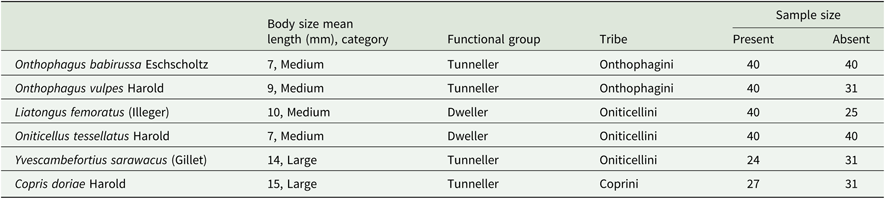
Six different species were used in this study: Onthophagus babirussa, Eschscholtz; Onthophagus vulpes, Harold; Oniticellus tessellatus, Harold; Liatongus femoratus (Illiger); Yvescambefortius sarawacus (Gillet) and Copris doriae, Harold. These species were selected on the basis of having sufficient sample sizes for comparisons in both localities and little to no sexual dimorphism in regards to the pronotum. Due to the lack of sexual dimorphism on the pronotum (Arrow Reference Arrow and Stephenson1931; Balthasar Reference Balthasar1963), both males and females were pooled for this study. The sample sizes for each species are indicated in Table 1. We also selected these species in order to obtain a variety of body sizes, functional groups and tribes.
The body size category, functional group, tribe and sample size of each species

We define the pronotum width as the distance between the two widest points of the pronotum. All beetles were measured three times with a digital calliper and the mean was taken to increase the precision of the measurement. All beetles were dried in an oven at 50°C prior to measurement.
The pronotal widths of some species were not normally distributed, therefore we opted for the Bayesian estimation alternative to t-tests, Bayesian Estimation Supersedes the t-Test (BEST) (Kruschke Reference Kruschke2013), which could account for deviations from normality in the samples. All analysis was done with R ver. 3.2.2 and package BEST (Kruschke & Meredith Reference Kruschke and Meredith2018).
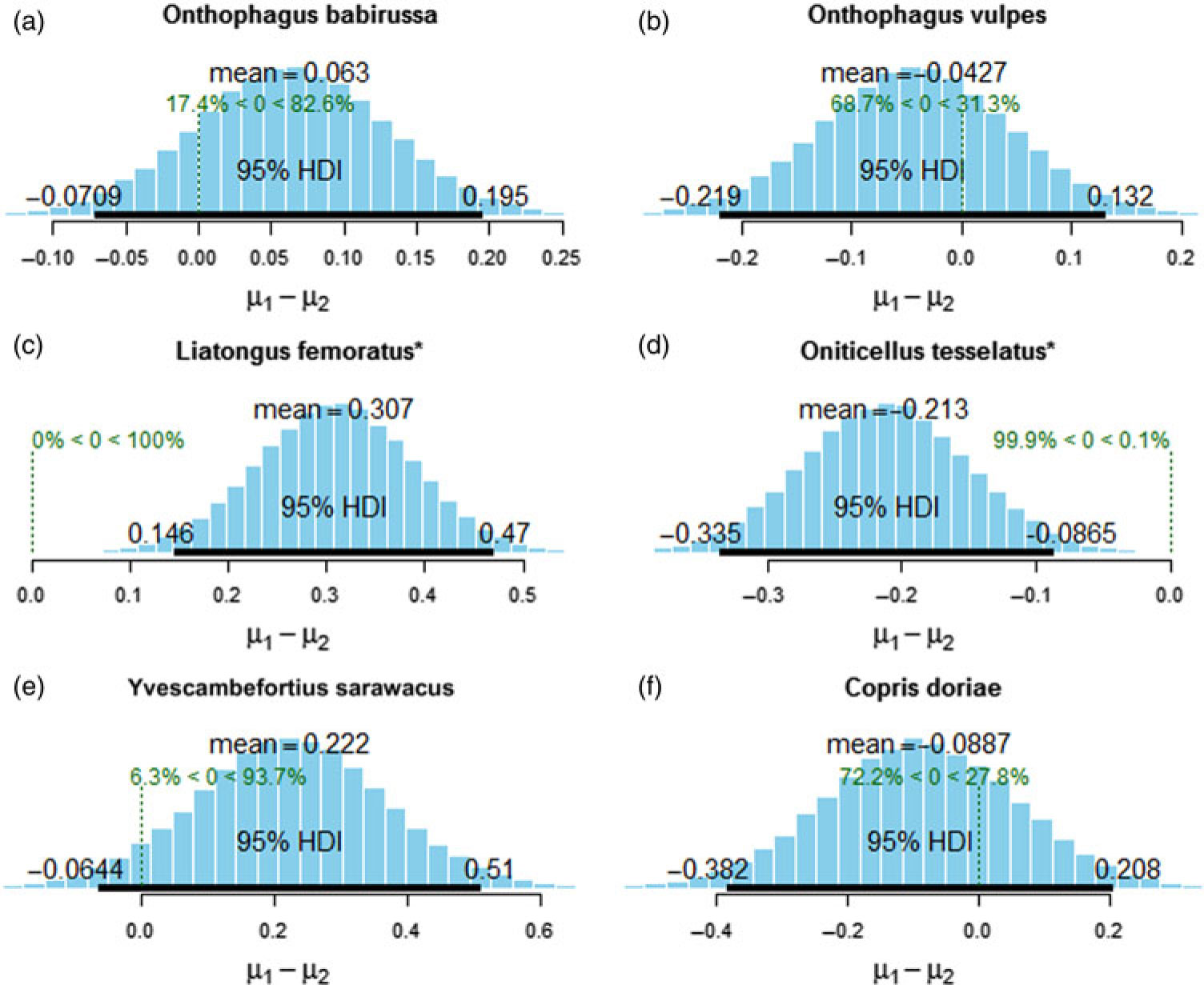
Four species did not have any credible differences between mean pronotum width, these were O. babirussa, O. vulpes, C. doriae and Yvescambefortius sarawacus. Only two species, L. femoratus and Oniticellus tessellatus showed credible differences between mean pronotum width, this can be seen by the lack of overlap between the Highest Density Intervals (HDIs) of μ1–μ2 and the value of zero (Figure 1c, d). Liatongus femoratus was larger (0.31 ± 0.08 mm) in the locality with megafauna absence (Figure 1c) while On. tessellatus was smaller (0.21 ± 0.06 mm) in the locality with megafauna absence (Figure 1d). Both these beetles were medium-sized Oniticellini while the other species were medium-sized Onthophagini, large-sized Oniticellini and large-sized Coprini. The standard deviations of all species were not credibly different.
The Bayesian highest density interval (HDI) distributions of the difference between the pronotal widths of six species of dung beetles from forests with and without megafauna presence in Peninsular Malaysia. *represent credible differences between means.

To our knowledge this is the first study to use intraspecific differences to determine the effects of trophic collapses on dung beetles. Of the six beetle species surveyed, only two showed any difference between samples. While all of these species have been recorded to be attracted to elephant dung (Doll et al. Reference Doll, Butod, Harrison, Fletcher, Kassim, Ibrahim and Potts2014), based on these results it is possible that not all species utilize elephant dung as a nesting medium for larva. Most adult dung beetles feed on a variety of dung types (Frank et al. Reference Frank, Krell, Slade, Raine, Chiew, Schmitt, Vairappan, Walter and Blüthgen2018) and are known to have a prolonged stage of ‘maturation feeding’, in which beetles build up body reserves after eclosion (Hanski & Cambefort Reference Hanski and Cambefort1991). While elephant dung may be a food resource for adult beetles, it is probably not used by some species for breeding. These results indicate that by looking at the variation of response in terms of morphological development on an intraspecific scale, the preferred nesting medium of dung beetle species can be explored.
It may be that L. femoratus and On. tessellatus have adapted to feeding on the fibrous dung of large mammals such as wild cattle and elephants. These types of dung are believed to be of low quality as more provisioned dung is needed to produce larger sizes of beetles (Moczek Reference Moczek1998). The ecology of one of these beetles supports this hypothesis as L. femoratus is known to occur in cattle farms across Malaysia and Southern Thailand (Hanboonsong et al. Reference Hanboonsong, Chunram, Pimpasalee, Emberson and Masumoto1999). However, L. femoratus showed an increase in pronotum width in the site where these large mammals were absent. This probably indicates that L. femoratus is capable of switching to other resources when large herbivore dung is absent. With less viable breeding sites, possibly larger individuals are more capable at competing for scarce resources, leading to directional selection towards larger sizes. The On. tessellatus individuals from forests without large mammals were smaller than those of the other sample. On. tessellatus has been found to feed on other sources of food aside from dung, such as rotting durian fruit (Goh, T.G., unpubl. data). It may be that loss of large-mammal dung causes a switch from more nutritious dung to less nutritious options or that fewer available resources results in less larval provisioning, resulting in smaller pronotal widths.
The lack of a phenotypic response from Y. cambefortius and C. doriae was possibly due to these species being large tunnellers. Large tunnellers are believed to have a competitive advantage in environments of scarce dung because they are able to remove large amounts of dung (Hanski & Cambefort Reference Hanski and Cambefort1991). It is possible these large tunnellers are actually better suited for high competition/low persistence resource availability and therefore do not need to undergo phenotypic adaptation when there is a change in resource availability. Alternatively, large tunnellers displayed a larger standard deviation in pronotum size (C. doriae: 6.53 ± 0.53 mm, Y. sarawacus: 5.82 ± 0.50 mm), this existing variation within size could possibly buffer the effect of resource loss on these species.
We acknowledge several caveats in this study. For instance, studies into the effects of forest loss on dung beetle diversity may also be confounded by presence and absence of different types of mammals. This is further complicated by the unequal response of dung beetle to megafauna as seen in this study. The inclusion of different categories of mammalian diversity (carnivore, omnivore, small herbivore, large herbivore) as parameters in models may yield more accurate models in the investigation of human disturbance on dung beetle diversity. Our study was also conducted on only two sites with extreme differences in mammalian fauna, hence it could only produce a limited and less nuanced description of the relationship between the presence of megafauna and dung beetle larval provisioning. Expanding the geographic scope and comparing dung beetle size in multiple sites which have properly quantified mammalian surveys would likely lead to a more complete understanding of how the developmental physiology of dung beetles is affected by anthropogenic mammalian extinctions.
We have shown that comparative trait-based studies can help elucidate the effects of trophic collapses on species that may otherwise go undetected in community-level ecological studies. In our study, the loss of megafauna species appeared to cause a phenotypic change in beetles that depend on the dung that they produce. It is therefore important to prevent trophic collapses, not only because they cause extinctions of some species, but also because they can jeopardize the survival of others by altering their phenotypic characteristics.
Acknowledgements
We would like to thank the Malaysian Department of Wildlife and National Parks (PERHILITAN) for their cooperation and Gopalsamy Reuben Clements for his valuable guidance.
Financial support
This study was funded by the Nagao Environmental Foundation Research Grant Program.