Over the past two decades, the significance of patient-reported outcomes (PROs) in healthcare has increased drastically. The patient’s (or proxy’s) reported health condition, behaviour, or experience are important indicators of healthcare quality and can be used to enhance and inform treatment. While PRO measures, such as those assessing health-related quality of life, have been utilised in paediatric cardiology research, Reference Uzark, Jones, Burwinkle and Varni1–Reference Marshall, D'Udekem and Sholler3 the systematic collection of PROs to inform clinical care is underutilised and varied in the field of paediatric cardiology, as well as paediatrics at large. Reference Bevans, Moon and Carle4
Adult cardiology has demonstrated the clinical utility of PROs in practice. Reference Rumsfeld, Alexander and Goff5 Among adults with heart failure, patient-reported health-related quality of life is associated with meaningful changes in health status and outcomes, including mortality and heart failure hospitalisation. Reference Marshall, D'Udekem and Sholler3,Reference Sepehrvand, Savu and Spertus6 It has been reported that among adults with heart failure, patient-reported health-related quality of life is more closely associated with clinical status than the clinician-assigned NYHA Class. Reference Greene, Butler and Spertus7 Through an international cross-sectional study of PROs in adult CHD, both modifiable and non-modifiable demographic, medical, psychological, behavioural, and social correlates of PROs have been detected, highlighting meaningful targets for intervention and further research study. Reference Moons, Luyckx and Kovacs8 A two-center programme to implement standard longitudinal collection of PROs following childhood congenital heart surgery demonstrated strong success with >90% of eligible patient proxy’s completing surveys of disease burden and health-related quality of life. This experience, however, underscored a need for automated, electronic PRO capture systems, as well as a recommendation for PRO integration into learning networks and registry databases. Reference Pasquali, Ravishankar and Romano9,Reference O’Connor, Lorts and Kwiatkowski10
The Advanced Cardiac Therapies Improving Outcomes Network (ACTION) was designed as a collaborative learning network as defined by the Institute of Medicine in 2007. Reference Olsen, Aisner and McGinnis11 This 55-center network was developed in 2017 with a mission to improve clinical outcomes and the patient/family experience for children with heart failure and those supported by ventricular assist devices. Reference Lorts, Smyth and Gajarski12 Within ACTION, the PRO Committee is comprised of parent representatives, physicians (cardiologists and cardiac intensive care physicians), ventricular assist device coordinators (nurses and advance practice providers), and a psychologist with expertise in paediatric heart failure. The development and execution of the PRO programme within ACTION represents an initial step in comprehensively understanding the paediatric/young adult patient and family experience during ventricular assist device support. Detailing one of the first experiences of a multi-center PRO clinical initiative in paediatric cardiology, we describe the development of the ACTION PRO programme, pilot feasibility testing, patient/parent and clinician feedback, and initial PRO findings of patients and families receiving paediatric ventricular assist device support.
Materials and methods
PRO programme rationale and design
Patient and family needs and perspectives
Patient and parent inputs have been integral to the design of the ACTION PRO programme with patient and parent feedback collected in iterative cycles throughout the 2-year project development. First, the PRO Committee developed a survey (Appendix A) to better understand the unique challenges faced by ventricular assist device patients/families and their perspectives. The survey was distributed to 21 ventricular assist device recipients ≥9 years of age currently on support at the time of the survey, and/or a parent/guardian of a child on ventricular assist device at seven ACTION sites from October to December 2018. Responses were grouped by age and broad theme (symptom, stressor, and protective theme) and reviewed by the PRO Committee. Themes were then used to refine the selection of validated PRO measures for pilot testing and identify patient/parent concerns that may not be addressed by existing measures. Parents of children under 8 years of age with a ventricular assist device reported fatigue, vomiting, sleep issues, ventricular assist device alarms, ventricular assist device noise, and blood draws as the most distressing concerns. Patients aged 8 years and older reported fatigue, pain, nervousness, worry, sleep issues, ventricular assist device noise, ventricular assist device alarms, headache, blood draws, shortness of breath, and irritability as the most distressing concerns.
PRO measures
These initial survey findings were then used to select candidate PRO measures, which were reviewed by the ACTION Family Advisory Council and PRO Committee. Written feedback was obtained regarding content appropriateness, ease of use, and length of questionnaires. Candidate PRO measures were chosen to include validated existing instruments that assess fatigue, anxiety, depression, pain, peer relationships, and quality of life.
A further refined selection of candidate PRO measures was then presented to a large, multidisciplinary group of ACTION investigators, clinicians, and parent advisors during an annual meeting. Small breakout workgroups were formed to discuss the candidate measures, again with focus on content, ease of use, clinical utility, and research/industry utility. Frequency of assessment and implementation using automated, electronic capture via Tonic Solutions was also discussed. A summary of these discussions were presented to the ACTION Family Advisory Council and PRO Committee. Per consensus, the PedsQL Generic Core Scales and Patient Reported Outcomes Measurement Information System (PROMIS) 25 and 29 were selected for use in the PRO measure bundle. The PedsQL represented a legacy measure in paediatrics and would also enable consistency across other paediatric cardiac registries and learning networks. The 23-item PedsQL is a general measure of health-related quality of life in children, adolescents, and young adults with chronic diseases. Reference Varni, Burwinkle, Seid and Skarr13 This widely used and well-validated measure assesses physical, emotional, social, and school functioning. The PedsQL was selected for use in the ACTION PRO measure bundle due to its brevity (i.e., 4 minutes to complete), demonstrated use in cardiology, Reference Uzark, Jones, Burwinkle and Varni1 transplant, and paediatrics, incorporation of both self and parent proxy reports, available language translations, and wide range of age appropriateness (i.e., ages 2 years to adulthood).
PROMIS represents contemporary measures endorsed by the National Institutes of Health with the advantage of capturing information from patients at high and low ends of functional status. The 23-item PedsQL is a general measure of health-related quality of life in children, adolescents, and young adults with chronic diseases. Reference Varni, Burwinkle, Seid and Skarr13 This widely used and well-validated measure assesses physical, emotional, social, and school functioning. The PedsQL was selected for use in the ACTION PRO measure bundle due to its brevity (i.e., 4 minutes to complete), demonstrated use in cardiology, Reference Uzark, Jones, Burwinkle and Varni1 transplant, and paediatrics, incorporation of both self and parent proxy reports, available language translations, and wide range of age appropriateness (i.e., ages 2 years to adulthood). The PROMIS measures were developed by the National Institutes of Health and have been used across paediatric and adult chronic illness populations (healthmeasures.net). The PROMIS 25 (pediatric) includes a fixed collection of PROMIS short surveys assessing anxiety, depressive symptoms, fatigue, peer relationships, mobility, and pain/pain interference. Reference Forrest, Bevans and Tucker14 Both self (ages 8–17 years) and parent proxy reports are available. The PROMIS 29 (adult) assesses the same domains in adult reporters. The PROMIS 25 and 29 scales were selected for use due to their inclusion of subscales of interest/priority to patients, families, and clinicians surveyed during the measurement selection phase, including anxiety, depressive symptoms, fatigue, and pain.
Some clinical concerns (such as ventricular assist device alarms, ventricular assist device noise, distress with dressing changes, blood draws, headache, and shortness of breath) that were reported by patients/guardians in the initial surveys would not be well captured by the PedsQL and PROMIS 25 and 29 instruments. As a result, these clinical concerns were incorporated into a network-derived measure, the “Take ACTION” checklist, developed by the PRO Committee. The aim of Take ACTION was to provide information regarding patient/guardian prioritised concerns, using an objective tool that could be administered on a frequent basis (weekly or biweekly) as patients’ clinical status evolved. Ideally, these data would be used in real time to better support patients and families. Take ACTION was developed in an iterative fashion from January to March 2020, with feedback obtained from patients and families at three ACTION sites. Based on this feedback, a single-item health-related quality of life visual analogue scale was also included.
The novel ACTION PRO measure bundle was incorporated into Tonic Solutions’ electronic delivery platform for use within the learning network. The final measure bundle for pilot testing was comprised of: PROMIS Parent Proxy-25 Profile v2.0 (administered to parents of ventricular assist device recipients under <18 years of age) or PROMIS-29 Profile v2.1 (adult self-report for ventricular assist device recipients ≥18 years of age; Appendix B); Take ACTION checklist (parent report for ventricular assist device recipients <18 years of age, and self-report for ventricular assist device recipients ≥18 years of age; Appendix C); and a visual analogue scale (Appendix C). Feedback was again solicited from the Family Advisory Council, the PRO Committee, and network leadership prior to launch of the pilot project. Feedback and revisions were incorporated. Kid- and family-friendly design and graphics were also integrated into the Tonic Solutions’ electronic delivery platform (e.g., sliding scales with use of colours/happy/sad faces; images of child with belly pain).
PRO pilot
The PRO measure bundle was distributed to patients/parents at set intervals between ventricular assist device implant and explant (Appendix D), at six ACTION sites spanning the United States: UF Health Shands Children’s Hospital, C.S. Mott Children’s Hospital, Primary Children’s Hospital, Boston Children’s Hospital, Lucile Packard Children’s Hospital at Stanford, Cincinnati Children’s Hospital Medical Center. All PRO data were prospectively collected. Inclusion criteria for the pilot study included patient/parent informed consent and enrolment into ACTION, ability to complete the measures in English, patient/parent access to email or cell phone.
Patients were eligible for participation in the pilot if they were about to undergo ventricular assist device implant (“preVAD”) or were already on ventricular assist device support. Measures were distributed based on time from implant. Patients currently on ventricular assist device support were eligible for inclusion regardless of their time from implant. In this feasibility pilot study, measures were completed only by English-speaking parents of patients under <18 years of age, or by English-speaking patients ≥18 years of age. For simplicity and to evaluate performance of the most frequently administered measures, the PedsQL (administered at 6 months post-implant) was not included in this pilot phase. The PRO measure bundle was administered electronically using either an on-site tablet or via a link emailed to the patient/guardian. After enrolment, a link to the measures was emailed or texted automatically to each patient/guardian at the time intervals specified in Appendix D. For measures administered weekly, one reminder email or text message was provided 1 day after the initial message. For measures administered at 1, 3, or 6 months from implant, three reminders were provided: first reminder was sent 1 day after the initial email/text, second reminder was sent 3 days after the first reminder, and a third reminder was sent 3 days after the second reminder. For analysis purposes, factoring in these reminder intervals, PRO “implant” data were defined as 0–13 days from ventricular assist device implant, “1 month” after implant was defined as 21–43 days post-implant, “3 months” was defined as 44–91 days, and “6 months” was defined as 92–185 days. Data were reviewed by the project leaders at each site, incorporating the findings into patient care based on local practices. Descriptive summary statistics were performed.
Results
Participant sociodemographic and medical characteristics
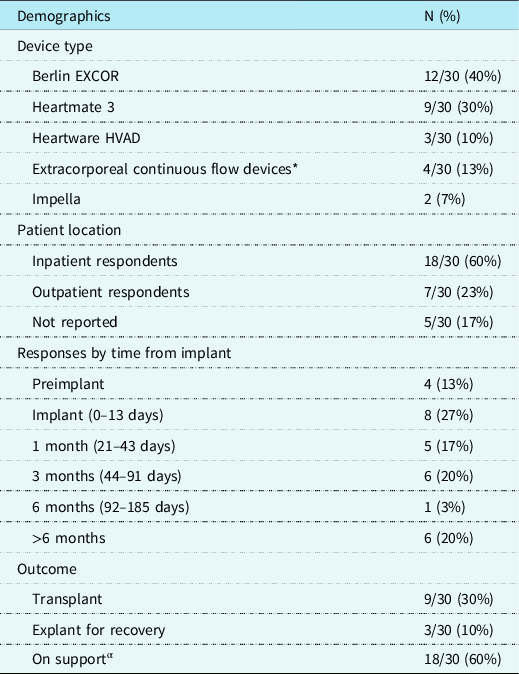
During the study period from 1 August 2020 to 25 April 2021, 30 of the 35 eligible patients (85.7%) were enrolled. Reasons for not enrolling patients included coordinator/clinician too busy (n = 1), lack of consent (n = 1), and patient transplanted shortly after ventricular assist device implant/clinician was unable to obtain consent in the time frame between implant and transplant (n = 3). For the 28 patients with complete demographic data, 20 (67%) were male, 20 (71%) identified as White/Caucasian race, 4 (14%) identified as Black/African American, 2 (7%) identified as Asian, and 2 (7%) identified as Native Hawaiian or Pacific Islander. The majority (77%) of participants reported non-Hispanic/Latino ethnicity. The median age of the patients at enrolment was 5.8 years (IQR 0.6, 15.9). For patients completing PROMIS 25, the median time from implant was 43.0 days (IQR 12.0, 239.5), whereas for patients completing PROMIS 29, the median time from implant was 636 days (IQR 468.0, 834.8). Number of respondents by time from implant as well as patient location (inpatient versus outpatient) are shown in Table 1, along with device types and clinical outcomes.
Cohort characteristics.

*Centrimag, Pedimag, Rotaflow; α four patients on chronic support.
PRO pilot feasibility and acceptability
Parent-reported PROs were collected from 23 patients and self-reported PROs were collected from 7 adult patients. In total, 73 PRO bundles were administered and only 4/73 had incomplete surveys (5%). All PROMIS measures were completed. Average time from initiation of survey to completion of survey for Take ACTION was 3 minutes 28 seconds. Average completion time for PROMIS surveys was similarly brief: PROMIS-25 (2 minutes 52 seconds) and PROMIS-29 (3 minutes 39 seconds). Attrition from the PRO pilot study was zero.
Overall, both pilot site clinicians and participating patients/parents reported positive experiences with the PRO pilot. Biweekly feedback was requested from clinicians using a electronic short survey, and ventricular assist device coordinators participating in the pilot reported that enrolling a new patient into the pilot project typically took <30 minutes (consent, enrolment, and baseline survey completion). On a spectrum of “very easy,” “easy,” “neither easy or difficult,” “difficult,” or “very difficult,” 11/12 (92%) clinician respondents reported the platform to be “very easy” or “easy” to use. For patients who were not enrolled, explanations included “coordinator too busy/not available,” “not able to contact parent”/“parent not at bedside,” or no “consent for PRO pilot obtained.” With each PRO administration, parents/patients were asked for feedback about the process. Per parents/patients, 100% of participants in the PRO pilot reported that the survey length was “just right.” Open-ended comments from parents/participants included “very simple,” “very informative,” “great so far,” and “you should add a do not know button.”
Patient and parent-reported outcomes
Data from Take ACTION were available at single time points for 30 patients, 6 of whom were self-reported. Serial Take ACTION parent proxy-reported assessments were available for 15 patients. Six patients had pre-implant Take ACTION data. For two of these patients, the pre-implant assessment was the only one completed. Responses were grouped by time from implant: 0–30 days and 31–100 days (Figs 1a and 1b, Figs 2a and 2b). Most common symptoms reported in the early post-implant period were limitations in activities (reported by 16/23; 70%), distress around dressing changes (reported by 13/23; 57%), and post-operative pain (reported by 13/23; 57%). Over half of the respondents found limitations in activities and distress around dressing changes to be moderate-severely distressing for their child. Worry, thirst, and poor sleep were also commonly reported. In comparison, beyond 30 days post-implant, poor sleep (15/23; 65%), distress related to dressing changes (13/23; 57%), sadness (12/23; 52%), and fatigue (12/23; 52%) were the most common symptoms endorsed. Dressing changes and sadness continued to cause moderate–severe degrees of distress.
( a ) Frequency and severity of patient symptoms as reported by their primary caregiver in the 0–30 days post-implant. Respondents N = 12, total responses N = 23. ( b ) Frequency and severity of patient symptoms as reported by their primary caregiver in the 31–100 days post-implant. Respondents N = 14, total responses N = 23.

( a ) Frequency and severity of family concerns as reported by the primary caregiver in the 0–30 days post-implant. Respondents N = 12, total responses N = 23. ( b ) Frequency and severity of family concerns as reported by the primary caregiver in the 31–100 days post-implant. Respondents N = 14, total responses N = 23.

Data from the health-related quality of life visual analogue scale were available at single time points for 24 patients, 8 of whom were self-report. There was a general trend toward higher parent proxy visual analogue scale scores with greater time from implant (Fig 3). There were few data available for self-reported visual analogue scale, and available data were widely spread across time, ranging up to >900 days post-implant.
Visual analog scale obtained by self-report ( a ) and parent proxy report ( b ) for the cohort. Self- report respondents N = 6, total responses N = 6. Parent proxy respondents N = 15, total responses N = 30.

Among the family-centered issues, early post-implant caregiver worry and difficulties balancing demands were most common and elicited moderate–severe degrees of distress and continued to be reported in the later period post-ventricular assist device implant. More caregivers reported financial stress, sibling stress, and family conflict in the 31–100 days post-implant period, compared to early post-implant.
PROMIS-25 parent proxy data were available for 10 patients, 4 of whom had serial assessments during the study period (Fig 4). At implant, the median PROMIS T scores were at least 1 standard deviation (SD) from the United States population mean of 50 for all domains except peer relationships (physical function, anxiety, depression, and fatigue). For physical function mobility, the median T score (23.3) was more than 2 SD from the general population mean. There was a general trend toward improvement for all domains at 1-month post-implant, with marked improvement for all domains at 3 months post-implant. By 3 months, median T scores for anxiety, depression, and fatigue were all within 1SD of the US population mean. Although there was an improvement in median T score for physical function mobility at 3 months post-implant, it remained >1SD from the United States population mean.
Median PROMIS-25 parent proxy T scores across time.

PROMIS-29 self-reported data were available from seven adult patients. Among these seven patients, one had only a pre-implant assessment. For Patient 1, the pre-implant physical function T score was >2SD below the average population (reflecting worse physical function), and the T score for fatigue was >1SD below the average population (reflecting more fatigue), with anxiety, depression, sleep disturbance, and pain interference that were between 0.5 and 1 SD of the average population. The majority of the PROMIS-29 self-report post-implant data were collected from patients who were at least 1 year from ventricular assist device implant, with only one patient completing the PROs within 91 days of implant (Patient 7). The median time from implant for those with post-implant data was 562 days (IQR 468, 834). Post-implant data illustrate physical function T scores that remain low (at least 1 SD from the average population); fatigue T scores that were 0.5–1 SD from the average population; and anxiety, depression, sleep disturbance, social roles, pain interference, and cognitive function T scores typically within 1 SD of the average population.
Discussion
While the incorporation of PROs into clinical practice and research trials has clinical utility and value in adult advanced heart disease Reference Sepehrvand, Savu and Spertus6,Reference Greene, Butler and Spertus7,Reference Anker, Agewall and Borggrefe15 and mechanical circulatory support, Reference McIlvennan, Magid, Ambardekar, Thompson, Matlock and Allen16,Reference White-Williams, Fazeli, Kirklin, Pamboukian and Grady17 the uptake of PROs in paediatric cardiology has lagged behind. This multi-center PRO pilot experience demonstrated both feasibility and acceptability of electronically captured PROs in paediatric and young adult patients with heart failure who were receiving ventricular assist device support. Further, results of this pilot study highlighted both physical and psychosocial symptom intervention targets for improving outcomes and quality of life in children and young adults on ventricular assist device.
Feasibility, acceptability, and data completion rates support this pilot as being one of the most successful multi-center PRO experiences to date in paediatric advanced heart disease. In partnership with Pedimacs, we built upon both strengths and challenges of previous experiences collecting health-related quality of life reports from children and parents on ventricular assist device. Through the Pedimacs experience, it was gleaned that patient critical illness status, urgency of ventricular assist device implantation, and ventricular assist device clinician/coordinator time/availability and were the biggest barriers to health-related quality of life survey completion. Reference Hawkins, Priest and Murray18 Via the incorporation of automatised electronically captured PROs through text or email to reporter, the burden on clinicians to administer surveys was greatly reduced. Additionally, as the survey text or email was sent directly to the PRO reporter, the patient or parent could opt to complete surveys at times best for them, without others feeling uncomfortable approaching patients or parents for survey completion during periods of critical illness or high stress. These strategies were effective as demonstrated by no patient/parent attrition from the pilot study and only 5% of PRO bundles with incomplete surveys. Further, patients and parents were intimately involved in the development and implementation of this PRO project. Patients and parents specifically weighed in on content, measurement selection, administration processes, and graphics and technology design. This partnership with stakeholders from inception to project execution was critical to the success of this PRO pilot and underscores the considerable value of engaging patients, parents and stakeholders in quality improvement and research design. It is also possible that the intended use of the PRO surveys to inform clinical care, as opposed to only for research use, contributed to the overall success of this pilot experience.
Early findings regarding symptom frequency and burden during the paediatric ventricular assist device course described in this pilot sample inform future clinical intervention and research. Similar to recent work by Molloy and colleagues describing symptom burden in paediatric advanced heart disease, Reference Molloy, DeWitt and Morell19 symptom burden was high in the pilot sample 0–30 days following ventricular assist device implant. Per pilot findings, high priority targets for intervention to reduce symptom burden in paediatric ventricular assist device in the immediate post-implant phase include dressing change distress and post-operative pain. Non-pharmacological efficacious interventions, including cognitive-behavioral therapy strategies and distraction, Reference Birnie, Noel, Chambers, Uman and Parker20 should be utilised and studied specific to paediatric ventricular assist device dressing change distress. Building upon work in adult burn populations, Reference Scheffler, Koranyi, Meissner, Strauss and Rosendahl21 distraction-based interventions, specifically the use of virtual reality and hypnosis, may provide pain relief during ventricular assist device dressing changes and wound cares. Respondents also reported that limitations in activities caused moderate to severe distress 0–30 days post-implant. While limitations in activity are expected during pre- and post-operative ventricular assist device period, data suggest that clinicians should engage patients/families in problem-solving to reduce related distress. Utilizing daily schedules that incorporate activities that can be safely done, such as participation in virtual school, music lessons, art/pet therapy or interests that can be done from one’s hospital bed such as basketball play could be incorporated into the post-implant care of paediatric ventricular assist device patients.
Per the network-derived PRO as well as established PROMIS measures, psychological distress, specifically sadness and worry, was notable in patients during the initial ventricular assist device period (0–30 days post-implant). On the network-derived PRO, frequency and intensity of sadness worsened among the sample 30+ days post-implant. Our pilot findings are consistent with a recent review of the paediatric ventricular assist device psychosocial literature by Rea and colleagues. Reference Rea, McCormick, Lim and Cousino22 Among a national sample of children bridged to transplant on ventricular assist device support, 40% had a psychiatric diagnosis, primarily adjustment, mood, or anxiety-related disorders. Reference Diaz, Thurm and Hall23 While based on a small sample, Ozbaran and colleagues noted that 63% of paediatric ventricular assist device patients had persisting psychiatric concerns 6 months post-implant. Reference Ozbaran, Kose and Yagdi24 Together with current study results, findings underscore the importance of mental healthcare integration for paediatric and young adult ventricular assist device patients. Although psychosocial assessment is recommended as a standard of care pre-implant, Reference Lorts, Conway and Schweiger25 continued mental health screening should occur throughout the ventricular assist device course to ensure appropriate referral and intervention. Reference Rea, McCormick, Lim and Cousino22
While it was not a focal point for pilot project outcomes, the ability to respond to parent/patient concerns in real time was beneficial as reported by clinicians. At most pilot sites, the PRO data were reviewed within hours or days of collection so that patient/family concerns could be discussed promptly, and social work or other services could be engaged in a timely fashion. Most pilot sites integrated the PRO findings into their clinical workflow and reviewed the data on rounds, during ventricular assist device-specific weekly meetings, and/or with the inpatient teams when results became available. Integration of PRO findings into patient care is generally known to be essential to maintaining engagement in the use of PROs and to ensure there is positive impact for patients and parents. Future iterations of this PRO programme will further investigate clinical utility of PROs and impact of PRO use on patient and family outcomes.
Based on strong recommendations from patient and parent stakeholders and collaborators in the PRO pilot design, parent and family functioning were also captured by the network-derived Take ACTION PRO survey. Although parent and family functioning significantly impact youth functioning, Reference Cousino, Rea, Schumacher, Magee and Fredericks26,Reference Leeman, Crandell, Lee, Bai, Sandelowski and Knafl27 they are not regularly incorporated into PRO initiatives. As one of the first studies to collect survey-reported data on parent and family functioning in paediatric ventricular assist device, findings highlight notable parent and family burden among this population. Parental sadness, anxiety, and burdens of balancing caregiver demands were notable among the sample in the first month post-implant, with these parent/family stressors, along with sibling distress and family financial stress continuing to increase in frequency and intensity 30+ days post-implant. Additional study of parent and family functioning, as well as their direct and indirect effects on child outcomes, is an important next direction for research.
Limitations of this pilot study are important to consider. First, while multi-center in nature, each of the participating centres were highly invested in the PRO project. PRO leaders in ACTION were heavily involved in the roll-out of this project at their centres. Thus, the investment in and commitment to the success of the PRO project from each participating centre may not capture the “real-life” experience across other busy centres. Collecting pre-implant PRO surveys is likely to pose an ongoing challenge given the acuity of illness, family stress, and time limitations. Currently, a 19-centre PRO study in paediatric ventricular assist device through ACTION is underway. Second, in this pilot phase, PRO completion was limited to one respondent, either patient or parent/proxy. Certainly, in paediatrics, both patient and parent experiences are important to understand. In the current sample, PROs were limited to only seven adult-aged patients. Inclusion of paediatric and self-reported PROs in clinical practice and research is an important next step. Further, despite the multi-center effort, the sample size is still limited. This limits further statistical analysis and our ability to make strong conclusions from the PRO pilot dataset. As paediatric medicine continues to move beyond the shared challenge of small samples, continued collaboration through learning networks and collaborative registries, such as ACTION will be critically important. Lastly, all data were collected during the COVID-19 pandemic, which has certainly contributed to increased distress in paediatric cardiology patients and caregivers. Reference Cousino, Pasquali and Romano28 COVID-19-related implications for ventricular assist device patients such as hospital visitor and volunteer restrictions, fears of infection, and greater limitations in activity may have impacted both patient and parent-reported distress.
In summary, this PRO pilot experience highlights important clinical implications and research directions. First, the use of electrically captured PROs can be easily integrated into the care of patients with advanced heart disease, such as those requiring ventricular assist device. Larger multi-center data with the incorporation of children-reported data is needed to better identify targets for intervention, but dressing change distress, post-operative pain, limitation in activity, patient psychological functioning, and parental mental health are important targets for improving patient- and family-reported outcomes post-ventricular assist device. With larger multi-center data, examination of the utilisation of PROs to predict health outcomes, such as hospitalisation, adverse events, or mortality, can also be conducted. Second, it will be important that quality improvement projects are developed and studied to determine how to best incorporate use of PRO data into the day-to-day clinical care of patients. Lastly, barriers to PRO survey completion, such as patient/family language (non-English speaking) or lack of technology/device access, must be defined and reduced, ensuring equitable access to participation in PRO initiatives.
Supplementary material
To view supplementary material for this article, please visit https://doi.org/10.1017/S1047951122004048
Acknowledgements
Many thanks to the patients and families who participated in this PRO pilot, along with the Families in ACTION (FACT) Committee, for sharing of their lived experiences, feedback, and ideas.
Financial support
Philanthropic support for the ACTION PRO programme was provided by Additional Ventures.
Dr Cousino’s research is supported by the National Heart, Lung, and Blood Institute (K23HL145096) of the National Institutes of Health.
Conflicts of interest
None.
Ethical standards
The authors assert that all procedures contributing to this work comply with the ethical standards of the relevant national guidelines on human experimentation (please name) and with the Helsinki Declaration of 1975, as revised in 2008, and have been approved by the institutional IRB at Cincinnati Children’s Hospital (ACTION Coordinating Site).