A-gbéni-kọluni, aláǹgbá orí èṣù / Thing/agent that pushes a person to hit (another) person, lizard that sits on ÈṣùFootnote 1 (Kòṣémání Reference Kòṣémání1987: 45–8)
We have met the enemy and he is us.Footnote 2
The Yorùbá and their òrìṣà Footnote 3
Recent historical scholarship, particularly evidence from archaeological studies,Footnote 4 has begun to cast a confirmatory light on the antiquity of the Yorùbá people and culture, dateable to the final millennium bce, locating the people in the sub-region of tropical West Africa that is still identified as the homeland and centre of dispersal of the people's current acknowledged diaspora.
This study focuses on Èṣù, the most important primordial bastion of the Yorùbá people's metaphysical embodiments of organizing and regulatory existential principles. Èṣù is, of course, not a lone inhabitant of the Yorùbá pantheon of the metaphorical 401 òrìṣà, or ‘divinities’, in which the odd ‘one’ is the ever present possibility of accretion by one.
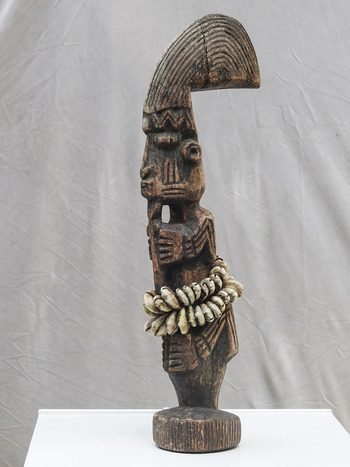
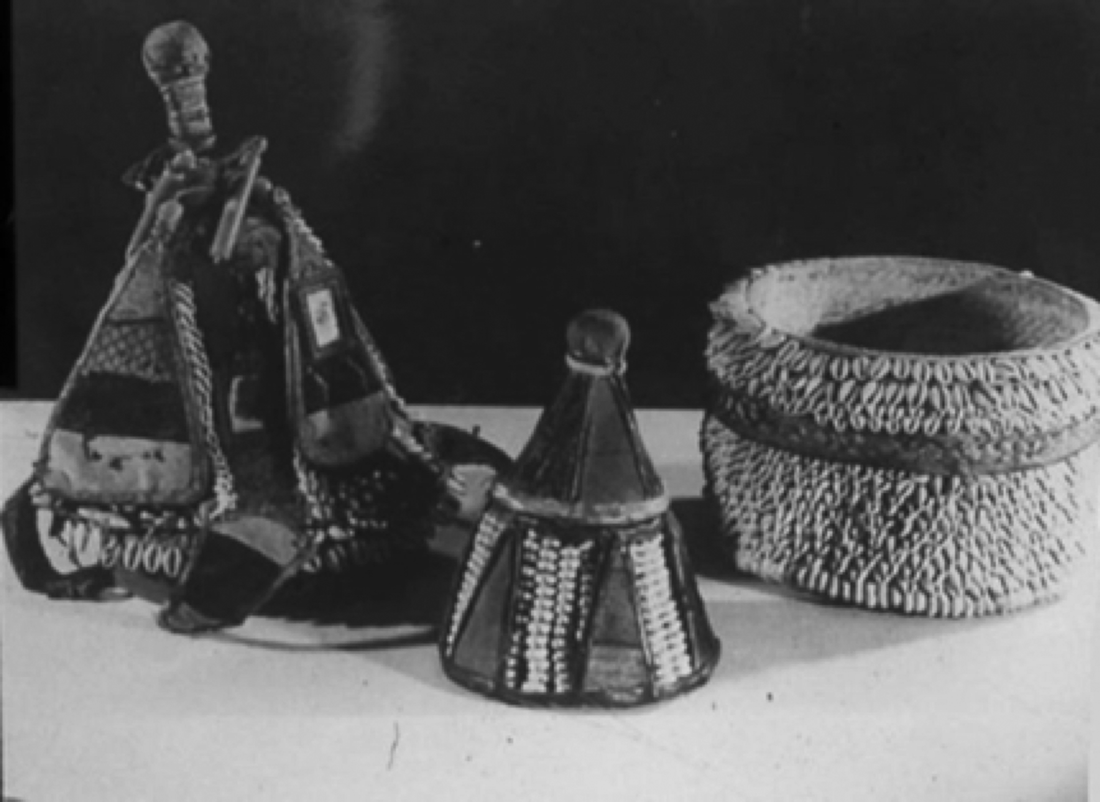
Along with its pantheon, the Yorùbá world established, very early, markets (Akintoye Reference Akintoye2010; Babalọla Reference Babalọla2017) and concomitant modes of exchange and valuation – or owó (money). This early emergence of markets and modes of valuation is important in establishing the antiquity of Yorùbá culture for two reasons. First, it negates the supposition that the use of cowries as ‘currency’ among the Yorùbá began with the infernal traffic in human beings of the seventeenth to twentieth centuries. Second, the secondary use of the cowrie for the adoration of Èṣù and Orí (see Figures 1 and 2) cannot be anachronistic, given that both are among the most important pan-Yorùbá òrìṣà.Footnote 5
Èṣù by Lamidi Ọlọ́nàdé Fákẹ́yẹ. Source: Photograph by David R. Randell Photographics. Published with the permission of Al Gemrich.

Ìbọrí, Orí symbol (centre) displayed between the top and the base of the Ilé-Orí.Footnote 7 Source: Abíọ́dún (Reference Abíọ́dún2014: 33). Republished with the permission of Rowland Abíọ́dún.

If, as Akintoye (Reference Akintoye2010: 26) suggests, ‘the use of the cowry shells as currency almost certainly … began in times before Odùduwà, that is, before the tenth century’, the Yorùbá phrasal nomenclature owó-ẹyọ, ‘elemental unit (ẹyọ) of money (owó)’, for the cowrie as currency must presuppose a prior mode of exchange (owó).Footnote 6 One argument in support of this supposition is that the intricate Yorùbá numeration system most certainly predates the emergence of markets and/or material transactional exchange. In a personal communication, Ọdẹ́túnjí A. Ọdẹ́jọbí, a specialist in computational technology who works on the Yorùbá numeration system, in answer to my query ‘What do the Yorùbá count?’, writes: ‘It turns out that the most computationally powerful number system in the recorded history of numeration is that of the Yoruba.’Footnote 8 A powerful system such as this must have preceded and ‘powered’ reckoning in the early market economy. It certainly facilitated the use of the cowrie when they began to come by the shipload and needed to be counted in the millions in the service of the human traffic that began in the sixteenth century.
The Yorùbá primordial òrìṣà include Ògún, the lord of artistic deployment of materials, beginning with iron as early as the first century ad and arguably earlier; Ifá, the Yorùbá fountainhead of knowledge and information about all objects of consciousness; Ifá’s inseparable companion, Èṣù, the arbiter among all sentient beings and custodian of the primordial àṣẹ, the life force for all ‘motion’; and Ọ̀sanyìn, custodian and dispenser of the powers that inhere in all flora and every medium for medicinal and curative preparations.
The eminent sociologist N. A. Fadipẹ’s inquiry led him to opine that ‘the universal distribution of Èṣù would seem to indicate that it was one of the earliest of Yorùbá orìṣà’ (Reference Fadipẹ2012 [1970]: 287). He finds that, among all subgroups of the Yorùbá:
Èṣù, alias Ẹlẹ́gbára, is undoubtedly the most ubiquitous of all òrìṣà and also one of the most universally worshipped. A Yoruba proverb says that every head of a compound must have an Èṣù outside his compound and the baálé who does not have one will have to give account to Èṣù … nearly every òrìṣà to which a priest or priestess is attached has an Èṣù or Ẹlẹ́gbára linked with it. (Fadipẹ Reference Fadipẹ2012 [1970]: 285f.)
Orí, ‘inner head’, is as distributively fundamental among the Yorùbá as Èṣù is ‘universal’.Footnote 9
Testimony with indigenous epistemological import
Studies such as those referenced above suggest that developments antecedent to the advent of the Odùduwà revolution appear to have turned the Yorùbá geopolitical territory of tropical West Africa into a homologue of Ancient Greece, with a proliferation of city states, each with its own ruler, but with shared metaphysical beings and institutions.
I was born into one such city state, one that is now fast becoming anachronistic, devastated largely by the malaise engendered by the decadence born of colonial and postcolonial secularization and political and social materialism. In my youth, during every state function and every major rite of passage, such as marriage and the death of elders, and during notable communal rituals of renewal, performing artists descended on my family, striving to outdo one another in their rendering of the oríkì (poetic citations)Footnote 10 of individuals and families. This was so in the life of my grandfather, Ọlábọ̀dé Ọláọmọ:
Ọlábọ̀dé died in about 1943 and never reigned in the city state of Àjáàwà, but his son, Oyètúnjí reigned from 1968 to 1979. And the performing artists, regularly joined by accomplished women chanters in the community, came to render the oríkì of my family. Typically, in the early morning and from a great distance, dùndún professional drummers beat out an appreciable portion of the oríkì; women pick it up; and soon other attendant professional performers begin to vie to outdo one another for recognition and reward. Among the professional performing groups came the family of Dáraléṣù,Footnote 13 from Ọ̀yọ́, the ancient capital of the Ọ̀yọ́ Empire that was relocated (as Àgọ́ dỌ̀yọ́) within twenty miles of Àjáàwà after its sack in 1832. Members of Dáraléṣù’s family, as the name suggests, were devotees of Èṣù.Footnote 14 Among other skills, they distinguished themselves in the performance of rárà, a celebratory chanting mode for rendering oríkì that provokes emotion.
This early exposure to Èṣù raised, for me, nagging questions about the identity, personality and status of Èṣù during the catechism classes to prepare me to be baptized into the local church of the American Southern Baptist Convention;Footnote 15 and later still, when I began an analytical study of the Christian Bible, and particularly of the four Synoptic Gospels, for the Cambridge School Leaving Certificate.
Yorùbá xenophilia
The Yorùbá autochthonous embrace of other faiths echoes across the ocean. The observable survival and apparent dominance of the Yorùbá tradition in the Americas, among other African traditions, is not well accounted for by the relatively small number of Yorùbá among the enslaved Africans at any time and in any of the landing sites throughout the period of the inhuman traffic in African bodies and minds from the sixteenth to the nineteenth century. Among other things, the enslavers and the plantation owners in the Americas lived in dire fear of ethnic homogeneity of the enslaved, even when the enslavers prized certain skills and/or attributes of particular ethnic groups for their purposes. Hence, they mixed up their human herds in order to minimize the predominance of any one ethnic group.
I suggest that the survival and pre-eminence of the Yorùbá tradition in the Americas should be more meaningfully sought in its ‘integrity’: that is, in the cohesive articulation of the conceptual system of the tradition. One testimony to this integrity was indicated by the fact that the Yorùbá people took minimal interest in despoiling other people they got the better of in any encounter, including those they defeated in conflicts. The Yorùbá did not proselytize, and they never initiated conflicts on the basis of doctrines or tenets. Instead, in situations of encounter, the Yorùbá sought to attract the intellectual fountainheads of other traditions to their own, particularly the intellectuals and custodians of the other peoples’ spiritual and ethical values. They slotted new elements into ‘grooves’ allowed by the Yorùbá tradition; this is encapsulated by the figure of speech that assigns to the Yorùbá pantheon 401 òrìṣà, where the ‘one’ represents the enduring possibility of accretion by one. This explains the following dictum, which gives us a diachronic insight into the tradition:

Ifá, the indigenous thought and information-processing system of the Yorùbá tradition, with the divinity Ọ̀rúnmìlà at its core, provided an accommodating groove for Islam with Mohammed perceived as its òrìṣà. Then, belatedly and, as it were, in historical time, entered Christianity, which, hubristically, claimed for itself the term and concept ìgbàgbọ́ – literally, ‘faith’ – and insisted that all adherents must acknowledge one and only one central figure, Jesus Christ.Footnote 16
This also suggests that, at their first encounter, the Yorùbá viewed both Islam and Christianity as other epistemological systems, like the one of which Ifá was the core component. This mindset, which enslaved Africans shared with those left behind, appears to have facilitated the following tendencies noted by Pierre Verger and Robert Voeks in relation to the development of the African-influenced tradition in the Americas, particularly in Cuba and Brazil. They write:
Black Africans mostly directed their devotion at Saint Barbara, Saint George, Saints Cosmas, and Damianus, Saint Jerome, Saint Anthony, Saint Lazarus, Saint Anne, Our Lady of Candlemas, and above all Our Lord of the Good End (O Senhor de Bonfim). The true reason of this devotion to the Saints at that time was beyond the comprehension of the majority of white Bahians. They did not know that to the Nago-Yoruba these names of the Catholic Saints represented those of their principal Orisa, by a phenomenon of syncretism, and that they stood for Oya, Osoosi, the Ibeji, Sango, Ogun, Omolu, Obaluaye, Nana Buruku, Yemoja, Osun and Obatala respectively. (Verger Reference Verger1977: 222–4)
Elaborate rituals and offerings, belief in magic and divinations, ancestor worship, votive offerings and sacrifices, and the adjuration of gods to deal with real world problems – all fundamental to African religious structure – found their ready parallels within Catholicism. (Voeks Reference Voeks1997)
This makes sense, because, as both authors propose, the enslavers and plantation owners in both Cuba and Brazil came largely from the Iberian Peninsula, with the Catholicism of the Middle Ages, characterized by rituals and saints, homologous to those identifiable with òrìṣà of the Yorùbá tradition. Furthermore, it appears that the enslavers and plantation owners from the Iberian Peninsula, during the material historical period, escaped the intellectual theodicy that motivated both John Milton (Paradise Lost, 1667) and Johann Wolfgang von Goethe (Faust: Part I Reference Goethe1992 [1808]). The former introduced Lucifer, the latter Mephistopheles, each as the embodiment of evil. Later enslavers, immigrant property owners in the Americas and missionaries from Protestant Western Europe carried these embodiments of evil in their heads as templates for and measures of elements of the African tradition to promote their goal of liquidating the indigenous faith traditions. Thus, the immigrant property owners and enslavers in the Americas and proselytizing missionaries on the ‘Slave Coast’ succeeded in voiding the indigenous concepts of their native meaning and alienated unwary bearers of tradition from that tradition.
The Yorùbá cosmos and world view revisited
Figure 3 illustrates the more familiar profile of the cosmos in Yorùbá thought. However, the now well-known Yorùbá world view succinctly described by Wọle Ṣoyinka (Reference Ṣoyinka1976) allows us to propose a cosmos with three non-linear realms as being more consonant with the Yorùbá conception of the cosmos. The three conceptual non-linear realms are: ọ̀run, the metaphysical realm populated by òrìṣà, spirits and the unborn, all of whom are thought of not in terms of corporeal manifestation; ayé, the realm of phenomena, of living things, corporeal consciousness and perception; and ilẹ̀, the earth, the nurturer and realm for the departed who were once corporeal but are not yet subject to apotheosis. As Ṣoyinka puts it:
Past, present and future being so pertinently conceived and woven into the Yoruba worldview, the element of eternity which is the gods’ prerogative does not have the same quality of remoteness or exclusiveness which it has in Christian or Buddhist culture. The belief of the Yoruba in the contemporaneous existence within his daily experience of these aspects of time has long been recognized but again misinterpreted. It is no abstraction. (Ṣoyinka Reference Ṣoyinka1976, emphasis added)
‘Yoruba cosmos’. Source: Drewal et al. (Reference Drewal, Pemberton and Abíọ́dún1989: 14). Published with the permission of Henry Drewal and Rowland Abíọ́dún.

In spite of their conceptual differences, however, both propositions suggest that no realm is hermetically sealed off from the others. It appears to be the case that, while the ‘element of eternity’ is the prerogative of the òrìṣà, who are not subject to restraints of time and space, only unembodied beings, including the dead, have the possibility of acceding to the realm of the òrìṣà. Nevertheless, earth dwellers may hold commerce with the realms of both the òrìṣà and the departed, ará-ilẹ̀, ‘people of the earth’, or òkú ọ̀run, ‘the dead in heaven’. This commerce is mediated by Ọ̀rúnmìlà, the custodian of the exhaustive account and information about the essence of all objects of consciousness, and of thought. The account and information are accessible through Ifá, the enormous literary corpus of the Odù (pàtàkìn in Cuba or Caminhos de Odù in Brazil) that serves as a storehouse for Ọ̀rúnmìlà. The details of the process of human access to the storehouse of Ọ̀rúnmìlà are well documented and need not detain us here (see Abímbọ́lá Reference Abímbọ́lá1975; Reference Abímbọ́lá1976; Bascom Reference Bascom1980; Reference Bascom1991 [1969]; Amherd Reference Amherd2010, among others).
Of course, Ọ̀rúnmìlà does not perform his responsibility of mediation alone; he relies on the executive authority of his constant companion, Èṣù (Ẹlẹ́gbára; Ẹlẹ́gbá; Legba). Èṣù alone is privy to the compendium of information in the storehouse of Ọ̀rúnmìlà. Nothing, therefore, is lost on Èṣù with respect to the situation-specific information, pronouncements, injunctions, directives, advice and prescriptions proffered by Ifá through the Odù. Èṣù ensures that the spirit and letter of the directive through the Odù to the individual are met. In performing this duty, Èṣù is above all the arbiter par excellence. He is no respecter of persons, human or òrìṣà, including even Ọ̀rúnmìlà. It is important to emphasize again that Èṣù is privy to the totality of information in the custody of Ọ̀rúnmìlà.
Ọ̀rúnmìlà has no representational image (Abíọ́dún Reference Abíọ́dún and Abímbọ́lá1975). The only sculptural objects identified with this òrìṣà include Ọpọ́n, ‘divinatory tray’; ìrọ́kẹ́, ‘divinatory tapper, with clapper’, for invoking Ọ̀rúnmìlà; Àgẹ̀rè Ifá, ‘a carved container with a lid that holds the ikin, the sacred palm nuts’; Ọ̀pá Ọ̀rẹ̀rẹ̀, ‘an iron staff usually prescribed by the babaláwo’, the master in the mystery to which only Ifá provides access, or diviner (Abíọ́dún Reference Abíọ́dún and Abímbọ́lá1975).
Èṣù, on the other hand, has a plethora of sculptural and visual representations, varying from simple laterite or clay mounds to full statues, usually placed at symbolically liminal points of access. Èṣù’s face critically surmounts Ọpọ́n, the Ifá divinatory tray, as if to keep watchful eyes on the mediation facilitated by the diviner, but more appropriately representing the knowing and watchful eyes of Èṣù on the realm of phenomena represented by the face and centre of the Ọ pọ́n, of which the four compass points represent the four corners of the universe.
Èṣù, too, like Ọ̀rúnmìlà, has a dedicated medium for access, a corpus in language through which the custodian of the mystery particular to him also accesses him. Èṣù’s medium of communication with humans is Ẹẹ́rìndílógún, ‘Sixteen Cowries’, after which William Bascom (Reference Bascom1980) named his book. The corpus of Ẹẹ́rìndílógún is organized into Odù, which are homologous to but more finite than those of Ifá. As if to underscore the robust continued presence of Èṣù in the Americas, Ẹ ẹ́rìndílógún is the sole means of accessing the òrìṣà, at least in both Cuba and Brazil. This suggests strongly that although Èṣù is the closest to Ọ̀rúnmìlà and his indispensable companion, Èṣù maintains his independence in this relationship.
We will revisit presently the critical players, along with Èṣù, and the concepts that have upheld the Yorùbá intellectual system for millennia, and have sustained the Yorùbá tradition as is reflected in the survival struggle of the African tradition in the Americas. We will isolate concepts and values from which the Yorùbá culture-bearers in the homeland, remarkably enough, have allowed themselves to be alienated, but which, if re-embraced, can serve us all creditably in re-envisioning the future.
Representations of Èṣù in the Yorùbá tradition
Views about and re-conceptualizations of Èṣù in particular in both secular literature and faith-related published materials are vast; indeed, so vast that it challenges our sanity, within the scope of this article, to entertain the notion of redirecting minds already inured to them. The challenge is daunting because purveyors of these views include disciplined intellectual Yorùbá culture-bearers, even those who have powerfully and validly adopted literal but glaringly pernicious misrepresentations of the òrìṣà, as they have the Yorùbá tradition that provides their fundamental essence. The views called into question in this article fall into two categories: first, those that persist in identifying Èṣù with Satan, the Devil and/or Iblis of the Abrahamic faith traditions – namely Christianity and Islam. I hasten to add that views of this sort are largely absent or are severely attenuated in the òrìṣà traditions of Santería (Cuba/Puerto Rico), Vodou (Haiti) and Candomblé (Brazil). This category of contestable views has become increasingly challenged and weakened by systematic arguments advanced to address them by scholars such as Ayodele Ogundipe (Reference Ogundipe1978) and Wọle Ṣoyinka in many well-known publications and public addresses, many of which find clear summaries in Of Africa (Ṣoyinka Reference Ṣoyinka2012).Footnote 17
The second category of contestable views and re-conceptualizations often goes something like the following, found in Pereira, who, in valorizing August Wilson's remarkable use of myth in the African tradition, says of his source:
Wilson was in this tradition. Devoid of their mythological dimensions, his characters, Levee, Troy, and Boy Willie, in their separate plays, are merely destructive forces at odds with their world instead of agents of change challenging the status quo and reordering their universe. Within the hill context of their cultural ancestry, they are the warrior spirit reincarnations of self-empowered trickster deities, figures which recur in myths from the Yoruban Eshu to the Hindu Krishna, from Bamapana the Australian Aborigine, Prometheus in ancient Greece and Sun Wukong in Chinese lore, to Reynard the French fox, Coyote the Native American, Maui in Hawaii, Susanowo in Japan, Loki the Norse god and even Jacob of the Old Testament. (Pereira in Bigsby Reference Bigsby2007, emphasis added)Footnote 18
Ayodele Ogundipe (Reference Ogundipe1978) goes further than any other scholar we have encountered to put beyond argument the impeccable standing of Èṣù in the comity of the other òrìṣà and as a plausible anchor for individual accountability and societal rectitude, particularly in the twenty-first century. Unfortunately, as if reducing Ogundipe's study to naught, there continues to be a spate of contestable tenets and re-conceptualizations that abuse Èṣù and the Yorùbá tradition. Perhaps Ogundipe herself retains some of the responsibility for this, for not going far enough and for capitulating to Bọlaji Idowu (Reference Idowu1962) when she concludes by demurring to her informants, agreeing, in the tradition of thoroughgoing anthropologists, that ‘Esu is a tempter, not Trickster, therefore, they [her informants] always explain why Esu causes dissension’. Thus, she allows herself to conclude with the apocryphal story of two friends whose dissension is used to exemplify Èṣù’s duplicitous ways:
[Èṣù’s] primary reasons for trying his victims include punishment for boastfulness or self-conceit and for defying the cardinal principle that life, with all its certainties, goes hand in hand with the unpredictability of chance and change. So for the two friends to boast about their friendship is to commit the sin of self-conceit. For two friends to say their friendship will endure forever was to be presumptuous about tomorrow, and to deny the unpredictability of life; therefore they committed an affront against Esu, the personification of flux and mutability. The two friends who in their friendship overlooked the blessing of God through Esu and sacrifice asked for their troubles. (Ogundipe Reference Ogundipe1978: 198)Footnote 19
Ogundipe believes that she also found evidence in her extensive fieldwork to ‘demonstrate that the essence of the deity Esu as Enforcer, the embodiment of chance, and father of sacrifice, is borne out by the folklore’ (Reference Ogundipe1978: 235, emphasis added). She adds:
Nevertheless, Esu myths go beyond simple storytelling to depict a natural and social order in which fate and destiny are counterbalanced by chance and uncertainty, where moral evil is punished, and where observance of religious order is demanded. (Ogundipe Reference Ogundipe1978: 235)
Esu provides enormous imaginative conceptual implications as deity because he is the messenger of the gods, the mediator between God [sic] and man, between order and chaos, sin and punishment, life and death, fate and accident, certainty and uncertainty. It is no wonder, then, that Esu in myth knows no master, that he is male and female, that he is tall and short, kind and cruel, an elderly deity of youth who lives at the crossroads. (Ogundipe Reference Ogundipe1978: 236–7, emphasis added)
As emphatically as Ogundipe, Wọle Ṣoyinka makes an unassailable case against the demonization of Èṣù by the proselytizers of the Abrahamic faiths, particularly those in the Yorùbá homeland. But he then adds:
This was quite convenient, since Esu is the most ubiquitous of all the deities, being their messenger, and a complex yet ‘mischievous’ one to boot. He sits at the crossroads and confuses the wisest of mortals and gods … Esu, however, is anything but evil – the notion is as absurd as to deem a high-spirited child a product of the devil. This deity represents the random, unpredictable factor in both divine and temporal affairs. Esu is the dialectician of reality, a cautionary spirit who teaches that reality has more facets than one. Trust not appearances – that is the lesson of Esu, a lesson often imparted the hard way. (Ṣoyinka Reference Ṣoyinka2012: 146, emphasis added)
Unlike Ogundipe and Ṣoyinka, other scholars have not redeemed themselves but give comfort to more contestable views about Èṣù and/or use Èṣù as a basis for building dubious theoretical scaffolding for poetics on tenuous premises.
It is little comfort that Wándé Abímbọ́lá (Reference Abímbọ́lá1976) and other excellent studies offer a source on which many scholars, at home and abroad, have based their representations of Èṣù. Most scholars, nevertheless, overlook the crucial positive presentation of this òrìṣà found in much of the non-interpretive work Abímbọ́lá has mediated as a boon to scholars of the Yorùbá tradition. More often than not, users of such work seize only on, for example, statements such as the following in which Abímbọ́lá apparently allows himself to be misled by published studies produced by non-culture-bearers. He writes:
Standing between the evil powers and the good powers is the mischievous figure of Èṣù (the Yoruba trickster god) who is more or less a neutral force in the conflict between the good supernatural powers and the evil ones. Although Èṣù is believed to belong to the zone of the gods, he does not always favor his fellow gods. Indeed, Èṣù is prepared at any time to favor any human being or supernatural power according to his own whims and caprices influenced by whether or not the person or power concerned has performed the prescribed sacrifices. (Abímbọ́lá Reference Abímbọ́lá1976: 152)
The attributive phrases ‘the mischievous figure of Èṣù (the Yoruba trickster god)’ and ‘according to his own whims and caprices’ do not find any justification anywhere in Ifá corpus, to the best of my knowledge, not even in the compendium of Abímbọ́lá’s otherwise careful analytical studies.
While Bascom quite correctly chastises Christians and Muslims for misappropriating Èṣù, his presentation of the òrìṣà as a mischievous trickster is ominously misplaced as well. He writes:
Eshu (Eṣu, Eṣu Bara, Ẹlẹgbara, Ẹlẹgba) is the youngest and cleverest of the deities. He is the divine messenger (iranṣe), and one of his roles is to deliver the sacrifices he receives to Ọlọrun. Understandably, the diviners consider his roles important. He is also a trickster, the divine counterpart of Tortoise in Yoruba folktales, who not only delights in trouble-making but also serves Ọlọrun and the other deities by causing trouble for human beings who offend or neglect them. He is notorious for starting fights … killing people by toppling walls and trees on them, and causing calamities to deities and humans alike; but his role in delivering sacrifices to God … is hardly consistent with his identification with Satan by Christians and Muslims, which can only be understood as the result of the failure to find the equivalent of the Devil in Yoruba belief. (Bascom Reference Bascom1991 [1969]: 105, emphasis added)
Nor does Bascom relent in his characterization of Èṣù in his work Sixteen Cowries, which pertinently focuses on the divinatory system identified with Èṣù, which also happens to be the one system of prognostication mostly practised in both Cuba and Brazil. Bascom writes:
Eshu (Èṣù) is the divine messenger who delivers the sacrifices offered at his shrine, as prescribed by diviners, to Ọlọrun. He is also the divine trickster who not only delights in trouble-making, but also serves the other deities by causing trouble for human beings who offend or neglect them. He is called ‘Eshu is not good’ (Èṣù, Ọ̀dàrà; …), and he is also known as Ẹlẹ́gba … and Júoríwà. (Bascom Reference Bascom1980, emphasis added)
It must be pointed out that the figure of Èṣù as trickster and sinister messenger does not ring true in the world of Ẹẹ́rìndílógún/Dilogún (Sixteen Cowries), the subject of Bascom's authoritative study. Suffice it to note here the following: first, any systematic recognition of Ọlọ́run as a demanding ‘prime mover’ appears to be a doubtful component of the Yorùbá thought system. Second, Èṣù as ‘the divine trickster who not only delights in trouble-making, but also serves the other deities by causing trouble for human beings who offend or neglect them’ is inconsistent with his role in the system as arbiter and custodian of the primordial àṣẹ. Finally, Bascom's reading ‘“Eshu is not good” (Èṣù, Ọ̀dàrà)’ is inconsistent with even his own stricture against the identification of Èṣù ‘with Satan by Christians and Muslims, which can only be understood as the result of their failure to find the equivalent of the Devil in Yoruba belief’. A more plausible reading suggests that the phrase ‘Èṣù Ẹlẹ́gbára’ more plausibly derives from ‘Èṣù Onígba-àrà’ (Èṣù capable of countless (literally igb or 200) wonders). Compare this to the structurally homologous attributive phrase ‘Èṣù Ẹlẹ́gbẹ̀rún Ọ̀gọ’ (Èṣù owner/holder of a thousand (ẹgbẹ̀rún) cudgels), referring figuratively to the uncountable ways in which Èṣù is capable of dealing with individuals who fail his test of probity and accountability.
Following a similar internal insight into language, the term ọ̀dàrà is more plausibly relatable to the lexical de-predicative nominal ọ̀-darà – ‘one who works wonders’. Compare this with ọ̀-daràn, ‘one who commits [criminal] deeds’; ọ̀dàlẹ̀ (ọ̀-dà-ilẹ̀), ‘one who overturns earth’ / ‘one who betrays trust’; ò-jòwú, ‘one who covets and is prone to jealousy’, from the predicate jowú or ‘express or engage in jealousy’; and ọ̀-falè, a promiscuous male, from the predicate fálè (<f ẹ́ àlè), ‘make love to àlè, a person to whom one is not married’.
Henry Louis Gates Jr, in his powerful and seminal work The Signifying Monkey (Reference Gates1988), proposes a profound hermeneutics for African and African-American poetics. However, he unnecessarily falls victim to the usual infelicitous characterization of Èṣù early in his otherwise important work. He writes, rather deceptively, as if to attribute the view he presents to other authorities:
Scholars have studied these figures of Esu, and each has found one or two characteristics of this mutable figure upon which to dwell, true to the nature of the trickster. A partial list of these qualities might include individuality, satire, parody, irony, magic, indeterminacy, open-endedness, ambiguity, sexuality, chance, uncertainty, disruption and reconciliation, betrayal and loyalty, closure and disclosure, encasement and rupture. But it is a mistake to focus on one of these qualities as predominant. (Gates Reference Gates1988: 6, emphasis added)
A charitable judgement of Gates’ characterization of Èṣù may take him to task only on how his position undermines the world view that assigns ethical integrity to the òrìṣà.
The distinguished scholar of the dramatic arts Femi Euba valiantly seeks to re-originate satire as a literary and dramatic genre in his important work Archetypes, Imprecators, and Victims of Fate (Reference Euba1989; see also Reference Euba and Carter Harrison2002; Reference Euba and Falola2013); this work was based on a dissertation supervised, not surprisingly, by Gates. An attentive student of satire from the Graeco-Roman classics will also easily impugn Euba's proposal of ‘Origins and developments of satire in black drama’ for unaccountably mischaracterizing Èṣù. Euba describes satire's prime mover as an Èṣù, a mischievous trickster and near sadist, always ready to do the biddings of any and all modern Archilochus with their wounded honour. Euba proposes a ‘trinity’ made up of Èṣù, Orí and ìpín (see below) and suggests an implausible, monstrous conceptual union of this trio with ‘Fate’ and ‘Destiny’ of the Graeco-Roman tradition. In doing so, Euba gives only a nod to the following felicitous observation by Melville J. Herskovits, a careful and attentive student of Dahomey, a Yorùbá cognate culture in which Èṣù also looms large. Herskovits writes about his observed veneration of Fá (Ifá) and Lẹ́gba (Èṣù), held to work in communion in the pantheon of Dahomey's primordial divinities:
In all probability, this deity was derived together with Fá cult from the Yoruba, among whom he takes the name Elegba, Elegbara, or Eshu. The usual translation of the name of this god, found above all in missionary literature, is ‘the Devil,’ and, in consequence, the native when asked by a European for an explanation of the nature of this deity contents himself with this characterization. Yet enough has been described of Dahomean religion to make it obvious that a concept such as that of the Devil of Christian theology, who represents the forces of evil in contradistinction to those of good, represented by God, is entirely foreign to Dahomean thought. (Herskovits and Herskovits Reference Herskovits and Herskovits1958: 222–3)
Instead of seeing Èṣù as a plausible godhead for satire, the dramatic scourge of the incongruous in human behaviour, Euba announces that he has come to terms ‘[w]ith Esu not only as a god of fate, master of peripeteia, ironist, and satirist, but also, in his New World manifestations, as the fateful/fatal satiric complex and concept in black drama’ (Euba Reference Euba and Carter Harrison2002: 167, emphasis added).
He wants us to believe that in Brazil and Cuba in particular:
The strong retention has been effected in the first place through the adaptive (and adoptive) dissembling of the slaves; a dissembling that points back culturally to the dissembling qualities of the trickster god, Esu-Legba. (Euba Reference Euba and Carter Harrison2002: 170, emphasis added)Footnote 20
The sardonic sadism of Euba's ‘trickster god, Esu-Legba’ is assuaged by the enslavement and expatriation of Africans to the Americas, because:
Slavery, the ‘racial burden’ that needs to be expiated, was the fate imposed on the African by Esu through exploitative aspirations of the white slavers. As Africans did not seem to deserve this, it was a catastrophic practical joke and inscrutable action of Fate. (Euba Reference Euba and Carter Harrison2002: 169)Footnote 21
Impugning contestable representations of Èṣù
I argue, first, that Èṣù is by no means a sinister òrìṣà, however one may seek to understand the word ‘sinister’. Second, Èṣù does not belong in the comity of tricksters and trolls, whether human or non-human.
First argument from Yorùbá names and naming
By tradition, names and naming in the Yorùbá language have an epistemic foundation.Footnote 22 The lexical item orúkọ, which is not entirely captured by the gloss ‘name’ in the English language, expresses the constitutive essence of the Yorùbá person,Footnote 23 people and culture. Orúkọ is not given in vacuo or by happenstance. This is captured by the expression ‘Ẹ̀yìnkùlé là á wò, ká tó ò sọ ọmọ lórúkọ’ (We must look into all the surrounding circumstances before assigning a child a name). This is because, once named, the orúkọ becomes the rein for controlling the bearer: ‘Orúkọ ọmọ ni ìjánu ọmọ’ (A child's name is the rein for ‘controlling’ the bearer). Also, a person's orúkọ determines the existential lot and comportment of the person: ‘Orúkọ máa ń roni’ (A name tells/impels the person).Footnote 24
This allows us to understand why, in the Yorùbá tradition, a child is named after a particular òrìṣà or a propitiatory supernatural agent recognized by the family and for the child at birth. Usually, orúkọ encapsulates the hopes and aspirations for and the potential of the child; it references events antecedent to the birth of the child for which the family recognizes a particular propitiatory agent. Sometimes o rúkọ is a charm to ward off present untoward events or to guard against redoubtable access by sinister forces, Ajogun, such as death, ikú. Such names reflect dire circumstances (see below).
The Yorùbá, in short, assign orúkọ based on benevolent forces and to memorialize and encapsulate, for a child's benefit, significant existential conditions of the child and of the family at the time of the child's birth. As Rogelio Martínez Furé (Reference Furé1985) carefully illustrates, the Santería tradition in Cuba embraces this critical significance of orúkọ as much as the homeland Yorùbá does. The data that follow from Furé provide supporting evidence.
Examples of Yorùbá proper nouns (orúkọ) in CubaFootnote 25
Relating to Elegba:
Eshu alai bodé, Eshu bi, Eshu dina, Eshu lari, Eshu laniwé, Eshu migbá, Oba gbe sí, Omó ako jú, [Eshu] Osiká, [Eshu] Towá
Compare with other òrìṣà (underlined) that appear as agency in naming:Footnote 26

If àṣẹ is the primordial life force for effective motion of any sort, whether transitive, intransitive, reflexive or ergative, then orúkọ serves as the key that unlocks the àṣẹ that inheres in the entity or being whose orúkọ is asserted, by virtue of the enabling agent (ò rìṣà or other).Footnote 27
Paradigmatic occurrences of names
Turning to the Yorùbá homeland, we begin with the appellation Dáraléṣù of the performer Èṣù family in Ọ̣yọ́. The name invites a paradigmatic list of names, as does that of Ọláọmọ’s wife Èṣúgúnwà (see below).

Adeboye Babalọla and Olugboyega Alaba (Reference Babalọla and Alaba2003) provide the following dictionary entry as the stem for personal names relating to Èṣù:
Esu: Èṣù: Àgékúrú orúkọ b.a. Eṣubankẹ: Abridgement of name e.g. Eṣubankẹ
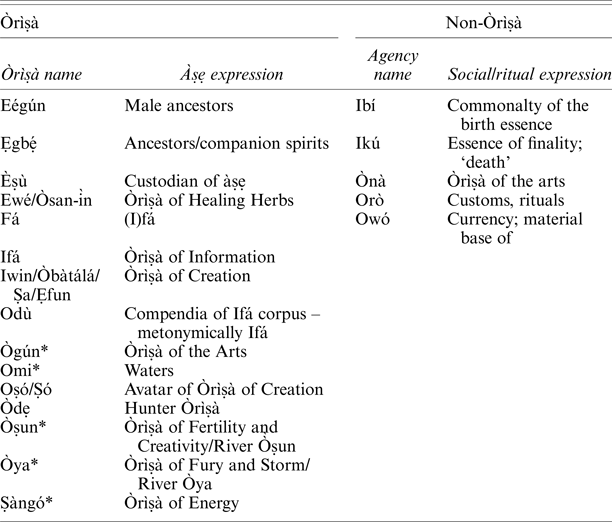
Fifty-three entries for such names then follow (Babalọla and Alaba Reference Babalọla and Alaba2003: 286–8), including those with the enabling metaphysical agents in Table 1. In that table, the òrìṣà are among the benevolent ‘supernatural powers’ whom Wándé Abímbọ́lá (Reference Abímbọ́lá1976: 151) rank among benevolent powers who ‘aid Man in his daily life’. He, however, unaccountably categorizes Èṣù as more or less a neutral force in the conflict between the good supernatural forces and the evil ones.
Non-human agency in Yorùbá personal names

Source: Babalọla and Alaba (Reference Babalọla and Alaba2003). *See also Furé (Reference Furé1985).
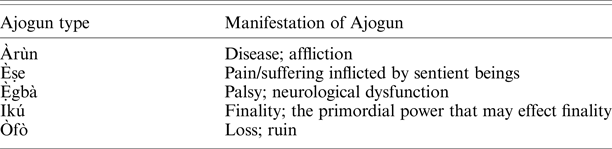
Ajogun types and manifestations

Ajogun:Footnote 29 supernatural forces evil in essence, restricted as agency or absent in naming
The evil connotation of the Ajogun as militantly inimical to wholesome existence proscribes their serving as an agency or purveyor of desirable àṣẹ for personal names. It is remarkable that Ikú is not entirely proscribed; rather, as an inevitable concomitant of motion and, therefore, of existence, the Yorùbá seek to risk, control and mark it in naming with the objective of invoking and checkmating it. We know of no other enabling agent for naming that is similarly restricted as Ikú.
The data above on orúkọ, ‘names and naming in Yorùbá’, emphasize that the people enlist Èṣù among the exclusive category of benevolent forces and agencies with which they identify positively when assigning names that control and may be deployed to control an individual's person and lot in life. The Yorùbá include Ikú, ‘Death’, in naming only to mark events that display its deleterious power and therefore to ward it off.
Èṣù is neither a dissembler nor a trickster
The second argument against contestable representations of Èṣù considers the set of beings and entities that traditions count as ‘tricksters’. Any defining feature or features of the trickster ought to apply empirically to traditions all over the world, allowing for particularities, but without confusing different types. To begin with, for an agent to be considered a ‘trickster’, it must be capable of initiating transactional motion in itself and in other entities. Furthermore, it must be capable of intentionality. We recognize that, in folklore, traditions often endow agencies intended to serve as tricksters with both of these attributes, among others.Footnote 30 But in order to pass for a trickster, additional psychosocial conditions must be fulfilled.
I wish to borrow first from Susan Niditch's Underdogs and Tricksters (Reference Niditch1987) and see a trickster as ‘a subtype of underdogs’ who brings about a change in status via trickery; and who typically progresses from low to higher status, making ‘their way with magical or human helpers or through their own wisdom or savvy’. By implication, a trickster is therefore a ‘deceiver, creator, acculturator, unmasked liar, and ethically ambiguous survivor’ (ibid.: 45). Niditch sketches a trickster hero's evolving morphology as made up of ‘low status, deception planned to improve conditions, improved status; deception uncovered; reduction of status or survival’ (ibid.: 46). ‘The trickster morphology has an antiestablishment quality at the very sources of its being … Success is achieved in an irregular, roundabout way, by deception, a trick’ (ibid.: 49).
Malcom Gladwell uses the story of David and Goliath to characterize ingeniously the trickster, one who meets Niditch's prescription. Gladwell writes:
At the center of many of the world's oppressed cultures stands the figure of the ‘trickster hero.’ In legend and song, he appears in the form of a seemingly innocuous animal that triumphs over others much larger than himself through cunning and guile. (Gladwell Reference Gladwell2013: 170)
Gladwell's trickster enjoys ‘the unexpected freedom that comes from having nothing to lose. The trickster gets to break the rules’ (Gladwell Reference Gladwell2013: 173).
If we comb through all recorded Yorùbá folktales, no trickster in the Yorùbá tradition is an òrìṣà; rather, the tortoise, ìjàpá or alábahun, has a ‘morphology’ that tallies with that proposed by Niditch and Gladwell – a seemingly innocuous underdog who enjoys the freedom to break rules and conventions, and triumphs under impossible circumstances through trickery, cunning and guile.
None of the ‘trickster attributes’ described above fit the òrìṣà Èṣù of the Yorùbá pantheon. We must, therefore, look into the Yorùbá thought system in order to identify the requisite elements that Èṣù embodies and sustains in all circumstances, and that undergird probity and ethical rectitude.
Yorùbá thought system for ethical rehabilitation
The following, then, outlines a reconsideration of the critical elements of the Yorùbá thought system, and I propose that these must have impelled enslaved Yorùbá culture-bearers in the Americas to engage in what historians refer to as ‘slave risings’. The self-determination that inspired these risings for self-liberation produced autonomous enclaves such as the Palmares (Brazil) and Maroon communities (the Caribbean). It may be a stretch, yet not farfetched, to attribute even slave risings in North America, such as the Stono Rebellion and the Nate Turner Rising, to the kind of consciousness that the elements of the Yorùbá thought system identified below collectively allow us to identify with Èṣù. I describe these elements in turn, beginning with the foundational concept of àṣẹ.
Àṣẹ
In àṣẹ, the Yorùbá conceive the ‘essential’ and ‘motive’ force that inheres in all objects of consciousness: material; non-material; physical and metaphysical; all objects of perception and of thought, including those we may apprehend by means of any and all of the senses.
This conception of àṣẹ resonates cross-culturally and surprisingly with the English poet William Wordsworth's musing on Tintern Abbey:Footnote 31
As has been noted in this article, Èṣù is the custodian of the primordial àṣẹ of the Yorùbá world view, and dispenses his authority as impartial arbiter under strict conditions specified below.
Ènìyàn: being human
The Yorùbá conceive of the human being, ènìyàn, as a being distinguished by a unique àṣẹ, endowed with the Mind that ‘houses’ the faculty of reason and serves as the seat of consciousness. The handmaiden of the Mind in humans is articulate language, èdè, which is not clearly isolable in any other sentient being. The òrìṣà are anthropomorphic sentient beings. They, too, however, are endowed, metaphysically and figuratively, with attributes of the Mind, reason and èdè. Footnote 32
Some aspects of the Yorùbá conception of the attributes of ènìyàn resonate with Goethe's characterization of Man, who is unique because he is endowed with the Mind. In the ‘Prologue’ to Faust, we encounter the following cynical retort about Man to The Lord by Mephistopheles, Goethe's embodiment of evil.
Òrìṣà Footnote 33
Each òrìṣà of the Yorùbá thought system is a metaphysical sentient being who embodies a discrete and definable set of primordial principles of àṣẹ. Within the limits of his/her àṣẹ, each òrìṣà may have an effective impact on any and all objects of consciousness, including other òrìṣà.
Since the àṣẹ attributable to a particular òrìṣà is discrete and definable, the scope of ‘influence’ – not to mention the ‘power’ or ‘authority’ of each òrìṣà – is delimitable, although it may overlap with that of other òrìṣà, like circles in a Venn diagram. This makes it possible for different devotees to approach different òrìṣà as supplicants for the same outcome.
Òrìṣà are not normally bound by time or space; indeed, they may traverse time and/or space at will, unlike other entities and sentient beings with physical bodies. Each òrìṣà is also capable of multiple manifestations, in consonance with and reflecting local prevailing existential conditions, but subject to the arbitrative àṣẹ of Èṣù, and the guidance and counsel of Ọ̀rúnmìlà.
Ọ̀rúnmìlà
Ọ̀rúnmìlà is the òrìṣà, who, alone, is privy to and is the custodian of the exhaustive store of the information that constitutes the essence of all things, all objects of consciousness. It is, perhaps, not unimportant that Ọ̀rúnmìlà has no bone in ‘his’ body and has a complexion that is black, the union of all colours. Ọ̀rúnmìlà is:

Ọ̀rúnmìlà being ‘black’ allows one to conceptualize him, from the point of view of entropy, as the optimal source of information. Ọ̀rúnmìlà is accessible and communicates through the Odù of Ifá, as described above.
Èṣù in the Yorùbá pantheon
Èṣù has custody of àṣẹ, which inheres as ‘tributaries’ in all entities, material or incorporeal, including elements of thought and language. Èṣù is also the arbiter in the exercise of àṣẹ by all sentient beings, including by the òrìṣà and spirits. That is why all access to àṣẹ goes through Èṣù for efficacy.
As arbiter, Èṣù takes as given the position that all sentient beings are endowed with consciousness and the ‘mind’. The mind has, as unique attributes, reason and will, as mentioned above. To all intents and purposes, therefore, Èṣù holds that any exercise of the will by a sentient being must of necessity be based on an exhaustive act of consciousness and reason, the human psychokinetic faculty. By the same token, any disposition of one's will engages one's àṣẹ. Accordingly, each sentient being should exercise their will, based only on impeccable, exhaustive consciousness, and is accountable for all outcomes of that exercise.Footnote 36
In the Yorùbá myths of origin, Èṣù is the constant companion of Ọ̀rúnmìlà. In that role, Èṣù has unmediated access to all information of which Ọ̀rúnmìlà is custodian. That enables Èṣù to have inside knowledge on all tropes and all òwe,Footnote 37 Ọ̀rúnmìlà’s paradigmatic mode of communication. It should be noted that not all òwe are epigrammatic. Indeed, more often than not, they are extensive narratives, as in Patakín (Cuba) and Caminhos (Brazil).
Much remains to be said about how Èṣù arrives at his role as the custodian of àṣẹ; how he becomes the constant companion of Ọ̀rúnmìlà; how he facilitates the deployment of àṣẹ for the benefit of those who meet his rigorous conditionality; and how he sanctions those who fail to measure up to expectation, particularly with respect to the exertion of consciousness in the exercise of their will. For this article, I have benefited from material made available by careful students of primary sources of Ifá texts.
I assume that all the Odù collectively stand metonymically for Ọ̀rúnmìlà.Footnote 38 I follow Rowland Abíọ́dún (Reference Abíọ́dún2014; Abíọ́dún et al. Reference Abíọ́dún, Drewal and Pemberton1994) on that premise and accept that seventeen Odù are present at the beginning of essence. Ọ̀ṣun, the lone female among them, stands for womanhood. All of the sixteen male Odù experience futility in the exercise of their àṣẹ until they recognize Ọ̀ṣun as an indispensable peer. They offer to include her in all they do in order to prosper. Ọ̀ṣun decides to maintain her dignity and gives her only offspring, Ọ̀ṣẹ́turá – that is, Èṣù – a male child, to join the comity of the other Odù as the indispensable facilitator of the exercise of àṣẹ.
In the Odù Ọ̀sá Méjì,Footnote 39 Èṣù facilitates, perhaps next to Abíọ́dún's narrative of Ọ̀ṣun's maternity of Èṣù, the most important grounding of the indispensable presence and power of women in human affairs through the instrumentality of Ọ̀rúnmìlà. Ọ̀rúnmìlà, of all the òrìṣà, with Èṣù’s àṣẹ, provides the Ẹlẹyẹ, ‘womanhood’, with the critical cover and security of his own body in their descent to earth.
Bascom (Reference Bascom1991 [1969]) also enriches our imagination about empirical ways in which Èṣù facilitates the ways in which humans and all òrìṣà who deserve it deploy àṣẹ for their benefit. Thus, in Ogbè Méjì (10; 154–7)Footnote 40 with a clap of his hands Èṣù revives the sacrificial rodent that wears around its waist precious beads, and causes the princess, Ayé (literally, ‘the entire realm of consciousness’), who covets the beads, to chase it. The princess loses all the clothes around her waist, exposing her nakedness to Ọ̀rúnmìlà, whom the princess must marry as the first man to see her nakedness.
In Ogbè Méjì (11; 158–61), Èṣù bats his eyelashes at Toro, the daughter of Olókùn, of fabled wealth and sources of riches, to make her see in Ọ̀rúnmìlà the most desirable suitor among all òrìṣà. In Ọ̀yẹ̀kú Méjì (10; 254–7), it is with his wand that Èṣù brings down illness on two friends who ignore their due observances; and, in Ọfún-(Ì)rosùn (5; 512–15), with his staff of authority, Èṣù causes Ojúro to lose his way in the woods. Only the ensuing community's vicarious atonement and enhanced acuity of consciousness enable Ojúro to find his way back home. This suggests a remarkable tone of Èṣù-inspired ethics: namely, that the individual is never alone and must never lose sight of that fact.
In short, Èṣù depends on the good-faith agency of sentient beings to effect all acts for which he holds àṣẹ.
Orí ÀtèténíranFootnote 41
Every individual is endowed with an Orí, which embodies the fundamental specificities of one's essence. Rowland Abíọ́dún (Reference Abíọ́dún1981; Reference Abíọ́dún2014; Drewal et al. Reference Drewal, Pemberton and Abíọ́dún1989) refers to Orí as ‘inner head’, but it also may be conceived as the liminal, symbolic encasement for one's àṣẹ; this would be consistent with the perspective of this study. Orí receives the existential lot, ìpín, for the individual sentient being, and guards it jealously throughout the terrestrial sojourn of the individual. An individual's Orí remains accessible to him or her throughout life and to his or her survivors even after ‘death’. Ọ̀rúnmìlà is witness to the allocation and reception of ìpín, the lot of the individual. That is why Ọ̀rúnmìlà is referred to as ẹlẹ́rìí-ìpị́n, ‘witness at allotment of ìpín’, and why Fábùnmi's (Reference Fábùnmi, Oyèláràn and Adéwọlé2007) citation of him is appropriate as:

The following celebrates the personal and particularistic nature of Orí:

Ìpín
Ìpín refers to a conceptual ‘script’, the ‘musical score’ for the unfolding of an individual's existential possibilities. How individuals act or play it out in life depends on the ‘paths’ they take as functions of how they deploy their will in the exercise of their inherent àṣẹ. This tremendous responsibility is acknowledged in the following:

Compare this with Abímbọ́lá (Reference Abímbọ́lá1976: 113):

Since Ọ̀rúnmìlà is witness to the allocation and acceptance of ìpín, the individual will benefit in life by seeking guidance from Ọ̀rúnmìlà on every life option.
Furthermore, since no one steps into the same river twice, there can be no end to turning to Ọ̀rúnmìlà to ascertain what plan one's Orí holds for one's next step. Again, this explains the injunction:

Èṣù, the arbiter, the assiduous companion of Ọ̀rúnmìlà, holds the individual accountable for the scrupulous observance of the act of consciousness required by each step in the dance of existence, how one plays out one's lot.
The Yorùbá conception of ìpín and the injunction that each individual must never tire, but must be constantly aware of the paths it lays before him or her to tread in all matters, at all time, underscores the position that the Yorùbá do not accept ìpín as immutable.Footnote 44 Indeed, three options present themselves to each individual: conserve your ìpín by diligently observing relevant directives from your Orí through consultation with Ọ̀rúnmìlà; ameliorate your ìpín by means of duty of care, industry, attention to all sources of information, keen consciousness and exercise of judiciousness in all circumstances that impinge on your life options at all times; or deprecate your ìpín by choosing neither of these two options.
The Yorùbá principle of Orì and concept of ìpín put every sentient being in the saddle and hand over the reins to him or her. Every sentient being is, therefore, accountable for how they play out the life script accepted on their behalf by Orí.
Implications for ethics in the Yorùbá world view
The Graeco-Roman concept of fate, accepted in the Euro-American tradition as ‘destiny’, is conceptually immutable, as already noted. It undergirds a world view that externalizes accountability for all life's vicissitudes and all personal options. To this extent, it suggests a culture that assigns authority and responsibility to a higher being to whom the individual must not only supplicate, but must also constantly seek to please. Neither the external authority nor the individual has any influence on fate or destiny, which is both pre-ordained and inaccessible. It is conceptually inaccessible to the individual for whom an instance of fate or destiny is predicated – it is even inaccessible to an intercessor on behalf of the individual.
Fate and destiny, so conceived, are both alien to Yorùbà thought. That explains why the Yorùbá embrace the advice:Footnote 45

Also

And

In the Yorùbá pantheon, Èṣù, the custodian of the primordial àṣẹ, is the òrìṣà that never tires in dealing out just deserts to individuals in accordance with how they exercise their options with regard to consciousness, vigilance, industry and assiduity as their ì pín unfolds and becomes manifest.
Setting aside, but not ignoring, the ‘satanized’ Èṣù of the West African Abrahamic religions’ evangelism,Footnote 46 how do we reconcile the Èṣù whom Femi Euba systematically espouses as the eponymous originator of satire with the Èṣù of the Yorùbá tradition, whom I have argued is neither a trickster, a deceiver nor the Devil, the Judaeo-Christian Satan or the Islamic Iblis? If satire is the pre-eminent dramatic art form that imaginatively exposes the incongruous at the expense and discomfiture of its perpetrator, be it a person or even an institution, this article proposes that the Èṣù of the Yorùbá pantheon would better motivate satire, because, like satire, Èṣù does not gloss over unjustifiable foibles in human behaviour. The Èṣù of the Yorùbá pantheon is not a prevaricator, or a dissembler who denies or overlooks individual accountability for one's acts or omissions to act. On the contrary, the Èṣù of the Yorùbá tradition operates on the premise that every sentient being is endowed with àṣẹ and the will to deploy it; the individual is not helpless in life, and may not externalize responsibility for his or her unfolding existential reality.
Chastened by a system that guarantees Èṣù’s role as the custodian and arbiter of primordial àṣẹ, the fulcrum of human dignity vested in individuals, one is hard put to imagine a compelling reason why people of African descent should not enjoy the capacity and the self-confidence to re-envision a future without any fear of injustice for anyone; indeed, if we embrace Èṣù, one must be so disposed, with a clear conscience of consistently safeguarding social justice and common good in the most humane sense. The status of Èṣù in both the Santería and Candomblé òrìṣà traditions suggests that this vision may not be impractical in an inclusive social, economic and political atmosphere that vouchsafes access and common good.
Acknowledgements
This article is based on my paper ‘Èṣù Ẹlẹ́gbára: an enduring icon of conceptual resistance in the Atlantic cultures’, presented at the international conference ‘Africa and People of African Descent: Issues and Actions to Re-envision the Future’, held at Howard University, Washington DC, 13–17 September 2011. Comments by participants at the conference and by reviewers of earlier versions of the article have strengthened the thrust of the case I seek to make for the ethical foundation of the Yorùbá tradition, buffeted as it has been by relentless assaults from aliens and alienated culture-bearers in the last five centuries.