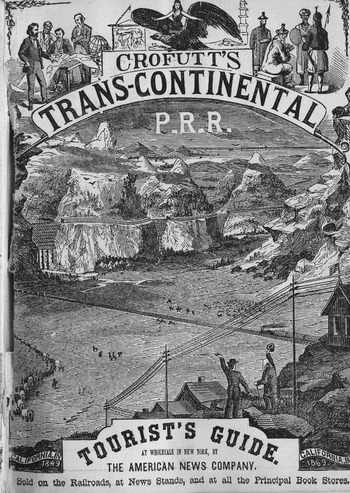
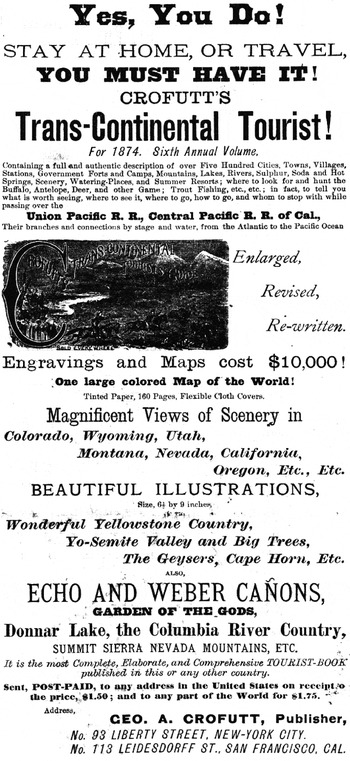
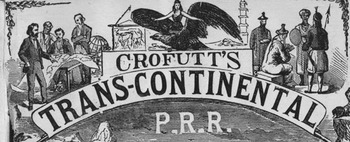
The completion of the transcontinental railroad in 1869 was signalled in two ways. The last spike was driven into the ground in Promontory, Utah on 10 May at 12.47 p.m. while, simultaneously, three clicks were sent over the nation's telegraphic wires. This was also the year that George A. Crofutt published his first guidebook aimed at the new breed of tourist who would be travelling along this iron network, eager to explore the American West largely from the distance of a speeding train. Over the course of the next two decades, as both tourist numbers and the length of the nation's railways dramatically increased, Crofutt would publish another fourteen versions of his book, most of which were sold as Crofutt's Trans-Continental Tourist's Guide (1869–76) (Figure 1) followed by Crofutt's New Overland Tourist and Pacific Coast Guide (1878–84).Footnote 1 Along with Appleton and Rand McNally, Crofutt helped to establish and popularize the genre of the general traveller's guide, but he distinguished his publications from the competition by including many illustrations. In two hundred to three hundred pages, Crofutt proclaimed in advertisements (Figure 2) that he would “tell you what is worth seeing – where to see it – where to go – how to go – and whom to stop with.” The term “transcontinental” was widely adopted in the United States following the release of Crofutt's first edition in 1869 and quickly became, according to the geographer J. Valerie Fifer, “a household word.”Footnote 2 The volumes were sold aboard trains, in stations and bookstores, from newsstands and ticket counters, and through the mail.Footnote 3 They were often recommended as valuable reference material – as important for the tourist scanning the blurry horizon for buffalo as for the schoolchild gazing at a blackboard.Footnote 4 By 1871, two years after his first guidebook appeared, he had gained an annual readership of more than two million.Footnote 5
Cover image, Crofutt's Trans-Continental Tourist's Guide (New York: Geo. A. Crofutt, 1871).

Advertisement, Crofutt's Trans-Continental Tourist's Guide (1871).

Crofutt's readers were most often those with the disposable income to be tourists: middle- and upper-class white travellers, both men and women. The socioeconomic status of his audience is most clearly revealed by the types of advertisement included in the guides. In the first 1869 edition, Tiffany & Co., Lord & Taylor (“Fashionable Dry Goods”), Henry E. Sharp (“Stained Glass”), Matzo & Co. (“Japan and China Goods”), J. W. Tucker & Co. (“Watches, Jewelry, Diamonds, etc.”) and other purveyors of luxury goods all placed ads. The tourists might also become settlers or investors, and Crofutt was careful to appeal to – and applaud – all of these interests, in addition to defining them in racial terms. In the preface to his 1876 guide, he states, “Since the completion of the Pacific Railroad it has been occupied by over half a million of the most adventurous, active, honest, and progressive white people that the world can produce.”Footnote 6
Crofutt may have extolled the beauty and benefits of the western frontier, as well as the virtues of its white settlers, but his books are most notable for their style, layout, and tone. They feature dynamic rhetoric, a reliance on personal observation and anecdote, an easily accessible wealth of information, and the incorporation of images. These were the characteristics that set his work apart and established a model for what a guidebook should provide and what it should look like. A consideration of both the text and images in Crofutt's railroad guides, as well as their intended audience, provokes a number of important questions. How were these readers being instructed to see? How do Crofutt's guidebooks construct, and complicate, the reader's experience of the West, as perceived through a train window?
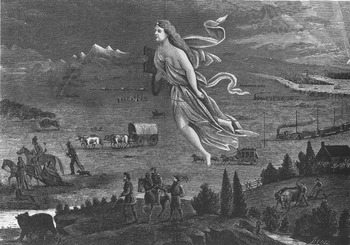
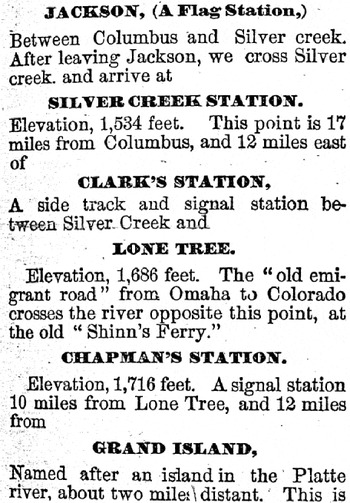
Although claiming to arrange and order the West for easy, and almost passive, consumption – to “tell you what is worth seeing” – there are two different yet also complimentary forms of representation operating in these popular works. While images like Crofutt's frontispiece (Figure 3) – a work entitled American Progress – represent a panoramic mode of vision, evoking the mythology of the endless frontier and a divinely inspired manifest destiny, the text (Figure 4) exemplifies a telegraphic language based on instantaneity, fragmentation, and velocity. Illustrating omniscience while writing in the language of speed, and often intertwining the two modes, Crofutt's publications both offered panoramic vision – from the Greek meaning “all view” – and embodied experience – the thrilling, if disorienting, compression of time and space made possible by the railroad and the telegraph. In differing terms, both forms of representation work to “sell” the West as a place of ecstatic possibility.
American Progress (1872), engraving. Beginning in 1873, John Gast's image served as the frontispiece for Crofutt's Trans-Continental Tourist's Guide.

Example of the graphic format of Crofutt's Trans-Continental Tourist's Guide (1871), 31.

The telegraph's implication of compact but fragmented transmission, the literal contiguity of its lines with the railroad, and its visual and psychological association with speed, all make “telegraphic” a fitting term to describe the form, the effect, and the particularly modern character of Crofutt's text. The wires transmitting coded language grew up next to the railroad tracks; these two new “transportation” technologies transformed the landscape, one moving physical bodies and material goods, the other transmitting information. The rows of poles served as regularized optical markers along the transcontinental route, as if to measure and impose order on the vast stretches of unoccupied land. Speeding across the nation, railroad travellers no longer directly encountered the landscape as they had using earlier forms of transportation. “Space is annihilated,” Crofutt writes, as “the tireless iron horse … haul[s] an iron wagon over an iron road.”Footnote 7 In his guides, annihilation is transformed into structure. The velocity and disorientation of train travel were both compensated for and registered by Crofutt's guidebooks to the American West.
MYTH AND LOSS
Crofutt visually introduces the West as a vast space of boundless promise. Many of the images – and most significantly those that appear as his frontispiece and on his title page – feature an elevated point of view and all-encompassing vistas. This unencumbered and comprehensive sight metaphorically connects nature and nation, Man and God, as well as past, present, and future, all in a seamless harmony. Such panoramic vision has been associated with the art and literature of the first half of the nineteenth century: the “transparent eyeball” of Emersonian transcendentalism and the sweeping landscapes of Hudson River school painters. As art historian Alfred Boime argues, the “characteristic viewpoint” of these artists “traced a visual trajectory from the uplands to a scenic panorama below,” an “experience on the heights” which then “became assimilated to popular culture.” This “panoramic prospect,” Boime contends, “embodies, like a microcosm, the social and political character of the land – of the desire for dominance.”Footnote 8
Such political and social connotations are essential to Boime's characterization of this vision, which he terms “the magisterial gaze.”Footnote 9 Alan Wallach pushes the ideological implications a step further by linking the panoramic to the panoptic, with its more explicit connection to power, surveillance, and the Foucauldian “sovereign gaze.”Footnote 10 Yet how does a guidebook visually represent power and “the desire for dominance”? The mass-reproduced visual image is, in fact, perfectly suited to convey an ideological message. With its push toward hegemonic generalization, ideology is, in a sense, already a symbolic discourse. Both the popular image and the ideological “program” are predicated on the appealing and instantaneous nature of the symbol. To communicate the message, each must be legible almost to excess. In Richard Slotkin's words, “myth does not argue ideology, it exemplifies it.”Footnote 11 Myth becomes the expression of ideology, symbolizing the past while existing outside the complexities of history. Although myth can certainly take textual form, images in a guidebook – black and white prints meant to be scanned rather than studied – provide a particularly potent medium for the reductive semiology of myth, which, as Roland Barthes has argued, “transforms history into nature.”Footnote 12
During the mid- to late nineteenth century, the dominance of “the magisterial gaze” as a representational and ideological trope was being challenged by the new facts of speed: the rapid, disorienting movement of the body through space and time, epitomized by the expanding network of railroad lines and telegraph wires. Speeding across the land violated the mythology of the endless frontier beyond the Mississippi by introducing temporality and limitations. Myth can only exist from an unchallenged distance, as an abstracted idea or story. “Living the myth” is always impossible – the former destroys the latter's claim to purity. But this is exactly the power, and potential complexity, of the guidebook. It can offer both. Crofutt's images work in the realm of myth, whereas the text communicates in the language of speed. Rather than merely being a supplement to the journey, his publications simulated the experience of travel as a hybrid of the actual and the imagined.
Yet the notion of a simulated experience also bears the connotation of loss – the loss, in this case, of a more intimate relationship between traveller and landscape. This is the absence that the guidebook works to “fill.” Wolfgang Schivelbusch argues that older modes of transportation, such as the stagecoach or the single horse, established a “mimetic relationship to the space traversed” since they were “organically embedded in nature” and thus preserved the “traditional space–time continuum.”Footnote 13 Rather than physically interacting with “the space traversed,” railroad travellers accelerated through it in a sealed compartment. The telegraph became the visual “emblem” of railroad travel. The world outside the train window, Schivelbusch notes, “was mediated to the traveler by the telegraph poles and wires which flashed by.”Footnote 14 Velocity could be judged by how fast the telegraph poles passed by the train windows, blurring together as the pace quickened.
Henry David Thoreau expressed his aversion to the speed and detachment of railroad travel in the first chapter of Walden (1854), entitled “Economy.” “I would rather ride on earth in an ox cart, with a free circulation,” he writes, “than go to heaven in the fancy car of an excursion train.” Rather than “grading the whole surface of the planet” with a railroad “round the world,” Thoreau argues that a man's time is better spent “digging in this dirt.”Footnote 15 The train traveller experienced the distanced anonymity of moving through the landscape, rather than the intimate interactivity, and comparative stability, of being “in” it – equivalent, for Thoreau, to having one's hands “in this dirt.” The passenger might read, sleep, or engage in conversation. These actions themselves are obviously unremarkable, but what is striking is what they entirely ignore: the space outside the train and the places passed by.
Crofutt's guides provided many of these lost spaces and sights, even while mimicking the rapidity of railroad travel. Indeed, the Union and Central Pacific railroads underwrote his guidebooks, and their popularity was dependant on balancing an acknowledgement, or even celebration, of the effects of “annihilation” with an attempt to compensate for the resulting sense of alienation. His main competitor, Appleton, in their Hand-Book of American Travel: Western Tour (1872), even admitted (albeit midway through the guide and lodged within a dense paragraph on Truckee, California) that “the traveller loses half the fine scenery by travelling by rail.”Footnote 16 But this edition of Appletons' guide included only eight maps and no images. By contrast, Crofutt's guide of the same year contained almost fifty illustrations, without counting the numerous maps. Both textually and visually, Appletons' hand-book was more informational supplement than evocative simulation. And as J. Valerie Fifer notes, Crofutt's rival may have “promised to guide its readers ‘from the cities and palaces of the East to the wildernesses and wigwams of the West,’ but while it was sound on the cities, it was weak on the wigwams.”Footnote 17 Crofutt's publications were as invested in the spaces between the cities – the wilderness and the wigwams – as they were in the West's emerging urban centres. Although the author had originally gone West as a freighter and wagon-train escort, he wrote primarily for the tourist, rather than the settler.Footnote 18 He translated personal experience into popular manifesto – declaratively easy to read and easy to follow.
The late 1860s and the 1870s were periods of unprecedented marketing and promotion of the American West. While earlier literature on the West had taken the form of novels, travellers' essays, government surveys, and scientific reports, after the transcontinental railroad was completed guidebooks became the most popular medium. Crofutt combined the exclamatory tone of a traveller with the snappy pace of a novel while also providing the important details gleaned from a range of more bureaucratic sources. This became the dominant model for tourist's guides until the end of the century, when railroads and independent tour operators increasingly flooded the market with free literature. As these sources edged Crofutt out of business, a new and more comprehensive guidebook also emerged. The Baedeker Guide to the United States (1893) weighed in at over five hundred pages and included thirty-nine colour foldout maps and city plans, as well as introductory essays by a variety of experts. It covered the whole nation and served as a reminder that western development had markedly slowed. Crofutt's annually revised editions about the West along the railroad lines were no longer needed.Footnote 19
But during the height of western expansion, Crofutt's guides helped to shape the terms of tourism. He created an appealing destination, but he also described what was not worth seeing. Tourism is about choice, and Crofutt often explained how and why the traveller should make scenic decisions. The author therefore differentiated his guides both from other books for tourists and from promotional material aimed at easterners emigrating West. They could serve as a visual and textual introduction to an unfamiliar region, as an entertaining and edifying replacement for an actual journey, or – most commonly – as a planning tool and reference during train travel, to be held in the hands, placed on the lap, read and viewed as well as skimmed and annotated. With their emphasis on phenomenological engagement, the guidebooks can also be linked to other similarly dynamic forms of representing the West: the moving panoramas and Indian galleries of the mid-nineteenth century, and the magic lantern lectures and “Wild West” shows of the later century.Footnote 20 Yet they are inseparable from the railroad and the experience of travel. Crofutt's guides directly (but briefly) engaged with the scores of towns, cities, and sites being sped through while also offering panoramic pictures of the western landscape – the West of the imagination. They registered the new transportation technology that enabled their existence while also reproducing the mythic vision of an endless frontier.
PICTURING “PROGRESS”
Beginning in 1873, the buyer of a Crofutt's Trans-Continental Tourist's Guide opened the front cover to find a full-page, foldout engraving of John Gast's American Progress (Figure 3).Footnote 21 Its rectangular format, revealed upon unfolding the page, invites the tourist to read the image horizontally. The eye is drawn laterally across the page, along the metaphorical course of “Progress,” from the darkened wilderness area of the left foreground, across the flat and unmodulated plains, following the telegraph wires to the triumphant rays of sunlight in the right background that illuminate a distant port city. Nearly every element is portrayed in motion. The black bear and Native Americans – closest to the tip of uncultivated land on the left – flee from the steady press of white settlers, turning to look back as covered wagons, stagecoaches, trappers, and gold-seekers threaten to push them out of the space of the picture. A herd of buffalo also follows this course of disappearance.
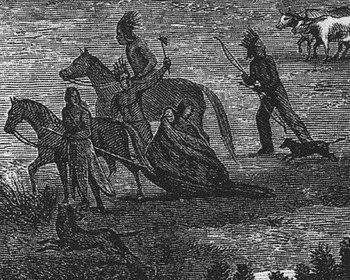
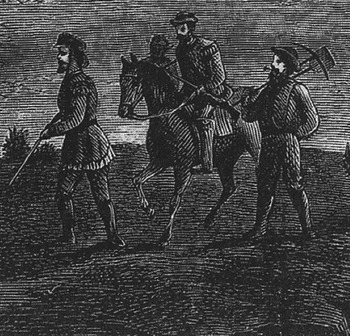
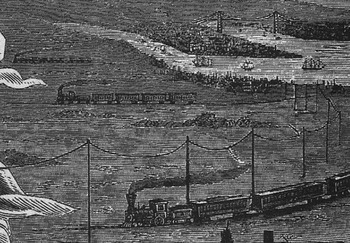
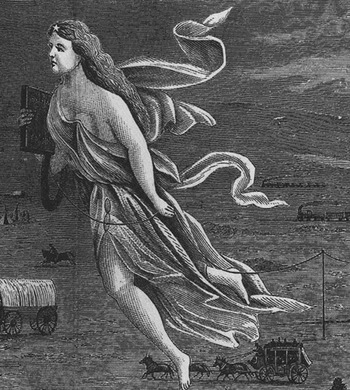
As with so much in this image, one point is repeated many times, giving visual emphasis to the picture's ideological message. The Native American group visually rhymes with the cluster of four white men in the centre foreground. But while the group of Native peoples (Figure 5) leans into the edge of the composition, the white men appear erect and relaxed, as if assured of their righteous purpose (Figure 6). One carries a prospector's axe, casually balanced over his shoulder. A Native American man raises his tomahawk, his arm taut as his body turns backward. The axe and tomahawk are analogous weapons, yet directly beneath the tomahawk a woman and child are bundled into a sled, weighing down this single defiant gesture, making it an impotent threat. Bear, Native Americans, and buffalo are all doubled and pushed forward by the three speeding trains on the opposite side of the image (Figure 7). This mechanical velocity presses into the composition, following on the heels of the first wave of migration, signalled by the horse-drawn covered wagon and the ox-drawn farmer's plough. But it is the central figure (Figure 8) – the woman floating above all of these small details – who most explicitly embodies the picture's ideological aims.
American Progress (1872), engraving. Detail.

American Progress (1872), engraving. Detail.

American Progress (1872), engraving. Detail.

American Progress (1872), engraving. Detail.

An allegorical figure of nation and empire, she both leads and oversees the march westward. She is a vision: the physical manifestation of an immaterial belief, the embodiment of manifest destiny – the divinely sanctioned right to expand the nation's borders, to conquer the native inhabitants, to settle the wilderness. From her privileged spot above the scene, she also has panoramic vision. In the air, looking out over the landscape, she becomes a force of nature, giving form to the claim of historical inevitability. And we see the picture this way; through her body, through her “magisterial gaze,” we take in what occurs below. With a schoolbook in her right hand and telegraph wires threading through her left, she offers two forms of information, two languages of information. The transmission of knowledge occurs through her body, the picture claims, as she educates and enlightens the world beneath her.
These signs of “Progress” emerge from the heroic, and sexualized, body of a woman. Her size and elevated position give her power and control. Yet her state of undress – her prominent breasts, her exposed leg and shoulder, her gauzy clothing – make her an oddly corporeal bearer of civilization, a fleshy figure that seems as though she could never gain such heights. She is at once a real, even maternal, body and a deified vision. Like a Greek statue in motion, she oversees the scene from the remove of art and allegory. But because her physical body is connected to the signs of technology – the telegraph wires emerge from her fleshy hand as if being produced by it – she also naturalizes the mechanistic. Her panoramic position aestheticizes the racial and environmental destruction occurring beneath her.
Barthes describes myth as “depoliticized speech,” appearing “innocent” and “natural” as it does away with contradictions and constructs an aura of inevitability. Myth, he writes, “is made of a material which has already been worked on so as to make it suitable for communication … all the materials of myth (whether pictorial or written) presuppose a signifying consciousness.”Footnote 22 The panoramic, as exemplified by American Progress, is a mythic form of speech in this sense. It aims for a reductive clarity that approaches innocence. The title's message is repeated in almost every iconographic, tonal, and spatial element in the composition, as well as in Crofutt's own description of the image. Under the sign of the female body, the messiness of history and politics is purified. But the scale of her body, like the national desires she is meant to carry West, is disturbingly, and even dangerously, unbounded. Crofutt himself alludes to the potency of this excess. Draped in white, floating in the heavens, the woman becomes the symbol for America, “bearing on her forehead the ‘Star of Empire’.” But for the fleeing Native Americans, “The ‘Star’ is too much for them.”Footnote 23
Crofutt contends that the picture both illustrates “the grand drama of Progress in the civilization, settlement, and history of this country” and is at the same time accessible “at a glance.”Footnote 24 The impact of such “drama” was predicated on the image's legibility: to stage such a performance for the reader flipping through the guidebook, the characters and the moral tone must be clearly and quickly recognizable. These conveyers of myth must, to use Barthes's terms, “presuppose a signifying consciousness.” And thus the reader would understand the symbolic discourse even before seeing it, the mythic image merely triggering the appropriate and predetermined response. Crofutt even framed the terms of the response, lest it be unclear how the reader should react. “What American man, woman, or child, does not feel a heart-throb of exultation as they think of the glorious achievements of PROGRESS since the landing of the Pilgrim Fathers, on staunch old Plymouth Rock!”Footnote 25 History, the author suggests, marks this picture after all. The viewer would supply it on demand. Yet this is not history, but the alchemy of myth.Footnote 26 Complicated, ambivalent events of the past are stripped of their troubling connotations and brought into the realm of exclamation and exultation. In American Progress, little is left open to interpretation. This is the panoramic mode becoming myth, claiming democratic inclusion – an elevated view offered to each “man, woman, or child” – while operating with dictatorial limitation. The panoramic perspective paradoxically excludes individual perception.
Often, when an opportunity for expansive description occurs, Crofutt refers the reader to an illustration or simply admits the text's inability to represent the view. About Weber Canyon, the author points to a lack of space. “We shall not attempt to give a minute description of this remarkable place, which would fill a volume were its beauties fully delineated, and each point of interest noted.”Footnote 27 About Yosemite, Crofutt first goes into rapturous exclamations, next declares the impossibility of detailing what he sees, follows this with a desire to try anyway, dismisses the viability of such an attempt due to the constraints of space, and finally references a picture:
Here is majesty! enchanting! awe inspiring! indescribable! The lofty cloud-capped waterfalls and mirrored lakes, the towering perpendicular granite cliffs and fearful chasms, strike the beholder with a wondering admiration impossible to describe.
We have often desired to take our readers with us, in a pen and pencil description of this most remarkable valley, and the “Big Trees,” but in view of our limited space, the magnitude of the undertaking, together with our conscious inability to do justice to the subject, we have contented ourselves by giving an illustration of the Great Yo Semite Falls.Footnote 28
The panoramic posed a textual dilemma. Three years later, for the 1874 version of this description, Crofutt replaced the exclamation points with a question mark and a series of dashes: “Here is majesty? – enchanting – awe inspiring – indescribable –” before concluding, “we have contented ourselves by giving a number of beautiful illustrations.”Footnote 29 This edition contained many more illustrations, perhaps compensating for those missing exclamations. Vastness, Crofutt seems to admit, was best conveyed through images. The text becomes a questionable purveyor of the panoramic.
But breadth was one of the central missions of the guide. The preface to Crofutt's 1876 edition promised to “cover a scope of country over two thousand miles in length, and hundreds of miles in width; a vast empire.”Footnote 30 In the cover illustration for the Trans-Continental editions, just above the book's title (Figure 9), a woman on an eagle spreads her hands out, as if to encompass the whole scene below her. She functions as a smaller version of the female allegorical figure of empire in American Progress. To the left, four white men converge around a map, which spills off the table, too big to be contained. They look down at this representation of the landscape – presumably the American West – while a globe behind them serves to contextualize the West in the world. One man points to the map, as he strikes an assured, contrapposto pose, while the others, sitting and standing, seem to reflect on his proclamation. The land spreads out before them, a panorama of possibilities. On the right side, by contrast, four figures – two Chinese and two Native American men – represent those who laboured or were displaced in order to realize the dreams of empire. These four figures in the upper right do not possess panoramic vision; they do not look down from above onto the landscape or at a map. Instead, they are turned inward, toward each other, as if to assure the white traveller who had bought Crofutt's book that these races had been pacified and contained.
Cover image, Crofutt's Trans-Continental Tourist's Guide (1871). Detail.

At the bottom of Crofutt's cover illustration (Figure 1), two small figures wave toward the landscape before them. Placed in the lower foreground, these figures serve as surrogates for the viewer. The tourists reading the Trans-Continental guide could, in other words, visually associate themselves with these back-turned figures who look out over the vista and feel the corresponding sense of dominance and possession. The image also contains a reminder of how the West was made so widely accessible to tourist and settler alike: the hill in the foreground is bisected by telegraph wires, the wide plains cut through by train tracks and a serpentine line of wagons, the tall mountains circumscribed by railroad snowsheds and connected by bridges. Signs of the railroad and telegraph are everywhere. The picture is a more populated version of one of the first illustrations in the guide – “Bird's Eye View of the Plains” (Figure 10). The viewpoint here is raised to an impossible height, the sparse details below barely recognizable except for a straight line of railroad tracks. Seeing so much paradoxically means knowing very little. Rather than reducing and excising information, as a telegraphic message does, panoramic perspective hinges on providing a breadth of vision for the white tourist that ultimately suppresses differences, producing a myth of empire that reads as divine destiny, a circumstantial blindness disguised as visual empowerment.
“Bird's Eye View of the Plains, from the crossing of Loup Fork River, 94 Miles West of Omaha.” This engraving was included in both Crofutt's Trans-Continental Tourist's Guide and his New Overland Tourist and Pacific Coast Guide.

WRITING ACROSS THE CONTINENT
Crofutt's guides were designed to be portable. While certainly not pocket-sized or petite, the books are generally lightweight and, literally and figuratively, compact.Footnote 31 In the preface to his 1871 edition, Crofutt declared that he had created a guidebook with “facts, names, dates, distances, condensed telegrams, in the smallest possible space” – this opposed to those other publications, like those of Appleton and Rand McNally, that only contained what he called “glittering generalities.”Footnote 32 To provide a “telegram,” in Crofutt's terms, was to offer a precise distillation of the vast lands between the Atlantic and the Pacific. Like the panoramic, the telegraphic mode produces and presents information. But opposed to the panoramic view, which claims to picture everything and therefore actually specifies very little, Crofutt's telegraphic text communicated specific details – those “facts, names, dates, distances” – at the expense of “glittering generalities.” The endless frontier was therefore delimited and demythologized, rewritten as real topography. But this physical landscape would also be quickly passed through, and perhaps just as quickly forgotten.
In 1872, Crofutt decided that his guidebooks, revised annually, were “too slow” to respond to the rapid changes occurring in the West; he needed a faster medium to appeal to those readers with deeper and more specialized interests in western development. Out of this desire to reach a broader audience, Crofutt's Western World, an illustrated monthly newspaper, was born.Footnote 33 The paper, as the masthead claimed, was “devoted to the railroad and kindred interests of the great west, and to information for tourists, miners, and settlers beyond the Mississippi.” With the newspaper satisfying the needs of settlers, Crofutt's guidebook became even more explicitly for tourists. In an advertisement for and an article about his guide that both appeared in Western World in January 1872, he emphasized the twin characteristics of a broad approach and a condensed account. The ad for the Trans-Continental Tourist's Guide promised “Panoramic Views and Pen Pictures from Ocean to Ocean,” as well as the “Union & Central Pacific Railroad ‘in a nutshell’.”Footnote 34 “Across the Continent,” an article about the guides most likely written by Crofutt himself (in the third person), was nearly as blatantly promotional. “Mr. Crofutt writes with the true Western sweep and freedom – nothing cramped or small about him. He takes you over the mountains, almost as the eagle flies, and brings you face to face with the Indians of the far West.”Footnote 35
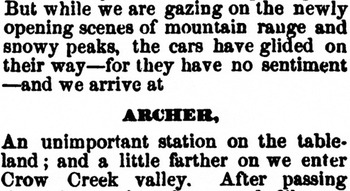
Advertisement and article each highlight the guide's ability to transport the reader/traveller above the terrain – “over the mountains, almost as the eagle flies,” to experience “Panoramic Views” – while also facilitating “face to face” encounters with sites and people via the railroad. At several moments, Crofutt abruptly transitions between these two types of experience. Passing from Hillsdale to Archer, Colorado, the narrator describes the breathtaking effect of Pike's Peak before noting a technological interruption (Figure 11):
But while we are gazing on the newly opening scenes of mountain range and snowy peaks, the cars have glided on their way – for they have no sentiment – and we arrive at
ARCHER,
An unimportant station on the tableland; and a little farther on we enter Crow Creek valley.Footnote 36
From a contemplative distance, the author, and perhaps the tourist with him, is brought back into the moment, back into his or her own body, through the assertion of the mechanical body that transports the traveller. The “newly opening” vista disappears from view as the train moves on. These cars have “no sentiment” and do not differentiate between “snowy peaks” and “an unimportant station on the tableland.” The guidebook mimics this abrupt transition, offering a glimpse of both the majestic and the mundane.
Crofutt's Trans-Continental Tourist's Guide (1871), 42.

Yet the mundane is just as vital to the text's effect. Why include Archer and the Crow Creek valley? Why not offer only the significant sights, the “must-see” spots along the transcontinental route? This is where Crofutt's guidebook differs from its competitors by more closely simulating the experience of travel. It may be, as Crofutt writes in the same passage, that “in less time than it takes us to tell it, the space has been passed,”Footnote 37 but that time and space is nevertheless registered by several sentences. The reader must pass through them, or make the choice to skip over them, as a tourist might sleep through these same towns, waiting for a more dramatic mountain pass.
Crofutt's language also conveys the difficulties of seeing while speeding along in a railroad car. The ordinary and the beautiful are both blurred by the pace of travel. “The beauties of Echo canyon,” Crofutt writes,
are so many, so majestic, so awe inspiring in their sublimity, that there is little use in calling the traveler's attention to them. But as we rush swiftly along, seemingly beneath these towering heights, we can note some of the most prominent features. The only difficulty will be that one will hardly see them all, as the cars thunder along.Footnote 38
The “beauties” are so excessive – “so many, so majestic, so awe inspiring” – as to become visually obvious and therefore textually superfluous. What cannot be seen is noted, as is the very fact of what the traveller optically loses while on board. In Crofutt's text, the visual is always on the verge of disappearance.
The text provides both the “prominent features” of the picturesque canyon and an account of the difficulties of actually obtaining these views. Although these sights might be inaccessible to the eye, the guide offers brief descriptions of their contours and significance, condensed into the time it may have taken to actually pass by the marvel in question. Such “images” become alluring potential views, brief anecdotes that simulate optical experience. The guide becomes the reader's prosthetic eye. Vision is synthetically restored, but only in the temporal framework of rushed rail travel and in the narrow spatial confines of a book that spanned half a nation. Crofutt's guides retain the intoxicating effects of speed – covering so much so quickly – while offering a way to understand the distance traversed. They mediate between viewer and landscape as well as between passenger and railroad. The “annihilating” effects of speed are given shape, form, and meaning. Within such a structure, the difficulty and disorientation of travel is presented as yet another expected effect.
Through the text and the simultaneous experience of train travel, the reader constantly moves forward, leaving what can no longer be seen, awaiting the next new site or city that will soon appear. Only a brief moment of contemplation is possible before some combination of the same formula is repeated: move, pause for reflection, interrupt the reverie – often with an adverbial prod – and then resume speeding ahead. Many paragraphs begin by conveying motion – “rushing,” “dashing,” “flying” – and by emphasizing a lack of time for thought or interpretation. In Utah, Crofutt writes,
Dashing along, with but a moment to spare in which to note its beauties, we enter the narrowing gorge again … and we pause for a moment at
WEBER STATION.
… two miles further, between towering mountains, the valley now lost in the narrow, gloomy gorge, when suddenly the whistle shrieks the password as we approach
DEVIL'S GATE STATION,
… With bated breath, we gaze on this wild scene and vainly try to analyze our feeling, in which awe, wonder, and admiration are blended. No time for thought, as to how or when this mighty work was accomplished; no time or inclination to compare the work of Nature with the puny work beneath us, but onward, with quickened speed.Footnote 39
The guide's text privileges the corporeal sensation of velocity over cerebral reflection. Analysis and assimilation are useless. The basic fact of the railroad journey – speed – is rarely ignored in Crofutt's prose. The reader/traveller is given only enough time to “glance” out of the window and down at the book. There is “no time for thought,” no moment “to analyze our feeling.” Train travel, accompanied by Crofutt's guide, only allows for the feelings themselves, not for the accompanying analysis. The tourist may experience “bated breath,” “awe, wonder, and admiration,” the sense of speed as the cars go “dashing along,” the shrill noise that marks each stop on the journey. The “whistle shrieks the password” as if transmitting the Morse code of the railroad, a code based on arrivals and departures and the speed in between that blurs vision.
The graphic design of Crofutt's text (Figure 4) imitates the mode of the quick “glance” rather than the pensive “gaze.” Sentences are cut off midway in order to announce, in bold capital letters, the name of the next city or station. The typeface and indentations give these locations a monumental quality, communicating a sense of permanence, although many of the actual places had little more than a signal station and geographical coordinates. The eye can scan the page for just these landmarks, or read between them to gain a brief sense of their key characteristics – Silver Creek Station: elevation 1,534 feet; Clark's Station: a “side track” between Silver Creek and Lone Tree; Grand Island: “named after an island in the Platte river.” The reader receives this essential information as if by telegraph, a rhetorical strategy oddly mirrored by the literal fact that many of the stops were themselves telegraph stations. The fractured layout makes it easy to read while also graphically communicating the sense of constant disruption train passengers would have actually experienced. Guidebook and train both direct the tourist to engage, disengage, and reengage in nearly the same instant.
RAILROAD TIME
Keeping time became a serious issue with the advent of rail travel. With people now able to quickly traverse great distances, it mattered that one city's noon was another's twelve-fifteen. When Crofutt began writing his guidebook, a traveller going from Washington, DC to San Francisco would have to reset his or her watch more than two hundred times.Footnote 40 But successful schedules inherently require standardization, and standardization required a different concept of time. On 18 November 1883, uniform time was officially imposed by the railroads in the United States. It became known as “the day of two noons,” since clocks were set back at mid-day in the eastern portion of each time zone. The following year, delegates from twenty-five nations met in Washington to divide the globe into twenty-four time zones, with Greenwich as the zero meridian.Footnote 41
Crofutt often remarks on the fast pace of the age. His earlier editions are book-ended by such exclamations. “We live in a fast age,” he writes in the opening pages of the Trans-Continental Tourist's Guide, “the breeze of to-day was the tornado of 50 years ago. Nature has called upon her children to rise and prepare for the changes constantly occurring.”Footnote 42 At the end of the text, the potential anxieties of such dramatic change are again transformed into a positive incitement in the present tense: “How fast we live. The gentle breeze of to-day was the whirlwind of fifty years ago. Will we – can we – continue at the same ratio? But why speculate? It is our business to write what is taking place to-day.”Footnote 43 Nature itself is different in the modern world, Crofutt implies. In his New Overland editions, he declares that the sun itself seems to have “aged,” having “run in the same old groove for too many years to retain much of the spirit of Progress.” Human technology may actually “beat the old luminary”:
It is within the memory of many, how [Samuel F. B.] Morse, with his lightning, beat the old luminary, and we are now “talking all around him.” Steam on the rail is next in speed; “one mile a minute” is not uncommon. The trip from New York City to San Francisco, a distance of 3,296 miles, was commenced June 1st, 1877, by Jarrett & Palmer, on a special train, and the run made in 83 hours, 53 minutes, and 45 seconds, an average of 39 miles an hour including stops. Sol must look sharp, or steam will also beat him in the race.Footnote 44
The sun, that symbol of the “old” system, was challenged or beaten by those representatives of the new world – first Morse's telegraph and then the steam-powered railroad.Footnote 45 As speed increased, distances shrank and time became mechanically, rather than environmentally, relative. The trip from New York to San Francisco was no longer measured by the number of sunrises and sunsets, but by an accumulation of hours, minutes, and seconds, “including stops,” along an iron track.
Numbers and statistics – quantitative details so far removed from the panoramic point of view – proliferate in Crofutt's guides. Distances and times between stops are often recorded, as are altitudes, population figures, prices, and even facts such as latitude and longitude. In the preface to the New Overland, the author describes the book itself as “a telegram of the most important facts and items of information in a trip of 5,493 miles by rail, and 792 miles by steamer, aggregating 6,285 miles, besides over 1,000 miles by stage coach.” This excess of numerical information attempts to order the vast space now available to the train passenger, in addition to lending precise dimensions to the scores of specific places passed. These numbers atomize the sprawling country, yet they also point back to the nation's great size. It is important that such size is not described using a visually evocative analogy (“as big as …,” “as long as …”) but rather given as precise quantitative data. The numeric denies the visual, even as the visual is recovered in images like American Progress. The guidebook begins by providing both.
In 1873, as Crofutt was establishing his “faster” monthly publication, Western World, Jules Verne published Le tour du monde en quatre-vingts jours, immediately translated into English as Around the World in Eighty Days. Phileas Fogg, Verne's protagonist, is a man obsessed with numbers – he even dines at “chronometrically set times.” His numerical inclination is both fascinating and disturbing. “What he did was always so mathematically the same,” the narrator states, “that one's imagination, disturbed, tried to look beyond.” Fogg undertakes a race around the world, attempting to win a bet wagering that he cannot circumscribe the globe in a mere eighty days. He arrives back in London, eighty-one days later, apparently defeated. But the twist, which comes right at the end, is that Phileas Fogg has made the journey within the allotted time, with the help of some complicated equations. In essence, he outraced the sun and therefore recovered the “lost” day.Footnote 46
George Crofutt's guidebooks also attempted to recover something that had been “lost.” Speeding across the nation, along the transcontinental route, railroad travellers no longer directly encountered the landscape as they had using earlier forms of transportation. The railroad mediated between the visual and corporeal experience – insulating the passenger, blurring the scenery, while also providing a thrill of its own. Crofutt's guides registered this new velocity in their language and graphic form. Fragmented but precise, dense but brief, the “telegraphic” mode embodied the advances of the time. But the Trans-Continental Tourist's Guide and the New Overland Tourist and Pacific Coast Guide also communicated by using images that mythologized and romanticized the West, even as those same images implied the end of the “endless” frontier. The panoramic point of view in American Progress signified manifest destiny and the march of empire. The rushing trains and horse-drawn wagons and the floating female figure all extend themselves across the pictorial terrain, pushing the signs of the wilderness to the margins, colonizing the landscape with their bodies and machines. Placed at the very beginning, before any text, American Progress set the tone for the rest of the guidebook, offering a sense of safety and superiority to the white tourist embarking on his or her journey. Travellers could locate themselves in one of the trains steaming westward across the plains, reading about the majestic scenery on the horizon while ensconced in the cushioned comfort of a Pullman car. But the guides also registered the strangeness – the perceptual discomfort – of this experience. Disruptions, sentence fragments, and a profusion of quantitative data continually mark the text.
The guidebooks therefore mark a double transition: a shift in the concept of the West from endless, undefined frontier to a region of commerce and culture, and a move from a language based upon mythic expansiveness to one that mimics discrete aspects of modernity. The “railroad tourists” who purchased one of Crofutt's publications witnessed this very transformation. Book in hand, travellers learned how to see and read the landscape even as it changed before their eyes.