

Introduction
The last European Parliament elections had an indisputable key player: the Eurosceptic parties. Nevertheless, as we shall see when looking closely at the data, another clear fact emerges: the widespread defeat of incumbent governments. Adding to this the gradual decline in the rate of voter turnout, one could say that the European Parliament elections continue to fit quite well with the well-known second-order model (Reif and Schmitt, Reference Reif and Schmitt1980). Going beyond this traditional framework, this article tries to explain European Parliament elections returns from the point of view of the economic voting literature (Nadeau et al., Reference Nadeau, Lewis-Beck and Bélanger2013), showing that macroeconomic data are related to European Parliament election results.
The so-called Great Recession (Canterbery, Reference Canterbery2011; Kahler and Lake, Reference Kayser and Peress2013) is operationalized by using a temporal criterion: before and after 2008, the year in which the economic crisis, originated from the US financial crisis, became most tangible within the EU. Although the economic crisis has hit the European Union as a whole, it is clear that the impact on different EU economies has been differentiated. First, only a few countries have experienced a real recession in GDP terms. Second, some have come out from the crisis sooner and better than others. Third, some countries have not experienced a real economic crisis. Countries such as Romania, Malta, Lithuania, Poland, and Slovakia have recorded very significant economic growth rates over the years in which the rest of the EU was in stagnation or in recession.Footnote 1 Nevertheless, there is no doubt that, compared with the previous situation, the post-2008 period is perceived by European citizens in a very different manner. For instance, before the European Parliament elections of 2004, on average, 42.7% of Eurobarometer respondents were very or fairly satisfied with the economic situation of their country. By contrast, before the European Parliament elections of 2009 the average was 34.4%, and before the 2014 European Parliament elections it had reduced further to 29.8%. For this fundamental reason, we believe that, at least in the descriptive section of this article, the temporal criterion may be appropriate.
Bearing this in mind, the first matter we shall analyse is the following: Is the electoral performance of incumbent governments and Eurosceptic parties affected by the economic crisis which begun in 2008? The answer is given on two levels. The first is descriptive (though some explanatory variables are included in a bivariate logic). It considers the two areas of interest for this study: the performance of the governing parties and the success of the Eurosceptic parties. As we shall see, in some cases Eurosceptics parties participate in government. This article will address also this under-investigated issue (Taggart and Szczerbiak, Reference Taggart and Szczerbiak2013).
The second level of analysis, employing the standard ordinary least squares (OLS) procedure, aims to provide an economics-based explanation of the results of European Parliament elections. It focusses on the electoral performance of the governing parties and on party-based Euroscepticism. Controlling for several political and socio-economic variables, it provides an estimation of the incidence of some macroeconomic variables, looking particularly at the level of unemployment.
The article is organized as follows. The first section offers a brief analysis of the literature on the relationship between European Parliament elections and the economy. Following this, a second section provides a description of the data set. Third section, to follow, deals with the electoral performance of governing parties. Fourth section looks at the increase in electoral success of Eurosceptic parties. The fifth section delivers two linear regression models, based on two different dependent variables: the electoral performance of governing parties and that of Eurosceptic parties. The empirical analysis shows that the unemployment rate is the most prominent variable in explaining both the success of Eurosceptic parties and the loss of votes of parties in government.
European Parliament elections and economic voting
The debate on economic voting (Anderson, Reference Anderson2007) dates back to the 1950s (Berelson et al., Reference Berelson, Lazarsfeld and McPhee1954). After the economic boom of the 1960s scholars have devoted increasing attention to this issue (Key, Reference Key1966; Kramer, Reference Kramer1971). According to Lewis-Beck and Stegmaier (Reference Lewis-Beck and Stegmaier2000), over 300 articles and books on economic voting could be found by the beginning of the new millennium. Scholarly interest in the relationship between the economy and elections is due to something more than a mere empirical question. The main reason to study economic voting lies at the core of the research on the quality of democracy and, in particular, can be linked to the normative relevance attributed to the concept of electoral accountability (Diamond and Morlino, Reference Diamond and Morlino2004). Put simply, most of the literature on economic voting assumes that if electors judge the government in accordance with the economic situation of their country, then electoral accountability works properly (Nishizawa, Reference Nishizawa2009; Fisher and Hobolt, Reference Fisher and Hobolt2010). Thus, the underlying motivation behind the spread of research on economic voting is that the presence of such tendency in voting behaviour is closely connected with and implies the existence of a high-quality democracy.
In addition to being studied for its role on national elections (Powell and Whitten, Reference Powell and Whitten1993; Lewis-Beck and Stegmaier, Reference Lewis-Beck and Stegmaier2007; Duch and Stevenson, Reference Duch and Stevenson2008), economic voting has been analysed to understand its impact on attitudes towards the process of European integration (Tucker et al., 2002). However, the influence of the economy on the European Parliament elections has been investigated to a lesser extent. This study tries to fill this gap by interpreting European Parliament elections as a supra-national arena in which voters can hold the elected accountable for their performance at the national level. This is not to say that, within the ‘second-order elections’ framework, economics has been completely ignored in scholarly analysis until to now. The point here is rather that, especially during an economic crisis (Dassonneville and Lewis-Beck, Reference Dassonneville and Lewis-Beck2014), the economy has a direct influence on voters’ choices in the European Parliament elections. On the one hand, this means that the state of a country’s economy affects directly the support for parties in government. On the other hand, it strengthens the electoral performance of Eurosceptic parties.
It is beyond the remit of this study to recall the vast theoretical debate on economic voting.Footnote 2 However, it is necessary to highlight the two pillars of this article’s approach to the study of economic voting. First of all, following most of the literature, the analysis conducted here is based on the concept of retrospective voting (Fiorina, Reference Fiorina1981), instead of prospective voting. So, the basic assumption is that voters judge elected candidates on the basis of their past performance and vote accordingly. The second choice concerns the adoption of a macro-level research design based on aggregate data, rather than the more widespread micro-level design based on individual data. Although the macro-level analysis is exposed to the well-known ecological fallacy (Robinson, Reference Robinson1950), as Dassonneville and Lewis-Beck (Reference Dassonneville and Lewis-Beck2014) stated, the micro-level approach could be exposed to a micrological fallacy. This second fallacy runs the risk of inferring the whole from the parts, and, in order to understand whether it is valid or not, there is a need of an accurate macro-level analysis which can confirm evidence from micro-level analysis (Anderson, Reference Anderson2000). This seems to be even truer for elections of the European Parliament, especially because there is less research than for national elections.
Moreover, as growing literature (Bartels, Reference Bartels2014; Kriesi, Reference Kriesi2014) shows that, at the national level, the punishment of the incumbent government increases during an economic crisis, in this article economic voting is analysed in the light of the crisis began in 2008.
In addition to being relevant for the dependent variable (voting behaviour), the choice between individual and aggregate data is also related to the independent variables included into the equation. Some scholars (van der Eijk et al., Reference van der Eijk, Franklin, Demant and van der Brug2007; Nadeau et al., Reference Nadeau, Lewis-Beck and Bélanger2013) resort to the voters’ perception of a country’s economic situation; other scholars (Powell and Whitten, Reference Powell and Whitten1993; Chappell and Veiga, Reference Chappell and Veiga2000; Singer, Reference Singer2011) employ objective economic indicators. Those who follow the second path need to select the macroeconomic variables on which to focus their attention. Usually, GDP growth, unemployment rate, and inflation rate are simultaneously included (Bengtsson, Reference Bengtsson2004). In this article, these and other macroeconomic variables will be considered, but particular emphasis will be placed on a single predictive variable: unemployment rate.
In order to justify this choice, it is worth pointing out that, among other things, the Great Recession has been accompanied by a significant increase in unemployment rate. In the European Union, this rose from 6.8% in January 2008 to 10.2% in May 2014 (Eurostat data). Thus, the unemployed have increased by 33.3% in 6 years. Moreover, European citizens consider unemployment rate to be the most important issue facing their country [European National Studies (ENSs) data]. Indeed, unemployment was considered as the most important problem by the relative majority of interviewees of the ENSs at the time when all four European Parliament elections under examination were being held. It is precisely for these reasons that the main aim of this article is to understand whether, and how, unemployment has affected the performance both of the parties in national governments and Eurosceptic parties.Footnote 3 It should be stressed that the relevance of unemployment rate for this type of analysis has been found by other scholars too (Anderson and Kaltenthaler, Reference Anderson and Kaltenthaler1996; Kousser, Reference Kousser2004), although referring to different databases.
Exploring the data set
The first aim of this paper is to examine the impact of the economic crisis on the electoral performance of the governing parties and Eurosceptic parties. Thereafter, it seeks to understand the reasons behind these electoral results, dedicating special attention to unemployment rate. Before beginning our analysis, it might be interesting to explore the most significant features of the data set.
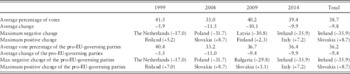
To begin with, in terms of research design, this paper takes into account all 28 EU member states, in a time span ranging from 1999 to 2014. Four European Parliament elections have been examined, two prior to the 2008 crisis (1999 and 2004) and two held after its outbreak (2009 and 2014). Overall, 98 national electoral contests have been considered: 15 in 1999, 25 in 2004, two in 2007 (Bulgaria and Romania), 27 in 2009, one in 2013 (Croatia), and 28 in 2014. As previously noted, we shall examine two dependent variables: the performance of parties in government and the performance of Eurosceptic parties. Some descriptive information on the first variable is provided in Table 1.
Governing parties: descriptive statistics

Vote change is calculated by means of comparison with previous general elections. When there is more than one government per term, the last government is considered.
Data processed by the author.
In the 98 national electoral contests considered in this paper, the parties in government obtained, on average, 38.7% of votes, with a slight difference between the pre- and post-crisis phase. However, by comparing the percentage of votes gained at the European Parliament elections and those obtained at the previous general elections, one discovers more interesting data: the total average change is equal to −9.8 percentage points. Thus, the parties in government lost votes at the European Parliament elections, but no clear diachronic trend emerges. For instance, although on average the government lost more in the post-2008 European Parliament elections (−10.0 points), two aspects must be emphasized: first, in the pre-crisis phase the average loss was practically identical (−9.7 points); second, the highest average loss was recorded in 2004 (−11.5 points), before the outbreak of the crisis.
Overall, the European Parliament election in which the government has the worst performance was in Ireland in 2014, where the coalition between Fine Gael and the Labour Party lost 35.9 percentage points compared with the national election of 2011. The impressive defeat of Fine Gael (−19 percentage points) and Labour Party (−16.9 percentage points), respectively, centre-right and centre-left parties which formed a coalition government, might be partly due to the electoral punishment of rightists and leftists voters not willing to accept that sort of political agreement.
In the three previous European Parliament elections, the national electoral contests with the greatest decrease were in the Netherlands in 1999 (−17.0 points), Poland in 2004 (−31.7 points), and Latvia in 2009 (−30.8 points). If we look at the countries with the highest positive change, we note that in the Slovakian European election of 2004, the government achieved its best performance ever (+8.7 points). This was due principally to the remarkable electoral growth of the Christian Democratic Movement (one of the four parties of the centre-right coalition government), which went from 8.3% in 2002 to 16.2% in 2004. Very close to these figures was the Italian European election in 2014, where the governing parties – especially in virtue of the 40.1% obtained by the Democratic Party of Matteo Renzi – gained 7.2 percentage points. Finally, while in 1999 the Finnish-governing parties recorded the best performance (+7.0 points), in 2009 the Slovakian parties in government gained 3.1 percentage points compared with the general elections of 2006.
It is worth noting that the ruling parties are not necessarily pro-EU parties (Taggart and Szczerbiak, Reference Taggart and Szczerbiak2013). Considering our data set, in 18 out of 98 cases the government includes Eurosceptic parties. Although their number has increased from the pre- to the post-crisis phase (from six to 12), the cases in which Eurosceptic parties participate in government are too few to make a relevant difference.Footnote 4 This is supported by Table 1, which shows that even considering only pro-EU governments the descriptive data remains basically the same. Table 2 provides the same information as above for Eurosceptic parties.
Eurosceptic parties: descriptive statistics

As several Eurosceptic parties do not run national elections, variation is calculated by means of comparison with previous European elections. Only parties that gained at least 1% of votes have been considered. Exceptions are parties that, despite having <1% of votes, obtained at least one seat in the European Parliament.
Data processed by the author.
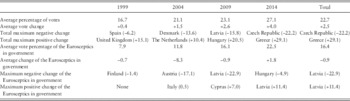
Considering the four European Parliament elections under examination, the Eurosceptic parties obtained, on average, 22.7% of the votes.Footnote 5 In addition, there is a growing trend: on average, the percentage of votes obtained by these parties went from 16.7% in 1999 to 27.1% in 2014. More specifically, before the crisis, the average was 19.6%, while after 2008 Eurosceptic parties achieved 25.1% of votes. Looking at the change in votes as compared with previous European Parliament elections, there are no cases with a negative result. The Eurosceptic parties systematically increased in electoral support: +0.4 percentage points in 1999,+1.5 in 2004,+2.6 in 2009 and, finally,+4.0 in 2014. Again, it is worth looking at the countries with the most significant changes. First, in the 2014 elections the Czech Eurosceptic parties had the greatest decrease as compared with the previous European elections: −22.2 percentage points. This result was mainly due to the electoral defeat of the conservative Civic Democratic Party, which went from 31.4% in 2009 European election to 7.7% in 2014. The collapse of this party seems to be a sign of a more general decline of traditional Czech parties. In fact, the pro-EU Social Democratic Party had the second-best defeat in 2014 European elections, losing 8.2 percentage points as compared with the 2009 elections. However, in 1999, this record was matched by Spanish Eurosceptic parties, but their loss amounted to just 6.2 percentage points. Given the Hellenic economic and political situation, it is not surprising that the highest positive change concerns the 2014 European election in Greece (+29.1 percentage points). In 2009 the highest increase belonged to the Hungarian Eurosceptic parties, but with values much more limited than those of Greece:+20.5 percentage points. Regarding the pre-crisis phase, data show that in 1999 the record belonged to the United Kingdom:+15.1 points, while the Dutch Eurosceptic parties had the highest positive change in 2004 (+10.4 points).
As argued by Taggart and Szczerbiak (Reference Taggart and Szczerbiak2013), party-based Euroscepticism is tempered by participation in government. Furthermore, generally speaking, governing parties tend to have negative electoral performances in European Parliament elections. Thus, one can hypothesize that, when in government, Eurosceptic parties lose voters’ support from one European Parliament election to another. From 1999 to 2014 just 22 out of 293 Eurosceptic parties (7.5%) have participated in a government.Footnote 6 At the European Parliament elections, on average, they obtained 16.4% of votes. This percentage, however, has increased over time, with an impressive growth in the two post-crisis European Parliament elections. On average, the Eurosceptics-governing parties gained 10.5% of voters support in 1999–2004 and 19.3% in 2009–14.
Looking at the average vote change, some significant differences emerge. While the whole set of Eurosceptic parties has always a positive variation, the governing Eurosceptic parties show an opposite trend. On average, they lose 0.9 percentage points in two successive European Parliament elections. The highest negative change occurs in 2004 European Parliament elections when, on average, Eurosceptic-governing parties lost 8.3 percentage points. This loss was due entirely to the electoral performance of the Austrian Freedom Party (FPÖ). The FPÖ obtained 6.3% of votes in 2004, when it was in government with the People’s Party. Four years earlier, when in opposition, it reached 23.4% of voters’ support.Footnote 7 Only at the 2014 European Parliament elections, Eurosceptic-governing parties had a positive change in voters support (+1.8 percentage points). On average, before the crisis outbreak, these parties lost 4.5 percentage points, while after the beginning of the crisis they gained 0.3 points. Then, the economic crisis seems to limit the extent to which the participation in government affects the electoral performance of Eurosceptic parties.
Government parties and European Parliament elections
Given that domestic incumbent governments lose votes at European Parliament elections, it is useful to understand to what extent the distinction between the 1999–2004 and 2009–14 elections matters, considering each individual member state. In order to prevent the number of parties which form the government from affecting the comparison, the variable has been operationalized as follows:
-
∙ The performance of governing parties is measured as the difference between the percentage of votes obtained by parties in the government at the European Parliament elections and their percentage at the general elections held before the European contest.
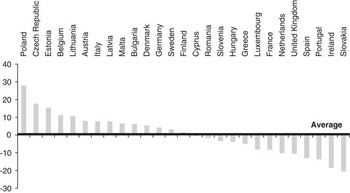
We can examine the performance of governing parties by making a distinction between the crisis and pre-crisis phase. As such, positive values in Figure 1 mean that, compared with prior general elections, the performance of governing parties was better after the onset of the crisis than before, whereas negative values mean that they performed better in 1999–2004.Footnote 8
Average performance of governing parties. Difference between the crisis and pre-crisis phase.

First of all, considering the 98 national electoral contests examined – including the two Croatian European elections of 2013 and 2014 – only 14 governments gained votes at the European Parliament elections as compared with the previous general elections. Moreover, nine of them gained less than 3 percentage points. As Figure 1 shows, the black line reveals that incumbent government performance remains constant between the two phases (the mean growth is 0.6 percentage points).Footnote 9 As an example, the performance of governing parties in Poland is equal to 27.9 because the Polish government lost 31.7 points at the 2004 European Parliament elections and, on average, lost just 3.8 points in elections during the crisis (with a gain of 1 point in 2009). A close look at the data reveals that 14 out of 27 cases are characterized by governments that perform better during the crisis than before. This might be due in part to the fact that some countries did not actually experience a crisis. The case of Poland just cited might be a good example. In May 2004 Poland’s unemployment rate was 19.3%, while in May 2009 and in April 2014 it was equal to 7.9 and 9.4%, respectively. Even the GDP growth shows percentages far from that of an economic crisis:+3.9% in 2003,+5.1% in 2008, and +1.8% in 2013.
The Polish case leads us to investigate which countries have experienced an effective economic crisis after 2008. To begin with, within the nine countries which did not enter a recession between 1999 and 2014, six have a government which performs better after 2008 than before. The main exceptions are Hungary, Romania, and Slovakia. Moreover, it is worth noting that only two countries entered a recession before the 2008 global crisis: Germany (the GDP negative growth was −0.4 in 2003) and Portugal (the GDP negative growth was −0.9 in 2003). More interestingly, to confirm that the post-2008 phase has been economically worse than the 1999–2004 phase, the only country which, on average, has grown more in 2009–14 than in the previous phase is Malta.
As has already mentioned, unemployment is our main independent variable, hence, it is useful to examine its cross-country variation in our samples. In six out of 27 countries, the average of the unemployment rate is higher before 2008 than after 2008: Finland, France, Germany, Malta, Poland, and Slovakia. In relation to the governing parties, Figure 1 shows that four of these six countries perform better during the crisis than before. On the basis of the theory of the economic voting, the Slovakian case is the most surprising. Regarding both unemployment rate and GDP growth, Slovakia has better values during the post-2008 phase than before. At the same time, it is the country in which the electoral performance of the governing parties is far better before 2008. However, this case simply shows that the punishment of the governing parties at the European Parliament elections does not always depend on the economic situation of the country. Nevertheless, in the next sections we demonstrate that – although not always – the state of the economy plays a significant role both in the performance of governing and Eurosceptics parties.
The reinforcement of party-based Euroscepticism
Although the concept of Euroscepticism is also used with reference to a general negative attitude towards European Union (Wessels, Reference Wessels2007; Boomgaarden et al., Reference Boomgaarden, Schuck, Elenbaas and de Vreese2011), its origin lies in the need to make a distinction between pro-EU and anti-EU political parties (Taggart, Reference Taggart1998). According to Taggart (Reference Taggart1998: 364), Euroscepticism includes both ‘contingent and conditional opposition to European integration as well as total and unconditional opposition to it’.
Euroscepticism is a multifaceted phenomenon (Conti and Memoli, Reference Conti and Memoli2012) which can be strengthened by a context of economic restrictions in which the populist appeal typical of Eurosceptic parties can obtain a large popular support (Ruzza, Reference Ruzza2009; Harmsen, Reference Harmsen2010). Originally, the Eurosceptic vote was simply conceived as the result of dissatisfaction with the governing parties. Thus, some scholars (Franklin et al., Reference Franklin, van der Ejik and Marsh1995; Anderson, Reference Anderson1998) did not consider it a consequence of the spread of anti-EU sentiments, but merely a way to punish national governments. By contrast, we interpret party-based Euroscepticism as a central phenomenon driven principally by the voters’ opinions on the European project. Theoretically, citizens who despise the domestic government have three options at the European Parliament elections: not to vote, cast a vote for pro-EU opposition, and cast a vote for Eurosceptic opposition. Therefore, only a part of party-based Euroscepticism can be interpreted simply as a punishment of the government.
Following Taggart and Szczerbiak (Reference Taggart and Szczerbiak2004, 2008), it is useful to distinguish between hard and soft Eurosceptic parties.Footnote 10 As one can easily comprehend, a hard Eurosceptic party is one that rejects projects for European integration or strives against the EU membership of its own country. Soft Eurosceptic parties oppose specific European policies, despite accepting European integration.Footnote 11 Although some scholars treat these two kinds of parties separately (Treib, Reference Treib2014), we propose a pooled analysis in which hard and soft Eurosceptic parties are examined jointly.Footnote 12 This is because our interest consists of an estimation of the maximum level of Eurosceptic votes in each EU member state. As in the previous section, four European Parliament elections are under examination: on the one hand, the 1999 and 2004 elections; on the other, the 2009 and 2014 elections.
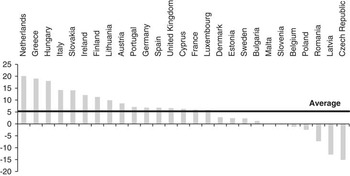
In order to better explore this issue, it might be useful to examine each individual EU member state, making a distinction between the percentage of votes going to Eurosceptic parties before and during the crisis. Having made this distinction, positive values in Figure 2 mean that, on average, Eurosceptic parties did better in 2009–14. On the other hand, negative values mean that, on average, they performed better in 1999–2004.
Average percentage of votes for Eurosceptic parties. Difference between the crisis and pre-crisis phase.

The values in Figure 2 originate from the difference between the average electoral performance of Eurosceptic parties after the onset of the crisis and their performance before it.
As the black line in Figure 2 shows, on average, during the crisis Eurosceptic parties gained 5.3 percentage points. Only six out of 27 countries had the opposite trend:Footnote 13 in Slovenia, Belgium, Poland, Romania, Latvia, and the Czech Republic, Eurosceptic forces performed worse during the economic crisis than in the 1999 and 2004 European Parliament elections. But in some cases this does not imply a disappearance of party-based Euroscepticism. For instance, the 2004 and 2009 European Parliament elections in the Czech Republic were characterized by a sweeping success on the part of anti-EU parties. In 2004 they reached 59.6% and in 2009 their performance dropped slightly to 55.6%: the top two performance rates among Eurosceptic parties. In 2014 there was a decrease, but the Communist Party, the Civic Democratic Party, the Party of Free Citizens, and three minor anti-EU parties together took 33.4% of votes. While the Czech Republic is the country with the greatest loss for Eurosceptics, the Netherlands is the one in which they obtained their largest gain. In 1999 and 2004 anti-EU parties stood at 10.2%, whereas in 2009 and 2014 they rose to 30.3%, with an increase of 20.1 percentage points. This impressive growth is largely due to the emergence of the Party for Freedom, which achieved 17% in 2009 – becoming the second Dutch party – and 13.3% in 2014.
Interestingly, yet unsurprisingly, two of the four member states whose Eurosceptic parties enjoyed the largest growth are Southern European countries. In particular, until 2009 the Eurosceptic parties in Greece had always been below 20%, gaining just over 17% in 2004. With the explosion of the Greek economic crisis, the Eurosceptics reached 20.2% in 2009 and 49.6% in 2014. Of course, the 2014 figure is largely attributable to the success of Syriza (26.6%), a soft Eurosceptic radical left party. However, it should be stressed that the neo-Nazi Golden Dawn obtained nearly 9%. In Italy, the phenomenon was of a similar size. Before 2009, the anti-EU parties had always been under 15%, peaking at 12.2% in 2004. In conjunction with the economic crisis, they obtained 15.8% (2009) and 35% (2014). Similarly to the Greek case, the 2014 percentage is principally due to the success of a party which is not against European integration in principle: the Five Star Movement headed by Beppe Grillo (20.1%). However, the Grillo’s party, unlike Syriza, cannot be categorized as belonging to the radical left (Gualmini and Corbetta, Reference Gualmini and Corbetta2013; Treib, Reference Treib2014).
For what concerns the other two large Southern European countries, according to Figure 2, in Spain and Portugal the Eurosceptics’ electoral success has apparently grown less than in Greece and Italy. This is mainly true for Portugal where the two (softly) Eurosceptic parties went from 12.1% in 1999 to 18.9% in 2014, climbing to 22.6% in 2009. By contrast, the 2014 Spanish European Parliament election was characterized by considerable growth on the part of Eurosceptic parties, which went from a percentage between 4.1 and 7.2 to 23.2%. In addition to 10% obtained by the Plural Left, this result is mainly due to 8% gained by another soft Eurosceptic party: Podemos, a leftist political force founded 5 months before the European Parliament election of 2014.
The economy and European Parliament election outcomes
By making a distinction between the two European Parliament elections before the onset of the economic crisis in 2008 and the two subsequent ones, a thorough description of the electoral performance of Eurosceptic parties and governing parties has been provided. This section goes beyond that description, offering an initial explanation of the electoral performance documented in the previous pages.
Employing a simple regression technique, we can assess the relevance of the economic crisis to European electoral returns using some substantial economic indicators. As before, the 28 EU members have been analysed from 1999 to 2014. Specifically, it is useful to provide two multivariate linear regression models, with two distinct dependent variables. The first model considers the difference between the percentage of votes obtained by the governing parties at the European Parliament elections and the percentage that they obtained at the previous general elections. The second model considers the difference between the percentage of votes obtained by Eurosceptic parties at the actual European Parliament election and the percentage that they achieved at the previous European Parliament election.
The two models take into consideration the same independent variables: four are substantial variables related to the economic situation of the country, while 12 are used as control variables. It is worth noting that, in order to explain the Eurosceptic parties’ electoral success, the three control variables on the domestic political system are theoretically irrelevant.
More precisely, the substantial variables are as follows:
-
∙ Unemployment rate: measured as the difference between the unemployment rate corresponding to the European Parliament election in t and that of the European Parliament election in t−1.
-
∙ Comparative growth of real GDP:Footnote 14 the measurement of this variable has a three-step procedure: first, countries are grouped in quartiles on the basis of their real GDP per capita; second, for each electoral year (1999, 2004, 2009, and 2014), an average real GDP growth rate per quartile is calculated; third, the variable’s value is equal to the difference between the real GDP growth of the country x at the elections a, and the average real GDP growth, at the election a, of the countries belonging to the same quartile as the country x. The data correspond to the year before the European Parliament election. For instance, the value for Germany 2009 is given by: (2008 German GDP growth)−(average 2008 GDP growth for second-quartile countries).
-
∙ Inflation rate: measured as the difference between the inflation rate corresponding to the European Parliament election in t and that of the European Parliament election in t−1.
-
∙ Social protection: measured as the difference between the total expenditure on social protection per capita (at constant 2005 prices) of the electoral year t and that of the electoral year t-1. Administrations costs are excluded.
Using these objective macroeconomic indicators, rather than the subjective perceptions of voters, we can avoid a typical phenomenon of European elections: the reciprocal causal relationship between partisan affiliation and judgements on the economy (Wlezien et al., Reference Wlezien, Franklin and Twiggs1997). Having clarified this, as previously mentioned, 12 control variables are included:
-
∙ Pre/post-2008: this is a dummy variable which distinguishes pre-2008 European elections (0) from post-2008 European elections (1).
-
∙ Seniority: measured as the number of years the country has been a member of the EU.
-
∙ South and East countries: this is a dummy variable which distinguishes Western and Scandinavian (0) countries from Southern and Central-Eastern countries (1).
-
∙ Log GDP per capita: used as a proxy of a country’s wealth, this is measured as the logarithm of the GDP per capita in the year preceding the European Parliament election.
-
∙ Long-term interest: used as an austerity variable (Armingeon and Guthmann, Reference Armingeon and Guthmann2014), this is measured as the average 10-year public debt interest in the 4 months preceding the European Parliament election.
-
∙ International Monetary Found (IMF) and/or EU bailout: this is a dummy variable which distinguishes countries under an IMF and/or EU bailout (1) programme from others (0).
-
∙ Anti-inflation policy: this is a dummy variable which makes a distinction between cases with a reduction in inflation greater than, or equal to, 100% in the period between two successive European Parliament elections (1) from others (0).
-
∙ First party seats %: measured as the percentage of seats obtained by the major governing party at the general election preceding the European Parliament election under examination.
-
∙ Number of parties: measured as the number of parties which formed the incumbent government.
-
∙ Time interval: measured as the interval (in years) between the European Parliament election and the entry in office of the incumbent government. This is useful for controlling for the honeymoon period, during which economic outcomes should have less impact on government electoral performance.
-
∙ Eurosceptics in government: this is a dummy variable that takes value 1 when Eurosceptic parties are in government, and 0 otherwise. This is useful to assess whether participation in government of Eurosceptic parties influences the way in which voters judge both the government and Eurosceptics parties.
-
∙ Government ideology: government ideology is measured as the weighted average of the left-right position of governing parties. This varies from 0 (extreme-left) to 10 (extreme-right). Data are drawn from the ParlGov data set. The weight is represented by the proportion of seats gained at the national elections.
The proper use of the OLS technique allows us to evaluate the influence of a single independent variable that must be explicit before analysing the data (Pisati, Reference Pisati2003). As noted earlier, in this specific case, we intend to focus mainly on unemployment rate.
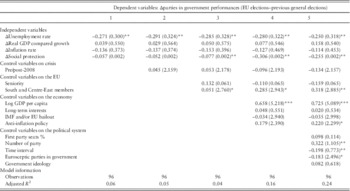
Table 3 shows an OLS model in which the performance of parties in incumbent government is the dependent variable.
Multivariate linear regression: performance of parties in government

Entries are standardized β coefficients; standard errors in parentheses.
***P⩽0.01; **P⩽0.05; *P⩽0.1.
Data processed by the author.
Excluding control variables and focussing solely on substantial independent variables, only two of them are statistically significant:Footnote 15 the change in the unemployment rate and the change in social protection expenditure, while both the change in the comparative growth of real GDP and the change in the inflation rate do not seem to have any relevance. The former has a very weak – and not significant – relationship with the performance of the incumbent government. The second is characterized by a weak and negative relationship with government electoral results and it is also not statistically significant.
Going back to the two relevant variables, one can note that the change in social protection expenditures became significant when introducing all the control variables into the model. Nevertheless, for our purposes what is important is that the change in the unemployment rate seems the only independent variable worthy of interest. As one can see, it has a negative and significant relationship with the performance of incumbent governments. And, most interestingly, its β coefficient (slightly) increases when controlling for the economic crisis (β=0.291; P⩽0.05). This means that the impact of unemployment increased during the years of the Great Recession. When all the control variables are introduced, the coefficient is equal to −0.250 (P⩽0.05). In a nutshell, when the unemployment rate varies positively, governing parties lose votes at the European Parliament elections (as compared with the previous general elections). An increase of a standard deviation, or rather 4 percentage points, in the rate of unemployment leads, on average, to a 2.5 percentage points decrease in the electoral performance of government parties. In addition, an interesting point is that, before including the control variable on the political system, the β coefficient is equal to −0.280 (P⩽0.05). This means that, as expected, controlling for the time interval between the government’s entry in office and the European Parliament elections, the impact of unemployment on voting behaviour decreases. This clearly confirms the classical ‘honeymoon hypothesis’ (Dominguez, Reference Dominguez2005), according to which, in the 1st months of its administration, a government enjoys a large voters’ support regardless of the actual economic situation.
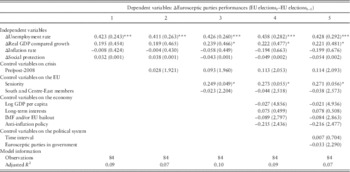
Turning to party-based Euroscepticism, it is worth remembering that, as some Eurosceptic parties run exclusively in European contests, the dependent variable is given by the comparison between the electoral results of the actual European Parliament elections and that of the previous ones.Footnote 16 As Table 4 shows, in this case one can see that the same trend has emerged by analysing the performance of the incumbent government: what really matters is the change in unemployment rate. In particular, when all control variables are included, the coefficient between the change in the unemployment rate and the performance of Eurosceptic parties is positive, rather strong and statistically significant (β=0.438; P⩽0.01). An increase of 4 percentage points in the rate of unemployment produces, on average, a 3.4 percentage points increase in the electoral performance of Eurosceptic parties. It is worth noting that, in this case, controlling only for the years of the economic crisis does not seem to strengthen the relationship between unemployment and the dependent variable. Interestingly, the relationship between unemployment and the performance of Eurosceptic parties strengthens when including the control variable on the EU and the economy.
Multivariate linear regression: performance of Eurosceptic parties

Entries are standardized β coefficients; standard errors in parentheses.
***P⩽0.01; **P⩽0.05; *P⩽0.1.
Data processed by author.
Similarly to other parties, Eurosceptic parties can be placed on the left-right continuum. We might therefore expect that the electoral performance of the leftist and rightist Eurosceptic parties is affected by different variables. By employing the same independent and control variables of the model in Table 4 and by running two separate regression models for the leftist Eurosceptics and for the rightist ones, we discover two very different patterns.Footnote 17 While the model fits very well in the case of the left-wing Eurosceptic parties, it does not fit at all in the case of right-wing Eurosceptic parties.Footnote 18 If this is true, the economy and, especially, the unemployment rate seem to affect primarily the electoral performance of left-wing Eurosceptics parties.
Conclusions
This article questions the existence of a relationship between economic variables and European Parliament elections’ outcomes. Using aggregate electoral results and member states’ macroeconomic data, the analysis shows that, in European elections, both the performance of governing and Eurosceptic parties are affected by the state of the economy. This suggests that the logic of economic voting does matter, not only at national level, but also at the European one.
In accordance with the ‘second-order theory’, at European elections voters’ turnout is usually lower compared with turnouts registered at general elections and, as we have demonstrated, electors cast their European vote as an instrument for punishing domestic incumbent governments. On average, parties in government at national level lost 5.9 percentage points in 1999, 11.5 in 2004, 10.1 in 2009, and 9.9 points in 2014. Thus, although there has been a descending trend since 2004, governments continue to lose votes. Importantly, as this article has demonstrated, such punishment is largely influenced by the economy and particularly so at times of economic crisis.
In relation to Eurosceptic parties, just 9 years ago, before the onset of the crisis, according to Hix and Marsh (Reference Hix and Marsh2007) the incidence of anti-EU surges was an exceptional phenomenon. Today we can observe that these parties have increased their number of votes over the years. As previously noted, Eurosceptic parties obtained, on average, 16.7% of votes in 1999, 21.1% in 2004, 23.1% in 2009, and 27.1% in 2014. This shows that a significant and growing part of the electorate is increasingly concerned about the present situation of the European Union. Again, the analysis presented in this article shows that the performance of the European economy plays a relevant role in explaining the voters’ support for Eurosceptics parties.
More specifically, our analysis shows that both the performance of the incumbent government and those of the Eurosceptic parties – especially the leftist ones – can be attributed to a significant degree to the increase in unemployment rate. This is the most important macroeconomic variable. Of course, the growth of unemployment does not only have an impact on the voting behaviour of those directly affected by it: it also indirectly affects the vote choice of employed people who perceive the economic environment as being unfavourable.
The economy has an undeniable impact on the performance of both governing parties and Eurosceptic parties. Moreover, the Great Recession has strengthened the relationship between macroeconomic variables and electoral results, especially in the case of governing parties. It seems therefore all too easy to conclude that without a rapid and generalized emergence from the crisis, the European project itself is at risk of continuing to lose legitimacy.
Acknowledgement
The author would like to thank the anonymous reviewers for their valuable suggestions.
Funding
The research received no grants from public, commercial, or non-profit funding agency.
Data
The replication dataset is available at http://thedata.harvard.edu/dvn/dv/ipsr-risp.