


Introduction
Adolescent depression
Depression is a serious mental health problem in adolescence, with 2.6% of the world youth population experiencing depression at any one time (Polanczyk et al., Reference Polanczyk, Salum, Sugaya, Caye and Rohde2015). Core symptoms include depressed mood or irritability, and/or a loss of interest and pleasure (anhedonia) along with other cognitive and behavioural changes including appetite and sleep disturbances, cognitive difficulties and negative self-perceptions (American Psychiatric Association, 1994). Depression in adolescence predicts a wide range of long-term negative impacts, including mental illness in adulthood (McLeod et al., Reference McLeod, Horwood and Fergusson2016), educational under-achievement (Fletcher, Reference Fletcher2008), and increased risk of suicidal behaviour (Cash and Bridge, Reference Cash and Bridge2009).
Adolescent depression treatments
The current National Institute for Health and Care Excellence (NICE) guidelines for treatment of moderate/severe depression in young people recommend individual cognitive behavioural therapy (CBT), interpersonal therapy (IPT), family therapy or psychodynamic psychotherapy for at least three months (NICE, 2015). NICE recommend that such therapies should only be provided by healthcare professionals trained to an appropriate standard of competence. However, there are a limited number of therapists with these qualifications, which can be a barrier to accessing these treatments. Waiting times in Child and Adolescent Mental Health (CAMH) services across the UK are extremely variable (National Society for the Prevention of Cruelty to Children, 2015), can be lengthy (House of Commons Health Committee, 2014) and GPs report inadequate CAMH provision for the young people they try to refer (Stem4, 2016). Evidence-based treatments are simply not able to meet the needs of the majority of depressed young people.
There are also difficulties engaging depressed adolescents in psychological therapy. Recent trials have provided evidence of a significant level of drop-out from CBT and other therapies (Goodyer et al., Reference Goodyer, Reynolds, Barrett, Byford, Dubicka and Hill2016), and a meta-analysis of adolescent depression treatments found psychological interventions with a cognitive component were no more effective than those without cognitive work (Weisz et al., Reference Weisz, McCarty and Valeri2006).
Behavioural activation for depression
In the UK, behavioural activation (BA) is recommended as an evidence-based treatment for adult depression (NICE, 2016). BA is based on the behavioural theory of depression and aims to improve mood by increasing positive reinforcement for healthy behaviours. Meta-analyses suggest that BA is equivalent to CBT for adults with depression (Cuijpers et al., Reference Cuijpers, van Straten, Andersson and van Oppen2008; Ekers et al., Reference Ekers, Richards and Gilbody2008) and can be more effective than medication (Ekers et al., Reference Ekers, Webster, Van Straten, Cuijpers, Richards and Gilbody2014). Two contemporary BA approaches have been developed. One involves 16–20 sessions (BA; Martell et al., Reference Martell, Addis and Jacobson2001, Reference Martell, Dimidjian and Hermann-Dunn2010) and the other is a brief, more structured approach [behavioural activation treatment for depression (BATD); Lejuez et al., Reference Lejuez, Hopko and Hopko2001, Reference Lejuez, Hopko, Acierno, Daughters and Pagoto2011].
Treatment complexity/length and clinician level of training do not affect BA treatment outcome (Ekers et al., Reference Ekers, Richards and Gilbody2008). Because BA can be delivered by staff who are not formally trained as psychological therapists, it is more cost effective than CBT (Richards et al., Reference Richards, Ekers, McMillan, Taylor, Byford and Warren2016).
Brief BA for adolescent depression
Almost no work has applied BA to adolescents, despite many aspects of BA fitting well with the characteristics of this developmental period (e.g. lower cognitive demands, ability to individualize therapy within a straightforward approach). Ruggiero et al. (Reference Ruggiero, Morris, Hopko and Lejuez2005) reported a case study of using BATD successfully with a depressed adolescent, with an indication that depression symptoms reduced as reinforcing life events increased. One small randomized controlled trial (n = 60) has evaluated Martell-based, 14 session BA with depressed adolescents in the USA (McCauley et al., Reference McCauley, Gudmundsen, Schloredt, Martell, Rhew, Hubley and Dimidjian2015). Adolescents were randomized to either BA or evidence-based practice for depression, and both groups showed significant improvements in depression symptoms and functioning (with no difference between groups).
To create a more streamlined BA intervention, Pass and Reynolds (Reference Pass and Reynolds2014) adapted BATD for use in routine CAMH service settings in the UK (see Pass et al., Reference Pass, Brisco and Reynolds2015b). The aim was to create a brief, structured behavioural intervention that was acceptable to young people and could be delivered by a range of professionals, in order to increase treatment accessibility. Treatment takes 6–8 sessions, involves parents and is delivered using a structured session by session workbook (Pass and Reynolds, Reference Pass and Reynolds2014) and therapist guide (Pass et al., Reference Pass, Brisco, Hodgson and Reynolds2015a). It can be used in cases where there is self-harm/suicidal ideation (Pass et al., Reference Pass, Whitney and Reynolds2016) and can be delivered successfully by non-specialist clinicians (Pass et al., Reference Pass, Hodgson, Whitney and Reynolds2017). This study reports the outcomes from a pilot and feasibility study of Brief BA in NHS CAMH services with data from 20 consecutive cases referred for treatment.
Method
Procedure
The study was completed within a local CAMH service Anxiety and Depression pathway. Potential participants were identified by NHS clinicians if they wished to receive treatment for depression. Brief BA was offered when a BA therapist and supervision was available. Clinicians outlined the usual treatment options [typically CBT, sometimes with selective serotonin re-uptake inhibitor (SSRI) medication if indicated] and described Brief BA to young people and parents. Collaborative decision-making determined treatment choice.
Berkshire Healthcare NHS Foundation Trust (BHFT) provided approval for an audit of these cases and dissemination of the findings (reference: 2623). All data obtained from young people and parents were part of service routine data collection.
Participants
Participants were the first 20 young people who opted to receive Brief BA treatment, referred between February 2014 and August 2015. Strict inclusion/exclusion criteria were not used; referrals were received from clinicians within the service for young people with depressive symptoms causing significant impairment in functioning. Therefore this case series was uncontrolled and unblinded, with no comparison group.
Measures
Revised Child Anxiety and Depression Scale: Child and Parent versions (RCADS, RCADS-P; Chorpita et al., Reference Chorpita, Yim, Moffitt, Umemoto and Francis2000)
The RCADS and RCADS-P are 47-item questionnaires assessing anxiety and low mood in 8–18 year olds. Both have good psychometric properties (e.g. Chorpita et al., Reference Chorpita, Yim, Moffitt, Umemoto and Francis2000, Reference Chorpita, Moffitt and Gray2005; Ebesutani et al., Reference Ebesutani, Bernstein, Nakamura, Chorpita and Weisz2010), and provide age and gender normed t-scores with clinical cut-offs (t scores of 0–64 denote normal range, 65–69 denote borderline clinical range, 70+ denotes clinical range). The full RCADS and RCADS-P were completed at assessment and final treatment session. The self and parent report Depression subscales were completed at the start of every BA session and was the primary outcome measure. An additional question (‘I thought about killing myself’/‘My child thought about killing themselves’) was added to monitor risk.
Outcome Rating Scale (ORS; Miller and Duncan, Reference Miller and Duncan2000 )
The ORS is a measure of functioning in four areas: Individual, Interpersonal, Social and Overall. These are marked on four 10 cm visual analog scales that are summed to give a total score, with higher scores indicating higher functioning. Young people and their parent were asked to rate the ORS every session. The ORS has good concurrent validity with other treatment outcome measures and high internal consistency and test–retest reliability (Duncan et al., Reference Duncan, Sparks, Miller, Bohanske and Claud2006).
Session Rating Scale (SRS; Duncan et al., Reference Duncan, Miller, Sparks, Claud, Reynolds, Brown and Johnson2003)
The SRS is an ultra-brief measure of therapeutic alliance. Similar to the ORS, the SRS scores are marked on four 10 cm visual analog scales that are summed to give a total score across four areas: Relationship, Goals and Topics, Approach or Method, and Overall Alliance. A higher score indicates a higher client rating of therapeutic alliance. The SRS has good psychometrics, including moderate concurrent validity with longer self-report measures of alliance (Duncan et al., Reference Duncan, Miller, Sparks, Claud, Reynolds, Brown and Johnson2003). The SRS was completed after each session by the young person.
Brief BA feedback questionnaire
At the end of treatment, young people and parents were asked to complete a questionnaire about their experiences of Brief BA. There were three forced choice questions about whether they liked the approach (‘really liked it’ to ‘hated it’), whether they found BA useful (‘very’ to ‘not at all’), and whether they would recommend BA to a friend/for a friend's child (‘yes definitely’ to ‘definitely not’). Young people and parents were also asked open-ended questions about what they liked best about BA, what they liked least, and any other comments including about the practical resources.
Participant characteristics
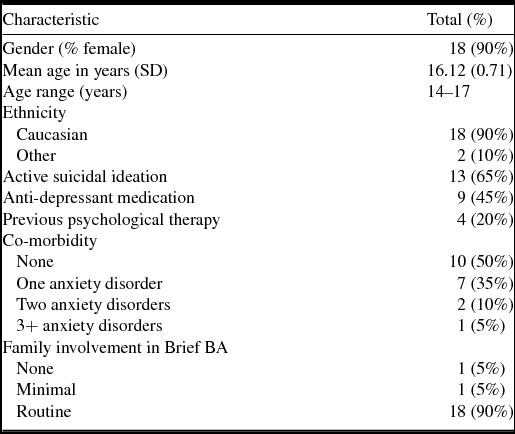
Most participants were white, 16-year-old females, representative of all young people who were referred with depression during this period (Orchard et al., Reference Orchard, Pass, Marshall and Reynolds2016). Ten had at least one co-morbid anxiety disorder (see Table 1), and in addition one had a diagnosis of chronic fatigue syndrome (CFS), and another was waiting for an autism spectrum disorder (ASD) assessment. There were no co-morbid behavioural diagnoses.
Participant characteristics

Nine young people were taking prescribed SSRI medication, and two of these had changes in medication type/dose during Brief BA treatment following psychiatry reviews. Thirteen young people reported active suicidal ideation at assessment, indicating an active wish to end their life.
Four participants had previously received CBT (two for anxiety and two for depression). A higher proportion had accessed some form of counselling, but this varied greatly and clinical records were not available to accurately assess this.
Brief BA treatment
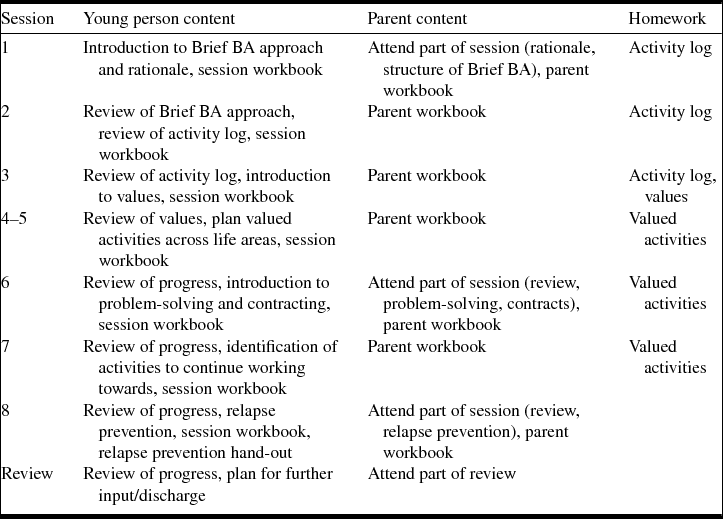
Brief BA involves 6–8 one-hour individual sessions with structured parental involvement in part of sessions 1, 6 and 8. There is a review session with the young person and parent approximately one month after the final treatment session (see Table 2 for Brief BA overview). One young person did not have any parental involvement as she was attending boarding school, and another attended most sessions alone and parental involvement was minimal.
Brief BA for adolescent depression: session overview

Brief BA clinicians and supervision
Brief BA was delivered in the routine CAMH service setting by three therapists including a clinical psychologist (n = 12) and two graduate psychologists, both of whom received additional training in Brief BA (four cases each). For further details on Brief BA training for clinicians, see Pass et al. (Reference Pass, Hodgson, Whitney and Reynolds2017). Supervision was provided by a clinical psychologist involved in the adaptations for Brief BA. During Brief BA, other multidisciplinary clinical care was provided as appropriate (e.g. ongoing psychiatry reviews).
Treatment adherence
No treatment adherence measure is available for Brief BA. However, all clinicians sought consent for audio recording of sessions, and a random selection of tapes were listened to by one of the developers of Brief BA (L.P.). BA supervision was held fortnightly (weekly for the first training case for each clinician) and used treatment audio recordings.
Analysis plan
Data were explored to assess the assumptions of parametric testing (paired t-tests). Where variables violated these assumptions, a non-parametric equivalent test was used (Wilcoxon signed ranks test) and any change to the results reported, for all analyses a p < .05 significance level was used. We used an ‘intent to treat’ (ITT) analysis; all participants were included in the analysis. Where data were missing, a last observation carried forward (LOCF) procedure was used. The exception to this was when no data was available at any time point. For data missing from assessment, a first observation carried backwards (FOCB) procedure was used.
Results
Engagement
Out of the 20 adolescents who started Brief BA, 19 engaged with the treatment and 18 completed all eight sessions and review. One young person reported that Brief BA was not the right treatment for her after four sessions. Two more sessions were used to review her symptoms and progress, before discontinuing Brief BA and putting her onto the waiting list for CBT. She subsequently declined CBT or any other input and was discharged from the service. Another young person attended four sessions of Brief BA, then was discharged because her symptoms remitted.
Primary outcome: RCADS Depression subscale
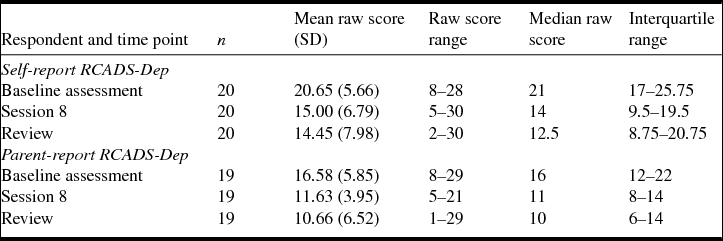
Pre- and post-treatment data for the RCADS Depression subscale are presented in Table 3. The data were slightly non-normally distributed, so pre/post comparisons were run both with parametric and non-parametric tests. There was no difference in results, so parametric tests are reported for simplicity, along with bias corrected and accelerated (BCa) bootstrapped 95% confidence intervals.
Pre- and post-Brief BA RCADS Depression subscale raw scores

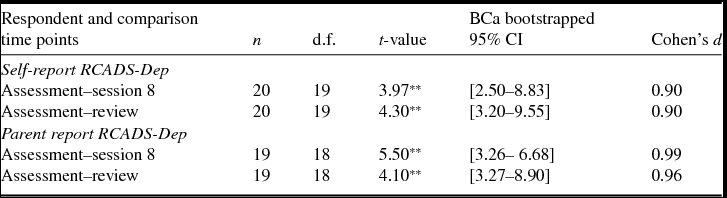
As shown in Table 4, there was a significant reduction in self-reported depression symptoms from assessment to session 8, and from assessment to review. This reduction was also shown by mean t-scores moving from the clinical range at assessment (mean = 82.25, SD = 15.95), to the borderline range at session 8 (mean = 66.25, SD = 16.19) and review (mean = 65.40, SD = 19.91). This decrease equates to a large effect size (0.2 = small, 0.5 = medium, 0.8 or above = large effect size; Cohen, Reference Cohen1992).
Pre- and post-Brief BA comparisons of RCADS Depression raw scores

*p < .05, **p < .01; d.f., degrees of freedom; CI, confidence interval.
Parent-report RCADS Depression subscale
The pre- and post-treatment mean scores for the parent-reported RCADS Depression subscale are shown in Table 3, and the pre and post comparisons in Table 4. There was a significant reduction in parent-reported RCADS Depression scores from assessment to session 8, and from assessment to review. The parental mean t-scores reduced but stayed in the clinical range across time points (assessment mean = 86.53, SD = 18.21; session 8 mean = 72.00, SD = 11.92; review mean = 69.24, SD = 19.59). In line with self-report scores, the parent-reported reduction in depression symptoms equates to a large effect size (Cohen, Reference Cohen1992).
Secondary analyses: Outcome Rating Scale
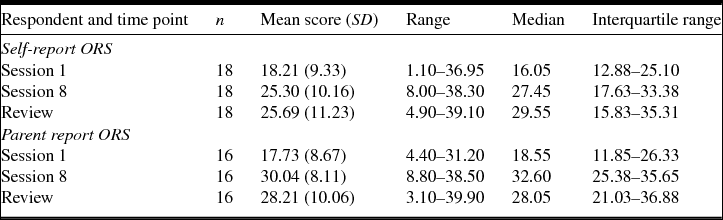
The ORS was completed for the first time at the beginning of session 1 as it was not part of the assessment measures. The pre- and post-treatment mean ORS scores are presented in Table 5. There was a significant increase in self-reported functioning from session 1 to session 8 [t (17) = –2.51, p = .022, d = 0.73], and from session 1 to review [t (17) = –2.44, p = .026, d = 0.73]. Parental report also indicated a significant increase in functioning from session 1 to session 8 [t (15) = –5.60, p < .001, d = 1.47] and from session 1 to review [t (15) = –4.69, p < .001, d = 1.12]. The treatment effect size was medium for self-report, and large for parent-report (Cohen, Reference Cohen1992).
Pre- and post-Brief BA ORS scores

Case 7 excluded as she did not feel her ORS self-report was valid, so this measure was discontinued; case 17 excluded as both self- and parent-report ORS score were 0 at session 1, indicating a lack of validity; case 9 had no parent ORS data; case 15 parent ORS excluded as only available from session 6.
Clinical outcomes
In addition to scores on routine outcome measures we examined clinical outcomes for each young person. Following completion of Brief BA, 13 young people (65%) required no further psychological input; of this group, eight were discharged from the service completely and five remained on SSRI medication (so required ongoing psychiatric monitoring). Of the remaining seven young people, four were referred for CBT (three for anxiety, one for anxiety and low mood). Two young people were offered additional input in CAMH services but declined this (one who had disengaged with Brief BA, and one who was offered both group CBT for anxiety and family therapy). One young person was referred to adult mental health services for CBT for anxiety as she was almost 18.
Reliable and clinically significant change: RCADS Depression subscale
Reliable change on the RCADS Depression subscale was indicated by a change score greater than the published reliable change criterion (RCC) based on each individual's age and gender. Clinically significant change was defined as moving down a clinical category. Two young people were already in the normal range on the RCADS Depression subscale at assessment, therefore clinically significant change was not possible. Out of the remaining 18, six (33%) showed reliable and clinically significant change between assessment and session 8. Two showed reliable improvement but did not change clinical category, while the others did not show reliable change in their scores. Between assessment and BA review session, seven (39%) of the 18 young people who could evidence reliable and clinically significant change showed this. Three others also showed reliable improvement but did not change clinical category.
Reliable and clinically significant change: ORS
Four young people scored in the normal range (28+) on the ORS at assessment so clinically significant change was not possible. Six (38%) of the 16 young people able to evidence reliable and clinically significant change (increase of more than 5 points and move from clinical to normal range) showed this between assessment and BA session 8. Another four showed reliable improvement but their ORS scores remained in the clinical range.
Between assessment and BA review, eight (50%) of the 16 young people who could show reliable and clinically significant change evidenced this. Another young person showed reliable improvement but remained in the clinical range.
Treatment satisfaction
Therapeutic alliance ratings were high across all Brief BA sessions, with mean SRS scores ranging from 35.55 (session 1) to 38.09 (session 7). At the end of treatment, feedback was received from 17 young people and 16 parents. The majority (over 70%) reported that they liked or really liked Brief BA, and importantly, nobody said they disliked it. Nearly all (94%) of young people reported they would definitely or probably recommend Brief BA to a friend, and 88% found the approach useful. Open-ended comments were also positive, including on the therapeutic relationship (e.g. ‘they truly listened to me’, ‘being able to talk freely’) and often directly about the Brief BA content (e.g. ‘It made me think about my activities and how they affect my mood’, ‘I like that it made me think about my own values’).
Over 75% of parents liked or really liked Brief BA, 81% found it very or fairly useful, and over 87% would recommend the treatment to a friend for their child. Positive parental comments identified the practical elements of Brief BA (e.g. ‘the focus on positive outcomes and encouraging activities, and a balance of fun and social as well as achievement’) and the importance of the therapeutic relationship (e.g. ‘the therapist treated [young person] like a young adult’).
When asked what they liked least about Brief BA, four young people chose not to write anything and one young person stated ‘nothing, I liked it all’. The others identified various minor issues, including challenges with completing activity logs and engaging in the work between sessions (e.g. ‘the activity logs at the start’, ‘having to organize things’). Five parents did not identify any negative aspect of Brief BA. A few identified concerns over the brief nature of the intervention (e.g. ‘8 weeks was probably too short, I feel she needs a little more help’), or practical issues (e.g. ‘planning appointments’). Two parents commented that they should have had greater involvement in the treatment (e.g. ‘I sometimes felt that my concerns about my child were not considered’, ‘the lack of communication between therapist, child and parent – a debrief I felt was needed to end the session’).
Discussion
The aim of this pilot study was to investigate the acceptability, feasibility and clinical effectiveness of a brief, structured behavioural intervention adapted for adolescents within a routine CAMH service setting. The high treatment completion rate, SRS ratings and feedback scores suggest that Brief BA was acceptable to both young people and their parents. Brief BA resulted in a significant decrease in depression symptoms over the course of treatment and a significant increase in functioning on both self and parent report. The treatment effect size on depression symptoms was large, and the majority of young people (65%) needed no further psychological intervention following Brief BA. These findings are promising (particularly given that this was a routine CAMH service population with a range of co-morbidity, suicidal ideation and previous therapy experience), and suggest that Brief BA warrants further evaluation on a larger scale.
Developing alternative treatments for adolescent depression is important and urgent. Adolescent depression is a serious health problem, a cause of great distress and long-term impairments in functioning and a leading cause of premature death (Thapar et al., Reference Thapar, Collishaw, Pine and Thapar2012). A number of evidence-based psychological therapies are recommended but they have some serious limitations. First, and perhaps most importantly, many young people do not engage with treatment and drop out before they receive the planned number of sessions. Secondly, existing psychological treatments (e.g. CBT, IPT, family therapy) are complex, require lengthy training and are delivered by specialist psychological therapists. This means that access to treatment is extremely limited and most young people with depression (or other mental health problems) are not able to access treatment at all, or must endure lengthy waiting lists. Evidence-based treatments are therefore simply not able to meet the needs of the majority of depressed young people.
Brief BA has the potential to overcome these two key limitations of existing therapies: engagement and accessibility. Brief BA treatment appears to engage young people successfully in treatment – although this must be examined in a larger sample and in other clinical settings. Features of Brief BA that may appeal more to young people include it being short-term, focused and simple to understand. Brief BA builds on a strong theoretical base (learning theory) that can explain symptoms of depression in simple (as well as more complex) terms. This simple version of the model can be adapted to the individual young person and their experience, and leads directly to a treatment plan. Successful engagement in any treatment is extremely important because it means that depressed young people are more likely to receive a full ‘dose’ of treatment and end therapy through mutual agreement with their therapist. If further treatment (medication or a more intensive psychological therapy) is then required, this engagement means that care can be more continuous and coherent and the well-being of the young person can be monitored.
BA also has the potential to be more accessible to young people. This is because the simple model of depression and treatment plan can be delivered to patients in a flexible but highly structured format. The treatment has been designed so that it could be delivered skilfully, and with fidelity, by professionals who are not fully trained psychotherapists. If effective interventions can be delivered by a wider range of professionals, in community settings (e.g. schools) there is potential to provide this brief focused and simple therapy to young people more promptly and efficiently.
However, this pilot study can only provide data that supports further research and evaluation of Brief BA. The treatment was provided in just one clinical setting by members of a team responsible for adapting Brief BA for depressed adolescents. The intervention clearly needs to be evaluated in more independent clinical settings to assess if these promising data can be replicated in services not directly affiliated with the research team, and in different types of services and staff teams. In addition, the absence of a control or active comparison treatment group means we cannot compare outcomes of Brief BA with current evidence-based treatments. Recent reviews (Weisz et al., Reference Weisz, McCarty and Valeri2006) and treatment trials (Goodyer et al., Reference Goodyer, Reynolds, Barrett, Byford, Dubicka and Hill2016) suggest that a range of psychological therapies for depression are equivalent. It is possible that Brief BA is not more effective than other psychological therapies; however, it may be more cost effective, and even more importantly, more acceptable to young people who are depressed.
These are promising preliminary results that need to be investigated further. However, Brief BA could be one possible solution to considerably stretched CAMH services delivering effective, cost effective, and engaging therapies to adolescents with depression.
Acknowledgements
We would like to thank Gemma Brisco and Lizzie Hodgson for their help delivering Brief BA, and Hannah Whitney for clinical supervision. We would also like to thank the local NHS trust for allowing dissemination of these findings, and to all the young people and families who took part.
Financial support: This research received no specific grant from any funding agency, commercial or not-for-profit sectors.
Conflicts of interest: The authors have no conflicts of interest with respect to this publication.
Ethical statement: The authors assert that all procedures contributing to this work comply with the ethical standards of the relevant national and institutional committees on human experimentation and with the Helsinki Declaration of 1975, and its most recent revision.



Comments
No Comments have been published for this article.