


Introduction
It is thought that the term ‘whiplash’ was originally introduced by Crowe in 1928 to describe the effects of sudden acceleration–deceleration forces on the neck.Reference Crowe1 Although, nearly 80 years later, there is still some controversy over the categorisation of these injuries, the Quebec task force on whiplash associated disorder has defined whiplash as ‘a bony or soft tissue injury resulting from an acceleration–deceleration mechanism of energy transfer to the neck’,Reference Spitzer, Skovron, Salmi, Cassidy, Duranceau and Suissa2 and it is this definition that is the most widely quoted. The prevalence of patients with whiplash injury attending accident and emergency departments is thought to be relatively high, with 40 cases per 100 000 patients cited in one study from the Netherlands.Reference Versteegen, Kingma, Meijer and ten Duis3
Most commonly, the clinical problems that result from such injuries follow the pattern of a flexion–extension injury of the neck due to sudden translation of horizontal forces to the patient during a rear- or front-end collision; however, pure flexion and extension may also be accompanied by torsional forces to the cervical vertebrae and muscles, especially in side impact injuries. Such trauma is normally the result of a road traffic accident, but diving and other mishaps may also result in bony or soft tissue injuries to the cervical spine. Frequently, the victim is unaware of the impending collision and is unable to undertake any sort of preventative action. In such circumstances, the injury may occur without any splinting or bracing of the adjacent musculature.
There is no doubt that, following such an injury, patients commonly complain of pain and stiffness in and around the cervical spine. In addition, they may complain of pain radiating to the arms, and even paraesthesia and sensory disturbances in the upper cervical dermatomes.Reference Fischer, Verhagen and Huygen4 However, it is also claimed that vertigo, imbalance, tinnitus and even hearing loss may result,Reference Fischer, Verhagen and Huygen4–Reference Toglia6 and this has led to controversy as to whether these symptoms should be admitted when the patient is claiming compensation. Instigation of legal proceedings following whiplash is common in Western Europe and North America, and otolaryngologists may be required to evaluate such patients or to give an opinion as to the likelihood of such symptoms having arisen as a direct consequence of a whiplash injury. Such research as is available has largely focused on the vestibular testing of patients reporting whiplash injury, with or without symptoms, and has produced contradictory information on the likelihood of symptoms and their site of origin.Reference Hinoki7–Reference Rubin11 It is possible that such studies are, in any case, somewhat biased, as they report data from patients referred to specialist centres.
This paper assessed the symptoms reported in a group of unselected patients referred to a single community-based practitioner for medicolegal evaluation. A Medline search showed no evidence of any prior community-based study attempting to evaluate the prevalence of vestibular and otological symptoms following simple whiplash injury.
Materials and methods
A retrospective review was performed of the medical assessments of 109 consecutive patients who had sustained a typical flexion-extension injury to the neck. All had been victims of a road traffic accident, and all were undergoing medical evaluation as part of an insurance claim resulting from the injury. The majority of the patients lived in the East Anglia region of the United Kingdom. The maximum claim permitted in these cases was £15 000.
A single practitioner conducted all patient assessments; all had a history taken and a thorough examination performed. In each case, the examination lasted approximately one hour. Assessments were carried out between December 2002 and April 2006. The time that had elapsed between the injury and the assessment was confirmed in all cases. All patients were asked whether they had any other symptoms to report, in addition to musculoskeletal symptoms resulting directly from the neck injury.
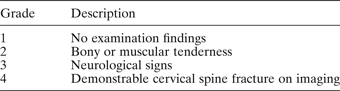
The assessing doctor also had the opportunity to review the patients' accident and emergency records, as well as any other consultation notes previously made by other practitioners. The presence of any specific neuro-otological symptoms was recorded, as was any history of head trauma or concussion. In each case, the likely severity of the injury was established, such that the patients could be retrospectively classified according to the system outlined by the Quebec task force (Table I).
Quebec task force classification of whiplash injury syndrome2
Results
In this study, the time elapsed between patients' trauma and clinical evaluations varied. However, the mean time between injury and assessment did not exceed six months (Table II); this patient group cannot, therefore, be categorised as suffering from chronic whiplash syndrome. All but three patients (106 in total) reported significant anxiety for a period following the accident, and this was exacerbated by attempts to drive (i.e. situation-specific anxiety). Three patients had symptoms consistent with post-traumatic stress disorder at the time of assessment.
Patients' whiplash injury grade and demographic data*

* For 109 patients assessed by a single general practitioner 2002–2006. Pts = patients; yrs = years
Twenty-two patients (20 per cent) reported a history of minor head trauma resulting from their head hitting either the car dashboard, steering wheel or headrest. Of these 22 patients, only three were diagnosed with concussion, and, while they introduce an element of heterogenicity, it did not seem that these patients should be excluded from any subsequent analysis as their symptoms were minor and very transient.
Four patients (3.7 per cent) complained of non-specific ‘dizziness’ immediately following the injury. None of these patients had sustained a concomitant head injury. In all these cases, the symptoms were self-limiting and short-lived – lasting for a few minutes only – and were associated with complaints such as nausea, shaking and agitation. In one case, the patient reported dizziness lasting 30 minutes which was associated with tingling of the hands, possibly suggestive of hyperventilation syndrome. However, there were no reports of late symptoms of dizziness, imbalance or vertigo elicited at the time of the subsequent clinical assessment, and no patient complained of hearing loss or tinnitus in association with their injury.
Discussion
Minor whiplash injury is common. Acute symptoms associated with neck pain and stiffness are consistently reported and are commensurate with a sprain to the cervical spine and the associated muscles. In the majority of such cases, the symptoms are self-limiting and remit within a matter of weeks. If symptoms persist for more than six months after the trauma then they are considered to be chronic; in such cases, the rationale for the ongoing symptoms becomes considerably more difficult to explain.Reference Pearce12 This difficulty is compounded by that fact that in Greece and Lithuania, countries without an active compensation culture, late symptoms after such injuries are not reported.Reference Schrader, Obelieniene, Bovim, Surkiene, Mickeviciene and Sand13–Reference Ferrari, Kwan, Russell, Schrader and Pearce15 In patients with chronic symptoms, there also seems to be a poor correlation between the prolongation of symptoms and the severity of the injury,Reference Fischer, Huygen, Folgering, Verhagen and Theunissen16 although recent magnetic resonance imaging studies in patients with low grade whiplash injury have shown subtle trauma to the alar ligaments, transverse ligaments and discs,Reference Krakenes and Kaale17 and such changes might explain the ongoing symptoms in a small percentage of cases.
It is also difficult to explain the majority of neuro-otological symptoms that might result from such injuries. In experimental situations, injection of local anaesthetic into the cervical region may result in transient difficulties in postural control.Reference Rudge18 It has also been shown that trauma to muscle spindle receptors in the neck can lead to persistent over-activity, which might result in a sensory mismatch between proprioceptive and visual input and a feeling of unsteadiness.Reference Tjell, Halling and Tenenbaum19 However, objective testing with the smooth pursuit neck torsion test has failed to demonstrate a significant difference between symptomatic and asymptomatic whiplash patients.Reference Tjell and Rosenhall20 Even if dizziness can be so explained in a small percentage of cases (and it might explain the giddiness reported in our patients), it is difficult to comprehend how ongoing vertigo or substantive long-term sensorineural hearing loss could result from such an extra-cranial injury. There is no doubt that benign paroxysmal positional vertigo (BPPV) may follow head injury,Reference Davies and Luxon21 but that is a separate issue and would be evident both from the history and from Dix–Hallpike testing. Concomitant minor head trauma is not uncommon (affecting 20 per cent in our study, with three diagnosed with concussion), and, although none of our patients gave any positive history suggestive of BPPV, such pathology could certainly explain the vertigo reported in some instances. What is more difficult to understand are reports detailing vestibular pathology after whiplash. The lifetime prevalence of vertigo in the general population is as high as 4.9 per cent, according to a recent epidemiological study,Reference Neuhauser22 and this, of course, might be one factor leading to a false perception of causation in whiplash-related trauma. Certainly, when vestibular injury is investigated objectively after whiplash, the evidence is contradictory. For example, the reported prevalence of canal paresis varies between 4 and 40 per cent in such cases,Reference Fischer, Verhagen and Huygen4–Reference Chester9 but these studies also lack normal control groups, which casts doubt on the validity of the conclusions proffered. In addition, such patients are those presenting to specialist or tertiary referral centres and are therefore highly selected groups.
If evidence of cause and effect in producing vestibular pathology is lacking, then this is even more obviously difficult when sensorineural hearing loss is considered. A Swedish study assessed the pure tone audiograms of 153 patients with whiplash injury and demonstrated that 21 patients (14 per cent) had hearing thresholds in the better ear which were greater then the 90th percentile of the ISO standard.Reference Tjell, Tenenbaum and Rosenhall23 However, in 16 cases noise-induced hearing loss or hereditary impairment was diagnosed, leaving just five patients (3 per cent) as having no obvious cause for their hearing loss. It is obvious that this evidence does not support the hypothesis that these patients' whiplash injuries necessarily produced their hearing impairment.
In a recent Canadian study of 85 patients, 15 complained of auditory symptoms, including tinnitus, after their whiplash injury.Reference Ferrari24 However, eight had complete occlusion of one or both ear canals with wax.
Since the cochlea is surrounded by the dense bone of the otic capsule, it is difficult to see how it could be directly damaged by an injury at some distance from the relevant end organ. Moreover, the fact that those involved in contact sports do not report hearing loss after minor blunt trauma or neck sprain also mitigates against sensorineural hearing loss as a direct consequence of such injuries. It may be that some patients complaining of neuro-otological symptoms have a significant history that shows a clear-cut time line between injury and positive audiological findings, but the mechanism is certainly very obscure. Many of the reported studies assessing neuro-otological symptoms have been conducted within tertiary referral settings, where patients are likely to be symptomatic with hearing loss, tinnitus or imbalance as their primary complaint,Reference Claussen and Claussen5, Reference Toglia6 and such symptoms may thus have been falsely misinterpreted and weighted. What seems even more likely in many instances is that the unwary clinician may record a previous history of whiplash and, if he or she is not careful, erroneously document the injury as causative of a presenting symptom.
• A variety of otological and vestibular symptoms have been reported following whiplash injury, mainly in studies based on series from tertiary referral centres
• There have been no previous community-based studies examining the prevalence of otological and vestibular symptoms following low grade whiplash injury
• This study of 109 patients referred to a single general practitioner for medicolegal assessment of whiplash injury found a low or non-existent prevalence of such symptoms
• Other causes should be excluded before implicating whiplash injury as a potential cause of such symptoms
Whether this is so or not, it is clear from our study that patients with low grade whiplash injury do not tend to exhibit significant neuro-otological symptoms. Our study cohort was homogeneous, with equal numbers of males and females (54:55, respectively, a ratio of 1:0.98), matching the sex ratio of the large prevalence study performed in Gronigen.Reference Versteegen, Kingma, Meijer and ten Duis3 Our patients all gave a history of a low impact, flexion-extension neck injury following a road traffic accident, with no history of loss of consciousness, and their injuries could all, therefore, be classified according to the Quebec system as grades one or two. The majority of patients (76 out of 109) were evaluated within six months of the original injury; therefore, these patients could still be classified as being in the acute or early phase. The average time between the injury and the clinical review was 149 days. In our study, one doctor assessed all 109 cases; a long, detailed and structured interview was conducted, together with a full neurological examination. A full review of original accident and emergency department and general practitioners' case records, where available, was also made. Ample opportunity was given for patients to report and enlarge upon any other symptoms if they felt this to be appropriate.
Although there is a poor correlation between severity of injury and prolongation of symptoms, a homogeneous study group such as ours is clearly less prone to bias. No patient was considered to require formal pure tone audiometry or vestibular testing as the result of the history obtained. We accept that our study group could be argued to be selective and skewed, as these are a group of patients with a maximum limit to their compensation claim of £15 000. Therefore, patients with significant balance symptoms or tinnitus may well have been screened out and referred elsewhere. However, we feel that our study demonstrates that the prevalence of significant, acute neuro-otological symptoms following low grade, uncomplicated whiplash injury must be extremely low or non-existent, and that other potential reasons to explain such symptoms should be sought before attributing them to a recent or historical whiplash injury.
Conclusion
In our study, based in a rural primary care setting, neuro-otological symptoms following uncomplicated, low grade whiplash injury were found to be uncommon. Before whiplash injury is nominated as a potential aetiological factor in the development of neuro-otological symptoms, other causes should be excluded. A thorough history establishing precisely the circumstances regarding the development of new symptoms of vertigo, tinnitus or hearing loss should be obtained before attributing such symptoms to whiplash injury, particularly if a significant period has elapsed since the initial trauma was sustained.




