INTRODUCTION
Since pre-colonial times, West African traders have developed unique ways of doing business that have attracted increasing attention from various disciplines. Historians, in particular, have documented the historic roots of trade networks, focusing either on the historical development of a specific type of product or on traders' historical adaptation strategies (Baier Reference Baier1980; Lovejoy Reference Lovejoy1980; Brooks Reference Brooks1993; Howard Reference Howard, Howard and Shain2005, Reference Howard, Engel and Nugent2010). The geographic expansion of such networks across West Africa and the world has also received a great deal of attention from geographers, who have studied in detail the spatial strategies of ethnic groups involved in trade (Egg & Igué Reference Egg and Igué1993; Grégoire & Labazée Reference Grégoire and Labazée1993; Lambert & Egg Reference Lambert and Egg1994; Soulé Reference Soulé2000; Grégoire Reference Grégoire2003; Walther Reference Walther2009). Similarly, political economists have expressed an increasing interest in the social embeddedness of trade networks in West Africa, as well as a growing concern about their regulatory performance under the current conditions of liberalisation and globalisation (Meagher Reference Meagher2005, Reference Meagher2010). While those networks increasingly supply West African urban centres, they are often accused of undermining the authority of the state, as they rely mostly on informal or illegal practices and thus create new vulnerabilities.
To date, the historical and socio-cultural perspectives dealing with trade in West Africa have regarded networks in metaphorical terms or as a heuristic device for dealing with informal relations or spatial arrangements. Despite a favourable research environment in the 1970s, hardly any studies explicitly used formal social network analysis (SNA) to analyse regional trade in Africa over the following decades. The aim of this paper is to fill this gap by considering networks as an analytical concept and applying theoretical models provided by relational theories of social interaction.
Our first purpose is to give an overview of social network analysis and to discuss its methodological and thematic advantages, including how it can be successfully applied to the study of West African trade. This paper argues that SNA is a credible alternative to the two main methodological approaches developed so far to analyse regional trade: the flow approach which estimates the intensity of agricultural and manufactured goods exchanged between markets or countries, and the price approach which uses market prices as a proxy to estimate regional integration. Analysing trade without necessarily considering the intensity of flows or the level of prices, but focusing on social actors, can be of great value in a context of informal and unrecorded trade circuits, hidden actors and clientelist ties.
The second purpose of the paper is to show how SNA is complementary to the historical and socio-cultural approaches developed in African Studies. Echoing Mitchell's (Reference Mitchell1969: 8) long-forgotten claim that social network analysis was ‘complementary to and not a substitute for conventional sociological or anthropological frameworks of analysis’, we show how a combination of qualitative and quantitative approaches can guide future empirical investigations for certain kinds of social and spatial issues, particularly those pertaining to the relationship between brokerage and embeddedness or cross-border trade. This paper explores these two issues using the case studies of two trade networks that developed across the Niger, Nigeria and Benin borders. We start by discussing how recent developments in regional trade in West Africa, brought on by urbanisation, liberalisations and globalisation, have challenged the social structure of traders. We then discuss the changes brought to the spatiality of regional trade by looking at the influence of spatial location and geographic scale on traders' abilities to trade. In both cases, we argue that SNA's value for understanding how traders have progressively adapted to social and spatial changes in economic activities, by considerably increasing market relations and border-related activities, has been greatly underestimated.
The next section of this article first reminds the reader how networks have been progressively conceptualised in the recent history of African Studies. In a third section we combine the profile, the location and the scale of economic actors to illustrate how SNA can benefit contemporary historical and socio-cultural approaches. We conclude with a summary of our key findings and elaborate on further perspectives.
THE MISSING CONNECTION BETWEEN NETWORK ANALYSIS AND AFRICAN STUDIES
Network analysis has rarely been applied to sub-Saharan African societies, and even more rarely to regional trade, for at least two main reasons. First, community studies centred on social and family issues initiated in the 1970s by British sociologists and anthropologists in Africa were not recognised as a mainstream area of interest among network scientists. Second, approaches applied concurrently by economists, historians and geographers tended to overshadow formal network analysis to the profit of econometrics or qualitative studies.
Social network analysis in Africa
At the beginning of the 1970s, the application of SNA to trade networks looked promising in Africa. Taken collectively, three books that were published simultaneously could have formed the basis for a formal investigation of trade networks.
In Customs and Politics in Urban Africa, Cohen (Reference Cohen1969) documented the historical development and political implications of a trade diaspora among the Hausa of Ibadan in Nigeria. He showed how diasporas, defined as nations of ‘socially interdependent, but spatially dispersed, communities’ (Cohen Reference Cohen and Meillassoux1971: 267), decreased transaction costs among the members of their community. The importance of trade diasporas to pre-colonial and colonial long-distance trade was also thoroughly explored in Meillassoux's (Reference Meillassoux1971) edited volume on The Development of Indigenous Trade and Markets in West Africa. This work provided an impressive collection of case studies dedicated to the transformations of West African trade as a result of changes brought by the slave trade and colonisation, and proved inspiring for the analysis of both the social structure of long-distance trade and the spatial arrangements of flexible networks. Simultaneously, in Social Networks in Urban Situations, Mitchell (Reference Mitchell1969) and his colleagues from Manchester introduced an analytical approach to networks in urban sociology and social anthropology. At that time, social scientists working in Africa on networks were particularly interested in rural–urban migration, kinship, dispute settlement, economic cooperation and patron–client networks. However, this community-based approach was progressively marginalised among social network scientists, who moved from Britain to the US and towards a mathematical analysis of human systems (Scott Reference Scott2006: 32).
Consequently, SNA has rarely been applied in sub-Saharan Africa. Existing studies mainly focus on the impact of social networks on kinship (Bollig Reference Bollig, Schweizer and White1998), health conditions (Adams et al. Reference Adams, Madhavan and Simon2006; Ayuku et al. Reference Ayuku, Odero, Kaplan, de Bruyn and de Vries2006) or on the role of social networks in coping with vulnerability (Schnegg Reference Schnegg2006). A number of scholars focus on hunter-gatherers based on the evolutionary idea that such societies ‘resemble that of our early ancestors’ and enable the discovery of the ‘possibly adaptive origins of human social networks’ (Apicella et al. Reference Apicella, Marlowe, Fowler and Christakis2012: 497; see also Hill et al. Reference Hill, Walker and Bozicević2011). SNA has also been used to investigate the relations between social networks and the diffusion or adoption of innovative agricultural techniques (Matous Reference Matous2010). However, regional trade remains a terra incognita of SNA in Africa, despite its key importance for the development of both rural and urban African societies.
Networks as chains
The second explanation for the lack of social network approaches in scholarship on African trade is linked to the fact that other approaches have proved more popular among economists, historians and geographers. In the 1970s, Boutilier (Reference Boutilier and Meillassoux1971) introduced the distinction between two spatial structures which he called the ‘relay’ and the ‘network’. ‘Relays’ were conceived of as chains of actors, each of them supplying goods to the limits of another ethnic group, whereas ‘networks’ were supposed to transport goods over long distances through traders who crossed ethnic boundaries. Since then, literature has shown that the ‘relay’ organisation could no longer be applied to the post-colonial spatial organisation of trade. Nevertheless, the idea that social actors are organised in some kind of a chain has survived and has influenced the way West African trade networks have been conceptualised by economists, historians and geographers.
Documenting the spatial and social organisation of the production and circulation of one particular product, economists usually divided the productive systems vertically into homogeneous sub-sectors, known as filières in the francophone literature (see Duteurtre et al. Reference Duteurtre, Faye and Dièye2010). In West Africa, the contribution of this approach was to highlight that economic filières were often based on closely embedded ties, be they family, ethnic or religious. Well-known examples include the supply of cement to Niamey and of onions to Abidjan, which is predominantly organised by the Aderawa merchants of Niger; the hardware or spare parts business by Igbo from Nigeria; or the cattle business dominated by Fulani herders or Hausa traders.
Despite its usefulness for understanding the organisation of economic activities, the filière approach only captures a fraction of the business landscape of a region. Most notably, its emphasis on one product may neglect the fact that traders usually deal with several products at the same time in order to protect their businesses from uncertainty, which can include the closing of a border, rapid changes in import legislations, droughts or change in consumers' taste. The filière approach also fails to take into account the complementarities between traders working on the same markets but with different products, and the business communities that arise from the concentration of people and goods in certain market places.
The idea that networks are predominantly composed of chain elements organised in a hierarchical way has also permeated geographic studies. For instance, Grégoire's (Reference Grégoire1992) classical study of Hausa traders shows that trade networks are controlled by a limited number of ‘chiefs’. These wholesalers exercise their influence over numerous representatives in charge of collecting agricultural products in rural areas, who have power over a score of local dependents in charge of buying goods from the producers in the countryside. According to this hierarchical conception, each of the actors has a precise task to perform and is linked to a patron by clientelist ties. Following the chain of actors, one can easily go from the farmer working in his field in a remote production area to the largest merchant involved in large-scale trading from a major West African city, which is a straightforward way of representing the social and spatial structure of economic activities.
However, it can also be argued that such a conception does not take fully into account the diversity of horizontal ties that very often bind actors from the same hierarchical level and the diversity of profiles that such actors can have. Focusing exclusively on the hierarchy of trade organisations does not permit us to study how social structures facilitate or constrain the business activities since the relevant actors and ties are not all taken into consideration. The chain/hierarchy approach does not adequately capture the nature of social networks, just like formal hierarchical trees do not take into account informal relations that are primarily based on ties between peers. Horizontal connections between individuals of the same rank or status are important to the function of organisations. In real-world networks, traders can interact between hierarchical levels in order to access information or resources.
A COMPREHENSIVE APPROACH OF WEST AFRICAN TRADE NETWORKS
In this section we discuss what can be gained from bringing together the historical and socio-cultural approaches with SNA and where problems of intersection might lie. We argue that SNA can contribute to better study three key variables that influence the success of trade: (1) the social structure of trade networks, which highlights if traders are predominantly brokers through which information and resources are exchanged or central actors connected to a large number of people; (2) the geographic location of traders, which can be crucial considering the cost of doing business in an environment where transport and communication infrastructures are poor; and (3) the scale of their business activities, which is very likely to influence profitability.
The social structure of trade networks
Embeddedness and brokerage
Economic studies have long shown that, despite the informal nature of their activities and a highly uncertain business environment, West African traders face three fundamental problems: making information exchange secure when business partners are separated by long physical and cultural distance; making secure exchanges without delay throughout the continent; and establishing trust and credit relationships (Fafchamps Reference Fafchamps2004; Lydon Reference Lydon2009). As previously discussed, Cohen (Reference Cohen1969) demonstrated that such obstacles were overcome by the creation of strongly embedded business networks founded on kinship, ethnic and religious ties. Since then, as Meagher (Reference Meagher2005) has noted, the new economic sociology literature has emphasised the importance of such embedded ties in reducing risk, pooling complementary skills, improving access to new markets, and safeguarding property rights when formal contracts are not possible. In a business environment with little reliance on formal institutions, these elements contribute to the embeddedness of West African traders in a dense network of customers and partners. Prominent examples of strongly embedded economic ties include the Mourides (Stoller Reference Stoller2002), the Soninke (Whitehouse Reference Whitehouse2012), the Hausa (Grégoire Reference Grégoire1992) or the Fulani (Jalloh Reference Jalloh1999).
However, recent studies have shown that a strong degree of embeddedness can also have disadvantages: established networks may exclude many entrepreneurs and suppliers when limited to a minority and favour the well-connected rather than the well-qualified (Quarles van Ufford & Zaal Reference Quarles van Ufford and Zaal2004). These studies have also highlighted that the ethnic and religious diversity of traders have increased, making ‘commercial identity no more exclusive’ (Warms Reference Warms1994: 101). Thanks to the internationalisation of trade, African traders have developed a more universal entrepreneurial culture (McDade & Spring Reference McDade and Spring2005; Beuving Reference Beuving2006) than what used to be the case before the accelerated liberalisation and globalisation of the 1980s. The development of new ties that stretch beyond the bounds of the local business community has certainly not led to the complete disappearance of embedded ties in the context of a more market-oriented economy. Patron–client relationships have proved resilient in Africa (Ensminger Reference Ensminger1996). However, while exchanges were previously based mainly on strong ties, firmly embedded in kinship or ethnic groups, the opening of trade to world markets has encouraged the development of brokerage relations that are predominantly made of weak ties based on symmetrical and reciprocal bonds between peers. These weak ties are made necessary by the need to do business with distant partners who may not share the same origin, religion, culture or language.
As a result, West African traders are increasingly forced to combine strong embeddedness within the social group with brokerage ties beyond the group if they want to enter new global markets. As Meagher (Reference Meagher2010: 17) puts it, these traders need to find a ‘balance between norms of group solidarity and more instrumental linkages across social cleavages’. Extending Burt's (Reference Burt2005) work on the relationships between embeddedness and brokerage, we argue that such a cohesive group with diverse external contacts provides a mix that is suited to the informal nature of regional trade in West Africa in the absence of alternative or appropriate formal structures. This idea is close to what Uzzi (Reference Uzzi1996: 684) formulated, albeit in a very different context, when he noted that ‘a theoretic optimum between the countervailing effects of under- and over-embeddedness exists when a network is composed of a mixture of arm's-length and embedded ties’. This is highlighted by the fact that the relationship between embeddedness and economic performance is non-linear but follows an inverted U-shape curve. Similar ideas were developed by Everton (Reference Everton2012) about terrorist networks, which also aim at finding a balance between being too strongly rooted locally and being too global, and by Fleming et al. (Reference Fleming, King and Juda2007: 939) in their study of small worlds created between patent co-authorship in the US. For them, ‘small-world networks simultaneously exhibit high clustering and low path length’, which means that such networks are created both by a strong embeddedness in local clusters and by distant ties which provide innovative ideas. Small worlds have strong cohesion and brokerage, which make them well adapted to change and uncertainty.
Brokers
The trade-off between brokerage and embeddedness can be analysed using SNA, by looking at the structural roles occupied by the actors engaged in a network. Various measures allow researchers to calculate to what extent social actors are either playing a brokerage role with other actors or are strongly embedded in their group. One should note that the way ‘brokers’ and ‘central actors’ are defined in the formal network literature contrasts with how these roles have been documented in the African studies literature. One example of these definitions in the African studies literature is Hill's (Reference Hill1966) analysis of middlemen who work between buyers and sellers on the Kumasi cattle market (see also Lovejoy Reference Lovejoy1980; Little Reference Little1992; Brooks Reference Brooks1993). As Hill (Reference Hill1966: 350) puts it, brokers are ‘formally recognised’ actors well known by everyone willing to engage in business on African markets. As such, they constitute a particular category of actors without which trade could not be performed. By contrast, SNA argues that brokers are primarily defined by their structural position with regards to the other actors: as brokers, they take advantage of sparsely dense parts of the networks, from which they can bridge ties to other actors across structural holes (Burt Reference Burt1992). Brokers occupy a structural position – and not a recognised professional occupation – that can vary according to the kind of information or resources conveyed by the network and that can only be identified once the entire network is mapped.
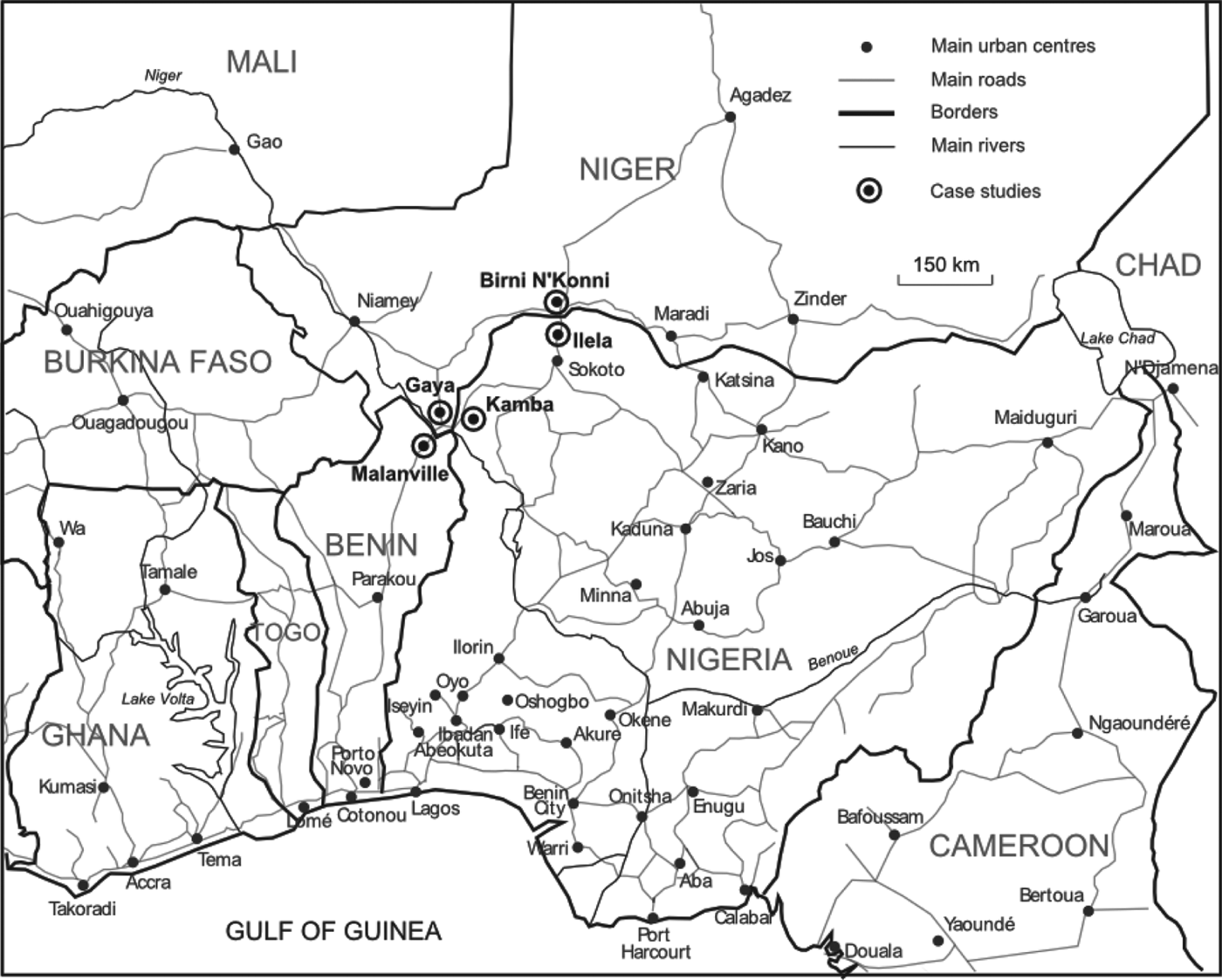
In order to map such a network and illustrate how brokerage can differ among the actors, we use data collected between January and April 2012 on five border markets located between Niger, Nigeria and Benin. The surveyed markets form two highly integrated border regions, Gaya-Malanville-Kamba (GMK) and Birni N'Konni-Illela (BI), that provide short-distance opportunities to traders who exploit border differentials and offer a favourable location for larger merchants willing to develop transnational routes (Retaillé and Walther Reference Retaillé and Walther2011; Figure 1). Gaya, Malanville and Kamba are the main markets of the region known as the Dendi, whose recent economic development is mainly related to the liberalisation of trade that occurred in the 1980s (Walther Reference Walther2012a, Reference Walther2012b). The opening of the West African market had tremendous consequences for the small Nigerien town of Gaya (44,000 inhabitants in 2010), which became a regional hub for large wholesalers dealing with Nigeria, where the imports of used clothes – among other goods – is prohibited. Across the Niger River, the Beninese city of Malanville (60,000) progressively developed into a regional centre for agricultural products such as onion and cereals. Both Gaya and Malanville are located on the Cotonou transport corridor, one of the busiest road axes linking the Gulf of Guinea to the Sahel (Walther Reference Walther2009). Traders from both border localities have close business ties with businessmen from the neighbouring Nigerian city of Kamba (27,000), whose economic activity has however recently declined due to poor road conditions, rising oil prices and insecurity (Walther Reference Walther2008).
Case studies. Source: adapted from OECD (2009) by the author.

Three hundred kilometres further north-east are the two border markets of Birni N'Konni in Niger (63,000) and Illela (32,000) in Nigeria. Birni N'Konni and Illela are important border posts on the road between Sokoto and the northerner Hausaland in Niger as well as on the east-west N1 highway which cross the Republic of Niger. The two cities have a relatively long history of trade, which builds on the pre-colonial trade networks developed by the Hausa (Adamu Reference Adamu1978; Lovejoy Reference Lovejoy1980). Today, the market activity between the two cities – only separated by 8 km – relies heavily on informal exchanges of manufactured products and oil from Nigeria, cattle and onion from Niger, and second-hand cars re-exported from Benin through Niger.
Analysing business ties in West Africa requires time and trust, as many traders are reluctant to talk about their business activities or name their business partners. In order to acquire reliable information on the structure of trade networks in both regions, we started by interviewing a number of freight agents working at the border posts. These agents are in charge of handling the goods of the traders across the borders and have developed a thorough understanding of the respective importance of the activities of their customers. This allowed us to identify the traders whose annual turnover was over 100 FCFA million (€152,000), considered as ‘large traders’. Using snow-balling techniques, a sampling technique that enables the identification of new economic agents from among the subjects' existing acquaintances, we conducted three waves of interviews during which those large traders were asked to nominate whoever they consider as business partners in the region, whatever their age, gender, ethnic group, nationality or religious membership. This gave us a precise idea of who was dealing with whom across national borders in the two regions. Only trader-to-trader ties were analysed in this paper. Despite their crucial importance for facilitating the transit of goods across national borders, the relationships between traders and state representatives were not represented.
The GMK network located between Niger, Benin and Nigeria is composed of 85 actors – or nodes – and 104 business relations – or ties, and the BI network located across the Niger–Nigeria border of 53 nodes and 64 ties. With a response rate of 88·9% in the GMK network and 87·9% in the BI network, this represents an almost complete population rather than a sample.
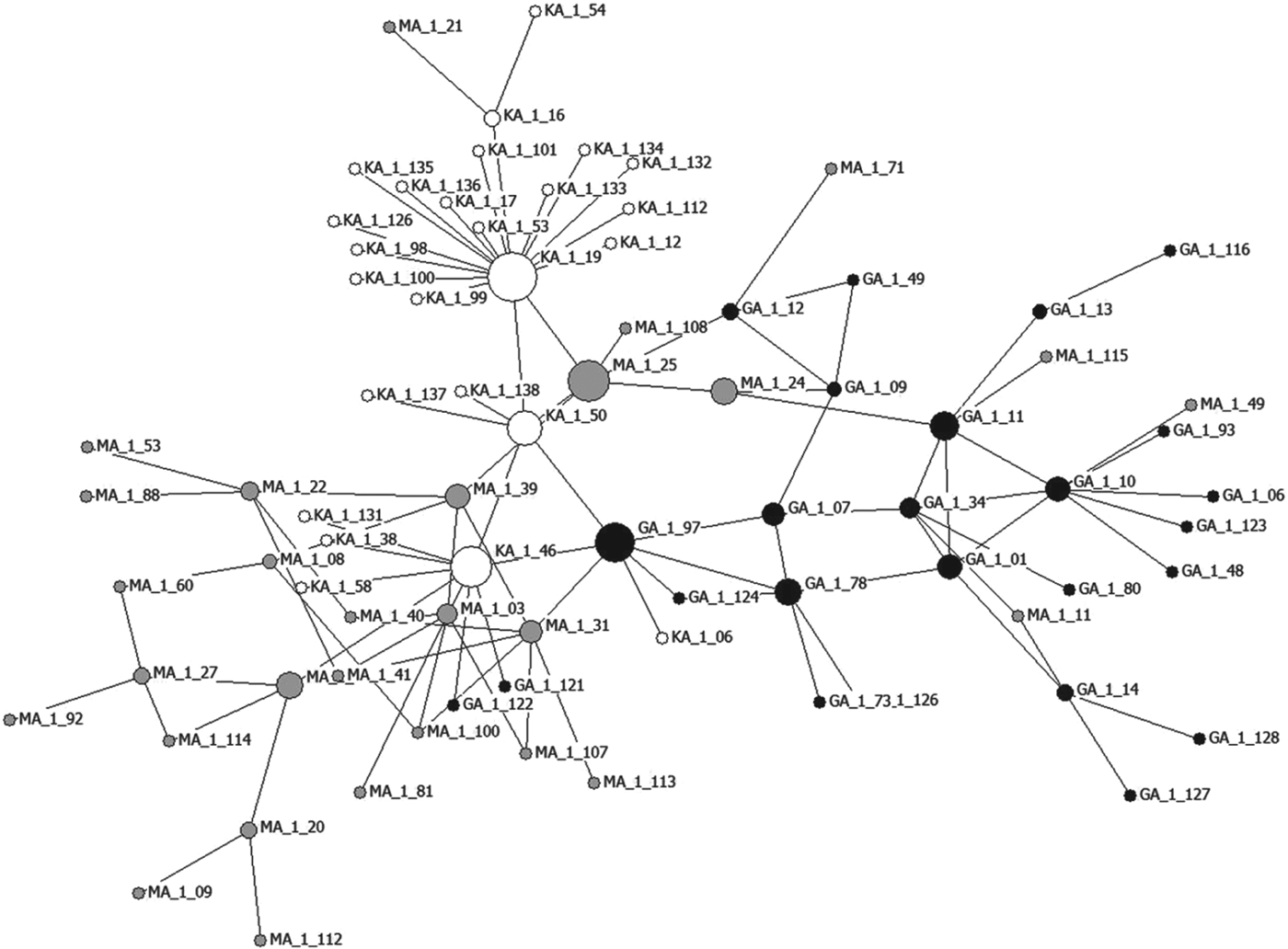
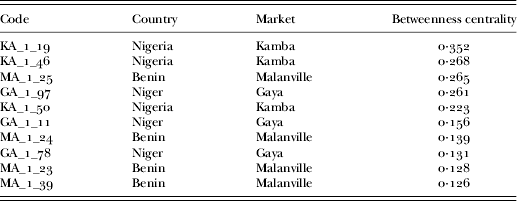
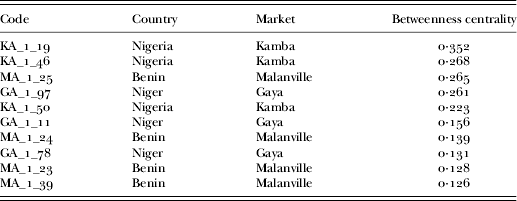
The sociogram presented in Figure 2 is a representation of the social distances that separate traders in the Gaya-Malanville-Kamba region: the closer two nodes are on the sociogram, the closer they are in terms of business relations. The colour reflects the country of residence of traders: black for Niger, white for Nigeria and grey for Benin. One can immediately see that traders working in this border region tend to form several clusters segmented by country membership. Despite the fact that local traders are located in the immediate vicinity of a national boundary, 86·6% of the ties are exchanged with business partners from the same country, which is the sign of a highly homophilous network. Such a network provides huge potential opportunities for brokers who can develop cross-border ties and without whom the network would break into several isolated components, each of them organised around a national basis. The sociogram also indicates how important traders are in terms of brokerage: the larger the nodes, the more prominent these actors are in playing a role of gatekeepers. Brokerage can be measured in several different ways. In Figure 2 and Table I, we use betweenness centrality, a commonly used measure which indicates how actors are potentially influential because other actors need to pass through them to have access to other actors. It is formally defined as the percentage of ties that pass through this node across all node pairs that have a shortest path containing the node.
Gaya-Malanville-Kamba trade network: betweenness centrality. Source: author. Produced with UCINET (Borgatti et al. Reference Borgatti, Everett and Freeman2002). Sub-networks are not shown.
Gaya-Malanville-Kamba network: Top scoring nodes for betweenness centrality
Calculations by the author using *ORA (Carley Reference Carley2012). Note: mean 0·036, Std. Dev. 0·073.
With a betweenness centrality score of 0·352, the actor KA_1_19 is the most prominent broker of the network: 35·2% of the shortest paths from all nodes to all others pass through this 35-year-old Nigerien textile and auto parts dealer based in Kamba who brokers business ties between his home country and Malanville in Benin. The actor GA_1_97, a 33-year-old Nigerien cereal wholesaler from Gaya, also shows a high betweenness centrality score, which can be explained by his ability to maintain connections to both Nigerian and Beninese traders. Another prominent broker from Niger is GA_1_78, a 46-year-old trader whose betweenness centrality mainly comes from his ability to bridge business partners from his own country.
The position of brokers provides several advantages compared with a more central position. In network terms, these advantages are explained by the fact that a broker connects two actors that would otherwise be isolated, which, in return, gives him access to non-redundant information. In such a triad, a broker can play individuals off each other, a situation termed tertius gaudens (‘the rejoicing third’) by Simmel (Reference Simmel1908), and profit from the conflicts or competition that may develop between his alters. The broker can also play the role of connecting two actors for their own benefit, a situation called tertius iungens (‘the third who join’) by Obstfeld (Reference Obstfeld2005). In the particular case of a cross-border network, brokers draw resources from the fact that transaction costs are particularly high in a cross-border environment due to various national legislations. Moreover, brokers need to monitor prices on different markets over long distances, find new trading partners, and maintain contacts with state representatives who are very likely to shift from one position to another, a volatility that hinders sustained investment in social ties (Ensminger Reference Ensminger1996). Business partners have known each other for a long time and are used to performing regular transactions. They are highly embedded in a social and cultural context that provides trust and reputation to those who follow the rules and can punish or exclude those who are untrustworthy or unreliable. But, at the same time, strongly embedded networks also limit the potential for gains because every business partner provides more or less the same products or services. Much larger gains can be expected from less embedded actors, who may be more complementary to each other, have different ideas, and better exploit cultural or monetary differentials.
Central actors
In network terms, central actors are important because the number of ties that originate or that lead to them is high. This structural position is well known for bringing power and influence, since central actors can potentially constrain a larger number of other actors than peripheral actors. Again, such definition is directly related to the centrality measures performed on a network and does not necessarily correspond to a socially recognised status, such as the one of ‘landlords’ for example, whose social importance in helping to bind freshly arrived strangers with their host society has been extensively documented (see notably Lovejoy Reference Lovejoy1980; Pellow Reference Pellow2002). It is very likely that most of the landlords identified in the African Studies literature would have a high centrality if a formal analysis was conducted on their social network, but their structural role would also be constrained by the relative centrality of other actors of potentially higher importance, such as local chiefs.
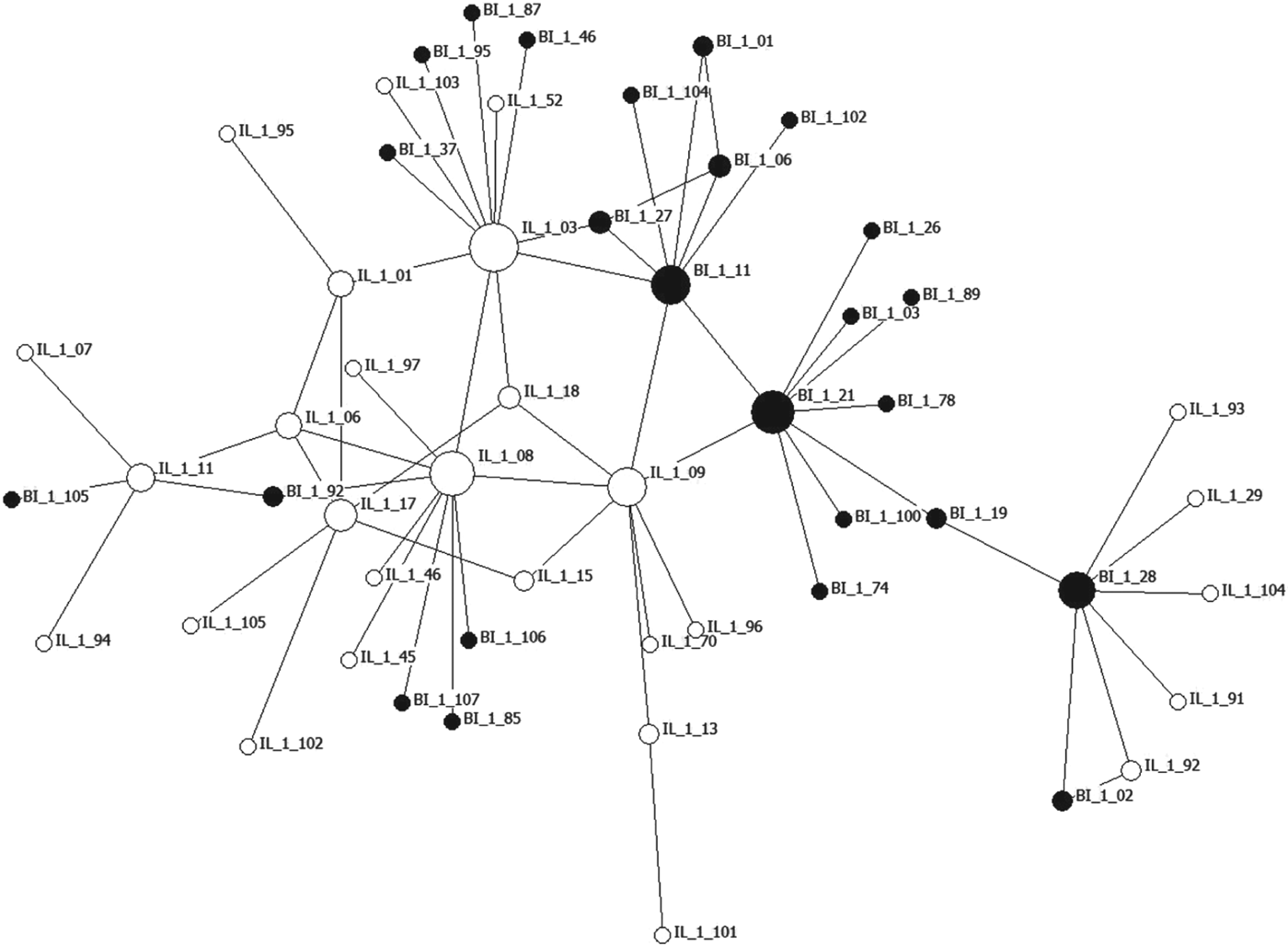
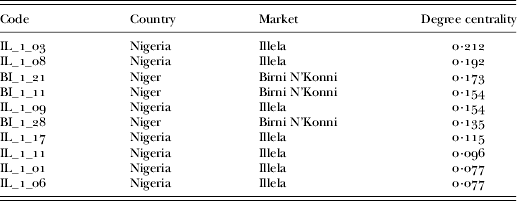
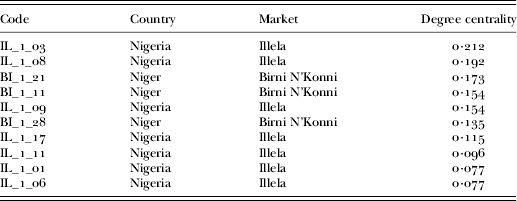
In order to illustrate how centrality can vary depending on the constraints imposed by the relative position of each actor in a network, we use the case study of the Birni N'Konni-Illela markets on the Niger–Nigeria border. As for the Gaya-Malanville-Kamba network presented earlier, Figure 3 shows how close traders from Birni N'Konni and Illela are in terms of business ties. Each of the actors is represented according to his country of residence, with Nigerien actors in black and Nigerian actors in white. A very large number of measures have been developed over the last decades to characterise central actors. Here, we use the total degree centrality, which takes into account the number of actors with whom each actor is related, and is calculated as the normalised sum of its row and column degree (see Newman Reference Newman2010: 168–234 for an extensive survey). Degree centrality scores presented in Table II are calculated by considering the total number of connections of this actor, known as their degree, divided by the maximum possible degree, which in this case is equal to the total number of actors minus themselves. In the case of the most central actor IL_1_03, for example, the centrality score of 0·212 is calculated as 11 divided by (53–1).
Birni N'Konni-Illela trade network: degree centrality. Source: author. Produced with UCINET (Borgatti et al. Reference Borgatti, Everett and Freeman2002).
Birni N'Konni-Illela network: Top scoring nodes for total degree centrality
Calculations by the author using *ORA (Carley Reference Carley2012). Note: mean 0·031, Std. Dev. 0·031.
As can be seen from Figure 3 and Table II, which gives the centrality scores for top-scoring nodes, Nigerian traders seem to be generally more central than their business partners in Niger. However, the network appears to be relatively non-hierarchical, as evidenced by the fact that very few actors stand out in terms of centrality. On the Nigerian side, the most central actors are two large Hausa wholesalers: IL_1_03, a 65-year-old cereal trader, and IL_1_08, a 57-year-old trader involved in cereal, cement, transport and oil activities. On the Niger side, the highest centrality scores are attributed to two cereal traders: BI_1_21, a 41-year-old trader originally from Maradi and BI_1_11, a 21-year-old trader originally from Dosso in Niger.
The visual impression of a non-hierarchical network given by Figure 3 is reinforced by the fact that degree centralisation, which measures the difference between the most central actors and all the others and ranges between 0 (no centralisation) and 1 (perfect centralisation), is equal to 0·17, a clear indication of a decentralised structure.
The spatiality of trade networks
Another contribution of SNA is its ability to bridge social and spatial studies, i.e. combine the position of each actor in a social structure with its position in a spatial system. As this section argues, the spatiality of trade networks can primarily be understood through the spatial distinctions between central places and border markets and between long- and short-distance trade. The first distinction builds on the relative location of each actor in the geographic space whereas the second one considers its spatial range of activity. Both variables are crucial to understand the controversial impact of the structural adjustment policies and monetary changes adopted by most of the West African countries since the early 1990s on the development and organisation of trade in the region.
Recent changes
Liberalisation and subsidy removals encouraged West African traders to import massive amounts of goods from the global markets. The lifting of restrictions on the foreign currency combined with a removal of customs duties also helped the exchange of commodities. This increase in domestic imports relative to gross domestic product caused a cross-border boom during the first decade of structural adjustment, particularly in the Gambia region and between Benin and Niger (Terpend Reference Terpend2006). In 1994, the devaluation of the CFA franc used within the West African Economic and Monetary Union (WAMU) encouraged the regional production of agricultural products and livestock, which suddenly became competitive in comparison with imported products. Until the economic growth brought by the devaluation dissipated in the early 2000s, intra-regional trade grew fairly rapidly (van den Boogaerde & Tsangarides Reference van den and Tsangarides2005). Despite the fact that very few of them were included in the discussions on structural adjustment policies, traders developed networks that proved particularly adept at coping with such changes. Large trade networks dominated by wholesalers from Sahelian countries, for example, played an important role in supporting the increasing urban demand for manufactured and agricultural goods. In addition to supplying cities, private trade networks also proved flexible enough to reduce food shortages in regions affected by drought, and have almost completely replaced government agencies regulating food supplies, which were restructured or dismantled since the 1990s.
Trade networks have also demonstrated their abilities to cope with recent shifts in African political economy, such as insecurity and instability in certain areas. Since the beginning of the Ivoirian crisis in the early 2000s for example, traders from landlocked countries such as Burkina Faso or Mali have adapted their activity by relying increasingly on the ports of Tema in Ghana and Lomé in Togo to import from the world markets and to export cotton, instead of using the port of Abidjan in Côte d'Ivoire (OECD 2009). A similar phenomenon has been reported on the road between Niamey and the port of Cotonou in Benin, which constituted the principal point of entry for Nigerien imports and exports. During the recent periods of conflicts between Niger and Benin over the functioning of the port of Cotonou (in 2004, 2010–11), trade has regularly been diverted to the port of Lomé and Tema until an agreement was found between the parties (Walther Reference Walther2008; Teravaninthorn and Raballand Reference Teravaninthorn and Raballand2009). Such measures can of course only be temporary for Nigerien traders, because the cost of moving goods through Togo and Ghana from Niger is up to twice as expensive as through Benin; they illustrate, however, the importance of being able to operate business activities across national borders, and of being able to build a long-distance network at the regional and inter-continental level. In a region characterised by poor transport infrastructure and considerable distances between urban centres, the balance between brokerage and embeddedness, discussed earlier in social terms, is likely to be highly constrained by the geographic location of economic actors and by the spatial scale of their business activities.
Location
SNA can be used to study whether actors tend to have different roles according to their geographic location. In a classical centre-periphery model, for example, one would expect the actors with the highest centrality to be located predominantly in central places such as capital cities and large urban centres, where accumulation, diversification and profit is supposed to occur. However, recent research has challenged this view and suggests that in West Africa the national borders of the political space rarely correspond to the ‘natural borders [of] the social space’, which Smith-Doerr & Powell (Reference Smith-Doerr, Powell, Smelser and Swedberg2005: 381) describe as areas of low density in a network or structural holes (see Nugent Reference Nugent2003). In a regional trade system primarily based on cross-border flows, border activities are not necessarily marginal and there is a frequent disjunction between the apparent spatial marginality of the actors and their actual importance in network terms. As Nugent (Reference Nugent, Wilson and Donnan2012: 568) recently argued, ‘while African border towns may be geographically peripheral, they are often economically pivotal’. In other words, social actors working in border markets could be more central than their spatial location implies in a centre-periphery model. This can principally be explained by the fact that brokers, who are one particular but important kind of central actor, are likely to be located in peripheral locations, such as border markets, from which they can connect disconnected parts of nationally organised markets.
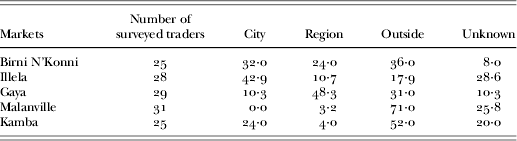
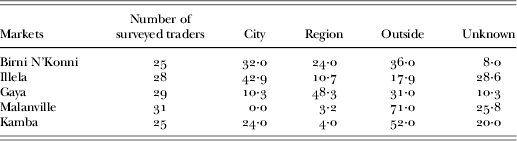
A network analysis focusing not only on the local ties within a region but also on the relationships between border areas and central places could shed light on the specific profile of border traders. By mapping the social relations between these locations, one could explore the hypothesis that border markets attract traders with distinctive behavioural characteristics that affect their network brokerage roles and unique relational attributes affecting their control of business information flows. As in many other regions in Africa (Chalfin Reference Chalfin2001; Grätz Reference Grätz2004; Dobler Reference Dobler2008), the prosperity of the border regions located between Niger, Benin and Nigeria is often due to foreign traders who act as trailblazers for trade diasporas. These traders were specifically attracted by the potential of border activities. As is shown in Table III, traders who came from outside the administrative region where border markets are located are particularly numerous in Malanville (Benin) and Kamba (Nigeria), where they represent 70% and 52% of the traders surveyed. In both regions, Nigerien traders of Zarma origin and to a lesser extent Igbo and Yoruba traders from southern Nigeria dominate the trade of cereals and manufacturing products. The market of Gaya (Niger) is also strongly dependent on the presence of Zarma traders from the region of Tillabéri and Dosso in Niger, because the local Dendi population is only marginally engaged in trade activities (Walther Reference Walther2012a). This contrasts very much with the situation on the Birni N'Konni and Illela markets, where a significant proportion of traders originate in the region where the study was conducted. A third of the surveyed traders are from the city itself on the Nigerien side and about 43% of them on the Nigerian side.
Traders' origin according to markets (%)
Calculation by the author.
The differences between the two border situations are mainly due to the historical development of the regions. The border area of Birni N'Konni-Illela is characterised by the highly informal nature of economic activities between Niger and Nigeria and the historical ethnic networks that have developed between them since pre-colonial times. A large majority of the traders come from the cities where they do business and are of Hausa origin. The Gaya-Malanville-Kamba case study is more atypical in the sense that trade is dominated by traders from abroad who found business opportunities in the region. Situated on the fringe of the great pre-colonial socio-political formations, this case study illustrates how the emergence of a market place can be linked primarily to the creation of modern national borders.
Scale
In addition to location, the scale of the activities also matters since the more that traders go into long-distance trade, the more they have to rely on weak ties. Long-distance trade entails a higher risk than short-distance trade, because it aims at bridging business partners that do not necessarily share the same values. However, greater resources can be drawn from the exploitation of long-distance trade, as shown by Lydon (Reference Lydon2008), which implies the crossing of multiple and often distant borders. In a regional environment where most of the free trade policies are only marginally enforced locally, crossing a border entails a potential benefit from price, monetary, legal and regulatory differentials that a ‘regular’ national market does not provide. Profits made in long-distance trade depend on the possibility of moving a product with the smallest number of intermediaries and not on the transformation brought to a product itself. Therefore, the geographic extension of African networks, which implies a move from short to long-distance trade, is a necessary condition for the prosperity of traders.
As a consequence, SNA can test the hypothesis according to which, as in the pre-colonial trans-Saharan trade (Austen Reference Austen1987, Reference Austen2010), brokerage opportunities in the Sahel depend on the scale of business activities carried out by the traders. This would result in two categories of traders: long-distance traders who should be more likely to have expanded outside the local community to find a balance between embeddedness and brokerage, and short-distance traders working between border cities and privileging locally embedded ties. This idea of having two categories of traders distinguished according to their structural position shares many similarities with Braudel's historical distinction between long-distance trade and local trade. As Braudel (Reference Braudel1985: 58) argues, ‘It is not a hazard if, in all countries of the world, a group of large traders stands out from the rest of the merchants, and if this group is always related to long-distance trade’ (our translation). Whereas Braudel implicitly assumes that large traders should also be long-distance traders, evidence from West African markets suggests that the scale of activities does not necessarily dictate the return of traders, who can make profits and become ‘large traders’ in short or long-distance trade. Howard (Reference Howard2011: 4) developed a similar argument in his study of pre-colonial traders in the Sierra Leone–Guinea system when he classified economic actors based on the scale of their activities. In West Africa, small and large traders make use of the same markets, road infrastructures, and institutions but form two distinct categories separated by their origin, wealth and education. Large traders are different in the sense that they have benefited from the development of international trade and deregulations that have taken place since the 1980s and, in addition, have successfully built alliances with state representatives and politicians at the national scale.
Combining the historical and socio-cultural with the formal
As is true of any school of thought, the models and tools provided by social network analysis have been the subject of criticism. Among the most common criticisms is the fact that SNA would build on the existence of ties between social actors without necessarily taking into account the meanings that these actors give to their relations or understanding their historical formation (for a review, see Scott Reference Scott2011). In order to address this challenge, we believe that any comprehensive theory of trade networks should aim at combining the quantitative approach developed by SNA with qualitative information. Bringing together the historical and socio-cultural with the formal would contribute to overcome the frequent limitation of the network-based approach in explaining the intensity of ties and the changes of social networks. In our case, traders may occupy a more central or brokerage position in social networks because of their personal migration history, ethnic group affiliation or political alliance with state authorities. Therefore, we strongly suggest that any network approach to trade should be complemented with other approaches that can focus on the content of relationships, notably professional biographies, that usefully contribute to documenting those factors that drive West African traders to leave their original areas and establish businesses in border regions, the patterns of these migrations, and the foundations of contemporary trade diasporas in border areas.
Integrating qualitative information derived from historical analysis in networks would first improve our understanding of both the structure and the nature of social ties. In this paper, for example, the information used to map and analyse the two cross-border trade networks only relies on the structure of interaction between traders. A much more elaborate network analysis would need to take other crucial information into account, such as the duration of interaction between business partners, their intimacy, the emotional intensity (mutual confiding) and reciprocity. Understanding the nature of the ties is crucial to explain their formation and their historical development. It also helps to explain differences of income and social status, since weak and strong ties do not potentially lead to the same outcomes. Strong ties are influential in determining trust, providing access to tacit (i.e. non-codified) information, advice, resolution of conflicts, while weak ties are best at searching out non-redundant information and are less likely to influence reciprocity. The social ties that bind people in Africa are usually seen as extremely strong, since they imply an obligation of reciprocity and assistance but, with the geographic extension of trade networks, more weak ties will be needed to develop business transactions with the rest of the world.
Another important contribution of qualitative analysis in network studies is that mental perceptions often determine power positions. The actors with the best perception of the networks are usually those who are the most successful from a professional point of view, because they can have an overview of the largest number of other actors involved, some of them potentially located extremely far from their immediate friends and allies. Actors also tend to take decisions based on the perception of the network, and not on the actual network, which can be partially hidden and is often difficult to ascertain especially when numerous actors are involved. As Krackhardt (Reference Krackhardt1987: 110–12) argued, people tend to behave according to what they suppose is the real network, and not according to an objective picture of the network, which would anyway be almost impossible to reconstruct without sophisticated analytical tools, such as those used in this paper.
CONCLUSION
The success of economic activity in West Africa does not rely solely on the attributes of the social actors but also and predominantly on their capability to draw resources from the structure of their social relations. Economic exchange can rarely be explained through arm's-length ties with no prior social bond. Rather, it takes place within a complex set of social interactions. Therefore, a relational approach seems highly relevant for illuminating West African economic activities.
As this paper suggests, SNA can be used to better understand regional economic activities by giving special importance to the actors who run trade networks, to the places where trade is being concentrated, and to the scale of their activities. This approach provides an alternative to the mainstream approaches in economics that consider either flows of commodities or prices to evaluate the intensity of trade and the degree of integration between markets, and to geographic approaches that conceptualise networks as hierarchies or chains. Focusing instead on social actors offers the opportunity to circumvent a certain number of methodological issues related to the absence of long-term data on cross-border flows and to examine the evolution of trade since post-independence times through the social structure, location and scale of the networks.
SNA allows investigating the trade-off made by traders between a strong embeddedness in the local community and more open brokerage roles. While embeddedness has long provided a way of minimising transaction costs, the globalisation of West African trade should lead traders to rely increasingly on weak ties when dealing with foreign partners from a different culture. The most successful traders are likely to be those who can play both roles: strongly embedded in a dense network that provides trust and reputation, and at the same time building brokerage ties between disconnected markets.
The empirical case presented in this paper suggests that border markets are a particularly favourable location to illustrate such a trade-off. Playing an intermediary role between different nationally organised business networks, these markets are not primarily designed to serve as central places for local trade in West Africa. Their specificity is rather to develop as hubs for inter-national flows where economic agents can play a brokerage role. In addition, SNA can contribute to distinguishing between short-distance traders predominantly benefiting from local prices and regulatory differentials, and long-distance traders who play a key role in the functional integration of West African countries and cities and their inclusion in the global economy.
While formal network analysis can map and analyse social ties based on business interactions, it can hardly explain the origin and historical changes of such ties over time without also integrating more qualitative information. A comprehensive theory of West African network should, therefore, aim at integrating – rather than opposing – the contribution made by the historical and socio-cultural approaches of networks with social network analysis.