The phenomenon of vowel reduction has been the focus of much recent work in phonology, and several proposals have been put forward to account for vowel reduction in Russian (both Modern Standard Russian and dialectal varieties). In line with a general functionalist trend, Crosswhite (Reference Crosswhite, Crosswhite and McDonough2000, Reference Crosswhite2001) proposes that perception- and sonority-driven constraints are responsible for vowel reduction, and Padgett (Reference Padgett2004) and Padgett & Tabain (Reference Padgett and Tabain2005) explore the role of dispersion. De Lacy (Reference de Lacy2006) and Hermans (Reference Hermans, Zybatow, Szucsich, Junghanns and Meyer2008) also propose sonority-based accounts of reduction phenomena, though their proposals are less explicitly grounded in functional considerations. Finally, recent work by Barnes (Reference Barnes2006, Reference Barnes2007) addresses the issue of the division of labour between the phonological and phonetic components of grammar (see also the discussion in Kingston Reference Kingston and de Lacy2007).
In this paper I propose that the correct choice of phonological representations allows us to eliminate functional considerations such as dispersion and sonority as factors relevant for the phonological computation of Russian reduction. I show that reduction to schwa, which is potentially a sonority-reducing process, is properly outside the domain of phonological computation. With respect to other processes involved in vowel reduction, sonority-based constraints succeed in deriving the resulting surface inventories, but fail to explain the patterns of faithfulness constraint violation. I propose that phonological vowel reduction in Russian is due only to positional faithfulness/markedness effects, if the representations are correct. I present an analysis in terms of the Parallel Structures Model of feature geometry (Morén Reference Morén2003, Reference Morén2006, Reference Morén, Blaho, Bye and Krämer2007; Youssef Reference Youssef2010), and argue for the superiority of a substance-free approach to the phonology of vowel reduction.
The organization of this paper is as follows. In Section 1, I describe the facts of Russian vowel reduction. Section 2 contains a short overview of the model I am using, and presents the representational assumptions underlying the account and an analysis of the patterns in terms of Optimality Theory. The aim of Section 3 is a comparison of the account proposed in the present paper with other explanations of Russian vowel reduction. Section 4 concludes.
1. Vowel reduction in Russian
The term ‘vowel reduction’ with reference to Modern Russian is traditionally used to describe a range of neutralization patterns in unstressed syllables. I retain the traditional name, even though it might be something of a misnomer, since this process can actually lead to the appearance of higher-sonority vowels.
In this paper I concentrate on contemporary Central Standard Russian, essentially as spoken by educated Moscow speakers, abstracting away from both dialects and other varieties of Standard Russian, as well as from older norms which are often prominent in the literature.
1.1 The facts, take one
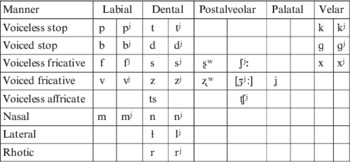
The outcome of vowel reduction in Russian is defined by three independent variables: the identity of the underlying segment, its position within the word and the palatalization or lack thereof of the consonant preceding the vowel. Table 1 presents a slightly simplified version of the Russian consonant inventory. For more details of the Russian phonetic system, the reader is referred to standard overviews such as Jones & Ward (Reference Jones and Ward1969) and Timberlake (Reference Timberlake2004). Table 1 excludes some detail of the variation (for instance, in the case of [v] and [ʝ]), and ignores some obstruents which only appear as a result of voicing assimilation. Since these are never followed by a vowel, they are irrelevant to the present study.
Russian consonant inventory.

The exact number of distinctive vowel segments in Russian is, famously, the subject of longstanding discussion. In this paper I assume that the inventory of stressed vowels in Russian consists of the five vowels /i u e o a/. What is often described as the high central unrounded vowel /ɨ/ is in complementary distribution with [i]. I assume that it is not a phonological segment. Following Padgett (Reference Padgett, Hume and Johnson2001, Reference Padgett2004) and Padgett & Tabain (Reference Padgett and Tabain2005), I interpret the [ɨ] used in transcription as the effect of strong velarization on consonants preceding the front vowel (though, as discussed below, I disagree with Padgett on the precise phonological interpretation).Footnote 2
Traditionally, Russian vowel reduction is described as a three-term system: apart from stressed vowels, there are two sub-inventories depending on the position in the word. Crosswhite (Reference Crosswhite, Crosswhite and McDonough2000) terms them ‘moderate’ and ‘radical’ reduction positions, and I follow this terminology here. The contexts for moderate reduction are as follows:
• Moderate reduction is found in the syllable immediately preceding the stressed one (the ‘first pretonic’).
• Onsetless syllables, irrespective of their position relative to stress, block radical reduction and exhibit the moderate pattern.Footnote 3
• Unstressed phrase-final open syllables exhibit a gradient effect: moderate reduction is possible but not compulsory in this position.
• Timberlake (Reference Timberlake2004: Section 2.2.7) claims that if a hiatus consists of two /a/ or /o/ vowels (in any combination), then both of these vowels only undergo moderate reduction (note that the second would fall under the onsetless syllable clause). However, he does not a give a reference, and some sources contain contradictory examples (for instance, Timberlake has [ɐ.ɐ] in the word sootnošenie ‘proportion’, but Kasatkin Reference Kasatkin2003 writes [ə.ɐ] in the same word, implying radical reduction of the first vowel in hiatus).
Radical reduction is best described as the elsewhere case: in other words, it happens in syllables with onsets which are not stressed and do not immediately precede the stressed syllable. An often-used mnemonic is the so-called ‘Potebnya's formula’: if 1 means radical reduction, 2 means moderate reduction, 3 means no reduction and the acute accent indicates stress, the distribution of the reduction ‘grades’ can be described by the formula 1123′11.
1.1.1 Moderate reduction: Non-palatalized context
The high vowels /i/ and /u/ (the former traditionally transcribed as [ɨ] in the non-palatalized context) are not subject to phonological changes in unstressed position. However, they are significantly centralized, and consequently I transcribe them as [ ] and [
 ]. Examples are given in (1) and (2).
- (1)
(a) [dɨrkə] ‘hole (diminutive)’
(b) [d
 ˈra] ‘hole’
- (2)
(a) [ˈruʧʲkə] ‘hand (diminutive)’
(b) [r
ˈka] ‘hand’
Probably the most prominent feature of the Russian vowel reduction system is the neutralization of /o/ and /a/. Both of these segments, when in unstressed position, surface as an [a]-like sound, the transcription of which has been a contentious subject. The traditional symbol is [ʌ], similar to the STRUT vowel in English Received Pronunciation; this is advanced, for example, by Jones & Ward (Reference Jones and Ward1969). More recent sources, notably Padgett & Tabain (Reference Padgett and Tabain2005) and Barnes (Reference Barnes2006, Reference Barnes2007) in the West, use [ɐ] on the basis of their phonetic findings.Footnote 4 This question is specifically discussed by Kasatkina (Reference Kasatkina2005), who claims that the pronunciation of [ɐ] is characteristic of Moscow and the surrounding areas, and of varieties of Standard Russian spoken in territories where the local dialects neutralize the contrast between /a/ and /o/ at least in some positions. The pronunciation of [ʌ], on the other hand, is characteristic of Standard Russian as spoken in territories where the local dialect lacks any neutralization between /a/ and /o/. This includes Northern Russia (with, importantly, St Petersburg) and large territories in the Urals and Siberia; the same pronunciation is said to be used by Russian speakers in Ukraine. Since this paper concentrates on Standard Russian, and more specifically on Moscow Russian, I follow latest practice in transcribing the outcome of neutralization of /a/ and /o/ as [ɐ]. Examples are shown in (3) and (4).
- (3)
(a) [ˈdavnʲÏj] ‘ancient’
(b) [dɐvˈno] ‘long ago’
- (4)
(a) [ˈkot] ‘cat’
(b) [kɐˈta] ‘cat (gen.sg.)’
The facts of moderate reduction of /e/ after non-palatalized consonants are somewhat difficult to ascertain. In the native Russian lexicon, /e/ is not encountered after non-palatalized consonants other than [ʂʷ], [ʐʷ], and [ts]: the so-called ‘unpaired’ or ‘immutable’ (Timberlake Reference Timberlake2004) ones, which do not have a palatalized counterpart. These cases are treated in Section 1.1.4 below. However, many borrowings exhibit a non-palatalized pronunciation before /e/, and these words most often still undergo reduction.Footnote 5 Where they do, in the modern norm /e/ neutralizes with /i/ to become []; essentially, there is no difference in the behaviour of /e/ across the non-palatalized and palatalized contexts (see below on /e/ in the palatalized context).
- (5)
(a) [fɐˈnɛtʲÏkə] ‘phonetics’
(b) [fən
ˈtʲiʧʲÏskʲÏj] ‘phonetic’
Vowels in onsetless syllables pattern with vowels following non-palatalized consonants, in that the strong coarticulatory effects associated with palatalized consonants (Kochetov Reference Kochetov2002) are absent.
In terms of vowel reduction, the ‘non-palatalized’ and onsetless contexts pattern together, in that /o/ and /a/ neutralize with each other but not with /e/ or /i/ (as they do following palatalized consonants, see below). The behaviour of /e/ also seems to demonstrate neutralization with /i/, though examples with alternations are extremely hard to come by, since most /e/-initial words are borrowings, and stress is consistent across the paradigm, so that there are no stress-related alternations. However, unstressed initial (orthographic) /e/ is normally realized as [i], as (6) shows.
(6) [iˈtaʂʷ] ‘floor’ (French étage)
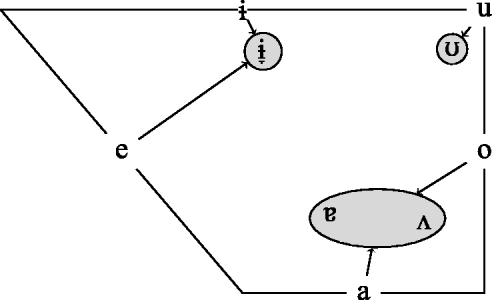
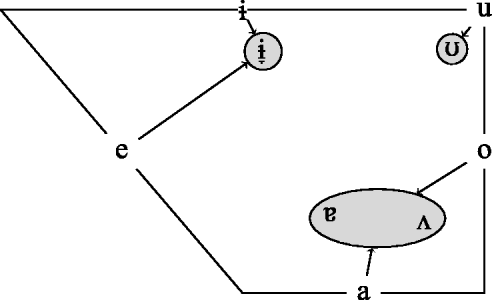
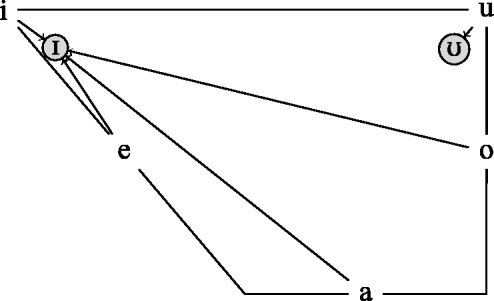
A schematic representation of moderate reduction following non-palatalized consonants is given in Figure 1.
Moderate reduction, non-palatalized context.
1.1.2 Moderate reduction: Palatalized context
More contrasts are neutralized following palatalized consonants, than in the non-palatalized context. Specifically, in newer forms of Central Standard Russian all vowels except /u/ are realized as [i], i.e. identically with unstressed /i/. This is demonstrated by the following examples:
- (7)
(a) [ˈnʲos] ‘he carried’
(b) [nʲisˈɫa] ‘she carried’
- (8)
(a) [ˈpʲatʲ] ‘five’
(b) [pʲiˈtʲi] ‘five (gen.sg.)’
- (9)
(a) [rɐzˈdʲeɫ] ‘divide (n.)’
(b) [rəzdʲiˈlʲiɫ] ‘(he) divided’
- (10)
(a) [ˈpʲiɫ] ‘(he) drank’
(b) [pʲiˈɫa] ‘(she) drank’
The vowel /u/ does not neutralize, although, like /i/, it is significantly centralized (and fronted due to coarticulatory effects):
- (11)
(a) [ˈlʲudʲi] ‘people’
(b) [lʲ
tˈskoj] ‘people's (adj.)’
In older versions of the norm (and in some dialects), only /e/, /a/ and /o/ are neutralized in this context, and the outcome of this neutralization remains distinct from /i/ (often transcribed as something like [ie]). However, in modern educated pronunciation the two-term system seems to be prevalent; for an overview, see Comrie, Stone & Polinsky (Reference Comrie, Stone and Polinsky1996), and see discussion of Padgett & Tabain's (Reference Padgett and Tabain2005) results below. In this paper, I concentrate on the newer norm.
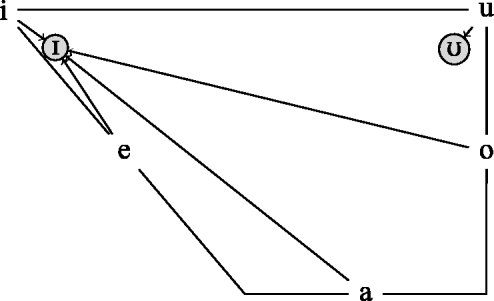
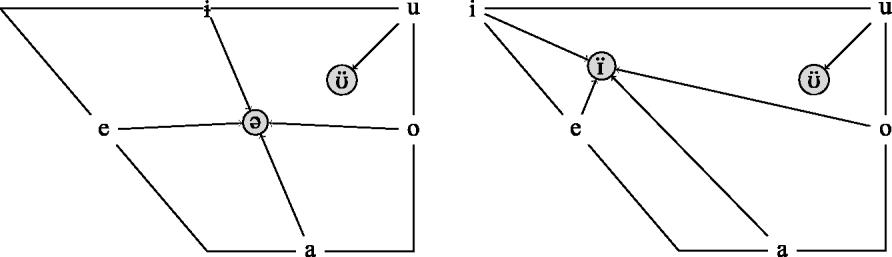
A schematic representation of moderate reduction in the palatalized context is given in Figure 2.
Moderate reduction, palatalized context.
1.1.3 Radical reduction
In radical reduction, more contrasts are neutralized: the modern norm is that all vowels except /u/ neutralize. Following non-palatalized consonants (recall that radical reduction is impossible in onsetless contexts), all vowels are realized as a schwa, as demonstrated in the following examples. Note that there is no difference between paired and unpaired (i.e. [ʂʷ], [ʐʷ], and [ts]) non-palatalized consonants in this instance.
- (12)
(a) [ˈsat] ‘garden’
(b) [sədɐˈvot] ‘gardener’
- (13)
(a) [ˈdom] ‘house’
(b) [dəmɐˈvoj] ‘house sprite’
- (14)
(a) [ˈʐʷeʧʲ] ‘burn’
(b) [ˈvɨʐʷəʧʲ] ‘burn (perf.)’
- (15)
(a) [ˈdɨm] ‘smoke’
(b) [dəmɐˈxot] ‘stovepipe’
- (16)
(a) [ˈpusk] ‘launch’
(b) [ˈvɨp
sk] ‘issue’
Following palatalized consonants, the situation is essentially the same: all vowels neutralize except for /u/, though in this case the pattern of neutralization is identical to that found in moderate reduction in the non-palatalized context. The outcome of the reduction is normally transcribed in Russian-language literature as [Ь], implying that it is essentially a variant of the schwa following a palatalized consonant. When IPA is used (mainly outside Russia), the sound is normally transcribed as [i], thus collapsing the distinction between the outcome of this neutralization in moderate and radical reduction positions. This is technically warranted, since a vowel's position in the word defines to which Cyrillic character the graphical [i] corresponds. For clarity, however, I use [Ï] where the distinction is important. For consistency, I also use [ ] for the realization of /u/ in this position.
- (17)
(a) [ˈpʲatʲ] ‘five’
(b) [pʲÏtɐˈʧʲok] ‘five-ruble coin (dim.)’
- (18)
(a) [ˈlʲes] ‘forester’
(b) [lʲÏsɐˈvot] ‘forester’
- (19)
(a) [ˈlʲot] ‘ice’
(b) [lʲÏdʲiˈnoj] ‘icy’
- (20)
(a) [ˈpʲitʲ] ‘drink’
(b) [pʲÏtʲ(j)iˈvoj] ‘potable’
- (21)
(a) [ˈʧʲudə] ‘marvel’
(b) [ʧʲ
dʲiˈsa] ‘marvels’
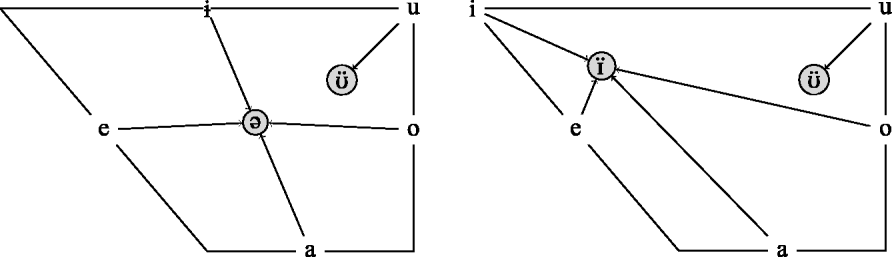
Again, older descriptions insist on distinguishing between the two high vowels and a third vowel to which all non-high vowels are neutralized, such that, for example, výžat' ‘squeeze dry’ (from žát' ‘squeeze’) and výžit' ‘survive’ (from žít' ‘live’) are not homophonous (following Russian tradition, the acute accent in transliteration represents stress). Only two-vowel sub-inventories are present in the modern norm on which I concentrate here. A schematic representation is given in Figure 3.Footnote 6
Radical reduction. Left panel: Non-palatalized context; right panel: Palatalized context.
1.1.4 Complications
The realization of unstressed non-high vowels following the ‘unpaired’ non-palatalized consonants [ʂʷ], [ʐʷ], and [ts] deviates from the system described above. In the older norm, all these consonants consistently behave exactly like palatalized ones, in that all non-high vowels neutralize to a sound written [ɨe], which is obviously to be phonemicized as /e/ (in parallel to the [ie] symbol used following palatalized consonants). In Modern Russian, the situation is more complex, in that /e/ and /o/ behave exactly like after palatalized consonants in reducing to /i/ (phonetically [ɨ]), at least in those cases where there is evidence from alternations as to the nature of the stressed vowel. In the case of /e/ this is in any case the expected behaviour, as shown in Section 1.1.1. This is demonstrated in (22) and (23) (see below for exceptions).
- (22)
(a) [ˈʐʷemʧʲʊk] ‘pearl’
(b) [ʐʷ
mˈʧʲuʐʷnəj] ‘pearl (adj.)’
- (23)
(a) [ˈʐʷon
] ‘wives’(b) [ʐʷ
ˈna] ‘wife’
As for /a/, there is considerable variation, the precise nature of which has remained largely unexplored. The consensus seems to be that there is variation across lexical items. What seems to be happening, in any case, is the progressive spread of the retention of /a/.
All sources agree that borrowings with unstressed /o/, even well-nativized ones, have /a/ as the outcome of reduction, as in (24).
- (24)
(a) [ˈʂʷok] ‘shock (n.)’
(b) [ʂʷɐˈkʲirəvətʲ] ‘shock (v.)’
Alternatively, borrowings may fail to undergo reduction at all (see below). As for /ts/, there are only very few words where it is followed by an unstressed /a/ or /o/, so generalizations are hard to come by; it does seem that [ɐ] is taking over.
The overall picture is clear, even if not all details are sufficiently understood: the system is in transition from a state where there is a mismatch between the phonetic properties of the ‘unpaired’ non-palatalized consonants and their phonological behaviour to a state where their behaviour with respect to vowel reduction is more straightforwardly defined by their phonetic properties.
Finally, borrowings, especially those which are not well-nativized or belong to technical vocabulary, may fail to undergo vowel reduction in the relevant sense altogether. This means that vowels in these words retain their quality (e.g. labialization of /o/) even in unstressed syllables. They are still ‘reduced’ in the sense that they have a shorter duration under normal conditions.
- (25)
(a) [bŏ.ˈa] ‘boa’
(b) [lʲĕˈɡatŏ] ‘legato’
1.2 The facts, take two
Before I turn to the technical analysis in Section 2, I present a body of data which have seldom been brought to bear on the issue of how Russian vowel reduction is to be described in phonological terms. Specifically, I provide evidence that only a small fraction of the data presented above are in fact directly relevant to a phonological analysis of vowel reduction in Russian. I propose, following Barnes (Reference Barnes2006, Reference Barnes2007), that only the patterns of neutralization among the five vowels of Russian are explananda for phonological theory, while much of the detail is to be explained as a consequence of phonetic implementation.
1.2.1 Radical reduction is reduced duration
In phonological accounts of Russian vowel reduction, especially in the generative tradition (see Section 3 below for an overview), it has been customary to analyse ‘moderate’ and ‘radical’ reduction as two phonological processes with outputs that are distinct units of the phonological alphabet. This is problematic for a variety of reasons, both conceptual and empirical.
On the conceptual side of things, the relatively fine-grained traditional approach distinguishes, for instance, [ə] and [ɐ] (the latter often identified with [a]). Consequently, segments such as [ə], which are not used to implement lexical contrast in Modern Standard Russian, are admitted into the phonological alphabet. Therefore, an analysis of Russian vowel reduction which recognizes radical reduction as a separate phonetic process would appear to present a problem for contrastivist approaches which eschew redundant features in phonological computation (Dresher, Piggott & Rice 1994, Morén Reference Morén2003, Hall Reference Hall2007, Dresher Reference Dresher2009).
The empirical difficulty can be summarized as follows: contexts for radical reduction are simultaneously contexts for extremely reduced duration, and contexts for moderate reduction are simultaneously contexts for less reduced duration. This opens up the possibility that the crucial difference between moderate and radical reduction is simply duration, not some phonological representation.
This position is most clearly stated by Barnes (Reference Barnes2006, Reference Barnes2007). On the basis of experimental data, he demonstrates that the chief factor determining the F1 value of the segment which represents the outcome of /o/ and /a/ neutralization is actual duration, while position relative to the stressed syllable does not play a significant role. Specifically, if an unstressed syllable which is not in the first pretonic position is sufficiently lengthened (for whatever reason), the F1 of the vowel can be as high as that of a vowel in the first pretonic syllable, or even in the stressed syllable. The same effect obtains in the first pretonic syllable: given sufficient length, the /o/–/a/ vowel in this position is qualitatively the same as stressed /a/.Footnote 7 Barnes concludes, correctly in my opinion, that a phonological distinction between [ə] and [ɐ] and [a] is not a valid one: rather they represent a continuum of possible realizations of a single segment /a/ as constrained by the duration of the unstressed syllable. Thus, the role of position in the realization of unstressed vowels is indirect, insofar as position determines possible lengths.
This interpretation allows Barnes (Reference Barnes2007) to provide a very straightforward explanation of the cases of ‘moderate’ reduction in ‘exceptional’ contexts. Recall that exceptional moderate reduction appears in onsetless syllables (consistently so in phrase-initial position). If moderate reduction is simply phonetic lengthening, it can be explained as an instance of the well-known phenomenon of lengthening at a domain boundary (Fougeron & Keating Reference Fougeron and Keating1997). Barnes (Reference Barnes2007) also shows how lengthening in non-initial onsetless syllables and in hiatus can be explained. The gradient nature of exceptional moderate reduction in phrase-final open syllables also needs no additional explanation, since it is again found at a domain boundary. This particular case brings out an advantage of length-related interpretation: an account in terms of discrete phonological elements [ə] and [a] (and possibly [ɐ]?) would need some special device to derive the gradient nature of this alternation in the phonology, whereas if it is a phonetic phenomenon, the variability is in fact to be expected.
Further evidence for this interpretation can be found in the sources. First, if reduction to [ə] and similar segments were phonological, we could expect significant phonetic stability, in that a phonological /ə/ would provide a target for phonetic implementation (Keating Reference Keating1988). This is manifestly not the case in Russian. Vowels in radical reduction positions (i.e. where they surface as [ə] and [Ï]) are notoriously susceptible to coarticulation effects (Paufošima Reference Paufošima1980) or deletion. Thus, for example, ‘[ə]’ is normally assimilated to the /u/ of a following syllable, even if the latter is unstressed:
- (26)
(a) [pɐ.ˈuk] ‘spider’
(b) [pʊ.ʊˈkʲi] ‘spiders’
However, this process is clearly a gradient coarticulation phenomenon rather than a categorical phonological process, since unassimilated pronunciations are also possible and the conditioning factors are often speech rate and style. Thus, the supposed phonological /ə/ is not in fact always phonetic [ə]. The reverse is also true. Consider the case of /u/. It is normally assumed not to neutralize with any other segment, i.e. it ‘does not reduce’. In fact, however, its phonetic realization varies very widely, from [u] to [ʊ] and all the way through [] to [əʷ]. Moreover, in casual or fast speech it can lose its labialization and neutralize with other vowels in a [ə]- or a [Ï]-like sound (see e.g. Likhtman Reference Likhtman1999), yet it seems that this process does not represent true phonological vowel reduction, but is rather a phonetic phenomenon. What such facts show is that many cases of surface [ə] (or something like it) are not to be ascribed to a phonological /ə/; it then follows that cases of putative phonological /ə/ need positive evidence, which, as I show in this section, is hard to find.
There is even more evidence that the distinction between various reduction grades is mainly one of duration. Kasatkina (Reference Kasatkina2005) notes that many published transcriptions of running speech have [ə] instead of [ɐ] in the first pretonic syllable, especially when the stressed vowel is [a]. While this system is reminiscent of (and obviously related to) the ‘dissimilative akan'je’ patterns (Crosswhite Reference Crosswhite, Crosswhite and McDonough2000, Bethin Reference Bethin2006), where such an alternation is clearly phonologized, it is nowhere near as regular in Standard Russian as spoken in Moscow. Kasatkina (Reference Kasatkina2005) notes that there is a length trade-off between the stressed syllable and the first pretonic syllable, in that a lower (and thus inherently longer) stressed vowel may cause shortening of the first pretonic syllable. Thus, ‘exceptional’ radical reduction in the first pretonic syllable is merely the instantiation of reduced duration caused by this trade-off.
I conclude that an [ə] in transcription does not necessarily involve a phonological change to an /ə/ segment, and thus that the non-peripheral vowels appearing as the outcome of vowel reduction are to be interpreted as artifacts of undershoot under conditions of reduced duration.Footnote 8
One potential piece of counterevidence is mentioned by Kniazev & Požarickaya (Reference Kniazev and Požarickaya2005). They claim that in words with stress on the fifth syllable, the first syllable can be prolonged, but they transcribe it with the symbol for [ə], so kr[əː]snoproletárskij ‘of the red proletariat’; under the interpretation proposed here the vowel in such a syllable should be more [a]-like. In the absence of actual phonetic data on the pronunciation of such words (which are relatively rare), I leave this question for further research.Footnote 9
1.2.2 Reduction is real
The analysis in the previous section poses a serious question: if such a great deal of the vowel reduction facts is due to the phonetics of reduced duration, how do we know that the posited neutralization processes are in fact real and not artifacts of reduced duration too?
One reason why that is unlikely is the direction of neutralization: since /a/, the lower vowel, has longer intrinsic duration, it is not entirely clear how shortening could promote this sort of neutralization (though Padgett & Tabain (Reference Padgett and Tabain2005) show how shortening promotes neutralization in general – by pushing vowels closer together, overstepping the perceptibility threshold). The question, however, remains: do we actually know that the phonological computation maps underlying /o/ to surface /a/ and underlying /e/ to surface /i/?
The principal evidence in this case comes from cases where duration is increased for one reason or another, but neutralization still happens. This may occur both under laboratory conditions and in actual speech.
A laboratory study was undertaken by Barnes (Reference Barnes2007), who set up his experiment to promote hyperarticulation, essentially forcing the speakers to prolong all vowels, including unstressed ones. His results are unambiguous: while the difference between [a] and [ə] as the outcomes of reduction turns out to be illusory, duration does not influence the extent of neutralization of underlying /o/ and /a/: for both of these segments in unstressed positions, the F1 target is clearly that associated with stressed /a/, modulated by length restrictions. He notes that a high F1 target for both of these segments is also consistent with the results of Padgett & Tabain (Reference Padgett and Tabain2005), who themselves note that unstressed [a] (i.e. [ɐ]) is lower than it would be expected to be if vowel-space cramping alone were responsible for reduction.
Lengthening (or at least lack of shortening) can also occur ‘in the wild’: as noted above, Kniazev (Reference Kniazev2006) finds that vowels in moderate reduction contexts (first pretonic syllable, onsetless syllable, phrase-final open syllable) can be as long as those in stressed syllables, and nevertheless neutralization is intact.
An important context for lengthening is the first pretonic syllable, which is consistently longer than other unstressed syllables. It is, however, not the case that it is always consistently shorter than the stressed syllable. In particular, it is lengthened in a number of intonational constructions, as demonstrated by Kasatkina (Reference Kasatkina2005). Specifically, ‘focused’ words (in Moscow pronunciation) are often characterized by a rising pitch contour on the first pretonic syllable. It is well-known that rising pitch requires bigger excursions and thus can promote lengthening of the tone-bearing segments (e.g. Ohala Reference Ohala and Fromkin1978). Kasatkina (Reference Kasatkina2005) observes that pretonic vowels with rising pitch are lengthened, and sometimes even become longer than stressed vowels.Footnote 10
Nevertheless, even under conditions of this lengthening, the neutralization happens, as in podx[aː]dít' ‘approach (v.)’ (Kasatkina Reference Kasatkina2005: 41), compare podxód ‘approach (n.)’.
In fact, the interaction of pitch and length also gives a clue to the special status of the first pretonic syllable. If lengthening in the first pretonic syllable is an artifact of the placement of tonal accents with respect to the stressed syllable, the ‘bisyllabic domain’ of Bethin (Reference Bethin1998), consisting of the stressed and the first pretonic syllable, is reduced to a descriptive generalization, and is not necessarily a representational entity such as for example the foot, as in the analysis of Crosswhite (Reference Crosswhite, Crosswhite and McDonough2000), on which see below.Footnote 11
The independence of length-related facts and potential for /o/–/a/ neutralization is further confirmed by the behaviour of unassimilated loanwords. As noted above, vowels in such words can fail to undergo ‘reduction’, in that there are no changes in vowel quality even in unstressed syllables. Nevertheless, the duration of such unstressed syllables is still smaller than that of stressed syllables, which shows that shortening does not necessarily imply neutralization.
Summarizing this section, I have presented evidence for the following three claims:
• The distinction between ‘radical’ and ‘moderate’ reduction is an artifact of differences in duration, in that shorter syllables tend to be more strongly undershot, which produces an [ə] sound, while smaller undershoot permits the production of less centralized vowels.
• At the same time, I have proposed that length differences do not follow rigidly from the phonological structure, being contingent on factors such as speech rate and style, prosodic position, presence/absence of nuclear accent and pitch contours, etc.
• The phonological module is responsible for a number of symbolic operations, specifically the collapse of /o/–/a/ and /e/–/i/ distinctions (with the second member of both pairs as output) following non-palatalized consonants, and the neutralization of all vowels except /u/ following palatalized consonants.
In the next section I present a technical analysis of these phonological patterns.Footnote 12
2. Analysis
In this section I present an analysis of Russian vowel reduction in terms of the Parallel Structures Model of feature geometry (Morén Reference Morén2003, Reference Morén2006). I show how a language-specific approach to phonological representations leads to a simple analysis of vowel reduction in Russian without recourse to sonority-specific constraints.
2.1 The model
In the Parallel Structures Model of feature geometry (henceforth PSM), the phonological make-up of segments is determined on the basis of their phonological activity in the particular language under consideration. This means that, modulo other assumptions, a segment is specified for a feature [F] only if reference to [F] is crucially necessary to describe some phonological phenomenon (i.e. lexical contrast or alternations). In this sense, the PSM approach is related to the theory of contrast espoused by Dresher et al. (Reference Dresher, Piggott and Rice1994), Hall (Reference Hall2007), Dresher (Reference Dresher2009).Footnote 13
The workings of the Parallel Structures Model are as follows. First, PSM utilizes a rich feature geometry with head and dependent nodes for each dimension (Place, Manner, Laryngeal, etc.). In the spirit of Clements (Reference Clements1991) and Clements & Hume (Reference Clements, Hume and Goldsmith1995), head nodes are referred to as C-{Place,Manner,…}, and dependent nodes are referred to as V-nodes. However, in PSM this is a purely notational convention without any intrinsic content: consonants can have V-features (e.g. this is the case for palatalized consonants in Russian), and vowels can potentially have C-features.
Second, there are no major class features such as [vocalic] or [consonantal]. Major classes are identified as stricture classes, and are represented using manner features (at least [open] and [closed]), see Steriade (Reference Steriade1993).
Third, features are assumed to be uniformly privative, much as in e.g. Dependency Phonology (Anderson & Ewen Reference Anderson and Ewen1987) or Element Theory (Harris & Lindsey Reference Harris, Lindsey, Durand and Katamba1995). In practice, this means that [−F] cannot be used either in the representations or in the constraints.
2.2 Representation of the vowels
In this subsection I introduce the representations to be used in this paper, and propose an account of the Russian vowel inventory in terms of Optimality Theory (henceforth OT).
2.2.1 Feature specifications
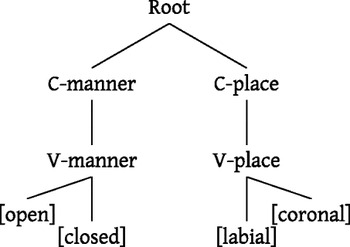
Figure 4 shows the feature geometry I propose for Russian vowels. It makes use of the place features [labial] and [coronal], which can potentially be used for round and front vowels respectively, and the manner features [open] and [closed], with the former implying (relative) lowness and the latter (relative) highness. However, the assignment of these features is nontrivial.
Feature geometry for Russian vowels.

First, since all features are privative, there is no obvious way of referring to classes such as [−high] or [−round], which play an important role in other analyses of the phenomena.
Second, the PSM is predicated on the assumption that feature assignment reflects phonological activity. Thus, the four features proposed must be distributed in the inventory in such a way that they reflect the patterns of reduction.Footnote 14
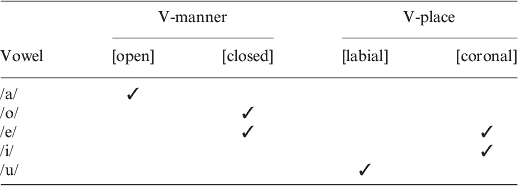
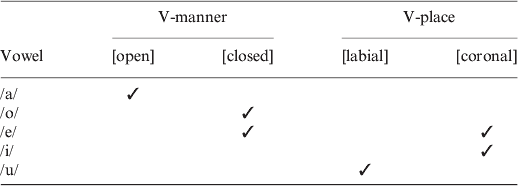
The feature assignment I propose for Modern Russian is demonstrated in Table 2. The most important facts to note about the hypothesis are as follows:
• There is no coherent class of [+high] vowels, which, as we shall see below, plays an important role in some sonority-based analyses of the Russian phenomena.
• Since only phonologically significant features come into play, a phonetic property can be phonologically relevant for some segments but not for others. This is the case with roundness, expressed here as V-place[labial]: the phonetically rounded /o/ does not bear the feature. This is so because the rounded vowels /o/ and /u/ nowhere pattern together, and /o/ in fact shows no evidence of having any sort of roundedness feature.
• The representation of mid vowels is asymmetrical. One alternative here would be a system similar to a Dependency Phonology analysis (Hermans Reference Hermans, Zybatow, Szucsich, Junghanns and Meyer2008) or one based on elements (see in particular Harris Reference Harris, Carr, Durand and Ewen2005), with V-place features corresponding to the {I} and {U} elements and V-manner[open] to the {A} element. However, symmetrical representations for mid vowels present insurmountable problems with faithfulness, as I demonstrate below (Section 3.5).
Feature specifications for Russian vowels.
If these representations are accepted, vowel reduction following non-palatalized consonants is quite straightforwardly represented as deletion of the feature V-manner[closed], which leads to a reduction in phonological complexity (see Harris (Reference Harris1997, Reference Harris, Carr, Durand and Ewen2005) for a forceful argument for reduction as a complexity-related phenomenon in privative-feature theories). No recourse is made to factors such as e.g. perceptual (non-)salience (Crosswhite Reference Crosswhite, Crosswhite and McDonough2000, Padgett & Tabain Reference Padgett and Tabain2005) or sonority (de Lacy 2006, Hermans Reference Hermans, Zybatow, Szucsich, Junghanns and Meyer2008); since this is a straightforward markedness-based explanation, and featural markedness constraints of the form *[F] are independently needed, such an account is more parsimonious, at least as far as purely phonological considerations go.
The representational proposal made in this section is essentially theory-agnostic: it can be adapted to any number of theories of phonological computation. In this paper, however, I present an analysis in terms of OT. In Sections 2.2.2 and 2.3 I discuss the constraints and rankings operative on Russian vowels.
2.2.2 Constraints and rankings for stressed vowels
Before providing an account of vowel reduction, I will demonstrate how the representations in Table 2 can be derived for stressed vowels. This is necessary if one assumes Richness of the Base, to make sure that potentially illicit inputs do not surface unchanged; for another example of this procedure, see Morén (Reference Morén2006).Footnote 15
Since (most) underlying vowels only surface faithfully in stressed positions, we need to assume some computational device to make sure that stressed and unstressed positions are treated differently. In this paper I assume that this effect is due to positional faithfulness constraints applying to prosodic heads (Beckman Reference Beckman1999, Alderete Reference Alderete, Oostendorp and Hermans1999).Footnote 16
In line with Morén (Reference Morén2006), I assume that the Generator function of OT only outputs potentially licit PSM representations, i.e. that, say, it does not provide the evaluation with structures where a V-node dominates a C-node or where a feature is attached directly to the root node. However, the evaluation component still has a role to play, as it filters out structures which are disallowed in the particular language.
Assuming a Correspondence theory of faithfulness, I employ two types of constraints:
• Max([F]) constraints, prohibiting deletion. In the framework employed here, [F] can stand for a feature attached to a specific class node.
• *[F] constraints (with the same understanding of [F]) militate against certain features appearing in the surface representations. Following Morén (Reference Morén2006), I also assume that markedness constraints can be locally conjoined, militating against segments which contain features banned by both of the conjoined constraints. I refer to Morén (Reference Morén2006) for discussion of multiple constraint conjunction.Footnote 17
The existence of a contrast is accounted for by the standard OT ranking of faithfulness above markedness. Thus, the representation {V-place[labial]} surfaces faithfully because Max(V-place[labial]) is ranked above *V-place[labial], as shown in (27). The same ranking obtains for V-place[coronal] and V-manner[open], since these also surface faithfully, as /i/ and /a/ respectively.
(27) Surfacing of V-place[labial]

On the other hand, a potential input consisting of a feature that cannot make up a segment on its own does not surface faithfully because the reverse ranking obtains for this feature. For instance, Russian does not makes use of the feature V-place[dorsal], which is explained by the following ranking:
(28) Potential V-place[dor] cannot surface
When the input consists of more than one feature, conjoined constraints potentially come into play. Thus, when a combination of two features surfaces faithfully, this means that MaxHd constraints for both features outrank the conjoined constraint against that combination of features. This is shown in (29) for the vowel /e/.
(29) {V-place[coronal],V-manner[closed]} surfaces faithfully
Illicit combinations of features, on the other hand, cannot surface because the conjoined markedness constraint dominates one or more of the faithfulness constraints. This is exemplified by (30), which shows why the impossible combination {V-manner[closed],V-manner[open]} cannot surface faithfully, even though it could be a reasonable representation for /o/. The actual winner depends on the ranking between the two faithfulness constraints, but I am not aware of any evidence from Russian which would provide evidence on this point, so I leave the matter undecided.
(30) {V-manner[open],V-manner[closed]} is illicit
The same effect is achieved if the conjoined markedness constraint dominates only one faithfulness constraint, as shown in (31).
(31) {V-manner[open],V-manner[closed]} is illicit (a different ranking)
With respect to potential three-feature inputs, no Russian vowel surfaces with three features. I am also not aware of any processes which might give insights as to how such illicit inputs are repaired. In any case, this restriction can be derived in the same way as the restriction on illicit two-feature structures: the conjoined markedness constraint dominates at least one faithfulness constraint, as shown in (32).Footnote 18 For reasons of space, candidates with fewer than three features which are otherwise not licit segments (such as {V-manner[open],V-place[coronal]}) are excluded.
(32) {V-place[coronal],V-manner[open],V-manner[closed]} is illicit
This concludes the demonstration of how the stressed vowel inventory of Russian can be derived using relatively simple faithfulness and markedness constraints. In the following sections I take up the analysis of vowels in unstressed syllables.
2.3 Russian vowel reduction: The simple case
First we turn to the simpler case of reduction, namely one where the vowel is preceded by a non-palatalized consonant. We assume that phonologically non-palatalized consonants (i.e. all those that are not phonetically palatalized minus [ʂʷ], [ʐʷ], and [ts]) do not bear any secondary articulation feature. This position stands in contradistinction to both the traditional account, where such consonants are usually assumed to have (redundant) [−back] specifications, and to the position of Padgett (Reference Padgett2003), who argues that velarization before [i] is phonologically relevant, since it participates in the expression of contrast (and presumably because a contrast between plain and velarized consonants is available in Universal Grammar, since other languages make use of it). I assume, following both contrastivist thinking in early structuralism and approaches such as those of Morén (Reference Morén2003), Blaho (Reference Blaho2008), Dresher (Reference Dresher2009), that only phonological activity within a language is to be reflected in the featural specifications. Thus, there are no redundant specifications, and, since there is no phonological contrast between [Cˠi] and [Ci] in Russian, I propose that there is no need to specify velarization or lack of palatalization in the phonology.
Thus, I assume that non-palatalized consonants (with some exceptions to be discussed below) do not bear vowel place features, and thus cannot intrude onto the reduction processes. Therefore, reduction in this context presents a kind of emergence of the unmarked effect, since potentially high-ranking constraints relevant to reduction following palatalized consonants are inactive, as their activity is presumably contingent on the presence of the palatalization feature.
The analysis of vowel reduction brings out an important advantage of the representations shown in Table 2. Specifically, if we assume that reduction is due to a prohibition on V-manner[closed] in prosodically weak positions, deletion of this feature leads to the desired result in one case of reduction.
Since the feature V-manner[closed] is only present in the mid vowels, the effect of a constraint against this feature is the same as that of a descriptive constraint *Mid, as used by Alderete (Reference Alderete, Oostendorp and Hermans1999), for example. More formally, this prohibition could be expressed as a feature co-occurrence constraint *[−high −low],Footnote 19 but this option is not available in a model with privative features.
Since the high vowels /i/ and /u/ and the low vowel /a/ do not possess the feature V-manner[closed], they satisfy the markedness constraint in all prosodic positions and are not expected to undergo reduction. This, as we have seen, is exactly the case, modulo the centralization phenomena which have been interpreted above as phonetic coarticulation facts. This is demonstrated for /u/ in (33). The constraint MaxHd(V-place[labial]) is inactive, as it is vacuously satisfied in a non-head context.
(33) No reduction of /u/
The mid vowel /e/ is subject to the classic positional faithfulness ranking, which leads to deletion of the offending feature in non-head position. Given the representations in Table 2, this deletion creates /i/, which is exactly the outcome of the reduction of this vowel in Modern Standard Russian. This is demonstrated in example (34).
(34) Reduction of /Ce/
The reduction of /o/ is a bit more complicated. The deletion of V-manner[closed] in this case would be expected to create the empty root node, which is not a licit representation in Modern Russian phonology. I propose that the non-appearance of an empty node is due to an augmentation constraint Have.anner, penalizing segments which do not bear a manner feature. Ranking this constraint above Dep(V-manner[open]) explains the pattern.Footnote 20
(35) Reduction of /Co/
The introduction of Have.anner raises the issue of why the mannerless vowels /i/ and /u/ can surface at all, both in stressed and unstressed positions. In the case of /u/, the answer is simple: since V-place[lab] does not combine with any other features, Have.anner is ranked below the feature co-occurrence constraints. In the case of /i/, V-manner[open] cannot be epenthesized as in (35), again because of the feature co-occurrence restrictions. However, V-place[coronal] can combine with V-manner[closed] to form /e/. That this does not happen is explained by ranking Dep(V-man[cl]) above Have.anner, as shown in (36).
(36) Failure of manner epenthesis in /i/
Thus, a simple constraint system is enough to produce a system where all vowels making up the inventory are realized in stressed positions, while in unstressed positions only those segments which consist of a single feature are allowed. Note that the representational system allows to capture the correct input–output mappings as well. In the next section I discuss the analysis of reduction following palatalized consonants.
2.4 Russian vowel reduction: The complex case
As we have seen above, the main difference between positions following a non-palatalized and a palatalized consonant is that the latter disallows all non-high vowels. The outcome of reduction of all vowels except /u/ is the vowel /i/.
To explain the pattern, we can leverage a key insight of Unified Feature Theory (Clements Reference Clements1991, Clements & Hume Reference Clements, Hume and Goldsmith1995) and note that the secondary articulation of palatalization is (potentially) represented by the same feature V-place[coronal] as the vowel /i/. That is, the majority of the vowels following consonants bearing a V-place[coronal] feature, map precisely to V-place[coronal]. I propose that this is not a coincidence, but rather an inevitable consequence of segmental organization, specifically, that reduction to /i/ is an instance of autosegmental spreading.
A full discussion of options to formulate constraints which promote spreading cannot be undertaken here. For the sake of the argument, I use the constraint Share(V-place[coronal]) (Honeybone Reference Honeybone2006, McCarthy Reference McCarthy2009). With respect to Russian, several caveats must be made, since spreading of V-place[coronal] might potentially affect other areas of the grammar which have nothing to do with vowel reduction and are thus outside the scope of this paper. For reasons of space and focus, I do not pursue an account of other processes which implicate the spreading of V-place[coronal] in Russian.Footnote 21
In stressed syllables, spreading is precluded by a positional faithfulness constraint Dep.inkHd(V-pl[coronal]), which prohibits the insertion of non-underlying associations of a root node and V-place[coronal], only in the head of the prosodic word. It only has to dominate Share, as shown in (37).Footnote 22
(37) No spreading of V-place[coronal] into stressed syllables
In unstressed syllables, however, Share(V-place[coronal]) dominates both featural faithfulness and Dep.ink. In the case of /a/, this spreading leads to deletion of the existing feature, since the result would be an otherwise illicit segment, as shown in (38).Footnote 23
(38) Reduction of /tʲa/
The reduction of the mid vowels after palatalized consonants proceeds in a similar way. In the case of /e/, V-manner[closed] has to be deleted just as in the case of /e/ following non-palatalized consonants, and it seems impossible to know whether spreading happens (and the relative ranking of Share(V-place[coronal]) and Max(V-place[coronal])), since the phonetic result is the same. This is shown in (39).
(39) Reduction of /tʲe/
In the case of /o/, V-manner[closed] is deleted because of the markedness constraint driving vowel reduction in all other cases, while V-manner[open] is disallowed by the same mechanism as in (38). The tableau is shown in (40).
(40) Reduction of /tʲo/
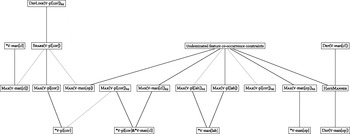
The complete ranking for Russian vowels is shown in Figure 5. It assumes that /i/ in unstressed syllables following palatalized consonants is due to spreading, i.e. that the winner in (39) is candidate (39b), but this is done for the sake of the argument, since there does not appear to be specific evidence either way.
The complete ranking.

In the next section I consider the facts of reduction following /ts/, /ʂʷ/, and /ʐʷ/.
2.5 Russian vowel reduction: The tricky case
As discussed above, reduction following [ʂʷ], [ʐʷ], and [ts] is often presented as an additional complication. Specifically, in older norms, these segments, which are historically palatalized (but synchronically non-palatalized), behave like palatalized consonants, in that they cause neutralization of all non-high vowels to /e/, rather than just neutralization of /o/ with /a/. In the modern norm, however, there seems to be a great deal of variation, at least across lexical items, as described in Section 1.1.4 above.
First, I consider the case of [ts] mostly unproblematic in Modern Russian. Following this segment, /e/ neutralizes with /i/, as in (41), but we have seen that this is in fact the normal pattern for both palatalized and non-palatalized consonants.
- (41)
(a) [ˈtsɛnnəj] ‘valuable’
(b) [ts
ˈna] ‘price’
With respect to the /o/–/a/ neutralization, it was remarked above that such words are extremely rare in Russian, and where evidence does appear, it seems that /ts/ behaves like an ordinary non-palatalized consonant (or at least one which does bear the V-place[coronal] feature).
As for [ʂʷ] and [ʐʷ], their behaviour is traditionally described as follows: in radical reduction, they behave like non-palatalized consonants, in that they are followed by [ə] where reduction happens (i.e. except where the vowel is /u/), and in moderate reduction they can behave like palatalized consonants in that they are followed by /i/ corresponding to all underlying vowels except /u/, so [ɫəʂʷˈdʲej] ‘horse (gen.pl.)’ instead of the expected *[ɫəʂʷɐˈdʲej], from underlying /loʂʷadʲ/.
The apparent paradox of the difference between radical and moderate reduction is easily solvable, since this difference is never phonologically relevant, as radical reduction is due merely to reduced duration. Since [ʂʷ] and [ʐʷ] are articulated with strong velarization and some labialization (Jones & Ward Reference Jones and Ward1969, Hamann Reference Hamann2004), it is not surprising that a short following vowel will be almost completely obscured by the formant transitions from the consonant. In particular, it is unrealistic to expect that an [i]-like segment can surface given the restrictions imposed by reduced duration, since the F2 transition of velarized/labialized consonants is much lower than the 2500 Hz required by [i]. In other words, it is not inconceivable that the vowel is actually /i/, but phonetic contingency makes it sound much more [ə]-like.
As for the neutralization pattern, the problem lies in the following: while the consonants are not palatalized on the surface, they behave as if they carried the same feature as palatalized ones (at least where they cause exceptional patterns of reduction). This apparent paradox is strengthened when we consider the consonant alternations of Russian. Specifically, both [ʂʷ] and [ʐʷ] in Russian are the outcomes of the processes of Velar Palatalization and Iotization, which are commonly assumed to be triggered by front vowels (Rubach Reference Rubach2000, Mołczanow Reference Mołczanow2007) and also output the palatalized [ʧʲ]. For this reason, Rubach (Reference Rubach2000, Reference Rubach2007) and Mołczanow (Reference Mołczanow2007) take the behaviour of these segments as evidence for multiple-level derivations in OT, postulating a ‘backness switch’ whereby these consonants are [−back] at intermediate levels in the derivation and become [+back] on the way to the surface.
Within the tenets of the theory espoused in this paper, it behoves us to ask what evidence there is for the [+back] specification in these consonants. For Rubach (Reference Rubach2000) and Mołczanow (Reference Mołczanow2007), the evidence is that they induce a phonological change from /i/ to /ɨ/; however, here we assume that the difference between [i] and [ɨ] is not phonological, and follows as part of the implementation of phonetically velarized consonants before /i/. In other words, if the phonetic implementation of a given segment – irrespective of its featural make-up – requires velarization, it will be followed, in transcription, by ‘[ɨ]’. Consequently, the fact that a consonant is followed by ‘[ɨ]’ does not constitute evidence against a [−back] (or V-place[coronal]) specification.
In fact, if we assume that /ʂʷ/ and /ʐʷ/, along with /ʧʲ/, do bear the V-place[coronal] feature (see Iosad & Morén-Duolljá Reference Iosad and Morén-Duolljá2012 for details), the exceptional pattern of vowel reduction follows automatically, in line with the analysis shown in the previous section. Thus, the ‘backness switch’ (i.e. the change of /i/ to ‘[ɨ]’) is a matter of phonetic implementation. Presumably the retroflexion/labialization of [ʂʷ] and [ʐʷ] is a kind of enhancement strategy, which improves perceptibility (Padgett & Żygis Reference Padgett and Żygis2007). It has, however, no bearing on the distinctive status of the phonological symbols involved, and thus need not be reflected in the phonological representation.
Within such a framework, the exceptional behaviour of [ʂʷ] and [ʐʷ] can be accounted for without recourse to multiple-level phonological derivations. In fact, this behaviour follows directly from the feed-forward modular architecture of grammar.
However, some issues arise with those cases where [ʂʷ] and [ʐʷ] behave as if they were non-palatalized consonants. This case obviously involves variation, and variation can be dealt with in any number of ways in current phonological theory. I propose that cases where [ʂʷ] and [ʐʷ] behave like non-palatalized consonants represent a new variety of Modern Russian. Here, I consider two possibilities.
One option is that unlike other cases of vowel reduction, vowel reduction following [ʂʷ] and [ʐʷ] no longer represents a phonological process, but rather selection of different allomorphs (a similar route is taken by Crosswhite Reference Crosswhite, Crosswhite and McDonough2000). How this selection is undertaken is not crucial here (but see Wolf Reference Wolf2008 for discussion of some possibilities). This allows us to uphold the generalization regarding the behaviour of V-place[coronal] segments in the language otherwise.
Another option is assuming that for some speakers the phonological representations have actually changed, so that /ʂʷ/ and /ʐʷ/ no longer have a V-place[coronal] feature. Thus, the ‘new’ cases where /o/–/a/ remain distinct from /e/–/i/ now represent regular behaviour, while the older patterns are now exceptional. This option has the advantage of having a simpler phonetic implementation component; however, this means that the generalizations with respect to the behaviour of [ʂʷ] and [ʐʷ] in palatalization-related processes are more difficult (if at all possible) to express. I would like to propose, however, that it is not infeasible that those systems where [ʂʷ] and [ʐʷ] behave like non-palatalized segments are a natural result of the life-cycle of palatalization-related rules. Specifically, both Velar Palatalization and Iotization are ‘old’ rules with a relatively small degree of regularity. In terms of Lexical Phonology, they are often assigned to deeper levels, such as the stem level (Plapp Reference Plapp1999, Blumenfeld Reference Blumenfeld, Brown, Kim, Partee and Rothstein2003), and Rubach (Reference Rubach2000) explicitly proposes viewing Iotization as a morphological rather than phonological phenomenon. It would thus not be surprising if for some speakers these rules have by now ceased to be a part of the phonological computation, and have been relegated into (or have ascended to) the morphology (for a concise statement of a framework which explicitly deals with these life-cycles, see Bermúdez-Otero Reference Bermúdez-Otero and de Lacy2007).
If this is correct, and Velar Palatalization and Iotization are no longer part of the phonological system of Russian, there is no robust evidence for /ʂʷ/ and /ʐʷ/ bearing the feature V-place[coronal], and then the ‘new’ vowel reduction behaviour is expected. The strong prediction made here is that precisely those speakers who have abandoned the phonological palatalization-related rules will tend to generalize the new reduction pattern. This prediction is at least potentially testable, but clearly needs further work.Footnote 24
To summarize, in this section I have proposed a new account of the Russian vowel inventory and vowel reduction processes. I have shown that a minimalist feature theory, together with a non-trivial phonetic implementation component, can allow us to resolve a number of issues identified in Section 1.
First, the theory proposed here enables us to state the reduction patterns in a very simple and straightforward way. Second, the interpretation of the phenomena of Russian reduction proposed in Section 1.2 has also allowed us to dispense with rather complicated mechanisms which would otherwise be needed to derive the difference between moderate and radical reduction, and eliminate the problem of the non-contrastive segments. Third, a non-trivial phonetics–phonology interface offers a solution to the problem of backness mismatches, which has previously been argued to represent a difficulty for monostratal OT.
In the next section, I consider some other accounts of vowel reduction in Russian which can be found in the literature.
3. Other approaches to vowel reduction
Vowel reduction in Standard Russian has been the subject of numerous studies in recent years. In this section I consider one alternative account of vowel reduction following palatalized consonants, which is more in keeping with several recent approaches. Then I concentrate on some specific details of accounts proposed by Crosswhite (Reference Crosswhite, Crosswhite and McDonough2000), Padgett (Reference Padgett2004), and Hermans (Reference Hermans, Zybatow, Szucsich, Junghanns and Meyer2008), and also show the importance of Russian data for the universal-specification theory of de Lacy (Reference de Lacy2006).
3.1 Sequential markedness
In Section 2.4 I presented an account of reduction following palatalized consonants which uses a constraint actively promoting the spreading of a V-place[coronal] feature. Most previous accounts of vowel reduction use a different approach, which I briefly consider in this section.
Instead of being actively promoted, spreading can be viewed as a last resort strategy to repair an illicit representation with an empty root node. From the analytical viewpoint, the advantage of this strategy is that no additional rankings must be adduced to exclude unattested spreading. However, it needs an additional constraint to motivate the exclusion of /a/ following palatalized consonants.
The simplest way to do this is to set up a constraint that penalizes the sequence of a palatalized consonant and the low vowel /a/. Much of the existing literature does just that: Crosswhite (Reference Crosswhite, Crosswhite and McDonough2000) proposes a constraint Cʲ[+front] (‘in unstressed syllables, palatalized consonants are followed by [+front] vowels’), and Padgett (Reference Padgett2004) uses Cʲ [+hi] (‘after a palatalized consonant, a short vowel is [+hi]’). In effect, this is a type of sequential markedness constraint.
It is possible to ‘translate’ this account into the representational theory espoused here. The relevant constraint would ban the sequence of a consonant bearing the V-place[coronal] feature and any segment with a non-empty V-manner node. However, this raises a number of issues, of which the most significant is the descriptive nature of the constraint. All three formulations proposed in this and the preceding paragraphs, when taken at face value, merely restate the facts. The constraint plays a role in producing the patterns, but does not contribute much to explaining their reason.
The account of reduction following palatalized consonants as a spreading phenomenon, presented in Section 2.4 above, on the other hand, makes the connection between the reason behind the process and the pattern itself very explicit: /i/ is the outcome of reduction following palatalized consonant precisely because [i] and the consonants have the same feature.
The sequential markedness constraint can be said to be explanatory by virtue of its grounding in the phonetic or perceptual system (this is the line explicitly taken by Padgett Reference Padgett2003, Reference Padgett2004). However, the present paper is set within the context of a theory which seeks a separation between phonetic and phonological concerns rather than their integration (see Anderson Reference Anderson1981).
Sequential markedness is certainly a possible solution in terms of empirical adequacy. My conclusion, however, is that the account presented in Section 2.4 is preferable within the context of PSM, for two reasons. First, it makes very explicit the connection between the reason for the deviant behaviour of palatalized consonants as triggers of vowel reduction and the sound pattern itself. Second, the explanation it provides is purely phonological, and does not need recourse to factors outside of the phonological computation to achieve explanatory adequacy.
3.2 Phonetically based phonology
Crosswhite (Reference Crosswhite, Crosswhite and McDonough2000, Reference Crosswhite2001) presents the reduction pattern of Modern Standard Russian within the context of reduction patterns in other Eastern Slavic dialects. She distinguishes ‘radical’ and ‘moderate’ reduction as being characteristic of non-moraic and moraic positions respectively. As we have seen in Section 1.2, this move does not appear to be warranted by the data, making some of the theoretical machinery she employs to derive this distinction redundant (at least for Russian).
However, there are other empirical and conceptual concerns with her proposal. Both of these are related to the key constraint driving the reduction of mid vowels, which she calls License.onperipheral/Stress, i.e. ‘only peripheral vowels are allowed in unstressed syllables’. First, as pointed out by de Lacy (Reference de Lacy2006), the inclusion of such a constraint into the universal constraint set predicts the existence of sonority-based stress systems where stress is attracted to non-peripheral vowels at the expense of peripheral ones. Specifically, if both the licensing constraint and faithfulness dominate other constraints on stress placement, it is better to avoid violating the licensing constraint by placing stress on the non-peripheral vowel than by vowel reduction. Such a system does not seem to be attested. (However, see Section 3.6 below for more discussion of this matter.)
On the conceptual side, this constraint, just like the sequential markedness constraint discussed in Section 3.1, is not explanatory in itself, and must make reference to external grounding (which is, of course, the essence of the research program that Crosswhite Reference Crosswhite2001 works within). In that sense, the proposal contained in this paper can be said to be more parsimonious, since it allows deriving the vowel reduction patterns using only mechanisms that are independently founded in the phonological computation.
3.3 Dispersion-based approaches
A dispersion-based approach to vowel reduction in Standard Russian is offered by Padgett (Reference Padgett2004) and Padgett & Tabain (Reference Padgett and Tabain2005). Padgett & Tabain (Reference Padgett and Tabain2005) present three important findings, based on a phonetic study. First, they claim that the neutralization of /i/ and /e/ is incomplete, contrary to the impressionistic descriptions. Second, they report significant raising of the vowel space floor in unstressed positions, and some lowering of the vowel space ceiling in unstressed positions following non-palatalized consonants, which is consistent with a theory viewing vowel reduction as the direct result of undershoot. Third, they show that dispersion-theoretic claims with respect to equal spacing of vowels in all positions do not hold up for Russian in the simplistic form where spacing is measured in terms of simple formant values.
The first fact is not surprising at all, given Padgett & Tabain's (Reference Padgett and Tabain2005) set of informants, which included speakers from outside Moscow, and notably from regions such as St Petersburg and Ukraine. As pointed out above in Section 1.1.1, the local dialects in some of these regions may differ from Central Russian in the phonetic patterns of vowel reduction. Moreover, a significant part of their sample are Russian émigrés in Australia, who left the country after 1917: Padgett & Tabain (Reference Padgett and Tabain2005) do argue that Russian is well-preserved among this group, but given that the norm where /e/ and /i/ are neutralized is relatively new, we might well be dealing with preservation of the older norm. The plots in Padgett & Tabain (Reference Padgett and Tabain2005) show that their informant MK, who is perhaps likeliest to speak a newer Moscow norm, is strongly neutralizing.Footnote 25
The claims with respect to the role of phonetic factors do not bear much on the phonological interpretation – possibly except where they seem to demonstrate that phonetic factors are not the only ones relevant in reduction. Thus, Padgett & Tabain (Reference Padgett and Tabain2005) note that in the first pretonic syllable, the distance between the allophone of /a/ (the traditional [ɐ]) and of the other vowels is greater than might be expected if reduction was due to mechanical undershoot. This can be consistent with the suggestion that the phonetic target in this position is in fact the low vowel /a/, as suggested by Barnes (Reference Barnes2006, Reference Barnes2007).
Thus, while the study of Russian vowel reduction by Padgett & Tabain (Reference Padgett and Tabain2005) is extremely valuable, in that it goes a long way towards demonstrating the phonetic factors involved in the realization of vowels in unstressed positions, it seems that dispersion theory cannot fully account for the observed facts. In particular, dispersion theory can explain why the vowel space is cramped, but not why this cramping leads to the mid vowels neutralizing in ‘different directions’: lowering for the back vowel and raising for the front one. These questions are discussed by Padgett (Reference Padgett2004).
Padgett (Reference Padgett2004) attempts to express dispersion-theoretic insights in terms of OT. Apart from rather orthodox faithfulness and markedness constraints, he introduces a number of functionally grounded constraints, such as *[+low jaw], which serves to reproduce the floor raising effects, and *[Cʲə]. These constraints are all subject to the criticisms provided above in Section 3.1.
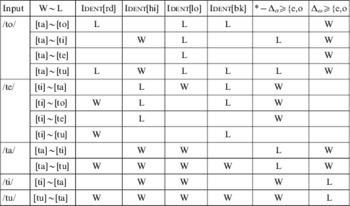
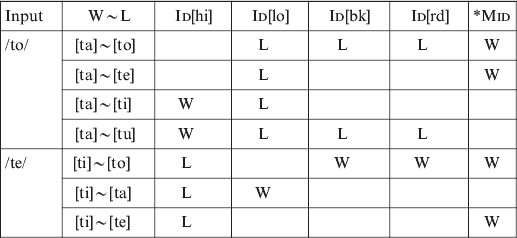
More importantly, Padgett's (Reference Padgett2004) analysis runs into empirical problems. First, his constraint *[+low jaw] excludes all non-high vowels except [ə] from unstressed position; as a consequence, he has to assume that phonetic [ɐ] in the first pretonic syllable is phonologically /ə/: a suggestion that appears inconsistent with the data adduced above, in Section 1.2. Second, Padgett (Reference Padgett2004) cannot provide an account of the input–output mappings, since no ranking of the Ident constraints (for the orthodox features [back], [high] and [round]) can produce the necessary patterns. He suggests that either neutralization to [i] following palatalized consonants is a phonetic effect, and that phonologically the result is [ə], or that Russian vowel reduction is an instance of opacity, which must be handled by a multi-level OT computation.
The first option is difficult to reconcile with the approach espoused in this paper because I assume that /ə/ is not part of the Russian vowel inventory, for reasons discussed at length above. Unfortunately experimental data that could settle this issue (for instance, an experiment along the lines of that by Barnes Reference Barnes2007 but involving /e/ and /i/) do not seem to be available.Footnote 26
As for the second option, I submit that the problem is largely due to the inadequacy of the featural specifications used by Padgett (Reference Padgett2004), which do not take into account the segments' phonological activity. However, once the representations are amended, as proposed in the present paper, dispersion-theoretic mechanisms are unnecessary, since featural markedness alone can provide an explanation of the pattern.
It must be emphasized that the criticism of the dispersion-based phonological account of Russian vowel reduction offered in this section does not constitute a rejection of a possible role for dispersion factors in the sound pattern. The phonological representations used in the present account are heavily underspecified, in that they clearly do not contain enough information for the phonetic implementation module to accurately place the vowels within the vowel space. It remains entirely possible, and in fact extremely likely in view of the findings of Padgett & Tabain (Reference Padgett and Tabain2005), that factors such as dispersion are to a significant degree responsible for ‘filling in the blanks’ in the representations, i.e. in providing those phonetic properties which cannot be said to follow from the output of the phonological module (see also Keating Reference Keating1988).Footnote 27
3.4 Element Theory
Hermans (Reference Hermans, Zybatow, Szucsich, Junghanns and Meyer2008) provides an account of Russian vowel reduction in terms of Element Theory and constraints on sonority for (non-)designated terminal elements as proposed by de Lacy (Reference de Lacy2006). The representations he uses bear an obvious affinity to the ones proposed in the present paper, in that mid vowels are assumed to be complex segments composed of several primes (elements), while peripheral vowels are simpler, consisting of just one element (see also Harris Reference Harris, Carr, Durand and Ewen2005). However, Hermans (Reference Hermans, Zybatow, Szucsich, Junghanns and Meyer2008) seems to assume that vowel features are assigned in a universal manner, possibly based on the segments' phonetic properties, rather than on the basis of their phonological behaviour in a given language. Thus, for example he assumes that [e] is cross-linguistically specified as {I,A;I}: that is, the head position is occupied by the elements {I} and {A}, and the dependent position is occupied by {I}.
Further, Hermans (Reference Hermans, Zybatow, Szucsich, Junghanns and Meyer2008) assumes a set of Presence and Absence constraints which correspond to de Lacy's (2006) constraints on the sonority of (non-)designated terminal elements. This is possible because, as is commonly assumed in Element Theory and related approaches, sonority is represented structurally, as the position of the {A} element. A crucial difference is that de Lacy (Reference de Lacy2006) essentially defines sonority in terms of height (barring the schwa and high central vowels), and thus for him the mid lax vowels [ɛ ɔ] are less sonorous than [a], while for Hermans (Reference Hermans, Zybatow, Szucsich, Junghanns and Meyer2008) these are the most sonorous vowels, since they contain the element {A} in both head and dependent positions.
In terms of triggering, Hermans (Reference Hermans, Zybatow, Szucsich, Junghanns and Meyer2008) essentially follows Crosswhite (Reference Crosswhite2001) in distinguishing between moderate and radical reduction, thus inheriting many of her problematic assumptions, in particular the presence of a phonological segment /ə/. Most importantly, his account predicts that /a/ should be impossible in unstressed syllables outside the first pretonic position, since the appearance of the {A} element is promoted by constraints applying to what he calls the head foot in the word. This is inconsistent with the results reported in Section 1.2 above.
The account by Hermans (Reference Hermans, Zybatow, Szucsich, Junghanns and Meyer2008) does have an advantage over that by Crosswhite (Reference Crosswhite2001) in that the externally grounded licensing constraint is replaced, as in the present paper, by a constraint which makes much more direct reference to feature structure. Hermans (Reference Hermans, Zybatow, Szucsich, Junghanns and Meyer2008) proposes that Russian mid vowels are lax and thus maximally sonorous, which renders them amenable to reduction: since highly sonorous segments are dispreferred in non-head positions, they will either attract stress (which, Hermans proposes, is the case in Dutch, thus implicitly rebutting de Lacy's criticism regarding factorial typology) or reduce easily. However, the assumption of laxness as a phonologically active feature in Russian is problematic. First, there is no contrast between tense and lax mid vowels, so if specifications are assigned economically, the assumption of redundant structure is unwarranted. Second, the phonetic implications are difficult to disentangle. Given that there is significant coarticulatory influence on Russian vowels from preceding consonants, and especially in the case of the front vowels (Evans-Romaine Reference Evans-Romaine1998, Padgett Reference Padgett, Hume and Johnson2001, Kochetov Reference Kochetov2002), formant data are to be interpreted with great care (see also Section 3.5 on this point). It seems that there is little positive evidence for the contrastive laxness of Standard Russian vowels. Examination of the formant plots and figures in several sources (Timberlake Reference Timberlake2004, Kniazev & Požarickaya Reference Kniazev and Požarickaya2005, Padgett & Tabain Reference Padgett and Tabain2005) seems to show that while /e/ is indeed a rather low vowel [ɛ], /o/ tends to be quite high, thus possibly [o].Footnote 28
Moreover, the assumption that mid lax vowels are maximally sonorous might be problematic in view of the data from languages such as Gujarati, where it is the low vowel does seem that is more sonorous in the relevant sense, i.e. acts as a better stress attractor, as in [pəhɛˈlã] ‘in the past’ (de Lacy 2006: Section 5.3.2.1).
To summarize, the account by Hermans (Reference Hermans, Zybatow, Szucsich, Junghanns and Meyer2008) incorporates a number of problematic assumptions, both in his analysis of the distribution of various reduction types (some of which he inherits from Crosswhite Reference Crosswhite, Crosswhite and McDonough2000) and in his representational proposals.
3.5 Universal specification and input–output mapping
Many of the proposals described in the previous subsections follow an essentially similar schema: first some mechanism is proposed to reduce the vowel inventory from five vowels to three or two, and then more orthodox faithfulness constraints are deployed to get the correct input–output mappings. The latter part often proves problematic, as acknowledged especially by Padgett (Reference Padgett2004). In this section I demonstrate that this problem is largely due to the assumption of universal feature specification and the uncritical use of features based on phonetic substance. Specifically, I take issue with the (often unspoken) assumption that segments which are phonetically similar in different languages have essentially the same, possibly fully specified, representation in terms of phonological features. I show that this creates two significant problems when faced with the input–output mappings involved in Russian vowel reduction.
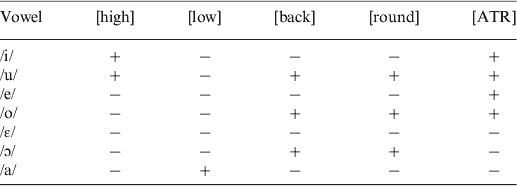
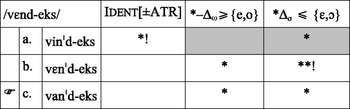
A recent proposal arguing at length for universal feature specifications is that by de Lacy (Reference de Lacy2006). To account for vowel reduction, he proposes a set of universally valid specifications (shown in Table 3) and a set of markedness constraints demanding highly sonorous vowels in designated terminal elements (‘heads’) and low-sonority vowels in non-designated ones. These markedness constraints can derive a triangular inventory /i u a/ easily by ranking *Δσ⩽{e,o} (i.e. the constraint penalizing nuclei with vowels less sonorous than /a/) above faithfulness, but below Ident[±high]. This is demonstrated in (43), which shows how vowel reduction is analysed in (Standard) Belarusian, a language closely related to Russian. In Belarusian, all non-high vowels are realized as [a] in unstressed syllables.
- (42)
(a) [ˈrɛʧka] ‘river (diminutive)’
(b) [raˈka] ‘river’
(c) [ˈmʲot] ‘honey’
(d) [mʲaˈdovɨ] ‘honey (adj.)’
(43) Vowel reduction in Belarusian (de Lacy Reference de Lacy2006: 321)
Table 3Universal featural specifications for vowels (de Lacy 2006).
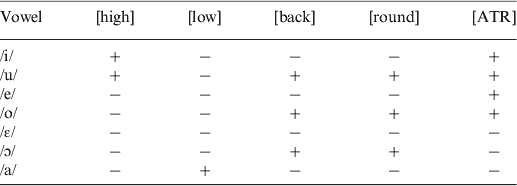
In (43), the stressed syllable is protected by positional faithfulness (as in the present account), high vowels are protected by high-ranking faithfulness to height features, while mid vowels are free to lower in order to satisfy the high-sonority requirement.
The crucial difference between languages such as Belarusian on the one hand and Russian on the other hand is that in the former, mid vowels behave identically with respect to height: in Belarusian, they uniformly lower. This effect is achieved by the high ranking of a faithfulness constraint to some feature which is then preserved in the input–output mapping: in the case of Belarusian, the feature is [high].
In Modern Standard Russian, of course, mid vowels behave differently: /e/ raises while /o/ lowers. This presents a very significant problem for the theory advanced by de Lacy (Reference de Lacy2006), which assumes that vowels have consistent featural representations cross-linguistically.
Let us assume that the Russian vowels are phonologically /e/ and /o/: above I have noted that it is very difficult to determine phonetically whether Russian mid vowels are /e o/ or /ɛ ɔ/, but this assumption will serve for the sake of the present argument. Let us also assume that the Russian /a/ is indeed /a/ and not /a/ (its [+back] correspondent). If we ignore the [ATR] feature, above argued to be redundant, there is no ranking which can account for the input–output mapping needed for Russian. This is demonstrated by the comparative tableau in Table 4; the result does not change if the mid vowels are /ɛ ɔ/ or the low vowel is /a/.
Comparative tableau for Russian vowel reduction ([ATR] excluded).

The tableau in Table 4 is inconsistent, in that the operation of fusion on all its rows yields a row consisting only of L symbols (for details of the procedure, see Prince Reference Prince, Carpenter, Coetzee and Lacy2002 and references therein). In other words, no ranking of the constraints enumerated in Table 4 can produce the desired outcome.
It is possible to provide an account of Russian reduction if /e/ and /o/ do not have symmetrical feature structures. Specifically, if it is assumed that Russian /e/ is [+ATR] and Russian /o/ is [−ATR] (i.e. /ɔ/), then the relevant neutralization patterns can be derived. The analysis is then essentially identical to the analysis of Bergüner Romansh proposed by de Lacy (2006), but with inventory gaps. In Bergüner Romansh, unstressed /e/ and /o/ raise while /ɛ/ and /ɔ/ lower. For this system to work, the constraint Ident[±ATR] must be ranked above all constraint driving the reduction of mid vowels. This is demonstrated in (44) and (45), which are reproduced from de Lacy (Reference de Lacy2006: 323).Footnote 29
(44) Reduction of /e/ in Bergüner Romansh
(45) Reduction of /ɛ/ in Bergüner Romansh
There are three objections to such an analysis of Modern Standard Russian. First, as argued above, from a phonetic perspective the assumption that the Russian inventory is /i e a ɔ u/ is not extremely well-founded: even if an asymmetry between the mid vowels exists, it goes in precisely the opposite direction.
Two other objections are more theory-oriented. First, the [ATR] feature is entirely redundant for the purposes of contrast: [−high −low] vowels are distinguished by [back] (and [round]).Footnote 30 Whether redundant features are phonologically active is a difficult question to answer, but see Dresher (Reference Dresher2009) for arguments that they are not. Third, the analysis in terms of [ATR] specifications goes against the grain of de Lacy's (Reference de Lacy2006) proposals, in that it essentially subverts Richness of the Base: if Russian is like Bergüner Romansh with a smaller inventory, we expect input /o/ to map to /u/ and input /ɛ/ to map to /a/. This statement is very difficult to falsify or verify (as with many Richness of the Base statements), but in any case the analysis of Russian using universal feature specifications crucially relies on the properties of the input representations, which is something that the whole research programme represented by de Lacy (Reference de Lacy2006) aims to avoid.
An anonymous JL referee points out that the problem shown in Table 4 is in large measure due to the nature of the constraints employed by de Lacy (Reference de Lacy2006). A relatively orthodox constraint or set of constraints militating against mid vowels, however represented, in weak position is satisfied whenever a non-mid vowel appears on the surface, and does not make reference to the relative sonority of the possible repairs. The constraints on sonority used by de Lacy (Reference de Lacy2006) prefer a certain kind of repair (uniform reduction or increase in sonority as appropriate), and this uniformity can only be defeated by featural identity constraints, as in the case of Bergüner Romansh, where [ɔ] appears to resist the sonority increase in order to ensure faithfulness to the value of [round].
The referee notes that if Russian /a/ is assumed to be [+back], then the ranking in (46) can account for the pattern of vowel reduction.
(46) Positional faithfulness >> Id[bk], *Mid >> Id[hi] >> Id[rd], Id[bk]
Under this ranking, the back mid vowel [o] cannot raise because of high-ranking faithfulness to [hi], so it lowers instead. The mid front vowel [e] cannot resist raising, because lowering would involve a violation of highly ranked Id[bk]. This is an attractive solution from the perspective of the OT grammar, but I suggest that it faces exactly the same problem in terms of universal feature specification as the account within de Lacy's (Reference de Lacy2006) system sketched above.
This is because just as the Bergüner-Romansh–style account of Russian has to rely on /e/ being [+ATR] and /o/ being [−ATR], so the solution shown in (46) can only work if /a/ is assumed to be [+back]: in fact, no ranking can derive the pattern if [a] is assumed to be [−back], as shown in Table 5. Both of these accounts crucially rely on some input specification.
No solution if /a/ is [−bk].
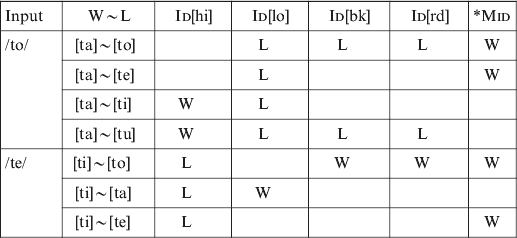
This is problematic both empirically and conceptually. From an empirical perspective, Russian [a] is clearly different from the low back unrounded vowel [a]: sources consistently describe it as a central vowel or even a relatively front vowel, with F2 values of around 500 Hz compared to about 200 Hz for back vowels such as [o] and [u]. What this means from a conceptual perspective is that for any of the solutions discussed in this section to work, one must necessarily assume that the learner has to abstract from some aspects of the relevant segments' phonetic realization and attend to the phonological pattern to identify the correct feature specification. In other words, the mapping between phonetic signal and phonological representations must be learned, and does not come ‘for free’ as part of Universal Grammar (de Boer Reference de Boer2001, Boersma & Hamann Reference Boersma and Hamann2008, Boersma Reference Boersma, Boersma and Hamann2009). Moreover, the learning must crucially make reference to the phonological patterning of the segments (Mielke Reference Mielke2007, Morén Reference Morén, Blaho, Bye and Krämer2007, Blaho Reference Blaho2008, Dresher Reference Dresher2009).
To summarize, in this section I have shown that accounts of vowel reduction in Russian which solely rely on the phonological computation to derive the observed sound pattern, without regard to the set-up of phonological representations, face significant empirical and conceptual problems. I suggest that representational variation across languages is not only real, but far from trivial, and cannot be entirely derived from the computation, at least as this latter is understood in commonly accepted approaches.Footnote 31
In the next section I reconsider the specific importance of the Parallel Structures Model for the present paper.
3.6 The relevance of PSM and substance-free phonology
So far, the intent of this paper has been threefold. I have started with defending a specific approach to the relationship between phonetics and phonology and exploring its implications for the analysis of vowel reduction in Modern Standard Russian, following work by Barnes (Reference Barnes2006, Reference Barnes2007). Second, I have presented an analysis couched within a specific theory of representation, namely the Parallel Structures Model of feature geometry (Morén Reference Morén2003, Reference Morén2006, Reference Morén, Blaho, Bye and Krämer2007). Third, I have defended a more general thesis, namely the non-trivial nature of phonological specification.
In the last case, much of my argumentation has been empirical, in that I have shown the challenges met by some previous proposals couched in an approach which sees all phonological specification as more or less trivially derived from the phonetics. However, I have not yet demonstrated the superiority of the PSM. The question is the subject of this section.Footnote 32
The PSM is certainly not the only theory that can provide an empirically accurate account of vowel reduction in Russian. For instance, as discussed in the preceding section, such an account can be achieved using relatively orthodox features, even though it requires significant latitude in interpreting the features' possible phonetic content. More to the point, Crosswhite (Reference Crosswhite, Crosswhite and McDonough2000) achieves the same result using only standard Sound-Pattern-of-English-style (SPE-style) features.Footnote 33
I submit that the PSM has a number of significant advantages. They might not seem compelling on the relatively simple set of data such as those found in Russian vowel reduction, but nevertheless they do exist.
One such advantage is privativity. As discussed above, the PSM uses only privative features. With respect to Russian vowel reduction, this enforces one radical departure from SPE-style featural theories: mid vowels must perforce have a special feature that sets them apart from the peripheral vowels. Without recourse to negative values, it is simply impossible to formulate a non-descriptive constraint to militate against mid vowels without recourse to a third factor such as phonetic grounding (Crosswhite Reference Crosswhite, Crosswhite and McDonough2000) or sonority (de Lacy Reference de Lacy2006). However, since the PSM makes the representation of a ‘mid vowel’ feature available to the computation, it is possible to formulate the relevant constraint in terms of a constraint schema that is independently necessary, namely *[F] constraints: as discussed above, no approach to OT assuming Richness of the Base can do without this type of constraint.
The approach employed by Crosswhite (Reference Crosswhite, Crosswhite and McDonough2000) is seemingly simpler: since she makes no commitments to privativity, she can use SPE-style features for the markedness constraint. Moreover, her rankings produce the desired result. Nevertheless, her account is not necessarily more parsimonious. First, as I argued above in Section 3.2, her constraint is essentially descriptive from a purely phonological standpoint. A second, and more serious, objection is relevant for her approach to computation. Instead of Ident, she follows Zoll (Reference Zoll1998a) in using separate Max and Dep constraints for plus and minus values of features. Given that the rankings for these are independent, her system is in fact much more complex than a privative approach: in effect, instead of a system which only distinguishes between a feature and its absence, the computation operates on pairs of mutually incompatible privative features, of which at least one must always be present. I submit that the PSM approach is conceptually superior, since it does not require these additional stipulations.
A second advantage of PSM arguably lies in its embrace of feature geometry. Specifically, I argued in Section 3.1 that an approach based on Unified Feature Theory (Clements Reference Clements1991, Clements & Hume Reference Clements, Hume and Goldsmith1995) (or approaches that are similar in this respect such as Element Theory) provides a more straightforward account of the association between palatalized consonants and vowel reduction to [i] than a traditional SPE-style feature set.
Nevertheless, it is certainly true that PSM shares both advantages and disadvantages with several other theories, and it remains quite possible that other frameworks allow for a similar account of the Russian data. For instance, Modified Contrastive Specification (e.g. Dresher et al. Reference Dresher, Piggott and Rice1994, Hall Reference Hall2007, Dresher Reference Dresher2009) makes it possible to derive the inventory compatible with the account of Russian data sketched in the previous section by assuming the feature hierarchy shown in Figure 6; it should be possible to do in any theory where the assignment of phonological specifications is based on contrast. I do not believe this detracts from the other major points made in this paper: for instance, even if the solution in Figure 6 is adopted instead of one based on PSM, sufficient latitude must be allowed in the phonetic interpretation of phonological features to interpret phonologically [+back] [a] as central, which means that non-trivial phonetic implementation is required.Footnote 34
Possible contrastive hierarchy for Russian vowels.

A very important objection against substance-free approaches in general and against the PSM in particular involves their apparent non-restrictiveness. Given that the mapping between phonological representations and phonetic substance is said to be arbitrary, it is trivial to think of systems which the PSM ‘predicts’ to be possible but which are unattested (and highly unlikely to be attested).Footnote 35 This problem comes in addition to the ‘pathologies’ that PSM shares by virtue of being embedded in an OT-based computation. For instance, the use of positional faithfulness to implement vowel reduction makes the present account open to the criticism levelled at Crosswhite (Reference Crosswhite2001) by de Lacy (Reference de Lacy2006) : it is predicted that in some languages stress placement may be disrupted in order to protect ‘weak’ features; in the case of Russian, the weak elements are mid vowels, which produces a typologically implausible pattern (though we have seen that de Lacy's sonority-based alternative is not without problems).
I believe, however, that, given the wider perspective espoused in this paper, this lack of restrictiveness vis-à-vis standard OT approaches is not necessarily a fatal flaw. The standard OT approach achieves restrictiveness by locating all variation in the constraint ranking and assuming that all other components involved in the computation of phonological symbols are trivial. Yet if we assume that variation is driven by a number of aspects of human linguistic competence, many of which are learned, the attestation of sound patterns becomes influenced by more factors than just the constraint ranking.
One such widely recognized ‘filter’ is diachrony (Ohala Reference Ohala1981, Kavitskaya Reference Kavitskaya2002, Blevins Reference Blevins2005, Barnes Reference Barnes2006, Yu Reference Yu2007): a ‘crazy’ pattern that is predicted to exist by a theory of phonology may be unattested simply because its appearance requires a series of events with very low cumulative probability (see Harris Reference Harris and Good2008 for an example from morphosyntax). Distinguishing between a pattern that is unattested because it is not permitted by the phonological computation and one that is unattested because it is unlikely to arise, often for ‘functional’ (phonetic) reasons, is extremely difficult.
Second, as emphasized by Reiss (Reference Reiss, Reiss and Ramchand2007), some languages which the computational system predicts to be possible may be unlearnable. One possible reason is that the ambient data produced by the relevant grammar are indistinguishable (in the relevant respects) from those which lead the acquisition device to always converge on a different mental grammar: for concrete implementation of similar ideas, see Alderete (Reference Alderete2008), Heinz (Reference Heinz2009).
I suggest, therefore, that while the PSM and similar models may be less restrictive than standard OT approaches with regard to the cardinality of the set of grammars allowed by the theory, the disadvantage is not that great if a substance-free approach is embedded into a more general theory of grammar armed with a better understanding of the functional pressures, learnability mechanisms and consequent diachronic biases that all drive the attestation patterns of phonological phenomena; what disadvantage remains can hopefully be offset by better conceptual and explanatory adequacy. The construction of such a grand theory must of course remain the subject of ongoing research.
Summing up, in this section I have argued that while the use of the Parallel Structures Model is not absolutely necessary to express many of the insights I have proposed in the paper, it nevertheless has a number of important advantages over its competitors. In particular, I have suggested that the set of assumptions labelled ‘substance-free phonology’, which includes language-particular phonological representation and an – in principle – arbitrary mapping between phonology and phonetics, is both empirically and conceptually superior to a more traditional approach which sees phonological representations as a trivial ‘continuation’ of phonetics. If that is so, possible differences in representational formalisms should not detract one of the advantages offered by a substance-free approach as formulated in the present paper.
4. Conclusion
The purpose of this paper has been twofold. On the empirical side, I have presented evidence to corroborate the view of Russian vowel reduction first envisaged by Barnes (Reference Barnes2006, Reference Barnes2007). I have argued that the ‘radical’ reduction obtaining in most unstressed syllables does not involve any symbolic computation that is different from that employed in ‘moderate’ reduction positions.
The data adduced in this paper support Barnes' (Reference Barnes2006) proposal with respect to the division of labour between the phonetic and phonological modules of grammar. In his discussion of vowel reduction, Barnes (Reference Barnes2006) argues that natural phonetic tendencies, such as those related to the cramping of the vowel space, tend to become phonologized, in that the resultant sound patterns at some point become ‘detached’ from their original phonetic motivation, and must be accounted for purely in terms of the phonological computation (as proposed by Hyman Reference Hyman and Juilland1976; see also the discussion in Kingston Reference Kingston and de Lacy2007). The existence of two ‘vowel reduction’ processes in a single language provides further evidence for the independence of the phonetic and phonological modules of grammar (see Bermúdez-Otero Reference Bermúdez-Otero2010, who calls this phenomenon ‘rule scattering’, following Robinson Reference Robinson1976).
Thus, I have proposed that a proper understanding of the processes involved in vowel reduction in Russian presupposes a clearer separation between phonetic and phonological phenomena, and a non-trivial phonetics–phonology interface (Keating Reference Keating1990b, Kingston & Diehl Reference Kingston and Diehl1994). Once these are in place, the phenomenon of vowel reduction in Russian can be understood in terms of a very simple theory of markedness, as Section 2 demonstrates.
Specifically, I have argued that if phonological representations are set up to reflect the patterning of segments within a given language, the computational operations needed to derive the vowel reduction patterns can be accounted for using very basic faithfulness and markedness constraints on features, rather than reduction-specific constraints making reference to externally grounded phenomena such as sonority or vowel space characteristics. This approach to representations also greatly simplifies the description of the input–output mappings involved in Russian vowel reduction, avoiding many of the pitfalls encountered by a more computationally oriented approach.
Overall, the paper can thus be taken as an argument for a proper division of labour in phonological theory. It presupposes that phonetic factors do not have a direct role to play in much of the phonological computation, that is, that phonology as a grammatical module is largely autonomous and is determined by phonetics only inasmuch as phonological sound patterns are a ‘phonologization’ of phonetic tendencies (Anderson Reference Anderson1981). On the other hand, the autonomous nature of phonology manifests itself in the assumption that phonological representations are not more or less trivially ‘read off’ the phonetic substance, but rather are constructed (presumably both by the learner and by the analyst) on the basis of explicit evidence provided by the sound patterns of the language in question (for a similar view, see Mielke Reference Mielke2007). I hope to have shown in this paper that such an approach provides an account of the facts of vowel reduction in Modern Russian that is relatively simple but also avoids many empirical and conceptual pitfalls encountered by a more phonetically-oriented view (as shown in Section 3), and thus to have provided an argument for the superiority of a substance-free approach to phonology.
 ləʃ ‘finger’ (Lutta