
Introduction
Growing demand for robots working alongside humans requires significant improvements to the human–robot interface, which is presently limited by rigid components of the conventional robotic systems. Incorporating soft materials into robot design may provide the much-needed compliance, allowing nature-like environment-adaptive soft robots to be engineered. The key challenge in soft-material robotics presently stems from the lack of materials combining actuation and sensing as an inherent responsive property.[Reference Rus and Tolley1] Most of the existing soft actuation solutions, exerting both high stress and high strain,[Reference Miriyev, Stack and Lipson2] are based either on hydraulic and pneumatic devices, inflating and deflating elastomer bladders [fluidic elastomer actuators (FEA),[Reference Sridar, Majeika, Schaffer, Bowers, Ueda, Barth, Sorrells, Wu, Hunt and Popovic3–Reference De Greef, Lambert and Delchambre8] pneumatic artificial muscles (PAM),[Reference Chou and Hannaford9–Reference Wirekoh and Park11] or on dielectric elastomer actuators (DEAs)].[Reference Nguyen, Phung, Nguyen, Jung and Choi12–Reference Gu, Zhu, Zhu and Zhu14]
Unlike rigid robotic systems, FEAs and PAMs are able to withstand mechanical impacts.[Reference Martinez, Glavan, Keplinger, Oyetibo and Whitesides15] However, as they are prone to physical damage, such as perforations and cuts, their inflating ability is limited and their actuation functionality is compromised.[Reference Martinez, Glavan, Keplinger, Oyetibo and Whitesides15, Reference Terryn, Mathijssen, Brancart, Lefeber, Van Assche and Vanderborght16] Purely elastomeric pneumatic channels were reported to weaken during repeated inflating even in the absence of punctures.[Reference Shepherd, Stokes, Nunes and Whitesides17] This shortcoming has led to the development of bio-inspired self-healing solutions, allowing punctures to be sealed, thereby extending the actuator functionality.[Reference Bilodeau and Kramer18] Self-healing methods for these soft actuators include, among others, blending of uncured silicone matrix with polyaramid fibers,[Reference Shepherd, Stokes, Nunes and Whitesides17] shaping Diels–Adler polymers into inflatable chambers,[Reference Terryn, Mathijssen, Brancart, Lefeber, Van Assche and Vanderborght16] and incorporating excess UV-curable resin into 3D-printed hydraulic elastomer actuators.[Reference Bilodeau and Kramer18]
DEAs are also prone to physical damage, whereby small externally introduced or manufacturing-related defects may lead to failure. In these actuators, high voltages (typically exceeding 1 kV) are utilized to induce an electromechanical response in an elastomeric membrane, which is sandwiched between two compliant electrodes. This makes them prone to failure by dielectric breakdown, especially at the defect locations. The demand for solutions extending the DEA life cycles has led to the development of fault-tolerant electrodes, such as those fabricated by spray-coating of dielectrics by single-walled carbon nanotubes, limiting damage to local material degradation.[Reference Bilodeau and Kramer18] In addition to fault-tolerant compliant electrodes, self-healing material systems for DEAs include, among others, self-healing silicone elastomers resistant to both physical and electrical damage by reassembly of ionic bonds,[Reference Bilodeau and Kramer18] and a two-phase dielectric layer made of silicone sponge filled with silicone oil for self-healing of physically-damaged regions.[Reference Hunt, McKay and Anderson19] Recently reported hydraulically amplified self-healing electrostatic actuators[Reference Acome, Mitchell, Morrissey, Emmett, Benjamin, King, Radakovitz and Keplinger20] utilize liquid dielectrics and locally generate hydraulic pressure via electrostatic forces, allowing self-healing and extension of functionality following dielectric breakdown.
Despite the described advances, neither hydraulic/pneumatic nor dielectric elastomer actuation solutions are optimal for soft robotic applications. FEAs and PAMs require compressors and pressure-regulation equipment, which tend to be rigid and are prohibitively large in size. On the other hand, DEAs require high voltage converters and are subject to safety limitations.[Reference Pourazadi, Shagerdmootaab, Chan, Moallem and Menon21] Recently, we reported on the development of soft, robust, self-contained composite material–actuator, exhibiting high actuation stress along with very high actuation strain[Reference Miriyev, Stack and Lipson2] This material consists of silicone rubber matrix throughout which ethanol is distributed in micron-scale pockets. The material may be electrically actuated through Joule heating of a resistive wire at a voltage as low as 8 V. The material was characterized and operative recommendations for its application as soft material–actuator and artificial muscle were formulated.[Reference Miriyev, Caires and Lipson22] One of the key drawbacks of this material is its degradation through escape of ethanol. Owing to the demand for a simple technique that would extend the soft material–actuator life cycle after ethanol depletion, we propose a method for its rejuvenation and extension of its functionality by saturation with ethanol through immersion. As a part of this investigation, we studied the saturation kinetics, and determined the immersion duration that would lead to full saturation for actuators of different radii. We also assessed the effect of the proposed rejuvenation method on the mechanical properties and actuation performance of the material–actuator. The rejuvenation method was successfully applied on a soft robot developed specifically for this study, which was actuated under extreme conditions and its performance compared with that of an untreated robot.
Materials and methods
Materials
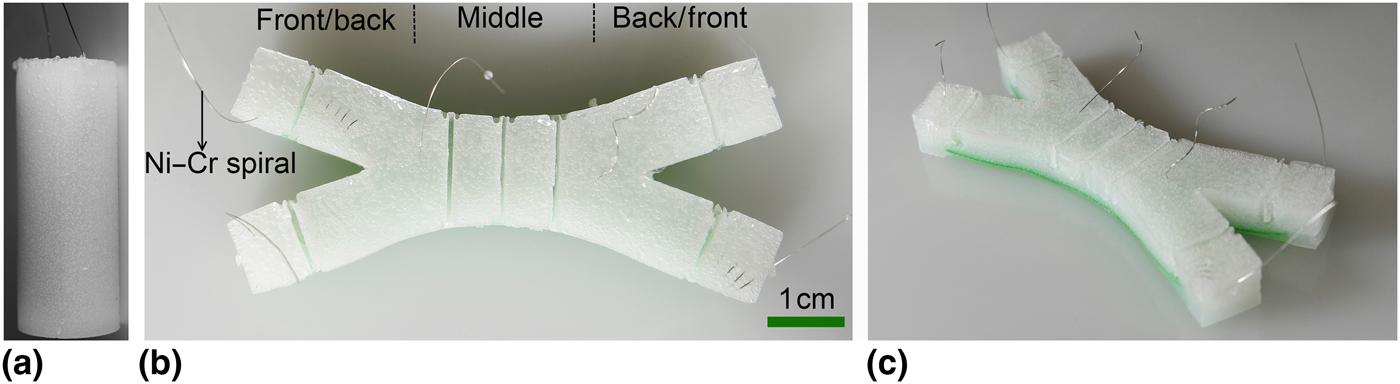
Platinum-catalyzed two-part silicone rubber Ecoflex 00–50 (Smooth-On, PA, USA) was used as a matrix material (80 vol%), whereby 20 vol% ethanol (≥99.5% pure; Sigma Aldrich, MO, USA) was utilized as an active phase change material. The material–actuator preparation process described in[Reference Miriyev, Stack and Lipson2] was applied. Briefly, specimens for the mechanical testing were prepared by casting the mixed composite material in molds of 50 mm length and 20 mm diameter with preinstalled double-coiled Ni–Cr resistive wire [Fig. 1(a)], after which the mold lid was closed. After 3 h, the mold lid was opened and the ready-specimen was removed. The cast specimen was inserted into a braided mash sleeving of 25.4 mm diameter, and two plastic zip ties were placed close to the composite specimen edges to ensure that it is firmly harnessed inside the net, thus preventing undesirable axial expansion during actuation. This procedure was described in detail in.[Reference Miriyev, Stack and Lipson2, Reference Miriyev, Caires and Lipson22] Four specimens were prepared for each type of testing.
Soft material–actuator and soft robot designed for the rejuvenation experiments. (a) Cylindrical soft material–actuator (radius 1 cm); (b) soft robot, top view; (c) soft robot, isometric view.

Imaging
Micro-CT (Mediso, Boston MA), a small-animal computer tomography (CT) scanner with an image resolution of 100 µm, was used for x-ray CT of the internal structure of the actuator material. The images in the Fig. 6 show cross-section of the top view at the mid-height level of the soft robot specimen. These images reflect the structure of the entire specimen volume.
Saturation experiments
For the saturation experiments, cylindrical specimens [of 50 mm length and 20 mm diameter, shown Fig. 1(a)] were exhausted by cyclic actuation to 15% axial contraction[Reference Miriyev, Caires and Lipson22] in the Instron Dynamight 8841 hydraulic axial test machine (MA, USA), until no further actuation ability was detected. In this context, “exhausting” refers to prolonged actuation that results in ethanol depletion from the silicone-ethanol material–actuator leading to complete cessation of actuation. The specimens were subsequently immersed in ethanol within a closed plastic container for a required time. At each measuring time point, a batch of specimens was extracted from the container, held for 10 s in the air to allow evaporation of excess dripping ethanol, and its mass was measured using precise scales (Prime Scales, Ontario, CA; model PS B203, maximal weight 200 g, accuracy ±0.001 g). Soft robot specimen exhaustion tests were conducted using actuation in severe conditions, achieved by prolonged holding times (10 min) at the robot's highest bi-morph bent position, possible for the specific run. Soft material saturation was performed by immersing robots in ethanol within a closed container for 24 h.
Mechanical testing
Instron Dynamight 8841 hydraulic axial test machine (MA, USA; load capacity 125 N) served as the mechanical properties evaluation apparatus. Mechanical tests were performed on specimens actuated using 15 V voltage and 1 A current. The ability of the artificial muscle to reach 15% axial contraction was tested and the contraction (under a constant force of 2 N) was plotted as a function of the experiment duration.
Soft robot
Soft walker robot [Figs. 1(b) and 1(c)] was designed for use in the actuator material rejuvenation tests. The robot was fabricated by casting the actuator material into a plastic mold with a thin cloth layer placed at the bottom. The non-stretchable green cloth provides flexibility and allows bi-morph bending of the robot at actuation. The robot has three Ni–Cr spirals, distributed between its front, middle, and back to provide electrically-driven (Joule) heating using 15 V, 1 A, supplied by three distinct power supplies.
Results and discussion
Immersing the material–actuator in ethanol facilitated the diffusion of the latter into silicone rubber. Since, during immersion, the amount of ethanol in silicone continuously increases, the diffusion process may be described as a non-steady state mass transfer, given by Fick's second law:
 $$\displaystyle{{\partial C} \over {\partial t}} = D_{{\rm Ethanol}}^{{\rm Silicone}} \displaystyle{{\partial ^2 C} \over {\partial x^2}}, $$
where  $D_{{\rm Ethanol}}^{{\rm Silicone}} $ denotes coefficient of diffusion of ethanol in silicone. According to the data reported in pertinent literature,[Reference Tamai, Tanaka and Nakanishi23, Reference Okamoto, Nishioka, Tsuru, Sasaki, Tanaka and Kita24]
 $D_{{\rm Ethanol}}^{{\rm Silicone}} $ = 4.5 10−6 cm2/s. Comyn[Reference Comyn25] used the well-known Crank's solution[Reference Crank26] to describe sorption of small molecules in polymers. In this model, polymer film of a 2l thickness was immersed in a liquid penetrant bath, and the ratio of the penetrant concentration C t in the polymer at each time point t to the saturation concentration C ∞ was given. Diffusion of dye into the cylindrical fiber of radius r was described as a non-steady state mass transfer, and was described by the following equation:[Reference Jones27–Reference Karimi29]
 $$\eqalign{\displaystyle{{C_t} \over {C_\infty}} & = 1 - (0.692[\exp ( - 5.785Dt/r^2 ] \cr & \hskip-6pt + 0.190[\exp ( - 30.5Dt/r^2 ] + 0.0775[\exp ( - 74.9Dt/r^2 ] \cr & \hskip-6pt + 0.0415[\exp ( - 139Dt/r^2 ] + 0.0258[\exp ( - 223Dt/r^2 ] +... )} $$
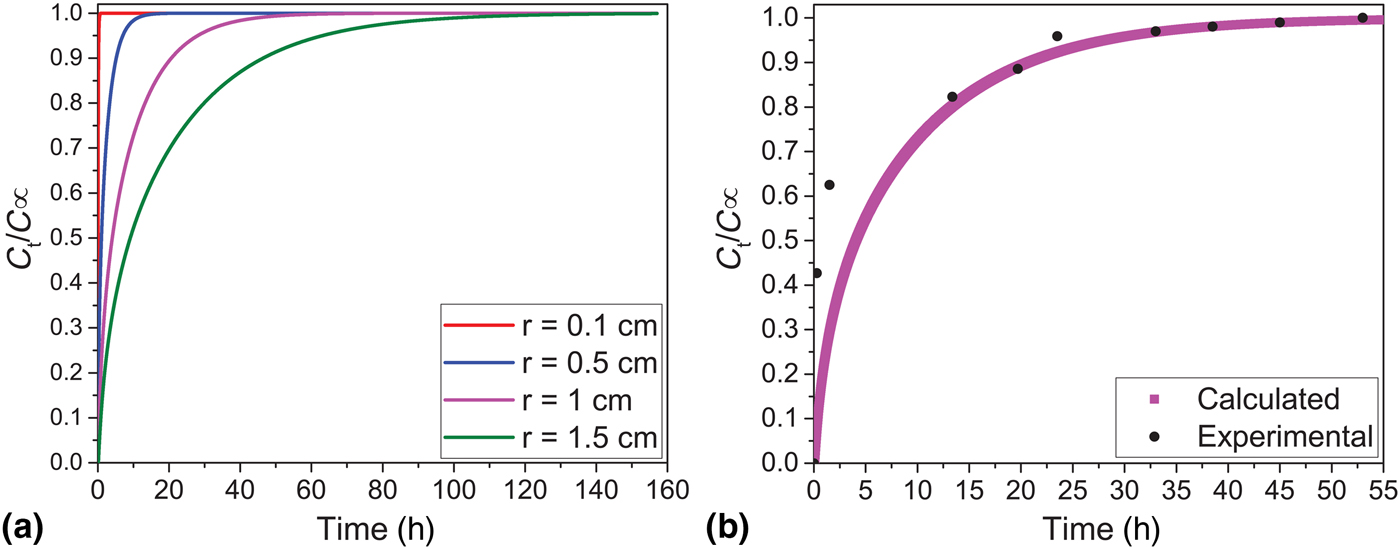
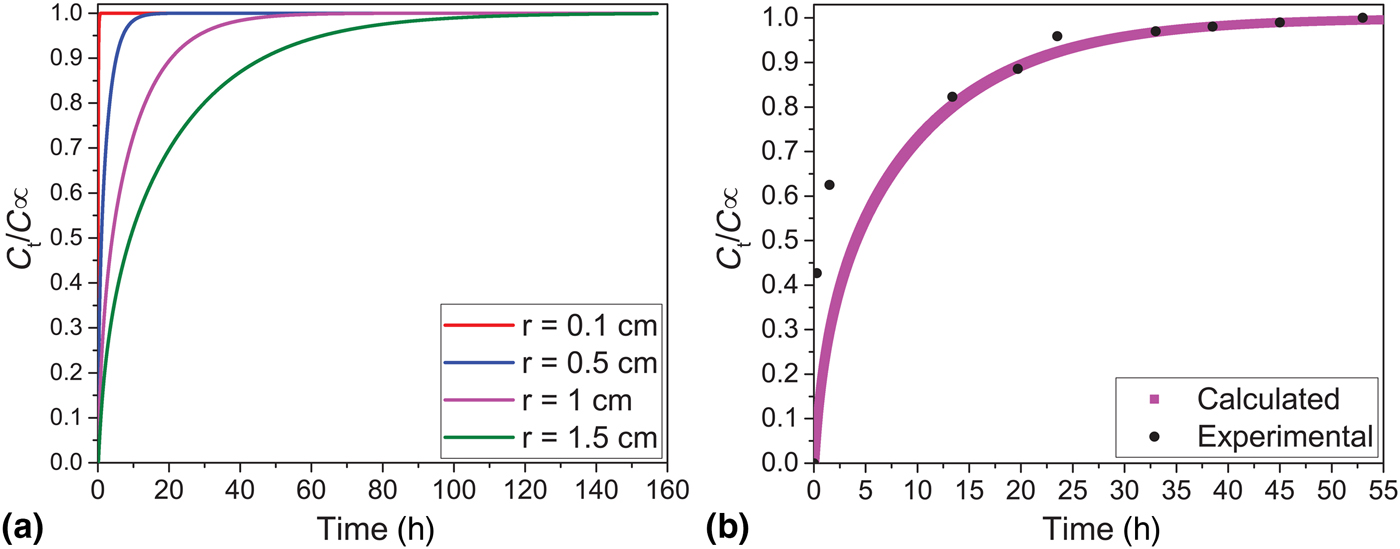
Diffusion of dye in a fiber is similar to our case of ethanol diffusion in a silicone cylinder. Thus, using this equation and the known  $D_{{\rm Ethanol}}^{{\rm Silicone}} $ value, we calculated the saturation profiles for silicone cylinders of various radii, and compared the findings with the experimental results obtained for a cylinder of radius r = 1 cm.
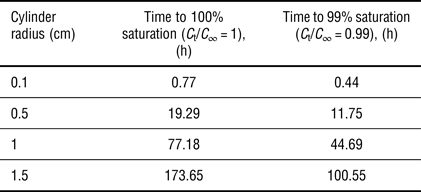
Figure 2(a) shows that, as expected, as the cylinder radius increases, so does the time required for full silicone saturation with ethanol (C t/C∞ = 1). Figure 2(b) shows a good agreement between the experimental data pertaining to the immersion of a cylindrical material–actuator specimen of 1 cm radius in ethanol and the calculated data for the same radius, confirming the validity of the model. Time to full saturation (100%) and that required for 99% saturation (C t/C ∞ = 0.99), derived from the graph plotted in Fig. 2(a) for cylinders of different radii, is shown in Table I. It may be seen that the cylinder radius is proportional to the square root of the saturation time, which varies from 0.77 h for a cylinder of 0.1 cm radius, to about 173.65 h for a 1.5 cm radius material. It is also evident that the pre-asymptotic part of all the curves in Fig. 2(a), ranging from 99% to 100% saturation, constituted about 40% of the total saturation time. While the practical difference between 99% and 100% saturation may be minimal, using 99% target in application design may result in significant time and resource savings.
Saturation profile of ethanol in the cylinder-shaped soft material–actuator. (a) Calculated profiles for various cylinder radii; (b) the calculated and experimental data for r = 1 cm.
Time required for 100% (C t/C ∞ = 1) and 99% (C t/C ∞ = 0.99) saturation for various cylinder radii.

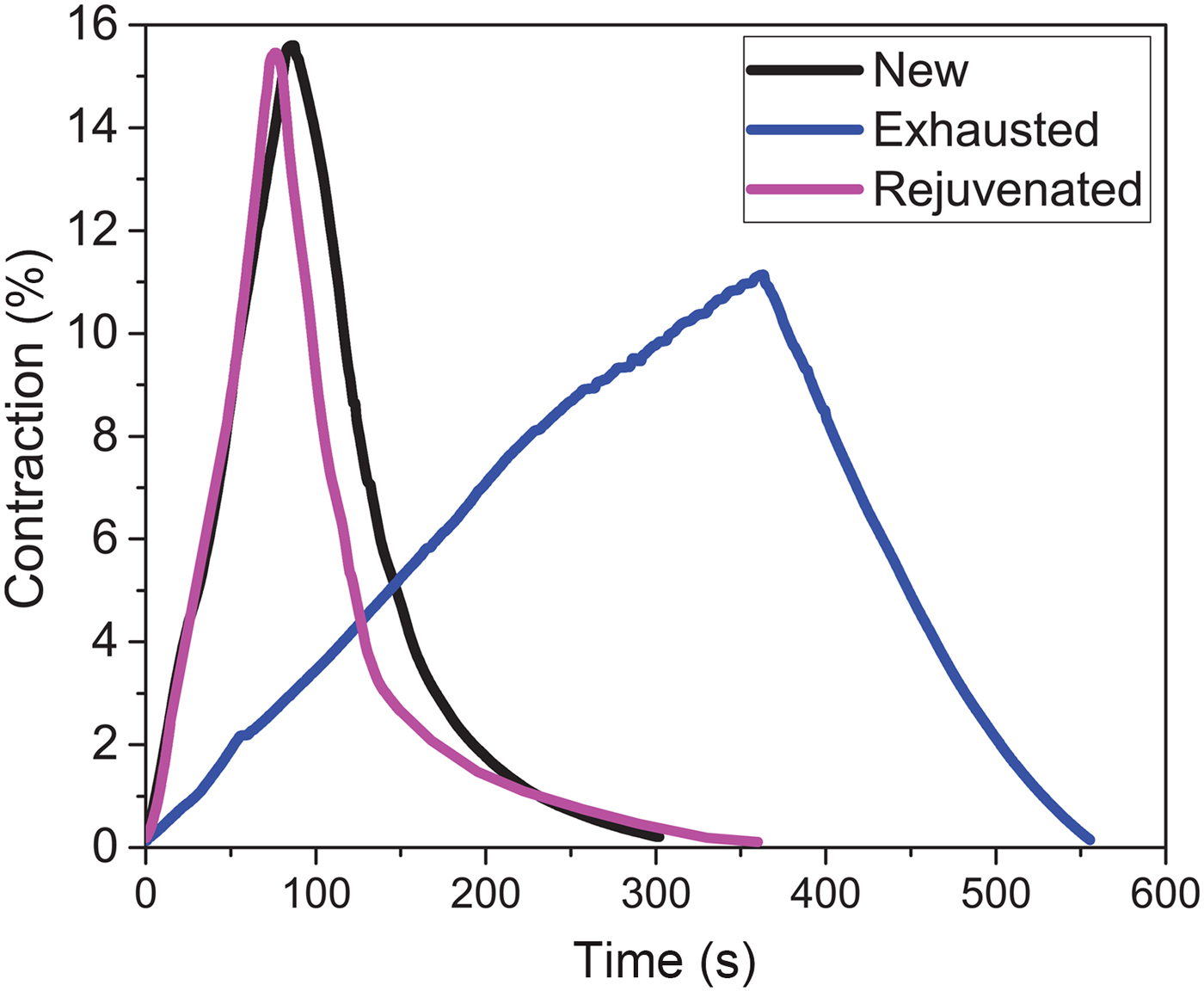
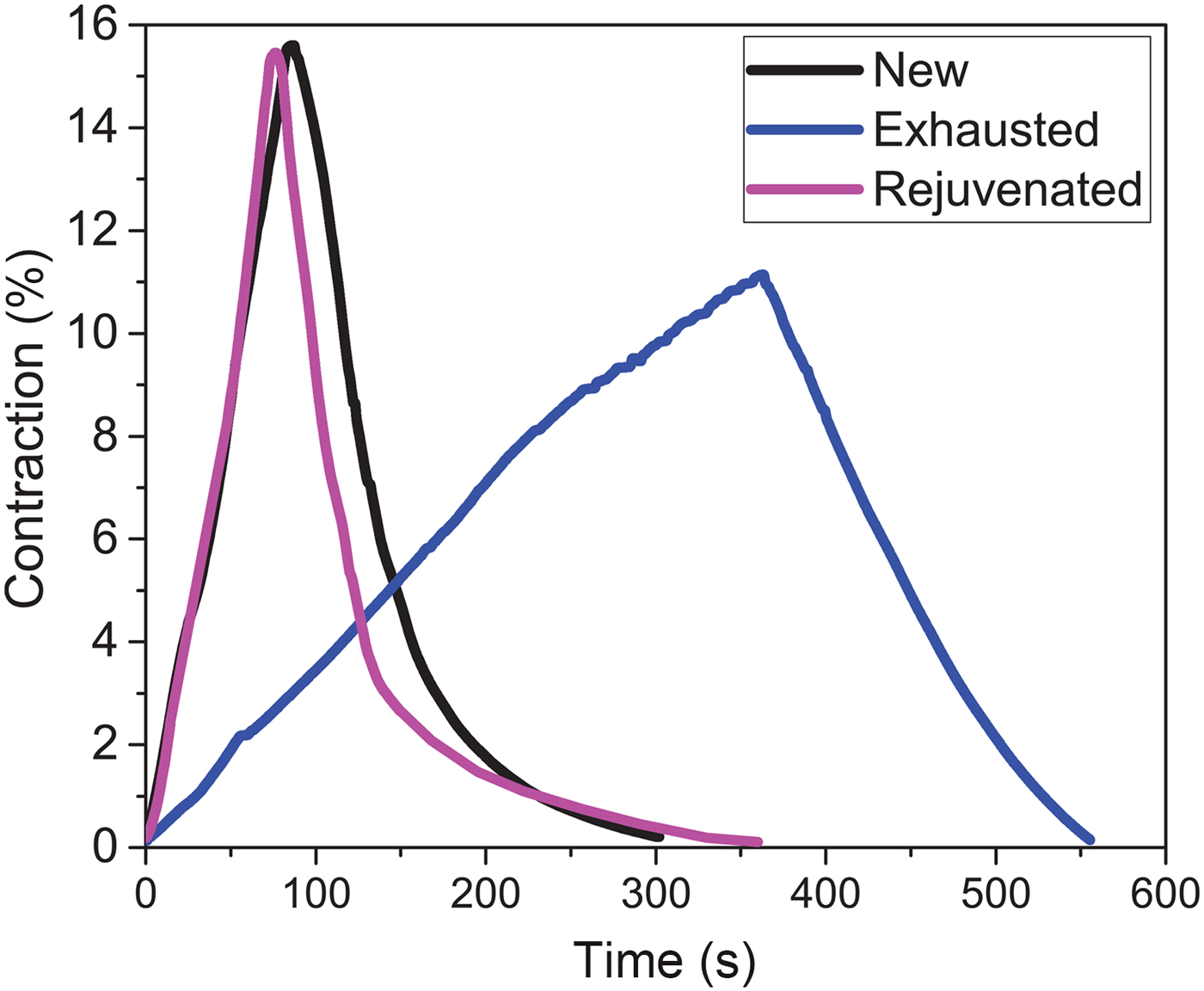
In order to test the saturation effect on the mechanical properties of the material–actuator, rejuvenation experiments were performed on cylindrical actuators of 1 cm radius. Material–actuator specimens were prepared in a configuration of the artificial muscle[Reference Miriyev, Stack and Lipson2, Reference Miriyev, Caires and Lipson22] and axial contraction of 15% was induced in each one.[Reference Miriyev, Caires and Lipson22] Fig. 3 shows a sharp peak for a new specimen, indicating that the target 15% contraction was achieved in about 100 s, similar to the results reported in.[Reference Miriyev, Stack and Lipson2] However, when a specimen was exhausted by prolonged cyclic actuation, it could not attain the required 15% contraction. Specifically, it exhibited a maximal strain of about 11% in about 6 min, resulting in non-linear and oscillating contraction − time curve. This phenomenon may be attributed to ethanol escape from the composite during prolonged actuation.[Reference Miriyev, Stack and Lipson2, Reference Miriyev, Caires and Lipson22] After immersing in ethanol for 48 h, which was sufficient for attaining 99% saturation according to Table I, the performance of the rejuvenated material–actuator was similar to that of the new specimen. This experiment demonstrates the beneficial effect of ethanol saturation on mechanical properties of the soft material–actuators.
Axial contraction cycle of new, exhausted, and rejuvenated soft artificial muscle.
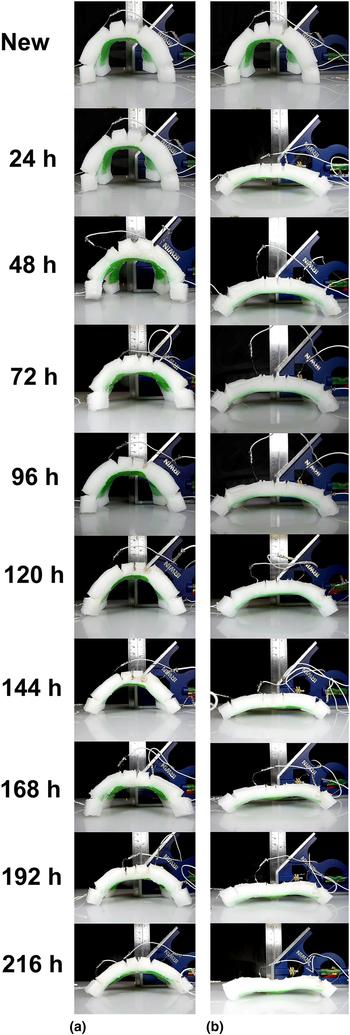
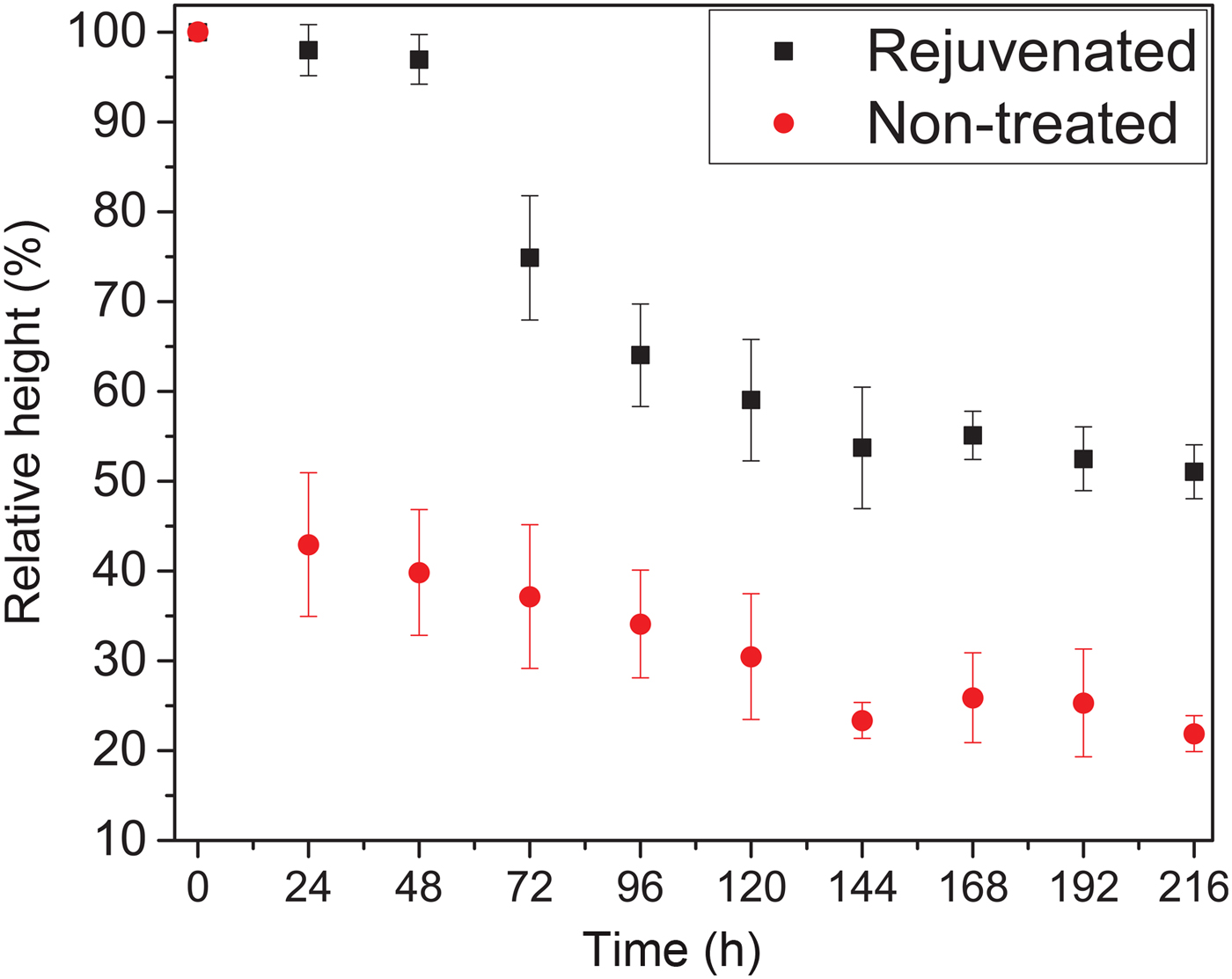
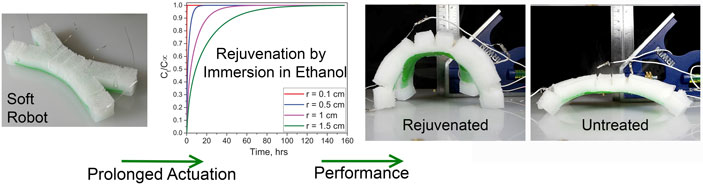
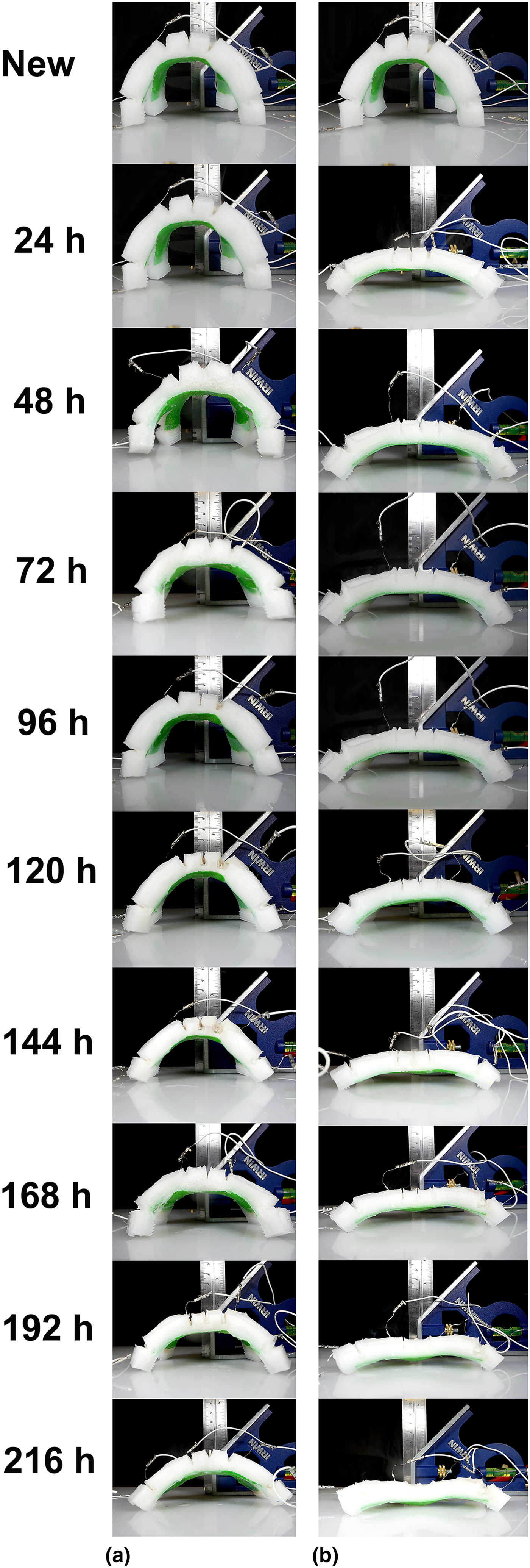
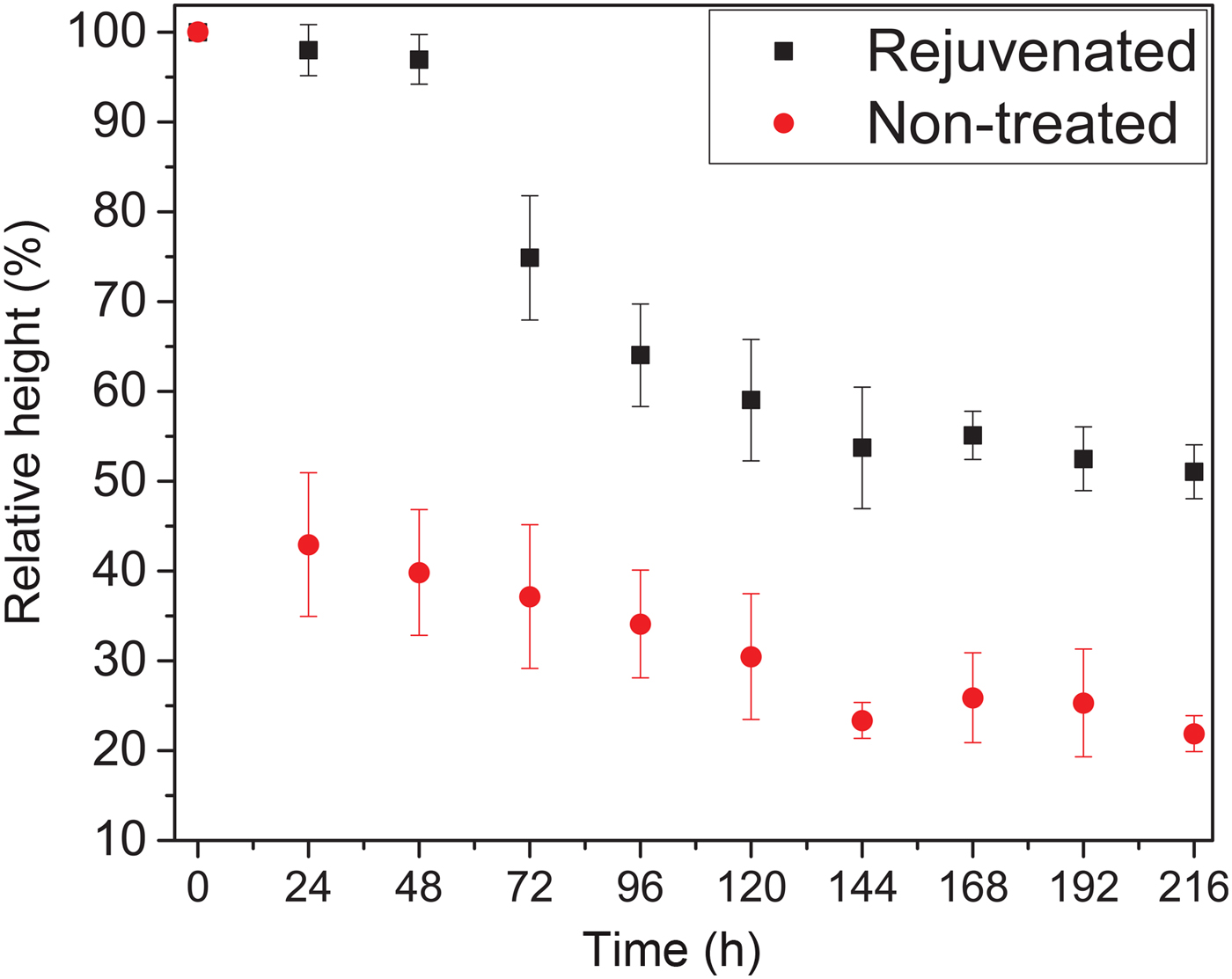
We applied this rejuvenating method on a soft robot specifically designed for the purpose of the present study. The robot's motion is achieved through electrically-actuated bi-morph bending of soft material comprising its body. The thin cloth layer placed at its bottom facilitates bi-morph bending (robot locomotion is shown in Supplementary Video 1). For comparison, the robot was actuated and kept in its maximal bending position for 10 min, thus creating extreme conditions, whereby prolonged actuation cycle would markedly increase its temperature, resulting in significant ethanol escape. After actuation, the robot was immersed in ethanol in a closed container. Although the robot is not of a cylindrical shape, its design fits the 0.5 cm radius cylinder model well. Thus, according to the curve shown in Fig. 2(a) and the data presented in Table I (≥19.29 h), and for the convenience of experimental periodicity, the robots were immersed in ethanol for 24 h. We repeated the experiment daily over a 9-day period (whereby an untreated specimen was compared with the one that was repeatedly rejuvenated, thus providing data for up to 216 h of rejuvenation). Figure 4 shows the comparative profile images of the soft robots taken at the maximal bi-morph bending height (the apex of the arch formed at bending) for both exhausted and rejuvenated robots over the 10-day experimental period (new specimen and nine rejuvenation cycles). Comparison between the performance of the rejuvenated and untreated robots is demonstrated also in the Supplementary Video 2. Figure 5 shows the change in the maximal bi-morph-bent height, relative to that of the new robot, for the exhausted and the rejuvenated soft robots over the 10-day experimental period. As can be seen from the images shown in Fig. 4, the rejuvenated robot performance was superior to that of the exhausted one at each measuring time point. The non-rejuvenated robots’ performance declined to below 50% after the first exhausting run, decreasing to below 25% at the end of the 10-day experiment (Fig. 5). On the other hand, the rejuvenated robots retained their full performance capability for three rejuvenation cycles, followed by a decrease to about 75% at the fourth rejuvenation cycle. Towards the end of the experiment, the performance of the rejuvenated robots gradually decreased to the asymptotic value of about 55%.
Comparative profile images taken at the maximal bi-morph bending height for both (a) rejuvenated and (b) untreated specimens during the 216-h rejuvenation experiment period.
Maximal bi-morph-bent height (relative to that of the new robot) of the exhausted and the rejuvenated soft robots along the rejuvenation experiment.
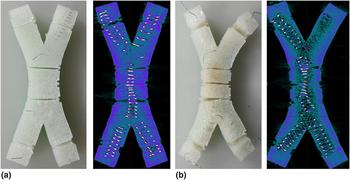
The decline in the performance of the rejuvenated robots may be attributed to the severe conditions of the rejuvenation experiments and the consequent silicone degradation. During prolonged actuation, ethanol escapes from the material–actuator and more time is required to achieve the same performance. As the latter requires longer heating, the resulting heat buildup leads to material (silicone) degradation with time.[Reference Miriyev, Caires and Lipson22] This effect is especially pronounced along the Ni–Cr spiral, where the temperature increase is the greatest. Figure 6 shows the optical and CT images of the soft robot before [Fig. 6(a)] and after [Fig. 6(b)] the prolonged actuation experiment. Optical image of the specimen after 216 h [Fig. 6(b)] shows slight shape deformation, along with brown stains in the vicinity of the spirals, which is indicative of material burning and can be contrasted with white and undeformed specimen prior to the experiment [Fig. 6(a)]. A large number of voids (appearing as black dots of circular or irregular shape) and internal deformation are observed on the CT image of the robot actuated under severe conditions [Fig. 6(b)]. Thus, we suggest that material degradation in severe actuation conditions leads to a performance decline. The applied rejuvenation method, comprising of immersing soft material–actuator in ethanol, was shown to be effective in retaining the actuation performance and keeping the robot actuated even under extreme conditions. Thus, the proposed rejuvenation method, whereby the actuator is exposed to direct contact with ethanol, may facilitate sufficient revival of the actuation performance after prolonged service. In addition, this method may be utilized for designing saturation-based self-healing soft material–actuators.
Soft robot (a) before and (b) at the end of the prolonged (216 h) actuation experiment. Material degradation and voiding (black pores) along the Ni–Cr spirals may be seen in (b).

Conclusions
In the present work, we demonstrated a simple method for performance revival of silicone-based soft-actuator material. The method is based on ethanol saturation of the actuator material through immersion. The saturation kinetics curves were developed for cylindrical actuators of different radii. The calculated data was compared with the results of saturation experiments, whereby a cylindrical material–actuator specimen of 1 cm radius was immersed in ethanol for different time periods. Not only were the experimental results in good agreement with the calculated values, but they also allowed determining the optimal saturation time for actuators of different radii. When specimens rejuvenated according to the determined saturation times were compared with untreated actuators, they exhibited superior performance. The validity of the proposed rejuvenation method was further assessed in practice by comparing the actuation ability of the rejuvenated soft robots under severe actuation conditions with that of untreated robots. The robots immersed in ethanol showed the ability to retain their actuation performance at >95% even under extreme service conditions. Mild decrease in the performance noted after three rejuvenation cycles is attributed to the extreme experimental conditions, which induced significant heat build-up and thus severe material degradation. We thus propose that soft actuator–material rejuvenation through direct contact with ethanol may allow sufficient revival of the actuation performance after prolonged service, and may pave the way for self-healing soft actuator–material.
Supplementary material
The supplementary material for this article can be found at https://doi.org/10.1557/mrc.2018.30.
Acknowledgments
We wish to acknowledge the help of the Columbia University Preclinical Molecular Imaging Laboratory under the direction of Dr. Lynne Johnson and specifically the technical assistance of Mr. Jordan M. Johnson in performing the micro-CTs. We thank Mr. Artur Autz of the Department of Bio-Medical Engineering at Columbia University for providing the mechanical testing equipment. This work was supported in part by the Israel Ministry of Defense (IMOD) Grant number 4440729085 for Soft Robotics. AM acknowledges support from the Columbia University funds.