Grinding stones, and more specifically manos and metates, are ubiquitous tools found at archaeological sites throughout the Americas. These tools were important, even to foragers, and grew in importance with the spread of agriculture, especially maize cultivation. Analyses of grinding stones recovered from archaeological sites are a common aspect of site reports, but these tend to generate data that emphasize the middle and end of the use-lives of these tools (Searcy Reference Searcy and Pitezel2011:8).
The prehistoric manufacture of ground stone tools has received scant attention, and we suggest this may be due to two primary factors. First, the quarries where much of the production of grinding stones occurred are often remotely located from the primary habitation sites at which archaeologists tend to focus their research. Settlement surveys are most often intended to locate sites of occupation where people spent much of their time engaged in domestic activities. Second, quarry sites may be difficult to identify due to their lack of visible architecture and limited artifact distribution on the ground surface. Quarry sites are principally composed of stone tools and debitage that tend to blend with the natural environment.
Despite these circumstances, several ground stone quarries have been identified and documented in the Americas. These include quarries in California (Conlee Reference Conlee2000; Schneider Reference Schneider1996; Schneider et al. Reference Schneider, Lerch and Smith1995), Arizona (Bostwick and Burton Reference Bostwick and Burton1993; Fratt and Biancaniello Reference Fratt and Biancaniello1993; Huckell Reference Huckell1986; Schneider Reference Schneider1996), Mexico (Cook Reference Cook1973), and Belize (Ward Reference Ward2013). These quarries were exploited by prehistoric stoneworkers for their sandstone, andesite, rhyolite, granite, and basalt for the production of grinding stones.
Several studies on ground stone production at modern quarries have also been conducted and provide rich ethnographic data that serve as analogies for the manufacture of manos and metates in prehistory (Cook Reference Cook1973, Reference Cook1982, Reference Cook2014; Dary and Esquivel Reference Dary and Esquivel1991; Diaz Reference Diaz2010; García Chavez Reference Garcia Chávez2002; Hayden Reference Hayden and Hayden1987; Horsfall Reference Horsfall and Hayden1987; Nelson Reference Nelson and Hayden1987a, Reference Nelson and Hayden1987b; Rodríguez-Yc Reference Rodriguez-Yc2013; Searcy Reference Searcy2005, Reference Searcy2007, Reference Searcy2011). These studies document the manufacturing process by modern metateros (metate stoneworkers) at over 10 active quarries in Guatemala and Mexico. They address stone selection, quarry morphology, the chaîne opératoire of manufacture, prehistoric and modern tools, ground stone economies, and several other aspects of modern production. Importantly, they provide analogical clues as to how prehistoric ground stone tools were produced.
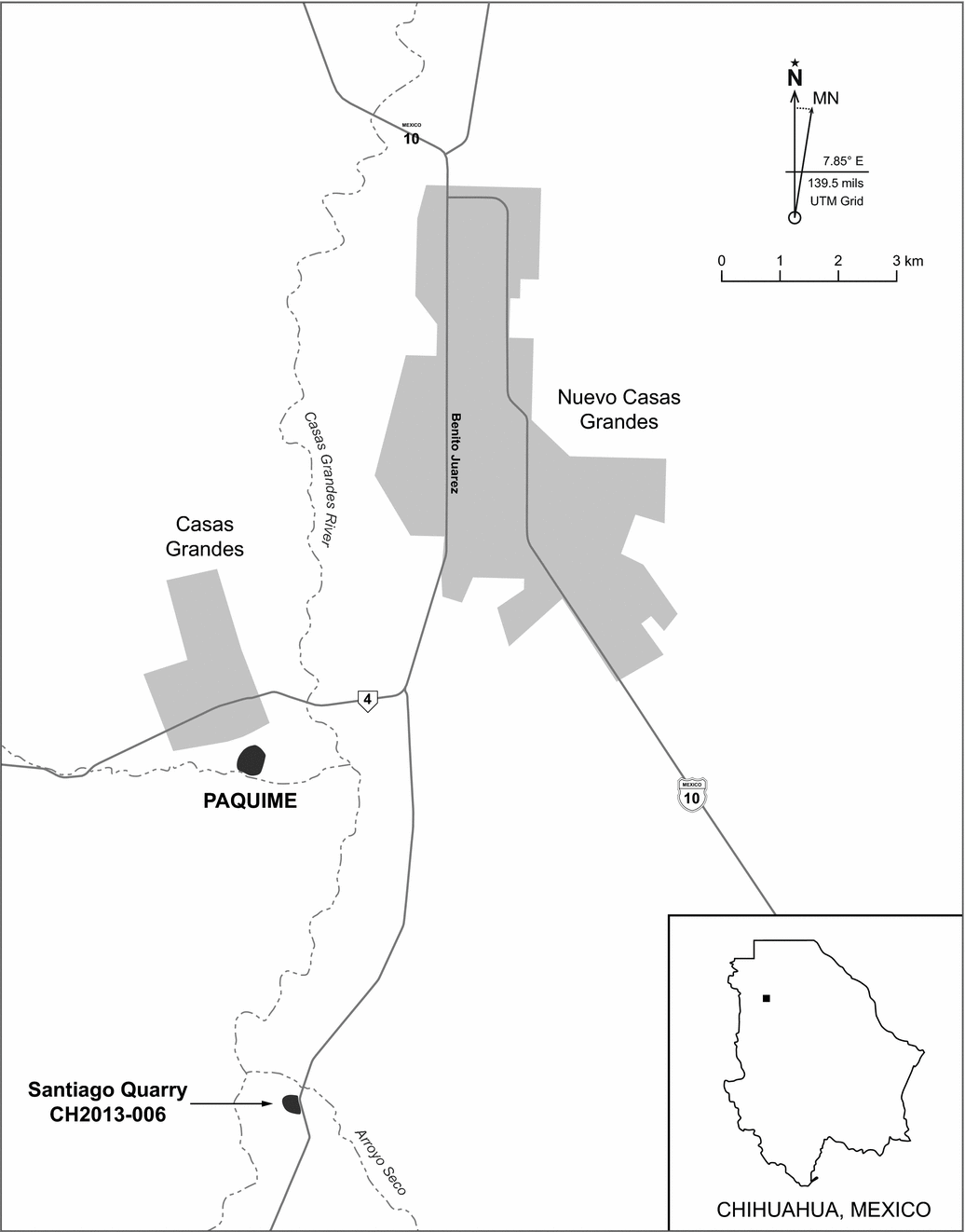
In 2013, during a pedestrian survey in the Casas Grandes River valley in northwest Chihuahua, Mexico, we identified a stone quarry on a terrace above the Casas Grandes River (Figure 1). We call this site the Santiago Quarry (CH2013-006), and its discovery is significant, not only because it is the first of its kind found in the Casas Grandes region, but also because of its relation to the site of Paquime, one of the largest city centers ever built in the prehistoric US Southwest/Northwest Mexico. This primate ceremonial and economic center reached its zenith sometime during the thirteenth and fourteenth centuries AD, and many artifacts made of volcanic stone have been found at Paquime (Di Peso et al. Reference Di Peso, Rinaldo and Fenner1974, vol. 7).
Location of Santiago Quarry in relation to Paquime and modern towns of Casas Grandes and Nuevo Casas Grandes in northwestern Chihuahua, Mexico. Map drafted by Scott Ure.

Two of the most notable artifact types made of this material are manos and metates. VanPool and Leonard (Reference VanPool and Leonard2002:725–726) have explored standardization in metate manufacturing at Paquime, in an excellent study using data from the original analyses by Di Peso and colleagues. (Reference Di Peso, Rinaldo and Fenner1974, vol. 7). Their use of the coefficient of variation (CV) statistically showed that both Type 1A (square-cornered) and 1B (smooth-cornered) metates evidenced morphological standardization (VanPool and Leonard Reference VanPool and Leonard2002:723).
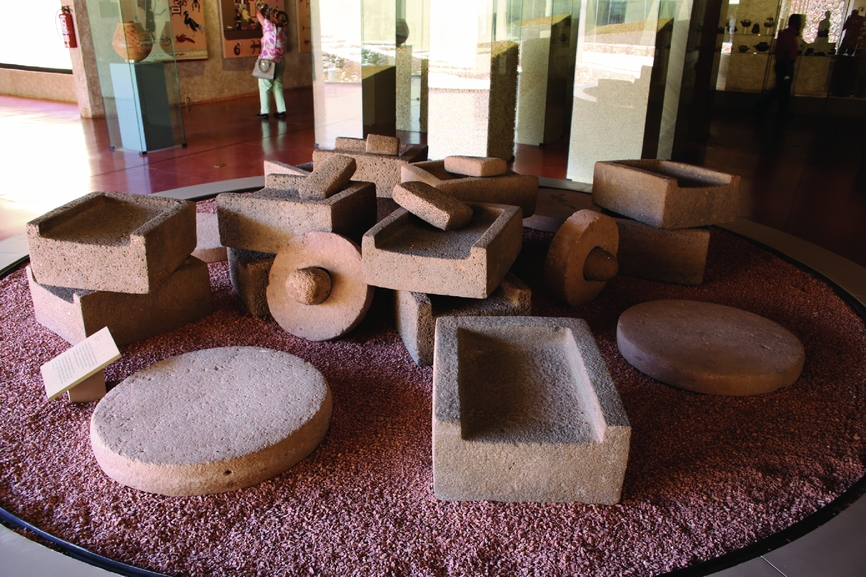
The well-formed Type 1A metates (Figure 2) had much less variation than the Type 1B metates. Most square-cornered (Type 1A) metates from modern excavations in the region have been found at the site of Paquime as opposed to smaller sites in areas outside of this primate center (see Whalen and Minnis Reference Whalen and Minnis2009:207–208). Di Peso (Reference Di Peso1974:2:395–396) notes that both metate types were found in the House of the Pillars at Paquime, which he suggests is evidence for a “metate manufactory” in one of the upper rooms. In addition, VanPool and Leonard (Reference VanPool and Leonard2002:717) illustrate one of the “storerooms” at Paquime that included several Type 1A metates stacked on top of one another, a possible indication that they were cached by the inhabitants of the site.
Artifacts made of basalt on display at the Museo de las Culturas del Norte in Casas Grandes, Chihuahua, Mexico.

Although manos and metates are the most commonly recovered artifacts made of volcanic rock, various other items have been found in the Casas Grandes region, including macaw cage stones, altar stones, and anthropomorphic statues. This suggests that quarries such as the Santiago Quarry were important sources of raw material for the production of a range of goods (Di Peso et al. Reference Di Peso, Rinaldo and Fenner1974, vol. 7; Searcy and Pitezel Reference Searcy and Pitezel2016; Whalen and Minnis Reference Whalen and Minnis2001, Reference Whalen and Minnis2009).
The primary goal of this research is to provide a detailed description of the Santiago Quarry, with the purpose of contributing to a better understanding of the prehistoric manufacture of ground stone tools at similar quarry sites. We describe important characteristics of the quarry and items found there, which can aid in the identification and interpretation of other quarry sites. In particular, we describe the metatero's tool kit resulting from the analysis of artifacts found at the Santiago Quarry. We also examine ethnographic and ethnoarchaeological research associated with ground stone manufacture, to inform our interpretations of the organization of ground stone production in the Casas Grandes region.
Paquime and the Casas Grandes Region
The terrain of northern Chihuahua can be characterized as a basin-and-range landscape with a few well-watered valleys. One of the most verdant valleys in this desert region is marked by the Casas Grandes River that flows north from the confluence of two major drainages out of the Sierra Madre Occidental mountain range to the west. Although the heat of the Chihuahuan desert can be formidable, the perennial waters of the Casas Grandes River have provided a source of livelihood for people in this region for millennia.
At least since 1500 BC, prehistoric people had made this valley their home, and by AD 700, pithouse-dwelling people began to build small communities where they hunted and gathered wild resources, and developed a more widespread tradition of maize agriculture (Kelley and Searcy Reference Kelley, Searcy, Minnis and Whalen2015). By about AD 1200, the Casas Grandes region experienced increasing population growth that coincided with the aggregation of people into numerous sites along drainages with access to arable land and water (Lekson et al. Reference Lekson, Bletzer, MacWilliams, Adams and Duff2004). This also led to the establishment and construction of Paquime, which Lekson and colleagues (Reference Lekson, Bletzer, MacWilliams, Adams and Duff2004:60) consider to be “the largest settlement in the Pueblo IV Southwest” and “almost certainly the most cosmopolitan, most spectacular city in the long history of the Southwest.” Its multistoried buildings, built of massive, meter-thick walls, enclosed approximately 1,100 rooms. These were constructed adjacent to monumental architecture that included platform mounds, Mesoamerican-style ball courts, large roasting ovens, communal plazas, and effigy mounds.
The Santiago Quarry
The quarry is about 1 km east of the Casas Grandes River, immediately west of a road between the modern towns of Nuevo Casas Grandes and Madero, and about 200 m south of Arroyo Seco. We named the site Cantera Santiago (Santiago Quarry) for a historic inscription with the name “Santiago” pecked into the surface of a large boulder at the site. Santiago Quarry is on a narrow, low hill where an outcrop of mostly vesicular igneous stone, dark gray in color, is exposed at the top of the hill. Geologic maps of this area indicate Tertiary formations that include deposits of rhyolite, andesite, and basalt (SGM 2002). Trace elemental analyses performed using XRF spectrometry characterize the stone at this quarry as basaltic trachyandesite, an extrusive igneous rock. The surrounding geology includes other volcanic formations, including remnants of basaltic and rhyolitic flows. These are evident in the exposed rock faces that manifest as cliffs and eroded bedrock along the east-facing slopes of Cerro Montezuma, located directly west of the Santiago Quarry (Pitezel Reference Pitezel2011).
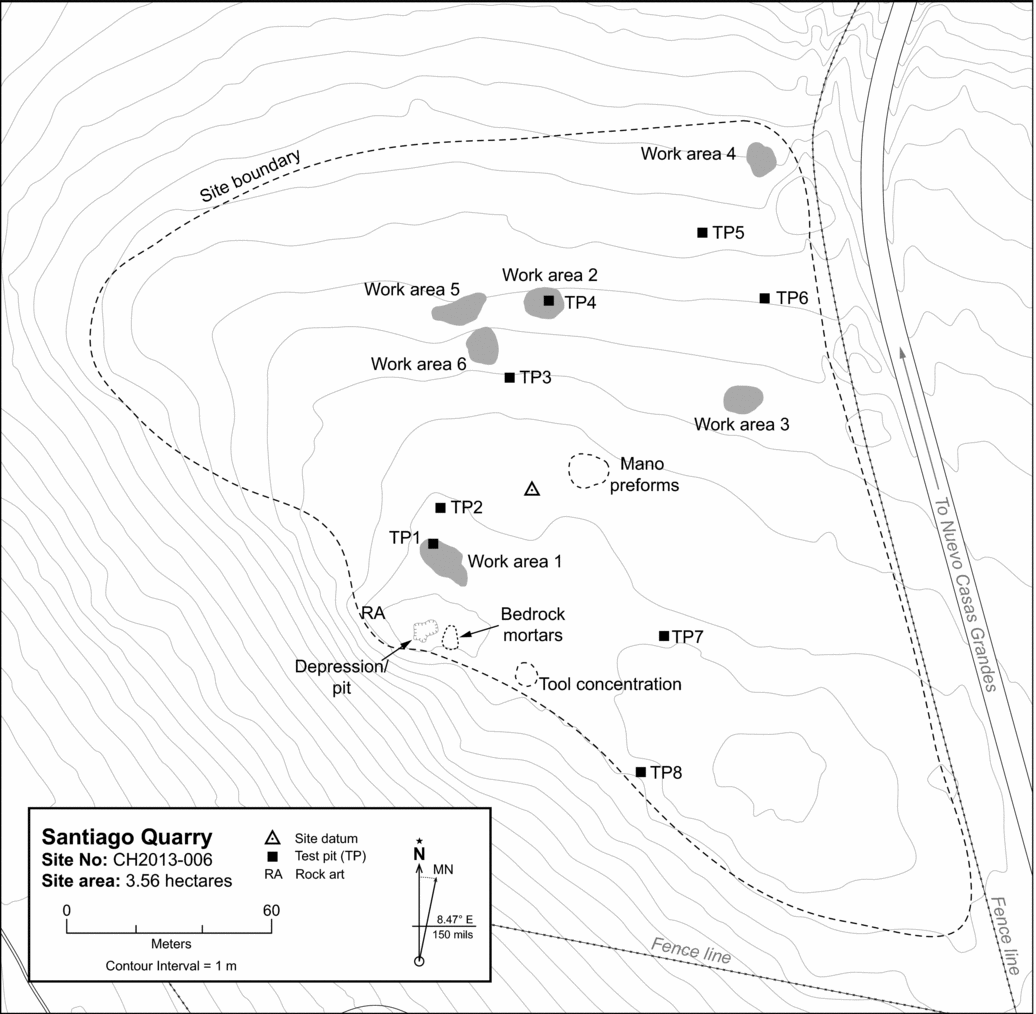
The Santiago Quarry is defined by the distribution of large, worked boulders, mano and metate preforms and fragments, chipped stone debitage, and stone tools on the surface, the majority of which are located on the north-northwest slope facing the Casas Grandes River and Arroyo Seco. The site is approximately 272 m × 154 m, covering a total of 3.56 hectares (8.8 acres; Figure 3). As mentioned above, it is the first igneous stone quarry of its type recorded in the Casas Grandes region, and likely was one of several that were exploited for production of manos, metates, and other tools found at sites in this area.
Map of Santiago Quarry. Map drafted by Daniel King.

Once identified, we considered a systematic survey of the entire 3.56 hectares, collecting each tool identified. This would have required several transects with a distance between people of approximately 5 m. We soon realized that the density of artifacts would not warrant such a survey, so we decided to identify the boundaries of the quarry and chose six sample areas to systematically survey.
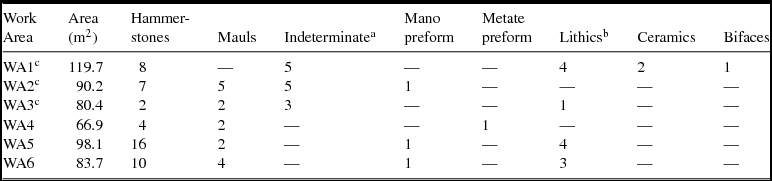
We selected sample areas defined by high concentrations of basalt debitage and quarry tools, and these we identified as possible work areas. We documented artifacts from the six work areas, each averaging approximately 90 m2 in area. Table 1 includes counts for artifact types identified in each of the work areas. Due to the high number of large, stone artifacts identified during the survey, and the significant amount of effort required to transport such heavy loads to our vehicle, systematic surface collection of artifacts was performed in only Work Areas 1–3. In addition to collecting artifacts in the six work areas described above, we also conducted a general site-wide surface collection of artifacts that were characteristic of those found across the site, to increase the sample size of tools that were later analyzed. Debitage was not collected for the reason of weight mentioned above, but measurements were taken on site. On average, debitage found on the surface included small basalt flakes that ranged from 1 to 7 cm in diameter and were 2 mm–2 cm thick. Larger flakes ranged from 7 to 20 cm in diameter and were 3–7 cm thick.
Artifacts Identified in Work Areas at Santiago Quarry.

a. Unable to determine whether fragments were mauls or hammerstones
b. Chipped stone other than vesicular basalt, including obsidian, chert, quartzite, rhyolite/fine-grained basalt
c. Systematic surface collection of artifacts performed in these areas
To define subsurface contexts, we excavated eight shovel test pits (25 × 25 cm each), randomly placed throughout the quarry. These revealed that at depths varying from 3 to 30 cm, the vesicular basaltic trachyandesite and what appeared to be a lighter-colored igneous bedrock, perhaps volcanic tuff, lay in rather shallow deposits. The soil matrix included flakes and debitage similar in size to that found on the ground surface. This suggests that buried deposits include some accretional layers of debitage created during the quarrying and manufacturing process.
Most artifacts identified were the tools and byproducts of quarrying, but other artifacts identified and collected were nine Casas Grandes plainware ceramic fragments, one red-on-brown painted sherd, two bifaces made of gray chert, one uniface made of white chert, and several chert flakes. These are common at sites in the Casas Grandes region, which date between AD 700 and 1450. Unfortunately, the lack of multiple ceramic types, especially painted varieties, and the absence of organic materials that could be radiocarbon dated, prevented us from being able to further refine the chronological use of the Santiago Quarry. We recognize the issues this poses but submit that only further excavation at the quarry site will resolve this problem.
Other characteristics of the quarry include a concentration of mano preforms and a concentration of hammerstones (ca. 12). A depression or pit at the western edge may be the result of basalt extraction. It is approximately 5 m wide in diameter and has inward tapering sides to a depth of about 1–2 m. Several bedrock mortars that range in size from 7 to 18 cm wide and 3 to 20 cm deep are just to the east of the depression. There is no evidence of above-ground architecture and no evidence of looting.
Metateros Tool Kit
The majority of artifacts found at the Santiago Quarry appear to be associated with quarrying activities, and we assume that these represent the suite of tools used by prehistoric craftsmen to extract and shape basalt. Evidence for this interpretation can be gleaned from ethnoarchaeological studies described below, but the most prominent lines of evidence for quarrying activities derives from the extensive distribution of chipped basalt debitage associated with unfinished and broken manos and metates at the site. In addition, we identified several large boulders on the surface, which were altered. These worked boulders included cut lines and large voids where pieces had been removed, likely through direct percussion using large hammerstones or mauls.
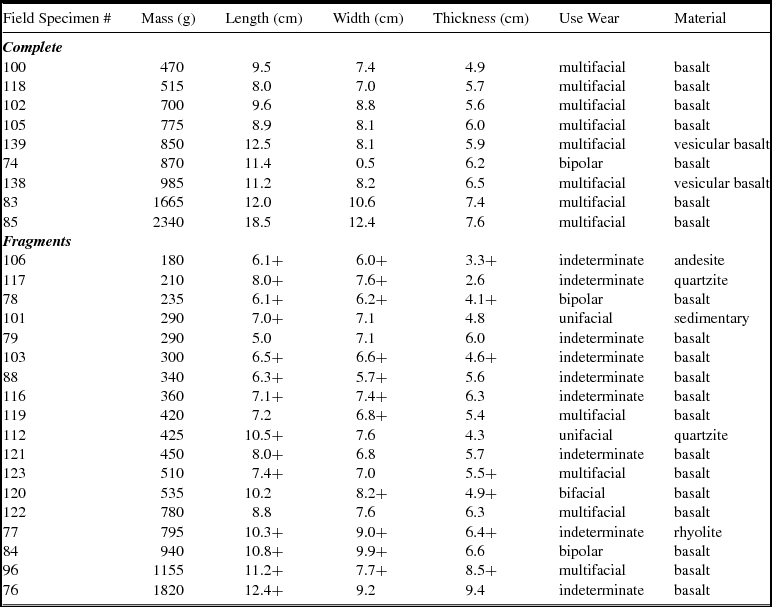
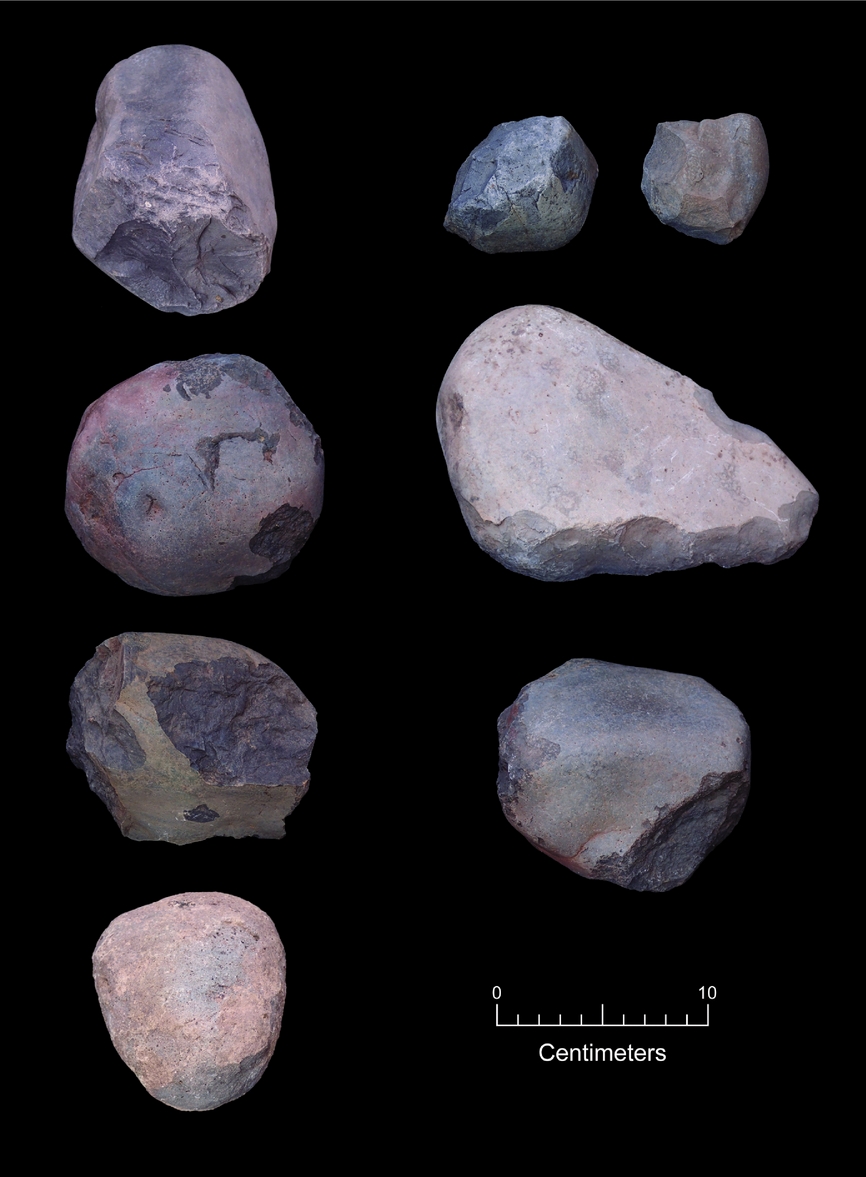
Hammerstones and mauls make up the majority of the tools (Tables 2 and 3). Hammerstones appear to be river-worn cobbles of fine-grained basalt, rhyolite, or quartzite (Figure 4), likely collected by prehistoric metateros from the Casas Grandes River or Arroyo Seco. We collected and analyzed 27 hammerstones (9 complete; 18 fragments), which vary in shape and size (see Table 2). Many are unifaces or bifaces, but several also showed signs of use on several facets of the surface (i.e., multifaces).
Hammerstones Recovered from Santiago Quarry.

Note: Measurements with “+” indicate that tool was fragmented along this axis of measurement. Artifacts are listed in ascending order according to weight. All measurements of length are recorded in centimeters and weight in grams.
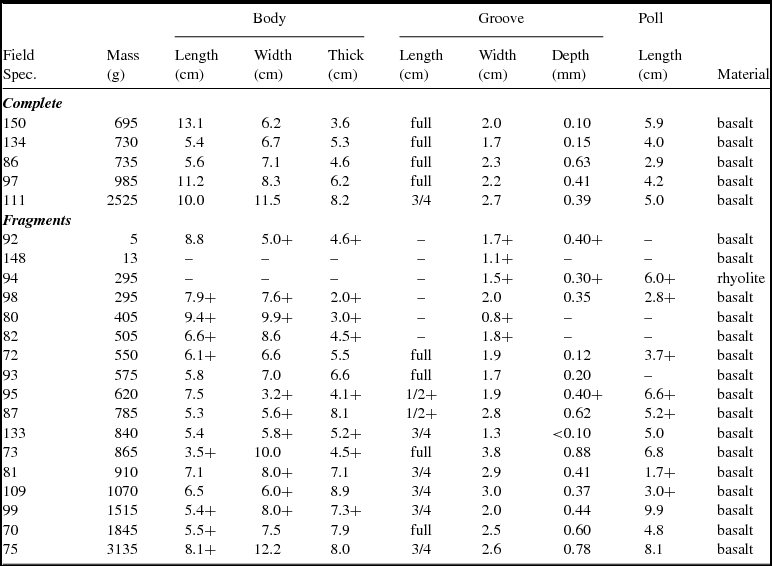
Mauls Recovered from Santiago Quarry.

Note: Measurements with “+” indicate that tool was fragmented along this axis of measurement. Artifacts are listed in ascending order according to weight. All measurements of length are recorded in centimeters and weight in grams.
Examples of hammerstones collected at the Santiago Quarry.

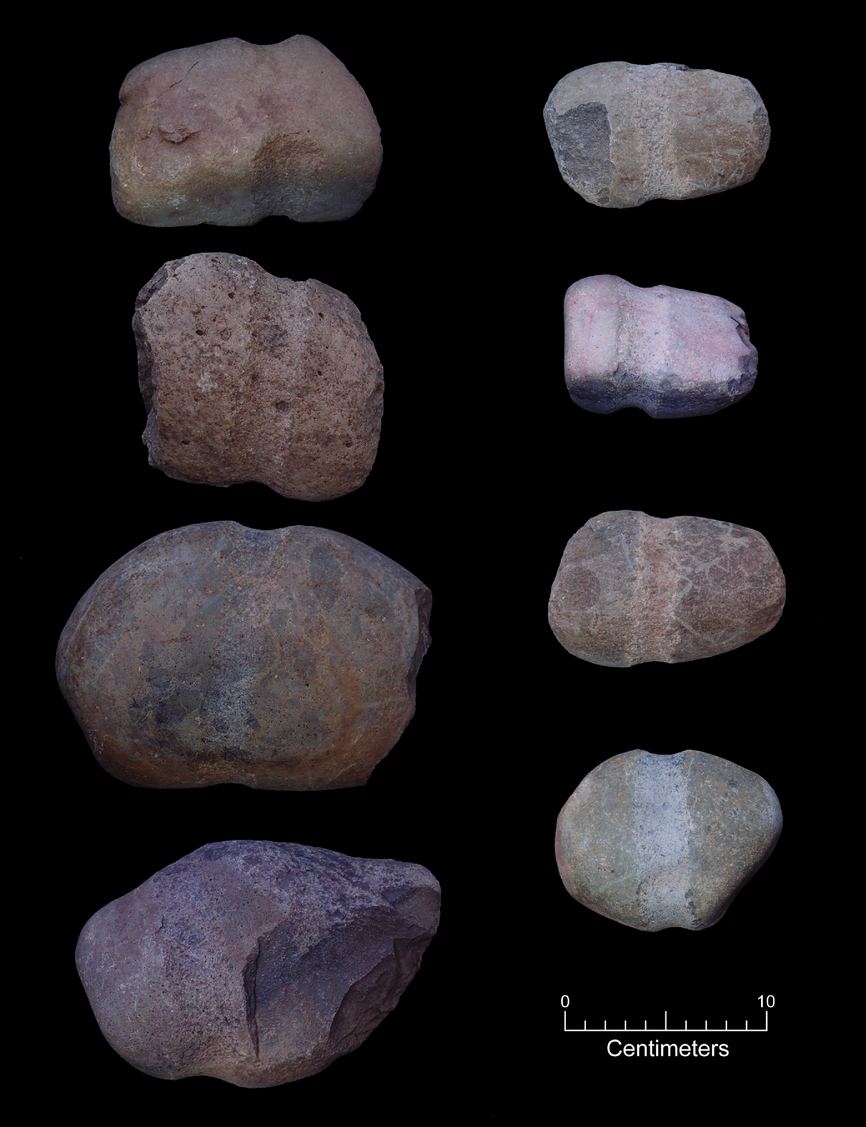
We also collected 22 grooved mauls made of fine-grained basalt and rhyolite (Table 3). These are each characterized by a 1 to 2 cm wide groove, pecked to a depth of 1.0 to 6.3 mm along the surface of the maul, likely to facilitate hafting to a stick used as a handle (Adams Reference Adams2014:178–179) (Figure 5). For specimens that are complete or nearly complete, we identified fully grooved and ¾-grooved mauls. Mauls also appear to have been made on river cobbles, possibly selected for their lenticular or cylindrical shapes, which also made them more conducive to hafting to a stick or handle.
Examples of mauls collected at the Santiago Quarry.

Adams (Reference Adams2014:157) has noted that “there is a fuzzy boundary between hammerstones and mauls. Both have the same general percussion function and incur the same use-wear damage.” She goes on to indicate that the groove is what sets mauls apart from hammerstones, so if a fragmented object is found without a groove, there is a chance it will be erroneously characterized as a hammerstone. We identified 14 percussion tools as indeterminate maul or hammerstone fragments due to their incompleteness.
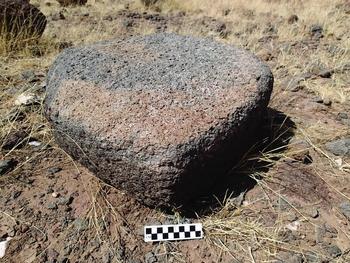
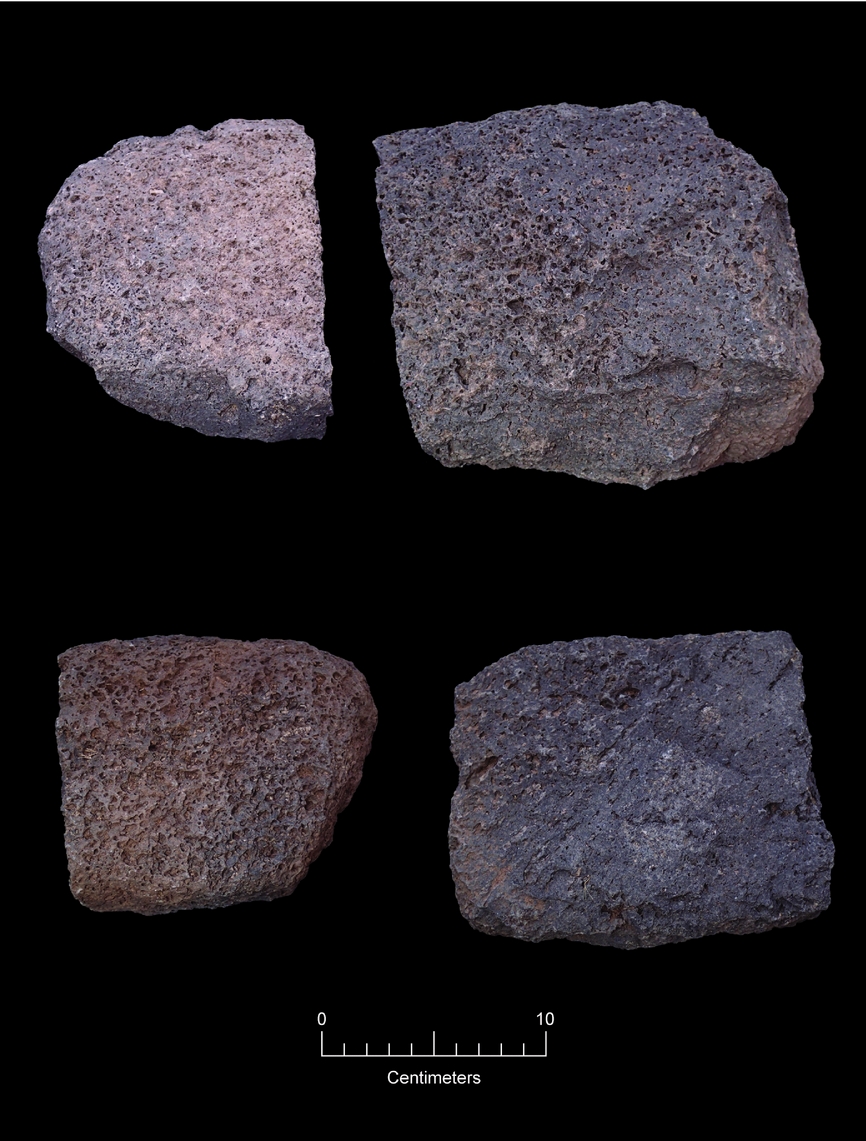
In addition to tools, we identified mano and metate preforms. These are the only artifacts of production found at the site, although it is possible other types (e.g. altar stones, macaw cage stones, etc.) were not identified due to their incomplete stage of manufacture. One large metate preform was identified, but was not collected due to its weight (Figure 6). It was 63 cm long, 57 cm wide, and 27 cm thick. Although more were noted, only four mano preform fragments were collected (Figure 7). Identifying manos and metates is important, because doing so indicates not only the type of tools manufactured at this quarry, but also the stage at which the tools were produced. All the tools at this quarry were rough preforms that had not yet been refined or abraded to a state of completion. All of the mano preforms were broken, so their incomplete state could be the result of breakage during production.
Metate preform located near Work Area 3.

Four mano preform fragments collected at the Santiago Quarry.

Ethnoarchaeology of Ground Stone Quarries
In this section we review ethnographic and ethnoarchaeological literature regarding modern ground stone production. Drawing from some of the most comprehensive studies, we note characteristics of modern quarries comparable to the Santiago Quarry. Primarily, we discuss patterns in quarry morphology (work areas), tool kits, and workflows (what is done where) related to the manufacturing process.
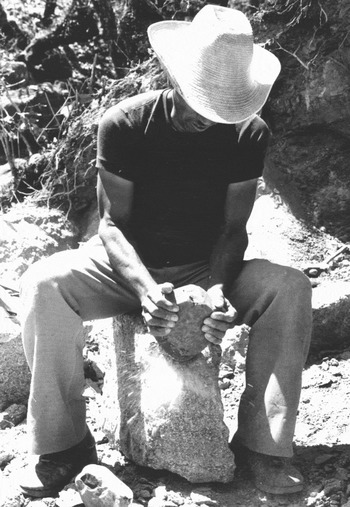
In the late 1970s, Brian Hayden (Reference Hayden and Hayden1987) studied among metateros of Malacatancito in the Guatemalan Highlands. His work is significant because he located a metatero who still knew the craft of metate and mano production using stone tools. Ramón Ramos Rosario, one of the only full-time stone workers in the area, demonstrated the process of producing a metate using primarily hammerstones (or pics) found along the riverbed where basalt was also extracted (Figure 8). Although metal chisels were used to initially procure a block of basalt in this recorded exercise, the remainder of production was performed using only stone tools made of either fine-grained basalt or gabbro. Hayden documented this process in detail, including the collection and use of a suite of hammerstones described as two-handed pics (1.8–3.0 kg), one-handed pics (0.8–1.8 kg), or abraders (0.3–0.7 kg) (Hayden Reference Hayden and Hayden1987:53).
Ramón Ramos Rosario using a two-handed hammerstone to work a basalt block extracted from the Malacatancito quarry. Photo courtesy of Brian Hayden.

Tools ranged in size and shape and could be held using one or two hands, depending on the size of the implement. Most were made of the abundant fine-grained basalt available along the Malacatancito riverbed quarry. According to Ramos, there were several criteria he used in choosing suitable pics, including material that would effectively indent the vesicular basalt, stone that could properly maintain a cutting edge, material that could be resharpened through the removal of flakes, tools that would not fracture or break upon impact, material with shapes that were easy to grip, and material that was of a manageable size (generally less than 5 kg; Hayden Reference Hayden and Hayden1987:18–20). Hayden (Reference Hayden and Hayden1987:52–53) notes that while a trihedral (acutely angled) pointed implement is ideal for making indentations and removing flakes of vesicular basalt, pics and abraders vary in shape, and their morphological features evolve over their use-lives as they are resharpened or break during use. He also notes that there is no preference for either unifacial or bifacial resharpening, and that any pointed surface can be used to perform the same tasks (Hayden Reference Hayden and Hayden1987:55).
For the most part, Ramos used direct percussion with the one- and two-handed pics to remove flakes from the basalt block and to shape it into a rough form in the quarry. These flakes ranged in size from 2 × 2 cm to 20 × 10 cm and ended up in piles of debitage surrounding his work area (Hayden Reference Hayden and Hayden1987:26). This roughing-out stage of manufacture resulted in a preform that was then transported to his home workshop to be finished. Similar stages of production seem to correlate with location (quarry vs. workshop) at several other modern metate communities where the roughing-out of preforms occurs in the quarry, and the thinning and finishing of the product takes place in a workshop, usually at or close to the metatero's home (Cook Reference Cook1982; Diaz Reference Diaz2010; Searcy Reference Searcy2011). At Ramos's home workshop, he used abraders to “regularize” the surfaces and make them “as flat or smooth as possible” (Hayden Reference Hayden and Hayden1987:72). Using a swiping motion, Ramos smoothed the raised surfaces of the metate, which resulted in tools that exhibited extremely abraded surfaces (Hayden Reference Hayden and Hayden1987:38). In the end, he was able to successfully produce a tripodal metate using the one- and two-handed pics and the abraders made of fine-grained basalt and gabbro.
Searcy (Reference Searcy2011) also spent time among metateros at two other active basalt quarries in Guatemala in 2004 and 2005. The Nahuala quarry is located southeast of Malacatancito in the department of Sololá, and the other is in San Luís Jilotepeque, located west of Guatemala City in the department of Jalapa. Searcy notes that distinct patterns in the morphology of quarries correlates with several behaviors. As at the Malacatancito quarries, Searcy (Reference Searcy2011:52–53) found that metateros would extract basalt from other areas in the quarry and haul the blocks of stone to work stations, many of which were covered by trees or champas (grass-covered ramadas) to shade them from the scorching sun (see also Dary and Esquivel Reference Dary and Esquivel1991:8). These areas are where metateros stored their tools and worked stone into rough shapes. The debitage in these work areas was somewhat smaller than in places where the stone had been extracted, although Searcy (Reference Searcy2011:53) noted that some large pieces of stone removed at work stations were cleared to the perimeter so they were not in the way as metateros refined their blocks of stone (see also Nelson Reference Nelson and Hayden1987b:133).
Discussion
The purpose of reviewing the ethnographic literature on ground stone production is to provide possible contextual clues for our interpretation of the ground stone economy in the Casas Grandes region. The ethnographic studies described above provide rich details and serve as formal analogies for the interpretation of prehistoric ground stone quarries and the manufacturing process. We do not suggest that ethnographic analogies take the place of data, nor do we suggest that data from this single quarry site provide conclusive evidence for our interpretations. We simply propose that the ethnographic record provides suggestions for the interpretation of ground stone production at these quarry sites. While the metateros studied by Searcy (Reference Searcy2011) and Cook (Reference Cook1982) used metal tools in the reduction process required to produce manos and metates, Hayden's (Reference Hayden and Hayden1987) research with Ramón Ramos provides important clues regarding stone tool selection.
One of the first correlations we address are the similarities between stone tools used by modern metateros and those found at the Santiago Quarry. Hayden's (Reference Hayden and Hayden1987) work with Ramón Ramos is the only available record of a modern metatero using stone tools to produce a mano and metate, and therefore is unique. Ramos's use of three different types of stone tools (two-handed pics, one-handed pics, and abraders) correlated with steps in the manufacture process. We observed that only one- and two-handed hammerstones, equivalent to ethnographic examples, were identified at the Santiago Quarry. Abraders, according to Ramos, were typically used at his home workshop where the process of refining took place. In addition, other ethnographic accounts also record this step as occurring primarily at a home workshop. For these reasons, we suggest that tools (i.e., abraders) associated with this final step in ground stone production at the Santiago Quarry were not found because refining of manos and metates likely occurred at home workshops prehistorically. In addition, many of the stone tools identified were grooved mauls used to quarry large blocks of vesicular basalt, which were then roughly shaped at quarry workstations.
The morphology of the hammerstones can also be interpreted using the information Hayden (Reference Hayden and Hayden1987) recorded when working with Ramos during his selection of stone tools. Most of the hammerstones we collected were either unifacial or multifacial. As Ramos indicated, selection criteria for stone pics included sizes small enough to hold, shapes that were ergonomically effective, and surfaces that included pointed angles that would effectively indent vesicular basalt in order to remove flakes and to break large blocks from the bedrock. There were no unique patterns among our assemblage of hammerstones, although we could possibly categorize them as one- or two-handed, according to the weights and sizes of those identified by Hayden (Reference Hayden and Hayden1987). Once again, we hesitate to pigeonhole these artifacts based only on Hayden's work with Ramos. Nevertheless, we suggest that the size and shape of the hammerstones used for prehistoric quarrying are likely closely linked to their specific task (i.e., removal of large blanks from bedrock or for shaping boulders, removal of large flakes, and removal of small flakes) because of their association with the quarry site itself.
Additionally, we collected 22 whole and fragmented grooved mauls, which could have accommodated a wooden handle. The complete specimens averaged 1.3 kg in mass, and tended to be larger than most hammerstones. The sizes of the mauls from the Santiago Quarry are closely related to the two-handed pics used by Ramos (Hayden Reference Hayden and Hayden1987:53). We suggest that these were primarily used to quarry stone due to their size and the ability to enact more force with less impact to the hands and arms because of the attached wooden handle (see Searcy Reference Searcy2011:41–42). We further suggest that smaller mauls were also used in the reduction of stone products into their roughed-out forms.
Stone tool material was also selected based on certain qualities. Although hard gabbro was preferred by Ramos for stone pics, fine-grained basalt was just as effective when working to remove flakes of vesicular basalt. Most of the hammerstones and mauls at Santiago Quarry were made of fine-grained basalt, while others were made of other locally available stone types, such as quartzite. All of these were water smoothed and were likely obtained and carried from the nearby river or arroyo. We observed that nearly all water-worn river cobbles picked up from the surface of the quarry site showed signs of battering, suggesting that these were carried to the site specifically for quarrying activities.
Another similar comparison that can be made between modern quarries and the Santiago Quarry is that debitage is consistent in size and shape; most flakes range between 10 and 30 cm in length and width. These sizes are consistent with the reduction and shaping phase of metate and mano blanks among contemporary metateros who carry out this task primarily at the quarry location (Hayden Reference Hayden and Hayden1987:26; Searcy Reference Searcy2011:53). The presence of only preforms at the Santiago Quarry could be explained by the fact that the metateros studied by Cook (Reference Cook1982), Searcy (Reference Searcy2011), Hayden (Reference Hayden and Hayden1987), and Nelson (Reference Nelson and Hayden1987b) at various metate quarries in Mexico and Guatemala only roughed out their product at the quarry site. Further refining was carried out at household workshops where the surfaces of these tools were smoothed and refined. The whole and fragmented preforms we found at the Santiago Quarry were rough in shape, and surface smoothing was minimal or absent.
Work areas at the Santiago Quarry were defined by the presence of both flaked debitage and stone tools; a few included mano and metate preforms. Applying Nelson's (Reference Nelson and Hayden1987b) observations on quarry types, some work areas at Santiago Quarry are large, reoccupied areas, while others are single-use areas due to the small scatter of vesicular basalt flakes and no tools or preforms. Nelson (Reference Nelson and Hayden1987b:126) suggests that it is often difficult to identify the boundaries of individual work spaces in bedrock quarries, whereas the streambed quarries were more distinct. The bleeding together of boundaries often is the result of many metateros working in close contact at the quarry core, and their resulting debitage piles easily blend at the peripheries. We found that well-defined work areas at the Santiago Quarry were few (see Figure 3). Most of the site is a scatter of flakes, hammerstones, and mauls. We would surmise that the Santiago Quarry, a bedrock quarry, may have been used by many metateros whose work stations overlapped. In addition, we consider the long duration of time that this quarry may have been used by metateros, whose workstations not only overlapped, but also could have covered one another as debitage accumulated. Further excavation of work stations may provide more evidence regarding successive use of the quarry.
Conclusions
The analysis of the Santiago Quarry, coupled with ethnoarchaeology, provides some interesting archaeological patterns that can help better define ground stone quarries. Ethnographic sources provide excellent analogs for the production of manos and metates from vesicular basalt at extraction points and quarry workshops. They are significant resources that provide unique clues to the behaviors associated with ground stone production, and they represent the valuable preservation of prehistoric traditions that soon will not be observable. Some of the important information that aided in our interpretation of the Santiago Quarry includes the nature and common characteristics of stone tools used for quarrying and manufacture and site formation and morphology.
The finely crafted manos and metates from the Casas Grandes area stand out as examples of the incredible skill possessed by a group of stoneworkers. The discovery of this quarry and its analysis allow us to better describe the nature of the ancient metateros’ craft. This study also serves as a resource for comparable prehistoric quarry sites and the interpretation of their artifacts and features.
Acknowledgments
We are grateful for the support of our sponsoring institutions, Brigham Young University, the University of Arizona, and the Arizona State Museum. In Mexico we were welcomed by the Ejido Mata Ortiz, and appreciate the cooperation of the Ejido Madero. We are forever grateful for our friend Luís Tena, Curator at the Museo de las Culturas del Norte, and appreciate the assistance of the museum's director, Mauricio Salgado, with the storage of and access to the artifacts analyzed for this project. We also thank Julian Hernández for his friendship and help with the storage of our field equipment. The Roots of Casas Grandes Project (2013 and 2015 field seasons) was comprosed of a competent and willing crew that included Adam Searcy, Lauren Kingston, Daniel King, Jessica Simpson, Haylie Ferguson, Scott Ure, Andrew Fernandez, Andrew Krug, Marco Martinez, Sean Dolan, and Christopher Schwartz. We also thank Scott Ure for his direction and aid in the mapping of the Santiago Quarry with an Unmanned Aerial System, Daniel King for his help drafting maps and artifact photos included in this paper, and Tess McCormick for her help with data entry. We also thank Suzanne Fish for her suggestions on an earlier version of this paper. Permitting was facilitated by the Consejo de Arqueología of the Instituto Nacional de Antropología e Historia (Permit Number 401.B[4]19.2013/36/0893: June 3, 2013). Finally, funding for this project came from the Rust Memorial Fund, awarded by the Department of Anthropology at Brigham Young University, to whom we express our gratitude for their support.
Data Availability Statement
The artifacts collected and analyzed in this study are housed at the Museo de las Culturas del Norte in Casas Grandes, Chihuahua, Mexico. All data, including maps, analyses, and photographs in digital and paper form are housed at the Museum of Peoples and Cultures at Brigham Young University in Provo, Utah. Access to the data is available upon request.