At the beginning of the 1980s a young married couple, Erdmute and Wacław Sobaszek, arrived in the small rural settlement of Węgajty, located in northern Poland. They were looking for a place for their alternative theatrical activity, and settled in a destroyed farm at the edge of the forest. They transformed the old cowshed into a theatre stage which became a central space of the newly established Węgajty Theatre.
The purpose of this article is to assess the role of landscape in shaping the sociocultural activities undertaken by the Węgajty Theatre. As I will demonstrate, landscape is an intrinsic component of the theatre and everyday life of the Sobaszeks. The article reveals the deep attachment of the artists to the local environment, and the landscape's influence on their theatrical work, as well as on the theatrical experience of the audience. I will analyse the landscape through the lens of humanistic geography, anthropology and philosophy, and mobilize the term ‘landscape theatre’ to explore Węgajty Theatre as an alternative theatre deeply intertwined with the natural world.
Alternative culture in Poland formed between the late 1970s and the second half of the 1990s. It was a time of intense sociopolitical transformation, to which the participants of alternative culture adopted a nonconformist attitude. They acted in an unofficial and informal way, creating artistic, theatrical, esoteric and religious communities. The dominant features of theatrical communities were creativity, participation, openness and non-institutionalism.Footnote 2 As ‘contestants of conservative, traditional visions of reality’,Footnote 3 alternative artists were looking for non-standard forms of expression.
This exploration took place in economic and political conditions which limited the possibility of development for many kinds of collective activity. Polish alternative theatre, as emphasized by Kathleen Cioffi, aimed at
dealing with political and social reality … Theatre often reflected a nationwide discontent with the Communist system … While the movement had some striking similarities to American, British and other alternative theatres of the 1960s, 70s, and 80s, it also developed in a way unique to the Communist bloc.Footnote 4
In the communist reality, alternative artists were involved in practising resistance against the cultural policy of the authorities and against censorship. They demanded freedom of speech and artistic expression. Their efforts focused on building a community, underpinned by ideological thought and spiritual beliefs. In Poland, there were no organizations fighting for the liberation of women or the rights of sexual minorities, as was the case in the West. In his research on American alternative theatre, Theodore Shank pointed out that ‘the new [American] theatre was expressive of those who aligned themselves with the various social movements of the time – civil rights, free speech, hippie, anti-nuclear, anti-Vietnam war, ecology, feminist, and gay’.Footnote 5
Regardless of the historical context and the ruling political party, alternative artists were rejecting the traditional theatre, breaking previous aesthetic habits and developing experimental techniques. They revised theatrical canons, moving towards an interactive style and creating a performance community outside theatre walls. Richard Schechner defined this kind of activity as environmental theatre. He understood the term ‘environment’ in two ways – on the one hand as ‘what one can do with and in a space’, and on the other hand as ‘the acceptance of a given space’.Footnote 6 Schechner argued that artists have the possibility to ‘create environment by transforming a space’ or to ‘negotiate with an environment, engaging in a scenic dialogue with a space’.Footnote 7
Developing Schechner's concept, Shank distinguished between ‘found environments’ and ‘constructed environments’.Footnote 8 According to Shank, alternative theatres attempted to ‘revive the earlier perceptual relationship of spectator to environment. They created performances which the audience perceived as sharing their environment’.Footnote 9 All these recognitions are significant in relation to Polish alternative communities, which often rejected not only theatre buildings but also urban areas, and turned rural spaces into the venues of their everyday activities. The village as a ‘found environment’ became a key determinant of their artistic work.
‘Alternative settlement’ developed in the Polish mountains and in the regions of Podlasie, Lubelszczyzna and Masuria.Footnote 10 Visitors from alternative circles, or new settlers, as researchers used to call them,Footnote 11 began to appear in the province after martial law was imposed in 1981. Nevertheless, as Xawery Stańczyk pointed out, the new settlement movement should not be reduced to ‘escapist and anti-communist behaviours’ (if only because waves of alternative migration also took place in the 1990s).Footnote 12 This movement was mainly associated with ‘an attempt to overcome the dominant sociocultural system and the formation of alternative forms of community, not with escape from state bodies’.Footnote 13 The village, as Stańczyk argued, allowed for the building of a community not only because of its economic or geographical advantages, but also because it offered valuable lifestyle patterns to the newcomers.
The proximity of ‘earth, nature, truth’ became paradigmatic for alternative theatres.Footnote 14 This triad accurately defines the attempts of young artists to seek spontaneity and authenticity. At the same time, it fits into the Polish romantic tradition and reveals the frequently romanticized attitude of newcomers to local culture.Footnote 15 With time, the fascination with folklore, ethnographic research and settling in the provinces became a distinctive feature of Polish anthropological theatre, an ‘ethnography infected theatre’.Footnote 16 This theatre drew its inspiration from the activities of Mieczysław Limanowski.Footnote 17 Limanowski, who together with Juliusz Osterwa co-founded the Reduta Theatre, developed an ecological vision of culture in which theatre was seen as the central institution of spiritual and social life. One of Limanowski's and Osterwa's students, Jędrzej Cierniak, added that ‘the theatre should have the rural landscape, forest meadows and barrows as its stage’.Footnote 18 Indeed, landscape turned out to be crucial for Polish alternative-theatre artists. They settled in the landscape temporarily or for long periods in order to study it and transform it in an artistic way.
This embedding was processual in nature, and I see its beginning in the paratheatrical activities undertaken by Jerzy Grotowski. In the 1970s Grotowski developed his idea of the ‘active culture’:
It stemmed from an opposition to the ‘passive’ culture of reception which relied on becoming acquainted with others’ works. The guiding principle of the ‘active culture’ was carrying out one's own creative acts actively participating in creative process rather than consuming the others’ products. ‘Active culture’ suggested a departure from the clear division between active individuals (actors) and spectators.Footnote 19
Grotowski argued that the strength of the theatre was exhausted and that in order to revive interpersonal relations one should turn to ‘a meeting – not confrontation’, to ‘common-holiday’.Footnote 20 The idea of a holiday leading to social change was consistent with the alternative proposals. The Holiday project, consisting of harmonious coexistence with nature, work with the body and community life according to ascetic discipline, was carried out by Grotowski in the village of Brzezinka near Oleśnica.
In a way, Brzezinka became the foundational landscape of Polish alternative theatre, whose creators adopted Grotowski's thinking about rural space. On the one hand it was a space of life and creation, and on the other hand it was explored through numerous Polish and foreign expeditions. Expeditions, hikes and journeys in the countryside constitute another important motif of alternative culture, which was implemented ‘in motion and through motion’.Footnote 21 Eventually, Brzezinka as a landscape was significant in the independent activities of young artists participating in Grotowski's projects: in 1978 Włodzimierz Staniewski established the Centre for Theatre Practices in Gardzienice near Lublin, and in 1986 Erdmute and Wacław Sobaszek joined in the establishment of the Węgajty Village Theatre near Olsztyn. ‘The experience of Gardzienice is as important to me as the experience of the Laboratory Theatre’, claimed Wacław Sobaszek.Footnote 22
Both Staniewski and Sobaszek were contesting Grotowski's activities. Staniewski referred to the Laboratory Theatre in the following words: ‘Those experiments … were of a laboratory character … They were closed, disconnected from the social context, referring primarily to psychology, to intimate experiences, to the exploitation of an individual's own personality’.Footnote 23 Sobaszek, on the other hand, described the events in Brzezinka as ‘isolated from reality’; he treated Brzezinka as a space of utopia ‘sunken in amber’.Footnote 24
At the same time, despite their critical attitude towards Grotowski's project, Staniewski and Sobaszek chose what Grotowski called ‘interhuman ecology’ as the core focus of their theatre projects. The substance of their activity was contact and relationships with people. Their expeditions and exploration of the villages were conceptually intertwined with Grotowski's search for dramatic and performative source traditions and the ecological aspect of his activities – seeing human life as connected to the entirety of the world, including the world of nature. The work ethos of ensembles, which focused on the development of their members and their contact with the natural environment, as well as their work outside cities, is a distinctive feature of the theatre ecology. Researchers associate this trend with Grotowski's Theatre of Sources, the Gardzienice Centre and the Węgajty Theatre, among others.Footnote 25 Polish theatres oriented towards ecology located native or distant cultural traditions within their circle of interest, and one of their fundamental texts was Limanowski's Rok polski i dusza zbiorowa from 1916.
The emerging range of ideas related to cultural traditions, provinciality and the natural environment allows me to include the category of landscape in this article's exploration of the transformation of theatre. Here ‘landscape’ is a conceptual tool through which I want to rethink findings in the field of research on alternative theatres. I am interested in how the strong presence of nature shaped the work of alternative artists, focusing on the example of the Węgajty Theatre, in order to determine some of the distinct features of theatre inscribed in the rural landscape. I do not think of landscape as a neutral, external background to human activities, as I adopt the ‘dwelling perspective’ proposed by an anthropologist Tim Ingold.Footnote 26 According to this perspective, ‘the landscape is constituted as an enduring record of – and testimony to – the lives and works of past generations who have dwelt within it, and in so doing, have left there something of themselves’.Footnote 27 Therefore the landscape tells a story, or rather is a story, ‘a chronicle of life and dwelling’,Footnote 28 covering the lives and times of predecessors, and the perception of landscape is an act of remembrance. This remembrance, according to Ingold, is not about recalling an internal image stored in the mind, but about perceptual engagement with an environment that is ‘pregnant with the past’.Footnote 29 I perceive Ingold's view as particularly valuable when attempting to describe these activities of the Węgajty Theatre that aim to protect the multiethnic tradition of Warmia. It is also valuable in seeing the path that Erdmute and Wacław Sobaszek went through, leading them to the province – from fascination with Grotowski's activities, through co-creation of undertakings in the area of theatre ecology, to establishing their own art space.
Exploring historical East Prussia
Before the Sobaszeks moved to the village of Węgajty in 1982, they lived in nearby Olsztyn. They arrived there from Warsaw in the 1970s together with other young graduates of art history and cultural studies at the University of Warsaw. Wacław Sobaszek, Ewa Kusiorska-Wołoczko, Ryszard Michalski and Krzysztof Gedroyć founded the Interdisciplinary Cultural and Research Centre ‘Pracownia’ in Olsztyn. Their programme emphasized their interest in active participation in culture and collective approach to art making. In the text Geografia działania (Geography of Action) they wrote, ‘We thought that the very creation of “Pracownia” would open up possibilities for the fulfilment of existing needs and expectations. We believed in the existence of Atlantis’.Footnote 30 The mythical land that appears in the manifesto of the young artists points to an alternative and utopian character of their approach to theatre and, at the same time, to the rich imaginarium of the historical region in which they were situated. Former East Prussia was perpetuated in German literature as the imaginary Atlantis of the north or the grail far to the east.
The landscape of this mythical province, which in the post-war period was marked by numerous resettlements, was revealed to the artists during the Podróż do domu (Journey Home) action in 1979. Walking together with the participants through the abandoned farms of Warmia, they asked the questions ‘what is home? Not this particular one, mine. Home in general. What does it mean to me?’Footnote 31 I see this paratheatrical gesture as a perceptual engagement with the landscape ‘pregnant with the past’. The perception of the participants was ‘grounded in an act of attention’Footnote 32 by wandering along roads full of clay and mud, looking into old houses, and lighting a fire in one of them to eat some food. They were literally ‘in touch’ with the Warmian households, and through the engagement expressed by watching, listening and feeling (Ingold suggested that ‘feeling should be recognized as a mode of active, perceptual engagement’Footnote 33) they could have got closer to the land marked with pain, to have an ‘active involvement’ in that land. The earth, seen not so much historically but ecologically, was at the centre of the successive actions of ‘Pracownia’, realized in Olsztyn in 1980 – Tu było drzewo (Here Was a Tree) and Smok (A Dragon) with a significant banner reading ‘The earth does not belong to man; man belongs to the earth’.
‘The sensuous engagement’ is a key category in my understanding of the landscape, referring to both the anthropological findings of Ingold and the philosophical considerations of Berleant. Abandoning Kant's concept of aesthetic experience, Arnold Berleant recognized the need to broaden the scope of aesthetics: ‘While descriptive aesthetics is an appropriate form of inquiry in the arts, it also lends itself particularly well to environmental situations’.Footnote 34 Berleant departed from the classic interpretation of selfless view, or distance, as a condition necessary to distinguish a fragment of nature and space. According to this interpretation, ‘landscape exists insofar as it makes itself present to the subject’, nature ‘becomes’ a landscape in the eyes of an observer experiencing it and feeling it in an aesthetic way.Footnote 35 Berleant formulated a proposal of the ‘participatory landscape’, departing from the receptive, contemplative attitude of the observer, characteristic of the ‘panoramic landscape’, in favour of the participant's active attitude.Footnote 36 The landscape, in his view, has transformed itself into an all-encompassing environment: ‘The boundlessness of the natural world does not surround us; it assimilates us’.Footnote 37 The introduced ‘aesthetic engagement’, related both to art and to nature, is an engagement reflecting various forms of activity undertaken by an artist and a viewer who unite in an aesthetic experience.
Traces of the involvement that Berleant wrote about, as well as traces of participatory landscape, can be seen in many of the actions of ‘Pracownia’. The young artists also produced Podróż do świtu (Journey to Dawn). Wacław Sobaszek recalled them as participants: ‘Leaving the forest cottage at dusk and wandering until dawn. Through half-abandoned villages and completely empty village colonies. In the morning we walked as if in delirium, like ghosts among ghosts, the owners of abandoned yards’.Footnote 38 The undertakings of ‘Pracownia’ in the 1970s brought Sobaszek in a symbolic and literal way to the Warmian countryside, to Węgajty, which became a formative factor for his further theatrical work.
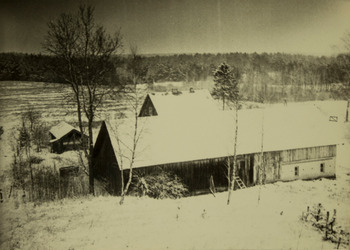
In this article I intend to reflect on whether the Węgajty landscape, which Sobaszek soon began to shape, can be defined as the ‘participatory landscape’ of Berleant's imagining, and whether or not ‘the aesthetics of nature can serve as the model for appreciating arts’Footnote 39 among the guests of the Węgajty Theatre. This coexistence of nature and art, important in assessing the activities of the Węgajty Theatre, will also be described in relation to the concept of participation coined by ethnologist Dorota Angutek. This participation is understood as a natural experience of the environment that is not limited to the visual structure faced by a unit.Footnote 40 Perception is treated by Angutek as a subjective process, the ‘nature reception’ described by her conceals two notions: passive reception (vita contemplativa), which is contemplative, reflective and reserved, and active reception (vita activa), based on dynamic participation in space ‘unlimited by contour’.Footnote 41 I will use this binary concept to try to define the connection between nature and the Węgajty Theatre. The above-mentioned life (vita) in the Węgajty Theatre has been inseparably interwoven with nature, or immersed in the rural landscape. I approach this landscape as a subject, not an object, remembering Ingold's conviction that ‘life-process is also the process of formation of the landscape in which people have lived’.Footnote 42 Combining what is cultural with what is natural (according to the typology of humanistic geographers, the landscape is divided into natural, cultural and primitive), the Węgajty landscape will be of interest to me only in relation to theatre, which I intend to describe as the relation that establishes an alliance between the theatre and nature (see Fig. 1).
Węgajty Theatre in the 1980s. Photograph © the Węgajty Theatre Archive.

New settlers in the Warmian village: the establishment of the Węgajty Theatre
Geographer Carl Ortwin Sauer claimed that everything that exists in the landscape is intrinsically interlinked. The content of landscape can be found in the terrain's physical properties that are of great significance for humans, as well as in different forms of use of this terrain – in the facts of physical environment and in the facts of human culture. Human activities are expressed in cultural landscape, which is a derivative of natural landscape. Sauer formulated the concept of the cultural landscape in these terms: ‘Culture is the agent, the natural area is the medium, the cultural landscape is the result. Under the influence of a given culture, itself changing through time, the landscape undergoes development, passing through phases’.Footnote 43
Following Sauer's findings, one can ask how the Węgajty Theatre, being a separate entity modifying the environment, expresses its place in nature. Nature must have been an important factor regulating the relationship of the new settlers with farmers who led different lifestyles (although their economic status was similar in the late 1970s) and had a different approach to the land. Artists usually lived on the outskirts of the village, they did not run farms and they made a living from creative activity. They showed many attributes of colonizers – education, high personal culture, knowledge of modern technologies, possession of electronic devices.Footnote 44
Nevertheless, their intention was to find asylum, not to modernize rural areas. ‘The alternative environment played out in a completely different context than the agricultural environment’ – wrote Stańczyk in reference to Justyna Laskowska-Otwinowska's research on the presence of new settlers in the Polish countryside. Laskowska-Otwinowska pointed out that for the agricultural population social ties are based primarily on ‘a physical proximity in a common geographical space’, whereas the new settlers ‘relate their community to spatially distant villages of a similar type’.Footnote 45 This difference of views on community may have disturbed the territorial co-presence of the villagers and the newly arrived artists, and may have led to tensions. The tensions were different depending on the history of each region. The Warmian villages, one of which was chosen by the Sobaszeks, were characterized by cultural diversity.
Węgajty village, with a population of approximately 173 inhabitants, is located in the Warmian–Masurian Voivodeship. Historically a part of East Prussia, Warmia was incorporated into the Polish state in 1945 as a result of the Potsdam conference.Footnote 46 The cultural landscape of Prussian lands was shaped for centuries by German, Polish, Lithuanian and, to a lesser extent, Dutch, Russian (Filippians) and Jewish settlements.Footnote 47
At the same time, eastern borderlands were excluded from the Polish state, which resulted in numerous migrations of the local population to the newly acquired western regions, to which the name Regained Lands was attached. These people came with their ‘cultural baggage’ from different regions and thus contributed to the cultural diversity of Warmian cities and villages.Footnote 48 Another migration took place at the turn of the 1970s and 1980s. This time 30,000 of the then 40,000 Warmians left Warmia.Footnote 49 It was the effect of the 1970 treaty between the People's Republic of Poland and the Federal Republic of Germany. The treaty confirmed the inviolability of the borders established by the Potsdam agreement.
The history of resettlement has made Warmia an unrooted space of low social capital. In the 1980s, when the new settlement movement took place and when alternative activities of Polish artists were dynamically developing, Warmia was still undergoing cultural changes. It was then that the Węgajty Village Theatre (Węgajty Theatre's name at the time) began to form.
When, after the introduction of martial law in 1981, the Olsztyn ‘Pracownia’ was dissolved, its members had to find a new place for their relatively independent activities. The Sobaszeks decided to create a biodynamic collective farm and for this purpose they bought land with partially ruined buildings.Footnote 50 At that time, they had two children and Wacław was working in the Regional Culture Centre in Olsztyn as a drama instructor. Wacław, who was born in Ożarów (Świętokrzyskie Province), was no stranger to Warmia; his grandfather lived near Łukta (in the Warmian–Masurian Voivodeship). For Erdmute, Warmia was a symbolic homeland. She was born and raised near Berlin, but her father came from Kaliningrad, the former capital of East Prussia (the family fled to the west at the end of the war).Footnote 51 She claimed that she was a Prussian, that she belonged to a ‘nation that no longer existed’.Footnote 52 At the same time, after leaving East Germany, she quickly and strongly ‘entered the Polish world’.Footnote 53
Erdmute began dating Wacław as a teenager in Wrocław after he invited her to see the play Apocalypsis Cum Figuris by Grotowski. The play proved to be extremely important to her: ‘For me, this meeting was something I could not describe in aesthetic terms, only in terms of being’, she confessed years later. ‘It was an experience that gave me certainty that I would never return to where I came from, not in the geographical sense’.Footnote 54 Although Erdmute described her experience as extra-aesthetic and existential, Grotowski's theatre influenced her artistic self-education path. She managed to skilfully compose the role of a mother with theatrical roles that she played and still plays at the Węgajty Theatre. By doing so, she managed to create a ‘family theatre’, in which creative work intertwined with everyday life.Footnote 55
Węgajty was to become home for an entirely independent, alternative facility combining ecology, art and counterculture to create a natural environment.Footnote 56 After years Erdmute said,
We decided to move to the artistic underground, to organize a partisan theatre movement in the nearby forests. The former ‘Pracownia’ team rolled up their sleeves, we threw manure from the cowshed located in the brick part of the barn, we adapted the house, which was practically a ruin.Footnote 57
The theatre stage was situated in the cowshed. The remaining wooden part of the barn (especially the hard earthen floor) was to be used for meetings and dances held after performances. A Gypsy waggon was set in a clearing in front of the barn; there was also room for a bonfire.
The alternative ‘theatrical partisan activity in the forest’ that the young people undertook can be described as an expression of ‘the acceptance of a given space’ which Schechner wrote about.Footnote 58 The Sobaszeks entered into a relationship with a space, without violating its natural tissue. This space was found, discovered and at the same time fully embraced by them. ‘Physical surroundings’, to return to Shank's considerations, became part of their creative work. They decided to ‘revive the relationship with environment’.Footnote 59 Building or renewing the relationship with the environment, lost throughout the history of theatre, took place at the Węgajty Theatre not only through living in close proximity to the village, but also through activities within the village.
Some of the first workshops in Węgajty were conducted by Wacław and his friend Ryszard Michalski, and were inspired by Grotowski's Theatre of Sources (Michalski also participated in Grotowski's projects). In 1986, a few other artists, including the Polish–German couple Małgorzata Dżygadło-Niklaus and Johann Wolfgang Niklaus, Witek Broda, Ewa Wronowska and Katarzyna Krupka, came to Węgajty. A few years later, the Węgajty Village Theatre Association was established. It was committed to its goal of acting in rural environments. The association aimed at ‘giving cultural impulses to village inhabitants, protecting them from the negative influence of popular culture’.Footnote 60 The conservation of natural and cultural heritage as well as ‘drawing the attention of the public to ethnic and historical sources of contemporary culture became the overriding objectives of the artists’.Footnote 61
Visitors from cities (Polish and foreign) did not build an alternative cocoon, but, inspired by folk art, searched for possibilities of contact and cooperation with residents of Węgajty and the surrounding villages. It seems that they tried to follow the footsteps of past generations written in the landscape. If, as Ingold assumed, ‘landscape is history’, the Węgajty Village Theatre intended to explore this history landscape. It was always a local story told by individual inhabitants, disturbing the emblematic image of Warmia as a great holiday resort and revealing the beliefs about the curse of eternal beginning that was weighing on the Warmian communities. The creators of the theatre also travelled outside Poland to conduct research on folk songs in Macedonia, Belarus and Ukraine. The first plays presented to the public (Historie Vicenza (Stories of Vicenza), 1988, Gospoda ku wiecznemu pokojowi (The Inn towards Eternal Peace), 1992) directed by Wacław Sobaszek), explorations within folk rituals and activities outside the city contributed to recognition of the Węgajty Theatre as an important phenomenon on the Polish theatre map.Footnote 62
Over the years, the theatre underwent transformations, and in 1995 the Węgajty Theatre Schola was established. It was headed by Wolfgang Niklaus and remained under the wings of the association. Thus the theatre was run almost exclusively by the Sobaszeks, who still live and work in Węgajty. Invariably, the core of their work remains the landscape – both cultural and natural, which is derived from the cultural, as Sauer reminded us.
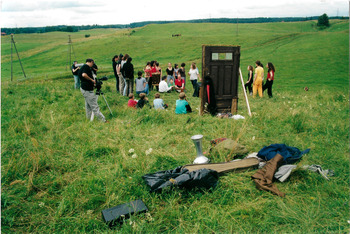
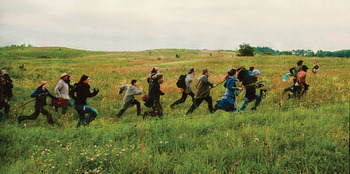
It is a landscape perceived as a participant in theatrical events, as can be seen in the theatre's outdoor performances (see Fig. 2). Missa Pagana (2000) and Upiorny całun (The Ghostly Shroud) (2001) took place in the natural landscape of Warmia, ‘under the great roof of the sky’, to quote a passage of Edward Stachura's poem, on which the Missa Pagana performance was based (see Fig. 3). The architecture of the show was ‘the rural landscape, forest meadows and barrows’, as the already mentioned Jędrzej Cierniak would have wanted. The musicality and open-air nature of the show, and in particular Adam Mickiewicz's drama, on the basis of which ‘Dziady Warmińskie’ or Upiorny całun was based, show how strongly the landscape is intertwined with the romantic tradition of Polish theatre.
Rehearsal for the 2001 outdoor performance of Upiorny całun (The Ghostly Shroud). Photograph © the Węgajty Theatre Archive.

An outdoor performance of Missa Pagana in 2000. Photograph © the Węgajty Theatre Archive.

Through their activities, the Sobaszeks have permanently inscribed themselves in the Warmian landscape and stopped being ‘local strangers’.Footnote 63 ‘I feel at home in Węgajty’, Erdmute claimed after years spent in Warmia.Footnote 64 Despite some difficulties connected with the economic transformation of Warmia after 1989 and its ‘desertification in terms of human resources’,Footnote 65 the Sobaszeks continue their cultural and social activities. They carry out numerous projects, such as the Theatre Village Festival, Other Theatre School, and Shrovetide, and they conduct cultural activities in the nursing home in Jonkowo. Thus they take care of Warmia's symbolic resource, opposing the local government policy aimed at promoting tourism.Footnote 66
In their lives and cultural practices, the Sobaszeks join the ‘landscape creation process’ mentioned by Ingold. A significant tool of their artistic work is cultural barter. Based on reciprocity, the barter, which is ‘a non-monetary exchange of goods’, was proposed by Eugenio Barba as ‘a spontaneous exchange of songs, dances and theatrical scenes’.Footnote 67 The director used this term to define the way Odin Teatret conducted his activities with the inhabitants of the Italian village of Carpigiano in 1974. This natural exchange of cultural goods allowed both artists, Odin Teatret and the Sobaszeks, to establish relations with the local inhabitants.
Barter is one of several components that make up Barba's definition of the Third Theatre: ‘The Third Theatre lives on the fringes, often outside or on the outskirts of the centres and capitals of cultures’.Footnote 68 This theatre is created by people mainly without traditional theatrical education. But they are not amateurs, as Barba pointed out, because ‘their entire day is filled with theatrical experience, sometimes what they call training’.Footnote 69
Polish researchers used to include the Węgajty Theatre in the trend of the Third Theatre, at the same time emphasizing the importance of the rural landscape in the Sobaszeks’ development of community. For them, this landscape is a lasting trace of the lives and work of past, ethnically diverse, generations of the Warmia region, which they are trying to preserve through cultural activities. It is theatrical art inscribed in the rural landscape that has allowed them to strengthen their ‘perceptual engagement’ that saves the memory of this land, builds a community and involves its inhabitants in social activity.
Theatrical activity within the rural space: the concept of landscape theatre
The ‘landscape praxis’ of the Sobaszeks, to use the term coined by archaeologist Christopher Tilley,Footnote 70 is primarily a theatrical praxis. Tilley claimed that landscapes are experienced in practice while performing various daily activities. In his opinion, ‘a landscape has ontological import because it is lived in and through, mediated, worked on and altered’.Footnote 71 The constant practice (theatrical training) of Wacław and Erdmute is a ‘daily run’ in the forest surrounding their home and the theatre. Wacław wrote in his journal:
Twilight, forest, forest paths. First – uphill, then – gently down the hill. The forest makes you feel calm, but it also makes you more energetic and attracts you with the possibility of movement. A sense of closeness with animals is tempting … Although we have been running for years, still in the same area of the forest close to the theatre, we are finding new paths. It depends more on our imagination rather than the forest itself.Footnote 72
In this case, the forest becomes a space of topographic experiences, which Berleant wrote about in the perspective of participatory landscape. According to him, ‘being engaged with the landscape’ allows us to open ourselves to a whole range of multisensory experiences, rather than merely a distanced visual experience.Footnote 73 Berleant attributed this distance to the panoramic landscape, calling it ‘being in the distance’ that appears only as an object. However, as emphasized by culture expert Frederick Charles Inglis, the landscape is a living process that makes people and is made by them.Footnote 74
This idea can be linked both to the Sobaszeks’ everyday practice of running, and to their cultural activities, in particular the Theatre Village Festival or carol singing. Carol singing, or wandering through Warmian forests, clearings and villages, singing together with their inhabitants, can be regarded as ‘being in the landscape’, or, as Berleant wanted, participating in the landscape, in natural and cultural terms. Wandering matches Tilley's horizon of reflections. He recognized that it is a paradigmatic cultural act, since it is following in the footsteps left behind by others who have trodden the path. In fact, while striding along the Warmia region every year, the Węgajty Theatre not only symbolically follows in the footsteps of past generations, but also realistically protects the memory thereof by singing old, traditional songs.
These works of the Sobaszeks are ‘grounded in and in-depth exploration and expression of spatial practice’,Footnote 75 to use Joanne Tompkins's description of the place and practice of site-specific theatre and performance. The term ‘site-specific performance’ seems to be another significant term in the rich array of activities undertaken by the Węgajty Theatre. The Sobaszeks’ stagings can be considered ‘inseparable from their sites, the only contexts within which they are intelligible’,Footnote 76 as Pearson and Shanks wrote about site-specific performances. The researchers pointed out that ‘performance recontextualizes such sites: it is the latest occupation of a location at which other occupations – their material traces and histories – are still apparent: site is not just an interesting, and disinterested, backdrop’.Footnote 77
‘Material traces and histories’ seem to be the building components of the Węgajty performances, the inspiration in the workshop work with the participants, the source tradition explored in accordance with the ritual calendar of the village, i.e. during carolling, carnivals, alilujkas, bonfires. They belong to the old imaginarium of East Prussia and were included in numerous processes of mythicizing historical Warmia. In the pre-war collective imagination, as well as many years after the war, the Warmian countryside functioned as a world of stunning images, dreams and metaphors, whose holiness bordered on the divine.Footnote 78 The German borderland (Deutsches Grenzland Ostpreuβen), burdened by the numerous migrations of its population, represents something existing outside time, something quasi-substantial, always past, as emphasized by Siegfried Lenz. In the images that spread beyond its borders it appeared as a rural region, reduced to the impressive landscapes that were its hallmark.
This landscape seduced Erdmute and Wacław Sobaszek in the 1970s and 1980s, at a time when the imagination of young alternative artists was particularly awakened in spite of the communist reality. They saw the former East Prussia as Atlantis. By incorporating their life and work into the rural landscape, they in a way became part of the mythicization process. The Węgajty landscape, shaped over the years by various cultural activities of the Sobaszeks and artists invited by them, becomes a utopian ‘landscape phenomenon’,Footnote 79 i.e. a landscape that is perceived by people in a certain way. This is the space of synergy between art and nature. ‘I heard that this is an open community that lives in harmony with nature’, said one of the participants of the Theatre Village.Footnote 80
Bolesław Schmidt defined this harmony with nature as ‘harmonious cooperation’,Footnote 81 or the presence of a man in space that is neither autocratic nor competitive towards nature. The theatre created in a committed and harmonious way by Wacław and Erdmute Sobaszek interacts with the environment; it has a topophilic nature. The notion of topophilia was introduced by a geographer Yi-fu Tuan and should be understood as a sensation combining simple sensual pleasure with aesthetic perception of beauty. According to Tuan, the neologism topophilia expresses ‘human being's affective ties [Greek philia] with the material environment [Greek topos]’.Footnote 82
The topophilic approach of the Węgajty Theatre deepens the image of the village as a ‘landscape phenomenon’. In the perspective of research on alternative theatres this phenomenon should be examined with critical insight because of its utopian potential. East Prussia is a mythical ‘land of crystalline lakes and boundless fields’, but also ‘dark forests’ which, as an asylum, may pose a certain threat.Footnote 83 The gesture of departing from the theatrical canon and moving towards peripherality carries the risk of creating artistic and ideological cocoons, as well as financial and administrative banishment. The creation of symbolic Atlantis, characteristic of Polish alternative theatres, is in line with the discussed creation of landscapes that become history. Ingold's recognition that landscapes are ‘pregnant with the past’, as well as Salwa's term ‘landscape phenomenon’, can serve as an accurate conceptual account of the alternative in order to demythologize it.
The landscapes are one of many components in the voluminous repertory of theatre history, in which one can see the fuzziness of definitional borders and terminological difficulties. This is evidenced by the multitude of labels attributed to the Węgajty Theatre – ‘anthropological theatre’, ‘ethnography-infected theatre’, ‘third theatre’, ‘ecological theatre’. The kaleidoscopic approach of researchers to Polish alternative theatres, which escape the net of the notions and definitions they create, also bears witness to this.Footnote 84
Some of these theatres were active in the rural landscape, which I intend to highlight in my reflection on the achievements of Polish alternative theatre. I see the landscape as an important participant in the work and art of individual artists. I identify the term ‘landscape theatre’ with the Węgajty Theatre, because it has strongly incorporated itself into nature and the village. Landscape theatre is a type of theatre or ‘theatrical partisan’, as Erdmute once used to say, which stimulates its participants to actively participate in the landscape and which cultivates ‘critical patriotism’.Footnote 85 Finally, it is an ongoing and relentless establishment of an alliance with nature, while engaging in sociocultural activities in the province.
These activities are associated with much effort on the part of the new settlers to tame the individual areas and to develop a strategy of financial survival. Initially, the Sobaszeks were struggling with a sense of isolation. In the 1990s, Wacław wrote, ‘Sprinkle your path with withered pine needles so that no one would know that someone lives there’.Footnote 86 At the same time, they were looking for the right artistic formula that would allow them to transform this landscape. Sobaszek wanted to ‘get some kind of impulse, a live impulse, the kind that gives energy, but also thought. The kind that causes the feelings and thoughts to rise and overflow. In this sense, one can talk about an impulse’.Footnote 87
If this impulse were to be inscribed in considerations about the landscape, it would become an ‘aesthetic impulse’ restoring the relationship between people and space.Footnote 88 Art would then present an important medium for restoring the relationship between people and space, as in the case of the Theatre Village Festival, when audiences sat around the earthen floors of the barn, surrounded by vibrations of the night songs. The forest can be seen as a theatre space or an ‘architecture of action’,Footnote 89 to use the term coined by Grotowski, and all viewers as participants in the Węgajty landscape. The workshops that take place in the forest, daily wandering from one village to another or joint feasting by the fire, give the new settlers an opportunity to transform the receptive attitude of theatre spectators into an active and participative attitude. The issues tackled by the Węgajty Theatre, such as productions about the four elements created within the Other Theatre School programme, or the action in defence of old trees located in Warmian alleys (Łączą nas aleje, 2007) also serve this purpose.
Conclusion
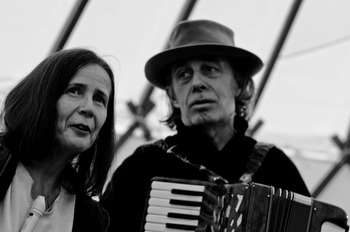
The Łączą nas aleje (United by Alleys) action, like a clasp, closes my considerations of alternative theatre and landscape which began with one of the many actions of the Olsztyn ‘Pracownia’, Tu było drzewo (Here Was a Tree). It shows the road the Sobaszeks have travelled and are still travelling, immersed in the landscape of Węgajty and devoted to it through their everyday lives (see Fig. 4). At the beginning of this journey, the young artists wrote in their programme that their ‘“Pracownia” will have the character of an experimental creative workshop’, that it will ‘be a gathering place for a new, active community involved in the transformation of our reality’. They wanted ‘to focus more on creativity itself than on the pursuit of a finished product’.Footnote 90
Erdmute and Wacław Sobaszek in 2014. Photograph by Piotr Nykowski.

These declarations, originating from the old world of Polish alternative culture, seem to be still valid. They illustrate the processes of sociopolitical change that have taken place in Poland and at the same time indicate the constancy and unchangeability of the Sobaszeks's convictions, their belonging to the world of the provinces. When Wacław Sobaszek arrived in the village of Węgajty in 1982, he found himself in solitude, with its wilderness full of animals and the voices of birds. ‘What an abundance of content’ – that is how he began his encounter with the rural landscape.Footnote 91 Remaining there, he continued to fulfil the declarations he had made; together with his wife Erdmute, over many years he created an active artistic environment, and his productions are still focused on the creative process. This process does not presuppose a final outcome, because a performance is not a commodity. Nor does it have a classical plot, but springs from the ‘great breath’ that Limanowski wrote about.Footnote 92
Erdmute and Wacław still lead vita activa, as described by Angutek, so they actively experience nature and are its active participants. The forest surrounding the barn theatre and the Sobaszeks's house, forest paths leading to nearby houses, farms and farm dwellings of Węgajty, became a dimension of their lives and an art space. On the one hand, it became their artistic, utopian Atlantis, and on the other, it became a small homeland, Heimat, or home, preserved in songs and fairy tales about East Prussia.