Introduction
We are pleased to be able to contribute to this Festschrift celebrating the impact of the Manual of Nearctic Diptera and its coordinators. Because this is a paper on flower flies, we intend to focus on Richard (Dick) Vockeroth. Dick was one of the pre-eminent dipterists of the 20th century and had tremendous impact on syrphid taxonomy. His species concepts (whether published or not) are tremendously insightful and his keys covering many families are among the best ever written for fly identification. It will be decades before we are finished compiling his collection data and notes into published papers. Here, we have incorporated his unpublished work on Sericomyia Meigen with our own views and some new data.
Sericomyiine flower flies are common in boreal forests across the Holarctic region and extend southward at higher elevations into the Oriental and Neotropical regions. Thirty species were known at the inception of this project: 10 restricted to the Palaearctic, 13 restricted to the Nearctic, two Holarctic, three from the Orient, and two from the Neotropics.
In this paper we describe one new species of Sericomyia, highlight the presence of a Holarctic species not previously known from North America, recognize a misplaced and junior synonym, provide new data on the difficult to identify and often Holarctic northern species, illustrate the genitalia of some species for the first time, provide habitus illustrations for all of the species, and provide the first key to the group since Curran (Reference Curran1934).
Sericomyia larvae are rat-tailed maggots and live in ponds rich in decomposing vegetation where they filter out microorganisms as their food (Rotheray Reference Rotheray1993; van Veen Reference van Veen2004). Adults are regularly found on flowers and many are also conspicuous members of the hilltopping community (J.H. Skevington, unpublished data).
Materials and methods
Specimens examined in this study were obtained from the following collections: Biodiversity Institute of Ontario, Guelph, ON, Canada (BIOUG), Canadian National Collection of Insects, Ottawa, ON, Canada (CNC), University of Guelph Insect Collection, Guelph, ON, Canada (DEBU), Royal Ontario Museum, Toronto, ON, Canada (ROME), University of Alberta, E.H. Strickland Entomological Museum, Edmonton, AB, Canada (UASM), National Museum of Natural History, Washington, DC, United States of America (USNM).
Specimen preparation follows Skevington (Reference Skevington2003). Photographs were taken with a Leica DM550B compound microscope (Leica Microsystems Inc., Concord, Ontario, Canada) and a Canon EOS 50D camera equipped with a 100 mm macro lens (Canon Canada Inc., Mississauga, Ontario, Canada). In most cases, Leica Application Suite was used to create a montage from multiple layers of photographs. Measurements were made using a graticule. At least five specimens were used from each species to obtain the recorded values. Terminology follows Thompson et al. (Reference Thompson, Rotheray and Zumbado2010). All specimens are labelled with a unique reference number, typically in the format J. Skevington Specimen # n, CNC Diptera # n, debu n, or USNM ENT. The former three have been shortened to follow the format JSSn, CNCDn, and debun, respectively, throughout the text. These numbers are used in the CNC Diptera specimen database (available upon request). Standard two-letter postal acronyms are used for distribution data.
Figures are presented in the order that they appear in the key. Maps include points for all specimens examined and were produced using SimpleMappr (Shorthouse Reference Shorthouse2010). When additional range data are known from the literature it is mentioned in the key along with a citation.
Molecular methods
All molecular specimens (Appendix 1) were dried, pinned, labelled, and labelled with a unique number (see above). Two Palaearctic and 14 New World species of Sericomyia were successfully sequenced. Data are missing for the following New World species: Sericomyia arctica Schirmer, Sericomyia carolinensis (Metcalf), Sericomyia harveyi (Osburn), Sericomyia meyeri (Fluke), and Sericomyia fairmanorum Fairman. Attempts were made to sequence these species but our material was too old to amplify or had been prepared in such a way that the DNA was destroyed (e.g., dried using ethyl acetate). A single leg was removed from each specimen for sequencing and a 658 base pair fragment of the 5′ end of the cytochrome oxidase subunit I (COI) gene (the ‘barcoding’ fragment) was amplified using the primer pair LepF1 (5′-ATTCAACCAATCATAAAGATATTGG-3′) and LepR1 (5′-TAAACTTCTGGATGTCCAAAAAATCA-3′) (Hebert et al. Reference Hebert, Cywinska, Ball and deWaard2003). DNA extraction and sequencing was performed at both CNC and at the Canadian Centre for DNA Barcoding following protocols outlined in Hajibabaei et al. (Reference Hajibabaei, deWaard, Ivanova, Ratnasingham, Dooh and Kirk2005). The resultant sequences, as well as images and related data, can be accessed through the Barcode of Life Data Systems (BOLD) (http://www.barcodinglife.org/) in the public project ‘Sericomyia – Skevington (SERSK)’ (http://www.boldsystems.org/views/projectmenu.php?&). In addition, all sequences were deposited in GenBank (Appendix 1).
Data analysis
No insertions or deletions occur in the dataset so alignment was unambiguous. Phenetic and parsimony analyses were performed with PAUP* (Swofford Reference Swofford2001). Neighbour-joining was used to explore species concepts for all 105 ingroup taxa. Parsimony and Bayesian methods were used with a reduced dataset (one exemplar per species) for creating phylogenetic hypotheses. Character polarity was based on outgroup comparison (Nixon and Carpenter Reference Nixon and Carpenter1994). Several species of Cheilosia Meigen were defined as outgroup for all analyses (but not constrained as such) because they are genetically closest to Sericomyia from all of the available COI data available on BOLD and in GenBank. Parsimony analysis with a heuristic search procedure was used with stepwise-addition and 100 random replications. The heuristic search option was used with tree bisection–reconnection branch swapping, MULPARS, and random addition of taxa. Multistate characters were treated as non-additive. Evidential support for different clades was assessed using the nonparametric bootstrap (BS – 1000 replicates) (Felsenstein Reference Felsenstein1985). For Bayesian analysis, models of evolution were determined based on the Akaike Information Criterion (AIC) using ModelTest 3.7 (Posada and Crandall Reference Posada and Crandall1998). Bayesian analyses were conducted using MrBayes 3.1.2 (Ronquist and Huelsenbeck Reference Ronquist and Huelsenbeck2003) with a Markov Chain Monte Carlo (MCMC) method. Four chains (three hot, one cold) were run simultaneously for 400,000 generations. Trees were sampled every 10 generations and each simulation was run twice. The MCMC chains achieved stationarity (standard deviation of split frequencies <0.01; all parameter estimates asymptotic) at 370,000 generations. Following the discard of the first 10,000 samples as burn-in, 30,000 samples were used for each simulation to generate a majority-rule consensus tree, posterior probabilities for each node, and branch length estimates.
Results and discussion
Sericomyia Meigen
Cinxia Meigen, Reference Meigen1800: 35. Type-species, Musca lappona L. by subsequent designation of Coquillett (Reference Coquillett1910: 524). Name suppressed by International Commission on Zoological Nomenclature (1963).
Sericomyia Meigen, Reference Meigen1803: 274. Type-species, Musca lappona L. by subsequent designation of Latreille (Reference Latreille1810: 443).
Arctophila Schiner, Reference Schiner1860: 215. Type-species, Syrphus bombiformis Fallén by subsequent designation of Williston (Reference Williston1887: 158). Syn. nov.
Condidea Coquillett, Reference Coquillett1907: 75. Type-species, lata Coquillett by original designation.
Conosyrphus Frey, Reference Frey1915: 17. Type-species, tolli Frey by original designation. Syn. nov.
Bulboscrobia Gaunitz, Reference Gaunitz1937: 91. Type-species, undulans Gaunitz by original designation = lappona L.
Tapetomyia Fluke, Reference Fluke1939: 370. Type-species, meyeri Fluke by original designation.
Description
Head
Face variable, black to yellow, with or without black medial vitta, broad, about as broad as long, occupying about one-third head width, concave beneath antenna, usually with large low medial tubercle, pollinose and pilose laterally, shiny and bare medially; gena narrow, about half as broad as long; anterior tentorial pit short, extending along ventral one-third of eye; facial stipes narrow; frontal prominence low, at dorsal half of head; frontal lunule small, narrow; frons broad, about as long as broad at antenna, with slightly convergent sides dorsally, half as broad at vertex as at antenna, pollinose and pilose; vertex triangular, as long as broad, pollinose and pilose; ocellar triangle small; eye bare; narrowly to broadly holoptic in male; antenna short, at most about one-third as long as face; basoflagellomere oval to quadrate; arista pilose, about one and a half times as long as antenna.
Thorax
Slightly broader than long, long to short pilose, without setae; postpronotum pilose; proanepisternum pilose, prokatepisternum bare; proanepimeron pilose; mesonotum without pollinose pattern; katepisternum discontinuously pilose, with broadly separated patches; metasternum pilose; anepimeron with dorsomedial portion bare, posterior portion usually bare, rarely with some pile anteroventrally; katepimeron bare; postalar pile tuft absent, but with pile along anterodorsal edge of postalar area; metathoracic pleuron bare; metathoracic spiracle about same size in height as length of basoflagellomere, but narrower in width; plumula simple, elongate, short, not reaching calypteral margin; scutellum without apical sulcus, with ventral pile fringe.
Legs
Mesocoxa bare posteriorly; metafemur usually narrow, rarely slightly swollen, without basoventral setose patch; metatibia transverse apically, rounded basoventrally.
Wing
Cell R1 open; stigmatic crossvein absent; cell R4 + 5 with long petiole, longer than humeral crossvein; vein R4 + 5 straight to moderately sinuate; vein M2 absent; vein A1 + CuA2 short, oblique.
Abdomen
Oval, slightly longer than broad.
Classification
Within the current classification of flower flies, Sericomyia falls into the tribe Sericomyini of the subfamily Eristalinae. This tribe now contains only four genera. Besides Sericomyia, these are: (1) Pyritis Hunter, with a single species restricted to the Pacific Northwest of the Nearctic region characterized by pilose eye and face. (2) Pseudovolucella Shiraki, an Oriental and Far Eastern Palaearctic group of 10 species characterized by a distinctive enlarged flattened head and enlarged metafemur (Reemer and Hippa Reference Reemer and Hippa2008). (3) Pararctophila Hervé-Bazin, a small group of two to three species ranging from the Transbailkalia to the Himalayas characterized by a strongly sinuate vein R4 + 5.
The taxonomic concept of Sericomyia is old, dating back to Meigen (Reference Meigen1800), and based on two species (M. lappona and Syrphus mussitans F.). The essential characters were the pilose arista on an oval basoflagellomere. Meigen (Reference Meigen1800) first named the taxon Cinxia but the International Commission on Zoological Nomenclature (1963) suppressed that name, so his subsequent name, Sericomyia, is valid.
This original concept included two kinds of flies: short pilose flies with transverse yellow fasciate maculae on the abdomen and long pilose flies without yellow maculae on the abdomen. The latter are bumble bee (Bombus Latreille (Hymenoptera: Apidae)) mimics. Schiner (Reference Schiner1860) proposed the name Arctophila for the bumble bee mimics. He also noted that these species are more robust and their faces are produced much more ventrally.
Next, Coquillett (Reference Coquillett1907) proposed Condidea for a new species which has large circular yellow maculae on the abdomen and is similar to Sericomyia. Frey (Reference Frey1915) described Conosyrphus for a new high arctic species, which is sexually dimorphic (male with an entirely black abdomen, the female with the standard yellow fasciate maculae on the abdomen) and has a greatly ventrally produced face. Later, Gaunitz (Reference Gaunitz1937) encountered an aberrant specimen of Sericomyia lappona and, because of the unusual appearance of furrows on the abdomen, proposed Bulboscrobia for it. Finally, Fluke (Reference Fluke1939) described Tapetomyia for a bumble bee mimic from Mexico. The “truncated” basoflagellomere and dichoptic male along with the “longer and narrower” face were declared as distinctive.
Hull (Reference Hull1949), in the last comprehensive generic treatment of the family, recognized Sericomyia and Tapetomyia as distinct with Arctophila, Bulboscrobia, Condidea, and Conosyrphus as subgenera of Sericomyia. Curran (Reference Curran1934) declared Condidea as “hardly tenable”, and Wirth et al. (Reference Wirth, Sedman and Weems1965) formally synonymized the genus with Sericomyia. Gaunitz (Reference Gaunitz1963) later synonymized his own genus Bulboscrobia under Sericomyia (as Cinxia). Thompson et al. (Reference Thompson, Vockeroth and Sedman1976) in their Neotropical flower fly catalogue synonymized Tapetomyia with Arctophila. Later Thompson et al. (Reference Thompson, Thompson and Fairman2000) declared Arctophila to be only a phenetic group.
When these new off-shots from Sericomyia were proposed, they seemed reasonable. For Schiner (Reference Schiner1860), the two European Arctophila species were quite different from the other Sericomyia species as they were bumble bee mimics with robust metafemora and long faces. Later, however, when Osten Sacken (Reference Osten Sacken1875) described flagrans from North America, which has neither a long face nor robust metafemur, the only distinction was the mimetic appearance. Likewise, when Fluke (Reference Fluke1939) described Tapetomyia, he was comparing his species with flagrans, not the European species, which have longer faces. As for the dichoptic male, there is a Chinese bumble bee mimic which is also dichoptic, but has a short face like flagrans. So, the only characteristic that defines and separates “Arctophila” from Sericomyia is the mimetic appearance; hence the declaration that Arctophila is only a phenetic group.
As for Conosyrphus, again when the species tolli was described (Frey Reference Frey1915), it was atypical of the genus Sericomyia due to it long face and dimorphic sexes. However, Portschinsky (Reference Portschinsky1881) described a species from Caucasia with a long face just like tolli that was later placed in Conosyrphus (as a new species by Coe Reference Coe1966). This species is not sexually dimorphic but does have a face even longer than tolli! Also, Sericomyia himalayensis Brunetti (Reference Brunetti1907, Reference Brunetti1908) has a long face, but otherwise is typical of Sericomyia.
In summary, the characters originally proposed to define the taxonomic concepts of Arctophila, Conosyrphus, and Tapetomyia vary independently within the clade that Meigen originally recognized as Sericomyia. Hence, we here formally return to Meigen's concept and officially treat Arctophila and Conosyrphus as new synonyms of it. Molecular support for this is discussed in the phylogeny section below.

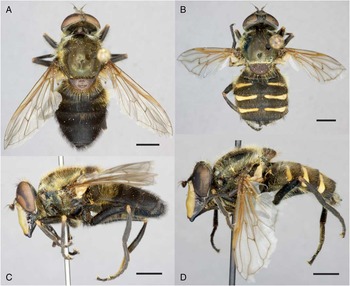
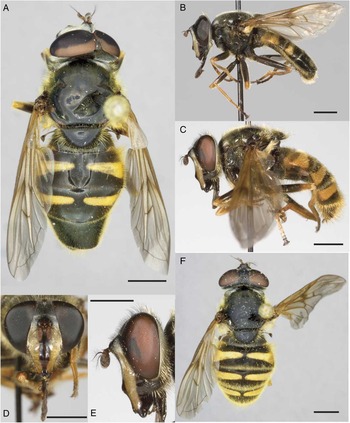
Sericomyia tolli. A, Male habitus, dorsal (CNCD30733); B, female habitus, dorsal (CNCD30743); C, male habitus, lateral (CNCD30733); D, female habitus, lateral (CNCD30743). Scale bars = 2 mm.

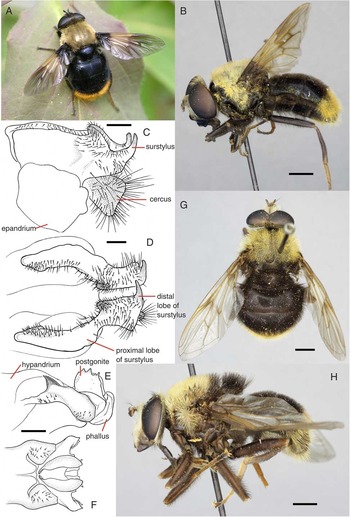
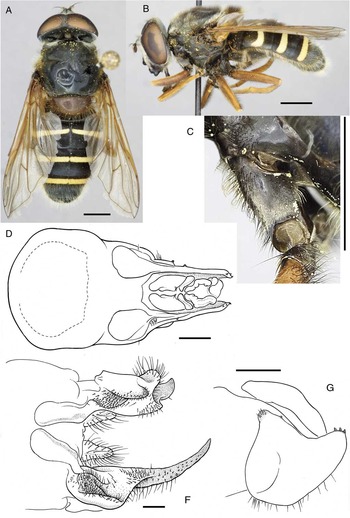
A, Sericomyia vockerothi female field photo, dorsal (Canada: AB: Blackfoot Lake, 53.536944°N, 112.779722°W, 14.v.2006, J.J. Dombroski (specimen not collected)); B, S. vockerothi male habitus, lateral (CNCD35754); C, S. vockerothi surstylus and associated structures, lateral (CNCD35755); D, S. vockerothi surstylus and associated structures, dorsal (CNCD35755); E, S. vockerothi hypandrium and associated structures, lateral (CNCD35755); F, S. vockerothi hypandrium, dorsal (CNCD35755); G, S. harveyi male habitus, dorsal (JSS22100); H, S. harveyi male habitus, lateral (JSS22100). Scale bars for colour illustrations = 2 mm; for genitalia = 0.2 mm.

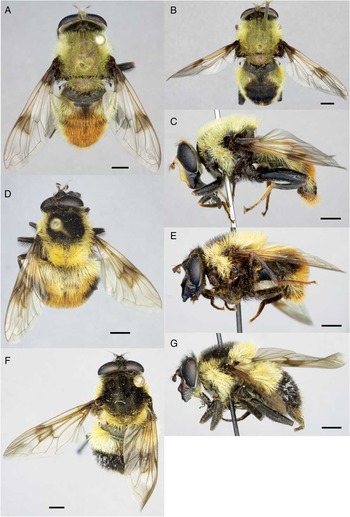
A, Sericomyia flagrans male habitus, dorsal (CNCD1976); B, S. flagrans male habitus, dorsal (to show variation in abdominal colouration) (USNMENT00035368); C, S. flagrans male habitus, lateral (CNCD1976); D, Sericomyia meyeri female habitus, dorsal (USNMENT00022495); E, S. meyeri female habitus, lateral (USNMENT00022495); F, Sericomyia fairmanorum female habitus, dorsal (USNMENT00037868); G, S. fairmanorum female habitus, lateral (USNMENT00037868). Scale bars = 2 mm.

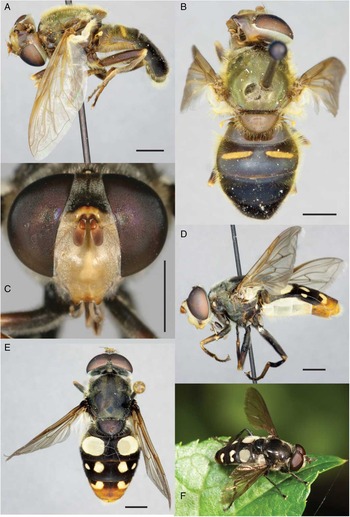
A, Sericomyia carolinensis male habitus, lateral (CNCD29611); B, S. carolinensis male habitus, dorsal (CNCD29611); C, S. lata female, frontal of head (CNCD601); D, S. lata male habitus, lateral (CNCD2222); E, Sericomyia lata male habitus, dorsal (CNCD2222); F, S. lata female field photo (S.A. Marshall). Scale bars = 2 mm.

Sericomyia bifasciata. A, Male habitus, dorsal (CNCD29545); B, male habitus, lateral (CNCD2711); C, female habitus, lateral (CNCD2712); D, female head, frontal (CNCD600); E, female head, lateral (CNCD2712); F, female habitus, dorsal (CNCD31287). Scale bars = 2 mm.

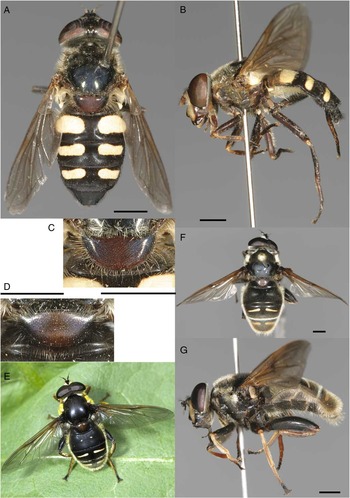
A, Sericomyia transversa female habitus, dorsal (CNCD509); B, S. transversa female habitus, lateral (CNCD510); C, S. transversa male scutellum, dorsal (CNCD509); D, Sericomyi militaris male scutellum, dorsal (CNCD111); E, S. militaris female field photo (S.A. Marshall); F, S. militaris male habitus, dorsal (CNCD111); G, S. militaris male habitus, lateral (CNCD111). Scale bars = 2 mm.

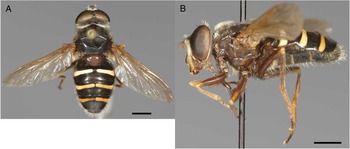
Sericomyia slossonae male habitus (CNCD508). A, Dorsal; B, lateral. Scale bars = 2 mm.

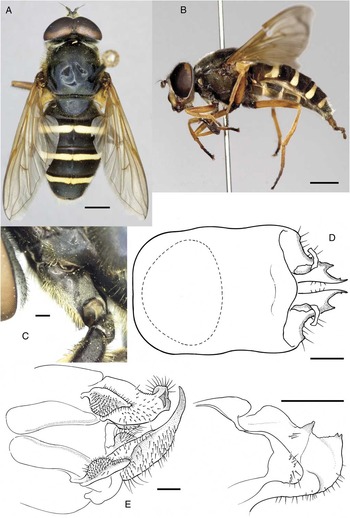
Sericomyia nigra. A, Male habitus, dorsal (CNCD30637); B, female habitus, lateral (CNCD9764); C, male foreleg, lateral (CNCD30583); D, hypandrium (phallus removed; CNCD30591); E, surstyli and associated structures (CNCD30590); F, lateral of hypandrium and associated structures (CNCD30951). Scale bars for colour illustrations = 2 mm; for genitalia = 0.2 mm.

Sericomyia woodi. A, Male habitus, dorsal (CNCD30858); B, female habitus, lateral (CNCD30858); C, male foreleg, lateral (CNCD30856); D, hypandrium and associated structures (CNCD2232); E, surstyli and associated structures (CNCD2232); F, lateral of hypandrium and associated structures (CNCD2232). Scale bars for colour illustrations = 2 mm; for genitalia = 0.2 mm.

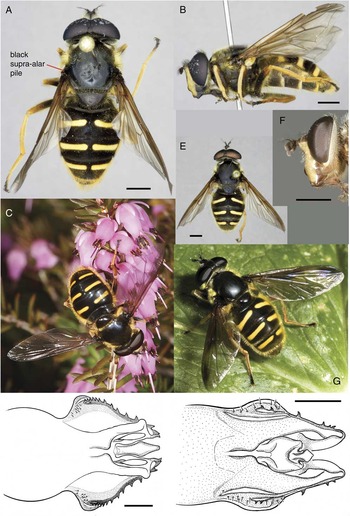
A, Sericomyia chalcopyga male habitus, dorsal (CNCD1843); B, S. chalcopyga male habitus, lateral (CNCD1843); C, S. chalcopyga male field photo (John Davis); D, S. chalcopyga hypandrium (CNCD33896); E, Sericomyia chrysotoxoides male habitus, dorsal (CNCD29977); F, S. chrysotoxoides male head, lateral (CNCD505); G, S. chrysotoxoides female field photo (Virginia, Dave Cheung); H, S. chrysotoxoides hypandrium (CNCD29795). Scale bars for colour illustrations = 2 mm; for genitalia = 0.2 mm.

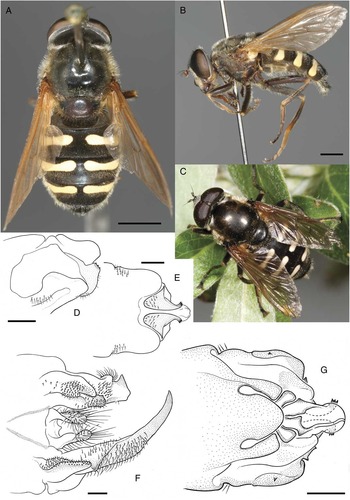
Sericomyia sexfasciata. A, Female habitus, dorsal (CNCD507); B, female habitus, lateral (CNCD507); C, male field photo (Churchill, Manitoba, J.H. Skevington); D, lateral of hypandrium and associated structures (CNCD30648); E, hypandrium, ventral (CNCD30648); F, surstyli and associated structures (CNCD30648); G, hypandrium, dorsal (CNCD30648). Scale bars for colour illustrations = 2 mm; for genitalia = 0.2 mm.

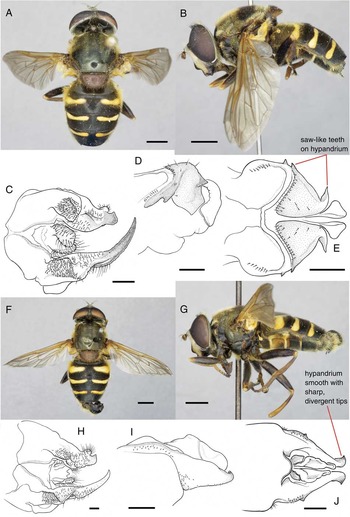
A, Sericomyia arctica male habitus, dorsal (CNCD29517); B, S. arctica male habitus, lateral (CNCD29517); C, S. arctica surstyli and associated structures (CNCD29518); D, S. arctica lateral of hypandrium and associated structures (CNCD29518); E, S. arctica hypandrium and associated structures (CNCD29518); F, Sericomyia jakutica male habitus, dorsal (genitalia twisted out for examination – CNCD30683); G, S. jakutica male habitus, lateral (CNCD30683); H, S. jakutica surstyli and associated structures (CNCD30107); I, S. jakutica lateral of hypandrium and associated structures (CNCD30107); J, S. jakutica hypandrium and associated structures (CNCD30669). Scale bars for colour illustrations = 2 mm; for genitalia = 0.2 mm.

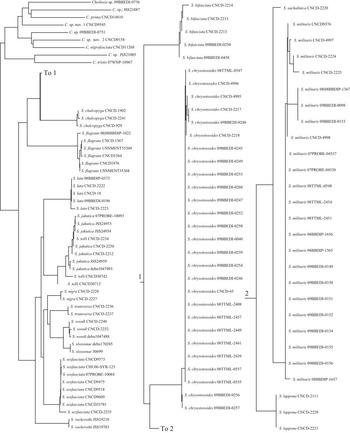
Neighbour-joining phenogram of Sericomyia species produced from analysis of COI data.

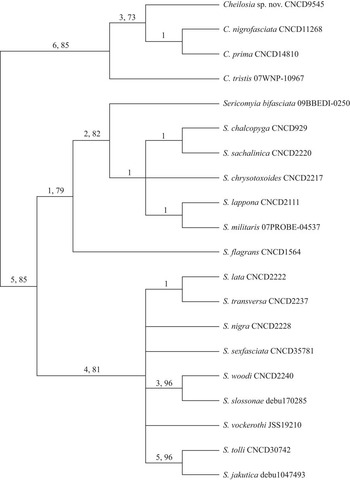
Strict consensus cladogram of Sericomyia species produced from parsimony analysis of COI data. Bremer supports followed by bootstraps indicate clade support.

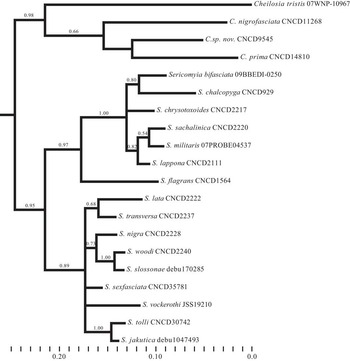
50% majority rule consensus cladogram of Sericomyia species produced from Bayesian analysis of COI data. Clade supports shown are posterior probabilities.

Sericomyia vockerothi Skevington sp. nov.
Range map for Sericomyia slossonae (triangles), Sericomyia tolli (circles), and Sericomyia vockerothi (stars).

Range map for Sericomyia fairmanorum (circles), Sericomyia harveyi (triangles), and Sericomyia meyeri (stars).
Range map for Sericomyia bifasciata (circles), Sericomyia carolinensis (stars), and Sericomyia flagrans (triangles).
Range map for Sericomyia lata (circles) and Sericomyia arctica (triangles).
Range map for Sericomyia transversa (triangles) and Sericomyia woodi (circles).
Range map for Sericomyia militaris.
Range map for Sericomyia nigra.
Range map for Sericomyia chrysotoxoides (circles) and Sericomyia jakutica (triangles).
Range map for Sericomyia chalcopyga.
Range map for Sericomyia sexfasciata.
Diagnosis
Sericomyia vockerothi is superficially similar to the common and widespread Sericomyia flagrans (Fig. 3) but differs in having an entirely black pilose scutellum (similar to the uncommon S. harveyi). The face is entirely black, the postalar callus is yellow pilose, and the scutum is entirely yellow pilose.
Description
Body length: 12.6 to 14.0 mm; wing length: 9.5 to 10.5 mm.
Head
Frons and face entirely dark brown to black (Fig. 2B); face bare and shiny except for golden vestiture beneath antennae and a mixture of pale yellow and black pile along the lateral fringe; frons and ocellar triangle covered with long, pale yellow pile; occiput silvery-white pollinose, yellow pilose dorsally; antenna light brown, black pilose; arista pilose; male holoptic with area of contact somewhat shorter than length of ocellar triangle, female dichoptic.
Thorax
Black; postpronotum, mesonotum and postalar callus entirely yellow pilose; scutellum black pilose (Fig. 2A); proepisternum with sparse yellow pile; proepimeron with black pile; anterior anepisternum bare; posterior anepisternum and anterior anepimeron with long, dense yellow pile; katepisternum with black pile ventrally, bare and shining medially and with yellow pile dorsally; meron, posterior anepimeron and katetergum bare; metasternum black pilose; plumula black with short black pile; calypter black with black fringe.
Legs
Femora and tibiae shape cylindrical with no protuberances, black, black pilose; tarsomeres 1–3 reddish brown with dorsal setae black, ventral pile reddish brown; tarsomeres 4–5 blackish with black setae.
Wing
Wing completely densely microtrichose; dark brown at base and on pterostigma, light brown in costal cell, middle of r1, basal half of r2 + 3, distal third of br and around r-m and bm-cu; remainder of wing hyaline.
Abdomen
Black; terga 1–4 shiny, black pilose; tergum 5 mostly to entirely black, sometimes yellow along posterior margin, shiny to weakly grey pollinose, yellow pilose; sterna 2–4 shiny black with black pile; sternum 5 black to brown with yellow pile; terminalia black to brown and yellow pilose.
Genitalia
Surstylus short, with pointed, upturned terminal finger deflected left (Fig. 2C–2D); proximal lobe of surstylus bare on outer surface, heavily setose on medial surface; distal lobe of surstylus covered with setae on most surfaces, bare only on finger-like tips; cercus somewhat rectangular with longer setae than surstylus; hypandrium with large holes dorsally giving it a skull-like appearance from above (Fig. 2E); large tooth at distal end of hypandrium (Fig. 2E–2F); ejaculatory apodeme bulb-shaped; phallapodeme broad, axe-shaped proximally; postgonite with four to five dorsal teeth on outer lobe (Fig. 2E), inner lobe smooth; phallus smooth, hook-shaped, with hook projecting dorsally (Fig. 2E).
Material examined
Holotype ♂ labelled: CANADA, YUKON TERRITORY: Sheldon Lake, 62.6677°N, 131.1000°W, 914 m, 21.vii.1960, J.E.H. Martin, CNCD35752 (CNC).
Paratypes:CANADA: ALBERTA: Doussal, 55.6169°N, 116.8315°W, 632 m, 1.vi.1961, A.R. Brooks, CNCD35754 (1 ♂, CNC). NORTHWEST TERRITORIES: Martin River, 10 miles NW of Fort Simpson, 61.8934°N, 121.6132°W, 15.vi.1972, B.V. Peterson, CNCD35755 (1 ♂, CNC). QUEBEC: Albanel, 48.8294°N, 72.3512°W, 13.vi.2009, blueberry field, J. Moisan-De Serres, JSS19703 (1 ♀, CNC); Dolbeau, 48.8610°N, 72.2345°W, 17.vi.2009, blueberry field, J. Moisan-De Serres, JSS19236 (1 ♀, CNC); St.-Eugène, 49.0003°N, 72.3476°W, 16.vi.2009, blueberry field, J. Moisan-De Serres, JSS19210 (1 ♂, USNM). YUKON TERRITORY: Swim Lakes, 62.2167°N, 133.0000°W, 975 m, 23.vi.1960, F.W. Rockburne, CNCD35753 (1 ♀, USNM); La Force Lake, 62.6833°N, 132.3333°W, 1006 m, 5.vii.1960, F.W. Rockburne, CNCD35751 (1 ♀, CNC). UNITED STATES:MINNESOTA: West Cook, Saganaga Lake, Conners Island, 48.24016°N, 90.84955°W, 3.vi.1964, W.E. LaBerge & D.W. Ribble, USNMENT00036891 (1 ♂, USNM).
Etymology
Named for John Richard Vockeroth, in recognition of his life-long achievements in syrphidology research. Dick was also in the process of revising Sericomyia, so here we build on his knowledge of the group.
Distribution
Widespread but rarely collected across northern Canada (AB, NT, QC, YT – Map 1).
Remarks
This is the “nov. spec.” from north central North America given in the Arctophila key by Thompson et al. (Reference Thompson, Thompson and Fairman2000).
Revisionary notes
1. Mallota powelli Nayar and Cole (Reference Nayar and Cole1968: 288) is merely a mis-identified species and is a junior synonym of S. flagrans (Osten Sacken) (syn. nov.).
2. The colour characters given by van Stackelberg (Reference Stackelberg1927) and van Veen (Reference van Veen2004) to separate S. arctica from Sericomyia jakutica do not work. Nielsen (Reference Nielsen1997) also recognized this.
3. Sericomyia jakutica is here recognized for the first time from the Nearctic Region, we have examined the following specimens from the Nearctic Region: USA: AK: King Salmon, Naknek River, 58.6833°N, 156.65°W, 1.viii.1952, 13.vii.1952, 23.vii.1952, 31.vii.1952, J.B. Hartley, CNCD30105, 30108, 30670-6, 30683 (10 ♂♂, CNC); Oumalik, 69.8333°N, 156.00°W, 15.vii.1949, N.A. Weber, CNCD30669 (CNC). Canada: MB: Twin Lakes, 58.63208°N, 96.78851°W, 15.vii.2007, P. Hebert, CNCD30696 (CNC); 23 km E Churchill, Ramsay Creek, 58.73010°N, 93.77100°W, 3.vii.2007, P. Hebert, 07PROBE10093 (BIOG), CNCD30690 (2 ♂♂, CNC); Churchill, 58.7688°N, 94.1716°W, 10, 12.vii.1948, 25, 28.vi.1952, 24.vii.1952, J.G. Chillcott, L.A. Miller, CNCD30104, 30688, 30692-4 (2 ♂♂, 3 ♀♀, CNC). NT: Coppermine, 62.56273°N, 115.09276°W, 3.viii.1951, S.D. Hicks, CNCD30689 (1 ♂, CNC); Norman Wells, 65.26667°N, 126.81667°W, 5.viii.1969, G.E. Shewell, CNCD2230 (1 ♀, CNC); Reindeer Depot, Mackenzie Delta, 68.66897°N, 134.07157°W, 2,4.vii.1948, J.R. Vockeroth, W.J. Brown, CNCD30106-7, 30678-81, 30686-7, 30695 (8 ♂♂, 1 ♀, CNC), Kidluit Bay, Richard Island, 69.32634°N, 134.43724°W, 28, 30.vii.1948, J.R. Vockeroth, CNCD30677. 30691 (1 ♂, 1 ♀, CNC), 21 miles E Tuktoyaktuk, 69.42684°N, 132.17247°W, 8–12, 17–21.vii.1971, D.M. Wood, CNCD2212, 30682, 30684-5 (4 ♂♂, CNC), Tuktoyaktuk, 69.43385°N, 133.01473°W, 15–18.vii.2010, H. Goulet, C. Boudreault, JSS24604–6, 24959 (1 ♂, 3 ♀♀, CNC), Sachs Harbour, 71.98653°N, 125.243°W, 19–22.vii.2010, H. Goulet, C. Boudreault, JSS24953-4 (2 ♀♀, CNC). YT: Summit Lake, N. Richardson Mountains, 68.16403°N, 136.98825°W, 3.vii.1987, S.A. Marshall, debu1047493 (1 ♂, DEBU).
Species concepts
DNA barcode data (5′ end of the COI) were collected for 101 Sericomyia specimens of 16 species to test current morphological species concepts and provide a database to assist with future identifications (particularly of non-adults). Most (97 specimens of 14 species) sampled were Nearctic. All morphological species except two were supported by the molecular data and all showed very little intraspecific variation (Fig. 13). Uncorrected pairwise divergences varied from 0% to 0.72% within species and 0% to 9.85% between species. Average pairwise divergence between species was 5.36% and most species were more than 2% different. Exceptions were Sericomyia slossonae and Sericomyia woodi (0.73–1.21% different) and S. jakutica and Sericomyia tolli. The latter two species were found to be genetically identical. Several specimens were sampled for each species to ensure that this was not the result of a sequencing error. These species are dramatically different morphologically and have been treated as belonging to separate subgenera historically. S. tolli has pronounced sexual dimorphism (sexes are similar in S. jakutica), different colour patterns from S. jakutica, and a greatly projecting face (face of S. jakutica is half the length).
Some species that show substantial variation in colour patterns among individuals were found to be genetically cohesive. For example, 22 specimens of Sericomyia militaris were sampled from across the species range, including a variety of phenotypes. These specimens varied by less than 0.69% for COI and no differences were found within the genitalia. Similarly, six specimens of S. flagrans were sampled and included dark specimens, predominantly yellow specimens and specimens with considerable orange pile. They varied by less than 0.61% for COI and also showed no variation in genitalic characters. Specimens showing pronounced differences in colour pattern were also collected at the same location on the same dates, further supporting their treatment as a single species.
The molecular data from this study are available from GenBank and can be analysed and explored in the public project on BOLD “Sericomyia – Skevington (SERSK)” (http://www.boldsystems.org/views/projectmenu.php?&).
Phylogeny
Parsimony analysis of COI data using single exemplars for each species available produced 12 equally parsimonious cladograms (Fig. 14). The strict consensus tree produced is very similar to the topology of the Bayesian consensus tree (Fig. 15). The only difference is that the Bayesian tree shows some additional resolution. Two major lineages of Sericomyia are supported but they do not reflect the current subgeneric concepts.
The close relationship between S. (Conosyrphus) tolli and S. (Sericomyia) jakutica supports our belief that Conosyrphus is a synonym of Sericomyia. The two Arctophila species included in the analysis (S. flagrans and S. vockerothi) are hypothesized to be in entirely different lineages, supporting our synonymy above as well as the contention of Thompson et al. (Reference Thompson, Thompson and Fairman2000) that Arctophila is not monophyletic. In the future it would be interesting to add some Old World Arctophila species to the analysis to see how many times bumble bee mimicry arose within the group.
A few other patterns appear from this analysis. The two Old World species that we have data for are in this same lineage and are closely related to S. militaris. Sequence data for more Old World Sericomyia are needed to find out if they are all in this one clade.
Within the other large lineage Sericomyia lata and Sericomyia transversa are weakly supported as sister taxa. These are both rather autapomorphic Sericomyia that would be difficult to place morphologically so it will be interesting if future research using more genes supports this relationship. Within this lineage Sericomyia nigra, S. slossonae, and S. woodi are supported as closely related. Their relationship was anticipated based on morphology as they all have continuous bands on abdominal terga 2–4 and have very similar genitalia. S. slossonae and S. woodi have virtually identical genitalia, are very similar genetically and are best separated based only on leg colour. Their disjunct distributions support their continued treatment as separate species but more study is needed. Adding additional genes and a morphological dataset is clearly the next step to more fully understand the relationships and evolution of Sericomyia species.
Acknowledgements
Thanks to Barry Flahey for producing the excellent genitalia drawings and to Scott Kelso for developing protocols for sequencing historical pinned specimens and for collecting the COI barcoding data for many of the species of Sericomyia. This study was supported by funding to Agriculture and Agri-Food Canada, the International Barcode of Life Project (iBOL) through the Canadian Centre for DNA Barcoding, from the Ontario Genomics Institute, Genome Canada, the Ontario Ministry of Research and Innovation, and the Natural Sciences and Engineering Research Council of Canada. NSERC Canpolin provided the framework for this and other current research on Syrphidae (this is Canpolin publication no. 22). The following curators and curatorial assistants provided specimens and data used in this study: V. Levesque-Beaudin (BIOUG), S.A. Marshall (DEBU), B. Hubley (ROME), and F. Sperling and D. Shpeley (UASM). Steve Marshall, Jason Dombroski, Dave Cheung, and John Davis provided some of the field photographs. We first discovered John's excellent photo of Sericomyia chalcopyga on BugGuide (http://bugguide.net). Martin Hauser, Ximo Menguel, Bradley Sinclair, and Robb Bennett reviewed the manuscript and helped to improve the final product. Skevington was responsible for the DNA work and took the lead in the preparation of the manuscript. Thompson contributed to the morphological work and the identification key.
Appendix 1. Sericomyia specimens sequenced