Humour is usually meant to be funny and is often fun. Indeed, on occasion, it can be so funny that streams of tears flow down cheeks, lungs struggle for air, stomachs tighten and cramp and persistent hiccups are miraculously cured. We have all been in the precarious predicament when the desire to spontaneously laugh momentarily precedes the swallowing of food at a lively dinner table and which in turn prompts a stifled request to be excused from the table so as to deal with the laryngoesophageal miscommunication. There is, however, a lot more to humour than physiological responses and gastric remedies. Indeed, the role of humour is far-reaching, extending into all realms of human life and social interaction. However, perhaps, especially within the practice of psychiatry, humour has the potential to significantly influence not only general health and wellbeing but potentially play a more specific and important role in therapeutic engagement, assessment and diagnosis and possibly form a component of a psychiatric management/care plan.
Sadly, humour is viewed with scepticism within psychiatry and somewhat ironically rarely taken seriously. Unfortunately, ‘humour researchers’ have been derided and criticised by colleagues who have been ‘humourally challenged’ for endeavouring to understand something that is thought not to be serious. Indeed, it is ironic that psychiatry, itself often societally stigmatised and maligned, could be a source of stigmatising fun. The teaching of the art of psychiatry rarely incorporates the uses (and abuses) of humour. Classic psychiatric texts are void of humour in their bibliographical listings, and the Diagnostic and Statistical Manual IV (1) relegates humour to a glossary on specific defence mechanisms and coping styles. Within clinical practice, it is unlikely many psychiatrists routinely explore their patient’s sense of humour or ability to laugh when conducting a mental state assessment or initiating treatment for anxiety disorders or depression.
What then are the reasons for this serious dearth of humour in psychiatry? A pun may be pardoned, but can such a void be excused? Should psychiatrists leave humour to clowns and comedians and laughter to the anaesthetist in possession of a nitrous oxide cylinder? It is widely accepted that humour is by its very nature difficult to research. Humour is a complex phenomenon that emerges from the confluence of social experience, self-identity and motivation. Some evolutionary theorists have posited that humour is one of the most complex cognitive functions in the animal kingdom Reference Polimeni and Reiss(2). Clearly, apes and chimpanzees may not see the lighter side of such a proposition. Indeed, the use of humour by our putative ancestors has been used to explore its evolution and the reasons why it has survived Darwinian attrition to form a key component of our present day social discourse Reference Caron(3).
Beyond the definitions, theories and categories of humour, there are a range of questions within psychiatric practice that, if addressed, could provide deep insights into the mind and the treatment of mental illness. For instance, how can humour be effectively used within a therapeutic frame by mental health professionals? What are the benefits and dangers of utilising humour within a clinical setting and what role does a specific pathology, culture, gender, generation, personality and a range of other elements play in a humorous exchange? How can humour be researched and measured and outcomes be related to clinical practice? And how can psychiatrists utilise research already conducted by sociologists, ethnographers, behaviouralists, comedians and the like?
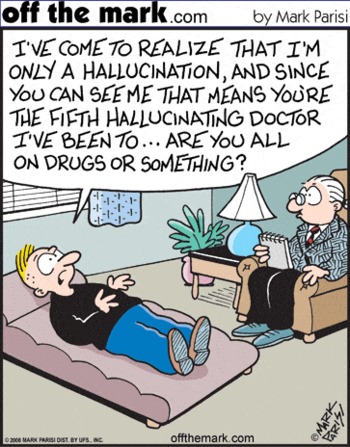
Figure 1 provides an example of humour that has pertinence to psychiatry. It also provides an example of an opportunistic moment for a psychiatrist to introduce humour into a consultation so as to alleviate evident distress. The psychiatrist may remove his glasses, place his notepad on the table next to him and provide a response to the question posed to him. Naturally, this requires creativity, judgement and perhaps most critically an ability to laugh at oneself. Multiple layers of interpretation exist in the humour within this cartoon, and its understanding relies on a range of cognitive, intellectual and social abilities that as yet, we do not fully understand.
Humour in the consulting room.

Psychiatrists do not need to be on drugs to use humour, but if psychiatrists are able to embrace humour in clinical practice and in research, then an alternative to anti-hallucinatory medication may be used to benefit our patients.
Acknowledgements
Photo: Mark Parisi, http://www.offthemark.com, Atlantic Feature Syndicate, Melrose, MA USA 02176.