Introduction
Caregiving provides the basis of nursing. Nursing care is individualized, holistic, and ethical practices planned and implemented to affect health positively, to control symptoms, and to enable peaceful dying (DalPezzo, Reference DalPezzo2009). Nurses preserve the dignity of individual as performing care practices. Dignity is a dynamic and subjective sense leading to an individual feel valuable as well as being treated likewise by other people (Haddock, Reference Haddock1996). The conception of dignity is divided into four within itself, which are labeled as dignity of merit, dignity of moral stature, dignity of identity, and menchenwürde (Gallagher, Reference Gallagher2004; Nordenfelt, Reference Nordenfelt2004; Tadd et al., Reference Tadd, Vanlaere and Gastmans2010). Menchenwürde and the dignity of merit are kind of respect that other people show for individual, and the dignity of moral stature and identity are types of self-respect (Gallagher, Reference Gallagher2004; Nordenfelt, Reference Nordenfelt2004; Tadd et al., Reference Tadd, Vanlaere and Gastmans2010). The dignity of merit is gained formally or informally such as having a position or title, or achievements in the arts or the science. The dignity of moral stature is an expression of the individual's actions being compatible with one's own principles (Gallagher, Reference Gallagher2004; Nordenfelt, Reference Nordenfelt2004; Tadd et al., Reference Tadd, Vanlaere and Gastmans2010). When an individual contradicts with own values and principles, self-confidence and self-esteem of individual may decrease. (Gallagher, Reference Gallagher2004; Nordenfelt, Reference Nordenfelt2004; Tadd et al., Reference Tadd, Vanlaere and Gastmans2010).
“Menchenwürde” is an essential human value that every human being has without any discrimination (Tadd et al., Reference Tadd, Vanlaere and Gastmans2010). This value is also stated in the United Nations Universal Declaration of Human Rights as “all human beings are born free and equal in regard to dignity and rights” (UN General Assembly, 1948). The dignity of identity is related to self-esteem. It is the way of the perception of the individual's own identity. This type of dignity can be harmed by reasons such as restricting the freedom of the individual or being insulted or humiliated by other people and being persecuted physically or psychologically (Statman, Reference Statman2000; Gallagher, Reference Gallagher2004; Nordenfelt, Reference Nordenfelt2004; Tadd et al., Reference Tadd, Vanlaere and Gastmans2010). These factors can cause individual to be excluded from the society or to be ashamed and traumatized and, accordingly, lead to loss in self-confidence. Furthermore, disease and aging may harm an individual's dignity of identity (Gallagher, Reference Gallagher2004; Nordenfelt, Reference Nordenfelt2004; Tadd et al., Reference Tadd, Vanlaere and Gastmans2010). The dignity of identity of a palliative care patient may be hurt by challenges due to the disease such as lifestyle restriction, diminished autonomy, inability in carrying out self-care activities by oneself, or changes in physical appearance depending on aging and/or disease. As disease progresses, the individual feels that the control of his life is not in his power but in his sick body due to challenges in everyday life; this “death reminding” situation may increase anxiety of the individual about being care dependent on someone else (Ek et al., Reference Ek, Sahlberg-Blom and Andershed2011). Because dignity is an important issue in palliative care, Chochinov et al. (Reference Chochinov, Hack and McClement2002) developed a dignity model by description of the term “dignity” according to terminally ill patients (Chochinov et al., Reference Chochinov, Hack and McClement2002). The model was aimed to find out how terminally ill patients perceive the end of life and, therefore, promote the patient's dignity and the quality of life (Chochinov et al., Reference Chochinov, Hack and McClement2002). Three themes identified in this model were Illness-Related Concerns, Dignity-Conserving Repertoire, and Social Dignity Inventory (Chochinov et al., Reference Chochinov, Hack and McClement2002). After the determination of the dignity model, Chochinov et al. (Reference Chochinov, Hassard and McClement2008) developed the Patient Dignity Inventory (PDI) to evaluate the dignity-related distress in palliative care patients.
The PDI was aimed to identify the aspects of care to be supported in palliative care patients (Chochinov et al., Reference Chochinov, Hassard and McClement2008). The PDI was found to be valid and reliable in German (Sautier et al., Reference Sautier, Vehling and Mehnert2014), Italian (Ripamonti et al., Reference Ripamonti, Buanoccorso and Maruelli2012), Spanish (Rullán et al., Reference Rullán, Carvajal and Núñez-Córdoba2015), Greek (Parpa et al., Reference Parpa, Kostopoulou and Tsilika2017), Czech (Kisvetrová et al., Reference Kisvetrová, Školoudík and Danielová2018), Persian (Abbaszadeh et al., Reference Abbaszadeh, Borhani and Mehdiour-Rabori2015), and Mandarin (Li et al., Reference Li, Wang and Ho2018) languages. In addition, the face and construct validity of Swedish version of the PDI was completed; psychometric properties will be assessed in the next phase (Blomberg et al., Reference Blomberg, Lindqvist and Harstäde2019). In addition, terminally ill patients were found to have dignity-related distress, and dignity was shown to be associated with the quality of life of those patients (Chochinov et al., Reference Chochinov, Krisjanson and Hack2006; Hosseini et al., Reference Hosseini, Rezaei and Bahrami2017). In the light of all these previous studies, the aim of our study was to evaluate the Turkish validity and reliability of PDI in palliative care patients with advanced cancer, thus, to provide an instrument for nurses and other healthcare professionals to evaluate dignity-related distress and to plan spiritual care for palliative care patients.
Methods
Participants
Advanced cancer patients hospitalized in medical–surgical oncology clinics of two different university hospitals in Ankara were included in the study. The sample size was aimed to reach at least five patients per each item to provide factor analysis (Karakoç and Dönmez, Reference Karakoç and Dönmez2014). The research was conducted between February 8, 2018 and July 30, 2018 with 127 advanced cancer patients. Test–retest reliability was conducted with 32 patients within the sample at least one week (min–max: one to five weeks; average: two weeks) after the initial application to evaluate the stability of the inventory over time.
Measures
The data of the study were collected by demographic data form, Turkish version of PDI (PDI-TR), and Turkish version of Hospital Anxiety and Depression Scale (HADS-TR) (Aydemir, Reference Aydemir1997).
Demographic data form
The demographic data form was prepared to obtain information about age, gender, marital and educational status, perceived socioeconomic status, family members they live with, working conditions, health insurance, and medical history of the palliative care patients participating in the research.
Patient Dignity Inventory
The PDI, consisting of a total of 25 items, was developed in English in accordance with the dignity model (Chochinov et al., Reference Chochinov, Hack and McClement2002) by Chochinov et al. (Reference Chochinov, Hassard and McClement2008). This five-point Likert-type inventory is rated as “1 = no problem, 2 = a slight problem, 3 = a problem, 4 = a major problem, and 5 = an overwhelming problem.” The minimum and maximum total score of the inventory is 25 and 125 points, respectively. There is no reverse-scored item in the inventory. A higher total score means that the dignity of the individual is complicated. Items scored three or more are clinically significant (Chochinov et al., Reference Chochinov, Hassard and McClement2008). Factor analysis resulted in a five-factor structure; factors were labeled as “symptom distress,” “existential distress,” “dependency,” “peace of mind,” and “social support” (Chochinov et al., Reference Chochinov, Hassard and McClement2008).
Hospital Anxiety and Depression Scale
The Turkish version of the scale (Aydemir, Reference Aydemir1997) was used, which was originally developed by Zigmond and Snaith (Reference Zigmond and Snaith1983). The scale consists of 14 items measuring depression (7 items) and anxiety (7 items) factors. It is a four-point Likert-type scale with a maximum of 21 points for each factor. The scale is used to determine the risks of anxiety and depression in individuals with physical illness and is not appropriate for use in individuals with known psychiatric disorders. In our study, Cronbach's α coefficient for the total HADS, anxiety, and depression subscales were found as 0.92, 0.86, and 0.87, respectively.
Palliative Performance Scale
It was developed by Anderson et al. (Reference Anderson, Downing and Hill1996) to evaluate the patient in terms of ambulation, activity and disease findings, self-care, intake, and consciousness. The rating of the scale, which was developed for the use of healthcare personnel, starts from 0% and reaches 100% with 10% increments. Evaluation starts from the leftmost ambulation state; after finding the most appropriate ambulation percentile for patient, each column is evaluated from left to right to identify the most appropriate PPS score for patient. In this scale, a column on the left is more decisive than the right one (Anderson et al., Reference Anderson, Downing and Hill1996). In our study, this scale was used by researchers to select the patients included in the study.
Translation procedure
The PDI was translated into Turkish for language validity by the researchers independent of each other. The Turkish and original English version of the inventory were consulted for the expert opinion of 10 experts in different fields including five nurse academicians, a specialist nurse, an education nurse, a social care specialist, a psycho-oncologist, and a medical oncologist. The content validity index (CVI) was calculated according to expert opinions using the Davis method (Davis, Reference Davis1992). CVI of the 2nd and 9th items was 0.9 and 0.8, respectively; CVI of all other items including title and description sections was 1. After CVI calculation, the PDI-TR was applied to five patients out of study sample to test the language clarity. The PDI-TR, which was found to be clearly understandable by patients, was back-translated into English by a linguist.
Data collection
Patients completed the PDI-TR by themselves. When needed, the first researcher read out the items to patient and recorded responses. The individuals aged at least 18 years old with terminal cancer; without delirium, dementia, and other mental issues; willing to participate in the study; capable of giving informed consent, having at least 40% PPS (Anderson et al., Reference Anderson, Downing and Hill1996), able to read and write in Turkish; and having no communication problems were included into sample. The lowest limit for the palliative performance score of participants was determined as 40%, since terminal cancer patients may have inadequate functional capacity and get tired quickly.
Data analysis
Demographic data were presented as percentage and frequency. The adequacy of sampling and factor analysis was evaluated with the Kaiser–Meyer–Olkin (KMO) test and the Bartlett's sphericity test. The varimax rotation test was performed for exploratory factor analysis (EFA). Test–retest reliability was evaluated with paired-sample t-test and Pearson's correlation analysis. Internal consistency was examined by Cronbach's α coefficient. Spearman's correlation analysis was used to test the concurrent validity. Confirmatory factor analysis (CFA) and fit indices were performed to evaluate the fit of the model [normed fit index (NFI), comparative fit index (CFI), root-mean-square error of approximation (RMSEA)]. Statistical significance level was determined as 0.05. Data were analyzed using SPPS 15.0 (Statistical Programme for Social Sciences; SPSS Inc, 2006) and Lisrel 8.7 (Jöreskog and Sörbom, Reference Jöreskog and Sörbom2004) statistical software packages.
Ethical considerations
This study was approved by the Baskent University Institutional Review Board (Project No.: KA17/280). Permission was received from the authors of the PDI and HADS via e-mail. Permission for conducting the study was granted from institutional review boards of selected hospitals. Information about the purpose of the study was explained to the patients participating in the study, and written informed consent was obtained. The study was carried out in accordance with the Helsinki Declaration principles (World Medical Association, 2013).
Results
Participant characteristics
A total of 127 hospitalized terminal cancer patients participated in the study. The age of the patients ranged between 23 and 85 years, and the average age was 60.04 years. A majority of participants were women (56.7%; n = 72); were married (79.5%; n = 101); lived with their family members (94.5%; n = 120); and were at least primary school graduates (85.8%; n = 109). More than half of the participants (55.9%; n = 71) had stage 4 disease; the remaining had stage 3 disease (44.1%; n = 56). The PPS score of 88.2% (n = 112) of the patients was 70% and above. All patients were receiving active cancer treatment. Demographic data of the participants are presented in Table 1.
Participant's sociodemographic and clinical characteristics

Factor structure of PDI-TR
EFA and item characteristics
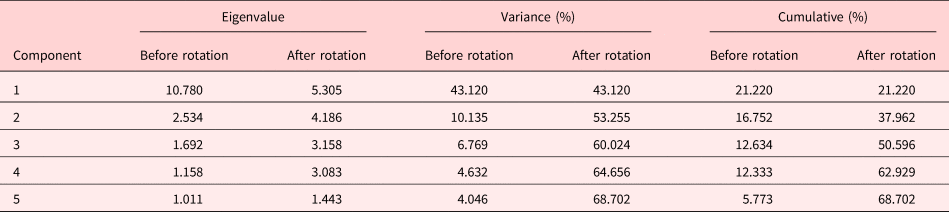
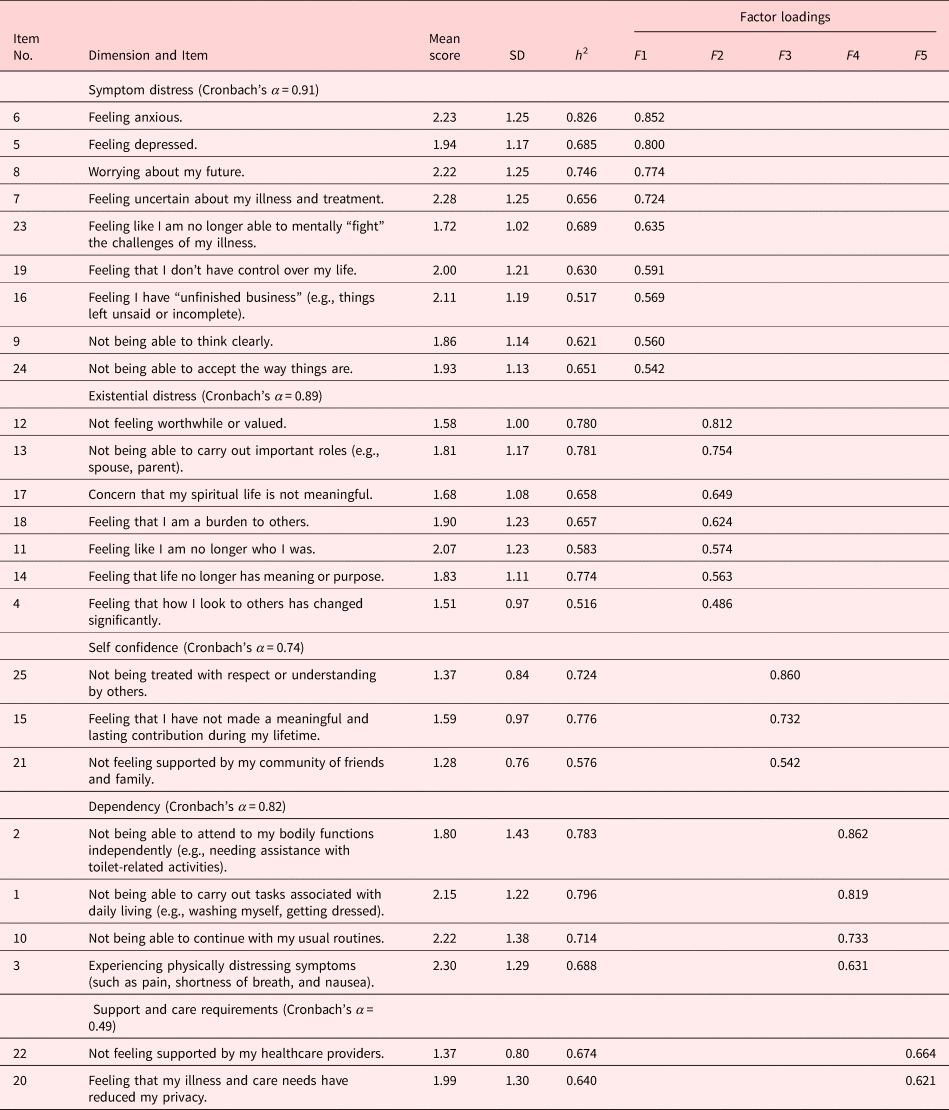
The result of the KMO sampling adequacy test was 0.89. Bartlett's sphericity test was found to be <0.001, revealing that sampling was adequate for factor analysis. The KMO value above 0.60 and Bartletts’ spherecity test below 0.05 show that sample was adequate for factor analysis (Pallant, Reference Pallant2001). Varimax rotation revealed five factors with an eigenvalue of 1 and above accounting for 68.70 of overall variances. Lower bound for factor loading was determined as 0.40 in the analysis. Items loaded on more than one factor were assigned to higher loaded one. Factors were labeled as symptom distress, existential distress, self-confidence, dependency, and supportive care needs, respectively. Table 2 summarizes varimax rotation test results, and Table 3 demonstrates factor loadings of items obtained by varimax rotation.
Factor loading of PDI-TR before and after varimax rotation

Factor analysis of PDI-TR

PDI-TR, Turkish version of the Patient Dignity Inventory; SD, standard deviation; h 2, communalities.
Confirmatory factor analysis
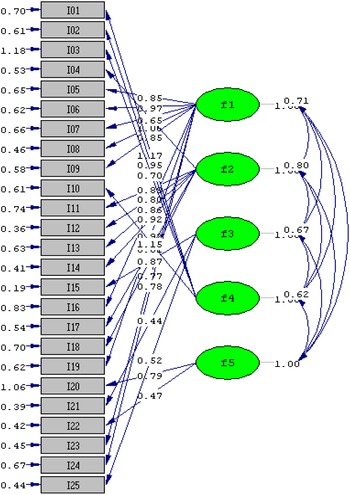
Data were re-analyzed in Lisrel 8.7 Windows version (Jöreskog and Sörbom, Reference Jöreskog and Sörbom2004) to verify the factors obtained by EFA. The CFA resulted in a five-factor solution, each factor containing same items as in EFA. Internal consistency Cronbach's α coefficient of the factors from 1 to 5 was found as 0.91, 0.89, 0.74, 0.82, and 0.49, respectively. Although the 5th factor consisted of only two items and its Cronbach's α coefficient was low, it is not combined with another factor as it is discrete from other factors in terms of content. Item distribution of factors is shown in Figure 1. NFI of the model was 0.90; CFI was found as 0.93, revealing that the model was acceptable. RMSEA was found as 0.114. RMSEA less than 0.08 means that the model has a good fit; RMSEA higher than 0.10 indicates that the model is above the acceptable level (Schermelleh-Engel et al., Reference Schermelleh-Engel, Moosbrugger and Müller2003; Çapık, Reference Çapık2014; İlhan and Çetin, Reference İlhan and Çetin2014). Another fit index, X 2/SD, was assessed, since RMSEA was above the expected level. The X 2/SD below 5 means that the model is acceptable (Çapık, Reference Çapık2014). The X 2/SD of PDI-TR was found as 2.64.
Path diagram of PDI-TR.

Internal consistency
The Cronbach's α coefficient of the PDI-TR was 0.94. There was no significant change in Cronbach's α coefficient when each item was removed one by one (min: 0.937; max: 0.942).
Test–retest reliability
Table 4 shows paired-sample t-test result, which is performed for test–retest reliability. Retest was conducted between one and five weeks after the first test (mean two weeks) with 25.2% of the sample. Test–retest mean and standard deviation scores of the patients in test–retest sampling were 43.46 ± 16.44 and 40.78 ± 13.96, respectively. Paired-sample t-test results performed for test–retest reliability showed that there was no significant difference between total scores of PDI-TR (p = 0.171). Pearson's correlation coefficient between the mean score of test–retest study was found as r = 0.757. An intraclass correlation coefficient of test–retest reliability was found as 0.855.
Paired-samples t-test and Pearson's correlation analysis between the first and second application mean scores

SD, standard deviation; r, Pearson's correlation coefficient; df, degree of freedom; p, significance.
Concurrent validity
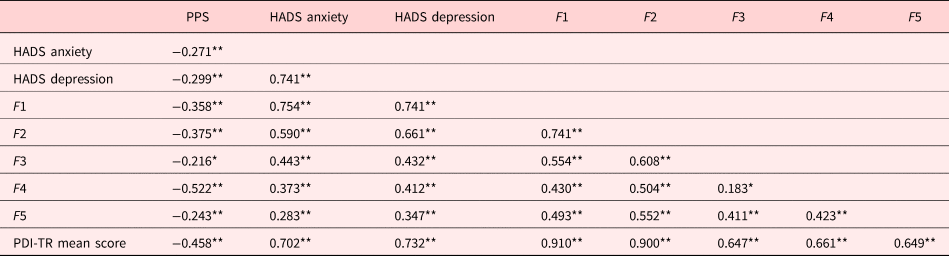
Spearman's correlation analysis was performed to determine the relationship between anxiety and depression subscale scores of HADS, the total score of the PDI-TR, and the PPS percentage of the patients. The result of the analysis showed that PPS had a negative moderate linear relationship with all other variables and that there was a moderate-to-strong positive correlation between subscales of HADS and PDI-TR (p < 0.05). The data of this analysis are shown in Table 5.
Correlation coefficients (r) among PDI-TR and concurrent validity measures

PDI-TR, Turkish version of the Patient Dignity Inventory; PPS, Palliative Performance Score; HADS, Hospital Anxiety and Depression Scale; F, factor; r, Spearman's correlation coefficient.
* Significance at 0.05 level.
** Significance at 0.01 level.
Discussion
The PDI, developed by Chochinov et al. (Reference Chochinov, Hassard and McClement2008) to measure dignity-related distress in palliative care patients, was found to be valid and reliable in German (PDI-G) (Sautier et al., Reference Sautier, Vehling and Mehnert2014), Italian (Ripamonti et al., Reference Ripamonti, Buanoccorso and Maruelli2012), Spanish (PDI-s) (Rullán et al., Reference Rullán, Carvajal and Núñez-Córdoba2015), Greek (PDI-Gr) (Parpa et al., Reference Parpa, Kostopoulou and Tsilika2017), Czech (PDI-CZ) (Kisvetrová et al., Reference Kisvetrová, Školoudík and Danielová2018), Persian (PDI-P) (Abbaszadeh et al., Reference Abbaszadeh, Borhani and Mehdiour-Rabori2015), and Mandarin (PDI-MV) (Li et al., Reference Li, Wang and Ho2018) languages. In our study, the Turkish version of the PDI was found to be valid and reliable. The construct validity analysis of the the PDI-TR revealed five factors with an eigenvalue of 1 and above, and all items were loaded in factors. Factors were labeled as symptom distress, existential distress, self-confidence, dependency, and supportive care needs, respectively. The 1st factor “symptom distress” included nine (items 5, 6, 7, 8, 9, 16, 19, 23, and 24); the 2nd factor included “existential distress” seven (items 4, 11, 12, 13, 14, 17, and 18); the 3rd factor “self-confidence” included three (items 15, 21, and 25); the 4th factor “dependency” included four (items 1, 2, 3, and 10); and the 5th factor “supportive care needs” included two (items 20 and 22) items. In the original version of PDI, four items (10th, 19th, 23rd, and 24th items) neither were loaded on any of factors nor extracted from the inventory, since factor loadings were below 0.55 and three out of that four items loaded on two factors (Chochinov et al., Reference Chochinov, Hassard and McClement2008). In the PDI versions of German, Czech, Persian, and Mandarin, all 25 items were loaded on four factors (Sautier et al., Reference Sautier, Vehling and Mehnert2014; Abbaszadeh et al., Reference Abbaszadeh, Borhani and Mehdiour-Rabori2015; Kisvetrová et al., Reference Kisvetrová, Školoudík and Danielová2018; Li et al., Reference Li, Wang and Ho2018). A total of five factors were obtained in PDI-CZ; however, the 4th and 5th factors were combined due to the low number of items loaded on the 5th factor, and item 22 was neither included in the factor analysis since it was not correlated with any other items nor removed from the inventory (Kisvetrová et al., Reference Kisvetrová, Školoudík and Danielová2018). A single-factor–25-item structure was obtained in the Italian version of PDI (Ripamonti et al., Reference Ripamonti, Buanoccorso and Maruelli2012). In PDI-s, 25 items were loaded on three factors (Rullán et al., Reference Rullán, Carvajal and Núñez-Córdoba2015). In the PDI-Gr, a total of five factors consisting of 18 items were obtained by removing 7 items loaded more than one factor from the inventory (Parpa et al., Reference Parpa, Kostopoulou and Tsilika2017). Factor numbers and the items loaded on factors in all those validity and reliability studies, including our study, differ from the original PDI and from each other (Chochinov et al., Reference Chochinov, Hassard and McClement2008; Ripamonti et al., Reference Ripamonti, Buanoccorso and Maruelli2012; Sautier et al., Reference Sautier, Vehling and Mehnert2014; Abbaszadeh et al., Reference Abbaszadeh, Borhani and Mehdiour-Rabori2015; Rullán et al., Reference Rullán, Carvajal and Núñez-Córdoba2015; Parpa et al., Reference Parpa, Kostopoulou and Tsilika2017; Kisvetrová et al., Reference Kisvetrová, Školoudík and Danielová2018; Li et al., Reference Li, Wang and Ho2018). This difference may be explained by the cultural diversity of the societies in those studies carried out.
In our study, NFI of the five-factor model was 0.90; CFI was found to be 0.93 indicating an acceptable level. RMSEA was found to be 0.114, suggesting that the model fit is above acceptable range. Since RMSEA is above the expected level, another fix index was assessed showing that the model fit is acceptable (X 2/SD = 2.64). In the study of Parpa et al. (Reference Parpa, Kostopoulou and Tsilika2017), the fit indices of the 21-item and five-factor structure proposed in the original PDI were found to be higher than acceptable level, but PDI-Gr fitted well.
The Cronbach's α coefficient of PDI-TR was 0.94. The Cronbach's α coefficient of the original PDI, the PDI-G, Italian version, PDI-s, PDI-Gr, PDI-P, PDI-MV, and PDI-CZ were 0.93, 0.96, 0.96, 0.89, 0.70, 0.85, 0.95, and 0.92, respectively (Ripamonti et al., Reference Ripamonti, Buanoccorso and Maruelli2012; Sautier et al., Reference Sautier, Vehling and Mehnert2014; Abbaszadeh et al., Reference Abbaszadeh, Borhani and Mehdiour-Rabori2015; Rullán et al., Reference Rullán, Carvajal and Núñez-Córdoba2015; Parpa et al., Reference Parpa, Kostopoulou and Tsilika2017; Kisvetrová et al., Reference Kisvetrová, Školoudík and Danielová2018; Li et al., Reference Li, Wang and Ho2018).
Test–retest analysis was performed in our study with 25.2% of the sample after one to five weeks (mean two weeks) from the first test, and PDI-TR was found to be reliable (p > 0.05, r = 0.757). In the original PDI, retest was conducted after 24 h with 52.25% of the sample, and the test–retest reliability correlation coefficient was found to be r = 0.85 (Chochinov et al., Reference Chochinov, Hassard and McClement2008). Test–retest reliability was not assessed in PDI-G, PDI-P, and PDI-MV (Sautier et al., Reference Sautier, Vehling and Mehnert2014; Abbaszadeh et al., Reference Abbaszadeh, Borhani and Mehdiour-Rabori2015; Li et al., Reference Li, Wang and Ho2018). The retest study was conducted following a certain time from the first test in Italian version (14 days), PDI-s (48 h), PDI-CZ (14 days), and PDI-Gr ( seven days) (Ripamonti et al., Reference Ripamonti, Buanoccorso and Maruelli2012; Rullán et al., Reference Rullán, Carvajal and Núñez-Córdoba2015; Parpa et al., Reference Parpa, Kostopoulou and Tsilika2017; Kisvetrová et al., Reference Kisvetrová, Školoudík and Danielová2018).
As the eigenvalue increases, the explained variance per factor increases resulting in the higher reliability of scale (Büyüköztürk, Reference Büyüköztürk2002). A scale, accounting for at least 50% of total variances, means to be reliable (Yaşlıoğlu, Reference Yaşlıoğlu2017). The explained variance rate of original PDI, PDI-G, Italian version, PDI-s, PDI-CZ, and PDI-P was 58%, 71%, 48%, 79.40%, 56.3%, and 72% (Chochinov et al., Reference Chochinov, Hassard and McClement2008; Ripamonti et al., Reference Ripamonti, Buanoccorso and Maruelli2012; Sautier et al., Reference Sautier, Vehling and Mehnert2014; Abbaszadeh et al., Reference Abbaszadeh, Borhani and Mehdiour-Rabori2015; Rullán et al., Reference Rullán, Carvajal and Núñez-Córdoba2015; Kisvetrová et al., Reference Kisvetrová, Školoudík and Danielová2018). There were no data explained in the PDI-Gr and PDI-MV (Parpa et al., Reference Parpa, Kostopoulou and Tsilika2017; Li et al., Reference Li, Wang and Ho2018). In our study, the explained variance was found to be 68.70%.
Samples of the original PDI and PDI-CZ included adults needing palliative care due to cancer and non-cancer diseases (Chochinov et al., Reference Chochinov, Hassard and McClement2008; Kisvetrová et al., Reference Kisvetrová, Školoudík and Danielová2018). Samples of the German, Italian, Spanish, Greek, and Mandarin versions of PDI were adult cancer patients (Sautier et al., Reference Sautier, Vehling and Mehnert2014; Rullán et al., Reference Rullán, Carvajal and Núñez-Córdoba2015; Parpa et al., Reference Parpa, Kostopoulou and Tsilika2017; Li et al., Reference Li, Wang and Ho2018). The PDI-P was conducted with adult patients with coronary syndrome, myocardial infarction, and heart failure (Abbaszadeh et al., Reference Abbaszadeh, Borhani and Mehdiour-Rabori2015). The sample of this study was adult patients with terminal cancer. The cognitive function and communication status of participating individuals were paid attention in all these studies (Chochinov et al., Reference Chochinov, Hassard and McClement2008; Ripamonti et al., Reference Ripamonti, Buanoccorso and Maruelli2012; Sautier et al., Reference Sautier, Vehling and Mehnert2014; Abbaszadeh et al., Reference Abbaszadeh, Borhani and Mehdiour-Rabori2015; Rullán et al., Reference Rullán, Carvajal and Núñez-Córdoba2015; Parpa et al., Reference Parpa, Kostopoulou and Tsilika2017; Kisvetrová et al., Reference Kisvetrová, Školoudík and Danielová2018; Li et al., Reference Li, Wang and Ho2018). The Italian version of PDI was conducted with psychiatric patients in another study and was found to be reliable (Di Lorenzo et al., Reference Di Lorenzo, Ferri and Biffarella2018).
Turkish version of HADS was used in PDI-TR to test concurrent validity. A strong positive correlation was found between the total scores of PDI-TR and subscales of HADS (p < 0.05). In the original PDI, concurrent validity was analyzed with the Functional Assessment of Chronic Illness Therapy-Spiritual Well-Being (FACITsp), Edmonton Symptom Assessment Scale (ESAS), Beck Depression Inventory (BDI), the suffering and dignity items of the Structured Interview Assessment of Symptoms and Concerns in Palliative Care, and the Brief Quality of Life Scale, showing a significant correlation with PDI subscales (Chochinov et al., Reference Chochinov, Hassard and McClement2008). Distress Thermometer, Patient Health Questionnaire, Generalized Anxiety Disorder Scale, Demoralization Scale, Beck Hopelessness Scale (BHS), Life Attitude Profile-Revised, European Organisation for Research and Treatment of Cancer Quality of Life Questionnaire-Core 30, Short Form Supportive Care Needs Survey were used for concurrent validity in PDI-G. A negative correlation was found between higher PDI-G total score and the global health status and functionality subscales of the quality-of-life scale, while a positively significant correlation was found between other variables (Sautier et al., Reference Sautier, Vehling and Mehnert2014). In the Italian version of PDI, concurrent validity was assessed with ESAS, FACITsp, HADS, and the system of belief inventory-15-r (Ripamonti et al., Reference Ripamonti, Buanoccorso and Maruelli2012). A higher PDI total score was found to have a strong relationship with physical and psychological symptoms, while a negative, moderate correlation was found with spiritual well-being (Ripamonti et al., Reference Ripamonti, Buanoccorso and Maruelli2012). The concurrent validity of PDI-s was assessed with ESAS, FACITsp, and HADS. The PDI-s was found to have a strong, positive correlation with ESAS and HADS, while there was a moderate, inverse correlation with FACITsp (Rullán et al., Reference Rullán, Carvajal and Núñez-Córdoba2015). The concurrent validity of factors of PDI-Gr was assessed with HADS, Short Form Health Survey-12 (SF-12), and Schedule of Attitudes Toward Hastened Death (SAHD). A positive, moderate relationship was found between the depression subscale of HADS and the 4th factor of PDI-Gr, while an inverse, moderate correlation was found between the 4th factor of PDI-Gr and the physical component summary of SF-12. A strong, positive correlation was found between factors of PDI-Gr except for the 4th factor and other variables (Parpa et al., Reference Parpa, Kostopoulou and Tsilika2017). Concurrent validity was not assessed in PDI-CZ (Kisvetrová et al., Reference Kisvetrová, Školoudík and Danielová2018). In PDI-P, concurrent validity was assessed with BDI, Beck Anxiety Inventory (BAI), BHS, and SF-36 Health Survey. The PDI-P showed a strong, positive correlation with BDI, BAI, and BHS, while negatively correlated with overall subscales of SF-36 Health Survey (Abbaszadeh et al., Reference Abbaszadeh, Borhani and Mehdiour-Rabori2015). A positive, moderate correlation was found between PDI-MV and overall scores of the Demoralization Scale and the Patient Health Questionnaire-9 , while a moderate, inverse relationship was found between PDI-MV and the Rosenberg Self Esteem Scale (Li et al., Reference Li, Wang and Ho2018).
Limitations
This study has some limitations. The first limitation is the small sample size. Although 376 patients were hospitalized in medical–surgical oncology clinics during the study period, only the minimum sufficient sample size was reached due to several reasons such as not meeting eligibility criteria or undergoing therapeutic interventions. The second limitation is the small sample size of test–retest reliability study. Only 32 individuals were included for the test–retest reliability study due to discharge, or worsening performance status, or death of the participants. Therefore, an intraclass correlation coefficient was also calculated.
Conclusions
Dignity is the expression of the value that individual feels for oneself and is exhibited by others (Nordenfelt, Reference Nordenfelt2004). In palliative care patients, there is a high risk of loss of dignity due to challenges related to progressive disease such as functional limitations, physical symptoms, and difficulties in carrying out self-care needs. Dignified care is an essential human right; therefore, it is a professional necessity for healthcare staff to determine dignity-related issues giving care to palliative care patients. The findings of our study demonstrated that PDI-TR is valid and reliable in palliative care patients in Turkish society. It is recommended to use PDI-TR for planning care in palliative care patients by the healthcare professionals. Future studies of PDI-TR with various patient populations are also recommended.
Supplementary material
The supplementary material for this article can be found at https://doi.org/10.1017/S1478951521000948.
Acknowledgments
The authors wish to express their appreciation to Harvey Max CHOCHINOV for giving permission and advice; Işıl UNUTMAZ forb ack-translation; Şeref KÖMÜRCÜ, Ayfer AYDIN, Ebru KILIÇARSLAN TÖRÜNER, Figen ARI İNCİ, İmatullah AKYAR, and Banu ÇEVİK; Seda ATTEPE ÖZDEN, Gülcan BAĞÇİVAN, Ayşin KAYIŞ, and Ozan BAHÇIVAN for providing their expert views; and patients who participated in this study.
Funding
The authors received no financial support for the research.
Conflict of interest
The authors declare no conflict of interest.