I. INTRODUCTION
Finds from a fourth-century family tomb at Argos shed new light both on local burial customs and on the variety of Late Classical Argive pottery. This article presents the tomb in its context, reconstructing as far as possible its relationship to other contemporary burials via reference to the currently known cemeteries of Argos. The tomb contents, which consist almost exclusively of pottery, are then presented in three groups following the chronological sequence of the burials (beginning from the oldest). Analysis of each vessel shape includes a brief introduction to its history in Argos. Since there is no overarching study of Late Classical Argive pottery to which reference can be made, these short introductions serve to illustrate the hitherto unknown wealth of fourth-century bc Argive pottery as represented in the tomb contents.
II. THE TOMB AND ITS CONTEXT
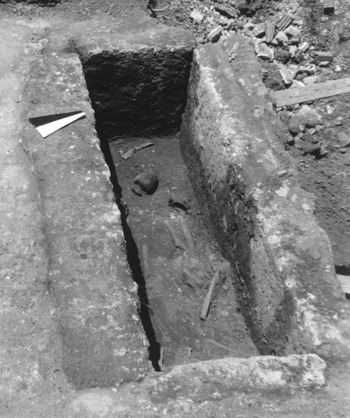
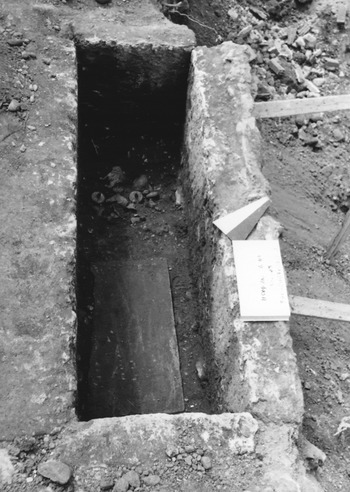
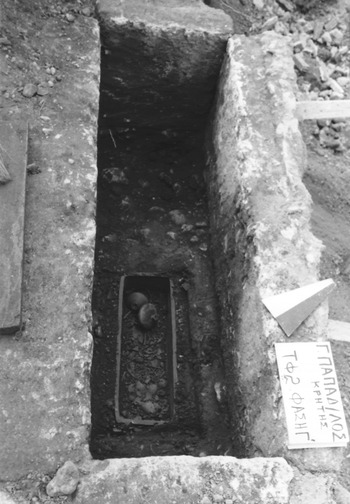
The tomb (Figs. 1, 2, 3 and 4) was revealed in 2002 during rescue excavation on the property of G. Papadopoulos on Kritis Street in the neighbourhood of Neos Kosmos.Footnote 1 It lay 1.56 m below the modern land surface, in the bed of the Xerias river (ancient Charadros) which crosses the north and east sides of the city.Footnote 2 It is a cist, oriented north-west–south-east,Footnote 3 made of roughly hewn limestone slabs (one for each side, and two forming the cover), with a natural soil floor.
The cist grave at Argos. Finds from Group B.

The cist grave at Argos. Larnax and finds from Group A.

The cist grave at Argos. Inside of larnax.

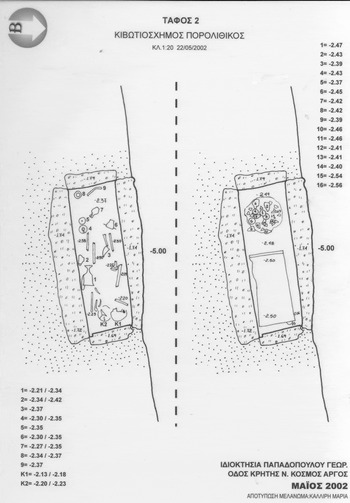
The cist grave at Argos. Drawings of the burial assemblages: left, Group B; right, Groups A and C (larnax).

Within the grave, three disturbed adult burials,Footnote 4 each with grave gifts, were excavated at depths of 2.13–2.37 m below the modern surface. Skeletal remains include two skulls, one male and one female, found in the east part of the tomb. The sex of the third individual could not be determined. Below this level (at a depth of 2.37–2.47 m), a heap of broken pottery was identified in the north-west part of the tomb. Lastly, a rectangular terracotta larnax covered by a flat tile was found in the south-east part of the tomb, at a depth of 2.50–2.64 m.Footnote 5 The larnax had been placed inside a simple pit and the space around its sides then backfilled with soil and small stones: fragments of the broken pottery mentioned above were found around, below and inside it. The larnax contained the skeletal remains of two infants, with grave gifts, as well as the bones of an adolescent who would have been too big to have been buried inside it originally.
Sites located near rivers or torrents, and therefore unsuitable for cultivation, were often chosen for burial grounds in Greece during the historical period (Kurtz and Boardman Reference Kurtz and Boardman1971, 188–9; Kefalidou Reference Kefalidou2009, 23–4 n. 18). Our tomb belongs to one of the clustersFootnote 6 discovered in the Charadros riverbed, which date from the Mycenaean to the Hellenistic period (Barakari-Gleni Reference Barakari-Gleni1996–7, 519 n. 54; Barakari-Gleni and Pariente Reference Barakari-Gleni, Pariente, Pariente and Touchais1998, 175 n. 127; Papachristodoulou Reference Papachristodoulou1971, 92–4).Footnote 7 Inhumation in a cist grave was the most common form of burial at Argos up to the fourth century bc (Dimakis Reference Dimakis, Cavanagh, Cavanagh and Roy2009, 39), and the reuse of cists for multiple inhumations, possibly of members of the same family, is characteristic of Argive cemeteries (Karouzou Reference Karouzou1933–5, 21–44; Barakari-Gleni Reference Barakari-Gleni1984, 174–202; Barakari-Gleni Reference Barakari-Gleni1996–7, 515, 522). This trait distinguishes Argive cemeteries from those elsewhere in Greece, for example at Corinth, Rhodes, Athens or Olynthos (Carter Reference Carter1998, 108–9 n. 184–6).Footnote 8 The inhumation of infants and children in terracotta larnakes, a custom with a long tradition in ancient Greece (Mylonas Reference Mylonas1975, 277–9; Sabetai Reference Sabetai2000, 498–500; Kountouri Reference Kountouri2008, 678 n. 74), was also adopted at Argos (Barakari-Gleni Reference Barakari-Gleni1996–7, 519; Dimakis Reference Dimakis, Cavanagh, Cavanagh and Roy2009, 39), although the larnax in our tomb is the first published example.Footnote 9
While the reuse of cist graves for multiple burials is a characteristic feature of Argive cemeteries, two other practices revealed in our tomb (the placement of a terracotta larnax inside an earlier cist grave and the secondary deposition of an earlier burial inside a larnax made for child burial) are so far without parallel.Footnote 10
Any attempt to interpret these two practices requires us to reconstruct and date the use phases of the tomb. Stratigraphical information and pottery dates indicate that the cist grave was built early in the early fourth century bc for the burial of the adolescent whose grave gifts are represented by the heap of broken pottery (Group A). It was then reused through much of the fourth century for the consecutive burials of three adults, which were accompanied by the vases in Group B. Finally, at some point late in the century the tomb was reopened for one last time to receive the terracotta larnax with the two infant burials of the same family and the vases of Group C. On this occasion, the remains of the three adults and their grave gifts (Group B) in the tomb's upper level were disturbed and the vases accompanying the original burial (Group A) were pushed aside to make room for the larnax. The skeletal remains of the adolescent were gathered and placed inside the larnax alongside the two infants. The fact that no bones were found among the heap of broken vases or around the larnax indicates that the placing of the adolescent's remains was no accident, but a careful and deliberate act.
The discrepancy of almost 50 years between the primary burials of the adolescent (a female: for her sex, see below) and the two children (according to the date of the accompanying pottery) precludes the kind of close family relationship (e.g. between a mother and her children) which might otherwise explain the subsequent use of the larnax for the secondary burial. The respect accorded to the remains of the adolescent (which were not pushed aside for the new burial), may imply that she was of high social status.
Inhumation of children and adults together in the same family grave was a common practice in the ancient world. But in such cases both were buried directly in the same soil. Was the use of a separate terracotta larnax a sign of special care for the two infants? The presence of two children in a single larnax is also unusual (the suggestion that they could be twins is not confirmed by the anthropological data). The simultaneous death of two children in the same family may well have been due to some illness of epidemic nature. Finally, the fact that the larnax burial coincides chronologically with at least one of the three adult burials may support the idea that there were family ties between them (noting that at least one of the three adults was female).
All of the above traits are previously unattested in the Argive burial record. It therefore remains to be seen whether our tomb was an exception or part of a more general Argive pattern yet to be documented.
III. THE FINDS: GRAVE GIFTS AND FUNERARY RITUALS
Full assessment of the types of grave offering requires comparison with finds from other contemporary Argive burials, for which little published data is available. It is, however, possible to offer some remarks. The observation that jewellery was rarely used as a grave gift at Argos (Dimakis Reference Dimakis, Cavanagh, Cavanagh and Roy2009, 42) is confirmed here. Strigil no. 28,Footnote 11 deposited with one of Group B's three adult individuals, adds to the limited number of Argive examples known from this period. Strigils were occasionally used as grave gifts until the fourth century bc (Dimakis Reference Dimakis, Cavanagh, Cavanagh and Roy2009, 42–3 n. 48) and were not associated exclusively with male burials (Graepler Reference Graepler1997, 170; Carter Reference Carter1998, 801; Sabetai Reference Sabetai2000, 509; Kratzmüller, Lindner and Sojc Reference Kratzmüller, Lindner, Sojc and Heininger2003, 91–134; Sabetai Reference Sabetai, Adam-Veleni and Tzanavari2012b, 309).Footnote 12 An unidentified silver coin (no. 20) from the adolescent's burial is plausibly interpreted as Charon's obol (Dimakis Reference Dimakis, Cavanagh, Cavanagh and Roy2009, 42 n. 41; Alföldy-Găzdac and Găzdac Reference Alföldy-Găzdac and Găzdac2013).
Our tomb contained no figurines, but these were not a common grave gift at Argos (Karouzou Reference Karouzou1933–5 passim; Kritzas Reference Kritzas1973, 127, pl. 115; Tzachou-Alexandri Reference Tzachou-Alexandri and Mulliez2013, figs 5–7). Vases, on the other hand, were the most typical grave gift and our tomb contained no fewer than 31, an impressive number though by no means the highest attested (see, for example, Aslamantzidou-Kostourou Reference Aslamantzidou-Kostourou1985 for a grave with 64 vases). The absence of red-figure pottery is not surprising, since the few known examples from Argive tombs (Kritzas Reference Kritzas1972, 197, pl. 140β; Karouzou Reference Karouzou1933–5, 19 fig. 4; Barakari-Gleni Reference Barakari-Gleni1984, 179, fig. 8, pl. 77α; Bruneau Reference Bruneau1970, 511 no. 188.46, fig. 200) indicate that red-figure was little used in the region's funerary customsFootnote 13 during the fifth and the fourth centuries bc.Footnote 14
Black-glazed pottery is the most common ceramic category in the Argive cemeteries during the fourth century bc. Of the different types of black-glazed vases, drinking vessels are the most widely represented (Dimakis Reference Dimakis, Cavanagh, Cavanagh and Roy2009, 42 n. 42), with the kotyle (nos 8–16), the kylix in its many variants (no. 17), the skyphos (no. 24), and to a lesser extent the bolsal (no. 22) being the most popular. The Boeotian-type kantharos (no. 21) is also popular. By contrast, pouring vessels, such as the oinochoe (no. 23) (cf. Bruneau Reference Bruneau1970, 444 no. 3.4, fig. 13), are significantly fewer. The black-figure Corinthian pyxis (nos 18–19), a form which survives until the fourth century bc, was also widely used as a grave gift in Argive tombs. Both this and the lekanis (nos 29–30) are associated with grooming. At Argos, however, lekanides are mostly unglazed rather than black-glazed as the examples presented here.
Many of the vases in our tomb are types commonly found in Argive cemeteries. Others, however, are unattested or little-studied types. The latter include the white-ground lebetes gamikoi (nos 1–7) and kotylai (nos 10–16), which confirm the existence of exclusively funerary vases at Argos. The lebetes gamikoi may have had a specific symbolic significance as indicators of the deceased's social status. The lekanides nos 29–30 from the child burials in the larnax could also be interpreted in this way. And the phiale no. 26, which may have been used in association with the oinochoe no. 23, implies libation rituals previously unattested in Argive funerary practice.
We will now move to consider each vase type in detail. With the exception of Group B, where the disturbed stratigraphy does not permit us to associate individual vases with any particular one of the three adult burials, the discussion is arranged according to group. We will conclude with a summary outlining the contribution of this material to the study of fourth-century bc Argive pottery.
Burial Group A
The richest assemblage in the tomb, which belongs to the earliest burial (of the adolescent), consists of 19 vases. Fourteen of these – seven examples each of the Type 2 lebes gamikos (nos 1–7)Footnote 15 and the kotyle (nos 10–16) – have a white slip and traces of polychrome decoration. The lebetes gamikoi also have plastic decoration (two peplophoros protomes in the round) on the shoulder, and their bottoms are pierced. Along with the Corinthian-type pyxides (nos 18–19), which are traditionally associated with women and their world (Hoffman Reference Hoffmann2002, 88–98; Tzachou-Alexandri Reference Tzachou-Alexandri and Mulliez2013, 145),Footnote 16 these lebetes gamikoi indicate the burial of a woman.
White-ground lebetes gamikoi with lid and plastic decoration (nos 1–7)
-
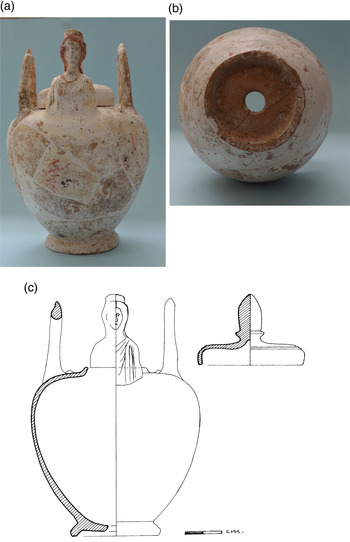
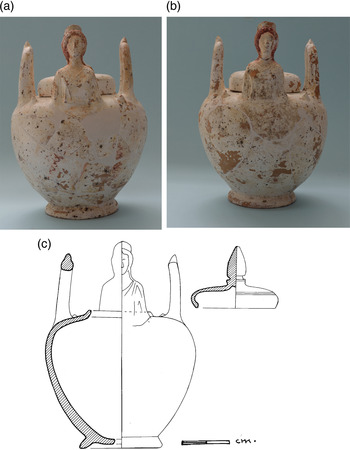
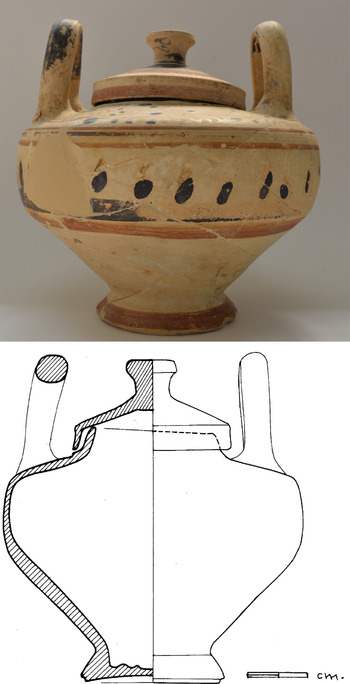
1. (Fig. 5a–c ). H. total 0.192 m, lid 0.065 m. Diam. foot 0.07 m, rim 0.047 m, lid 0.07 m. Restored (one peplophoros head missing). Fabric fine, hard, light orange (5YR 7/6) with abundant small sparkling inclusions. Flaring ring-foot; ovoid body; nearly horizontal shoulder. Upright handles; knobs on shoulder and handles. Base has a single perforation (hole diam. 0.015 m). Lid has an elongated knob, decorated with blue rays and with red on top. Dull white slip (poorly preserved) with traces of a thin ochre wash; sediments on surface. On one side of the body, two bands of irregular red spirals. Interior and underside reserved. On the shoulder, protomes of two peplophoroi (front moulded, back handmade) covered in white slip, with red paint on the hair and blue on the polos.
Early 4th century bc.
-
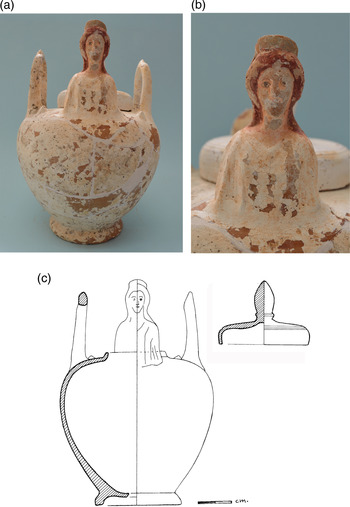
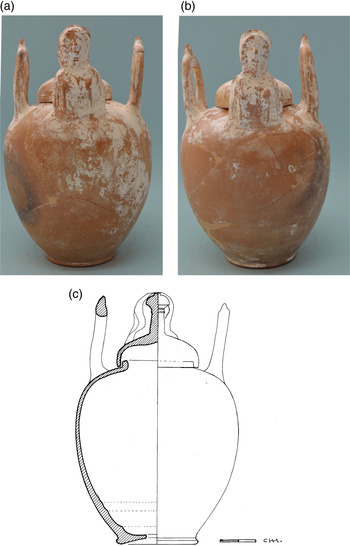
2. (Fig. 6a–c ). H. body 0.125 m, lid 0.061 m, total 0.181 m. Diam. rim 0.052 m, foot 0.077 m, lid 0.075 m. Restored (missing one peplophoros head). Fabric and vessel description as no. 1. Base perforation diam. 0.013 m. Flesh of the peplophoros tinted pink over the white slip, with brown on the eyes and eyebrows.
Early 4th century bc.
-
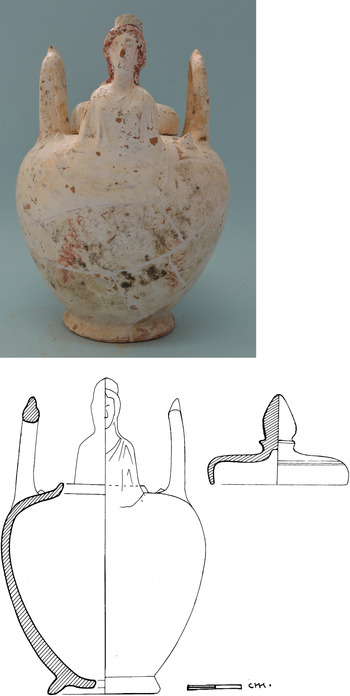
3. (Fig. 7). H. body 0.125 m, lid 0.065 m, total 0.195 m. Diam. rim 0.044 m, foot 0.074 m, lid 0.071 m. Restored. Fabric and vessel description as no. 1. Base perforation diam. 0.0 11 m.
Early 4th century bc.
-
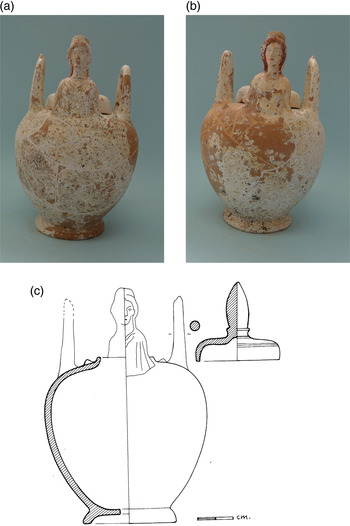
4. (Fig. 8a–c ). H. body 0.133 m, lid 0.062 m, total 0.192 m. Diam. rim 0.047 m, foot 0.077 m, lid 0.067 m. Restored. Fabric and vessel description as no. 1. Base perforation diam. 0.015 m. One surviving peplophoros preserves red paint on the hair and lips, brown on the right eye, and blue on the polos and the right side of the neck.
Early 4th century bc.
-
5. (Fig. 9a–c ). H. body 0.127 m, lid 0.064 m, total 0.181 m. Diam. rim 0.054 m, foot 0.072 m, lid 0.068 m. Restored. Fabric and vessel description as no. 1. Base perforation diam. 0.012 m.
Early 4th century bc.
-
6. White-ground lid only. H. 0.027 m, diam. 0.075 m. Elongated knob missing. Fabric as no. 1.
Early 4th century bc.
-
7. (Fig. 10a–c ). H. body 0.13 m, lid 0.06 m, total 0.2 m. Diam. rim 0.056 m, foot 0.066 m, lid 0.066 m. Restored. Fabric fine, hard, orange (5YR 6/6) with a few sparkling inclusions. Raised disc-foot (underside slightly concave); ovoid body; convex shoulder. Upright handles with knobs on top. Base perforation diam. 0.012 m. Lid thickened on the upper part. Peplophoroi wear the stephane rather than the polos: the hair of one is tooled. A small part of the body is blackened.
Early 4th century bc.
Olga Tzachou-Alexandri has based a thorough study of the white-ground lebes gamikos in Argos upon consideration of an example from a female burial in the city's north cemetery. She terms the Argive examples lebetes gamikoi following the traditional connection of the shape with the world of women (Tzachou-Alexandri Reference Tzachou-Alexandri and Mulliez2013, 145, 148). However, vases morphologically comparable with the Type 2 red-figure lebes gamikos (Cassimatis Reference Cassimatis1993, 35–9; Sgourou Reference Sgourou1994, 17) which do not feature scenes from the world of women are conventionally named stamnoid pyxides, and indeed, the Argive lebetes gamikoi have occasionally been so termed (Sarri Reference Sarri and Mulliez2013, 185 fig. 10). The term was established for Boeotian black-figure vases with floral decoration (Papuci-Wladyka Reference Papuci-Wladyka2012, 107) and was subsequently adopted for similar examples from other production centres. Yet according to a recent hypothesis, even the Boeotian black-figure examples were offered as wedding gifts (Sabetai Reference Sabetai, Schmidt and Stähli2012a, 127 n. 59), just like the red-figure lebetes gamikoi, and were not associated with daily life as previously thought. Nonetheless, I here apply the term lebes gamikos solely on the basis of the type's morphological characteristics rather than on its iconography or function, since we lack evidence for its use in wedding ceremonies at Argos. The name is applied in the same general way, independent of decoration, in south Italian ceramic studies, including all ceramic categories, red-figure, black-glaze, Gnathian and polychrome (Graepler Reference Graepler1997, 61 fig. 14, 92, 105 fig. 36, 115 figs 65–6; Hempel Reference Hempel2001, 240; Hoffmann Reference Hoffmann2002, 206 pl. 2; Carter Reference Carter1998, 659–63, 695).Footnote 17
Catalogue no. 1. White-ground lebes: (a) side view; (b) pierced bottom; (c) drawing.

Catalogue no. 2. White-ground lebes gamikos: (a) side view; (b) detail of peplophoros protome; (c) drawing.

Catalogue no. 3. White-ground lebes gamikos.

Catalogue no. 4. White-ground lebes gamikos: (a) side A; (b) side B; (c) drawing.

Catalogue no. 5. White-ground lebes gamikos: (a) side A; (b) side B; (c) drawing.

Catalogue no. 7. White-ground lebes gamikos: (a) side A; (b) side B; (c) drawing.

The lebetes gamikoi in our assemblage belong to two morphological variants. Nos 1–5, and possibly no. 6, only the lid of which is preserved, belong to the first variant, and no. 7 to the second. The main characteristics of the first variant include the wide, flaring ring-foot and ovoid body with almost horizontal shoulder. Knobs appear on either side and on the tops of the vertical handles. This variant also features a specific type of lid with a conical button knob. The peplophoros protomes on this group of vessels are identical, and several measurements indicate that they came from the same mould;Footnote 18 since the fabric and polychrome decoration of the vessels are also similar, we may conclude that they came from the same workshop. The peplophoroi wear the Argive peplos (Theisen Reference Theisen2009, 41–54), which is pleated around the upper arms and along the triangular edge of the apoptygma. Their fine, ovoid faces narrow towards the particularly long chin and are dominated by wide-open eyes with hatched eyelashes and a large nose with flaring nostrils. The mouth is well formed with thick lips. The long hair is parted in the middle and shaped into fine wavy locks, which fall on the shoulders. A cylindrical polos covers the top of the head. In the second category, vase no. 7 is distinguished primarily by its discoid base and more slender body, following from a more sloping shoulder.Footnote 19 It lacks the knobs on either side of the handles, and the lid has a different type of knob. The rendering of the hair and headdresses of the peplophoroi on no. 7 also differs, although the facial features are indistinguishable because of wear on the mould. Instead of forming fine wavy locks, the hair frames the face in a compact mass with wide, horizontally arranged locks. In fact, in one case the hair was reworked with a sharp tool after the protome was removed from the mould. Moreover, the figures wear a stephane rather than a polos.
The bases of all six fully restored lebetes gamikoi were pierced before firing, with holes 0.011–0.015 m wide. A thin white kaolin slip was applied over the entire vase, protomes included, after firing, and this was then covered with a thin, ochre wash, traces of which are preserved. Two basic colours,Footnote 20 red ochre and Egyptian blue,Footnote 21 were used to highlight the hair, mouth, and polos of the peplophoroi, as well as the lid knobs in the first variant. The lebetes gamikoi of this first variant also have bands of irregular red spirals. Infrared photography revealed the presence of two blue discoid objects painted between these bands on vase no. 1.
The closest parallel for the shape of the first variant (nos 1–6) is a lebes gamikos from grave 14 in the Kourou plot in Argos (Tzachou-Alexandri Reference Tzachou-Alexandri and Mulliez2013, 146, fig. 12). The rather high date (c.425 bc) proposed by Tzachou-Alexandri should be lowered by some 25 years to the end of the fifth or the beginning of the fourth century bc on the basis of typological parallels (Sparkes and Talcott Reference Sparkes and Talcott1970, no. 348) for the black-glazed skyphos found in the same grave (Tzachou-Alexandri Reference Tzachou-Alexandri and Mulliez2013, 146, fig. 14).The lebetes gamikoi of both variants should thus be dated to the late fifth or early fourth century, with differences between them a matter of workshops rather than chronology. The difference in fabric between no. 7 and nos 1–6 corroborates their attribution to two separate workshops where potters and figurine makers worked side by side. The two peplophoros types also date to the early fourth century. The first, with fine wavy locks falling onto the shoulders, originated in ArgosFootnote 22 and is most closely paralleled in an import found in Corinth (Merker Reference Merker2000, 299 no. I5, pl. 65). The worn features of the second type do not permit stylistic comparison, although the ovoid outline of the narrow face, common to both types, suggests a similar date.Footnote 23
The earliest known Argive white-ground lebetes gamikoi are the example from the Kourou plot noted above and those examined here. Two later examples (Tzachou-Alexandri Reference Tzachou-Alexandri and Mulliez2013, figs 10–11 and fig. 15), the dates of which should also be lowered respectively to c.380 and to post-350 bc,Footnote 24 demonstrate the development of the shape towards a more slender form with an angular join between the body and neck and an increasingly taller and narrower base. The same tendency is evident in another example without protomes (Sarri Reference Sarri and Mulliez2013, 185 fig. 10). It is thus clear that the shape was produced at least till the late fourth century. There are at least 14 more unpublished examples from graves in the Argos Museum storerooms, plus one unpublished example seized at Argos in the National Archaeological Museum (inv. no. 30508). The lebes gamikos as a shape is also attested in the repertoire of Argive black-glaze (Tzachou-Alexandri Reference Tzachou-Alexandri and Mulliez2013, 146) although without plastic protomes or base piercing.
White-ground or black-glazed lebetes gamikoi were not part of the Attic repertoire (Carter Reference Carter1998, 187 n. 47), but white-ground examples were produced in Boeotia exclusively as funerary vases from the late fourth century at the latest until the second century bc (Andreiomenou Reference Andreiomenou, Frei-Stolba and Gex2001, 160 n. 30, fig. 19; Bentz, Geominy and Müller Reference Bentz, Geominy and Müller2010, 62 n. 9; Jeammet Reference Jeammet2007, 21 pl. XI; Papadakis Reference Papadakis1914, 125–6 figs 4–5). The shape is also attested in the white-ground pottery of neighbouring Thessaly (Malakasioti Reference Malakasioti2000, 152–3 fig. 9–11, with colour illustration on p. 30 fig. XII), where it is found in graves of the late fourth to early third century. Individual examples are known from the Black Sea (Zervoudaki Reference Zervoudaki1968, 77 n. 297; Kammerer-Grothaus Reference Kammerer-Grothaus1976, 237–45). However the Argive production is the earliest, and it is clear that the Argive examples were not incidental expressions of an isolated workshop, but specifically characteristic of the local ceramic repertoire. The white-ground polychrome kotylai (nos 8–14) are also part of this phenomenon. Published examples indicate that systematic production of white-ground pottery began in Argos in the fifth century bc at the latest (Barakari-Gleni Reference Barakari-Gleni1996–7, 523; Karouzou Reference Karouzou1933–5, 47). The repertoire of shapes (both those published and those recorded in my study of unpublished material in the Argos Museum) includes kylikes (Barakari-Gleni Reference Barakari-Gleni1996–7, 523 no. 91, fig. 4; Karouzou Reference Karouzou1933–5, 47; Tzachou-Alexandri Reference Tzachou-Alexandri and Mulliez2013, fig. 3), kotylai (Karouzou Reference Karouzou1933–5, 45 fig. 27), Boeotian-type kantharoi (Barakari-Gleni Reference Barakari-Gleni1996–7, 523), and lekythoi (unpublished). Other shapes added in the fourth century bc comprise the lebes gamikos, bolsal (Sarri Reference Sarri2000, 176; Sarri Reference Sarri and Mulliez2013, 186 fig. 11), oinochoe (Sarri Reference Sarri and Mulliez2013, 186 fig. 10) and alabastron (Bruneau Reference Bruneau1970, 439–41 figs 1–3; Hägg and Fossey Reference Hägg and Fossey1980, 93–7). Production continued into the Hellenistic period with the characteristic Argive krateriskos (Bruneau Reference Bruneau1970, 521–2) and lagynos (Bruneau Reference Bruneau1970, 513–15, 518) the main shapes represented, along with several other more or less popular vase types (Andreadaki-Vlazaki Reference Andreadaki-Vlazaki2012, 90 fig. 4; Pariente Reference Pariente1991, 678 fig. 13).
This particular Argive production forms an important part of the puzzle of the peripheral Greek workshops of white-ground pottery. Unlike the well-known Attic and south Italian white-ground productions, other local workshops have not yet been studied as a whole (Bentz, Geominy and Müller Reference Bentz, Geominy and Müller2010, 61 n. 10). In addition to Argos, these include Boeotian workshopsFootnote 25 as well as those of neighbouring Locris (Kyriakou Reference Kyriakou2008, 174 n. 405; Zampiti and Vasilopoulou Reference Zampiti and Vasilopoulou2008, 448 n. 13). Study of Macedonian white-ground pottery is more advanced (Kefalidou Reference Kefalidou2001; Kyriakou Reference Kyriakou, Drougou and Touratsoglou2012). Each region's local tradition was a catalyst and each production can be interpreted as an independent expression of a common idiom (Kefalidou Reference Kefalidou2001, 194). The lebetes gamikoi from Halos in Thessaly (Malakasioti Reference Malakasioti2000, 152–3 figs 9–11), which probably drew on Boeotian models, demonstrate relations between local white-ground production centres (Kefalidou Reference Kefalidou2001, 194). Both the ArgiveFootnote 26 and the Boeotian lebetes gamikoi are products of such local white-ground workshops; Attic production probably contributed to their establishment (Karouzou Reference Karouzou1933–5, 18 fig. 3; see Wehgartner Reference Wehgartner1983, 61 no. 40, for imported Attic white-ground pottery in Argos).
Very little remains of the polychrome decoration on our vases (see Appendix). While it is therefore risky to attempt to identify the iconography, the original decoration may have consisted of frontal female heads, since traces of the long wavy hair are preserved along with discoid earrings (as the blue discs visible through infrared photography have been interpreted). The representation of female heads has a long tradition in iconography (Eschbach Reference Eschbach2012, 28), although they are mostly shown in profile (Hoffmann Reference Hoffmann and Hitzl2011, 124–30).
The second distinctive feature of the Argive lebetes gamikoi is the plastic decoration of peplophoros protomes in the round. The subject and placement of the protomes are identical in all cases, with no structural relationship between the plastic decoration and the vase.Footnote 27 This standard decoration distinguishes the Argive white-ground lebetes gamikoi from their Boeotian–Thessalian counterparts. Known Boeotian products feature only pairs of relief heads on the shoulder (Bentz, Geominy and Müller Reference Bentz, Geominy and Müller2010, 62 n. 9),Footnote 28 permitting no direct comparison with Argive products. A distant parallel for the Argive examples is provided by a lebes gamikos from Sinope (Kammerer-Grothaus Reference Kammerer-Grothaus1976, 237–45),Footnote 29 which, instead of protomes, displays female heads in the round and on a different part of the vase. Closer to the Argive examples are the red-figure south Italian lebetes gamikoi with female heads in the round placed near the handles (Schauenburg Reference Schauenburg2003, 18–19, figs 30–5; Tzachou-Alexandri Reference Tzachou-Alexandri and Mulliez2013, 151 nn. 78–9).
The decoration of vases with female figures in the round was widespread in many parts of Greece in many periods. Characteristic examples are the mourners on early sixth-century Attic black-figure vases (Kübler Reference Kübler1970, pls 80, 93–4; Sabetai Reference Sabetai and Tsingarida2009, 298 n. 46), heirs to a tradition that began in the seventh century (Rocco Reference Rocco2008, 196, pl. 30.1; Alexandridou Reference Alexandridou2011, 11–12, 125, fig. 6) and continued until the late sixth century, as suggested by the mourners on an Attic loutrophoros now in the Vlastos Collection (Williams Reference Williams and Lapatin2008, 164 fig. 6).Footnote 30 Thereafter, female figures in the round disappeared from Attic vases after almost two centuries of continuous presence. The fifth and fourth centuries were dominated by relief decoration which, even when high and almost three-dimensional (Williams Reference Williams and Lapatin2008, 166 fig. 7; Jeammet Reference Jeammet and Giannikouri2014), obeyed the rules of red-figure painted decoration, formed a part of it, and was not imposed as a separate component on the vase as was the plastic decoration examined here.
This type of decoration was also common in the pottery of nearby Corinth, where it is mainly represented by the female protomes on the particularly popular black-figure pyxides (Tzachou-Alexandri Reference Tzachou-Alexandri and Mulliez2013, 151 n. 75; Pemberton and Warner Slane Reference Pemberton and Warner Slane1989, 179–82). These appeared in the late seventh century (Payne Reference Payne1931, 234 pl. 47:7–9) and survived until the mid-fifth, as suggested by a late example that marks the end of the series (Payne Reference Payne1931, 332 cat. 1503 A fig. 174).
The earliest examples of plastic decoration in the round in the Argolid date to the sixth century (Caskey and Amandry Reference Caskey and Amandry1952, 200, nos 243–5, pl. 56; Cook Reference Cook1953, 49 no. C9, pl. 20; Biers Reference Biers1971, 404 nos 9–12, pl. 86). These follow the well-known examples from Attica (Kübler Reference Kübler1970, nos 51–3, pls 43–5) and Crete (Dvir Reference Dvir2011, 27–8, pl. 29), which imitate bronze dinoi with griffin busts. Female protomes in the round, the focus of our present study, are also adopted on a series of early sixth-century Argive dinoi (Tzachou-Alexandri Reference Tzachou-Alexandri and Mulliez2013, 151 n. 76–7; Wells, Ekroth and Holmgren Reference Wells, Ekroth and Holmgren1996, 197–8, no. 11, fig. 10), demonstrating the popularity at Argos of female figures in the round placed on pottery. One such early Argive dinos with protomes was found on Aigina (Spathi Reference Spathi2007, 183–4, no. 378, pl. 53). However, the long time period between these Archaic dinoi and the earliest known examples of Argive lebetes gamikoi with peplophoros protomes seems to preclude a common, continuous tradition (contra Tzachou-Alexandri Reference Tzachou-Alexandri and Mulliez2013, 151). Direct Corinthian influence seems more plausible, since the interval between the last Corinthian pyxides and the earliest Argive lebetes gamikoi is relatively limited.
Tzachou-Alexandri (Reference Tzachou-Alexandri and Mulliez2013, 148–50) associates the peplophoros protomes with the scenes of anodos that appear in Attic red-figure iconography of the fifth century bc and with the familiar Attic terracotta statuettes which she identifies as representations of a chthonian deity, possibly Kore/Persephone. But a different interpretation is possible, since it has been argued that the female protomes depict mortal women and not deities (Muller Reference Muller and Prêtre2009; Huysecom-Hahxi Reference Huysecom-Haxhi2009, 580–2). An essential difference in the iconography of the protomes is the presence or absence of the veil. Protomes with the veil are identified as wives, while unveiled protomes are considered to depict Kore. None of the protomes on the known Argive lebetes gamikoi wear a veil, supporting their identification with young girls. In addition, the polos worn by the protomes of our first variant can be explained as wedding attire (Pisani Reference Pisani2006, 283 n. 103; Huysecom-Haxhi Reference Huysecom-Haxhi2009, 579) and is not necessarily a divine attribute or the symbol of a priestess (contra Tzachou-Alexandri Reference Tzachou-Alexandri and Mulliez2013, 144–5).
Before we examine vessel function, we must consider their third distinctive feature, the pierced base. In another Argive cemetery, at Halieis (Rafn Reference Rafn and Brijder1984, 305–8; Rafn Reference Rafn1991, 67–8), drinking vessels with pierced basesFootnote 31 were found on or outside sixth- and fifth-century tombsFootnote 32 and were associated with libations performed in honour of chthonic deities and the deceased (compare Raftopoulou Reference Raftopoulou and Kaltsas2006, 138–9). Similar kylikes from the Athenian Kerameikos (Frielinghaus Reference Frielinghaus1999, 179–83)Footnote 33 and a group of polychrome white-ground hydriai with pierced bases from Vergina (Kyriakou Reference Kyriakou2008, 192) were interpreted in the same way. All of these examples, regardless of their shape, have two things in common: the base was pierced after firing and the vessels were found outside the tomb. But neither applies to the Argive lebetes gamikoi, which were carefully pierced before firing and placed inside the tomb. On the other hand, vases with bases pierced after firing were found both outside and inside fifth-century tombs at Metaponto (Carter Reference Carter1998, 121–3). The pierced vases from inside the tombs included two black-glazed lebetes gamikoi, which were considered to have a symbolic function and interpreted as mementos of the rituals that took place outside the tomb and in which the deceased participated in spirit.
To sum up, we have several lebetes gamikoi from a rich female burial in white-ground technique, which points to their exclusively funerary character (Kyriakou Reference Kyriakou2008, 192 with bibliography), decorated with female protomes identified as young women, and with a pierced base which was either symbolic or had a real use as a libation vessel (Tzachou-Alexandri Reference Tzachou-Alexandri and Mulliez2013, 150). The young age of the diseased female in our tomb (as confirmed by the skeletal remains) permits us to consider whether she could belong to the category of the ahoroi (unmarried maidens or young wives who died before or during their first pregnancy). Deceased ahoroi, a social category with a particular identity and cultural significance, received special treatment in ancient Greece, expressed in different ways according to the region and time period (Sabetai Reference Sabetai, Adam-Veleni and Tzanavari2012b, 312; Margariti Reference Margariti2010). The unfulfilled or prematurely curtailed social roles of wife and/or mother were given particular emphasis (Sabetai Reference Sabetai and Tsingarida2009, 299). It is tempting to speculate that in fourth-century Argos, the white-ground lebes gamikos with pierced base and peplophoros protomesFootnote 34 was selected as a grave gift to denote the prematurely deceased.Footnote 35 If so, the significance of the burial practice would lie in the vase itself rather than its contents (Sabetai Reference Sabetai and Tsingarida2009, 299 n. 50). Only future interdisciplinary research will determine whether the evidence published here reflects a coincidence or a general burial pattern. It is, however, important to note that our burial, as that published in Tzachou-Alexandri Reference Tzachou-Alexandri and Mulliez2013, is impressively rich, perhaps indicating an emotional charge to the grave offering and a distinctive social behaviour towards the untimely deceased (cf. Liston and Papadopoulos Reference Liston and Papadopoulos2004, 7–38).
Black-glazed kotylai (nos 8–9)
-
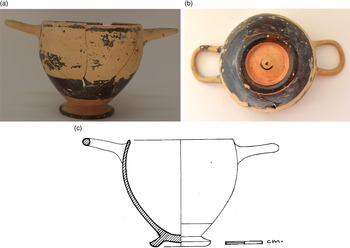
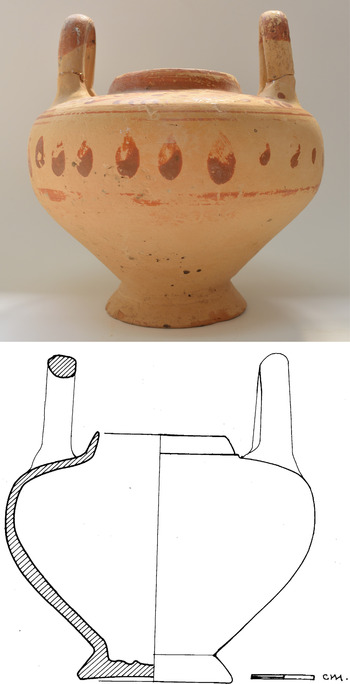
8. (Fig. 11a–c ). H. 0.09 m. Diam. foot 0.047 m, lip 0.09 m. Restored. Fabric fine, buff (10YR 8/4). Spreading ring-foot; convex wall with strong inward turn to lip; horseshoe handles. Shiny black glaze; lower part of wall reserved, with red wash. Underside reserved with red wash and traces of central black dot and circle.
Late 5th century bc.
-
9. (Fig. 12a–c ). H. 0.076 m. Diam. foot 0.051 m, lip 0.083 m. Restored; parts of lip and body missing. Fabric fine, buff (10YR 8/4). Heavy, thick foot with convex resting surface; handles slightly contracted at roots. Dull black glaze, fired red in part, peeling. Bottom of wall and top of foot reserved. Underside reserved with black dot and circle. Red wash on all reserved areas.
First quarter 4th century bc.
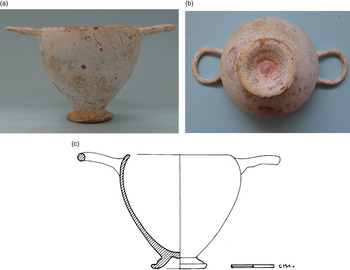
Catalogue no. 8. Black-glazed kotyle: (a) side view; (b) bottom; (c) drawing.

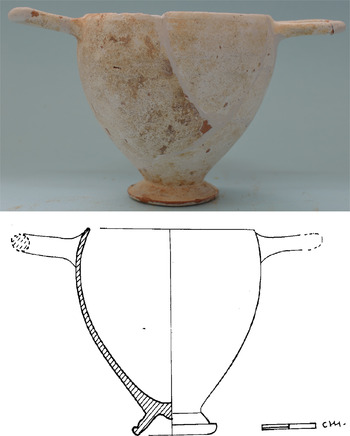
Catalogue no. 9. Black-glazed kotyle: (a) side view; (b) bottom; (c) drawing.

White-ground kotylai (nos 10–16)
-
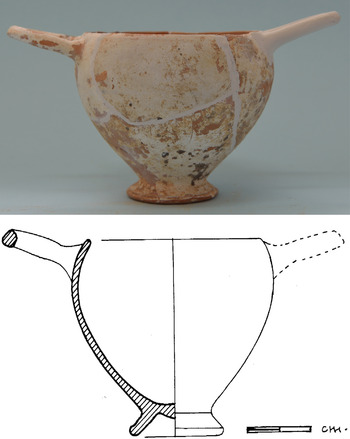
10. (Fig. 13a–c ). H.0.0765 m. Diam. foot 0.04 m, lip 0.074 m. Intact apart from small restoration on rim. Fabric fine, hard, orange (5YR 6/6) with a few sparkling inclusions. Tall and narrow flaring foot; handles slightly contracted at roots. White slip (peeling) over entire exterior, including underside, and inside rim. Traces of ochre wash. Underside painted red over white slip. Blue foliate branch across the body, under the handle zone.
380–360 bc.
-
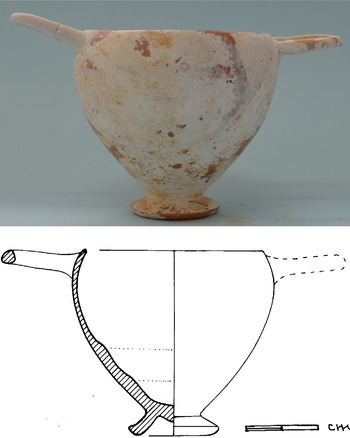
11. (Fig. 14). H. 0.076 m. Diam. foot 0.038 m, lip 0.075 m. Restored. For fabric and description, see no. 10. Traces of blue near one handle.
380–360 bc
-
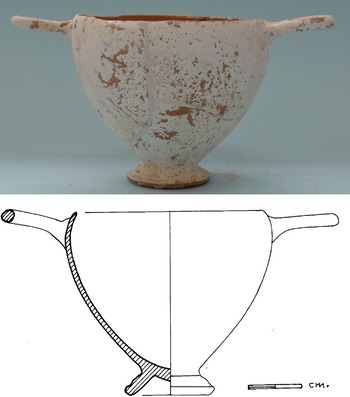
12. (Fig. 15). H. 0.075 m. Diam. foot 0.038 m, lip 0.075 m. Restored. For fabric and description, see no. 10.
380–360 bc.
-
13. (Fig. 16). H. 0.073 m. Diam. foot 0.0375 m, lip 0.07 m. Restored. For fabric and description, see no. 10.
380–360 bc.
-
14. (Fig. 17). H. 0.061 m. Diam. foot 0.034 m, lip 0.069 m. Restored. For fabric and description, see no. 10. Traces of blue colour.
380–360 bc.
-
15. (Fig. 18). H. 0.07 m. Diam. foot 0.036 m, lip 0.072 m. Restored. For fabric and description, see no. 10. Part of a blue foliate branch under one handle.
380–360 bc.
-
16. (Fig. 19). H. 0.079 m. Diam. foot 0.045 m, lip 0.088 m. Restored. For fabric and description, see no. 10.
380–360 bc.
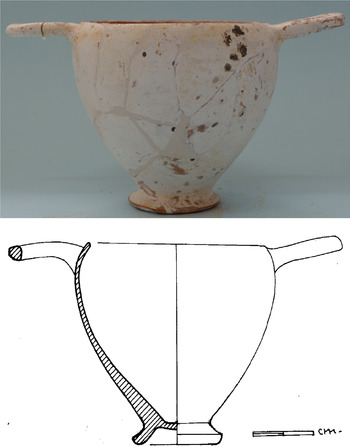
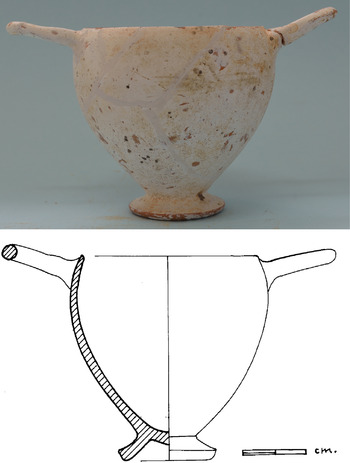
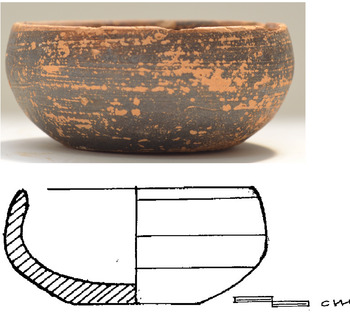
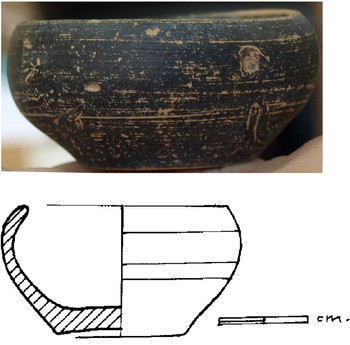
The impressive number of kotylai (nine) is a further distinctive feature of the burial assemblage examined here.Footnote 36 On the basis of typology (Sparkes and Talcott Reference Sparkes and Talcott1970, no. 322, pl. 15) and parallels from Argos (Bruneau Reference Bruneau1970, 449 figs 25–8; Karouzou Reference Karouzou1933–5, 46 fig. 28), the late fifth-century black-glazed kotyle no. 8 is the earliest. Its handles retain the horseshoe shape of the Classical period, whereas those of no. 9 represent a more developed stage. The handles and the ovoid shape of the body date no. 9 to the first quarter of the fourth century. The shape of this kotyle is comparable to that of the white-ground kotylai in the assemblage (nos 10–16), which, however, feature a distinctly narrower and taller base. Since they do not display the elongation that distinguishes examples of the mid-fourth century onwards (Sparkes and Talcott Reference Sparkes and Talcott1970, nos 325–6, pl. 15; Pemberton and Warner Slane Reference Pemberton and Warner Slane1989, nos 395–6, pl. 45; McPhee and Pemberton Reference McPhee and Pemberton2012, 170, fig. 34, pl. 27), a date of c.375/360 bc at the latest is proposed (cf. Sparkes and Talcott Reference Sparkes and Talcott1970, no. 324, pl. 15). This is also the terminus ante quem for the young woman's burial.
Catalogue no. 10. White-ground kotyle: (a) side view; (b) bottom; (c) drawing.

Catalogue no. 11. White-ground kotyle.

Catalogue no. 12. White-ground kotyle.

Catalogue no. 13. White-ground kotyle.

Catalogue no. 14. White-ground kotyle.

Catalogue no. 15. White-ground kotyle

Catalogue no. 16. White-ground kotyle.

The two black-glazed kotylaiFootnote 37 are attributed to Corinthian workshops on the basis of their fabric. In contrast, the white-ground kotylai are local products: in Argos this technique was applied to this shape already by the fifth century (Karouzou Reference Karouzou1933–5, 46 fig. 28, also mentioning a second white-ground kotyle in addition to the one illustrated). The vases were dipped in the white slip as indicated by traces on the rim interior. In all cases there was red painted decoration on the underside of the base. Infrared photography shows a blue foliate branch painted across the vessel body. Directly associated with eschatological beliefs, floral motifs were a popular decorative theme on funerary vases through time, whether or not on a white ground (Kyriakou Reference Kyriakou2008, 179–90; Trofimova Reference Trofimova2007, 114–15 no. 33). The kotyle is not found in the repertoire of other known white-ground production,Footnote 38 thus confirming the importance of this particular shape in Argive funerary rituals. This may also be inferred from the frequent presence of black-glazed kotylai among finds from the sporadically published Argive tombs, which suggests that the kotyle was a principal grave gift (Protonotariou-Deilaki Reference Protonotariou-Deilaki1970, 155, pl. 120b; Barakari-Gleni Reference Barakari-Gleni1984, 177, 179, 182 fig. 6, pls 76a, 77d–e, 79a; Tzachou-Alexandri Reference Tzachou-Alexandri and Mulliez2013, figs 2, 8, 13).
Black-glazed stemless cup (no. 17)
-
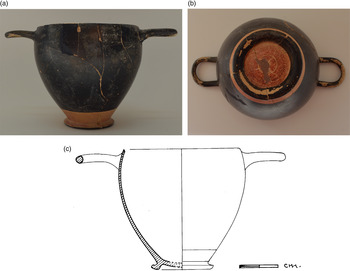
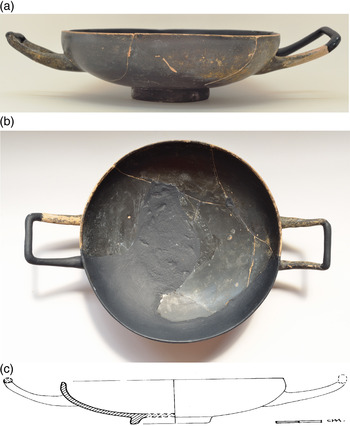
17. (Fig. 20a–c ). H. 0.039 m. Diam. rim 0.121 m, foot 0.045 m. Restored. Fabric fine, buff (10YR 8/4). Narrow ring-foot; wide, shallow profile with plain rim. Shiny black glaze inside and out, black to reddish, peeling. Inside, a band with stamped ovules.
Late 5th to early 4th century bc.
Both the fabric and morphological characteristics of no. 17 indicate that it belongs to a group of Corinthian vases which copy Attic plain-rim kylikes (Pemberton Reference Pemberton1997, 70 n. 19). The main difference between Attic and Corinthian examples is the latter's simpler, narrower foot (Pemberton Reference Pemberton1997, 69 n. 14). The Corinthian examples are dated to the late fifth or early fourth century bc at the latest, as is our cup (its date is corroborated by the impressed decoration, which dates to before 380 bc, when rouletting was established and interest in elaborate compositions lost). This Corinthian stemless cup is not the only example imported into Argos, as published burial assemblages show (Bruneau Reference Bruneau1970, 444, 446 nos 3, 6 figs 17–18; Papachristodoulou Reference Papachristodoulou1969, 107, pl. 85b [personal examination]).
Catalogue no. 17. Black-glazed stemless cup: (a) side view; (b) from above; (c) drawing.

According to a recent study, the stemless cup type had no practical function because of its minimal capacity, but was used purely for ritual purposes, like a bowl (McPhee and Pemberton Reference McPhee and Pemberton2012, 184). Therefore, our cup may have been a libation vessel used during the funerary ritual in honour of the deceased rather than a personal object intended for the afterlife.
Black-figure pyxides (nos 18–19)
-
18. (Fig. 21). H. body 0.112 m, lid 0.04 m, total 0.145 m. Diam. foot 0.07 m, rim 0.062 m, lid 0.075 m. Restored. Fabric fine, buff (10YR 8/4) with small white inclusions. Conical disc-base; straight, flaring lower body with maximum diameter set high, turning into horizontal shoulder. Lid has inward-sloping sides, offset from low, domed top, and flaring knob. Underside reserved; outer face of foot red; upper part of wall decorated with black blob buds bounded by red and black lines; on shoulder a pair of black palmettes, base to base, with counter-curving spirals and enclosed diagonal palmettes at far ends. Rim and handles black. Lid has linear decoration in red and black.
Late 5th to early 4th century bc.
-
19. (Fig. 22). H. body 0.113 m, lid unknown (not found), total 0.15 m. Diam. foot 0.072 m, rim 0.064 m. Intact apart from mended handles and lost part of rim. Fabric hard, reddish (2YR 6/8) with small to medium white and sparkling inclusions. For description, see no. 18: decoration executed only in red.
Late 5th to early 4th century bc.
The two black-figure pyxides which complete Group A belong to the Corinthian spherical pyxis type (Risser Reference Risser2001, 43 n. 18). This type originated in the late seventh century bc, but both of our examples belong to a later typological stage, characterised by the conical base, squat body narrowing markedly towards the bottom, and a wide, almost horizontal shoulder (McPhee and Pemberton Reference McPhee and Pemberton2012, 43–4). They date to the late fifth or early fourth century bc and are comparable both in form and decoration to examples from Argos (Bruneau Reference Bruneau1970, 441 no. 2.1, fig. 5; Karouzou Reference Karouzou1933–5, 46 fig. 28 [middle of upper row and second from right in lower row]; Barakari-Gleni Reference Barakari-Gleni1984, 178–9 MA 6053 and MA 6057 fig. 4–5, pl. 77b–c). They do not come from the same workshop, however, since no. 18 is Corinthian and no. 19 a local product closely imitating Corinthian models (Barakari-Gleni Reference Barakari-Gleni1984, 178 n. 13; Aslamantzidou-Kostourou Reference Aslamantzidou-Kostourou1985, 193, pl. 80β).
Catalogue no. 18. Black-figure pyxis with lid.

Catalogue no. 19. Black-figure pyxis.

Despite the fact that it is not attested in Corinthian tombs, this type of pyxis is one of the most common grave gifts (Rafn Reference Rafn1979, 25 n. 19) in the Argolid and Argos in particular (Tzachou-Alexandri Reference Tzachou-Alexandri1963, 62, pl. 76d; Sarri Reference Sarri1994, 138, pl. 53b; Aslamantzidou-Kostourou Reference Aslamantzidou-Kostourou1985, 189–90, pls 76–7; Lunsingh Scheurleer Reference Lunsingh Scheurleer1909, pl. 35; Courbin Reference Courbin1954, 182, fig. 45).Footnote 39 It is generally interpreted as part of a woman's toilette (Hoffmann Reference Hoffmann2002, 102; for an alternative interpretation see McPhee and Pemberton Reference McPhee and Pemberton2012, 219–20).Footnote 40 Our two pyxides were found inside the tomb of an adolescent girl and, although an original funerary function cannot be ruled out, it is possible that these vases were used in life before being placed inside the tomb for the afterlife.
-
20. Silver coin
Diam. 0.013 m. Corroded.Footnote 41
Burial Group B
This group contains the grave gifts that accompanied the three adult burials from the upper layer of the tomb. Its contents are treated as a group since, as noted, the disturbed stratigraphy does not allow us to associate any particular vase with a specific burial.
Black-glazed Boeotian-type kantharos (no. 21)
-
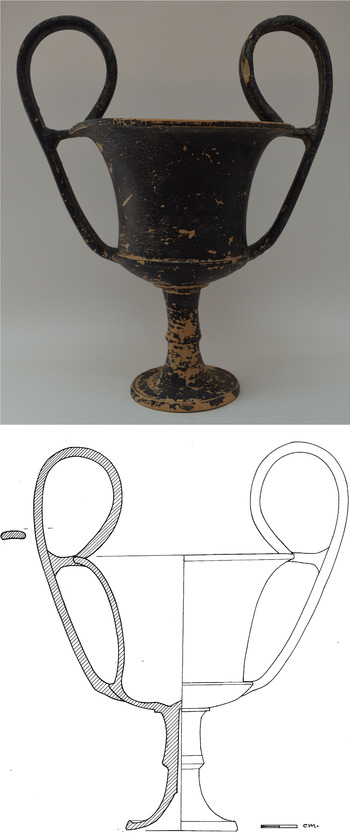
21. (Fig. 23). H. body 0.22 m, total 0.34 m. Diam. rim 0.178 m, foot 0.091 m. Intact (small chip missing from handle). Fabric fine, hard orange (5YR 6/6), with small white and sparkling inclusions. Broad disc-foot; high stem with a ring-shaped moulding around the middle; convex cup, offset from tall, concave upper wall. Strap handles curve high over the mouth, with struts from handle to lip. Dull brown glaze, peeling, cracked.
375–350 bc.
No. 21 recalls Boeotian examples of the second quarter of the fourth century bc, where the slender body with curved profile ends in a markedly out-splaying rim (Heimberg Reference Heimberg1982, 4–8, nos 19–20, pl. 2; Charami Reference Charami2008, 759–60, no. 32, fig. 12; on Boeotian kantharoi with exceedingly slender proportions see Heimberg Reference Heimberg1982, 5 n. 26e; Charami Reference Charami2008, 760–1, no. 36, fig. 10c; Andreiomenou Reference Andreiomenou2008, 370 fig. 104). However, two main features distinguish no. 21 from Boeotian kantharoi:Footnote 42 first, the shape of the calyx with its continuous convex profile instead of the typical concave–convex profile of the Boeotian examples and, second, the pronounced inward flexing of the raised handles before they join the body.Footnote 43 These morphological characteristics, as well as the vessel fabric,Footnote 44 indicate an Argive workshop which did not faithfully copy the Boeotian models which had been imported into Argos since the fifth century (Barakari-Gleni Reference Barakari-Gleni1984, 181–2 fig. 10, pl. 80a; Sarri Reference Sarri1996–7, 403, fig. 12), but adapted them to its own idiom.
Catalogue no. 21. Black-glazed Boeotian-type kantharos.

The excavators of Argive cemeteries frequently report finds of Boeotian kantharoi and local imitations in tombs (Barakari-Gleni Reference Barakari-Gleni1996–7, 523 n. 86: for AD 39, 1940, read AD 39, 1980). Our kantharos is a further example of these Argive imitations, but is the first to be published in detail. It is interesting to consider why a Boeotian type relatively unknown elsewhere in Greece (Schilardi Reference Schilardi1977, 304 nn. 24–6) grew sufficiently popular in this Peloponnesian city to become a common grave gift. On present evidence we cannot determine whether it indicates a burial custom common to the two regions or whether this vase shape assumed a different significance at Argos.Footnote 45 We can only note that the Boeotian kantharos, a symbol of Dionysus and his mystery cult (Tzanavari Reference Tzanavari, Adam-Veleni, Kefalidou and Stefani2011, 104–14 and 132–4 for bibliography) charged with strong eschatological connotations (Schilardi Reference Schilardi1977, 304 n. 23), was popular at Argos, revealing a minor aspect of the city's little-known funerary practices.
Black-glazed bolsal (no. 22)
-
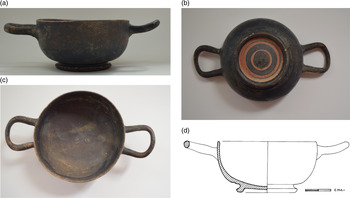
22. (Fig. 24a–d ). H. 0.059 m. Diam. foot 0.07 m, rim 0.116 m. Fabric hard, reddish (2.5YR 6/6). Deep cup with ridge on lower part of wall and flaring ring-foot. Handles (triangular from above) slightly rising. Dull black to brown mottled glaze. Underside reserved with red wash and a single dot and two glazed circles in the centre. Inside, three stamped palmettes.
380–350 bc.
No. 22 combines both early and late morphological features, which make it difficult to place within the form's typological development (Gill Reference Gill and Brijder1984, 102–6), as known from its counterparts in Athens (Sparkes and Talcott Reference Sparkes and Talcott1970, 107–8; Elrashedy Reference Elrashedy2002, 82–5; Blondé Reference Blondé2007, 52–3, pl. 25) and Corinth (Pemberton Reference Pemberton1997, 72–6; McPhee and Pemberton Reference McPhee and Pemberton2012, 179). The continuous convex profile of the deep body, and the rim that does not splay outwards, recall fifth- and early fourth-century examples. In contrast, the slightly raised, triangular handles are typical of Attic cups of the second quarter of the fourth century onwards (Sparkes and Talcott Reference Sparkes and Talcott1970, 107 no. 558, pl. 24, fig. 6). The underside of the foot is not painted solid black but decorated with a group of black concentric circles characteristic of bolsals from the mid-fourth century onwards. Also characteristic of this period is the lack of a central nipple on the base and the groove in the resting surface (Sparkes and Talcott Reference Sparkes and Talcott1970, 107). No. 22 is therefore dated from 380 to 350 bc. The standard impressed decoration – three free, radially arranged palmettes – corroborates this date (cf. Sparkes and Talcott Reference Sparkes and Talcott1970, 284 no. 682, pl. 56). Both the cup's technical features and the combination of early and late typological characteristics point to a local workshop which copied, albeit not faithfully, Attic models.
Catalogue no. 22. Black-glazed bolsal: (a) side view; (b) bottom; (c) from above; (d) drawing.

The bolsal was one of the most popular types of drinking vessel in Argive cemeteries, although few examples have been published (Karouzou Reference Karouzou1933–5, 43 fig. 25 and 47 fig. 29, 3; Bruneau Reference Bruneau1970, 448, 452 no. 4.11 and 4.12 figs 40–3).
Black-glazed oinochoe (no. 23)
-
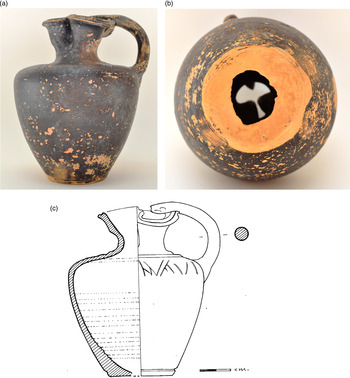
23. (Fig. 25a–c ). H. 0.139 m. Diam. base 0.051 m, max. diam. body 0.105 m. Intact. Fabric hard, orange (5YR 6/6) with small white and sparkling inclusions. Flat base with no foot; body ovoid with a ridge on the lower wall; flat shoulder; trefoil mouth with groove on top. Base perforated (hole diameter 0.028 m). Dull black glaze, peeling; base and lower edge of wall reserved. Mouth interior glazed. On shoulder incised vertical and diagonal lines.
375–350 bc.
No. 23 is a Type 2 oinochoe, a form which appears in Attic black-glaze at the end of the sixth century and survives until the Hellenistic period (Sparkes and Talcott Reference Sparkes and Talcott1970, 60; Andreassi Reference Andreassi1990, 107). It recalls fourth-century Attic examples with ovoid body and broad, prominent shoulder (Sparkes and Talcott Reference Sparkes and Talcott1970, no. 104 pl. 5; Robinson Reference Robinson1933, 212 nos 724–6, pl. 166; Elrashedy Reference Elrashedy2002, 85 nos 62–4, pls 84–5; Trinkl Reference Trinkl2011, 45–6, pl. 29). However, there are important morphological differences between no. 23 and its Attic counterparts. The latter feature a separate discoid foot, whereas the Argive example is footless. The neck of the Argive oinochoe is particularly squatFootnote 46 when compared with the slender Attic examples. Lastly, the engraved decoration on the shoulder of no. 23 is unknown on Attic examples, which in the fourth century usually feature neat ribs over the entire body. Ribbing on the shoulder only occurs on black-glazed south Italian oinochoai (Cassano Reference Cassano1992, 358 no. 35; Heenes Reference Heenes1998, 84, pl. 39 no. 152; Merzagora Reference Merzagora1971, 14 no. 64, pl. LVII).
Catalogue no. 23. Black-glazed oinochoe: (a) side view; (b) pierced bottom; (c) drawing.

Comparative typological study and the manufacturing characteristics of no. 23 allow us to attribute it to a local workshop as a hitherto unremarked Argive variant of the Attic type, which is also attested in white-ground (Sarri Reference Sarri and Mulliez2013, 186 fig. 10). The duration of this Argive production cannot yet be determined, although a general fourth-century date is plausible. No. 23 can probably be dated to the second quarter of the fourth century bc on the basis of comparison with an unpublished unglazed oinochoe with engraved and impressed decoration on the shoulder which comes from a mid-fourth-century bc Argive tomb.Footnote 47
The piercing of the base indicates that the vase served a ritual function. However, unlike the lebetes gamikoi in Group A, the piercing was made after firing: therefore we cannot exclude a practical, everyday use before the vase was selected for the funerary ritual and placed inside the tomb. One might conjecture that the oinochoe was used with the mesomphalos phiale (no. 26) for ritual libations in honour of the deceased.Footnote 48
Black-glazed skyphos (no. 24)
-
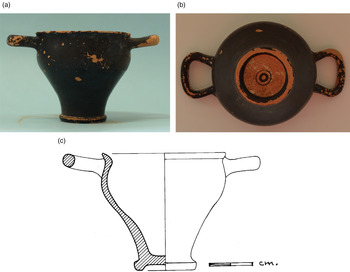
24. (Fig. 26a–c ). H. 0.076 m. Diam. foot 0.041 m, lip 0.084 m. Intact. Fabric hard, reddish (2.5YR 6/6) with small white and sparkling inclusions. Torus foot. Well-defined stem; maximum diameter high on body; strongly everted; handle profile triangular from above. Shiny, mottled black glaze, peeling. Base reserved with red wash and two black circles.
350–325 bc.
Comparison with well-dated parallels from Athens (Sparkes and Talcott Reference Sparkes and Talcott1970, no. 352, pl. 17; Rotroff Reference Rotroff1997, nos 150, 151, fig. 12, pl. 14) and Corinth (Pemberton and Warner Slane Reference Pemberton and Warner Slane1989, no. 410, fig. 7, pl. 46; McPhee and Pemberton Reference McPhee and Pemberton2012, 176 no. VI-41, fig. 37 and no. VI-18, fig. 35, pl. 28) suggest a date in the third quarter of the fourth century (probably towards the end). Characteristic features of this date are the more everted lip, the greater maximum diameter with more pronounced bulge, and the well-defined stem (compare Roux Reference Roux1957, 650, fig. 22; Bommelaer and Grandjean Reference Bommelaer and Grandjean1972, 184, fig. 42; Dengate Reference Dengate1976, 310, 312 nos 130, 145, pls 76–7; Jameson Reference Jameson1969, 320, pl. 81c; Rudolph Reference Rudolph1974, 115 no. 19, fig. 3).
Catalogue no. 24. Black-glazed skyphos: (a) side view; (b) bottom; (c) drawing.

No. 24 is a local productFootnote 49 which closely imitates Attic models to the point of adopting the two concentric circles on the base.Footnote 50 Late examples from Argos (Kritzas Reference Kritzas1973, 123, pl. 110d) and other towns in the Argolid (Penttinen Reference Penttinen1996, 158, 160 nos 22–3 fig. 15; Danali Reference Danali1994, 260–1, 278–9, figs 8, 10–11; Cook Reference Cook1953, 59–60 G7 fig. 33; Rudolph Reference Rudolph1978, 218–19 no. 29 fig. 7, pl. 28; Abadie and Spyropoulos Reference Abadie and Spyropoulos1985, 399, no. 2, fig. 26, 441, no. 4, fig. 137) confirm the development of the type to the third century bc (Rotroff Reference Rotroff1997, 94; Pemberton Reference Pemberton1985, 282). Along with the kotyle, the different variants of the kylix, and the bolsal, black-glazed skyphoi are among the most common drinking vessels in Argive cemeteries.
Black-glazed small echinus bowl (no. 25)
-
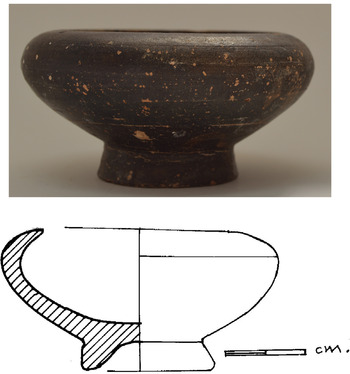
25. (Fig. 27). H. 0.035 m. Diam. rim 0.052 m, foot 0.034 m. Intact. Fabric hard, reddish (2.5YR 6/8), with small white and sparkling inclusions. Ring-foot; slight nipple on base. Convex wall with incurving rim and sharp lip. Dull black to brown mottled glaze, peeling.
325–300 bc.
This type of small, footed, echinus bowl was particularly popular in the fourth century bc but survived into the Hellenistic period (Rotroff Reference Rotroff1997, 167). The convex wall and markedly inturned (though not angular) rim of no. 25 find their closest parallel in a small echinus bowl from Mycenae (Rudolph Reference Rudolph1978, 215–16, 229 no. 14 fig. 3, pl. 28), which is attributed to an eastern Peloponnesian workshop and placed at the beginning of a series of similar examples from the site. Corinthian small echinus bowls of the last quarter of the fourth century (Pemberton and Warner Slane Reference Pemberton and Warner Slane1989, 41 no. 89, pl. 13 and no. 124 fig. 12, pl. 16) provide a chronological framework for no. 25. These too display a relatively uniform wall thickness, which distinguishes them from their Attic counterparts (Rudolph Reference Rudolph1978, 228 n. 2). Another criterion for a fourth-century date is the sharp edge of the rim. The fabric and form of no. 25 point to an Argive origin, even though there is no other example in the published Argive burial assemblages. It remains to be seen whether this absence is a coincidence or genuinely reflects the type's sporadic occurrence.
Catalogue no. 25. Black-glazed small echinus bowl.

Unglazed phiale mesomphalos with impressed and relief decoration (no. 26)
-
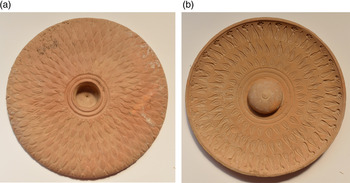
26. (Fig. 28a–b ). H. 0.026 m. Diam. 0.212 m. Almost intact (omphalos mended). Fabric fine, hard, light orange (5YR 7/6) with small sparkling inclusions: carbon and salt deposits on the surface. Very shallow profile. On the exterior, moulded relief decoration: around the omphalos, a row of alternating ovules and small leaves within single defining bands, followed by five concentric rows of radiating pointed leaves, increasing in size towards the outer edge. On the interior, stamped decoration (three different stamps): two ridges around the omphalos, surrounded by three concentric rows of teardrop-shaped buds in two different sizes, combined with small palmettes above the outer row.
400–350 bc.
Whereas the shape of no. 26 is common in ancient Greek pottery (Parlama and Stampolidis Reference Parlama and Stampolidis2000, 336 no. 356; Sparkes and Talcott Reference Sparkes and Talcott1970, 105 n. 5; Pemberton and Warner Slane Reference Pemberton and Warner Slane1989, 31–3; Tsingarida Reference Tsingarida and Lapatin2008, 187–93), its decoration is not. The combination of relief decoration on the vessel exterior and impressed decoration on the interior occurs on one other mesomphalos phiale from the cemetery of Halieis in the Argolid (Dengate Reference Dengate1976, 291–2 no. 33, pl. 69). Besides the technique, the two bowls also have in common the foliate decoration in concentric circles over the entire surface. The relief surface of no. 26 was obtained using a mould. A group of moulds from Taranto (Lippolis Reference Lippolis1994, 235–50)Footnote 51 and Poseidonia (Richter Reference Richter1959, 247 pl. 60, 51),Footnote 52 which have various plant motifs arranged in the same manner, may shed light on the distribution and manufacture of this type of relief phiale. As has already been emphasised (Lippolis Reference Lippolis1994, 248), it is strongly dependent on metal prototypes.
Catalogue no. 26. Unglazed phiale mesomphalos: (a) outside; (b) inside.

In contrast, the stamped decoration of no. 26 can more easily be associated with local Peloponnesian variants only recently studied as a whole (Schauer Reference Schauer2011). Black-glazed examples from Mycenae (Schauer Reference Schauer2011, 169 n. 19), Epidaurus (Schauer Reference Schauer2011, 170 n. 23) and Berbati (Penttinen Reference Penttinen1996, 262 no. 161 fig. 27) demonstrate the adoption by workshops in the Argolid of a technique invented in Attica around the mid-fifth century bc (Schauer Reference Schauer2011, 166 n. 3; Gill Reference Gill1986; Gill Reference Gill1990). In addition to black-glazed wares,Footnote 53 stamped decoration is found on unglazed vases from the Argolid (a further local peculiarity), including, in addition to no. 26, two vases from the Halieis cemetery (Dengate Reference Dengate1976, 291–2 no. 33, pl. 66 and 296 no. 53, pl. 71; Schauer Reference Schauer2011, 170 n. 24) and a dish from Argos (Bingen Reference Bingen1955, 318 fig. 20). A squat aryballos (Sarri Reference Sarri and Mulliez2013, 183, 197 fig. 9), an unpublished oinochoe (see above, n. 47) and the unpublished lebes gamikos (no. 30508 in the National Archaeological Museum in Athens) suggest that the range of shapes was much broader. Palmettes, egg-and-dot, and concentric circles are the most common decorative motifs.
No. 26 can therefore be attributed to an Argive workshop and to a regional production of stamped unglazed wares, thus shedding light on hitherto unremarked aspects of Argive ceramic production. Examples of phialai mesomphaloi with similar decoration from southern Italy (Cassano Reference Cassano1992, 195; Sotheby's, Antiquities and Islamic Works of Art, New York, 25 June 1992, no. 300) demonstrate that this was not only an Argive particularity. Both the contextual evidence of our tomb assemblage and parallels in metal (Richter Reference Richter1959, 246 pl. 59, 46; Strong Reference Strong1966, 82 n. 2; Konsolaki-Giannopoulou Reference Konsolaki-Giannopoulou and Konsolaki-Giannopoulou2003, 150–1, fig. 23–4) and pottery (Dengate Reference Dengate1976, 291–2)Footnote 54 date the bowl to the first half of the fourth century bc (greater precision is not possible).
The phiale was the ancient Greek libation vase par excellence (Krauskopf Reference Krauskopf2005, 196–201), and its discovery in a burial assemblage suggests that it was used in the funerary rites (possibly in association with the black-glazed oinochoe no. 23). While similar phialai are not attested in Argos as yet, the probably Argive example from the Halieis tomb indicates that no. 26 was not unique.Footnote 55
One-handled lidded chytra (no. 27)
-
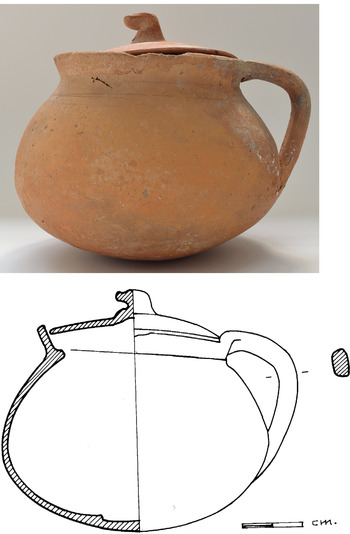
27. (Fig. 29). H. 0.08 m, lid 0.015 m. Max. diam. 0.107 m, lid 0.067 m. Restored (missing small parts of body and rim). Fabric very coarse, gritty, thick, red (10R 5/8) with abundant white, dark and sparkling inclusions. Salts on lid and part of the handle. Flanged rim. Shallow, slightly convex lid with small outturned knob. Thin reddish wash on exterior. Blackened on underside.
380–325/300 bc.
No. 27 features a single handle and a flanged rim to support the lid. This type of cooking pot appears in the sixth century bc and survives largely unchanged into the Hellenistic period (Pemberton and Warner Slane Reference Pemberton and Warner Slane1989, 74). It was not especially popular in Athens (Sparkes and Talcott Reference Sparkes and Talcott1970, 224; Rotroff Reference Rotroff2006, 169 no. 576) or Corinth (Pemberton and Warner Slane Reference Pemberton and Warner Slane1989, 74; McPhee and Pemberton Reference McPhee and Pemberton2012, 80), where the more common variant of the one-handled chytra featured a low flaring rim, not specifically designed for a lid. No. 27 was probably manufactured locally, but the lack of published parallels from Argos and the longevity of the shape make it impossible to date precisely. The proposed date is therefore based on the other finds from the same context.
Catalogue no. 27. One-handled lidded chytra.

One-handled cooking pots were common grave gifts in various regions and periods (Kunze-Götte, Tancke and Vierneisel Reference Kunze-Götte, Tancke and Vierneisel2000, nos 75.5, 123.1, 353.5, 409.7, 433.3, 605; Andreassi, Bianchin Citton and Bonomi Reference Andreassi, Bianchin Citton and Bonomi1995, 150 no. 2.2.10; Arapogianni Reference Arapogianni1984, 88–9, pl. 29α, γ and 91, pl. 30α; Drougou Reference Drougou2005, 55 fig. 38 and 94 fig. 103). The blackened underside of no. 27 suggests a period of use before the vessel was placed in the tomb.
-
28. Iron strigil.Footnote 56 Two corroded parts: (A) part of blade, l. 0.2 m, w. 0.033 m; (B) part of blade and handle, l. 0.046 m, w. 0.036 m.
Burial Group C
Group C comprises the vases that accompanied the two infant burials inside the clay larnax. Two shapes are represented: the lekanis and the small footless bowl.
Black-glazed lidded lekanides (nos 29–30)
-
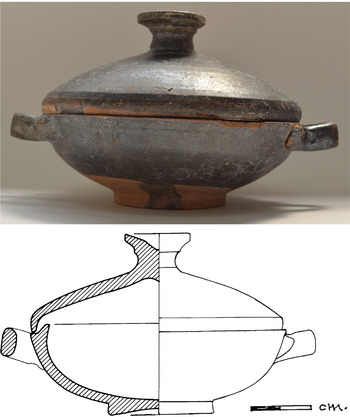
29. (Fig. 30). H. body 0.042 m, lid 0.0505 m, total 0.085 m. Diam. foot 0.051 m, rim 0.106 m. One handle mended; small chip on rim. Fabric fine, hard, orange (5YR 6/6), with white and sparkling inclusions. Deep bowl, with flanged rim, raised disc-foot and slightly concave base. Domed lid; knob has deep central depression. Handles have small pointed reflexes. Vessel dipped, with base, foot and lower body reserved: shiny black to brown glaze with metallic patches.
325–300 bc.
-
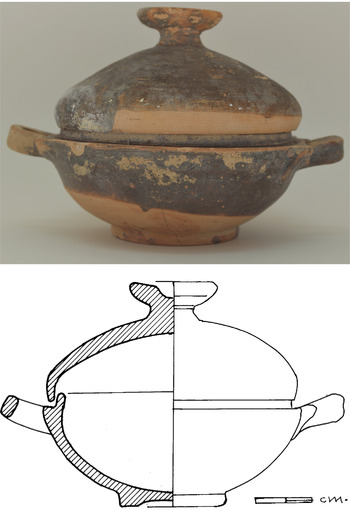
30. (Fig. 31). H. body 0.046 m, lid 0.0516 m, total 0.095 m. Diam. foot 0.055 m, rim 0.096 m. Restored. Fabric fine, hard, light orange (5YR 7/6) with white and sparkling inclusions. Deep bowl, with flanged rim, low foot, flat resting surface. Domed lid; knob has deep central depression. Handles have small pointed reflexes. Vessel dipped, with lower body and part of lid edge reserved: dull brown to red glaze, peeling.
325–300 bc.
Nos 29–30 belong to a Corinthian type particularly popular at Argos (Karouzou Reference Karouzou1933–5, 20 fig. 5 and 43 fig. 25; Barakari-Gleni Reference Barakari-Gleni1984, 177–8 fig. 7, pl. 76β). The type appeared in Corinth in the fifth century (Blegen, Palmer and Young Reference Blegen, Palmer and Young1964, 146–8; Edwards Reference Edwards1975, 95) and the latest examples date to the third (McPhee and Pemberton Reference McPhee and Pemberton2012, 218 n. 43). Both in Corinth and in Argos, however, the type is mostly unglazed and with a characteristic ribbed lid.Footnote 57 The manufacture of unglazed lekanides of this type at Argos is confirmed by the discovery of several examples among kiln wasters in the area of the Argos Archaeological Museum (Roux Reference Roux1957, 647 figs 20–21; Bruneau Reference Bruneau1970, 522 for the date of the deposit). Their black-glazed counterparts are significantly fewer both in Corinth (Blegen, Palmer and Young Reference Blegen, Palmer and Young1964, 146) and in Argos (Bingen Reference Bingen1955, 317 fig. 21).Footnote 58 The two main morphological characteristics of the black-glazed lekanides nos 29–30, namely the continuous body profile with a simple foot, and the body–foot proportions, are found on late fourth-century Corinthian unglazed examples (Blegen, Palmer and Young Reference Blegen, Palmer and Young1964, 147 group iii cat. no. X-228 fig. 16; Edwards Reference Edwards1975, 96 no. 556, pl. 18, 57; McPhee and Pemberton Reference McPhee and Pemberton2012, 218 n. 41).Footnote 59 The lids of nos 29–30, however, lack the concentric grooves on their Corinthian counterparts. Both are local products.
Catalogue no. 29. Black-glazed lidded lekanis.

Catalogue no. 30. Black-glazed lidded lekanis.

The placing of lekanides in children's tombs has not previously been attested at Argos, even though it is a common funerary practice (Stroszeck Reference Stroszeck, Hermary and Dubois2012, 58 nn. 12–13; Hoffmann Reference Hoffmann2002, 101 n. 531) found, for example, in the nearby cemetery of Asine (Hägg and Fossey Reference Hägg and Fossey1980, 106–8 figs 126, 129). The lumps of psimythion (face powder) (Mylonas Reference Mylonas1975, 292; Walter et al. Reference Walter, Welcomme, Tsoucaris, Adrymi, Nikolaou, Alexandrou and Kravaritou2008, 288–99) found while clearing our larnax were probably contained in one or both of the lekanides, confirming the common association of this type of vase with female toilette (Hoffmann Reference Hoffmann2002, 100–1 nn. 528, 531).Footnote 60 The presence of lekanides in child burials may thus denote the incomplete life cycle of a female who died prematurely (Huysecom-Hahxi Reference Huysecom-Haxhi, Muller and Bobas2008, 67). Indeed, gender-suggestive grave gifts could appear long before a child's sexual maturity (Graepler Reference Graepler1997, 173; Houby-Nielsen Reference Houby-Nielsen and Sofaer Derevenski2000, 153–5; Stroszeck Reference Stroszeck, Hermary and Dubois2012, 70–1).
Black-glazed small footless bowls (nos 31–33)
-
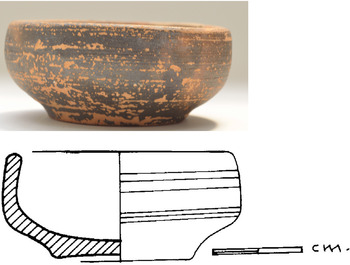
31. (Fig. 32). H. 0.024 m. Diam. base 0.034 m, rim 0.055 m. Complete; lip restored. Fabric fine, hard reddish (2.5YR 6/8) with white and sparkling inclusions. Flaring wall rising vertically to lip. Dull glaze, black to brown, peeling; marked wheel ridges on exterior.
325–300 bc.
-
32. (Fig. 33). H. 0.021 m. Diam. base 0.031 m, rim 0.047 m. Rim chipped away. Fabric as no. 31. Convex profile.
325–300 bc.
-
33. (Fig. 34). H. 0.024 m. Diam. base 0.031 m, rim 0.051 m. Complete (body chipped). Fabric fine, ochre (10Y 7/4) with sparkling inclusions. Incurved rim.
325–300 bc.
Nos 31–33 belong to an Attic type that appeared in the early fifth century (Sparkes and Talcott Reference Sparkes and Talcott1970, 136) and continued sporadically into the fourth (Knigge Reference Knigge2005, 206–7 no. 758, fig. 46, pl. 125). It was also produced at Corinth, where fourth-century examples are also rare (Pemberton Reference Pemberton1985, 284 n. 41) although the type persisted at least until the mid-third century (two examples come from a tomb of this period: Pemberton Reference Pemberton1985, 283–4, 301 nos 40–1, pl. 80). Nos 31–33 are Argive products, with a different body profile from their fourth-century Attic and Corinthian counterparts. This may reflect a difference in date, or it may be a local workshop variation. They recall the two mid-third-century Corinthian bowls noted above, apart from the rim profile. These parallels suggest a possible date range between the late fourth century and the first half of the third, but their association with the lekanides nos 29–30 narrows their likely date to the late fourth century bc (indeed the small bowl no. 33 was found inside lekanis no. 30).The reproduction of a type of small bowl which had only a limited distribution from the fourth century onwards suggests that Argive craftsmen did not confine themselves to stereotyped repetition of well-established types, such as the skyphos, the kotyle or the kylix. The use of this type of vase remains uncertain, although it is generally regarded as tableware (Rotroff Reference Rotroff1997, 167).
Catalogue no. 31. Black-glazed small footless bowl.

Catalogue no. 32. Black-glazed small footless bowl.

Catalogue no. 33. Black-glazed small footless bowl.

The association of a lekanis and a small handleless bowl in a child burial is unparalleled at Argos although attested in other cemeteries (Georgiadou Reference Georgiadou2005, 112, pl. 46). The discovery of the bowl no. 33 inside the lekanis no. 30 holds no evident significance (Blegen, Palmer and Young Reference Blegen, Palmer and Young1964, 81; Georgiadou Reference Georgiadou2005, 112 no. 2; Stroszeck Reference Stroszeck, Hermary and Dubois2012, 59 fig. 7).
IV. OVERVIEW OF THE POTTERY
Of the 31 vases in the tomb, four (nos 8–9, 17–18) are imports, all from Corinth. A strong presence of Corinthian pottery is also evident in other Argive burial assemblages (Barakari-Gleni Reference Barakari-Gleni1996–7, 522). Attic products are equally popular at Argos at least until the fifth century bc, but are absent from our tomb.Footnote 61
The remaining 27 vases are fourth-century local products. With the exception of the footless bowl no. 33, they were all made in the usual orange-red Argive fabric with abundant small sparkling inclusions (Bovon Reference Bovon1966, 13). Black-glazed wares have a red wash over the reserved areas, and their glaze is dull, unevenly coloured and flaky. The white slip of the white-ground wares is particularly fine and thin. The wide range of local Argive products in all categories, black-glazed, white-ground and unglazed, and the wealth of specific features observed, become plain for the first time via our assemblages.Footnote 62 Faithful copies of imported and usually common shapes (the black-figure pyxis, skyphos and chytra) coexist with more or less free reproductions of known types (the oinochoe, lekanis, kantharos and bolsal). The strong local tendency to experiment is also demonstrated in detail here for the first time (Dengate Reference Dengate1976, 296).
The white-ground vases (nos 1–7, 10–16), and the unglazed phiale with impressed decoration (no. 26) belong to two distinctive Argive productions, which, if originally inspired by foreign prototypes, responded to them early to adapt to local demands. At present there is no evidence to suggest that Argive white-ground pottery was exported. Rather, it appears that this repertoire was inextricably associated with local burial customs and thus intended exclusively for the inhabitants of Argos. On the other hand, the occurrence of an unglazed mesomphalos phiale similar to no. 26 at Halieis (Dengate Reference Dengate1976, 291–2 no. 33, pl. 69) demonstrates the distribution of this Argive ceramic category at least within the Argolid.
V. CONCLUSION
This presentation of an unpublished fourth-century bc family tomb at Argos has revealed several peculiarities in the material evidence for Argive burial customs. Further evidence is required to establish a broader picture and to determine whether the traits revealed in our assemblages are exceptional or coincidental, or fit a general pattern. The earliest assemblage in the tomb (Group A) dates to the early fourth century and is rich. It belonged to a young female, whose age has been determined by anthropological study. Prominent among these grave offerings are seven white-ground lebetes gamikoi with female protomes in the round, which belong to a distinctive local production of polychrome white-ground pottery, the significance of which is here emphasised for the first time. The association of these vessels with the burial of a young girl raises the question of their symbolic role in denoting the youth of the deceased. The only other Argive example of the shape yet known comes from a recently published burial (also rich) of a female of unknown age, and we must await further evidence to evaluate and further explore the symbolic function of this vessel type.
Next in sequence are three adult burials that extend chronologically through the fourth century (Group B). Anthropological study has identified two of the deceased as a male and a female, possibly a couple. Most striking among the grave offerings are a local black-glazed kantharos of Boeotian type and a black-glazed oinochoe with an unglazed phiale. The last two could be interpreted as libation vessels, especially as the base of the oinochoe was pierced. The unglazed phiale with stamped decoration belongs to a type here evidenced for the first time in Argos, and to a local production, the characteristics of which are also newly described.
Finally, a clay larnax contained the burial of two infants with the vases of Group C. Although a relationship between these infants and the young female of Group A must be ruled out because of the large chronological discrepancy between the burials, a connection with the female adult burial of Group B is possible. This is the first known case of the placing of a larnax inside a cist grave. The child burials in the larnax were accompanied by lekanides, which may be gender-suggestive grave gifts following known examples from the cemeteries of nearby Asine or Athens. A further problem of interpretation is presented by the subsequent insertion of the bones of a young female into the larnax alongside the bodies of the infants. Might this treatment reflect her social status? The present study has raised a number of such questions for future research as more evidence becomes available.
In conclusion, presentation of this tomb and its burial assemblages illustrates both previously unknown aspects of Argive burial custom and the wealth and diversity of fourth-century bc Argive pottery.
VI. ACKNOWLEDGEMENTS
I am particularly grateful to Dr Alkistis Papadimitriou for permission to publish the tomb and for her generous support throughout the study. Vangelis Giannopoulos was most helpful at the Argos Museum. I began this article in Oxford in June 2011 during my tenure of a British School at Athens Centenary Bursary, and completed it in Berlin in June 2013 while a guest of the German Archaeological Institute. My warmest thanks go to Professor Catherine Morgan and Dr Reinhard Senff. I am also grateful to Olga Tzachou-Alexandri for permission to read her manuscript before publication. Drawings are by Aspasia Drigopoulou, and the English translation by Dr Maria Xanthopoulou. Professor Catherine Morgan contributed a great deal to the editing of the paper. Photographs of the vases were taken by Dr Dimitris Athanasoulis. Figs. 1–4 are kept in the photoarchive of the Ephorate of Antiquities of Argolis. I offer many thanks to Dr Sophia Sotiropoulou for the infrared photography.
SUPPLEMENTARY MATERIAL
Supplementary material is available online at http://dx.doi.org/10.1017/S0068245415000192.
APPENDIX: The visible-induced infrared luminescence (VIL) imaging method, applied to a group of vases with white slip and traces of polychrome decoration from a fourth-century family tomb at Argos
by Sophia Sotiropoulou, ‘Ormylia’ Foundation, Art Diagnosis Centre, Ormylia, Greece
(Note – figures S1–20 referred to in the Appendix are available online at http://dx.doi.org/10.1017/S0068245415000192.)
The visible-induced infrared luminescence (VIL) imaging method was applied to detect and to map the use of Egyptian blue in the polychrome decoration of the vases. The VIL method was proposed by G. Verri (Reference Verri2009) and is based on the property of cuprorivaite to emit infrared luminescence when excited in the visible area of the spectrum. The emitting response of Egyptian blue in the infrared is captured and translated to greyscale image, in which the intensity (the grey level) of each pixel is proportionate to the concentration of the pigment in the paint surface. Thanks to the high sensitivity of the method, in certain cases it is possible to make visible any remaining pigment, present even in traces, and to help in reconstructing some imperceptible detail of the drawing. On the other hand, when blue paint is clearly visible, this exceptional property of Egyptian blue allows us to distinguish it from all other natural or synthetic blue pigments that are not photoluminescent in the spectral range under study (Vlachopoulos and Sotiropoulou Reference Vlachopoulos, Sotiropoulou and Papadopoulos2012).
For the application of the VIL method on five vases with white slip on which traces of blue are merely visible, LED PAR lights were used for excitation (Eurolite LED PAR56 RGB spots 20W [151 LEDs], 45°), of which the red LEDs were used selectively); a visually opaque polyester filter (LEE polyester IR filter 87 – visually opaque filter with transmission starting at 730) was placed in front of the lens of the digital photographic camera (Sony camera A300, 10.2 Mpixels) to absorb unwanted visible light. The camera's built-in IR-blocking filter, which is placed in front of the CCD sensor, was removed. For all shots, a specifically designed Egyptian-blue scale was placed next to the object. The scale consists of colour gradations of Egyptian blue resulting from mixing pure Egyptian blue pigment with white in a gradually increased concentration. The scale allows a rough estimate of the relative concentration of Egyptian blue in the sample examined. In the presented VIL images, stray infrared radiation has not been excluded in order to perceive the drawing of the decoration and its position on the vase.
A blue foliate branch across the body has been outlined in the VIL images, documenting the use of Egyptian blue in the paint decoration on the white-ground kotyle, Catalogue no. 10 (Figs S1, S2, S3 and S4).
In the VIL images of the white-ground lebetes gamikoi with lid and plastic decoration, the well-preserved Egyptian blue is evidenced on the polos of the peplophoroi, Catalogue no. 2 (Figs S5, S6, S7 and S8), Catalogue no. 3 (Figs S9, S10, S11, S12, S13 and S14) and Catalogue no. 5 (Figs S15 and S16). Then, on the elongated knob of the lid of the vase Catalogue no. 5, the shape of a blue ray pattern painted on a white slip is better visible in the VIL images (Figures S17 and S18).
Egyptian blue has also been identified in the frontal scene of the vase Catalogue no. 1, forming two rings of similar shape (Figs S19, S20).