Introduction
Intrauterine growth restriction (IUGR) affects 3–10% of all pregnancies in the developed world and is the leading cause of perinatal morbidity and mortality after prematurity.Reference Gagnon 1 Infants affected by IUGR are at increased risk for lifelong deficits in learning, memory and attention.Reference Fouron, Gosselin and Raboisson 2 , Reference Ley, Marsal, Dahlgren and Hellstrom 3 They perform poorly on intellectual standardized testing at childhood and adulthood when compared with controls matched for age, gestation and socioeconomic class.Reference Leitner, Fattal-Valevski and Geva 4 – Reference Strauss 10 Previous studies show that male IUGR children have greater risk for severe IUGR-associated neurologic impairment later in life.Reference Rooney, Hay and Levy 11 , Reference Jarvis, Glinianaia and Arnaud 12 However, it is not well understood how IUGR, an antenatal insult, can lead to impaired learning and memory that persists later in life.
One important molecular participant in learning and memory processes is the insulin-like growth factor 1 (Igf1) pathway. Igf1 and its receptor, insulin-like growth factor 1 receptor (IGF1r), play important roles in brain development and are widely expressed in the mammalian brain at all ages.Reference Torres-Aleman 13 Brain Igf1 is derived from locally produced Igf1, as well as from hepatically produced (serum) Igf1. In the brain, Igf1 signals via the IGF1r to effect proliferation, survival and differentiation of each of the major cell types.Reference Joseph D'Ercole and Ye 14 , Reference Aberg, Brywe and Isgaard 15 Igf1 signaling via the IGF1r modulates myelinationReference Joseph D'Ercole and Ye 14 , Reference Liu, Ye, O'Kusky and D'Ercole 16 and neuronal survivalReference Joseph D'Ercole and Ye 14 . In the hippocampus, the brain region critical for learning and memory, adult neurogenesis and cognition are positively correlated with circulating Igf1levels.Reference Chen and Russo-Neustadt 17 , Reference Trejo, Carro and Torres-Aleman 18 – Reference Trejo, Piriz and Llorens-Martin 20
In both humans and animal models, IUGR affects the Igf1 pathway in non-hippocampal tissues beyond infancy.Reference Tosh, Fu and Callaway 21 , Reference Chatelain, Nicolino, Claris, Salle and Chaussain 22 In newborn humans, IUGR decreases serum Igf1 levels.Reference Lee, Jeon and Lee 23 Decreased serum Igf1 levels are also demonstrated in newborn and weanling rats.Reference Bai, Yao, Li, Zeng and Yang 24 , Reference Fu, Yu, Callaway, Lane and McKnight 25 IUGR decreases liver Igf1 messenger ribonucleic acid (mRNA) expression in weanlings ratsReference Fu, Yu, Callaway, Lane and McKnight 25 and whole-brain Igf1 mRNA expression in newborn rats.Reference Lu and Cidlowski 26
Despite the importance of the hippocampus in learning and memory processes, the lifelong effect of IUGR on hippocampal Igf1/IGF1r expression is not well understood.
Changes in gene expression that remain long after the IUGR insult is resolved are often attributed to epigenetic phenomena.Reference Barros and Offenbacher 27 , Reference El-Osta, Brasacchio and Yao 28 Epigenetic phenomena are modifications to chromatin and/or to DNA that affect the accessibility of transcription factors to DNA, thereby altering gene expression.Reference Cheutin, McNairn and Jenuwein 29 , Reference Ng and Bird 30 Examples of epigenetic modifications include DNA methylation, histone methylation and histone acetylation. In the context of IUGR, epigenetic modifications to chromatin are thought to occur in response to an unfavorable prenatal environment and subsequently modulate gene expression to maximize fetal survival. Indeed, examples of altered gene expression associated with specific epigenetic modifications in the IUGR offspring abound.Reference Fu, Yu, Callaway, Lane and McKnight 25 , Reference Fu, McKnight, Yu, Callaway and Lane 31 – Reference O'Grady, Caprau and Ke 33
IUGR-induced epigenetic changes have a strong influence on brain development. IUGR-induced changes in epigenetic marks are associated with reduced myelination of the dentate gyrus, CA1 and CA3 hippocampal subregions.Reference Schober, McKnight and Yu 34 IUGR also increases apoptosisReference Ke, McKnight and Wang 35 and decreases neuron number and neuropilReference Mallard, Loeliger, Copolov and Rees 36 , Reference Rees, Bocking and Harding 37 in the hippocampus at birth. Although the effects of IUGR on animal hippocampal development are well studied, little is known about the degree of neurological impairment affecting the IUGR adult and specific molecular changes that occur simultaneously in the hippocampus.
The purpose of this study was to provide a better understanding of the IUGR-induced molecular and associated behavioral changes in adult male rats. We focused exclusively on male rats because of the numerous male-specific hippocampal abnormalities in IUGR rats.Reference Ke, Schober and McKnight 32 , Reference Schober, McKnight and Yu 34 , Reference Ke, Lei and James 38 Another rationale for focusing on male rats is that, in humans, males who were IUGR are at greater risk for behavioral and learning impairmentReference Rooney, Hay and Levy 11 , Reference Jarvis, Glinianaia and Arnaud 12 than are females. Therefore, we hypothesized that uteroplacental insufficiency (UPI)-induced IUGR would decrease mRNA transcript levels and protein abundance of hippocampal Igf1 and/or IGF1r genes in male rats at birth, weaning and adulthood (P0 – postnatal day 0, P21 – postnatal day 21 and P120 – postnatal day 120) when compared with age-matched male controls. We also hypothesized that changes in mRNA transcript levels and protein abundance would be associated with specific histone modifications in IUGR male rats. Lastly, we hypothesized that adult IUGR male rats would perform poorer on tests of hippocampal function when compared with age-matched male controls.
Methods
Animals
We used a rat model of UPI-induced IUGR, as described previously (Simmons et al., 2001; Lane et al., 2003).Reference Lane, Maclennan and Daood 62 , Reference Simmons, Templeton and Gertz 63 All the surgical procedures were approved by the University of Utah Animal Care Committee in accordance with the American Physiological Society's guidelines. 39 On day 19 of gestation, the maternal Sprague-Dawley rats were anesthetized with intraperitoneal (IP) xylazine (8 mg/kg) and ketamine (40 mg/kg), and both inferior uterine arteries were ligated (IUGR). The same anesthesia was administered to the control dams (Control). After recovery, the rats had ad libitum access to food and water. As demonstrated previously, milk from IUGR dams does not differ from control rat milk in terms of caloric, fat, protein, zinc and sodium content.Reference Ke, Lei and James 38 Therefore, we did not cross-foster the rat pups.
P0 pups were delivered by the cesarean section at term (21.5 days gestation) and decapitated (n = 6 litters IUGR and Control, respectively). For P21 and P120 rats, pups were delivered spontaneously at term and litters were culled to six, three males and three females, as described previously.Reference Lane, Crawford, Flozak and Simmons 40 At all time points, pup gender was determined by dissection or visualization. Two groups were defined: IUGR male and control male. After brain removal, hippocampus was dissected on ice for all analyses except for P0 Igf1 protein determination, for which, because of the very small size of P0 hippocampus, forebrain was used. Tissue was snap frozen in liquid nitrogen and stored at −80°C.
RNA isolation and complimentary DNA (cDNA) synthesis
DNase I-treated total RNA (Ambion Inc., Austin, TX, USA) was extracted from P0, P21 and P120 IUGR and Control rat pup hippocampi using the NucleoSpin RNA II Kit (Macherey Nagel Inc., Bethlehem, PA, USA) and quantified using the NanoDrop Spectrometer ND-1000 (NanoDrop Technologies, Wilmington, DE, USA). RNA integrity was confirmed by gel electrophoresis. cDNA was synthesized using the High Capacity cDNA Reverse Transcription Kit (Applied Biosystems, Foster City, CA, USA) from 1.0 μg of RNA.
Quantitative real-time reverse transcriptase polymerase chain reaction (RT-PCR)
Hippocampal mRNA levels of Igf1 and IGF1r were quantified at P0, P21 and P120, using quantitative real-time RT-PCR, with Taqman glyceraldehyde 3-phosphate dehydrogenase (GAPDH) as an internal control, based on value differences between the target and GAPDH control using the comparative CT method.Reference Menon, Shaufl, Yu, Stephan and Friday 41 Each sample was run in quadruplicate. cDNA- and gene-specific probes and primers were added to Taqman universal PCR master mix (PE Applied Biosystems), and samples were run on the ABI Prism 7900HT Sequence Detection System (Applied Biosystems Foster City, CA, USA).
Assay-on-Demand Rn01477918_m1 and Rn00710306_m1 (Applied Biosystems Foster City, CA, USA) were used for IGF1r and total Igf1, respectively.
Enzyme-linked immunosorbent assay (ELISA) and immunoblotting
For Igf1 determination using ELISA, Igf1 was freed from its binding proteins by homogenizing frozen frontal cortex tissue in cold 1 N acetic acid and subjecting the samples to boiling, freezing and lyophilization. After reconstituting with phosphate buffered saline with Tween 20, samples were placed in an ultrasound bath and vortexed thoroughly. After settling, the supernatant was aliquoted and stored at −80°C until use. Protein concentration was again determined using the bicinchoninic acid (BCA) method (Pierce Protein Research Products, Rockford, IL, USA) and used to normalize ELISA Igf1 results. The Quantikine® Rat/Mouse Igf1 Immunoassay kit (R&D Systems Inc., Minneapolis, MN, USA) was used to assay Igf1 levels in the samples. ELISAs were performed according to the manufacturer's instructions. Briefly, microplates were pre-coated with the first primary monocolonal antibody. Assay diluents were added to each well of the microplate (50 μl/well). Standard control samples were diluted serially (1:2) from 6 to 0 ng/ml or with the respective calibrator diluents and plated to two columns of wells (50 μl/well) designated for standard curve in every plate. The frozen samples for ELISA were thawed on ice, and every sample was plated in duplicate for measurement of each of the factors. Following a 2-h incubation period at room temperature, wells were rinsed in wash buffer and treated with an enzyme-linked second primary antibody solution for 2 h. The second primary antibody was a polyclonal Igf1 antibody conjugated to horseradish peroxidase (HRP) in Igf1 detection kit. The wells were rinsed in wash buffer and a substrate solution was added to the wells and incubated in the dark for 30 min. The color reaction was stopped with 1 M hydrochloric acid. The optical density of each well was measured using the GENiosPro microplate reader (Tecan, Research Triangle Park, NC, USA). The intensity of color was measured at a wavelength of 450 nm. To correct for optical imperfections in the plate, readings at 540 nm were subtracted from readings at 450 nm. The standard curve was used to assess the validity of the protocol and to determine the relative concentrations of Igf1. Values in all samples were normalized per microgram of protein assayed (expressed as picograms/microgram).
For IGF1r, total protein was isolated by homogenizing hippocampal tissue in radioimmunoprecipitation assay (RIPA) buffer (150 mM NaCl, 50 mM Tris, pH 7.4, 1 mM ethylenediaminetetraacetic acid (EDTA), 0.25% Na-deoxycholate, 1% Igepal CA-630) with EDTA protease inhibitor (400 μl; Roche, Mannheim, Germany), centrifuged at 10,000 × g for 15 min at 4°C. The supernatants were collected and stored at −80°C until use. Total protein (30–50 μg) and molecular weight markers were loaded and separated by XT Criterion gels (Bio-Rad Laboratories, Hercules, CA, USA) at 200 V for 60 min or until the dye ran off the gel. After gel electrophoresis, the proteins were transferred to PVDF membranes (Millipore Corporation, Billerica, MA, USA) at 4°C for 1 h at 100 V. Post transfer, the membranes were blocked in 3% bovine serum albumin (BSA) tris buffered saline-Tween 20 (TBS-T) for 40 min to 1 h and then washed three times for 10 min in 1X TBS-T. After blocking, bound proteins were exposed to antibodies against IGF1r (Catalog no. MAB1123 by Chemicon International, Temecula, CA, USA) 1:200 in 5% milk or GAPDH (Abcam Inc., Cambridge, MA, USA) 1:2000 in 5% milk. Blots were incubated overnight at 4°C on a rotating platform. After washing three times for 10 minutes in TBS-T, membranes were probed with HRP-conjugated anti-mouse IgG antibody for IGF1r and HRP-conjugated anti-rabbit IgG antibody for GAPDH (Cell Signaling Technology, Beverly, MA, USA), respectively, for 1 h at room temperature. After washing three times for 10 min in TBS-T, antibody signals were detected with Western Lighting™ ECL (Perkin Elmer Life Sciences, Boston, MA, USA) and quantified using a Kodak Image Station 2000R (Eastman Kodak/SIS, Rochester, NY, USA). GAPDH signal was used as an internal control.
Chromatin immunoprecipitation (ChIP) assay and real-time PCR ChIP
ChIP with anti-H3K9Ac, anti-H3K4Me2 and anti-H3K4Me3 (Cell Signaling Technologies, Beverly, MA, USA) was performed as described previously.Reference Trejo, Carro and Torres-Aleman 18 , Reference Fu, McKnight and Yu 42 These epigenetic markers have been demonstrated to be vulnerable to the IUGR insult.Reference Trejo, Carro and Torres-Aleman 18 , Reference Fu, McKnight and Yu 42 DNA fragments containing IGF1r site-specific sequences, including distal, medial and proximal IGF1r promoter region and an intergenic region, were quantified by real-time PCR. Primer and probe sequences listed in Table S1 were designed using Primer Express software (Applied Biosystems). Primers were designed around putative SP1 and Ap2 transcription factors’ binding sites in the promoter region.Reference Werner, Bach, Stannard, Roberts and LeRoith 43 , Reference Werner, Hernandez-Sanchez, Karnieli and Leroith 44 Intergenic sequences have been used as internal controls in ChIP assays.Reference Lan, Collins and De Cegli 45 Therefore, we used a site 263.8 kb (accession no. NM 047774) upstream of the Igf1 gene, which is not transcribed, as an intergenic control (primers/probe sequence listed in Table S1). This region was found to contain low levels of all six histone covalent modifications, with the signal proportional to the amount of input DNA from each ChIP analysis. Relative quantification of PCR products was based on value differences between the target and the intergenic control using the comparative CT method (TaqMan Gold RT-PCR manual; PE Biosystems).
Neurobehavioral testing
Behavioral apparatus
One eight-arm radial maze was used throughout the experiment. It was surrounded by 10 different visual cues. The maze consisted of a central platform with a diameter of 40 cm and eight arms radiating from the center, each 60 cm long and 9 cm wide. Each arm had 6 cm high Plexiglas walls. A food well 2.5 cm in diameter and 1.5 cm deep was located at the distal end of each arm. The food rewards (Froot Loops cereal; Kellogg's, Battle Creek, MI, USA) were placed in these wells. The central platform of the maze was surrounded by clear Plexiglas walls and doors allowing visualization of the extramaze cues. A cylindrical opaque bucket just smaller than the diameter of the central platform was suspended above it. The bucket, when lowered down to the center platform, completely prevented rats from viewing extramaze cues.
Behavioral phase 1: pretraining
Rats were 10–12 weeks old when pretraining and testing were initiated. The animals were handled for 5 min each day for 5 days before they were placed on the maze. Subsequently, they were allowed to freely explore the maze with all doors open on 2 consecutive days for 10 min with three pieces of cereal on each arm. The next 2 days the same procedure took place but with two pieces of cereal on each arm. The last day of pretraining, one piece of cereal was placed on each arm (in each feeding well). On the last day, at random times during exploration, the bucket was raised and lowered over the rat to habituate it to the bucket.
Behavioral phase 2: acquisition
Before each trial, the maze was cleansed with detergent to mask any intramaze odor cues. Each rat was introduced to the central platform of the maze with all doors closed and all arms baited. One door was then opened on which the rat traveled to the end of the study arm and ate the food reward. The time spent from opening the door to eating the reward on the study arm (study arm time) was recorded. When the rat returned to the central platform the bucket was lowered over the rat for a 10-s delay period during which an arm adjacent to the study arm was opened. Upon raising the bucket, the rat had to choose the unvisited ‘choice arm’ to receive a reward. If the rat selected (selection occurred when both of the rear paws touched the study arm) the study arm again, it was recorded as an error. On each trial, the study arm was randomly selected and a choice arm was always an adjacent arm on either side (randomly chosen). The time, or latency, to obtain the reward at the end of the choice arm (choice latency) was recorded. An error or a correct choice ended the trial. The purpose of this design was to make the two arms (study and choice arms) equally available at the time of the choice phase by preventing the situation in which the rat might easily avoid choosing a study arm by remembering the direction information of the study arm rather than the spatial cues. Each rat received eight trials per day and was given an intertrial interval of 20 s. Task acquisition criteria were met when rats made no more than 0–1 error per day for 5 consecutive days of the 10-s delay short-term working memory paradigm. The choice accuracy, percent of correct choices per day (1 day = 8 trials), was recorded.
Behavioral phase 3: variable delays periods
Following the same procedure as in the acquisition phase, the animals were tested in this ‘delay’ phase using four 10-s delay periods randomly intermixed with four 5-min delay periods. The 20-s intertrial interval remained the same. Rats were tested with this variable delay period paradigm for 8 consecutive days. The percent of correct choices of the 5-min delay trials were recorded each day as was the time to obtain the reward at the end of the choice arm.
Statistics
All data presented are expressed as mean ± s.e.m. Western blotting and real-time RT-PCR were analyzed using Analysis of Variance (ANOVA; Fisher's protected least square difference). For functional studies, we used two-way ANOVA for repeated measures and post-hoc testing, using the Student–Newman–Keuls method. We accepted P < 0.05 for statistical significance.
Results
Hippocampal mRNA and protein levels
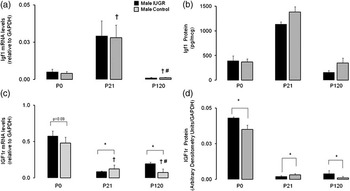
At P0, P21 and P120, IUGR did not alter male rat hippocamplal Igf1 mRNA transcript levels compared with age-matched male control rats (Fig. 1a). Consistent with Igf1 mRNA transcript data, IUGR did not change Igf1 protein abundance at any time point compared with age-matched male control rats (Fig. 1b).
IUGR alters IGF1r expression without altering Igf1 expression. Results are shown as mean ± s.e.m. for n = 6/group. IUGR did not alter male rat hippocampal Igf1 mRNA transcript (a) or forebrain protein abundance (b) when compared with age-matched male control rats at any time point examined. IUGR altered male rat hippocampal IGF1r mRNA transcript (c) and protein abundance (d) when compared with age-matched male control rats. At P0, IUGR increased male rat hippocampal IGF1r protein abundance when compared with age-matched male control rats (d). At P21, IUGR decreased male rat hippocampal IGF1r mRNA transcript (c) and protein abundance when compared with age-matched male control rats (d). Conversely, at P120, IUGR increased male rat hippocampal IGF1r mRNA transcript (c) and protein abundance (d) when compared with age-matched male control rats. †Different from P0 control (P < 0.05). Different from P21 control (P < 0.05). *Different from age-matched control (P < 0.05).

At P0, IUGR increased male rat hippocampal IGF1r mRNA transcript levels. This increase was not statistically significant compared with age-matched male control rats (P = 0.09; Fig. 1c). At P21, IUGR decreased male mRNA transcript levels (P < 0.05) compared with age-matched male control rats (Fig. 1c). At P120, IUGR increased hippocampal IGF1r mRNA transcript levels (P < 0.01) compared with age-matched male control rats (Fig. 1c).
At P0 and P120, IUGR increased male rat hippocampal IGF1r protein abundance (P < 0.01) compared with age-matched male control rats (Fig. 1d). In contrast, at P21, IUGR decreased male rat hippocampal IGF1r protein abundance (P < 0.05) compared with age-matched male control rats (Fig. 1d).
Histone modifications associated with the hippocampal IGF1r promoter
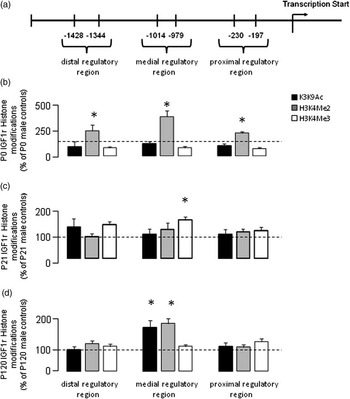
At P0, IUGR increased male rat hippocampal IGF1r H3K4Me2 accumulation in three segments of the promoter region: distal (−1428 to −1344 bp relative to transcriptional start (TS); P < 0.01), medial (−1014 to −979 relative to TS; P < 0.01) and proximal (−230 to −197 relative to TS; P < 0.01) compared with age-matched male control rats (Fig. 2a). At P21, IUGR decreased male rat hippocampal IGF1r H3K4Me3 accumulation in the medial promoter region (P < 0.05) compared with age-matched male control rats (Fig. 2b). At P120, IUGR increased male rat hippocampal IGF1r H3K4Me2 (P < 0.01) and H3K9Ac (P < 0.05) accumulation compared with age-matched male control rats (Fig. 2c).
IUGR alters accumulation of specific histone marks along IGF1r gene promoter. Result are shown as % of control ± s.e.m. for n = 4/group. Histone 3 lysine 4 acetylation (H3K9Ac; black bars), histone 3 lysine 4 dimethylation (H3K4Me2; gray bars), histone 3 lysine 4 trimethylation (H3K4Me3; white bars). (a) Schematic representation of the IGF1r gene showing the position of regions tested, relative to transcription start: distal regulatory region (−1428 to −1344), medial regulatory region (−1014 to −979) and proximal regulatory region (−230 to −197). (b) At P0, IUGR increases male rat hippocampal H3K4Me2 accumulation in all three IGF1r promoter regions tested, when compared with age-matched male control rats. (c) At P21, IUGR increases male rat hippocampal H3K4Me3 accumulation in the medial IGF1r promoter region when compared with age-matched male control rats. At P120, IUGR significantly increases male rat hippocampal H3K4Me2 and H3K9Ac accumulation in the medial IGF1r promoter region when compared with age-matched male control rats (c). *Different from age-matched control (P < 0.05).

Spatial memory with 10-s delays
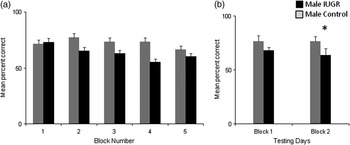
IUGR did not increase the number of testing days (eight trials per day) required for male rats to acquire the task compared with age-matched male control rats (9.5 and 8.8 in the IUGR and Control groups, respectively). At 10-s delay, IUGR did not change the acquisition of short-term working memory (WM) task (Fig. 3a). At 10-s delay, IUGR did not change the choice latency time when compared with age-matched male control rats (16 v. 27 s and 15 v. 20 s, in the IUGR and Control groups, respectively).
IUGR impairs adult male rats’ performances during an intermediate-term 5-min delay task. Choice accuracy results shows the % good choices made by of IUGR male rats compared with the % of good choices made by male control rats during the acquisition phase of spatial working memory paradigm on the eight-arm maze. (a) At 10-s delay, IUGR did not change the choice accuracy when compared with age-matched male control rats. The y-axis represents choice accuracy, or the percentage of correct choices expressed as IUGR % of age-matched male controls. On the x-axis, the six blocks represent a daily set of eight trails, or choices on the maze per day, per IUGR male rat. (b) At 5-min delay, IUGR significantly impaired male rat choice accuracy, when compared with age-matched male control rats. The y-axis represents choice accuracy, or the percentage of correct choice expressed as IUGR % of age-matched male control rats. On the x-axis, each block represents four days of testing with four 5-min delay trails per day per IUGR male animal. Controls (n = 5) and IUGR (n = 6). *Different from age-matched control (P = 0.05).

Spatial memory with 5-min delays:
IUGR significantly decreased male rat choice accuracy [F(1,10) = 8.143; P = 0.02] during the intermediate-term delay task (5-min delay) compared with age-matched male control rats (Fig. 3b). IUGR had no main effect on blocks of trials or choice latency.
Discussion
Our study has two major findings. First, IUGR alters male rat hippocampal IGF1r expression, as well as histone marks in the IGF1r promoter region, in a developmentally specific manner. Second, IUGR male rats present with learning and memory deficits as adults. These data demonstrate that an early prenatal insult such as IUGR affects gene expression, epigenetic characteristics and memory function into adulthood.
Our study is the first to report the effects of IUGR on hippocampal Igf1/IGF1r expression in an animal model. We demonstrated that Igf1 and IGF1r are expressed throughout life in the hippocampus of IUGR male rats. Decreased IGF1 mRNA in the whole brain of UPI-induced IUGR rats has been reported previously.Reference Lu, Liu and Li 46 Interestingly, our study did not find decreased hippocampal levels of IGF1 mRNA, suggesting that IGF1 regulation per se in the hippocampus is not sensitive to the IUGR insult. In contrast, IGF1r expression was altered throughout life. Other investigators have shown that increased IGF1r expression increases Igf1 signaling in vitro Reference Yamasaki, Prager and Melmed 47 and in vivo.Reference Pehar, O'Riordan and Burns-Cusato 48 , Reference Maier, Gluba and Bernier 49 In this study, we did not evaluate Igf1 signaling; however, exaggerated Igf1 signaling may be the result of increased hippocampal IGF1r expression in the adult male rat.
Changes in gene expression long after the intrauterine insult of IUGR can be attributed to epigenetics. Epigenetic regulation of gene expression is associated with multiple histone marks, and the interactions between multiple marks.Reference Vaissiere, Sawan and Herceg 50 – Reference Cheung, Allis and Sassone-Corsi 53 However, specific histone marks are often associated with specific changes in gene expression. For example, increased accumulation of H3K4Me2 and H3K9Ac are often thought of as ‘activating markers’ of gene expression.Reference Bloom, Giordani and Kwiatkowski 54 Indeed, in our study, increased H3K4Me2 and H3K9Ac are associated with increased IGF1r mRNA expression at P120. H3K4Me3 accumulation is also a mark commonly associated with gene activation.Reference Taverna, Ilin and Rogers 55 However, in our study, accumulation of H3K4Me3 was associated with decreased IGF1r mRNA expression at P21. In sum, although we did not show causality, we demonstrated that IUGR alters hippocampal IGF1r gene expression in association with specific changes in histone marks in the hippocampal IGF1r promoter throughout the life of male rats.
Several studies associated molecular changes in IGF1r with learning and memory impairment;Reference Pehar, O'Riordan and Burns-Cusato 48 , Reference Stenvers, Lund and Gallagher 56 however, none demonstrated this association in a model of IUGR. We identified specific hippocampal molecular changes and the degree of the associated learning and memory impairment in IUGR adult male rats. The results of our study provide evidence that adult IUGR males exhibit impaired intermediate-term spatial working memory. Moreover, evidence of this impairment was demonstrated even after 8 weeks of continuous testing, suggesting that spatial working memory deficits in IUGR male rats are long-lived. Computational models of hippocampal function have proposed that the dorsal CA1 subregion subserves intermediate-term spatial working memory. CA1-lesioned rats have deficits in working memory performance at intermediate, but not short-term, delays on the delayed non-match-to-place (DNMP) eight-arm maze, with no deficits in acquisition.Reference Lee, Hunsaker and Kesner 57 In addition, short-term spatial working memory is spared in rats with lesions or pharmacological disruption of the CA1 subregion on spontaneous object exploration paradigms and also in paradigms assessing short-term retrieval function (i.e. Hebb–Williams maze, contextual fear conditioning, eight-arm radial maze).Reference Lee, Hunsaker and Kesner 57 – Reference Vago, Bevan and Kesner 61 Thus, given these reports, the deficits shown in this study suggest an increased vulnerability of CA1 region of the male hippocampus to the IUGR insult.
Our study has limitations. P0 Igf1 protein results reflect levels in the forebrain, but not in the hippocampus.
The forebrain was used for Igf1 protein levels at P0 because the amount of tissue needed for the protein assay was high relative to the size of the hippocampus. Therefore, we chose to use the forebrain because it includes hippocampus, as well as the cortex. However, it is possible that the forebrain and hippocampal Igf1 levels could be different.
Another limitation is that the reported epigenetic changes in the IGF1r histone marks are limited to the promoter region. To further understand the epigenetic regulation of IGF1r gene, future experiments are needed to establish the histone mapping of downstream regions of IGF1r gene in the IUGR male hippocampus. Lastly, although our results suggest that altered hippocampal IGF1r expression may play a role in IUGR-associated cognitive dysfunction at adulthood, in this study we have not demonstrated causality. Our findings lay the groundwork for future, mechanistic studies in this regard. In conclusion, our study shows that a perinatal insult, UPI-induced IUGR, is associated with altered expression and epigenetic characteristics of the hippocampal IGF1r in male rats. In addition, we report novel evidence of spatial working memory deficits in adult IUGR male rats. We speculate that altered IGF1r expression in the IUGR male rat hippocampus may play a role in the cognitive dysfunction seen in our model.
Acknowledgments
Animal studies were performed in the Cognitive Neurobiology Lab of Raymond Kesner, PhD, in the Department of Psychology at the University of Utah.
Supplementary materials
The supplementary material referred to in this article is available online at http://www.journals.cambridge.org/doh