INTRODUCTION
Phoretic interactions are those in which one organism (the phorant) is transported mechanically by another (the host) of a different species, but without the two individuals being physiologically dependent on one another. Definitions of phoresy/phoresis have varied; modern definitions (e.g. Goater et al., Reference Goater, Goater and Esch2014) tend to be inclusive, with the interaction accepted to encompass everything from simple accidental transport to obligatory transport that is essential to life history. At the other extreme, Farish & Axtell (Reference Farish and Axtell1971) narrowly defined phoresy (in the context of studies on mites) as a ‘phenomenon in which one animal actively seeks out and attaches to the outer surface of another animal for a limited time, during which the attached animal (phoretic) ceases both feeding and ontogenesis, such attachment presumably resulting in dispersal from areas unsuited for further development, either of the individual or its progeny’. Here we favour the broader definition.
Phoresy has not been studied as extensively as other symbiotic interactions such as mutualism, commensalism and parasitism, all of which involve various types of physiological interaction, although it has been invoked as a mode of long distance dispersal for more than 150 years. Darwin (Reference Darwin1859) suggested that water birds dispersed freshwater plants and he also demonstrated experimentally that ducks were potential dispersers of freshwater snails. It has also been known since the early 20th Century that pseudoscorpions in Amazonia hitch rides on a variety of flying insects (see review of Aguiar & Bürnheim, Reference Aguiar and Bürnheim1998). Examples of marine phoresy include Columbus crabs (Planes minutus (L.)) and remoras (Echeneidae) actively attaching to sea turtles (Dellinger et al., Reference Dellinger, Davenport and Wirtz1997; Sazima & Grossman, Reference Sazima and Grossman2006). In these cases it is implicit that the phorant can leave its host (voluntarily or otherwise).
Amongst molluscs, phoresy has also been identified as a dispersal mechanism in small freshwater bivalves (Sphaeriidae) that have been shown to be transported by insects and salamanders (Darwin, Reference Darwin1882; Fernando, Reference Fernando1954; Davis & Gilhen, Reference Davis and Gilhen1982), apparently with no active involvement of the bivalves. Live cockles (Cerastoderma edule (L.)) are known to be occasionally transported by dunlin (Calidris alpina (L.)) in Europe; in this case the bivalves appear to have adducted their shell valves, trapping a digit of the bird concerned (Green & Figuerola, Reference Green and Figuerola2005). More familiar examples of molluscan phoresy include the short-range transport of barnacles by foraging limpets (hosts) and the attachment of Anomia ephippium (L.) (phorants) to shore crabs (Carcinus maenas (L.)). In these latter cases the sessile phorants (barnacles and saddle oysters, respectively) are attached permanently to the mobile hosts and are associated with them until death (or moulting in the case of crabs) intervenes; they are more commonly thought of as epifaunal fouling organisms because they have settled and metamorphosed on the hosts’ surfaces.
Here we describe a previously unreported relationship between juvenile nassariid whelks (Nassarius reticulatus (L.) (=Hinia reticulata) and/or Nassarius incrassatus (Ström) (=Hinia incrassata)) and the crab (Cancer pagurus (L.)). In this case both partners in the association were mobile.
METHODS
Our observations stemmed from a study of shallow-water marine scavengers at Lough Hyne, a small (0.8 × 0.6 km2) marine lake located (51°30′08.69″W 9°18′11.01″N) on the south-western coast of County Cork, Ireland. Scavengers are animals that feed upon carrion (dead or dying animals, or fragments thereof). Britton & Morton (Reference Britton and Morton1994) argue that most marine scavengers, which are attracted to carrion mainly by scent, are primarily predators that scavenge opportunistically because carrion is an unpredictable and ephemeral resource (although they accept that some nassariid gastropods approach being obligate scavengers). Cameras have been extensively used for several decades to study deep-water benthic scavengers (Bailey et al., Reference Bailey, King and Priede2007), but the emphasis has been upon identifying scavenger assemblages and most studies have involved time-lapse photography to permit long-term studies (days). We adopted a different approach, first using time-lapse video photography to study diurnal scavenging of relatively small items (single fish carcasses) over periods of a few hours in near-shore shallow water. The aim was to identify the composition of the scavenger assemblages (in terms of taxonomic makeup and numbers of scavengers) and determine their alterations with time. Second, continuous video photography was used to study short term (<1 h) behaviour of scavengers that were attracted to newly deployed fish baits. In this case the emphasis was on elucidating details of the behaviour of common scavengers.
Filming of scavengers took place between 2 July and 15 August 2006 in both the North and South basins of Lough Hyne at sites 16–18 m below low water. The apparatus used consisted of a fixed video camera (model Sony TRV950E) in a waterproof housing mounted on a metal frame 45 cm above a rectangular white acrylic sheet (60 × 55 cm2) that had a whole mackerel (Scomber scombrus L.) tied to it (by nylon ties 14 cm apart, which also provided a linear scale for subsequent video analysis) as bait. The camera was either set to record continuous footage (30 frames s−1), or time lapse (2 s every 30 s) footage; the dimensions of the field of view were 34.5 × 26 cm2. For a given site, the apparatus was deployed at about 9 am by scuba divers and retrieved about 8 h later. The camera recorded for about 1 h (continuous footage) or about 7.5 h (time-lapse) from the start of deployment before the videotape was fully used. Continuous and time-lapse filming was conducted twice at each site on successive days. Film was transferred from tape to a PC for analysis and analysed by repeated playback. Dimensions of animals and speeds of movement were measured using the Motion Analysis Tools software package (Ottawa Hospital Rehabilitation Centre, Ottawa, Canada).
RESULTS
The first scavengers to appear at the bait (within seconds/minutes) were swimming forms. At the North Basin site these were always fish (either shannies (Lipophrys pholis (L.)) or gobies (Pomatoschistus minutus Pallas)), but at the South Basin site, swimming crabs (Liocarcinus depurator (L.)) were the first arrivals, although fish arrived shortly afterwards. These swimming forms were shortly (minutes) joined by fast-moving, crawling portunid crabs, Carcinus maenas (L.) and/or Necora puber (L.). After tens of minutes, juvenile whelks appeared during some deployments (always the first of deployment pairs). The whelks were only 2–4 mm in shell length, but substantially larger than newly metamorphosed animals, which are about 0.8 mm in length (Lebour, Reference Lebour1931). Their siphons could be clearly seen (Figure 1), so there was no doubt that they were all whelks rather than other types of gastropod. However, they could not be identified directly from the video footage. In consequence, scuba divers put down mackerel bait at the South Basin site and collected similarly sized specimens of the whelk Nassarius reticulatus (=Hinia reticulata). However, the closely related Nassarius incrassatus (=Hinia incrassata) is also present within Lough Hyne (C. Little, personal communication), and therefore it is not possible to exclude the possibility that the observed juveniles were drawn from both species. Mostly they crawled around the area surrounding the bait, but a few climbed over the bait itself. Field-by-field analysis showed that some individuals ceased moving for periods (minutes) when they were in contact with scraps of fish flesh; we interpret this as feeding, although the whelks were too small for proboscides to be visible. Ten haphazardly selected whelks moved at a mean speed of 1.24 (SD 0.392) mm s−1.
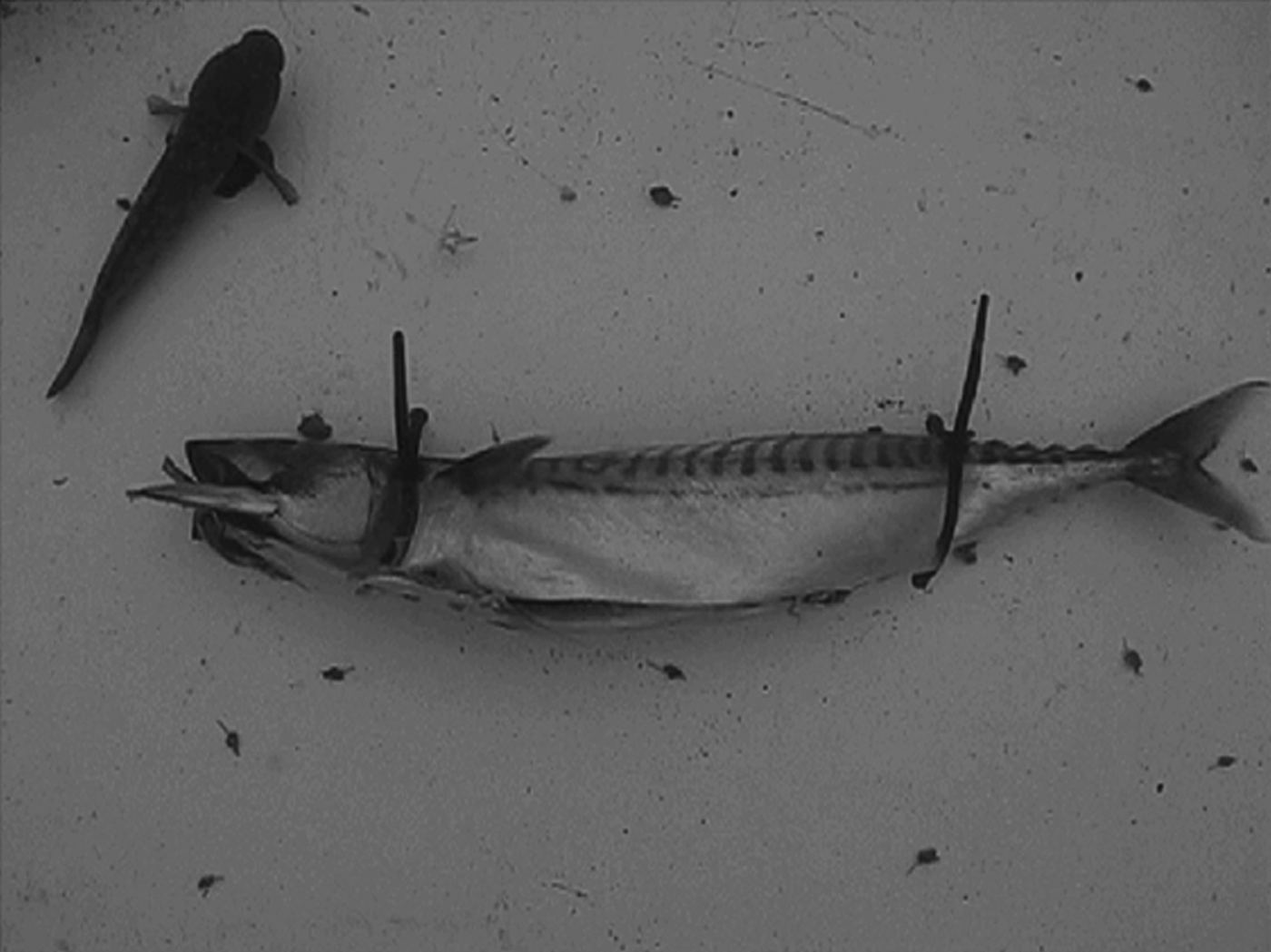
Frame taken from South Basin (16–18 m depth) time-lapse footage to show numerous juvenile whelks (Nassarius reticulatus or Nassarius incrassatus) around a mackerel bait. Note that the whelks all have extended siphons, indicating food-searching behaviour.

Eventually (tens of minutes to hours after bait deployment), larger scavengers (usually single) arrived, eating substantial quantities of mackerel flesh and often completing bait consumption before the end of the filming period. Large scavengers included the spider crab Maja squinado (Herbst), the starfish Marthasterias glacialis (L.) and the catshark/dogfish (Scyliorhinus canicula (L.)). However, the most common large scavenger was the crab Cancer pagurus (L.).
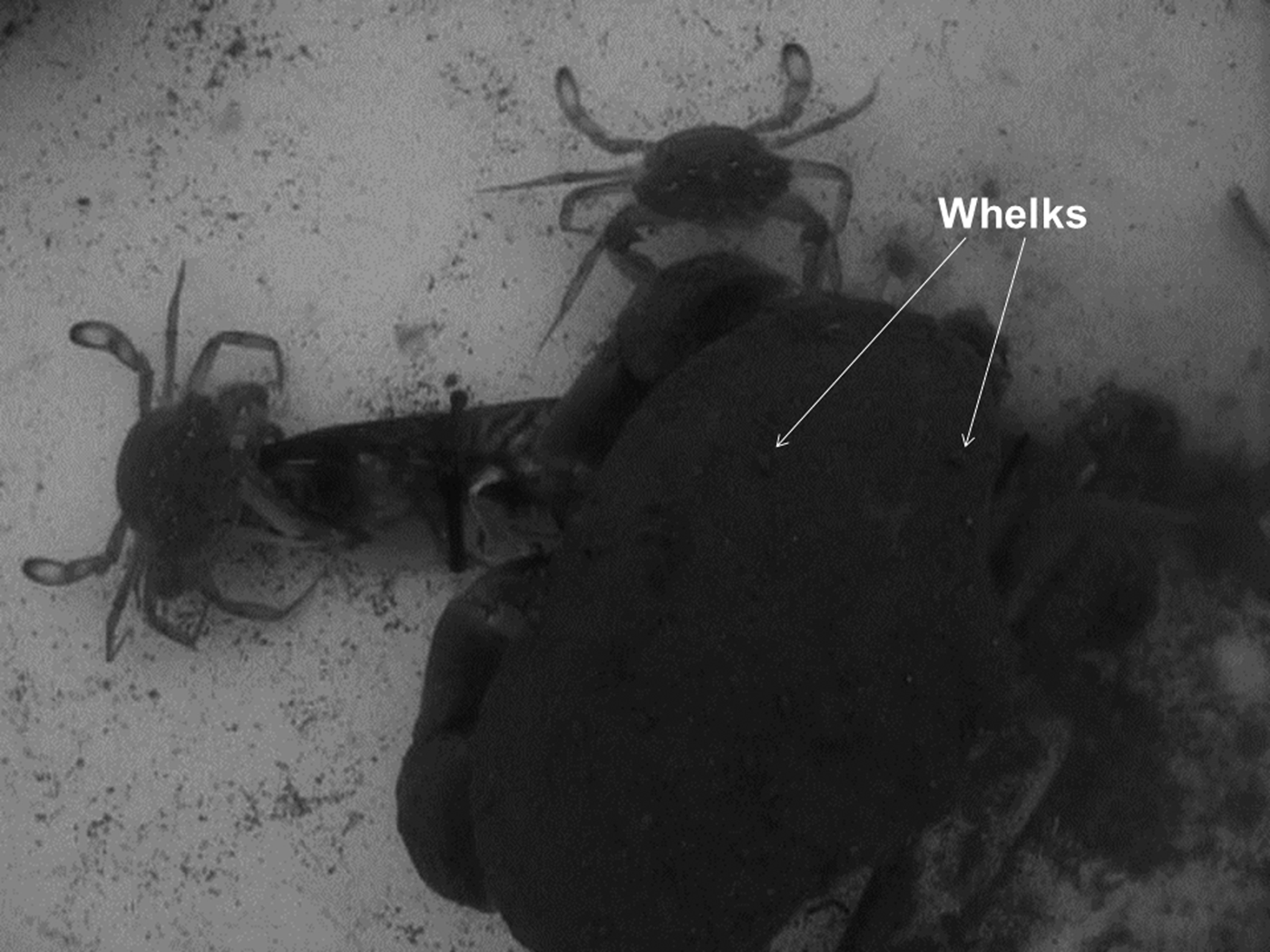
In the North Basin continuous footage of an individual C. pagurus (L.) of carapace width 197 mm entered the field of view about 21 min after bait deployment. The dorsal carapace, covered in fine silt, carried 24 juvenile Nassarius spp. that were moving around the carapace surface (Figure 2). At this time there were no other whelks within the field of view. There were no whelks on any of the crab's walking legs or chelipeds. During the crab's 6.8 min feeding bout (which generated clouds of mackerel fragments, some of which drifted over the carapace surface), the whelks continued moving; three of them fell off and were seen after the crab left. In consequence of this observation, all continuous and time-lapse C. pagurus (L.) sequences (nine in total) were inspected; no other phorant whelks were seen. Notably, a C. pagurus (L.) individual feeding in the South Basin showed no phorant whelks despite large numbers being present around the bait; this suggests that whelks do not climb aboard mobile crabs. C. pagurus (L.) entering the field of view (N = 5) were moving at a mean speed of 48.7 (SD 16.9) mm s−1. No phorant whelks were observed on any other species of foraging crab.
Frame taken from North Basin (16–18 m depth) continuous footage to show scavenging specimen of Cancer pagurus carrying numerous juvenile whelks (Nassarius sp.) on the dorsal surface of the carapace. Two whelks are indicated with white arrows.
DISCUSSION
Nassarius reticulatus has attracted significant study of its feeding and reproductive biology (Lebour, Reference Lebour1931; Crisp et al., Reference Crisp, Davenport and Shumway1978; Tallmark, Reference Tallmark1980; Davenport & Moore, Reference Davenport and Moore2002). There appears to be no evidence that adult N. reticulatus eat anything other than carrion and they remain buried close to the surface of muddy sediments between feeding bouts, thereby meeting the requirements of a sedentary obligate scavenger as envisaged by Ruxton & Houston (Reference Ruxton and Houston2004). However, Tallmark (Reference Tallmark1980) found that young N. reticulatus were probably feeders on organic-rich detritus in shallow Swedish waters. In our study, juvenile whelks clearly consumed carrion scraps. They were only seen during the first of pairs of time-lapse deployments. This is probably because the whelks eat huge meals in relation to their body size and are then unresponsive to the smell of carrion for several days (Crisp et al., Reference Crisp, Davenport and Shumway1978; Davenport & Moore, Reference Davenport and Moore2002). Baits were deployed in the same spot at 24-h intervals and it is probable that all juvenile whelks in the area were satiated during the first deployment.
Cancer pagurus is known to be an active and versatile predator on other crabs, mussels and clams (MarLIN, n.d.). It is mainly nocturnal, often burying itself in soft sediment, and it will take time to emerge and walk to the carcass. Telemetry has shown that edible crabs can forage as much as 50 m from their hiding places (Skajaa et al., Reference Skajaa, Fernö, Løkkeborg, Haugland, Lagardère, Bégout Anras and Claireaux1998), and therefore transit over such a distance to scavenging sites is likely to take several minutes – at least 15–20 min (assuming straight-line movements and immediate reactions to olfactory cues) at the speeds recorded here.
Phoresy is inherently difficult to study because it is rare for the phorant to be seen ‘boarding’ its host, as is the case here. Phoresy can be common, for example barnacles attaching to limpets, but is often an uncommon event; Green & Figuerola (Reference Green and Figuerola2005) found that only four individual wading birds out of 17,000 sampled carried live cockles on their feet. We do know how often C. pagurus in Lough Hyne carry hitch-hiking juvenile whelks on their backs; however, it is possible to envisage how they come to be aboard. First, both whelk species have planktotrophic larvae (Lebour, Reference Lebour1931) that metamorphose into 0.8 mm-long snails, and therefore it is not feasible that the whelks settle onto C. pagurus individuals and remain there as fouling organisms until they reach sizes of 2–4 mm. Second, C. pagurus individuals move more quickly than juvenile whelks (by a factor of 39 according to our observations). It is therefore most unlikely that crabs can be boarded when in motion, and attachment must occur when the crab is stationary. Cancer pagurus and N. reticulatus commonly bury in soft sediments between foraging bouts. Juvenile whelks are attracted to organic-rich sediments (Tallmark, Reference Tallmark1980) and N. reticulatus is also attracted by the odour of crabs (Davenport & Moore, Reference Davenport and Moore2002). It is therefore likely that the phorant whelks had accumulated in thin layers of sediment (a few mm deep) on top of the carapace of the resting host crab; they were simply raised and carried away when the crab emerged from the sediment to travel towards the mackerel bait.
Goater et al. (Reference Goater, Goater and Esch2014) point out that categories of relationships such as phoresy, commensalism and mutualism are often not clear-cut. It is evident that the C. pagurus host gained nothing by carrying the whelks; however, might the juvenile whelks have gained metabolically, thus indicating a commensal rather than phoretic relationship? This is difficult to answer definitively. When the crab was feeding, a cloud of mackerel scraps enveloped it and some of the whelks may have fed upon these, but this could not be either confirmed or denied given their small size and the quality of film collected. Most appeared to be in constant motion, which suggests that phoresy (sensu lato) was the more likely category of association.