Introduction
Hearing is one of the vital sensations of the body. Whenever such a sensation is lost, life loses its charm. Chronic suppurative otitis media (CSOM) is one of the most common treatable causes of hearing loss. The mainstay of treatment is surgical repair known as myringoplasty or type 1 tympanoplasty. Most of the textbooks advocate middle-ear packing post-grafting as an essential step of surgery. The primary purpose of this is to provide support to the tympanic membrane and ossicular grafts, aerate the middle-ear cavity, and help in haemostasis.Reference Joseph1–Reference Krupala, Gianoli and Smith3 It is requisite that packing material is biocompatible, safe for the patient and does not cause any mucosal reaction, which could otherwise compromise middle-ear ventilation.Reference Joseph1 Ideally it should also be conformable in the tympanic cavity and maintain the graft stability for an adequate time, which is required for healing. Various materials that have been used for middle-ear packing are Gelfoam®, Gelfilm®, Sepragel®, Seprafilm® and MeroGel® as examples.Reference Shen, The, Friedland, Eikelboom and Atlas4
Absorbable gelatin sponge (gelfoam) is the most frequently used middle-ear packing material worldwide.Reference Hellstrom, Salen and Stenfors5 It acts as a scaffolding material to support the tympanic membrane and the ossicular chain in middle-ear surgery. The use of gelfoam was pioneered by Correll et al.Reference Correll, Prentice and Wise6 in 1945. They manufactured it from denatured porcine skin. Initially it was treated as an absorbable haemostatic material in neurosurgery; later its use in otological surgical procedures was initiated by ZollnerReference Zollner7 and Wullstein.Reference Wullstein8 Gelfoam has many desirable properties such as non-antigenicity, non-toxicity, biocompatibility, good tolerance and ease of handling.Reference Shen, The, Friedland, Eikelboom and Atlas4,Reference Correll, Prentice and Wise6,Reference Ohsaki and Saito9 Although gelfoam is regularly used, many adverse side effects, such as fibrosis, tympanic membrane retraction, connective tissue hyperplasia and hearing loss have been reported.Reference Shen, The, Friedland, Eikelboom and Atlas4 In spite of these findings, many surgeons still prefer to use gelfoam for medial support to graft as chances of success might otherwise be reduced for tympanoplasty.Reference Shen, The, Friedland, Eikelboom and Atlas4
In order to avoid middle-ear packing, several studies have tried different options for graft support, such as use of fibrin glueReference Sakagami, Yuasa and Yuasa10 and cyanoacrylate glue,Reference Li, Lianga, Cheng, Zhanga, Rena and Shenga11 to stabilise the graft without packing the middle ear. Such techniques showed good graft take up rate along with immediate hearing improvement. We were doing surgical procedures in our hospital using a modified type 1 tympanoplasty techniqueReference Rastogi, Pandit and Vasamsetty12 without middle-ear packing and were getting good results. A review of the literature did not indicate any findings which compared the results of tympanoplasty with and without gelfoam packing in the middle ear objectively and subjectively. The purpose of this study was to compare the outcomes of type 1 tympanoplasty with and without gelfoam in the middle ear.
Research question
We asked whether gelfoam packing in the middle ear for graft support was an essential step for success of type 1 tympanoplasty. We made a null hypothesis that use of gelfoam significantly improved the graft uptake rate in type 1 tympanoplasty when compared with non-placement of gelfoam in middle ear. Our alternate hypothesis would be that both techniques (gelfoam packing or no gelfoam packing) gave equal results in graft uptake.
Aims
Our primary aim was to compare the graft uptake with and without gelfoam in the middle ear during tympanoplasty type 1 at the one and three month follow up. Our secondary aim was to compare post-operative gain in hearing at one month and three months by two techniques of type 1 tympanoplasty.
A visual analogue scale was used to compare the subjective improvement in hearing, heaviness (occlusive feeling) and overall satisfaction post-surgery at one and three months in both groups.
Materials and methods
The design of this study was a prospective randomised comparative study. It was carried out in the otorhinolaryngology department of a secondary care industrial hospital. All the patients requiring type 1 tympanoplasty between September 2017 and August 2019 were included in this study. Ethical committee clearance and informed consent from patients were obtained. The purpose of study was explained to patients and confidentiality was ensured.
Patients aged between 18 and 50 years who required type 1 tympanoplasty as a treatment for their inactive mucosal type CSOM were included in the study. Patients with a history of previous surgery, trauma to the ear, unsafe disease, and an air–bone gap (ABG) greater than 40 dB which is suggestive of ossicular pathology, mixed or sensorineural hearing loss, and cleft palate were excluded from the study.
A detailed patient history was taken, and clinical examination was performed for each patient. Pure tone audiometry was performed pre-operatively. The average ABG was calculated at a frequency of 500 Hz, 1000 Hz and 2000 Hz. Type 1 tympanoplasty was performed by underlay technique using temporalis fascia graft taking all aseptic precautions under general anaesthesia or monitored anaesthesia using a single surgeon.
In terms of surgical technique, the tympanic annulus was raised 360 degrees and graft was placed sandwiched between the bony canal wall and tympanomeatal flap. Special care was taken to rule out any ossicular pathology in any patient during surgery. All patients were discharged on post-operative day 3, stitch removal was performed on post-operative day 7 and canal pack was removed on post-operative day 10. Post-operatively, graft uptake was observed at one and three months by microscopy. Hearing assessment by pure tone audiometry and subjective assessment by questionnaire with visual analogue scale (VAS) score was performed at one and three months. Results were noted for assessment.
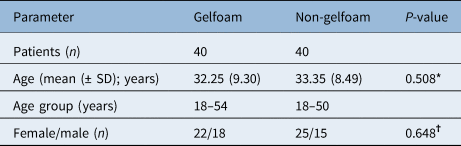
The study included a total of 80 patients, with 40 patients in each group (Table 1). Patients requiring type 1 tympanoplasty were randomly allocated by computer generated random number table into 2 groups: a gelfoam group, where gelfoam packing of the middle ear was performed, and a non-gelfoam group, where no middle-ear packing was performed. Patients were blinded regarding the type of surgical procedure.
Patient demographic data for gelfoam and non-gelfoam groups

*Student t-test; †chi-square test SD = standard deviation
Statistical methods
The collected data were entered in Microsoft Excel® spreadsheet software and later imported into the SPSS® statistical software (version 16) for analysis. Data were presented as mean with standard deviation or proportions as appropriate. Student's unpaired t-test was used as a statistical tool to test for significance of observed mean differences of age. Qualitative data were analysed using the chi-square test. Repeated measures analysis of variance was performed to compare the ABG change between the groups and within groups. The within group p-value was adjusted as per the Bonferroni corrections. Finally, the calculated value was compared with the tabulated value at a particular degree of freedom, and the level of significance was calculated. A p-value less than 0.05 was considered significant.
Observations
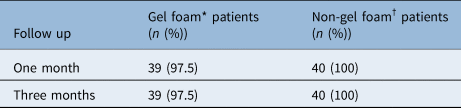
We used the chi-square test, which gave χ2cal = 0.0253 (at 95% confidence limit, with degree of freedom = 1, χ2 tab = 3.841) and χ2cal < χ2tab (0.0253 < 3.841) at 5 per cent level of significance. There was no significant difference between the success rates of two techniques (gelfoam and no gelfoam), and both techniques gave equal results. Therefore using gelfoam was not essential for success in type 1 tympanoplasty.
Hearing improvement
Patients were followed up with audiometry at one and three months. The average ABG or gain in hearing in the gelfoam and non-gelfoam groups were calculated.
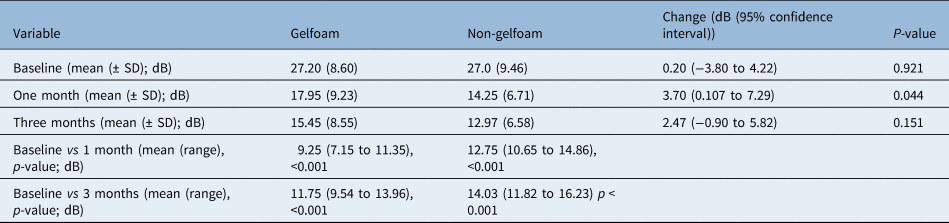
The repeated measures analysis of variance was applied to assess the between and within comparison for ABG. Bonferroni adjustment was performed on the p-value for within group comparison. The interaction between the follow-up time and group was found to be statistically significant and showed that the pattern of ABG between the groups varies according to the time of follow up.
There was no significant difference between the ABG or hearing gain between non-gelfoam and gelfoam groups at baseline and at three months; however, at one month the ABG or gain was statistically significant. The difference was 3.47 (95 per cent confidence interval, 0.107–7.29). There was a significant change in ABG from baseline to follow up at one and three months. The improvement in ABG was higher in the non-gelfoam than the gelfoam group.
In both the groups, there was a significant difference between the baseline and subsequent follow-up time points. However, between the groups, there was only a statistically significant difference at one month.
Subjective evaluation
Several questions were used for subjective evaluation of patients. Question 1 was ‘Do you feel ‘some improvement’ in hearing after surgery?’ All 80 patients responded affirmatively, showing that they perceived some improvement in their hearing.
Question 2 was ‘Are you happy with hearing improvement or do you feel ‘significant hearing improvement’ after surgery?’ In order to analyse the data from this question, we used the proportion test (chi-square test), at the 95 per cent confidence limit, with degree of freedom = 1, χ2 tab = 3.841, χ2cal > χ2 tab at 5 per cent level of significance. There was a statistically significant difference among the patients according to hearing gain after one month, with a p-value less than 0.05. However, statistically, there was no significant difference among the patients according to hearing improvement after three months with p > 0.05.
Question 3 was ‘Do you feel uncomfortable with occlusive feeling or is there heaviness in ear?’ In order to analyse the data from this question, we used the proportion test (chi-square test), at the 95 per cent confidence limit, with degree of freedom = 1, χ2 tab = 3.841, χ2cal > χ2 tab at 5 per cent level of significance. Therefore, there was a statistically significant difference among the patients according to heaviness or discomfort after one month with p < 0.05. However, statistically, there was no significant difference among the patients according to heaviness or discomfort after three month with p > 0.05.
Heaviness in the ear was found more in the gelfoam group than the non-gelfoam group, but this difference decreased as the time passed.
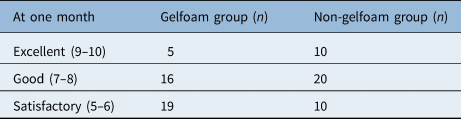
Question 4 was: ‘Are you satisfied with the results of surgery? Please rate your satisfaction on number line (0-10)' (VAS).
Happier patients were found in the non-gelfoam group both at one month and three months after surgery.
Results
There was no significant difference between graft uptakes of the two techniques. Hearing improvement was better in the non-gelfoam group in the early post-operative period. A feeling of heaviness was more pronounced in the gelfoam group early in the post-operative period. VAS score showed better acceptance of the procedure in the non-gelfoam group.
Discussion
Graft uptake
This study was done to analyse whether gelfoam packing of the middle ear had any bearing on success of tympanoplasty, thereby ascertaining whether packing of the middle-ear cavity with gelfoam was really an important step in tympanoplasty. The success of tympanoplasty was measured on the basis of graft uptake rate and hearing improvement.Reference Malhotra, Malhotra, Varshney, Priya, Bhardwaj and Tyagi13 The main purpose of using gelfoam is to support the newly placed graft which is held in its place by the surface tension force, keeping it affixed to tympanic membrane remnant for its epithelisation. Otherwise, the graft usually tends to fall down in the middle ear because of negative middle-ear pressure. Gelfoam packing endures this force by supporting it from the medial side and thus helping the graft to remain in position closely approximated to tympanic membrane remnant.Reference Shen, The, Friedland, Eikelboom and Atlas4
Li et al.Reference Li, Lianga, Cheng, Zhanga, Rena and Shenga11 looked at diverse surgical techniques that had been used by different surgeons to increase graft support to prevent its medial displacement. The different techniques were: (1) positioning of an anterior tab flap using lateral tension from an anterior tunnel under the tympanic annulus (Primrose and KerrReference Primrose and Kerr14), (2) using two anterior tunnels for graft stabilisation (Gristwood and VenablesReference Gristwood and Venables15) and (3) an anterosuperior anchoring technique that positioned the graft lateral to the malleus handle and medial to the external auditory canal (Hung et al.Reference Hung, Knight and Sankar16). Li et al. used a modified version of the Hung et al. technique of anterosuperior anchoring with graft placed lateral to the handle of the malleus with use of cyanoacrylates glue to avoid putting gelfoam in the middle ear. We performed a modified type of myringoplasty in which we performed a modified Rosen's incision, raised the tympanic annulus 360 degrees and placed the graft by underlay technique between the bony external auditory canal and tympanic remnant. This technique was detailed in another article by Rastogi et al. in 2018.Reference Rastogi, Pandit and Vasamsetty12
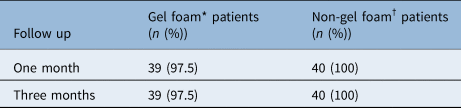
Graft uptake rate ranges from 60 to 100 per cent in different studies and usually depends on surgeon and patient factors.Reference Malhotra, Malhotra, Varshney, Priya, Bhardwaj and Tyagi13 In our study, the observed graft uptake rate was 97.5 per cent in gelfoam and 100 per cent in non-gelfoam groups, respectively (Table 2). One patient in the gelfoam group got otitis media on the 18th post-operative day resulting in a small residual perforation which persisted even after three months. In a comparative study by Ghiasi and TootonochiReference Ghiasi and Tootonochi17 a graft uptake rate of 71.1 per cent was found in tympanoplasty with gelfoam, and a rate of 62.2 per cent in tympanoplasty was found without gelfoam. The authors concluded that since the difference was not significant, packing with gelfoam was not an essential step for success of tympanoplasty. In a comparative study by Kim et al.,Reference Kim, King, AL-Swiahb, Park, Jeong and Kim18 graft uptake rates of 99.1 per cent and 99.2 per cent were found in the gelfoam and non-gelfoam groups, respectively. At a 6 month follow up, the graft uptake rate was 87 per cent in the glue group without gelfoam and 89 per cent in the control group with gelfoam.Reference Li, Lianga, Cheng, Zhanga, Rena and Shenga11
Graft uptake result
* n = 40; †n = 40
Hearing gain
Li et al.Reference Sakagami, Yuasa and Yuasa10 obtained a hearing gain (median) of 7.2 dB and 8.8 dB in the non-gelfoam and gelfoam groups, respectively. Furthermore, there was no statistical difference in hearing gain between the two techniques at six months post-surgery.Reference Li, Lianga, Cheng, Zhanga, Rena and Shenga11 In our study, there was gain in hearing level of 9.25 dB and 12.75 dB at 1 month in the gelfoam and non-gelfoam groups, respectively (Tables 3 and 4). The difference between the two groups was statistically significant. However, at three months, the gain was 11.75 dB and 14.03 dB in the gelfoam and non-gelfoam groups, respectively, which was not statistically significant. Similar findings were noted by Kim et al.Reference Kim, King, AL-Swiahb, Park, Jeong and Kim18 in their study in which the difference in hearing gain between the two groups became non-significant after three months from surgery. This suggested that gelfoam placement caused conductive hearing loss in the early post-operative period which improved with time as the gelfoam was absorbed in the middle ear. It was shown by Feghali et al. that gelfoam packing in the middle ear of guinea pigs led to 30 to 40 dB temporary conductive hearing loss which recovered within 4 to 6 weeks.Reference Li, Feghali, Dinces, McElveen and van de Water19 In a clinical trial, Cho et al.Reference Cho, Lee, Hong, Chung, Min and Hwang20 evaluated 17 patients with gelfoam in their middle-ear cavity and external auditory canal after middle-ear surgery and found that packing resulted in conductive hearing loss of up to 38.7 dB on the second day and 29.2 dB 2 weeks post-operatively.
Between and within comparison of air–bone gap or hearing gain

SD = standard deviation
Improvement in hearing at one and three months

SD = standard deviation
Subjective improvement of symptoms
Sometimes, even with graft uptake, many patients were not satisfied with hearing improvement and overall satisfaction. Although many studies have evaluated the success of CSOM surgery by comparing objective findings in the literature, there are few reports on subjective hearing improvement after middle-ear surgery.
In our study, we presented four simple questions regarding the outcome of surgery to the patients and evaluated the results. To the first question, all the 80 patients recognised that there was ‘some hearing improvement’ after surgery including one patient in the gelfoam group who had residual perforation. This suggested that patient hearing improved with tympanoplasty and that patients subjectively felt this improvement. With regard to question 2 on hearing improvement, it was observed that at 1 month there were 20 patients in the gelfoam group and 30 patients in the non-gelfoam group who said that their hearing had improved significantly, and at 3 months, 34 patients in the gelfoam group and 38 patients in non-gelfoam group said that their hearing had improved significantly (Table 5). This inference could also be correlated with an objective test. This question was presented to differentiate whether improvement was up to the patients' expectations or not. Patients in the non-gelfoam group felt an early improvement in their hearing whereas in the gelfoam group they showed late improvement in their hearing probably because of conductive hearing loss caused by gelfoam in the middle ear. The same trend was shown in objective assessment of hearing.
Patients indicating significant hearing improvement post-surgery

Post-operatively, many patients had complaints of ‘occlusive feeling or heaviness’ in the operated ear. This feeling was more pronounced in the gelfoam group compared with the non-gelfoam group. This result also suggested that gelfoam in the middle ear produced a feeling of heaviness in the ear which improved with time as the gelfoam was absorbed. After three months there was not much difference in heaviness between the two groups (Table 6).
Patients indicating occlusive feeling or heaviness in the ear post-surgery

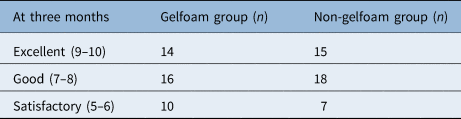
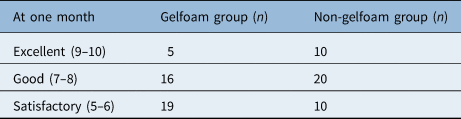
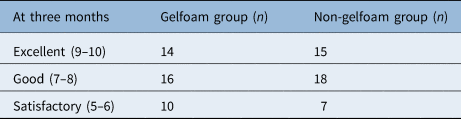
While evaluating patients for overall satisfaction using the VAS score, patients in the non-gelfoam group fared better when compared with the gelfoam group. Our result suggested that patients were more satisfied where no gelfoam was used (Tables 7 and 8). This could be because of the cumulative effect of early hearing improvement and less discomfort or heaviness in the non-gelfoam group. Therefore, gelfoam packing should be avoided as far as possible.
Satisfaction from surgery at one month follow up measured by visual analogue scale score
Satisfaction from surgery at three month follow up measured by visual analogue scale score
Aihara et al.Reference Aihara, Ohyama, Ushio, Kamio, Sakuma and Ohkawara21 investigated hearing level, ear symptoms and satisfaction with surgery outcomes for 212 patients who underwent tympanoplasty in a study using a questionnaire-based survey. They observed hearing improvement in 89 per cent of the patients by evaluating with pure tone audiometry, but only 63.2 per cent of patients were aware of the hearing improvement. This suggested that not all patients who showed hearing improvement objectively could perceive their improvement subjectively. Baba et al.Reference Baba, Fujikura, Pawankar and Yagi22 reported that pure tone average and VAS scores of patients who defined their hearing as ‘improved’ displayed a good correlation. They considered that an approach using both objective criteria and the patient's perspective in the evaluation of post-operative hearing, especially using VAS, was particularly helpful. In another study, Baba et al.Reference Baba, Yagi and Fujikura23 used a 0–100 mm non-graduated VAS scale and obtained a score of 90 mm or more in those whose hearing was ‘much improved,’ regardless of their hearing level before the operation, and reported that subjective hearing gain after the operation coincided with satisfaction with the surgery. A pure tone average equal to or more than 10 dB improvement was obtained in 91 patients (61.9 per cent) in their study. Similarly, 83 patients were aware of their hearing improvement. There was therefore a concordance between objective and subjective evaluation of hearing improvement for patients following surgery.Reference Baba, Yagi and Fujikura23
In the present study, there was also a predictive correlation between amount of hearing improvement and satisfaction with higher VAS values. Any technique that improved both objective assessment and subjective assessment of hearing is much better than a technique showing improvement in only one assessment. Therefore, one can conclude by stating that although middle-ear packing objectively showed similar tympanoplasty results to no packing in the long term, it causes more problems for the patient when compared with not using it. Hence, middle-ear packing with gelfoam should not be a norm but should be used on its merits when necessary.
• Middle-ear packing with gelfoam has been considered essential for tympanoplasty and other middle-ear surgery for graft support
• This study suggests that results of both graft uptake and hearing improvement are equal with and without gelfoam
• Gelfoam used as packing material in the middle ear causes early conductive hearing loss and other symptoms
• Middle-ear packing with gelfoam should not be an essential step but should be used at the discretion of the surgeon
The limitations of this study are that the sample size was small, and the population size was chosen according to our hospital case prevalence. Further studies with a greater number of patients should be undertaken to prove our results conclusively. Studies with larger sample sizes are needed, and multi-centre studies are always better than single-centre studies.
Conclusion
Gelfoam use in middle-ear packing is not an essential step in ear surgery, and it should be a surgeon's choice to use it on its merits when necessary. Patients remained more comfortable when the middle ear was not packed with gelfoam.
Competing interests
None declared