Introduction
Acquired brain injury (ABI) represents an enormous health problem with related social challenges worldwide. In Australia, at least 1 in 45 people are living with ABI and associated activity limitations or participation restrictions (AIHW, 2007). Further almost three-quarters of these people are aged less than 65 years and experience the ongoing challenges of adjustment to chronic disability. The vast scope of this health problem means that we have many sources of experience to draw upon in order to inform our understanding of factors that can facilitate and act as barriers to positive outcomes for people living with ABI. These rich sources of experience are held by people with brain injury themselves, their families, their friends, peers at school or work, health professionals who work with them across the rehabilitation continuum, researchers who explore problems and look for solutions, service providers, support workers, advocates, and policy-makers. The aim of this paper is to reflect on essentials of outcome and some of the things that help and the things that get in the way as they have been identified by the experience of people across these contexts.
Personal Perspectives on Outcome
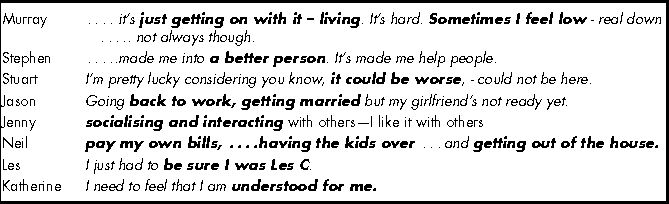
Outcome is defined with varied emphases from each of the perspectives involved but the most powerful renditions of a ‘good’ outcome are best accessed through conversations with people with brain injury. Table 1 presents a sample of outcome definitions as described by people with brain injury who have participated in research exploring life after injury. These descriptions capture various features considered central to each individual's post-injury experience and together provide important insights into the construct of outcome. Murray (Douglas, Reference Douglas2002) frames outcome as ‘just getting on with it’ and he acknowledges that getting on with living after brain injury can be ‘hard’ and at times associated with feeling ‘down’. Stephen (Douglas, Reference Douglas2013) casts a positive light on his outcome by framing his accident and its consequences as making him a ‘better person’ who has developed altruistic goals to ‘help people’. Stuart (Douglas, Reference Douglas2013) on the other hand considers his outcome comparatively as ‘lucky’ because the alternative could be ‘worse’ and indeed as bad as death.
Personal Perspectives on Outcome from People with ABI

Note: Participants’ quotes from Douglas (Reference Douglas2002, Reference Douglas2013) and Douglas and Spellacy (Reference Douglas and Spellacy2000).
Jason (Douglas, Reference Douglas2013) focuses on two important outcome ingredients, meaningful occupation (back to work) and personal relationship (getting married). Jenny (Douglas, Reference Douglas2013) continues the social relational theme by emphasising the significance of interpersonal activity through ‘socialising and interacting with others’. Neil (Douglas, Reference Douglas2013) too singles out the relational domain of outcome and captures the role of family when he talks about ‘having the kids over’. He also expands the activity domain to include everyday activities like ‘pay[ing] bills’ and ‘getting out’. Les (Douglas, Reference Douglas2002) and Katherine (Douglas & Spellacy, Reference Douglas and Spellacy2000) expand the lens of outcome to include the existential notions of self and identity.
Through the voices of these eight survivors of brain injury, we can identify multiple components of getting on with living (e.g., emotional, relational, occupational, existential) and also see how personal nuance characterises outcome experience. These components and their significant contributions to life after brain injury have also been revealed within numerous outcome studies employing both cross-sectional and longitudinal designs.
Self in the Context of Getting on with Living After Brain Injury
I'm a family person, I like dancing and the gym, I'm active and I don't like bad attitudes and being against people you care about. My favourite colour is purple.
Samantha (Douglas, Knox, De Maio, & Bridge, Reference Douglas, Knox, De Maio and Bridge2014).
Self-concept is a multidimensional, internal representation of the individual (Morf, Reference Morf2005). It is seen as a dynamic knowledge structure (Stein & Markus, Reference Stein and Markus1996) which shapes our behaviour, affects the way we process information about ourselves, influences our choice of goals and motivation, affects how we relate to others and provides existential meaning. Shaddon, Hagstrom, and Koski (Reference Shaddon, Hagstrom and Koski2008) give us a beautiful image of the self when they describe it as the unique product of the individual's own specific walk through life.
More than 30 years ago, Tyerman and Humphrey (Reference Tyerman and Humphrey1984) were the first to report on changes in self following traumatic brain injury (TBI) when they described significant negative discrepancy between post- vs. pre-injury ratings of self concept in 25 participants who were attending rehabilitation between 2 and 15 months after sustaining mild – very severe TBI. Nochi (Reference Nochi1998) later captured this negative discrepancy as a loss of self theme in his qualitative work and found that it was accompanied by poor social integration. Loss of self has also been associated with emotional dysfunction (Cantor et al., Reference Cantor, Ashman, Schwartz, Gordon, Hibbard, Brown and Cheng2005), low subjective quality of life (Vickery, Gontovsky, & Caroselli, Reference Vickery, Gontovsky and Caroselli2005) and poor occupational adaptation (Klinger, Reference Klinger2005). Themes reflecting the importance of the recovery of self and reconstruction of self-identity after brain injury have emerged from survivors’ narratives reported across a number of qualitative studies ranging from single cases (Sabat, Moodley, & Kathard, Reference Sabat, Moodley and Kathard2006) to case series (Nochi, Reference Nochi2000), group studies (Chamberlain, Reference Chamberlain2006; Knox, Douglas, & Bigby, Reference Knox, Douglas and Bigby2017) and a metasynthesis of qualitative research published between 1965 and 2009 (Levack, Kayes, & Fadyl, Reference Levack, Kayes and Fadyl2010).
Given the central role of self in shaping life after brain injury, several authors have emphasised the importance of considering self in the context of rehabilitation. For example, Ylvisaker, McPherson, Kayes and Pellett (Reference Ylvisaker, McPherson, Kayes and Pellett2008, p. 20) stated directly that rehabilitation necessitates a focus on self or identity construction, while Douglas (Reference Douglas2013) highlighted that the experience of self along the recovery continuum has implications for behaviour, motivation and emotional adjustment that requires attention during rehabilitation. Ownsworth (Reference Ownsworth2014) emphasised the importance of collaboration in rehabilitation to support individuals to maintain or re-establish a positive post-injury identity.
Understanding how Adults with Severe TBI Conceptualise Self Several Years After Injury
An understanding of the experiences of people who have sustained severe brain injury is an essential source of crucial insights to inform the development of rehabilitation practices to support the process of conceptualising self after injury. In 2013, the results of a 2-year qualitative study exploring the experiences of 20 adults with severe TBI were published (Douglas, Reference Douglas2013). Essentially, the motivation for this research evolved directly from recognition of the importance of addressing the self in therapy as articulated by people with TBI like Katherine and practitioner researchers like Mark Ylvisaker. Thus, the study was undertaken to gain some understanding of the way/s in which adults who have sustained severe – very severe TBI conceptualise themselves several years after injury.
Given the aim of this study was to develop understanding grounded in the experiences of adults living with the consequences of severe TBI, self-conceptualisation was explored within a constructivist Grounded Theory approach (Charmaz, Reference Charmaz2006, Reference Charmaz and Morse2009). Participants were recruited via purposive sampling of adults living in the community several years after sustaining severe – very severe TBI. Sixteen men and four women participated in the study. Severity of injury was indexed by either a Glasgow Coma Scale score ≤ 8 or duration of post-traumatic amnesia ≥ 14 days. At the time of interview, the average age of participants was 35.2 years (range: 21–54 years) and on average 10.4 years had elapsed since the time of injury (range: 5–20 years).
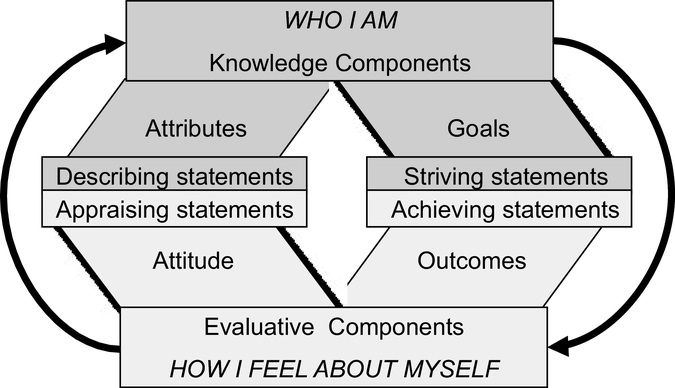
Participants were interviewed in their homes using an open-ended, in-depth interview format. Interviews were audiotaped and transcribed verbatim and transcript data were coded, iteratively compared and contrasted until clear categories and core themes emerged. Two self-concept themes emerged from the data: Who I am and How I feel about myself (see Figure 1). The first theme (Who I am) reflected knowledge components of self and involved two separate areas, personal attributes and personal goals. Attributes were captured in describing statements, while striving statements characterised goals. Attributes reflected straightforward descriptions of personal characteristics (e.g., Friendly and easy to speak to . . . I love nature and animals). Brain injury in any of its descriptive forms was conspicuous by its absence in personal attributes. In other words, none of these people defined themselves by the brain injury they had sustained. This lack of reference to brain injury did not mean that the injury did not play a role in the participants’ self-narratives, rather it was interpreted as signifying that at this point in their lives having sustained a brain injury was not perceived as an essential attribute of the self.
Conceptualising self after severe TBI (Douglas, Reference Douglas2013).

The second area of the knowledge components of self-emerged as goals evident in striving statements reflecting four distinct domains: physical, material, social-relational and activity. It was in these striving statements that the consequences of the brain injury became apparent. Impaired function was reflected in the majority of statements describing physical goals (e.g., All I want to do is walk) and for the most part material goals were related to a desire for financial independence (it's really important to have your own money) and ownership of possessions (e.g., to have a garage with a tool shed). The experience of social isolation gave rise to the social-relational goals (e.g., more socialising and interacting with others—I'd like it with others), while the experience of little or no involvement underpinned many of the striving statements in the activity domain (e.g., getting back into playing sport, especially basketball . . . I miss my basketball).
The evaluative component of self (How I feel about myself) was the second major theme that emerged in the model. Again, two distinct aspects of the evaluative component were apparent and these described self-attitude and sense of achievement or an evaluation of the knowledge components of self. Attitude to self was captured in appraising statements (e.g., I'm not a nice person to be around when I'm miserable, but I get over it pretty quickly). The outcome aspect of the evaluative component of self covered the same domains that were evident in the goal aspect of self (physical, material, social-relational and activity), but here they reflected an inventory of goals achieved rather than aspirations. These outcomes were signalled by achieving statements in the self-narratives of the participants: physical (e.g., I've done lots of gym work . . . working on balance, it's much better), material (e.g., I already got new house and getting a car), social-relational (e.g., I've made lots of friends . . . . .where I volunteer ) and activity (e.g., I have a herb garden and I sell herbs at the market ).
This direct exploration of self shed some light on how self-concept is experienced, constructed and supported following severe TBI. Conceptualising self was seen to be a dynamic process culminating at any point in life as an organised structure. The structure contained personal facts and memories of life experiences representing knowledge and evaluative components of the self. As suggested by others (e.g., Campbell, Trapnell, Heine, Katz, Lavallee, & Lehman, Reference Campbell, Trapnell, Heine, Katz, Lavallee and Lehman1996; Klein, Reference Klein2010), semantic and episodic memories provided the fabric from which these individuals fashioned a cognitive schema of self. The model implies a cyclical process whereby self-defined goals (represented in striving statements made by the individual) can become self-assessed outcomes (represented in achieving statements), potentially influence a person's attitude to self (represented in appraising statements) and become incorporated within self attributes (represented in describing statements). The way in which these people with brain injury constructed self bore considerable similarity to the components of self described in metaphoric identity mapping developed by Ylvisaker and Feeney (Reference Ylvisaker and Feeney2000a, Reference Ylvisaker and Feeney2000b). (See Douglas (Reference Douglas2010) for a more detailed discussion.)
Placing Rehabilitation in the Context of the Self
This research-based exploration of self provides a schematic representation that can be used to guide therapy through direct reference to the individual's conceptualisation of self. The model can be thought of as the ‘describe, strive, achieve and appraise’ framework that encompasses four iterative therapeutic phases situated within knowledge of the self. In this framework, therapy begins by developing a clear understanding of the person's characteristics or attributes from his or her own perspective. Self-relevant goals to guide the work of therapy are then developed collaboratively within the context of self-described attributes. Outcomes can be acknowledged and recorded as self-achievements and connected directly back to those self-defined goals. Self-attitude is shaped by regular collaborative review and self-appraisal focusing not only on achievements, but highlighting the attributes of the client that either support or are revealed by the achievement. (See Douglas (Reference Douglas2015) for a more detailed discussion.)
The Importance of Rights and Access to Rehabilitation
How could the system totally give up on a 19-year-old after two months of a traumatic brain injury? She was only two months in and they had given up on her already. How could she be denied the opportunity and support of a rehab program?
Australian Senate Inquiry into Adequacy of RAC for Young People Verbal submission 1103b, mother (Barry, Knox, & Douglas, Reference Barry, Knox and Douglas2018).
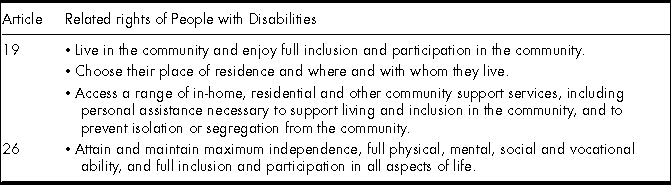
The United Nations (UN) Convention on the Rights of Persons with Disabilities (CRPD) and its Optional Protocol (OP) were adopted in December 2006, as the first comprehensive human rights treaty of the 21st century; it entered into force in May 2008 (UN, 2007). A large proportion of the world has either signed and or ratified the convention and its OP, with Australia having signed and ratified both the convention and the protocol. The articles of the CRPD have broad ranging implications for people with acquired disabilities and I would like to draw your attention to two articles in particular, article 19 and article 26 (see Table 2). Article 19 recognises the equal right of all persons with disabilities to live in the community, choose their place of residence, including where and with whom they live, and access services to support living and inclusion in the community. Article 26 calls on state signatories of the CRPD to take effective and appropriate measures to enable persons with disabilities to attain and maintain maximum independence, full physical, mental, social and vocational ability, and full inclusion and participation in all aspects of life.
Articles 19 and 26 of the United Nations Convention on the Rights of Persons with Disabilities (2007)

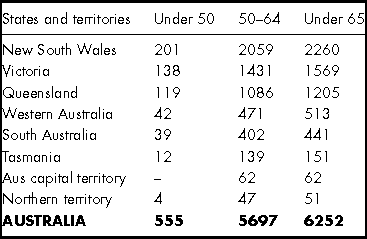
Unfortunately, data concerning the number and experiences of young people living in residential aged care (RAC) environments show the obligations enshrined in article 19 and article 26 are a long way from being achieved. In Australia, more than 6000 adults under the age of 65 live in RAC (see Table 3) (Commonwealth of Australia, 2017). Data from Canada, Ireland and the USA indicate that between 4% and 15% of nursing home residents are adults under 65 years of age (Cahill, O’Nolan, O’Caheny, & Boberksy, Reference Cahill, O'Nolan, O'Caheny and Boberksy2014; Canadian Institute for Health Information, 2013; Harris-Kojetin et al., Reference Harris-Kojetin, Sengupta, Park-Lee, Valverde, Caffrey, Rome and Lendon2016). A large proportion of younger residents of RAC have complex care needs as a result of ABI (Fries et al., Reference Fries, Wodchis, Blaum, Buttar, Drabek and Morris2005; Persson & Oswald, Reference Persson and Ostwald2009; Winkler, Farnworth, & Sloan, Reference Winkler, Farnworth and Sloan2006; Winkler, Sloan, & Callaway, Reference Winkler, Sloan and Callaway2010). Given that RAC is not designed to meet the needs of young people with ABI (Cameron, Pirozzo, & Tooth, Reference Cameron, Pirozzo and Tooth2001), it is predictable that living in RAC has a range of negative consequences for younger residents. Indeed, research has demonstrated that young people living in aged care are socially isolated, restricted in their ability to participate in the community, and lack opportunities to exercise choice and control in their lives (O’Reilly & Pryor, Reference O'Reilly and Pryor2002; Persson & Oswald, Reference Persson and Ostwald2009; Rissanen, Ehrlich, Kendall, & Zeeman, Reference Rissanen, Ehrlich, Kendall and Zeeman2014; Smith, Reference Smith2004). In contrast, young people with very severe ABI who are able to move into community-based settings from RAC demonstrate positive outcomes including increased social inclusion and independence in everyday activities that were not fostered in an aged care environment (Winkler, Farnworth, Sloan, & Brown, Reference Winkler, Farnworth, Sloan and Brown2011).
Number of Younger Residents in RAC (Australian Institute of Health and Wlefare, 30 June 2015)

Participation in rehabilitation plays a critical role in maximising the independence of adults with severe ABI and avoiding their entry into RAC (Von Groote, Bickenbach, & Gutenbrunner, Reference Von Groote, Bickenbach and Gutenbrunner2011). Although access to rehabilitation is also acknowledged as a right through article 26 of the CRPD, research has highlighted that many adults with very severe ABI may not receive adequate rehabilitation. McMillan and Laurie (Reference McMillan and Laurie2004) surveyed young adults with ABI living in RAC in Glasgow. They reported that less than half of the young people they identified had participated in rehabilitation prior to their admission. Once admitted to RAC, aged care workers have substantial difficulties meeting the rehabilitation needs of young adults with ABI; they have limited knowledge about ABI and in many cases access to specialist ABI services is limited (Cameron et al., Reference Cameron, Pirozzo and Tooth2001; Gray, Reference Gray2000).
Despite the prolonged and complex recovery trajectory of severe ABI, evidence shows that extended rehabilitation services can improve independence (Andelic et al., Reference Andelic, Bautz-Holter, Ronning, Olafsen, Sigurdardottir, Schanke and Roe2012; Nakase-Richardson et al., Reference Nakase-Richardson, Whyte, Giacino, Pavawalla, Barnett, Yablon and Walker2012) and be highly cost-effective for some adults with severe ABI. Indeed, the costs of rehabilitation are outweighed by reductions in ongoing care costs, particularly for those with greater functional impairments (Turner-Stokes, Reference Turner-Stokes2007; Turner-Stokes, Williams, & Bassett, Reference Turner-Stokes, Williams, Bill, Bassett and Sephton2016). The findings of our recently published scoping review (Knox & Douglas, Reference Knox and Douglas2018) provided further support for the functional- and cost-effectiveness of extended rehabilitation programmes for adults with extremely severe ABI. Eighteen studies with a total of 923 participants were included in the review. Taken together the synthesised results showed that adults who had participated in extended rehabilitation programmes required fewer hours of care, had lower care costs and were more likely to live in their own home, with family, or in disability-specific accommodation in the community. These findings clearly support the right of adults with very severe ABI to be given increased access to non-time-limited, specialist rehabilitation in order to participate equally as citizens and full members of the community.
The Needs of People with Brain Injury and their Family are Inextricably Linked
Jane: You need someone to talk to, someone who knows what you're talking about. Jane (Douglas & Spellacy, Reference Douglas and Spellacy2000).
For many years, research has demonstrated that ABI not only has far-reaching consequences for the injured individual but also for the family as a unit and for each family member as an individual (Douglas & Spellacy, Reference Douglas and Spellacy1996; Perlesz, Kinsella, & Crowe, Reference Perlesz, Kinsella and Crowe1999). In many cases, emotional distress for family members is as frequent and ongoing an experience of post-injury living as it is for the injured person.
This ongoing distress is especially the case for the family member who assumes the principal support function for those with severe brain injury. In our study of 35 families living with the consequences of severe injury to an adult family member on average 7 years post injury, we found that 57% of the participants with TBI and 60% of primary care givers reported case levels of depression symptomatology (Douglas & Spellacy, Reference Douglas and Spellacy2000). Qualitative exploration of the experience of injured family members (across the roles of husband (n = 14), wife (n = 5), son (n = 4) and daughter (n = 7) revealed that social isolation (lack of friendship and intimacy) and lack of involvement (occupation and activity) were their most distressing ongoing concerns. Primary care givers across the roles of husband (n = 3), wife (n = 14), son (n = 2) and daughter (n = 11) described needing instrumental support due to excessive responsibilities and demands (I need any service to offer me a break; he (husband) doesn't like to be by himself.), needing someone with whom to share their feelings and experiences, as exemplified by Jane in her comment at the beginning of this section, and frustration with the lack of knowledge about brain injury that confronted them and their family across society generally (You need to educate the public . . . like taxi drivers.) and in specific environments like school (The children’s school has no conception of head injury and why we're so stressed.). Similar themes regarding, care-giver role demands and changes in the family member with TBI, also emerged from the analysis of recent focus group data exploring how caregivers describe their quality of life (Kratz, Sander, Brickell, Lange, & Carlozzi, Reference Kratz, Sander, Brickell, Lange and Carlozzi2017).
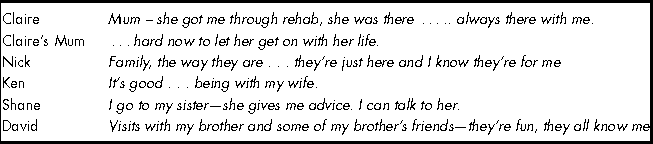
The lived experience also points to the crucial role played by families in shaping outcome following injury (see Table 4). Claire (Table 4) acknowledges the pivotal part played by her Mum in getting her through rehabilitation, and Claire's Mum talks about the challenges of reducing her protective attitude and letting Claire get on with her own life and independence. Family are clearly important in maintaining social engagement and acting as a source of social support, each of which in turn has been found to be a significant and reliable indicator of psychological functioning (Douglas & Spellacy, Reference Douglas and Spellacy2000; Ouellet, Morin, & Lavoie, Reference Ouellet, Morin and Lavoie2009), community integration (McColl et al., Reference McColl, Carlson, Johnston, Minnes, Shue and Davies1998), life satisfaction (Corrigan, Bogner, Mysiw, Clinchot, & Fugate, Reference Corrigan, Bogner, Mysiw, Clinchot and Fugate2001; Pierce & Hanks, Reference Pierce and Hanks2006) and quality-of-life (Steadman-Pare, Colantonio, Ratcliff, Chase, & Vernich, Reference Steadman-Pare, Colantonio, Ratcliff, Chase and Vernich2001; Vickery et al., Reference Vickery, Gontovsky and Caroselli2005) after severe TBI. Further, a better response to rehabilitation has generally been noted when family is involved and a significant correlation between improvement during post-acute rehabilitation (3–6 months after the event) and family dynamics has also been shown (Maggio et al., Reference Maggio, De Luca, Torrisi, De Cola, Buda, Rosano and Calabro2018). Following return home, neuro-behavioural function of the injured person makes a significant contribution to prediction of family functioning and family cohesion post injury (Douglas & Spellacy, Reference Douglas and Spellacy1996). Further, family care givers perceive challenging behaviours as a key source of distress and burden (Tam, McKay, Sloan, & Ponsford, Reference Tam, McKay, Sloan and Ponsford2015). Clearly, family-focused rehabilitation and support efforts continue to be required throughout the brain injury continuum from acute, through sub-acute and into community contexts (Shepherd-Banigan et al., Reference Shepherd-Banigan, Shapiro, McDuffie, Brancu, Sperber, Van Houtven and Williams2018).
Personal Perspectives on Family Following ABI

Note: Participants’ quotes from Douglas (Reference Douglas2002, Reference Douglas2013) and Douglas and Spellacy (Reference Douglas and Spellacy2000).
The Protective Nature of Friendship
I only see mum in the afternoons when she comes home from work. . . So I just get a bit lonely, sometimes in the house or sometimes when I'm at [uni], a loneliness sort of washes over me and I just want somebody to talk to. Rachel (Shorland & Douglas, Reference Shorland and Douglas2010).
Close relationships make an important contribution to wellbeing and the maintenance of a positive sense of self-worth for us all (Delle Fave, Brdar, Wissing, & Vella-Brodrick, Reference Delle Fave, Brdar, Wissing and Vella-Brodrick2013; O'Connor & Chamberlain, Reference O'Connor, Chamberlain, Reker and Chamberlain2000). Challenges in the domain of relationships and friendships can be common and enduring problems for many people with stroke (Barry & Douglas, Reference Barry and Douglas2000; Ford, Douglas & O'Halloran, Reference Ford, Douglas and O'Halloran2018; Lefebvre, Cloutier, & Levert, Reference Lefebvre, Cloutier and Levert2008; Pound, Gompertz, & Ebrahim, Reference Pound, Gompertz and Ebrahim1998), degenerative disorders (Clare et al., Reference Clare, Nellis, Whitaker, Martyr, Markova, Roth and Morris2012; Pozzebon, Douglas, & Ames, Reference Pozzebon, Douglas and Ames2016; 2018) and TBI (Dikman, Machamer, Powell, & Temkin, Reference Dikman, Machamer, Powell and Temkin2003; Douglas, Drummond, Knox, & Mealings, Reference Douglas, Drummond, Knox, Mealings, McPherson, Gibson and Leplege2015; Draper, Ponsford, & Schönberger, Reference Draper, Ponsford and Schönberger2007; Jourdan et al., Reference Jourdan, Bayen, Pradat-Diehl, Ghout, Darnoux, Azerad and Azouvi2016; Tate, Broe, Cameron, Hodgkinson, & Soo, Reference Tate, Broe, Cameron, Hodgkinson and Soo2005). As shown by Rachel's comment at the beginning of this section, many adults with ABI feel lonely and lack close friends with whom they can talk about their everyday lives and share the ups and downs they experience. This ongoing lack of friendship promotes social isolation and sets people apart from their peers and often contributes to the ongoing concerns and strain within family.
The negative impact of having few or no friends was clearly portrayed in the results of a recently completed study exploring the post-injury experience of friendship from the perspective of 23 adults with severe TBI with an average age of 37 years and a minimum of 2 years having elapsed since the injury event (Douglas, under review). For this group, the average number of 1.5 close friends excluding family fell well below that of 8.6 friends reported by the general population (Carroll, Reference Carroll2004). Nearly, two in three of these participants (61%) had no friends and this too contrasted strongly with the very small proportion (2%) of adults in the general population who reported having no friends (Carroll, Reference Carroll2004). Emphasising the importance of friendship, significant associations yielding moderate to large effects were demonstrated between number of friends and quality of life, depression and strong-tie social support.
The post-injury experience of friendship for these participants reflected a post-injury downhill or deteriorating process that incorporated early loss of social connections (losing contact), ongoing lack of understanding (being misunderstood) with reduced opportunities to share (wanting to share) and just hanging on to a place in society. This experience of loss and social disconnection has been reported by participants in a number of studies (Jumisko, Lexell, & Soderberg, Reference Jumisko, Lexell and Soderberg2005; Levack et al., Reference Levack, Kayes and Fadyl2010; Mealings, Douglas, & Olver, Reference Mealings, Douglas and Olver2017; Muenchberger, Kendall, & Neal, Reference Muenchberger, Kendall and Neal2008; Salas, Casassus, Rowlands, Pimm, & Flanagan, Reference Salas, Casassus, Rowlands, Pimm and Flanagan2016; Shorland & Douglas, Reference Shorland and Douglas2010), as has more frequent contact with family when compared to little or no contact with friends (Douglas, Reference Douglas2017, Reference Douglas2010; Douglas & Spellacy, Reference Douglas and Spellacy2000). Feeling misunderstood or stigmatised has also been revealed in previous work (Knox et al., Reference Knox, Douglas and Bigby2017; Levack et al., Reference Levack, Kayes and Fadyl2010; Mealings et al., Reference Mealings, Douglas and Olver2017; Nochi, Reference Nochi1998; Salas et al., Reference Salas, Casassus, Rowlands, Pimm and Flanagan2016). The downhill process stretched over many years with some moderating factors but little or no resolution to the problem of loneliness in the lives of these participants.
The process grounded in these participants’ lived experience revealed the need for early efforts during rehabilitation to prevent losing contact with valued friends. As suggested by Palmer and Herbert (Reference Palmer and Herbert2016), participation in inpatient rehabilitation can distance a person from their friends and their preinjury social context. Indeed, the demands of rehabilitation activities have previously been noted by participants with TBI to impact negatively on the frequency of contact and overall time spent with friends (Mealings & Douglas, Reference Mealings and Douglas2010; Nichols & Kosciulek, Reference Nichols and Kosciulek2014). Thus, early attention to supporting friendships is warranted and demands systematic consideration from the perspective of proactive and ongoing intervention. Further, a number of authors have pointed to the importance of including friends in rehabilitation across the continuum from acute hospital to community settings and have identified specific clinical strategies to use (Callaway, Sloan, & Winkler, Reference Callaway, Sloan and Winkler2005; Mealings et al., Reference Mealings, Douglas and Olver2017; Shorland & Douglas, Reference Shorland and Douglas2010; Tate et al., Reference Tate, Kennedy, Ponsford, Douglas, Velikonja, Bayley and Stergiou-Kita2014; Togher et al., Reference Togher, Wiseman-Hakes, Douglas, Stergiou-Kita, Ponsford, Teasell and Turkstra2014). Others have considered and/or trialled the benefits of peer mentoring (Hanks, Rapport, Wertheimer, & Koviak, Reference Hanks, Rapport, Wertheimer and Koviak2012; Struchen et al., Reference Struchen, Davis, Bogaards, Hudler Hall, Clark, Mazzei and Caroselli2011), support group participation (Salas et al., Reference Salas, Casassus, Rowlands, Pimm and Flanagan2016) and volunteer partnering (Johnson & Davis, Reference Johnson and Davis1998) as approaches to facilitate friendships with generally variable results. Such programmes require further development and rigorous evaluation to identify essential elements that deliver enduring positive change in the realm of friendship following severe TBI.
Concluding Comments
Working with survivors of ABI has taught me that life after brain injury is without doubt a multifaceted personal challenge that calls upon every ounce of energy, endurance and self-belief that a person can muster. It is a life experience that can trigger questions about an individual's very existence and how they see themself. Multiple avenues for sustained support and guidance are necessary, indeed essential, along the way. Effective support originates from multiple sources including societal level advancements involving legislative and policy frameworks like conventions to protect the rights of people with disabilities and legislation to underpin social insurance schemes, like Australia's recently introduced National Disability Insurance Scheme. Within a societal setting that truly acknowledges the rights and importance of choice and control for people with disabilities, effective rehabilitation, disability and mainstream services can build and maintain the skills of the individual, sustain their support networks of close others and facilitate their social participation and citizenship. Building on the things that help and minimising the impact of the things that get in the way is one way we can be working together to improve the lives of people with brain impairment.
Acknowledgements
Much of the work referred to in this presidential address reflects collaboration with a number of researchers and clinicians who I would like to thank for their much valued contributions: Sandy Barry, Christine Bigby, Helen Bridge, Carren (Mitchell) De Maio, Melanie Drummond, Amy (Muir) Ford, Lucy Knox, Margaret Mealings, Robyn O'Halloran, Margaret Pozzebon, Joanna Shorland, Frank Spellacy and the entire team at the Moving Ahead CRE. I would also like to extend my sincere thanks to those who have so generously participated in our research and provided such important input.
Ethical Standards
The author asserts that all procedures contributing to this work comply with the ethical standards of the relevant national and institutional committees on human experimentation and with the Helsinki Declaration of 1975, as revised in 2008.