Implications
Higher mob sizes at lambing may increase the risk of mismothering and therefore compromise lamb survival. This could be particularly evident in mobs of twin-bearing ewes compared to single-bearing ewes because a greater number of lambs are born per day. However, the current study showed that mob size did not influence interaction with foreign ewes or lambs at lambing or the survival of single- or twin-born lambs when pasture availability at lambing was high. Therefore, reducing mob size may not improve lamb survival when ewes have access to high levels of pasture at lambing.
Introduction
Lamb mortalities represent a major source of reproductive wastage in the Australian sheep industy. Over 80% of lamb mortalities occur during the first 3 days of life (Oldham et al., Reference Oldham, Thompson, Ferguson, Gordon, Kearney and Paganoni2011; Refshauge et al., Reference Refshauge, Brien, Hinch and van de Ven2016). Survival of lambs during this period is largely dependent on the development of a strong ewe-lamb bond. Mutual bonding generally takes at least 12 h following birth and is optimised where interference is minimised by isolation from other ewes (Alexander et al., Reference Alexander, Stevens, Kilgour, de Langen, Mottershead and Lynch1983b; Nowak et al., Reference Nowak, Poindron and Putu1989; Keverne et al., Reference Keverne, Lévy, Guevara-Guzman and Kendrick1993). However, isolation at lambing and the ability of Merino ewes to bond to their lambs can be compromised by their strong flock behaviour (Stevens et al., Reference Stevens, Alexander and Lynch1981; Arnold and Maller Reference Arnold and Maller1985; Nowak Reference Nowak1996). Furthermore, the mortality of twin-born lambs is typically double that of single-born lambs (Oldham et al., Reference Oldham, Thompson, Ferguson, Gordon, Kearney and Paganoni2011). This is partially associated with a greater risk of becoming permanently separated from the twin-bearing ewe due to her poorer mothering ability along with the poorer neonatal behaviours of twin-born lambs (Nowak, Reference Nowak1996). Therefore improving lamb survival requires a focus on strategies which optimise the development of the ewe-lamb bond during the first 3 days of life.
Domestic sheep display strong flocking behaviours and this is particularly evident for gregarious breeds like Merinos. Therefore, it could be assumed that the distribution of birth sites, and thus the lambing density, will largely be defined by the distribution of the mob in the paddock rather than the paddock size (Arnold and Maller, Reference Arnold and Maller1985; Lynch et al., Reference Lynch, Hinch and Adams1992). Research using Merinos has shown that typically less than 40% and as few as 2% of ewes isolate themselves to lamb (Stevens et al., Reference Stevens, Alexander and Lynch1981; Alexander et al., Reference Alexander, Stevens, Bradley and Barwick1990). The concentration of birth sites within the paddock is likely to be driven by the strong attraction of periparturient ewes to amniotic fluids and newborn lambs (Arnold and Morgan, Reference Arnold and Morgan1975). This may be exacerbated when ewes lamb in larger mobs because a greater number of lambs are born per day. Higher mob sizes at lambing may therefore increase the risk of interference from foreign ewes during the periparturient period and compromise lamb survival.
Limited experimental studies using small paddocks and mob sizes have indicated that increasing the stocking rate or density of lambed ewes may predispose intereferences from other lambing ewes and increase the risk of permanent ewe-lamb separations (Winfield, Reference Winfield1970; Cloete, Reference Cloete1992; Robertson et al., Reference Robertson, King, Broster and Friend2012; Allworth et al., Reference Allworth, Wrigley and Cowling2017). Robertson et al. (Reference Robertson, King, Broster and Friend2012) also suggest that intereference at lambing may inhibit ewe–lamb bonding and thereby delay sucking by the lamb following birth. Moving prematurely from the birth site and unequal bonding with twin lambs can increase the risk of separation between twin-bearing ewes and her progeny (Alexander et al., Reference Alexander, Stevens and Mottershead1983a; O’Connor et al., Reference O’Connor, Lawrence and Wood-Gush1992). Hence, poorer survival of twin-born compared to single-born lambs would be expected at higher mob sizes because the greater number of lambs born per day would increase vulnerability to intereference at lambing. Therefore, we hypothesised that; (i) decreasing the mob size of ewes at lambing has a greater impact on the survival of twin-born lambs than single-born lambs; (ii) the relationship between mob size and lamb survival can be explained by differences in the rate of interaction with foreign ewes and lambs at lambing; and (iii) ewes will utilise a limited area of the paddock at lambing and thus lambing density will be defined by the distribution of ewes in the paddock rather than the paddock area.
Material and methods
Research site, animals and experimental design
The research was performed at the University of Western Australia Future Farm near Pingelly in Western Australia (32°30ʹ23ʹʹS, 116°59ʹ31ʹʹE). Merino ewes (n=2310) aged 2 to 6 years were joined to a Merino sire in late January or early February 2016 following synchronisation of oestrus. Single-bearing and twin-bearing ewes were identified at pregnancy ultrasound scanning (n=770). Ewes were allocated into a 2×2 factorial combination of pregnancy status (single- or twin-bearing) and mob size (high (n=130 ewes) or low (n=50 ewes)) on day 140 from the start of joining (day 140 of pregnancy). Each treatment had two replicates excepting the low mob size for twins which had a third replicate. Ewes were allocated into a treatment and replicate according to pregnancy status, age, liveweight at joining, flock they were sourced from, sire of the lamb and the date of Controlled Internal Drug Release (CIDR) removal. The stocking rate was set at 11 ewes/ha across treatments such that ewes in the high and low mob size treatments lambed in paddocks of 11.8 and 4.5 ha. The allocation of treatments to lambing paddocks was randomised. The experimental site consisted of nine adjacent paddocks with similar shelter and water access. A visual grid network was established across the site by placing unique markers at each 50 m intersect in the paddocks to map the distribution of the mob. Lambs were born between late June and early July and were marked in late July. The average wind chill index between lambing and marking was 1030 kJ m2/h as calculated using the equation described by Donnelly (Reference Donnelly1984).
Animal management and treatments
The oestrus cycles of 2310 Merino ewes were synchronised for artificial insemination (n=1380) or natural mating (n=930) using CIDRs (EAZI-BREED™ CIDR® Sheep and Goat Devices, Zoetis, Australia). Controlled Internal Drug Releases were inserted into the vagina and removed 12 to 14 days later. The insertion and removal of CIDRs was staggered over 5 days. Upon CIDR removal, ewes were injected with 1.8 ml pregnant mare serum gonadotrophin (Pregnecol™, Bioniche Animal Health, New South Wales, Australia). Those ewes to be artificially inseminated were then joined with teaser rams at a rate of 29 : 1 until artificial insemination 48 h later. Ewes naturally mated were immediately joined with rams at a rate of 30 : 1 for 5 to 10 days. Ewes were pregnancy scanned via trans-abdominal ultrasonography in mid-April. Single- and twin-bearing ewes were selected for the experiment.
Ewes were weighed and condition scored at joining. Ewes were also condition scored at pregnancy scanning, day 95 of pregnancy, day 140 of pregnancy and lamb marking as described by Russel (Reference Russel1984). Ewes were managed under the same conditions and grazed paddocks with similar feed-on-offer (FOO) from pregnancy scanning until allocation to treatments. On day 140 of pregnancy, ewes were assigned a unique paint brand for identification, allocated to treatments and moved to their lambing paddocks. Twin-bearing ewes from two replicates of each mob size were also fitted with sensors attached to halters to record interactions between ewes (ActiGraph wGT3X-BT; Actigraph, LLC, Pensacola, FL, USA). Two sensors were fitted to each halter; one a beacon and the other a receiver as described by Sohi et al. (Reference Sohi, Trompf, Marriott, Bervan, Godoy, Weerasinghe, Desai and Jois2017). Ewe-ewe interactions within the mob were recorded 24 h per day for approximately 9 days during the peak of lambing. Halters were removed following the end of lambing. Activity monitors of 16 ewes malfunctioned during lambing.
Lambing observations and autopsies
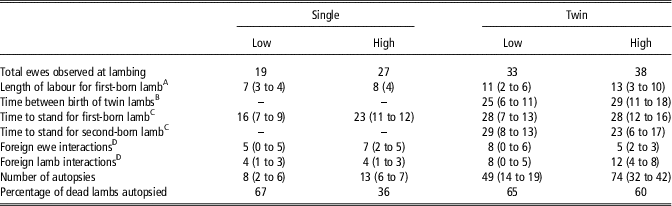
All ewes were intensively monitored between 0730 and 1600 h for 11 days commencing 150 days after removal of the first CIDRs. During intensive monitoring, entry of all personnel into the lambing paddocks was restricted such that the paddocks were only entered to assist ewes which were experiencing prolonged lambing difficulty. Details of labour, time taken for lambs to stand and interactions with foreign ewes and lambs were recorded. The number of observations are shown in Table 1. Length of labour was defined as the time between rupture of the amniotic sac and expulsion of the lamb. The time between birth of the first and second lambs was defined as the time between expulsion of each lamb. Time to stand was defined as the time between birth and the lamb standing on all four feet for at least 5 s as per Dwyer and Lawrence (Reference Dwyer and Lawrence1999). Interactions were defined as a foreign ewe or lamb being within two ewe body lengths of the ewe and her progeny whilst displaying interest, including following, nudging, grooming and allowing the lamb to suck or the lamb seeking the udder. The distribution of ewes in each paddock was recorded every 2 h by counting the number of ewes occupying each 2500 m2 grid. After monitoring had concluded for the day, dead lambs were collected for autopsy using the procedure described by Holst (Reference Holst2004). A total of 144 lambs were autopsied (Table 1). The categorisation of dystocia into three sub-categories; dystocia, stillbirth and birth injury, is described by Refshauge et al. (Reference Refshauge, Brien, Hinch and van de Ven2016).
Total number (range across plots) of observations for behavioural traits recorded during the periparturient period, number of autopsies and percentage of dead lambs that were autopsied for single and twin lambs born at the low (n=50 ewes) and high (n=130 ewes) mob sizes

Each treatment had two replicates excepting the low mob size for twins which had a third replicate.
A Measured as the time between rupture of the amniotic sac and expulsion of the lamb.
B Measured as the time between expulsion of each lamb.
C Measured as the time between birth and the lamb standing on all four feet for at least 5 s.
D Interactions were defined as the foreign ewe or foreign lamb being within two ewe body lengths of the ewe and her progeny whilst displaying interest, including following, nudging, grooming and allowing the lamb to suck or the lamb seeking the udder.
Pasture assessment
Visual assessments of FOO (kg dry matter (DM)/ha) were made at 20 sites in each paddock at day 140 of pregnancy and lamb marking. The visual assessments of FOO were calibrated against ten 0.1 m2 quadrat cuts taken from across the nine paddocks. Pasture within each quadrat was harvested to ground level. Soil and foreign matter were removed from the samples. The pasture samples were dried in an oven at 65°C and then weighed to determine the DM content.
Statistical analyses
All statistical analyses were performed using GENSTAT (VSN International, 2017). Statistical significance was accepted at P<0.05. Covariates were removed from the model if not significant.
Lamb survival, ewe condition score and FOO at lambing and marking, and the distribution of ewes within the lambing paddock were analysed using the method of restricted maximum likelihood. The distribution of ewes within the paddock, recorded 2-h during the 11-day observation period, were averaged for each day and expressed as the proportion of the paddock which was occupied, that is, the proportion of 2500 m2 grids within the paddock which were occupied. Mob size, birth type and mob size by birth type were fitted as fixed effects. Lambing paddock was fitted as a random term except for the analysis of the distribution of ewes within the paddock where date nested within lambing paddock and observer were fitted as random terms. Ewe condition score and FOO at lambing and marking were fitted as covariates for analysis of lamb survival. Data for lamb survival were angular transformed and results are presented in the back-transformed state.
Length of labour for the first-born lamb, time between birth of first-born and second-born lambs, and time taken for the first-born and second-born lambs to stand were analysed using ANOVA. Data were log-transformed and results are presented in the back-transformed state. The incidence of foreign ewe and lamb interactions and cause of death of lambs autopsied during the 11-day observation period were assessed by fitting GLM models. The approach used a logit-transformation and binomial distribution. Foreign ewe or lamb interactions were classified as having a total interaction time of at least 1 min. Interactions were not observed in two of the paddocks during the 11-day observation period, therefore data are for seven mobs. All single-born lambs that were autopsied had died from stillbirth, birth injury and starvation and mismothering, therefore analysis for all other causes of death includes twin-born lambs only. Only one lamb had died from misadventure and one from physical abnormalities, therefore data are not presented for these death categories. For these analyses, mob size, birth type and mob size by birth type, where applicable, were fitted as fixed effects and lambing paddock was fitted as a random term. Results are presented in the back-transformed state.
The number of ewe-ewe interactions recorded per minute by the activity monitors was summed for each ewe to determine the total number of ewe-ewe interactions per day. The mean number of ewe-ewe interactions per day was calculated relative to the day of lambing for the four lambing mobs. Data collected from ewes with known date of lambing was assessed for a period of 7 days before and following lambing, including the day of lambing. Mean total daily ewe–ewe interactions per mob were log-transformed and analysed by a smoothing spline approach as described by Verbyla et al. (Reference Verbyla, Cullis, Kenward and Welham1999). A linear effect of day and mob size were fitted as fixed effects and days to lambing nested within lambing paddock were fitted as random effects.
Results
Mob size, birth type and lamb survival
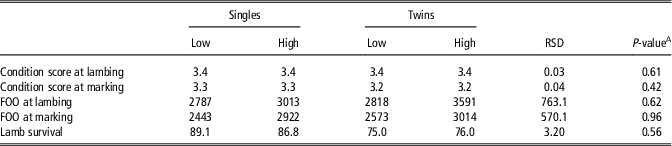
There was no mob size by birth type effect on the mean condition score of ewes within the mob or FOO at lambing or marking (Table 2). The mean mob condition score for single-bearing ewes did not differ to that of twin-bearing ewes at lambing (3.4 v. 3.4; P=0.12), but was 0.1 condition score higher at marking (3.3 v. 3.2; P<0.01). There was no effect of mob size by birth type on lamb survival (Table 2). There was also no effect of mob size on lamb survival regardless of birth type (P=0.78). Survival of single-born lambs was 12.6% higher than twin-born lambs (75.3% v. 87.9%; P<0.01). There was no effect of the mean mob condition score or FOO at lambing or marking on lamb survival (P>0.65).
Predicted mean condition score of ewes in the mob and feed-on-offer (FOO; kg dry matter (DM)/ha) at lambing and marking, and survival to marking (%) for single and twin lambs born at the low (n=50 ewes) and high (n=130 ewes) mob sizes

Results for lamb survival are presented in the back-transformed state.
A P-value corresponds to the effect of mob size by birth type.
Cause of lamb death
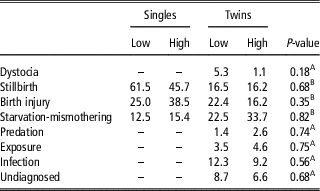
All single-born lambs died from stillbirth, birth injury and starvation-mismothering. There was no effect of mob size by birth type on the proportion of lambs which died from stillbirth, birth injury or starvation-mismothering (Table 3). Similarly, there was no effect of mob size on the proportion of lambs which died from stillbirth, birth injury and starvation-mismothering within birth types. There was no difference in the proportion of single- and twin-born lambs which died from birth injury (33.3% v. 18.70%; P=0.13) and starvation-mismothering (14.3% v. 28.7%; P=0.16). However, a greater proportion of single-born lambs died from stillbirth compared to twin-born lambs (52.8% v. 16.6%; P<0.05). The proportion of twin-born lambs which died from dystocia, predation, exposure, infection and undiagnosed causes did not differ between the high and low mob sizes (Table 3).
Proportion of lambs which died from dystocia, stillbirth, birth injury, starvation-mismothering, predation, exposure, infection and undiagnosed causes of single and twin birth type at the low (n=50 ewes) and high (n=130 ewes) mob sizes

Predicted means are presented in the back-transformed state.
A P-value corresponds to the effect of mob size.
B P-value corresponds to the effect of mob size by birth type.
Duration of labour and time to stand
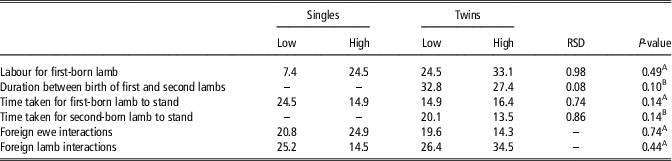
There was no mob size by birth type effect on the duration of labour or time taken for lambs to stand (Table 4). The mean duration of labour for single-bearing ewes was 14.9 min and for the first-born lamb for twin-bearing ewes was 24.8 min (P=0.40). Similarly, time between birth of twin-born lambs did not differ between the high and low mob sizes (Table 4). The mean time to stand was 17.7 min for single-born lambs and 15.4 min for first-born twin lambs (P=0.42). Similarly, there was no difference between the high and low mob sizes in the time taken for second-born lambs to stand (Table 4).
Predicted mean duration of labour for first-born lambs (mins), time between birth of first- and second-born twins (mins), time taken for lambs to stand (mins) and proportion (%) of ewes and progeny which interacted with a foreign ewe or foreign lamb during the periparturient period for single and twin lambs born at the low (n=50 ewes) and high (n=130 ewes) mob sizes

Results are presented in the back-transformed state.
A P-value corresponds to the effect of mob size by birth type.
B P-value corresponds to the effect of mob size.
Mob interactions at lambing and distribution of ewes in the lambing paddock
There was no effect of mob size by birth type on the proportion of foreign ewe or foreign lamb interactions during the periparturient period (Table 4). Similarly, there was no effect of mob size or birth type on the incidence of interaction with a foreign ewe or foreign lamb during the periparturient period.
There was no effect of mob size by birth type, mob size or birth type on the distribution of ewes within the lambing paddock. On average, single-bearing ewes which lambed at the high and low mob sizes occupied 34% and 36% of the paddock, and the corresponding values for twin-bearing ewes were 40% and 43% (P=0.95; RSD 7.22).
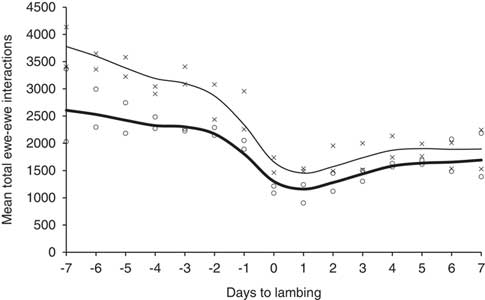
There was a significant mob size by days to lambing effect on the total number of ewe–ewe interactions recorded by activity monitors for twin-bearing ewes (Figure 1; P<0.01). Initially total daily ewe–ewe interactions were higher in the low mob size treatment, however interactions declined more rapidly in the approach to lambing resulting in similar levels of interaction on the day of lambing compared to the high mob size (P<0.05). Interactions with other ewes in the mob were lowest within 24 h of lambing regardless of mob size (Figure 1).
Predicted total ewe–ewe interactions recorded by activity monitors for twin-bearing ewes lambing at the low (thin line; n=50 ewes) and high (thick line; n=130 ewes) mob sizes on the day of lambing (day 0) and the 7 days before and following lambing. Fitted lines are for data in the back-transformed state. Raw means for ewes in each lambing paddock are shown as crosses for the low mob size and circles for the high mob size.

Discussion
The survival of lambs born at a mob size of 130 ewes did not differ to those born at a mob size of 50 ewes, regardless of single or twin birth type. There were also no differences in the rate of interaction with a foreign ewe or lamb during the periparturient period. Therefore, our first two hypotheses were not supported. However, less than 15% of ewes were observed at the time of lambing. Hence, caution is required when drawing conclusions regarding the influence of mob size on foreign ewe and lamb interactions at lambing given the limited data collected in this study. Regardless of mob size and birth type, ewes only occupied approximately 40% of the paddock area during daylight hours at lambing which supports our third hypothesis.
It is possible that the very high FOO in the current study may have encouraged the establishment of a strong ewe-lamb bond and therefore masked the effects of mob size on lamb survival. Ewe–lamb bonding and lamb survival are optimised when the ewe and her progeny maintain close contact in the first 12 h after birth (Val-Laillet et al., Reference Val-Laillet, Simon and Nowak2004). This is particularly important for twins which are at greater risk of becoming separated from the ewe (Alexander et al., Reference Alexander, Stevens, Kilgour, de Langen, Mottershead and Lynch1983b; Cloete et al., Reference Cloete, Scholtz and Ten Hoope1998). The high availability of lush pasture may have therefore encouraged the ewe to remain at the birth site rather than to seek feed or water. Furthermore, distribution and movement of ewes may have been limited during the lambing period due to the high pasture availability (Sibbald and Hooper, Reference Sibbald and Hooper2004). Therefore, interaction with other lambing ewes and newborn lambs may have been limited. Similarly, the high levels of pasture may have provided a degree of privacy at the birth site and prevented interference from foreign ewes and lambs. Hence, the high pasture availability may have reduced the risk of mismothering and ewe–lamb separations.
The average FOO between lambing and marking exceeded 2400 kg DM/ha. Maximal survival of Merino lambs is understood to be achieved when FOO at lambing is approximately 2000 kg DM/ha (Oldham et al., Reference Oldham, Thompson, Ferguson, Gordon, Kearney and Paganoni2011). Furthermore, feed intake of ewes is near maximum when FOO exceeds 2000 kg DM/ha during lactation (Hodgson, Reference Hodgson1990; Morris et al., Reference Morris, McCutcheon, Parker and Blair1994). This is supported by the minimal change in ewe condition score between lambing and marking with single- and twin-bearing ewes losing only 0.1 and 0.2 condition score. The results of the current study therefore highlight the need for further research into the relationships between mob size, FOO and lamb survival given previous studies have shown that higher lambing densities compromise lamb survival. Furthermore, these results suggest that deferring pastures or lambing ewes later in spring when FOO is greater may enable producers to lamb ewes in larger mobs without compromising lamb survival.
Ewes were observed to occupy less than 45% of the lambing paddock, regardless of mob size and birth type. However, the distribution of ewes within the paddock was only recorded during daylight hours and hence the distribution of ewes during the night is unknown. Based on the distribution of ewes during daylight hours, the actual density of ewes within the paddock was more than double than their stocking rate of 11 ewes/ha. Hence lambing density, or the number of lambs born per hectare per day, is likely to be defined by the distribution of the mob within the paddock rather than the paddock area. Over 90% of lambs in this study were born during a consecutive 9-day period. It is estimated that approximately 4 and 11 single lambs and 9 and 20 twin lambs were born per day in the mobs of 50 and 130 ewes. Hence, lambing density was approximately double in the mobs of twins as expected. Therefore, whilst single- and twin-bearing ewes appear to occupy a similar area of the paddock, the density of lambing ewes and newborn lambs would be expected to be twice as high in twin-bearing mobs which may increase the risk of mismothering.
The limited distribution of ewes within the paddock is not surprising given the gregariousness of Merinos and their tendency to remain within the mob at lambing rather than to seek an isolated birth site (Stevens et al., Reference Stevens, Alexander and Lynch1981; Arnold and Maller, Reference Arnold and Maller1985; Alexander et al., Reference Alexander, Stevens, Bradley and Barwick1990). Similarly, the high pasture availability may have reduced the need for ewes to travel to seek feed and therefore limited their dispersal within the paddock (Sibbald and Hooper, Reference Sibbald and Hooper2004). However, whilst ewes at the low mob size were observed to occupy a similar proportional area of the paddock, data collected from the proximity monitors indicated they interacted more with other ewes within the mob bfore lambing but this interaction decreased more sharply as lambing approached when compared to the high mob size. This may reflect the smaller paddock area and therefore greater likelihood of interacting more frequently with other ewes in the mob in the week before lambing.
Regardless of mob size, interactions between twin-bearing ewes were observed to decrease rapidly in the two days before lambing before reaching their lowest within 24 h of lambing. This is consistent with Dobos et al. (Reference Dobos, Dickson, Bailey and Trotter2014) who observed the mean distance to other ewes in the mob was lower on the day of lambing compared to the days before and following lambing using Global Navigational Satellite System technology. Furthermore, Dobos et al. (Reference Dobos, Taylor, Trotter, McCorkell, Schneider and Hinch2015) observed ewes spent less time foraging and more time stationary on the day of lambing. A gradual increase in ewe–ewe interactions from days 1 to 7 following lambing, albeit lower than those before lambing, is likely to reflect increased activity of the ewe with her newborn lambs. Similarly, Dobos et al. (Reference Dobos, Dickson, Bailey and Trotter2014) observed mean daily speed of ewes was lower in the 7 days post-lambing compared to the 7 days before lambing. Therefore, whilst research has indicated that most Merino ewes do not isolate themselves to lamb, their activity is lower on the day of birth which is expected to reflect the lambing process and development of the ewe-lamb bond at the birth site.
No differences were observed between mob sizes in the proportion of ewes which interacted with a foreign ewe or lamb during the period immediately surrounding birth. Similarly, the duration of labour and time taken for lambs to stand following birth did not differ between mob sizes. It could be expected that increased interaction between lambing ewes and newborn lambs at higher mob sizes would increase the risk of prolonged births or dystocia and inhibit the expression of normal maternal and neonatal behaviours. Although, mob size was not found to influence lamb survival in the current study and as such it is not surprising that no behavioural differences were observed between mob sizes. However, the limited number of observations and limited period of behavioural observation in the current study restricts interpretation of the behavioural data. This highlights the challenge of recording details of lambing via human observation when ewes lamb under commercial conditions. Furthermore, had FOO been lower in the current study, a greater rate of interaction with foreign ewes and lambs may have been observed due to a greater need for ewes to seek feed and water.
Approximately two thirds of lambs which died during the study were collected for autopsy. However, a lower proportion of single lambs born at the high mob sizes were collected. It is likely that the reduced proportion of single-born lambs autopsied from the high mob size treatments was reflective of the reduced ability to identify the limited number of dead lambs within the larger paddocks when FOO was very high. It is not unexpected that there was no difference in the proportions of cause of lamb death between mob sizes given there was no difference in lamb survival. Consistent with previous research, the primary causes of death in this study were dystocia and starvation-mismothering (Haughey, Reference Haughey1973; Holst et al., Reference Holst, Fogarty and Stanley2002; Refshauge et al., Reference Refshauge, Brien, Hinch and van de Ven2016). However, the rate of infection observed in this study is higher than that reported previously and is expected to be the result of the high FOO (Refshauge et al., Reference Refshauge, Brien, Hinch and van de Ven2016). Therefore, lambing ewes in paddocks with excessive FOO during winter-spring may increase the risk of infection in lambs, presumably due to a greater prevalence of infectious agents harboured in damp pasture and a greater risk of mastitis.
This study was limited by the number of observations of ewe-lamb behaviour at lambing. Hence, further research is required to understand the relationship between mob size, birth type and lamb survival. Similarly, research utilising remote technology such as sensors fitted to both ewes and lambs could enable further exploration of the relationship between mob size, interactions with foreign ewes or lambs and lamb survival throughout the entire lambing period. Previous research has shown that lamb survival is influenced by mob size. However, the current study indicates that this may be influenced by the seasonal conditions. Understanding the relationship between mob size, FOO and lamb survival is therefore important in determining the benefits of lambing ewes in smaller mobs to improve lamb survival.
Acknowledgements
A. Lockwood is the recipient of an Australian Government Research Training Program Scholarship and Meat & Livestock Australia Postgraduate Award. This research was supported by funding from Meat & Livestock Australia. Steve Wainewright and staff at the UWA Future Farm are thanked for their collaborative efforts in running this experiment. The efforts of all staff and students who assisted with data collection during lambing are appreciated. Mark Jois, Ani Desai, Maneka Weerasinghe and their team at La Trobe University are thanked for programming the activity monitors and assisting with data processing and interpretation.
Declaration of interest
The authors declare no conflicts of interest.
Ethics statement
All procedures described were performed according to the guidelines of the Australian Code of Practice for the Use of Animals for Scientific Purposes 2013 and received approval from the University of Western Australia and Murdoch University Animal Ethics Committees (RA/3/100/1441 and N2808/16).
Software and data repository resources
No software or data resources are deposited in an official repository.