In recent years, the impact of national emergencies on the American state has become a topic of extensive political debate and scholarly analysis. The resurgence of interest in crisis governance after the terrorist attacks on September 11, 2001, has inspired countless studies related to the erosion of civil liberties in favor of heightened security; Footnote 1 the expansion of executive emergency powers, constitutional or otherwise; Footnote 2 and the increasing use of private military contractors in the Afghanistan and Iraq wars. Footnote 3 While these accounts differ in important respects, they often suffer from a lack of historical understanding. Instead of providing a contextual argument for how past developments continue to shape statebuilding, much of the early post-9/11 literature focuses on the ostensibly extraordinary transformations in the current period. Overlooking these wider historical processes, commentators mistakenly assert that 9/11 changed everything.
Historical research undermines this assertion, however, demonstrating that the “war on terror” shares considerable roots in efforts to manage emergencies over the last century. Footnote 4 Some scholars have called for an explicit focus on these transformations in the American state. In a recent article for Perspectives on Politics, Daniel Tichenor proposes that we study executive emergency powers “in time,” by locating the specific “historical set points” that have established precedents for future administrations. Footnote 5 From this view, statebuilding has been episodic in that distinct crises have led to stark changes in the state institutional structure; but each period has nevertheless transformed the legal resources available to upcoming presidents. To ground current practices in this history, we thus need to trace the contours of institutional change during past times of emergency—what can be called emergency statebuilding.
Yet beyond this general directive, the historical scholarship lacks a unified interpretation. Analysts fundamentally disagree about legality during emergencies, Footnote 6 the types of emergency measures employed, the processes of statebuilding in crises, and the form of state power at these times. Focusing on these different aspects, many critics in post-9/11 such as Giorgio Agamben, Judith Butler, David Cole, Susan Herman, and David Unger center on efforts to suspend the normal legal framework to enable illiberal practices like surveillance, indefinite detention, and torture; legal theorists and advisors as diverse as Bruce Ackerman, Jack Goldsmith, Sanford Levinson, and John Yoo underscore the expansion of dictatorial powers through constitutional and congressional delegations of authority; while still others who focus on the history of American Political Development, including Marc Eisner, Aaron Friedberg, Michael Hogan, and Barry Karl, highlight how societal and institutional pressures limit state growth at all times.
In this essay, I reconstruct the claims commonly advanced by scholars into three models (refer to table 1). I employ ideal-typification as a methodological approach to bring analytical clarity to the prevailing views, by ordering them along central points of divergence and similarity. Footnote 7 There are several benefits to this process. First, it simplifies the complexity of various perspectives. The emergency statebuilding literature spans subfields within political science and includes works from different historical periods. While ideal-typification does not offer a complete representation of any single study, it brings together valuable insights from a wide range of scholarship. Second, this process adds analytical precision to diverse historical interpretations. It organizes distinct narratives according to broader conceptual scaffoldings, helping to recognize their potential and limitations.
Prevailing models of emergency statebuilding

This process, even more importantly, identifies avenues in need of further elaboration. In uncovering the assumptions of each model, I find that they are limited in their ability to explain institutional change. At the core is a shared framework of historical institutionalism, which identifies from the outset what constitutes an emergency, what measures are employed to address these situations, and how these actions influence statebuilding. Each model defines the state as a solidified material structure that is disrupted by emergencies—exogenous shocks that cannot be incorporated in the everyday processes of statebuilding or normal legal framework. This reinforces the notion that crises are discrete, extraordinary periods for which the government cannot prepare. The models also overlook key developments in the forms of emergency rule. They view the state as the product of efforts to address security threats through methods that have been consistently applied throughout the past—whether sovereign exceptionalism, constitutional dictatorship, or liberal self-government.
Seen in this critical light, none of them adequately explains a crucial aspect of American state development: the transition from temporary emergency statebuilding before the Cold War to enduring crisis governance ever since. Each perspective, as I show, purports to describe how emergency measures became embedded in state institutions following World War II. And yet, without acknowledging the dynamics of statebuilding and emergency management in what are considered normal times, analysts smuggle in factors that are exogenous to their models—namely, official discourse and expert knowledge about how to address novel security problems—to explain this formative change. The American state, accordingly, appears like a fixed institutional structure with emergency powers and presidential autonomy permanently built into it, when in actuality this apparent solidity is maintained through ongoing processes to reform institutions in preparation for emergencies.
A more comprehensive analytical approach is needed to account for these developments. I offer discursive institutionalism as a basis for viewing discourse and ideas as endogenous sources of institutional change. Footnote 8 This perspective traces the contingent processes through which political actors construct emergencies as objects of government management—in different ways, at different times. The construction of emergencies at once identifies what constitutes a threat and defines the appropriate form of institutional development to manage it. From this theoretical baseline, I argue that the shift to lasting crisis governance in the United States can be understood as part of a wider transition in the role of planning expertise beginning in the 1930s. Rather than assuming that emergencies are exogenous shocks to a stable structure, this approach demonstrates how discourse and knowledge about planning incorporated future emergency needs into the existing institutional system so that temporary, ad hoc measures were no longer necessary. This thread can be traced all the way through World War II mobilization, Cold War technocratic preparations for civil defense, and post-9/11 efforts to thwart terrorism. Footnote 9
The essay is organized as follows. The first three sections outline the models, respectively, and show how they apply to U.S. history. While this discussion is necessarily limited, the models are portable and should prove useful for broader studies. The fourth section explains how discursive institutionalism augments the prevailing models but more critically locates aspects that have long been overlooked, especially the influence of preparatory emergency management. The conclusion suggests how this approach contributes to studies of institutional development and post-9/11 statebuilding. In highlighting the role of social construction, I argue that scholars can better account for variations in emergency rule across time in the United States. In particular, discursive institutionalism opens prevailing analytical boundaries to recognize: 1) how national planning makes crisis conditions endogenous to statebuilding; 2) why certain institutions related to the post-9/11 surveillance state were fundamentally transformed while others dealing with homeland security were subject to incremental change; and 3) how official legal discourse has served to make torture a constitutionally legitimate security measure.
Permanent Emergency State
In a recent account, journalist David Unger laments that “America has slipped into a permanent, self-renewing state of emergency.” Footnote 10 Constitutional limits to dictatorial executive authorities and illiberal security practices, he finds, have been consistently undermined during periods of national emergency over the past century, leading to an enduring emergency state that favors security at all costs over liberal democracy. Unger is not alone in this view. The permanent emergency state (PES) model builds on a longstanding tradition in political and legal theory that considers the devastating impact of crises on constitutional liberal-democracies. The foremost scholar in this vein is Carl Schmitt, a Weimar jurist whose work infamously bolstered the Nazi’s rise to power in the early 1930s; but his insights have been given a new life after 9/11. Footnote 11
According to this model, emergencies result from the limitations inherent to liberal-constitutional systems. Principles like competitive federalism, the separation of powers, and the detailed enumeration of authority are designed as universal laws to ensure limited government. And yet, Schmitt argues, this arrangement cannot possibly account for all situations ahead of time. Emergencies—events for which there are no predetermined laws for government action—inevitably arise. The most a constitution can do to prepare for these conditions is to name who may act. Footnote 12 The need for effective government response, consequently, accelerates the statebuilding processes through which powers are redistributed to the executive. Crisis management requires executive rule that is boundless and dictatorial—what Schmitt calls sovereign exceptionalism. In deciding when an emergency exists and what measures are necessary, the executive becomes the sole ruling authority and lawmaker. Footnote 13 Such periods of exceptional rule, Schmitt explains elsewhere, arise from the threat posed by political enemies, those who intend to negate the state’s way of life and must be eliminated. Footnote 14
Building on this basic understanding, many scholars have resurrected Schmitt’s legacy in the post-9/11 literature—as a source of both analytical insight and ideological difference. Simply put, even though they describe the processes of emergency statebuilding in a related fashion, they use the analytical model for different political purposes: whereas Schmitt prescribes exceptionalism as a necessary sovereign tool, recent scholars oppose the legitimacy of this form of crisis governance. Some leftist theorists, most prominently Giorgio Agamben and Judith Butler, have explicitly traced Schmitt’s diagnosis of liberal-constitutional failures under crisis, not to promote the rise of dictatorship but to disrupt the emergency powers and indefinite detention witnessed in the “war on terror.” Footnote 15 Likewise, many liberal jurists and pundits, including David Cole, Susan Herman, and Unger, have implicitly adopted this analytical framework to critique what they see as the illegitimate use of extralegal emergency authorities to suspend civil liberties. Footnote 16
Most problematically, from this critical vantage, emergency statebuilding results in a permanent emergency condition. In suspending the legal order, it is argued, crisis rule becomes an enduring fixture of state institutions in at least two ways. First, emergencies continuously arise, due to the persistent threats posed by political enemies. Because the executive’s primary concern is to ensure the state’s preservation, emergency measures follow a double standard, whereby citizens are protected through policies to abolish the constitutional liberties of political enemies. Footnote 17 The executive uses extralegal authorities to place enemies in exceptional sites beyond the legal order—the detention camp—where, once imprisoned, they can be treated with impunity. Footnote 18 Second and related, these measures fundamentally alter normal institutional arrangements, such as the separation of powers, allowing the executive to remain unchecked and unbalanced by constitutional limits. Exceptionalism, as Agamben warns, “threatens radically to alter … the structure and meaning of the traditional distinction between constitutional forms.” Footnote 19
U.S. Emergency Statebuilding: A First Cut
Viewed in this way, exceptional statebuilding began in earnest with World War I (WWI). The American state initially lacked the capacities to engage in modern total war, which required the mass mobilization of the population and resources to produce armaments. Footnote 20 The Woodrow Wilson administration restructured institutions through measures to assume control of the national program. Extralegal authorities were disproportionately concentrated on suppressing the rights of those who impeded the mobilization program. Various inroads were paved through the Espionage Act of 1917 and the Sedition Act of 1918 to give the president powers to incriminate political enemies suspected of anti-mobilization activities. Footnote 21 These acts further legitimated a government program between 1919–1921 to suppress individuals considered threatening to the state, through unwarranted search and seizure, arrest, and deportation. Footnote 22
Despite these instances of dictatorial rule, Unger argues that it was not until the Franklin D. Roosevelt administration took power that extraconstitutional authorities were embedded in the American state. Footnote 23 The recession beginning in late 1929 was the first national economic emergency to garner dictatorial interventions. The lack of an existing institutional system to respond to the crisis led to the use of widespread governmental controls. Footnote 24 Though unprecedented, exceptional measures to address the economic condition of the 1930s were overshadowed by World War II (WWII). Much like earlier wartime efforts to establish a strong state, the FDR administration took command of the national program starting in late 1939. The most egregious exercise of authority, from this perspective, came not by controlling industries or labor but by suspending the rights of political enemies. After the attacks on Pearl Harbor in December 1941, President Roosevelt authorized the internment of roughly 120,000 foreigners and citizens of Japanese descent. Executive Order 9066 issued on February 19, 1942, initiated a vast detention program in the western United States to diminish the perceived threat posed by potential sabotage and espionage. Footnote 25
Because of practices like these, FDR is hailed as the founder of exceptional statebuilding in the United States. “The precedents he set, and his successors’ decisions to continue down the same paths,” Unger maintains, “make FDR the godfather of America’s emergency state.” Footnote 26 His suspension of normal government procedures and separation of powers, in addition to his heightened surveillance programs and insistence on government secrecy, mark some of the early foundations of the modern emergency state. Footnote 27 Following in these footsteps, U.S. statebuilding arguably entered a new stage after WWII. Footnote 28 No longer was exceptionalism employed merely as a temporary means to manage emergencies as they arose. Rather, President Harry S. Truman sought to ensure that expanded executive authorities were utilized even during peacetime. His decisions created a state with lasting executive powers to suspend legality, leaving security policies unaccountable to other branches of government and the American public. The Cold War presidents who followed further cemented sovereign dictatorship in their efforts to persecute alleged communists, draft dodgers, and anti-war activists.
This narrative has gained wide currency in the post-9/11 era. Many critics, as previously noted, argue that extralegal powers have been employed to erode constitutional liberties. Footnote 29 In order to defend against the new threat of terrorism, they argue, executive officials have instated emergency dictatorial rule by seizing lawmaking authorities; suspending the liberties of suspected terrorists, as well as the American citizenry, through heightened domestic surveillance; and eroding due process through the extraordinary rendition, torture, and indefinite detention of political enemies in extralegal sites, like Guantanamo Bay. With complete sovereignty to decide on these illiberal security practices, executive powers have become permanently unmoored from constitutional restraints, leading to a condition of perpetual emergency. “The state of emergency is potentially limitless and without end,” Butler claims, “and … the prospect of an exercise of state power in its lawlessness structures the future indefinitely.” Footnote 30
The applicability of this model, however, is fraught with complications. Its theoretical foundations stem from Schmitt’s work as a jurist in the Weimar period. Schmitt understood exceptionalism as a sovereign technique to suspend the constitutional framework, a revolutionary move that undermines the existing order. Footnote 31 Yet it is difficult to make this case for the United States. Wilson did not revolutionize the state institutional structure in a permanent way, nor did Roosevelt. The claim, made most forcefully by Unger, is that Cold War and post-9/11 administrations followed the same extralegal approach to emergency management as before. This implies that it is the executive’s decision whether to continue exceptional crisis government, not that earlier precedents transformed state institutions. Thus, while the pattern of emergency measures may be shared across time, it remains unclear how past instances of exceptionalism serve as direct precedents for later periods, unless one takes official discourse as a primary source of institutional change.
Furthermore, given the historical evidence, the argument that exceptionalism has revolutionized the constitution is unfounded. Government leaders have consistently legalized the ostensibly extralegal security measures identified by proponents of the PES model. Wilson utilized congressional acts to target political enemies in WWI; Footnote 32 and Congress and the Supreme Court were wont to support Japanese internment during WWII and the suspension of liberties in the Cold War. In current times, moreover, many commentators demonstrate that the expansion of executive powers and indefinite detention remain within constitutional limits. Footnote 33 The next model demonstrates more convincingly how emergency dictatorial rule has often been delegated through legal sources, and helps account for some of the historical oversights in the permanent emergency story.
National Security State
During times of emergency, as argued in the model above, dictatorship provides the benefit of acting outside normal constitutional constraints to allow for strong executive leadership of the emergency government. But whereas sovereign exceptionalism maintains that absolutist rule is employed through extralegal measures to appropriate legislative authorities and suspend the liberties of political enemies, the national security state (NSS) model emphasizes the legality of emergency statebuilding in the United States and other liberal democracies. Leaders, from this perspective, do not suspend the legal framework through the exception—quite to the contrary. The constitution sets limits so that emergency powers remain bounded by the law. Even if executives are called upon to take control of the crisis government, they nevertheless employ dictatorial rule through constitutional means.
Several features distinguish this perspective from the previous one. Footnote 34 First, dictatorial powers are instituted to uphold, rather than undermine, the existing political and legal framework. Instead of revolutionizing the state structure, constitutional dictatorship is a period of crisis governance designed to ensure the perseverance of the prevailing system. Second, in contrast to the claim that executives break free of legal shackles through declarations of sovereign right, emergency measures are permitted through legal channels. The constitution, according to this model, offers the flexibility to change institutional arrangements in crises; indeed, many argue, if it proved too inflexible to meet security needs, the liberal-democratic form of government would break under the demands of emergency. Footnote 35 Congressional delegation also transfers administrative authorities to the executive, giving the president autonomy to manage the government without interference. Last, constitutional dictatorship establishes temporal limits to crisis powers. The legal right to determine when emergency rule is necessary and when it is over does not reside within the executive, as an “inherent authority,” but in an independent legislative body that can appoint and depose the dictator. Footnote 36
As with sovereign exceptionalism, a long line of political theorists, historians, and jurists have grappled with the promises of constitutional dictatorship as a tool for effective government action in crisis periods. This form of emergency statebuilding was first employed in ancient Rome, and was extensively studied by Machiavelli in his classic Discourses on Livy. The impacts of total war mobilization during the early- and mid-twentieth century revived interest in this model among prominent political and legal scholars: Edward Corwin, Karl Friedrich, Lindsay Rogers, Clinton Rossiter, and Frederick Watkins. Footnote 37 A diverse set of analysts after 9/11 have also followed the insights of this model, whether indirectly or explicitly—from liberal jurists Bruce Ackerman, Jack Balkin, and Samuel Levinson to conservative legal scholars and advisors Jack Goldsmith, Richard Posner, and John Yoo to political scientists Mark Neocleous and Daniel Tichenor. Footnote 38 Yet even as each agrees on the logic of the analytical framework, they employ it for different ideological ends. Conservatives, on the one hand, emphasize the desirability of presidential autonomy in crisis, and liberals on the other, underscore the dangers of this method, which they insist fixes emergency powers in the constitutional order indefinitely.
Since absolutism is by definition the antithesis of limited government, these critics argue, all instances of dictatorship, regardless of intent, alter the existing system of government. In Corwin’s words, “[t]here is always a tendency, even in democracies, for the emergency device to become the normal.” Footnote 39 But while in the PES model sovereign exceptionalism expands through extralegal means, in the NSS model it is the delegation of presidential autonomy that transforms the state institutional structure. Footnote 40 The temporary aggrandizement of the emergency bureaucracy results in unending statutory authority that can be called into action in the event of future crises. Although intended as temporary expansions of power, these measures become part of the constitutional order. Following this logic, with the creation of an executive institutional system not subject to congressional oversight, the U.S. president has been given ultimate autonomy to manage emergency conditions. These measures have transformed the relationship between branches, in what many consider a national security state. Footnote 41
U.S. Emergency Statebuilding: A Second Cut
Adherents of this model argue that constitutional dictatorship was first introduced as a method for national mobilization in WWI, because it was necessary to centralize administrative decisionmaking within the executive branch. Emergency demands were met through the delegation of “vast unchannelled powers” to the president, according to Corwin. Footnote 42 Congress gave Wilson the authority to control transportation (Shipping Act of 1916); force industries to produce armaments (National Defense Act of 1916); seize private property deemed essential to the war effort (Army Appropriations Act of 1916); establish regulations on imports, manufacturing, storage, mining, and distribution of war necessities (Lever Act of 1917); and strengthen the executive branch’s control of mobilization (Overman Act of 1918). Footnote 43 With these delegations, it is claimed, numerous precedents were established for dictatorship in future times of crisis, and the presidency was converted into an institution with global reach. Footnote 44 Nevertheless, at the close of the war the Wilson administration dismantled the mobilization institutional machinery and wartime dictatorial authorities. When the crisis concluded, Rogers writes, the government “took off its war harness very quickly.” Footnote 45
Constitutional dictatorship on this scale was not reinstated until the FDR administration. Lacking the institutional capacity to ensure economic prosperity in the depression, New Dealers experimented with a variety of absolutist measures that were previously tested only in wartime. Yet in direct contrast to the sovereign exceptionalism narrative, many scholars insist that Congress was more than willing to define the emergency powers which, in Rogers’ words, installed President Roosevelt as “dictator of the economic life of the country.” Footnote 46 The authorities delegated to the Wilson administration during WWI were regarded as fruitful sources of constitutional legitimacy and legal precedent for early New Deal legislative measures. Footnote 47 Articulated as a continuous progression of past wartime efforts, this legislation sought to extend executive authorities to intervene directly in the economy through wage and price controls.
This approach proved even more useful for creating a strong state in WWII. Footnote 48 Just as total mobilization in WWI required absolutist rule, so did WWII. A vast national defense structure was constructed to compel big business to follow various regulations, giving the FDR administration full autonomy to direct production, set wage and price codes, and control shipping and other modes of transportation. Footnote 49 Corwin finds that a number of lasting institutional transformations were initiated through these actions: the development of an integrated conception of federalism, by which states were regarded as crucial parts of the program to fulfill the national government’s demands; the dissolution of the separation of powers through the delegation of executive administrative authorities; and the diminishing significance of Congress and the Judiciary in crises. Even more important was the shift in war powers. Whereas the constitution previously enumerated the president’s authorities, Congress delegated inherent powers for total mobilization, making national resources permanently available for the purposes of waging war. Footnote 50
For many looking back, this era foreshadows a greater transition in the American state. Footnote 51 With the threats of the Cold War looming after WWII, the Truman administration secured dictatorial powers. International pressures of impending war catalyzed executive institutional growth for continuous mobilization and heightened militarism. Premised on the fear of the ever-present possibility of nuclear attack, constitutional dictatorship began to take permanent form. The National Security Act of 1947 reorganized the Armed Forces and centralized foreign policy decisionmaking within the executive. Along with merging the Departments of War and the Navy, the act institutionalized many aspects of the modern U.S. security bureaucracy, including the National Security Council, Central Intelligence Agency, and Joint Chiefs of Staff.
This quest for presidential autonomy has important implications for studies of the post-9/11 state. The “war on terror,” from this vantage, does not simply represent an extraordinary break from traditional legal constraints and the separation of powers, as the critics above purport. Instead, the NSS model demonstrates how barriers to effective crisis management have been consistently undermined through the delegation of dictatorial authorities to the president. Cast in this light, the lack of congressional and judicial oversight concerning matters of national security is endemic to the longstanding tradition of constitutional dictatorship, not the ostensibly exceptional responses to 9/11. This narrative effectively disabuses us of the folk wisdom that before 9/11 there was a clear separation of powers and set of constitutional norms against illiberal security measures which have since been dismantled. Footnote 52
Still, several questions remain. First, without an in-depth comparison, it is unclear why constitutional dictatorship was dismantled after WWI but has persisted since the Cold War. If the process of statebuilding was the same, what explains the different outcomes? Second, if we assume that absolutist rule has become permanently embedded in state institutions, why do different administrations insist on establishing new agencies to deal with crises as they arise? Footnote 53 Third, what accounts for the different reasoning of administrations regarding the legality of emergency powers? The model does not provide adequate answers to these concerns. Scholars are ill-equipped to account for crucial variations between crisis periods. Indeed, proponents of this framework insist that it can be used to describe what Rossiter boldly says is the “whole gamut of emergency powers and procedures in periodical use in all constitutional countries.” Footnote 54 No matter the time or place, in other words, emergency management occurs in the same way. Following this assumption, analysts must argue that exogenous factors explain institutional change. Dictatorship is not simply embedded in state institutions but is continuously legitimated through official legal discourse about the constitutionality of emergency measures.
Contract State
Both of the models presented focus on efforts to expand executive authority, whether through extraconstitutional or constitutional means, in an attempt to deal with emergency conditions. A competing perspective has taken shape based on the premise that the liberal values, constitutional procedures, and government institutions which emerged at the founding of the American republic have historically limited state power even during crises. American Political Development scholars and historians such as Marc Eisner, Aaron Friedberg, Michael Hogan, and Barry Karl have sought to demonstrate the unique impact of constitutional and ideological restraints against dictatorship in the United States. Footnote 55 They argue that the American state is exceptional and that any conception of emergency statebuilding must be attuned a number of distinctive qualities.
From this perspective, the state appears as the product of an economic, political, and cultural idealism exclusive to the American people. At the heart of this idealism, Karl explains, is a “commitment to the autonomous individual as the fundamental element in American democracy.” The individual is said to possess natural rights to liberty, property, and security; and it is the individual who endows the state with the responsibility to ensure that these rights are upheld in a political collectivity. Liberal individualism “is the one most fundamental tenet in the American belief in self-government, in the state that serves its citizens and meets their demands.” Footnote 56 The state is constructed from the bottom-up, as an organization designed specifically to promote individual freedom, rather than to compel the private sphere to act in the collective interest.
This core belief in liberal self-government, it is said, provides the philosophical basis for anti-statism. Footnote 57 U.S. statebuilding occurs only through institutional and ideological pressures against dictatorship. On the one hand, institutions weaken unitary control of the government: the separation of powers doctrine lays out distinct, competing responsibilities so that each branch functions as a check against the others; and competitive federalism limits national government influence by giving states and localities the right to self-determination. On the other hand, liberal ideology leads to a suspicion of government. A strong state threatens individual rights to self-determination and the autonomous development of the private sphere. This concern bolsters a widespread push for traditional economic liberalism, which embraces laissez-faire as the foundation for non-interference with the market and decentralized forms of economic management.
Given these countervailing forces, analysts contend that the American state is weaker than it could be. “No matter how big and strong it grows,” Friedberg writes, “the American state is destined always to be uneasy.” Footnote 58 The struggle is to strike a tradeoff between the need for effective government action and the public demand to uphold the tenets of liberalism. This tentative balancing act throws the American state into tension, forever destined to lumber between executive interests in dictatorial government powers and a widespread cultural drive for decentralization. Even with rising security threats, Friedberg explains, officials have not succumbed to dictatorship. During moments of crisis, liberal values and institutions have catalyzed statebuilding solutions that encourage, rather than coerce, individuals and businesses to cooperate. Footnote 59
Liberal idealism thus motivates anti-statist solutions to emergencies. Capacities for crisis governance are expanded not through government controls, centralized executive authority, and heightened militarism but through compensatory processes which provide economic incentives to industrial leaders and the public to assist the state. Footnote 60 Security practices are contracted out to the private sector, leading to a contract state (CS). Instead of allowing for transformations in the normal constitutional order, anti-statist institutions and ideologies act as permanent barriers to dictatorship. Even if institutions must be reformed to stoke the unity required for emergency management, statebuilding subsides after these periods to restore pre-crisis arrangements. Expanded state capacities are rolled back once the threat dissipates, allowing for the return of liberal self-government and traditional, free-market economic policies.
U.S. Emergency Statebuilding: A Third Cut
These ideals were first seriously tested by the unparalleled need for national action in WWI. Before this time, the state was largely aloof from industrial activity and did not interfere with private institutions. Yet with the start of war, policymakers required administrative resources to equip and build industrial facilities for war production, employ skilled laborers, procure raw materials, and limit civilian consumption of war goods. Footnote 61 While many suggest that these demands necessitated an acute transformation in the state structure through absolutist measures to control the economy, suspend constitutional liberties, and expand presidential autonomy, Eisner and Karl find that anti-statism made dictatorial emergency government impracticable. Footnote 62 Industrial mobilization, for them, was initiated through compensatory processes that upheld the principle of industrial self-government. The Wilson administration expanded state capacities for mobilization by restructuring the government’s relationship with industry, drawing up contractual agreements with industrial leaders, and cultivating a voluntary program.
When the war concluded, the Wilson administration clarified its approach to reconvert the wartime security apparatus for peacetime. Administrative growth served a temporary purpose and was subsequently rolled back to resume normal functions. This general pushback against a state role in directing the economy stemmed from widespread aversions to centralized executive authorities, which acted as counterweights to the installation of dictatorship throughout WWI. Footnote 63 Mobilization did, however, establish a novel pattern of cooperation between the state and industry that lasted in the postwar period. The common arrangement during the war, by which business leaders took government positions to assist in the mobilization process, endured in the 1920s and after.
Compensatory practices, in turn, informed the FDR administration’s approach to emergency statebuilding. Early New Deal policies demonstrated the benefits of government non-interference in economic institutions and bolstered capitalist interests while maintaining industrial leaders’ autonomy. Footnote 64 Programs that smacked of dictatorship, such as the National Recovery Administration, were deemed unconstitutional by the Supreme Court and were dismantled to restore the ideal of self-government. In the same fashion, emergency authorities to direct mobilization in WWII were rarely, if ever, dictatorial in that the executive harnessed complete control of the economy through compulsory actions. Instead, for it to be successful, Friedberg argues that mobilization required a limited approach, intended to induce industrial production through the voluntary cooperation of the private sector. Footnote 65 Government officials incentivized businesses to collaborate by providing economic benefits to industrial leaders.
Building on these cooperative relations between public and private actors, efforts to mobilize for WWII ultimately laid the foundations for what has since become known as the “military-industrial complex.” Footnote 66 The overwhelming tendency in the Cold War was for the state to stimulate private businesses to produce armaments, conduct research, and develop technologies for national security purposes, instead of nationalizing these activities. Given the numerous pressures to expand state power to deal with the security issues of that time, Friedberg and Hogan ask why the American state did not grow as much as it could have. Footnote 67 They find that different ideologies competed to determine the most desirable path, resulting in an uneasy compromise between centralization and limited government. Because of a longstanding anti-statist tradition in the United States, emergency statebuilding throughout this period aimed to preserve the values of liberal self-government by demonstrating a constrained extractive scale, limited directive scope, and a reliance on private resources. Footnote 68
Even as the attacks on 9/11 arguably created a condition in which the principles of limited government were most threatened, this context did not simply constitute a perfect storm for the onset of absolutist rule. In addition to the widespread cultural shift in support of a unilateral response to terrorism, officials were largely predisposed to expand the reach of executive powers when the “war on terror” began. Nevertheless, it is often claimed that the historical development of a military-industrial complex through compensatory measures continued to inspire the use of private security companies to ensure that wartime state violence in Afghanistan and Iraq did not infringe on the freedoms of the American public but instead bolstered capitalist interests. Footnote 69
Despite its prospects, this model also has shortcomings. First, liberal ideals are reified as constant sources of anti-statism. While the CS model is laudable to the extent that it introduces the importance of ideas for statebuilding, it discusses them in a very limited way. Ideas are seen as a particular type of social ideology against state growth. Culture, legal institutions, and anti-statism appear stagnant since the dawn of the American republic. Rather than examine changes in institutional and ideological traditions, this approach views the constitution as an inflexible document impervious to conflicting interpretations, the separation of powers and federalism as inherently competitive means to limit state power, societal actors as always ideologically opposed to state growth, and laissez-faire as the only acceptable method of economic management. Yet even a brief glance at history demonstrates that these assumptions are, at best, inaccurate and, at worst, ideologically charged promotions of a certain political agenda. This narrow understanding neglects the influence of competing ideologies throughout U.S. history, many of which have served to undermine liberal values and bolster state authority.
Second and related, the CS model overlooks crucial developments in power. As William Novak argues in a scathing review, there is “a tension between the story that Americans themselves like to tell themselves about individualism, self-reliance, voluntarism, associationalism, free labor, and the free market and the actual history of the ‘concrete national institutions,’ … that have been capable of wielding such broad interventionist, coercive, and regulatory power.” Footnote 70 In emphasizing the rollback of emergency measures, this perspective does not account for ongoing statebuilding efforts. Collaborative relations between government, military, and industrial leaders in WWII and the Cold War, as shown by the other models, were ultimately grounded in a strong state structure; Footnote 71 and post-9/11 security also involves the widespread expansion of executive powers.
Towards a More Comprehensive Approach
The models outlined here inform insightful narratives about the history of U.S. emergency statebuilding. They are, however, based on a shared underlying framework that limits studies in problematic ways. Their differences notwithstanding, each proceeds from the same core understanding of the state, emergencies, and institutional change. Following historical institutionalism, the state is conceptualized as a stabilized material institutional structure, emergencies are seen as exogenous shocks that cannot be incorporated into the normal statebuilding processes or legal order, and it is argued that the approach employed to manage crises is consistently applied across time. Viewing institutional development in this way, each model struggles to identify crucial transformations in emergency statebuilding.
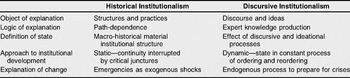
The remaining task is to develop a theoretical understanding that more thoroughly explains the dynamics of emergency statebuilding over time. In an effort to address these shortcomings, in this section I propose discursive institutionalism (refer to table 2). This perspective explains institutional change by reference to discourse and ideas. Instead of conceptualizing the state as a material structure subject to reorganization only during extraordinary periods, I argue that the state is an effect of discursive and ideational processes, and that expert knowledge about how to deal with crises can lead to important developments in state institutions. Discursive institutionalism is not an entirely opposing theory; in showing how discourse and ideas are endogenous to statebuilding, it can be used to bolster the findings of existing models. But it also, more significantly, helps to identify aspects that have been given insufficient attention by models that do not foreground discourse and ideas, specifically the role of national planning to continuously prepare the state for emergencies.
Emergencies and state development

Source: Adapted from Schmidt Reference Schmidt2010, table 1, 5.
Discursive Institutionalism and Emergency Statebuilding
Discursive institutionalism provides a useful starting point to work through the limitations of the prevailing models. Vivien Schmidt first proposed discursive institutionalism as an alternative approach to the existing frameworks of institutional development in American, comparative, and international politics. She laments, in particular, the apparent inability of historical institutionalism and other perspectives to explain change without relying on exogenous factors. The bulk of the “new institutionalisms” literature brings in discourse and ideas as the primary sources of change while inadequately theorizing these processes. Schmidt’s discursive institutionalism is intended specifically to view discourse and ideas as endogenous to these institutional dynamics. Footnote 72
Schmidt offers two important advances. First, institutions are seen not only as the settings within which actors produce meaningful political action but also as constituted through processes that grant them legitimacy. In contrast to historical institutionalism, which understands institutions merely as path-dependent material structures that constrain actors, Schmidt writes that discursive institutionalism “treats institutions as given (as the context within which agents think, speak, and act) and as contingent (as the results of agents’ thoughts, words, and actions). These institutions are therefore internal to the actors, serving both as structures that constrain actors and as constructs created and changed by those actors.” Footnote 73 With this understanding, secondly, discourse and ideas not only account for the stickiness of institutions but also change. Discourse and ideas are unsettled, open to revision; and as constitutive processes of institutional development, these changes can destabilize the apparent solidity of a given structure. Rather than exogenous critical-juncture periods, Schmidt writes, “for discursive institutionalists these moments are the objects of explanation through ideas and discourse, which lend insight into how the historically transmitted, path-dependent structures are reconstructed.” Footnote 74
These basic insights may be fruitfully extended to the issue of emergency statebuilding. Instead of conceptualizing the state as a material institutional structure whose stability is disrupted by exogenous shocks, discursive institutionalism views the state as an effect of discursive and ideational processes. This understanding echoes the insights of a long line of theorists—from Pierre Bourdieu, Michel Foucault, and Weber to the recent contributions of Timothy Mitchell and James Scott, among others. Discourse and ideas give meaning to the state, and they orient social activity towards the state as a material structure, based on the belief in the legitimacy of the rules that underlie its authority. The intersubjective meaning of state legitimacy, Weber tells us, is “one of the important aspects of the existence of a modern state,” because “the action of various individuals is oriented to the belief that it exists or should exist, thus that its acts and laws are valid in the legal sense.” Footnote 75
The state, from this view, takes a material form only through the social processes that constitute it as an existing structure with normative legitimacy. In this sense, it exists both as a material force and as a construct. The state institutional structure and the idea of the state, Mitchell clarifies, are part of the same process: “The phenomenon we name ‘the state’ arises from the techniques that enable mundane practices to take on the appearance of an abstract, nonmaterial form. Any attempt to distinguish the abstract or ideal appearance of the state from its material reality, in taking for granted this distinction, will fail to understand it.” The theoretical task, he concludes, “is not to clarify such distinctions but to historicize them.” Footnote 76
Ideas constitute the modern state in another way. All modes of state rule, as Foucault and Scott remind us, require knowledge about the state and its inhabitants. Footnote 77 With the creation of information about national resources, expert knowledge brings certain objects into sharper relief for the purpose of exercising administrative control through the state. Maps, censuses, and public opinion polls are just a few examples of the countless attempts to generate static facts for this purpose. Consider also the importance of accurate statistics about the functioning of the national economy and industrial production for wartime mobilization, which are unnoticed altogether by the historical narratives outlined above. These ideas constitute vital state developments, and they significantly enhance officials’ capacities to govern social life—from the banal to the extraordinary.
We can further outline, in logical terms, the different impacts that discourse and ideas may have on emergency statebuilding, by locating the processes through which the boundaries of a crisis are drawn and redrawn. Discourse names emergencies as threats that must be managed. This may be related to traditional security issues like war or economic depression, as the given models assume, yet is not limited to these types. U.S. officials have identified a much wider array of national problems that require government management, such as natural disasters and epidemics. Ideas help officials understand these emergencies and propose the best form of institutional development to deal with them. Expert knowledge can inspire not only responsive measures to address existing threats but also preparatory and preventive actions to transform state institutions before an emergency occurs. Footnote 78
This view of emergency statebuilding necessarily emphasizes historical contingency. Models should not assume from the outset what constitutes a national emergency, nor should they reify the modes of state power, the role of legality, or the processes of statebuilding in crises. Nevertheless, this is precisely what happens when analysts adhere to historical institutionalism, which reinforces problematic dichotomies—strong versus weak state, dictatorship versus limited government, legal versus extralegal powers, norm versus emergency. In direct contrast to this mode of theorizing, discursive institutionalism expands our analytical perspective to trace the contingent, ongoing processes through which political actors construct crises as objects of government management and rebuild state institutions to govern these apparent security threats.
U.S. Emergency Statebuilding: A Fourth Cut
Since it centers on the importance of context, this perspective can be used to support the findings of the prevailing models. For the PES model, it can demonstrate how presidents employ official discourse to name political enemies as existential threats and to justify the use of illiberal security practices. For the NSS model, it can illuminate how administrations cite the legal reasoning of past periods of emergency rule as a way to expand executive autonomy in the present. And for the CS model, it can show how normative claims against state growth and dictatorial rule in the United States stem from specific interpretations of the rule of law, separation of powers, and federalism. Yet rather than predefining the approach to crisis governance and institutional development, discursive institutionalism emphasizes the contextual forces that inspire emergency statebuilding in these various ways, and it establishes discourse and ideas as integral to these processes.
This approach, more crucially, expands existing analytical boundaries to recognize alternative modes of emergency statebuilding that go overlooked by historical-institutionalist models, which neglect the role of discourse and ideas. The transformation from temporary crisis government in WWI to enduring emergency measures after WWII, in particular, can be understood as a result of the rising influence of expert knowledge during and after the New Deal. In response to the economic downturn of the early 1930s, socioeconomic and public administration experts in the FDR administration proposed novel ideas about national planning, which helped create a state institutional system with the capacity to manage a range of emergencies without the need for further ad hoc measures. Planning incorporated future emergency needs into the existing institutional system, so that further expansions of executive power were unnecessary to deal with crisis conditions. Footnote 79
Experiments in planning laid the foundation for a shift from temporary crisis governance to preparatory emergency management. Beginning with the creation of the National Planning Board in the executive branch in 1933, planning experts such as Frederic Delano, Charles Merriam, and Wesley Mitchell advised officials on how to manage national social problems like mass unemployment without resorting to dictatorial measures or relying on the limited schemes of liberal anti-statism. Footnote 80 They insisted that national planning offered an innovative, systemic approach to view state resources, both natural and human, within the structure of the nation as a whole; and they expanded government capacities to govern security issues through advances in data collection and statistical generation along these lines. Based on this structural perspective, the board members were in a position to examine the more pressing problems of economic crisis and executive branch organization in a different light.
While outside the narratives of the prevailing models, these ideational changes proved remarkable. On the one hand, macroeconomic planning enabled New Deal policymakers to identify specific problem areas prior to full-scale crisis and to initiate targeted reforms that facilitated economic growth. Economic advisors, including Gardiner Means, Wesley Mitchell, Lauchlin Currie, and Marriner Eccles, recommended deficit spending as a way in which leaders could redistribute income to consumers without absolutist interventions or unwieldy business cooperation. Footnote 81 On the other hand, national planning reformed the institution of the presidency. Public administration experts in the President’s Committee on Administrative Management, led by Louis Brownlow, Charles Merriam, and Luther Gulick, promoted planning as a democratic approach to prepare the state for emergencies before threats materialized so further expansions in executive power were unnecessary. With the creation of the Executive Office of the President in 1939, the presidency became the primary system with the administrative resources and flexibility to manage crises within existing constitutional boundaries. Footnote 82
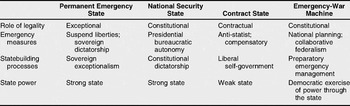
These developments similarly informed preparations for WWII mobilization and civil defense. National planning precluded the reliance solely on dictatorial executive authorities and compensatory measures, and instead gave Roosevelt the resources to continually reorganize the executive branch in preparation for impending war emergencies. Mobilization was managed through the creation of an innovative institutional system in the Office for Emergency Management. Footnote 83 This structure functioned as an emergency-war machine, designed to coordinate the activities of local, state, and regional actors. It did not require consolidated powers but rather facilitated a collaborative, dynamic federalist approach to statebuilding. Leaders formed crucial ties with local and state communities—both governmental and non-governmental—to devise plans to protect civilians and secure vital industrial facilities against sabotage, air-raid bombings, and other attacks. And industrialists’ voluntary efforts were coordinated within this wider government mobilization system to prevent redundancies and bottlenecks.
Innovations in preparatory emergency management at these times facilitated a crucial break from the prevailing models of emergency statebuilding (refer to table 3). By integrating future crisis needs into the policymaking space of the present, planning obviated the need for temporary measures. Unlike the PES model, this approach prepared the state for emergencies so extraconstitutional expansions of executive authority were no longer necessary to deal with national crises. In contrast to the NSS model, planning aided in the construction of a federal organizational system that could collaborate with local and state governments, as well as non-governmental actors, without the use of dictatorial controls. And by comparison with the CS model, it did not restrain statebuilding but rather reordered the American state to address the many limitations inherent to laissez-faire practices.
Alternative models of emergency statebuilding

Tracing this line further, one comes to a more nuanced historical understanding. Preparatory emergency management, as Stephen Collier, Andrew Lakoff, and Patrick Roberts all demonstrate, transformed the American state in the shadows of nuclear threat during the Cold War and terrorism following 9/11. Footnote 84 Alongside the typical story of the national security state apparatus established after WWII with the constitutional authority to permanently mobilize for war, the Truman administration sought to prepare the state for a potential nuclear attack through the Office of Defense Mobilization. From within this institutional setting, experts constructed technocratic plans for how the population and industrial centers could endure the projected impacts of a potential nuclear attack through civil defense preparations. Repurposing the WWII mobilization administrative machinery, the Federal Emergency Management Agency was later created as an institutional system that could be called into action in the event of a natural disaster to coordinate state and non-state actors.
This thread of institutional development continues to shape post-9/11 statebuilding. In order to reduce the devastating effects of a future terrorist attack or natural disaster, the Department of Homeland Security was established as a home for risk-assessment experts to determine the resilience of existing institutions, economic hubs, and other vital systems, and to propose solutions to inefficiencies before another crisis. Footnote 85 The department coordinates numerous agencies, including the Federal Emergency Management Agency, with a variety of preparatory mandates—ranging from disaster preparedness to infrastructure protection to cybersecurity defense. These efforts share important aspects of the New Deal, WWII, and Cold War lineage to plan for emergencies so that temporary emergency statebuilding is no longer required. Thus, what appears to many as a solidified American state permanently embedded with executive dictatorial powers is actually maintained through processes designed to continuously prepare the state before crises occur.
Bringing Social Construction into Institutional Development
Working from the recent directive to place post-9/11 within a broader historical context, I have constructed three models of emergency statebuilding, each of which produce compelling narratives of U.S. history—spanning all the way from WWI to the “war on terror.” Along with adding analytical clarity to these interpretations, I uncover that they all share the underlying perspective of historical institutionalism. This view, simply put, assumes that extended periods of institutional stability are interrupted by brief episodes of change, brought on by exogenous shocks. These moments of upheaval strike a new equilibrium which, in turn, becomes path-dependent.
A persistent criticism of historical institutionalism, however, is that it is better at explaining continuity than change. By focusing on discontinuous moments of crisis government, accepted accounts inadequately explain important variations across time. More specifically, without theorizing the role that discourse and ideas play in constructing security threats and proposing solutions, analysts are unable to answer crucial questions about how the processes of U.S. emergency statebuilding have varied over the past century. I argue that discursive institutionalism does a better job of accounting for the impact of emergencies on institutional change. By bringing social construction into models of emergency statebuilding, this perspective not only contributes to ongoing debates about institutional development but also reveals important aspects of the post-9/11 American state.
One of the principal implications laid out here is that planning expertise can influence statebuilding in ways that make emergencies endogenous. National emergencies, such as war, economic depression, and terrorist attacks, are not simply exogenous shocks that cannot be incorporated into the pre-existing institutional and legal structure of the state. Rather, they have become part of the ongoing processes of statebuilding through discourse and ideas about preparatory emergency management. Discursive institutionalism helps unearth an all but overlooked path of American state development, whereby planning knowledge prepares institutions to govern the catastrophic potential of crisis conditions before they happen. This is a critical intervention in the emergency statebuilding literature, and it updates our conception of crisis to better reflect historical developments.
Discursive institutionalism, at the same time, casts post-9/11 statebuilding in a different light than more structural accounts. Above all, it recovers the importance of agency. When scholars conceive of national emergencies purely as exogenous shocks, they minimize the influence of political actors in shaping institutional change. The emergency in itself is said to determine the form of state development required. Following this logic, the unprecedented threat of terrorism arguably necessitated a total transformation of state institutions. Discursive institutionalism allows us to move beyond this assumption, and instead locates the sources of both historical continuity and incremental change. Footnote 86 It shows how the construction of the terrorist threat influenced institutional development in different ways. Rather than assuming that everything changed after 9/11, this perspective inspires more nuanced inquiries: Why have some past institutional arrangements been reformed or dismantled altogether while others have been fitted into the post-9/11 system? And why has it become so easy for so many—elites, citizens, and scholars alike—to believe that “after 9/11 everything changed”?
On the one hand, it is clear that the domestic surveillance apparatus created promptly after the terrorist attacks was groundbreaking. Never before has there been such rampant spying on the American public. Indeed, earlier legal statutes were designed specifically to minimize the information that could be gathered on U.S. citizens. The Foreign Intelligence Surveillance Act of 1978 (FISA) was the main piece of legislation concerning domestic surveillance measures to detect foreign threats. FISA required government officials to obtain search warrants through the Foreign Intelligence Surveillance Court, designed specifically for this task. In response to the attacks on 9/11, leaders in the George W. Bush administration set out to redraw these legal boundaries. Officials found existing laws obsolete, slow, and ineffective to sufficiently quell the new threats posed by terrorism; and in an effort to speed up counterterrorism measures, they pushed the USA PATRIOT Act through Congress to outline appropriate measures for surveillance. The act significantly altered existing FISA warrant requirements and standards for gathering intelligence, and was designed in large part to revolutionize the flow of information across counterterrorism organizations by dismantling institutional barriers between domestic law enforcement and national intelligence agencies.
Yet on the other hand, there are areas where institutional development occurred more incrementally. Certain pre-existing institutional systems for crisis governance were subject to more gradual changes than demonstrated by domestic surveillance. The apparatus created for homeland security, most notably, shares the institutional lineage designed to prepare the state for catastrophes ahead of time. Past institutional structures, especially the Federal Emergency Management Agency, were not utterly transformed but were converted into a new system for protecting infrastructure against terrorism through the Department of Homeland Security. The main takeaway here is that the emergency itself does not determine the form of institutional change. This is, rather, a consequence of the social construction of the threat and how the proposed solutions for managing it fit within pre-existing institutions.
In addition to emphasizing the contingent processes of institutional stability and change, discursive institutionalism bolsters our understanding of the legality of illiberal security measures like torture. When critics of post-9/11 maintain that torture is extraconstitutional, they discount the work that went into legalizing torture as a legitimate form of intelligence gathering. Advisors in the Office of Legal Counsel—namely, Jay Bybee, Robert Delahunty, John Yoo, and Patrick Philbin—were integral to specifying the constitutional bases of torture during the Bush administration. They insisted that information gained from suspected terrorists could be used to prevent another imminent attack. The infamous “Bybee Memo” redefined what constituted torture, setting a much lower threshold for the legality of repressive tactics and bodily harm. What is more, advisors explicitly based their justifications on a specific interpretation of the Geneva Conventions treaty regarding the appropriate treatment of prisoners of war. They redefined the status of terrorist suspects as enemy combatants who are not granted the Geneva protections against extreme interrogations. Far from being extralegal, these discursive practices served to incorporate torture into the normal constitutional order.
With these developments in mind, we need to rethink prevailing conceptions of the modern American state. The primary analytical objective moving forward should not be to trace the historical development of a single state structure in the form of a permanent emergency state, national security state, or contract state. On the contrary, it is essential to uncover variation in administrative configurations across time and across issue areas. This basic insight shatters the assumption that there is a unified American state, and alternatively stresses the multiplicity of institutional arrangements and state structures designed for crisis governance, before and after 9/11—all of which may be subject to the forces of stability and change in diverse ways. Only in striking a balance between these two extremes can we hope to counteract the social and political turmoil unleashed in times of grave national emergency. As C.S. Lewis so elegantly put it: “Mere change is not growth. Growth is the synthesis of change and continuity, and where there is no continuity there is no growth.” Footnote 87