Introduction
Lichens are dominant members of the terrestrial flora of Antarctica and the sub-Antarctic islands with, to date, ~450 species being recorded (Øvstedal & Smith Reference Øvstedal and Smith2001). The lichen flora of Continental Antarctica, with ~150 species, is somewhat less diverse than that of the generally milder and wetter Maritime Antarctic, where ~250 species are recorded (Convey Reference Convey2017).
While being well-known for their ability to survive extreme environmental conditions, lichens are also very sensitive to changes in environmental factors. Monitoring studies at various Antarctic locations have demonstrated that changes in climatic factors (temperature, humidity and insolation), as well as direct anthropogenic and some indirect ecological impacts, significantly affect the growth and development of lichens and the biodiversity of lichen communities (Øvstedal & Smith Reference Øvstedal and Smith2001, Convey & Peck Reference Convey and Peck2019, Sancho et al. Reference Sancho, Pintado and Green2019).
The evolutionary success of lichens across multiple environments typified by different combinations of often extreme environmental stresses is indicative of their various adaptive strategies. These have been the focus of considerable research effort, particularly in the study of the physiological adaptation of lichens in Antarctica (e.g. Kappen Reference Kappen2000, Sadowsky & Ott Reference Sadowsky and Ott2016, Armstrong Reference Armstrong, Shukla, Kumar and Kumar2017). In considering the mechanisms of lichen adaptation to extreme conditions it is appropriate to take into account diverse features of their biology, from the morphometric and ecophysiological to the molecular and biochemical. Such an integrated approach is needed to improve our understanding and prediction of lichen responses to the challenges posed by climate change and other direct anthropogenic impacts. It will also allow the development of methodologies to assess and monitor the condition of lichens over time, potentially giving early warning of deleterious changes before more drastic signs of biodiversity change become apparent.
As lichens are used as bioindicators in monitoring the ecological state of the environment, many studies have been devoted to their physiology, as well as the morphometric and elemental analysis of thalli influenced by gradients of different factors, including anthropogenic impacts such as climate change and pollution (Sanchez-Hernandez Reference Sanchez-Hernandez2000, Nash Reference Nash and Nash2008). Considerable data are available relating to various aspects of metabolism in lichens, including fundamental studies of nitrogen metabolism (Millbank & Kershaw Reference Millbank, Kershaw, Ahmadjian and Hale1973), carbon metabolism (MacFarlane & Kershaw Reference MacFarlane, Kershaw and Brown1985) and secondary metabolism (Huneck & Yoshimura Reference Huneck, Yoshimura, Huneck and Yoshimura1996). Against this background, knowledge of the physiology and biochemistry of Antarctic lichens remains fragmentary, mainly related to the study of growth, photosynthesis and respiration (Kappen et al. Reference Kappen, Bölter and Kühn1986, Schroeter et al. Reference Schroeter, Kappen, Green, Seppelt, Lyons, Howard-Williams and Hawes1997, Balarinová et al. Reference Balarinová, Barták, Hazdrová, Hájek and Jílková2014), as well as the elemental composition of certain species, in particular of Usnea spp. (Osyczka et al. Reference Osyczka, Dutkiewicz and Olech2007, Lim Reference Lim2009, Bubach et al. Reference Bubach, Catán, Di Fonzo, Dopchiz, Arribére and Ansaldo2016, Rivera et al. Reference Rivera, Catan, Fonzo, Dopchiz, Arribere and Ansaldo2018). To date, insufficient information is available regarding the chemical composition or metabolic status of most lichens in Antarctica.
In this study, we expanded the range of Antarctic lichens studied to include representatives with different ecological tolerances from the families Parmeliaceae Zenker, Physciaceae Zahlbr., Ramalinaceae C. Agardh and Umbilicariaceae Chevall., obtained from locations in the Maritime and Continental Antarctic.
The species studied represent endemic Antarctic, bipolar and cosmopolitan taxa including Usnea aurantiaco-atra (Jacq.) Bory (South American-Antarctic species), Ramalina terebrata Hook. f. & Taylor and Thamnolecania brialmontii (Vain.) Gyeln. (Antarctic endemic species), Usnea sphacelata R. Br., Umbilicaria aprina Nyl. and Umbilicaria decussata (Vill.) Zahlbr.) (bipolar Arctic-alpine-Antarctic species) and Physconia muscigena (Ach.) Poelt and Physcia caesia (Hoffm.) Hampe ex Fürnr. (bipolar and cosmopolitan species) (Golubkova et al. Reference Golubkova, Savicz and Simonov1968, Andreev Reference Andreev1988, Øvstedal & Smith Reference Øvstedal and Smith2001, Lee et al. Reference Lee, Lee, Hur, Andreev and Hong2008). These species were pragmatically selected based on having relatively large foliose or fruticose thalli and their local abundance, allowing for ease of collection of sufficient biomass with minimal environmental impact. Some of these species (U. aurantiaco-atra, U. sphacelata, U. aprina, U. decussata) are widely used as bioindicators (Upreti & Pandev Reference Upreti and Pandev1994, Smykla et al. Reference Smykla, Szarek-Gwiazda and Krzewicka2005, Lim Reference Lim2009, Li et al. Reference Li, Kromer, Schukraft, Bubenzer, Huang, Wang, Bian and Li2014).
The aim of the current study was to assess the elemental contents, lichen compounds and photosynthetic pigment contents as well as antioxidant status of lichens collected from areas on King George Island (Maritime Antarctic) and the Thala Hills (Enderby Land, Continental Antarctic). These data will provide baseline information about levels of trace elements and other compounds that may provide useful indicators of future changes in Antarctica.
Materials and methods
Sampling
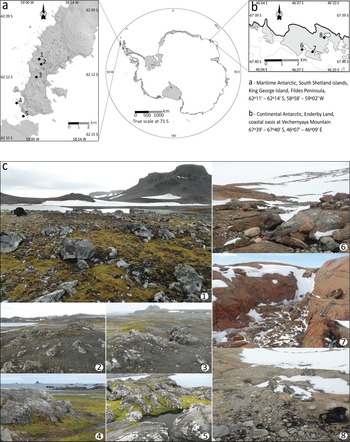
Maritime Antarctic lichens were collected by M. Andreev on the Fildes Peninsula in the vicinity of the Russian Antarctic Station ‘Bellingshausen’ (King George Island, South Shetland Islands) in the summer of 2017/2018 during the 63rd Russian Antarctic Expedition (Fig. 1, sites 1–5). Continental Antarctic lichens were collected by Y. Hihinyak at the coastal oasis of Vechernyaya Mountain (Enderby Land) in the vicinity of the Russian Antarctic Station ‘Molodezhnaya’ in the summer of 2016/2017 during the 9th Belarussian Antarctic Expedition (Fig. 1, sites 6–8).
Lichen sampling areas in Antarctica. a. Sites in the Maritime Antarctic (Fildes Peninsula, King George Island) (source: http://www.kgis.scar.org/; ©SCAR, IPG Universität Freiburg, 13.2.2007 with addition of M. Andreev, Reference Andreev and Budantsev2018). b. Sites in the Continental Antarctic (Vechernyaya Mountain, Enderby Land) [D. Lukashanets]. c. Collection locations: 1–5 - in the Maritime Antarctic (collected by M. Andreev); 6–8 - in the Continental Antarctic (collected by Y. Hihinyak). For details, see the main text.

King George Island is the largest island of the South Shetland Islands archipelago in the Maritime Antarctic (Osyczka & Olech Reference Osyczka and Olech2005). The archipelago is separated from the northern Antarctic Peninsula by ~120 km across the Bransfield Strait. Fildes Peninsula is located in the south-western part of King George Island and is the largest ice-free area on the island. The climate of the South Shetland Islands is characterized as cold moist maritime, and Fildes Peninsula has a mean annual air temperature of -2.11°C (Braun et al. Reference Braun, Mustafa, Nordt, Pfeiffer and Peter2012, Li et al. Reference Li, Kromer, Schukraft, Bubenzer, Huang, Wang, Bian and Li2014). Precipitation occurs mainly in summer, mostly as rain in recent years, with an annual total of 350–500 mm year-1 water equivalent (Michel et al. Reference Michel, Schaefer, Simas, Poelking and Fernandes-Filho2010). Aspects of the underlying geology of this region are outlined by Williams et al. (Reference Williams, Borchhardt, Colesie, Baum, Komsic-Buchmann and Rippin2016).
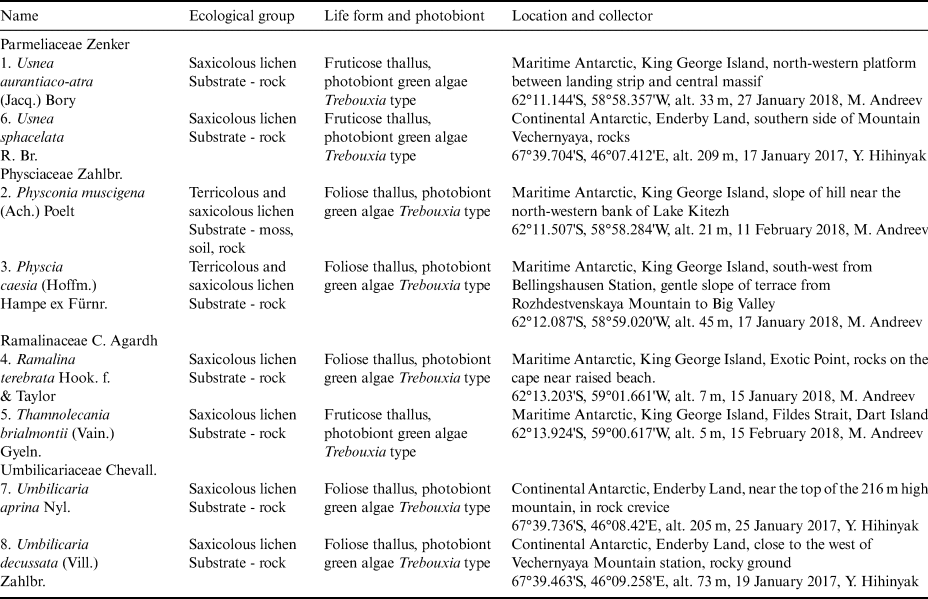
The Vechernyaya Mountain oasis lies within the Thala Hills in the western part of Enderby Land (Continental Antarctica). The local climate is harsh due to the strong catabatic winds blowing off the continent and is characterized by low temperatures and low humidity. The neighbouring Molodyozhnaya Station (20 km distant) has a mean annual temperature of approximately -11°C and total annual precipitation of ~270 mm water equivalent. Average precipitation between March and September (winter) is 48–71 mm water equivalent, while the summer months of December and January are the driest months (Dolgikh et al. Reference Dolgikh, Mergelov, Abramov, Lupachev, Goryachkin and Bockheim2015, https://atslib.omeka.net/items/show/9080). The underlying geology of this region is described by Vlček et al. (Reference Vlček, Pospíšilová and Uhlík2017). Summary details of lichen species and their collection locations are given in Table I.
Ecological characteristics of the Antarctic lichen species sampled in this study (for coding purposes, the numbers allocated to each lichen correspond with their sampling location numbers in Fig. 1).

Most of the lichens studied were saxicolous, characterized by a foliose or fruticose habitus. Saxicolous lichens had greater representation in the more severe Continental Antarctic, with the proportion of terricolous species being greater in the Maritime Antarctic. For analyses, at least 20 thalli of each lichen species of approximately the same size were used. Lichen samples were prepared by cleaning from physical impurities, then drying them for 7 days at a temperature of 18–24°C.
Elemental assay
The contents of macronutrients and micronutrients (Ca, K, P, Mg, Na, Mn, Fe, B, Zn), as well as of the toxic elements Cu and Hg, were evaluated using inductively coupled plasma atomic emission spectrometry on an Optima 2100 DV ICP spectrometer (PerkinElmer, Inc., USA). The contents in the samples were evaluated using an automated atomic absorption spectrometer FIMS 100 (PerkinElmer Inc., USA) with an integrated flow-injection system. Cd and Pb contents were quantified using a ZEEnit 700 P atomic absorption spectrometer (Analytik Jena AG, Germany). For this, acid mineralization of crushed dry lichen thalli was first carried out using a microwave acid mineralization system CEM MARS 6 (CEM, USA). The N content was evaluated with the Kjeldahl method (RosStandart Reference RosStandart.2011) using partially automated systems including a Kjeltec 2020 Digester (Foss Tecator, Sweden) and a Kjeltec 2100 Distillation Unit (Foss Tecator, Sweden). All analyses were carried out using the standard protocols established by the respective manufacturers. The results were expressed as μg/g dry weight.
Photosynthetic pigment analyses
Photosynthetic pigments including chlorophyll a and chlorophyll b (chl a and chl b), phaeophytin a and phaeophytin b (phaeo a and phaeo b) and carotenoids (neoxanthin, violaxanthin, lutein, β-carotene) in lichen samples were determined using a Prominence LC 20 high-performance liquid chromatograph (HPLC; Shimadzu, Japan) with a Nucleodur C18 gravity chromatography column (type C18, particle size 3 μm, length 15 cm; Macherey-Nagel, Germany). The selection, separation and identification of pigments were carried out following Forni et al. (Reference Forni, Ghezzi and Polesello1988), modified for lichen samples.
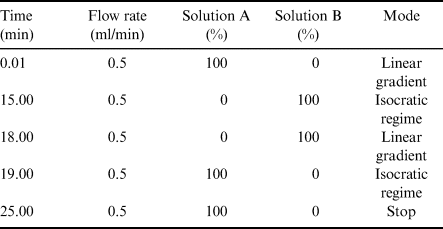
Pigments were extracted using alkaline acetone (100% acetone + 0.4% NH4OH in a 9:1 ratio) under shaded conditions, homogenizing 0.1 g of pre-ground dry thallus in a porcelain mortar. The homogenate was centrifuged for 5 min at 17,000 × g in a Heraeus Pico 17 centrifuge (Thermo Fisher Scientific, Inc., USA). Then, the supernatant was transferred to volumetric tubes and the pellet was washed with alkaline acetone. The washing procedure was repeated until the pigments were completely removed. The residual pigments were assessed using a UV PB2201 spectrophotometer (SOLAR, Belarus). The pigments were then separated on a chromatograph column using solutions A (90% acetonitrile; 9.9% H2O; 0.1% triethylamine) and B (100% ethyl acetate) with a flow rate of 0.5 ml/min following the programme presented in Table II. Pigments were quantified using an SPD-M20A spectrophotometric detector with a diode array in the range 200–800 nm (Shimadzu, Japan).
Programme for the separation of photosynthetic pigments on a Nucleodur C18 Gravity chromatographic column.

The chromatogram profile was visualized by absorption spectra at 440 nm (for chl a, chl b and carotenoids) and at 410 nm (for phaeo a and phaeo b). All pigments were quantified by assessing chromatogram peak areas and coefficients obtained for each pigment using standards.
The calculation of the pigment content used the formula in Eq. (1):
 $$C_{{\rm pigm}} = {\rm }\left( {S_{440} \times F_{{\rm pigm}} \times V} \right)/\left( {V_{{\rm injection}} \times m} \right)$$
where C pigm is the pigment content (μg/g dry weight), S 440 is the absorption peak area at 440 nm, F pigm is the coefficient for calculation, V is the supernatant volume, V injection is the injection volume (50 μl) and m is the mass of the sample (in g).
Analyses of the composition and content of lichen substances
Ten milligrams of pre-ground dry thalli were extracted using 1 ml of acetone with constant stirring for 24 h at a temperature of 20–25°C. Separation and identification of lichen substances in the extracts were carried out by HPLC using a Milichrome A-02 chromatograph (EkoNova, Russia) with a 2 × 75 mm ProntoSILC18 AQ reversed-phase column (120 Å, 5 μm).
We used an 0.1% aqueous solution of acetic acid as the mobile phase ‘A’ and acetonitrile as ‘B’ in the gradient elution regime, with an increasing proportion of ‘B’ from 10% to 50% for 5 min and from 50% to 100% for 20 min at a flow rate of 100 μl/min and a column temperature of 40°C. Detection was carried out at wavelengths of 210, 230, 240, 260 and 280 nm.
Identification of lichen substances was carried out using a chromatogram comparing the retention times and spectral ratios of the peaks obtained with the peaks of lichen substance standards from the collection of the Komarov Botanical Institute (St Petersburg, Russia). Results were expressed as mg/g dry weight.
Antioxidant activity assay
The antioxidant capacity of the lichen samples was measured using the photochemiluminescence method (Besco et al. Reference Besco, Braccioli, Vertuani, Ziosi, Brazzo, Bruni and Manfredini2007) and an antioxidant analyser Photochem® (Analytik Jena AG, Germany) with standard kits for water-soluble antioxidative capacity (ACW) and lipid-soluble antioxidative capacity (ACL) determinations. Photochemiluminescence determination of water- and lipid-soluble antioxidative capacity in lichen extracts (AW and AL, respectively) was achieved following the Photochem manufacturer's protocol for the determination of ACW and ACL in plant extracts (Analytik Jena AG Reference Analytik Jena2004) and following Pegg et al. (Reference Pegg, Amarowicz, Naczk, Shahidi, Shahidi and Ho2007). The results are presented as equivalents of ascorbic acid or Trolox® for AW and AL substances, respectively, and are expressed as μg/g dry weight.
Statistical analyses
All data are presented as mean values ± SD of at least three to five replicates. Student's t-test (α = 0.05) was used to identify significant differences. All statistical procedures were carried out using Excel.
Results
Element content in lichen thalli
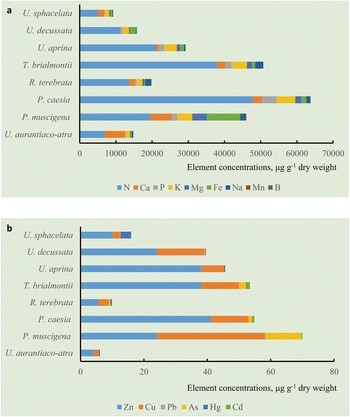
The thalli of the studied lichens contained a significant content of nitrogen and lower levels of the other elements assessed (Fig. 2). In descending order, the contents of the more abundant elements assessed in lichens from the Maritime Antarctic were N > Ca > K >Mg > Fe > P > Na, and from the Continental Antarctic they were N > K > Fe > Ca > P > Mg > Na (detailed element concentration data in each lichen species are given in Table S1).
Element concentrations in Antarctic lichen thalli. a. N, Ca, P, K, Mg, Fe, Na, Mn and B. b. Zn, Cu, As, Hg, Pb and Cd (note the different x-axis scales). Full concentration data are given in Table S1.

The studied species representing the genus Usnea (family Parmeliaceae) were compared to the remaining genera and families. Representatives of the families Physciaceae and Ramalinaceae were characterized by high nitrogen levels in their thalli. The thallus nitrogen concentration varied between species and ranged from 4970.0 μg/g dry weight (U. sphacelata) to 37,920.0 μg/g dry weight (T. brialmontii) and 47,740.5 μg/g dry weight (P. caesia). Relatively high contents of a number of toxic elements were notable in the thalli of P. caesia (Zn), P. muscigena (Cu, Pb, As, Mn), T. brialmontii (Cd) and Hg (U. sphacelata).
Photosynthetic pigments
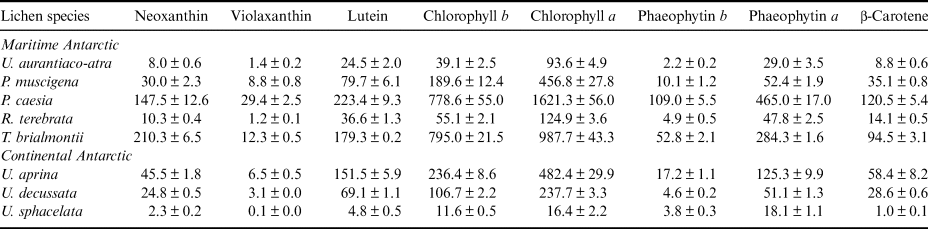
Our analyses did not reveal qualitative differences in the photosynthetic pigments present in the different lichen species studied (Table III), confirming that the studied lichens contain chl a, chl b, phaeo a, phaeo b and the carotenoids neoxanthin, violaxanthin, lutein and β-carotene.
Contents of photosynthetic pigments in lichen thalli from the Maritime Antarctic and Continental Antarctic (μg/g dry weight; n = 3 for each lichen species).

There was variation in contents of chl a and chl b in the lichen samples studied. Contents of chl a ranged from 16.4 μg/g dry weight (U. sphacelata) to 1621.3 μg/g dry weight (P. caesia). Those of chl b ranged from 11.6 μg/g dry weight (U. sphacelata) to 795 μg/g dry weight (T. brialmontii). The chl a/chl b ratios measured in our study were in the range from 1.2–1.4 (T. brialmontii, U. sphacelata) to 2.0–2.4 (all other species).
Phaeophytin is a degradation product of chlorophyll in which the Mg2+ ion is replaced by two protons. Total phaeophytin content was very high in U. sphacelata thalli (21.9 μg/g dry weight) relative to chlorophyll content (28 μg/g dry weight), indicating considerable chlorophyll degradation in the samples of this species. This was further supported by the low ratios of chl a/chl b (1.4) and chl a/phaeo a (0.9) in comparison with those of the other lichen species sampled.
Significant variability in carotenoid content in the lichen thalli was also observed. The highest concentrations were present in samples of T. brialmontii and P. caesia from the Maritime Antarctic (496.4 and 520.8 μg/g dry weight, respectively), and the lowest concentration was in U. sphacelata from the Continental Antarctic (8.2 μg/g dry weight).
The carotenoid pools of the studied lichens were dominated by xanthophylls, mostly lutein (> 50%), although with lower proportions in U. decussata (29.7%), T. brialmontii (36%) and P. caesia (42.9%). Neoxanthin, violaxanthin and β-carotene contents varied from 10.7% (U. decussata) to 42.4% (T. brialmontii), from 1.2% (U. sphacelata) to 5.7% (P. caesia) and from 12.2% (U. sphacelata) to 23.0% (P. muscigena), respectively.
Lichen substances
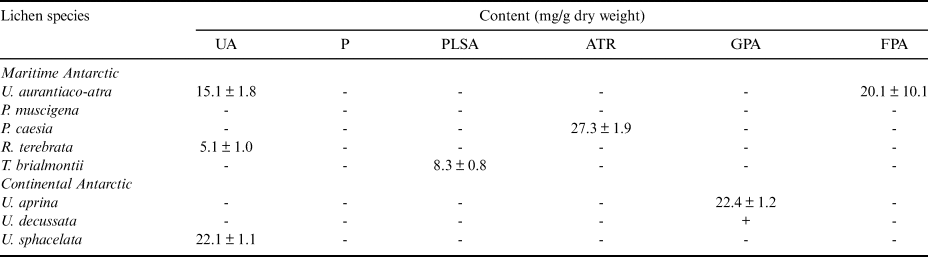
In the studied lichen thalli we found species-specific lichen substances (Table IV). We identified usnic acid in U. aurantiaco-atra, U. sphacelata and R. terebrata. U. aurantiaco-atra thalli contained fumarprotocetraric acid in addition to usnic acid. The main aromatic compound present in P. caesia was atranorin. Gyrophoric acid was present in U. aprina and, to a lesser extent, in U. decussata. No aromatic compounds were detected in P. muscigena. Finally, we identified protolichesterinic acid in T. brialmontii.
The composition and content (mg/g dry weight) of lichen substances present in the studied Antarctic lichen species (n = 3 for each lichen species).

UA = usnic acid; P = parietin; PLSA = protolichesterinic acid; ATR = atranorin; GPA = gyrophoric acid; FPA = fumarprotocetraric acid; + = lichen substances content < 1 mg/g of dry weight; - = lichen substances were not detected.
Antioxidant status
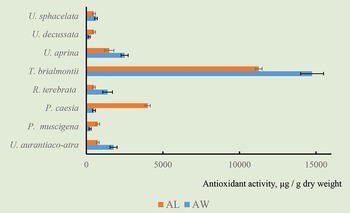
We investigated the antioxidant activity of the hydrophilic (AW) and lipophilic (AL) fractions in lichen thalli (Fig. 3). The AW and AL values ranged from 250 μg/g dry weight (P. muscigena) to 14,740 μg/g dry weight (T. brialmontii) and from 500 μg/g dry weight (R. terebrata) to 11,260 μg/g dry weight (T. brialmontii) in samples from the Maritime Antarctic.
Antioxidant activity of lichen samples from the Maritime Antarctic and Continental Antarctic (AW and AL = water- and lipid-soluble antioxidative capacity in lichen extracts, respectively). For more details, see the main text and Table S2.

In the Continental Antarctic samples, these parameters ranged from 190 μg/g dry weight (U. decussata) to 2500 μg/g dry weight (U. aprina) and from 500 μg/g dry weight (U. sphacelata and U. decussata) to 1500 μg/g dry weight (U. aprina). The highest antioxidant activity was observed in the T. brialmontii thalli. Detailed antioxidant activity data for each lichen species are given in Table S2.
Discussion
Lichens, similarly to other poikilohydric organisms, are characterized by slow metabolism and growth and the absence of specialized organs for the absorption of nutrients. They possess the ability to take up all essential and non-essential compounds over their complete thallus surface, as well as to concentrate various elements from their immediate environment, including the atmosphere and their underlying substrate. Furthermore, some lichens can absorb and accumulate specific heavy metals, such as from airborne pollution (Tyler Reference Tyler1989, Garty Reference Garty2001, Nash Reference Nash and Nash2008, Bačkor & Loppi Reference Bačkor and Loppi2009).
The elemental composition of lichens integrates the influence of multiple factors. Neither the distribution nor the content of heavy metals in lichen thalli are uniform, and they can be influenced by factors including species-specific features of thallus morphology, anatomical, physiological and chemical parameters, age and degree of thallus adhesion to the substrate, etc. Environmental conditions such as pH, moisture, temperature and features of the underlying substrate can also play important roles in the lichen accumulation of different elements, including heavy metals (Garty Reference Garty2001, Li et al. Reference Li, Kromer, Schukraft, Bubenzer, Huang, Wang, Bian and Li2014, Rola et al. Reference Rola, Osyczka and Kafel2016, Armstrong Reference Armstrong, Shukla, Kumar and Kumar2017).
Heavy metals in Antarctica originate from both natural and anthropogenic sources. Natural sources include volcanic emissions, biogenic activity, biotic transfer from the marine environment, leaching of naturally occurring minerals, soil dust, etc. (Bargagli et al. Reference Bargagli, Battisti, Focardi and Formichi1993, Planchon et al. Reference Planchon, Boutron, Barbante, Cozzi, Gaspari and Wolff2002). Anthropogenic sources include the burning of waste and fuel and pollution events (Boutron & Wolff Reference Boutron and Wolff1989, Osyczka et al. Reference Osyczka, Dutkiewicz and Olech2007). The element content of lichen thalli can, therefore, reflect chemical features of the local environment, and this phenomenon has formed the basis of biomonitoring studies of environmental pollution (Garty Reference Garty2001, Smykla et al. Reference Smykla, Szarek-Gwiazda and Krzewicka2005, Nash Reference Nash and Nash2008, Lim Reference Lim2009, Rola et al. Reference Rola, Osyczka and Kafel2016).
However, there is no consensus regarding the relationship between the chemical composition of lichens and their underlying substrates (Bargagli et al. Reference Bargagli, Iosco and Barghigiani1987, Chettri et al. Reference Chettri, Sawidis and Karataglis1997, Bajpai & Upreti Reference Bajpai and Upreti2012), although it has been suggested that the elemental composition of crustose lichens is more dependent on the substrate than is the case for species with fruticose or foliose growth forms (Rola et al. Reference Rola, Osyczka and Kafel2016). According to Rivera et al. (Reference Rivera, Catan, Fonzo, Dopchiz, Arribere and Ansaldo2018), Antarctic foliose lichens possess a more pronounced ability to uptake elements compared with fruticose lichens. Our data provide some support for this suggestion, with the foliose species studied accumulating to a greater extent As and Fe, for example.
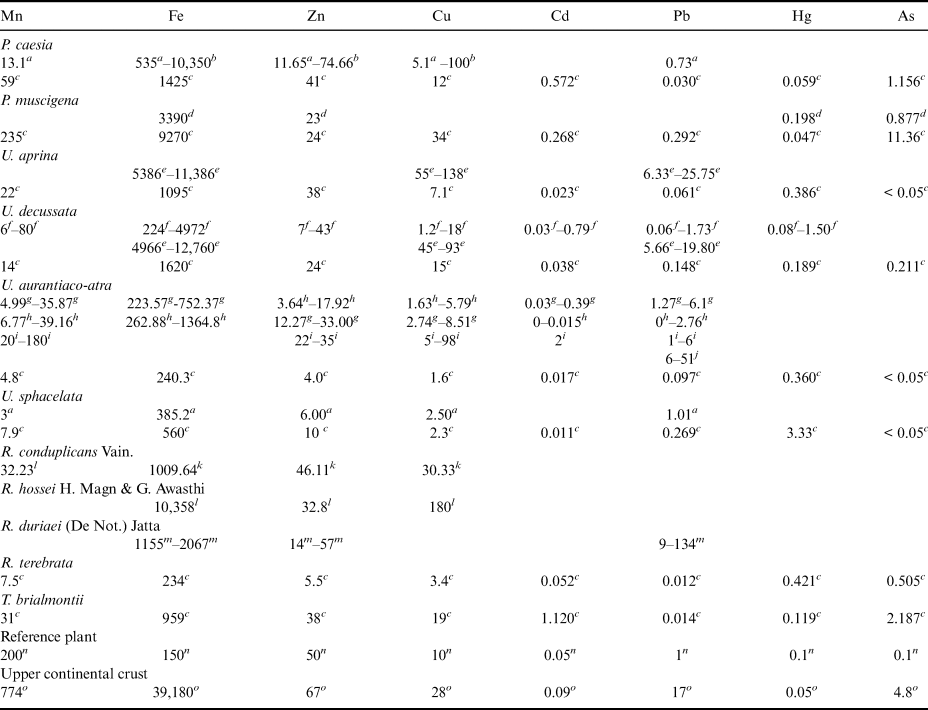
A comparison with previous studies of the data on the elemental composition of Antarctic lichen thalli obtained here is given in Table V. This indicates that the contents of Pb and Cu in the thalli of U. aprina and U. decussata were lower than in the same species sampled near Maitri Station in the Schirmacher Oasis (Upreti & Pandev Reference Upreti and Pandev1994). According to our data, the levels of the studied elements in U. decussata thalli were within the range reported for this species from Victoria Land in Continental Antarctica (Bargagli et al. Reference Bargagli, Borghini and Celesti2000).
Trace element contents (μg/g dry weight) in the studied lichens in comparison with data available in the literature.

a Kurchenko et al. (Reference Kurchenko, Bagmanyan, Myamin, Borodin and Giginyak2016); b Pandey & Upreti (Reference Pandey and Upreti2000); c This study; d Rivera et al. (Reference Rivera, Catan, Fonzo, Dopchiz, Arribere and Ansaldo2018); e Upreti & Pandey (Reference Upreti and Pandev1994); f Bargagli et al. (Reference Bargagli, Borghini and Celesti2000); g Smykla et al. (Reference Smykla, Szarek-Gwiazda and Krzewicka2005); h Pobelt et al. (Reference Poblet, Andradeb, Scagliola, Vodopivezd, Curtosid, Puccib and Marcovecchioa1997); i Osyczka et al. (Reference Osyczka, Dutkiewicz and Olech2007); j Olech et al. (1993); k Kambar et al. (Reference Kambar, Vivek, Manasa, Prashith Kekuda and Ramesh Kumar2014); l Praveen Kumar et al. (Reference Praveen Kumar, Prashith Kekuda, Vinayaka, Swathi, Mallikarjun and Nishanth2010); m Garty et al. (Reference Garty, Ronen and Galun1985); n Markert (Reference Markert1992); o Rudnic & Gao (Reference Rudnic, Gao, Holland and Turekian2003).
A similar pattern was observed for lichens sampled on the Potter Peninsula (Rivera et al. Reference Rivera, Catan, Fonzo, Dopchiz, Arribere and Ansaldo2018), where no Pb was detected in the thalli of P. muscigena, but a higher Hg content was noted. In our samples of this species collected on the same island, the presence of Pb and a higher content of As were confirmed (Table S1). The Hg content in the thalli of U. aurantiaco-atra previously reported from Potter Peninsula was a third (0.102–0.108 μg/g dry weight) of that found in the present study (Table S1). The contents of As and Pb in samples of U. aurantiaco-atra from Potter Peninsula were 0.66–0.13 and 1.9–2.6 μg/g dry mass, respectively, being greater than our data for this species (Table S1). Earlier studies conducted near the Argentinian Jubany (now Carlini) Station on King George Island (Poblet et al. Reference Poblet, Andradeb, Scagliola, Vodopivezd, Curtosid, Puccib and Marcovecchioa1997) found that this lichen species contained considerably higher concentrations of Mn, Pb, Zn and Cu than we recorded. In contrast, the Cd content recorded previously was half that of the samples analysed here (Table S1).
There do not appear to be data available on the elemental composition of Antarctic representatives of the family Ramalinaceae. Table V includes information about species in this family obtained in Israel and India. In our Antarctic samples of Ramalinaceae, the contents of Mn, Fe, Zn and Cu were considerably lower than in closely related Israeli and Indian species (Garty Reference Garty2001, Praveen Kumar et al. Reference Praveen Kumar, Prashith Kekuda, Vinayaka, Swathi, Mallikarjun and Nishanth2010, Kambar et al. Reference Kambar, Vivek, Manasa, Prashith Kekuda and Ramesh Kumar2014). We provide the first data on the 15 measured elements in the Antarctic species R. terebrata and T. brialmontii in this family, giving a baseline against which to study possible changes in the ecological state of this region. Our data also showed that thalli of the cosmopolitan species P. caesia from the Maritime Antarctic contained higher levels of Mn, Fe, Zn and Cu but lower levels of Pb than those from the Continental Antarctic (Kurchenko et al. Reference Kurchenko, Bagmanyan, Myamin, Borodin and Giginyak2016).
Comparison of the data presented in Table V on element contents in a ‘reference plant’ (Markert Reference Markert1992), the Earth's crust (Taylor Reference Taylor1964), the lichen data presented by Rudnic & Gao (Reference Rudnic, Gao, Holland and Turekian2003) and the current study indicates that the lichens U. sphacelata, T. brillianmontii and P. muscigena accumulated Hg, Cd and As, respectively. This suggests that they may be promising candidates as biomonitors of heavy metal pollution, in addition to more commonly used species such as U. aurantiaco-atra and U. antarctica.
The elemental composition differences observed in the Antarctic lichens studied suggest generally higher bioavailability of nutrients in the Maritime Antarctic than in the Continental Antarctic, with greater nutrient limitation typical of the latter (Pregitzer & King Reference Pregitzer, King and BassiriRad2005). We found a relatively high content of N in all studied lichens compared to the other elements measured and to the content in the Earth's crust (Taylor Reference Taylor1964). The relatively high N content in the thalli of P. caesia and T. brialmontii may indicate the significant role of ornithogenic factors for some lichens (Andreev Reference Andreev and Budantsev2018).
Successful adaptive strategies of lichens, as well as of higher plants and mosses, rely heavily on the flexibility of the photosynthetic apparatus and the qualitative and quantitative composition of the pigment complex. Lichen photosynthetic pigments are similar to those of higher plants and are markers of the specific photobionts present (Fridel & Büdel Reference Fridel, Büdel and Nash2008). Our analyses confirmed the presence of the main photosynthetic pigments in the species examined (chl a, chl b, phaeo a, phaeo b and the carotenoids neoxanthin, violaxanthin, lutein and β-carotene). However, we could not confirm the presence of zeaxanthin.
The chl a/chl b ratio can be used as an indicator of plant physiological state under different stress conditions, such as light intensity, N content, moisture or heavy metal exposure (Maina & Wang Reference Maina and Wang2015). The lower chl a/chl b ratio measured in the thalli of T. brialmontii and U. sphacelata may indicate an increase in the size of the photosynthetic antenna in these samples, as chl b is known to be involved in the adaptation of plants to light of different intensities, and it is the main regulator of the antenna size of the photosynthetic apparatus (Tyutereva et al. Reference Tyutereva, Ivanova and Voitsekhovskaja2014).
Environmental factors such as the levels of insolation, temperature, moisture or air pollution may lead to chlorophyll degradation and, thus, the degree of degradation can provide an indicator of environmental quality (Manrique et al. Reference Manrique, Redondo, Seriña and Izco1989). This can be expressed as the ratio of total chlorophyll to total phaeophytin, or chl a to phaeo a, or chl b to phaeo b (Garty et al. Reference Garty, Ronen and Galun1985, Manrique et al. Reference Manrique, Redondo, Seriña and Izco1989, Boonpragob Reference Boonpragob, Limis, Scheidegger and Wolseley2002). It is possible that the high content of phaeophytin measured in U. sphacelata thalli is linked with their high content of Hg in comparison with the other lichens sampled, as Hg-induced increases in the levels of phaeophytin in tissues have been reported previously (Manrique et al. Reference Manrique, Redondo, Seriña and Izco1989). Carotenoids function as auxiliary light-collecting pigments in the part of the solar spectrum (450–570 nm wavelength) where chlorophyll absorbs weakly. Carotenoids perform multiple functions contributing to photosynthesis, including antenna, photoprotective and structural roles (Cazzonelli Reference Cazzonelli2011).
Lichen substances are secondary metabolites synthesized by the lichen mycobionts. They are important in the systematic classification of lichens, as well as having a range of biological activities and functions such as antibiotic, antiviral, antifungal, antiproliferative, allelochemical and ultraviolet-protective roles (Lawrey Reference Lawrey1986, Yamamoto et al. Reference Yamamoto, Hara, Kawakami and Komine2015). Lichen substances can also form chelate complexes with metal cations and increase lichen tolerance to pollution (Pawlik-Skowronska et al. Reference Pawlik-Skowronska, di Toppi, Favali, Fossati, Pirszel and Skowronski2002, Bačkor & Loppi Reference Bačkor and Loppi2009). Although the spectrum of lichen substances in different lichens is generally used as a species-specific taxonomic feature, there is also evidence that their amounts and relative concentrations may vary depending on local environmental conditions, a factor that could underlie the vulnerability of some lichen species near their range boundaries (Prokopiev et al. Reference Prokopiev, Poryadina, Filippova and Shein2016, Kandelinskaya et al. Reference Kandelinskaya, Gryshchenko, Ripinskaya, Prokopiev, Filippova and Bely2017).
Our data on the presence of usnic acid, a dibenzofurane derivative (Huneck & Yoshimura Reference Huneck, Yoshimura, Huneck and Yoshimura1996), in U. aurantiaco-atra, U. sphacelata and R. terebrata are consistent with those published previously for these species (Elix et al. Reference Elix, Wirtz and Lumbsch2007, Cornejo et al. Reference Cornejo, Salgado, Caballero, Vargas, Simirgiotis and Areche2016). However, we did not detect atranorin in our samples of R. terebrata, a β-orcinol derivative of the depside structure previously reported in several representatives of the genus Ramalina, including R. terebrata (Moreira et al. Reference Moreira, Braz-Filho, Mussi-Dias and Vieira2015, Cornejo et al. Reference Cornejo, Salgado, Caballero, Vargas, Simirgiotis and Areche2016). The presence of atranorin in P. caesia samples is consistent with previous findings for this lichen (Lohtander et al. Reference Lohtander, Myllys, Källersjö, Moberg, Stenroos and Tehler2009). A member of the depsidone group, fumarprotocetraric acid (Huneck & Yoshimura Reference Huneck, Yoshimura, Huneck and Yoshimura1996, Elix et al. Reference Elix, Wirtz and Lumbsch2007), present in U. aurantiaco-atra thalli gives grounds for assigning this species to the previously defined chemorace I (Lagostina et al. Reference Lagostina, Dal Grande, Andreev and Printzen2018). Similarly, our confirmation of the tridepside gyrophoric acid (Huneck & Yoshimura Reference Huneck, Yoshimura, Huneck and Yoshimura1996) in U. aprina thalli is consistent with data presented by the Consortium of North American Lichen Herbaria (https://lichenportal.org/cnalh/taxa/index.php?taxon=Umbilicaria+aprina&formsubmit=Search+Terms). Our confirmation of the tridepside gyrophoric acid (Huneck & Yoshimura Reference Huneck, Yoshimura, Huneck and Yoshimura1996) in U. aprina and U. decussata thalli is also consistent with data presented by the Consortium of North American Lichen Herbaria (https://lichenportal.org/cnalh/taxa/index.php?taxon=Umbilicaria+aprina&formsubmit=Search+Terms; https://lichenportal.org/cnalh/taxa/index.php?taxon=umbilicaria+decussata&formsubmit=Search+Terms). We did not find any of the lichen substances listed in Table IV in P. muscigena. This possibly indicates that the pool of secondary metabolites of this lichen includes only secalonic acid A and/or variolaric acid (https://lichenportal.org/cnalh/taxa/index.php?taxon=Physcia+muscigena+&formsubmit=Search+Terms). To our knowledge, no information on the secondary metabolites of T. brialmontii is available in the literature. Our data therefore provide the first record that T. brialmontii contains protolychesterinic acid, an α-methylene-γ-lactone derivative (Huneck & Yoshimura Reference Huneck, Yoshimura, Huneck and Yoshimura1996).
Conclusions
The present study provides important new baseline data for the two study areas in Antarctica. The contents of Cu, Pb, Cd, Zn and As in P. caesia, P. muscigena, U. aprina, U. decussata and U. aurantiaco-atra thalli were comparable to or lower than levels previously reported for these species in the Maritime Antarctic and Continental Antarctic. The first data on the contents of 15 elements in the thalli of R. terebrata and T. brialmontii are reported. The cosmopolitan species P. caesia sampled from the Maritime Antarctic contained higher levels of Mn, Fe, Zn and Cu but lower levels of Pb than samples from the Continental Antarctic. The thalli of all the studied lichens contained significant levels of nitrogen. Relatively high contents of a number of other elements were detected in the thalli of P. caesia (Zn), P. muscigena (Mn, Fe, Cu, Pb, As), T. brialmontii (Cd) and U. sphacelata (Hg), suggesting that these species may be useful as bioindicators of these elements. All of the studied lichens contained chl a, chl b, phaeo a, phaeo b and the carotenoids neoxanthin, violaxanthin, lutein and β-carotene, with contents varying widely between species. Most lichen substances detected had been reported previously, but we provide the first report of protolychesterinic acid in the thalli of T. brialmontii.
Acknowledgements
We thank Dr P. Bely (Central Botanical Garden of NAS of Belarus) for assistance in identifying lichens collected in Continental Antarctica; Dr A. Dolgova (Research and Practical Centre of the National Academy of Sciences of Belarus for Arable Farming); Dr I. Pochitskaya (Republican Unitary Enterprise ‘Scientific and Practical Centre for Foodstuffs of the National Academy of Sciences of Belarus’) for valuable advice on the methodologies used; and Sutsiahina Nadya for technical assistance in the computer design of the illustrations.
Financial support
The authors thank the Belarusian Republican Foundation Research (BRFFR; grant no. B18IC-019) and the Scientific and Practical Centre of NAS of Belarus on Bioresources (task ‘Comprehensive research, assessment of the prospects for the use of biological resources and environmental monitoring of the biotic components of the Antarctic environment’ of the State Research Program ‘Monitoring of the polar regions of the Earth, the creation of the Belarusian Antarctic station and maintenance of polar expeditions for 2016–2020 and for the period up to 2025’) for financial and logistical support. The study also contributes to task N 57 of the Program of Scientific and Technical Cooperation between Educational and Scientific Organizations of the Republic of Belarus and Educational Scientific Organizations located in the territory of St Petersburg for 2017–2020 (between the V.F. Kuprevich Institute of Experimental Botany of NAS of Belarus and the Komarov Botanical Institute of the Russian Academy of Sciences, St Petersburg). Primary and logistical support for the research was provided by the Arctic and Antarctic Research Institute/Russian Antarctic Expedition, partly by the Russian Foundation of Fundamental Sciences (18-04-00900, 19-54-18003), and by the research project of the Komarov Botanical Institute RAS (АААА-А18-118022090078-2). Prof P. Convey is supported by NERC core funding to the BAS ‘Biodiversity, Evolution and Adaptation’ Team. We thank two anonymous reviewers for their constructive comments.
Author contributions
YH and MA conducted the field collections of Antarctic lichens. OK, HG, NK and IP carried out the biochemical analyses of the lichen samples. DL provided technical assistance in the design of Fig. 1. OK, PC, MA, NK and IP interpreted the results obtained. OK led the study and, with PC, prepared the drafts of the manuscript, to which all authors contributed.
Details of data deposit
The lichen collections are deposited at the Lichen Herbarium of the Komarov Botanical Institute of Russian Academy of Sciences (LE-L), St Petersburg, Russia, and at the Lichen Herbarium of the V.F. Kuprevich Institute of Experimental Botany of National Academy of Sciences of Belarus (MSK-L), Minsk.
Supplemental material
Two supplemental tables will be found at https://doi.org/10.1017/S0954102021000511.