Introduction
Reading strategies refer to the behavioural and neural processes by which sequences of graphemes, the smallest meaningful units of written language, are converted into phonological forms, their analogies in spoken language. Since the rules for converting the written to the oral linguistic codes (i.e., the grapheme to phoneme conversion rules, or “GPC”) vary across languages, reading strategies have been advanced to be language-dependent (Frost, Reference Frost2012). More precisely, different strategies would be involved in reading languages with opaque vs. transparent GPC (the orthographic depth hypothesis; Katz & Felman, Reference Katz and Feldman1983; Katz & Frost, Reference Katz, Frost, Frost and Katz1992). In opaque languages, such as French or English, the majority of words share an ambiguous grapheme-phoneme relationship. In transparent languages, such as German and Italian, words most often have a simple grapheme-phoneme relationship (Seymour, Aro & Erskine, Reference Seymour, Aro and Erskine2003).
This hypothesis has been confirmed by behavioural (Frost, Reference Frost1994; Ziegler, Perry, Jacobs & Braun, Reference Ziegler, Perry, Jacobs and Braun2001; Joshi, Tao, Aaron & Quiroz, Reference Joshi, Tao, Aaron and Quiroz2012) and neuroimaging data (Paulesu, Mccrory, Fazio, Menoncello, Brunswick, Cappa, Cotelli, Cossu, Corte, Lorusso, Pesenti, Gallagher, Perani, Price, Frith & Frith, Reference Paulesu, Mccrory, Fazio, Menoncello, Brunswick, Cappa, Cotelli, Cossu, Corte, Lorusso, Pesenti, Gallagher, Perani, Price, Frith and Frith2000; Simon, Bernard, Lalonde & Rebai, Reference Simon, Bernard, Lalonde and Rebai2006; Bar-Kochva & Breznitz, Reference Bar-Kochva and Breznitz2012). These studies show that following the identification of the pre-lexical units, the pronunciation of words is identified based on different processing routes which depend on the GPC of the language in which they are read (the dual route cascade model, Coltheart, Rastle, Perry, Langdon & Ziegler, Reference Coltheart, Rastle, Perry, Langdon and Ziegler2001; Taylor, Rastle & Davis, Reference Taylor, Rastle and Davis2013). A lexical route is involved for words with complex GPC, where the rule for producing the phoneme which matches each grapheme is likely determined by the whole word or lexical-semantic representations; this strategy improves with reading proficiency. In contrast, for words with simple GPC, reading would be achieved via a non-lexical route in which each grapheme can be converted into its corresponding phoneme. It should be noted that the non-lexical route is also associated with reading less frequent words and pseudo-words (Proverbio & Zani, Reference Proverbio and Zani2003; Proverbio, Vecchi & Zani, Reference Proverbio, Vecchi and Zani2004; Heim, Alter, Ischebeck, Amunts, Eickhoff, Mohlberg, Zilles, Von Cramon & Friederici, Reference Heim, Alter, Ischebeck, Amunts, Eickhoff, Mohlberg, Zilles, Von Cramon and Friederici2005; Lu, Tang, Zhou & Yu, Reference Lu, Tang, Zhou and Yu2011), and the lexical route with highly familiar words (Fisher, Cortes, Griego & Tagamets, Reference Fisher, Cortes, Griego and Tagamets2012). Thus, the use of both reading routes has been shown not only in early acquisition but also in adulthood as shown by behavioural, neuroimaging and clinical data (Timmer, Vahid-Gharavi & Schiller, Reference Timmer, Vahid-Gharavi and Schiller2012; Ripamonti, Aggujaro, Molteni, Zonca, Frustaci & Luzzatti, Reference Ripamonti, Aggujaro, Molteni, Zonca, Frustaci and Luzzatti2014). Moreover, recent evidences support the capacity of the adult expert reader to modulate the use of one or the other route across languages differing in their degree of opacity (Buetler, de León Rodríguez, Laganaro, Müri, Spierer & Annoni, Reference Buetler, de León Rodríguez, Laganaro, Müri, Spierer and Annoni2014; Rau, Moll, Snowling & Landerl, Reference Rau, Moll, Snowling and Landerl2015). In these studies, data suggest that the use of non-lexical reading route is promoted not only by lexical proprieties of the words but also by language's orthographic depth. Neuroimaging studies of the dual route model has identified different neuronal networks for the two routes: the non-lexical route relies on the left superior-temporal, supramarginal, and inferior-frontal areas, while the lexical route relies on left basal, inferior and posterior temporal, and inferior frontal areas (Jobard, Crivello & Tzourio-Mazoyer, Reference Jobard, Crivello and Tzourio-Mazoyer2003; Levy, Pernet, Treserras, Boulanouar, Aubry, Démonet & Celsis, Reference Levy, Pernet, Treserras, Boulanouar, Aubry, Démonet and Celsis2009).
In addition to a neuroimaging approach, the characterization of reading strategies requires eye movement studies. However, while many reading behaviour studies (e.g., Rayner & Juhasz, Reference Rayner and Juhasz2004; and for a review see Rayner, Reference Rayner2009) have explored eye movement patterns, very few of them have used this methodology to assess reading strategies across different languages (Fukuda & Fukuda, Reference Fukuda and Fukuda2009; Rau et al., Reference Rau, Moll, Snowling and Landerl2015). The lack of consistent data on this question may result from difficulties in designing experiments in which the comparison between eye movement patterns is not confounded by inter-subject factors (Bar-Kochva & Breznitz, Reference Bar-Kochva and Breznitz2012).
To circumvent this issue, we focused on an early bilingual population, in which reading strategies across languages can be investigated using a within-subject design. This is possible because in this specific population, indeed, the syntactic and lexical processes of each language are treated as in monolinguals (Paradis, Reference Paradis2000, Reference Paradis2001; De Groot, Reference De Groot, Schreuder and Weltens1993; García-Sierra, Ramírez-Esparza, Silva-Pereyra, Siard & Champlin, Reference García-Sierra, Ramírez-Esparza, Silva-Pereyra, Siard and Champlin2012; for a review of common and separate representation levels of processing in bilinguals see Buchweitz & Prat, Reference Buchweitz and Prat2013), especially when the second language (L2) is acquired before seven years (Fabbro, Reference Fabbro2001), and the level of proficiency and immersion in each language is high and balanced (Hernandez, Kotz, Hoffman, Valentin, Dapretto & Bookheimer, Reference Hernandez, Kotz, Hoffman, Valentin, Dapretto and Bookheimer2004; Perani & Abutalebi, Reference Perani and Abutalebi2005; Isel, Baumgaertner, Thrän, Meisel & Büchel, Reference Isel, Baumgaertner, Thrän, Meisel and Büchel2010). If the proficiency in the second language is high, the two languages are processed at the same skill level (Illes, Francis, Desmond, Gabrieli, Glover, Poldrack, Lee & Wagner, Reference Illes, Francis, Desmond, Gabrieli, Glover, Poldrack, Lee and Wagner1999; Isel et al., Reference Isel, Baumgaertner, Thrän, Meisel and Büchel2010) and, according to their specific structures, independently of the other language (Frost, Reference Frost2012). The exclusive activation of one language in early bilinguals is favoured by immersion in a pure monolingual setting (Abutalebi, Reference Abutalebi2008; Costa & Sebastián-Gallés, Reference Costa and Sebastián-Gallés2014). Finally, language-specific differences in brain activity in single-word and pseudo-word reading have been associated with early bilinguals speaking/reading languages that differ in the degree of orthographical opacity (Jamal, Piche, Napoliello, Perfetti & Eden, Reference Jamal, Piche, Napoliello, Perfetti and Eden2012; Buetler et al., Reference Buetler, de León Rodríguez, Laganaro, Müri, Spierer and Annoni2014).
The effect of language opacity on reading strategy can hypothetically manifest itself at several levels of eye movement patterns. First, a variation in reading strategy can become apparent at a pre-processing level of words which are about to be fixated for the first time (the parafoveal preview effect; Rayner, Reference Rayner2009). Second, the duration of the word first fixation can vary since this factor has been related to the cognitive load required by linguistic tasks (Rayner & Pollatsek, Reference Rayner and Pollatsek1989; Radach & Kennedy, Reference Radach and Kennedy2013). Furthermore, variations in reading strategy may also modulate the position within a word where the reader's first fixation lands (Rayner, Reference Rayner1979; Rayner & Juhasz, Reference Rayner and Juhasz2004; Kaakinen & Hyönä, Reference Kaakinen and Hyönä2010). One could indeed expect that in a transparent language, the eye movement pattern should be more local (processing style characterizing the indirect route; Coltheart et al., Reference Coltheart, Rastle, Perry, Langdon and Ziegler2001), thus the first fixation location (FFL) should be close to the beginning of words. In an opaque language, in contrast, the reading strategy should be more global and the FFL close to the centre of words. It is not surprising that a word's individual characteristics can affect the FFL, since the recognition is maximized when the eye first fixates a word near its centre (Vitu, O’Regan & Mittau, Reference Vitu, O’Regan and Mittau1990; Yao-N’Dré, Castel & Vitu, Reference Yao-N’Dré, Castel and Vitu2013), thus favouring a “global” strategy. However, orthographic ambiguities of a word may favour a more “local” strategy, indexed by a FFL near the beginning of words, in the case of ambiguous or infrequent words (Clark & O’Regan, Reference Clark and O’Regan1998). A more local word processing strategy in a transparent as compared to an opaque language can thus be hypothesized to be associated to a leftward shifted FFL.
The present study investigated reading strategies between German (transparent) and French (opaque) in early, highly proficient bilingual individuals. The participants were instructed to read aloud isolated words and pseudo-words presented in a French or German context while the landing position and the temporal dynamics (first fixation duration, latency for sending the saccade previous to the FFL) of the first fixation were measured. Temporal dynamic measures were not expected to vary between contexts as task demands were the same, FFL being the only measure to be modulated by the changing of the linguistic context. Because the transparent language context would preferentially involve a direct grapheme/phoneme conversion, we expected that reading in a German context should favour a more local word processing strategy than in a French context. In turn, the FFL should be closer to the beginning of the words in the German than in the French context. Since pseudo-word processing is associated with the non-lexical route, we expected a local processing reading strategy in both contexts. Thus, no difference in FFL between language contexts for pseudo-words was predicted. Furthermore, the FFL was expected to be nearer to the beginning of pseudo-words than words in French and no difference was expected in German.
A second point of particular interest in this study was the observation of which factors could characterise each context, thus indicating, for example, a global strategy specific to opaque languages. Assuming that the opaque language context favours the use of the lexical route and, therefore, the solicitation of lexical knowledge, a trace of this cognitive process should be present when reading in this opaque context, thus influencing values correlated to lexical factors, such as fixation duration. Such a correlation should be visible in an opaque language but not necessarily in transparent languages.
Method
Participants
A total of 26 early bilinguals (one male), between 18 and 33 years old (mean = 22.67; sd = 2.94), speaking French and German before the age of seven, participated in the study. The sample size was determined following Cohen's (Reference Cohen1992) criteria. In our within-subject language effect analyses for medium-large effect size, twenty subjects are at least needed to obtain a statistical power of .90 (d > .80, alpha = 0.05). The recruitment of participants was stopped as soon as the level between languages was equivalent. Participants were recruited from the academic staff of the Universities of Fribourg and Bern, Switzerland, and were paid to participate in the experiment. All of them had normal or corrected-to-normal vision and were unaware of the research hypotheses. All procedures were approved by the Ethics Committee of the University of Fribourg.
Evaluation of bilingualism
The level of bilingualism was evaluated by means of the Language Experience and Proficiency Questionnaire (LEAP-Q; Marian, Blumenfeld & Kaushanskaya, Reference Marian, Blumenfeld and Kaushkanskaya2007) and a lexical decision task from the DIALANG (Zhang & Thompson, Reference Zhang and Thompson2004).
LEAP-Q is a reliable, valid and efficient self-reporting questionnaire used for assessing the bilingual language status of healthy adults with a high level of education. The domains evaluated by the LEAP-Q include language competence (proficiency, dominance, and preference), age of language acquisition, method of language acquisition, and past and present language exposure. According to Marian et al. (Reference Marian, Blumenfeld and Kaushkanskaya2007), any differences in these domains would produce different bilingual profiles. The LEAP-Q was initially adapted to Swiss German and Swiss French from the original English version and then validated with a back-translation.
DIALANG is an on-line diagnostic language testing system, which comprises a preliminary level test consisting of a lexical decision task giving a score ranging from 0 to 1000 (i.e., 0–100: knowledge of very few words; 101–200: very basic knowledge; 201–400: a limited vocabulary; 401–600: a good basic vocabulary; 601–900: an advanced level with a very substantial vocabulary; and 901–1000: a native speaker level).
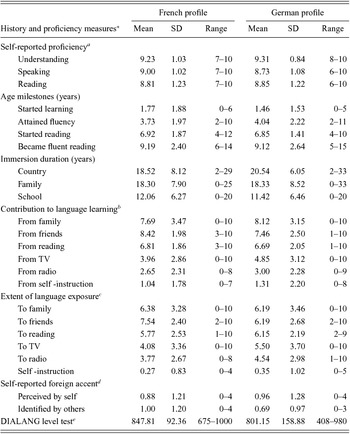
Table 1 shows results from the DIALANG and the LEAP-Q. No difference was found between the participants’ French and German profiles.
Bilingual language status assessed by LEAP-Q and DIALANG.

*At a level of .05 there is no significant difference between French and German measures of the DIALANG and LEAP-Q.
a. Range: 0 (none) to10 (perfect). b. Range: 0 (not a contributor) to10 (most important contributor). c. Range: 0 (never) to10 (always). d. Range: 0 (none) to 10 (pervasive). e. Range: 0–100 (low vocabulary level) to 901–1000 (native speaker level).
Material
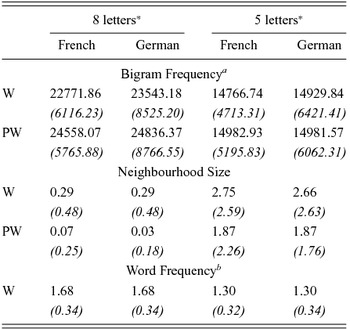
Stimuli were 80 five-letter and 80 eight-letter words (nouns) per language context, and 30 five-letter and 30 eight-letter pseudo-words used in both contexts. The rationale for choosing two different word lengths was to have a group of matched (both short and long) items. All items were presented in uppercase, without any accent, and using Courier News 72 pt. in bold as the font. The reason for it was twofold, first to increase the association of the FFL to a linguistic context change and second for measuring pseudo-words versus words in a comparable context in each language. Furthermore, the stimuli were equivalent across languages for several orthographic and psycholinguistic factors (see Table 2), namely summated position-nonspecific bigram frequency, lexical frequency and neighbourhood size. In addition, the 60 common pseudo-words were legal both orthographically and phonologically in both languages.
Mean values (standard deviation) for the psycholinguistic factors (Bigram Frequency, Neighbourhood Size and Word Frequency) of the stimuli (Words and Pseudo-words) as a function of length (8 and 5 letters) and language (French and German).

* At a level of .05 there is no significant difference between French and German measures.
a. Summated Position-nonspecific Bigram Frequency. b. Expressed in a log-transformed lexical frequency.
W: Words. PW: Pseudo-words
The words were selected from Lexique (New, Pallier, Ferrand & Matos, Reference New, Pallier, Ferrand and Matos2001) and CELEX (Baayen, Piepenbrock & Gulikers, Reference Baayen, Piepenbrock and Gulikers1995) databases. These databases allow the WordGen software (Duyck, Desmet, Verbeke & Brysbaert, Reference Duyck, Desmet, Verbeke and Brysbaert2004) to calculate the neighbourhood size and the summated bigram frequency in words and pseudo-words, and the word frequency expressed in a log-transformed lexical frequency.
The pseudo-words were created using Wuggy, a multilingual polysyllabic-pseudo-word generator software (Keuleers & Brysbaert, Reference Keuleers and Brysbaert2010), and selected after a rigorous procedure undertaken in three phases. The Wuggy software uses words as bases for creating pseudo-words in a large variety of languages, therefore the French and German research words were used as bases to generate French and German pseudo-words respectively. Previously set up to produce ten candidates (only pseudo-words) per word in a maximal search time of 30 seconds, the Wuggy software generated 3200 pseudo-words (800 per length and language categories). In the first selection phase, a German external judge chose the most German-like candidates from French bases, and the same procedure was carried out by a French judge for candidates from German bases. The second phase consisted of controlling the bi- and trigram legalities in each language (Lexique; New et al., Reference New, Pallier, Ferrand and Matos2001; DLEXDB, DWDS; Geyken, Reference Geyken and Fellbaum2007). Finally, after calculating the summated bigram frequency and the neighbourhood size for each language, the last set per length comprised half of the pseudo-words from French and half from German bases.
Apparatus
The procedure was designed, executed, and analysed using the SMI Experiment Suite™ system (Sensomotoric Instruments GmbH, Teltow, Germany) and eye behaviour was recorded with a video-based dark-pupil tracking system (SMI iView X™ RED 250). According to the manufacturer, the system has a sampling rate of 250 Hz and a spatial resolution of 0.03°. Calibration procedure was performed using the 13 calibration points option. No head fixation was necessary since the system is able to compensate for head movements. The experiment was carried out on a laptop and the procedure was run on a secondary screen (22” in size).
Procedure
Participants arrived at the place of evaluation, and directly read and signed the information and consent forms. The procedure was performed in a quiet room, where participants were placed at a distance of 60–80 cm in front of a screen (according to the system's specifications). Their heads were free but any head or body movement was discouraged, and the experimenter sat next to her/him.
Every participant was immersed in both language contexts, separated by a 15 minute break. Each language was rigorously tested using the same procedure by different well-trained experimenters, one speaking fluent French and the other speaking fluent German. At the beginning of each procedure, participants had to read aloud a text with a high level of difficulty for three minutes (“Boule de suif” in French; Guy de Maupassant, Reference Guy de Maupassant and Charpentier1880; and “Casanovas Heimfahrt” in German; Schnitzler, Reference Schnitzler and Fischer1918).
Apart from being written in different languages, both the French and German procedures were completely equivalent and were performed in the same way. Eleven participants started with French followed by German, and 15 in the reverse order. Each procedure lasted approximately 25 minutes and was divided into four parts: the Reading Aloud Activation part, the Instructions part, the Training part, and the Testing part. There were eight calibrations involved in each procedure: one before the Reading Aloud Activation part, six in the Testing part, and one at the end.
The Reading Aloud Activation part consisted of reading the above-mentioned text, and its purpose was to activate the linguistic mode.
In the Instructions part, participants were informed of the stimulus characteristics (words written in uppercase, without accents), and how to perform the task. Furthermore, the instructions stated that some words were extremely common and others extremely rare, but all of them were supposed to be real (e.g., “We draw your attention to the fact that some words are familiar and others are rare or even very rare, thus possibly unknown to you. Your task is only to read them aloud as best as you can.”). The existence and repetition of pseudo-words between languages was omitted in order to let participants be fully focussed on a reading aloud task, thus avoiding any resemblance to a lexical decision task. Although the Instruction part was very precise, additional information was given in the language of evaluation whenever necessary.
The Training part was comprised of five words of different lengths and allowed participants to practice the task.
In the Testing part, all stimuli were presented randomly in six blocks whose categories were organized in a pseudo-randomized order at a rate of one pseudo-word per two or three words (six blocks in total with 10 pseudo-words each, four blocks with 27 and two blocks with 26 words). Each block was structured as follows: first a rest period during which participants closed their eyes for 30 seconds, then a calibration, and finally the task. The experimenter was only allowed to interact with participants during the rest period and calibration measures.
Figure 1 shows the reading procedure for each trial that participants had to follow in order to read aloud every stimulus. The trials were divided into three critical moments (see Figure 1 for details) where participants were instructed firstly to fixate the down-cross (A in Figure 1), then to fixate the left-cross (B in Figure 1), and finally to read aloud as naturally as possible the stimulus on their right (C in Figure 1) then go back to the down cross (e.g., “. . .once the left-cross disappears you have to read aloud the word on your right, read it naturally and, when you have finished or the word has disappeared, go to the down-cross”). The left-cross appeared at different time intervals so as to avoid anticipations and the distance between the left-cross and the beginning of stimuli was 10.3º of visual angle.
Depiction of the way in which each stimulus was presented at three critical moments (A, B, C). (A): participants had to fixate the down-cross, presented during 1000ms. (B): participants had to fixate the left-cross, randomly presented at 900, 1400 or 1700ms. (C): participants had to read aloud the stimulus on their right, presented during 800ms for five-letter stimuli or 1000ms for eight-letter stimuli, and go back to the down-cross. The arrow represents the timeline.

As soon as both languages were evaluated, the existence of pseudo-words and their repetition across the languages were revealed, and the DIALANG was performed, starting with the last language evaluated in the procedure.
Measures
Any fixation with a previous saccade linking the left-fixation cross and the stimulus was taken as a first fixation. Three measures were calculated: i) the location of the first fixation within the stimulus (FFL, defined as the position of the first fixation, was expressed in percentage of the total length of the stimulus, with 0% and 100% respectively corresponding to the beginning and the end of the stimulus); ii) the latency between the stimulus onset and the beginning of the saccade (LSS, in milliseconds); and iii) the duration of the first fixation (FFD, in milliseconds). Anticipatory eye movements (i.e., saccade started before the stimulus onset) and FFL outside the initial part of the stimulus were considered as errors.
Data analysis
Statistical analyses were conducted using IBM® SPSS® Statistic 20. The analyses were divided in two parts. The first part aimed to evaluate the strategies across the languages for all participants. The second part aimed to test contextual characteristics in each strategy (the second interest in our study, see Hypothesis).
Data points excluded from the analyses due to errors (5.7%) were replaced by the median of values of the same stimulus in the same context.
Reading strategies across languages
The first reduction level (at a subject level) consisted of: for each context (French; German), stimulus type (words; pseudo-words), and dependent variable (LSS; FFL; FFD), the median per length category (five; eight letters) was calculated, then the median between both length categories was taken as the final participants’ data.
Three 2 by 2 repeated measure ANOVAs with Context (French; German) and Lexicality (words and pseudo-words) as within-subject factors were applied to FFL, LSS, and FFD. T-Tests were used for follow-up tests.
Context specificities in each reading strategy
In the second part of this analysis linear correlations were calculated between FFL and FFD in each context separately.
Results
Reading strategies across the languages
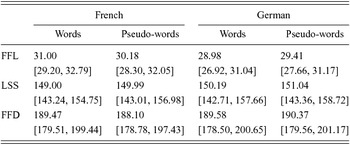
Mean results for LSS, FFL and FFD for words and pseudo-words as a function of context are summarized in Table 3.
Mean values for LSS (ms), FFL (%) and FFD (ms) in Words and Pseudo-words as a function of context (French, German).

Note: Values in brackets are 95% confidence intervals. FFL: First Fixation Location. LSS: Latency for Sending the Saccade before FFL. FFD: First Fixation Duration.
The 2 by 2 ANOVAs with Context (French; German) and Lexicality (words and pseudo-words) on LSS and FFD showed no significant main effects for Context (FFD, F(1,25) = .231; p = .635; η2 = .01; and LSS, F(1,25) = 0.372; p = .547; η2 = .02) or Lexicality (FFD, F(1,25) = .046; p = .832; η2 = .00; and LSS, F(1,25) = 2.041; p = .166; η2 = .08) nor interactions.
The 2 by 2 ANOVA with Context (French; German) and Lexicality (words and pseudo-words) on FFL showed no significant main effect (Context, F(1,25) = 3.285; p = .082; η2 = .12; Lexicality, F(1,25) = 0.790; p = .383; η2 = .03) but a significant Context X Lexicality interaction (F(1,25) = 11.914; p = .002; η2 = .32).
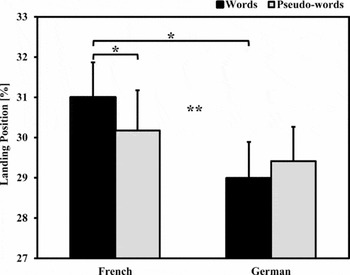
Figure 2 illustrates the Context X Lexicality interaction. This figure shows that the FFL was closer to the beginning of German words than the FFL of French words. Furthermore, in the French context the FFL was slightly, though significantly nearer to the beginning of pseudo-words than of words.
Average landing position (%) for words and pseudo-words in French and German contexts. The error bars represent the standard error of the mean. The * represents a significant difference at p = .01 and ** at p < .01.

Follow-up analyses confirmed the predicted significant differences in the FFL between French and German words (t(25) = 2.666; p = .013; Cohen's d = 0.53); and between words and pseudo-words only in French (t(25) = 2.789; p = .010; Cohen's d = 0.55; uncorrected p-values).
Context specificities in each reading strategy
Since reading strategies in opaque languages were postulated to rely more on lexical knowledge and the FFD was previously associated to be modulated by lexical aspects, its association to FFL in each linguistic context is of particular interest.
The results of the correlational analysis between the first fixation location and its duration show a positive association in the opaque context (French) for words, r = .63, p = .001, and pseudo-words, r = .60, p = .001, but show no association in the transparent context (German) for words, r = .31, p = .121, or pseudo-words, r = .29, p = .145.
Discussion
The aim of the present study was to identify how language opacity (i.e., the complexity of the grapheme to phoneme conversion rule) influences reading strategies. Our approach was based on the assumption that the FFL reveals whether readers are engaged in a local (FFL proximal to the beginning of the words) or a global (FFL less proximal to the beginning of the words) reading strategy. We measured eye movements in early bilinguals who were highly proficient in a transparent (German) and an opaque (French) language while they were reading words and pseudo-words written in each of these two languages. For each language condition, the words/pseudo-words were presented in pure monolingual settings so that participants used either transparent or opaque reading strategies. The results showed that FFL was closer to the beginning of German than French words, strongly suggesting that transparent linguistic contexts induce more local reading strategies and opaque linguistic contexts induce more global strategies. For pseudo-words, the FFL did not differ when compared to German words but was closer to beginning of the stimulus when compared to French words, which was similar to the transparent reading strategy.
We would further note that our effects of Language and Lexicality on FFL ranged between 1–3%, which may question their functional relevance. However, our effect sizes are in the range of what is usually observed in similar studies (e.g., Plummer & Rayner, Reference Plummer and Rayner2012; Paterson, McGowan & Jordan, Reference Paterson, McGowan and Jordan2012). In addition, the fact that the observed effect reached p < 0.01 significance level suggests that the effect was consistent across participants. Moreover, FFD and LSS did not differ across languages and they were not expected to do so as the very first aim of the task was to read aloud, therefore it was not a lexical decision task, and pre-lexical factors were equivalent across languages. Thus, no difference was found in FFD in previous studies through languages while reading aloud (Buetler et al., Reference Buetler, de León Rodríguez, Laganaro, Müri, Spierer and Annoni2014; Rau et al., Reference Rau, Moll, Snowling and Landerl2015) and LSS was not modulated by the lexical status of the stimuli (Vitu, Kapoula, Lancelin & Lavigne, Reference Vitu, Kapoula, Lancelin and Lavigne2004; Plummer & Rayner, Reference Plummer and Rayner2012).
Reading strategies in opaque vs. transparent languages
The FFL was closer to the beginning of words when reading in German than in French contexts, confirming our hypothesis for specific eye movement patterns as a function of language opacity during word reading. This result suggests that transparent linguistic contexts promote local word processing strategies, whereas reading in an opaque linguistic context encourages global strategies. The FFL seems indeed to determine whether the participants’ reading strategy consists of linearly processing each letter as distinct graphemes to be converted into phonemes (local strategy), or in processing the words as chunks of letters to be converted altogether into phonemes (global strategy).
The ‘dual route cascade model’ (Coltheart et al., Reference Coltheart, Rastle, Perry, Langdon and Ziegler2001) posits that reading using the non-lexical route consists of assembling letters serially from left to right into phonology, while reading using the lexical route consists of processing all letters of words in parallel. According to the ‘dual route cascade model’, our result, which shows FFLs closer to the beginning of words in German than in French, would indicate that readers are engaged in a serial process and thus rely on the non-lexical route when reading in a transparent linguistic context. In contrast, a FFL less proximal to the beginning of words in an opaque context would suggest that a global/parallel reading strategy, and thus the lexical-route, is engaged for reading.
Interestingly, when reading pseudo-words, the FFL was as close to the beginning of the word as when reading words in the transparent language, and the FFL for pseudo-words was no different in the opaque vs. transparent reading context. The fact that a similar local strategy was engaged when reading new meaningless legal non-words and words in the transparent language indicates that pseudo-word processing relies more on the non-lexical route (Buetler et al., Reference Buetler, de León Rodríguez, Laganaro, Müri, Spierer and Annoni2014). This interpretation is also corroborated by previous neuroimaging studies which show that reading pseudo-words activates the brain networks supporting the non-lexical route, namely the left infero-parietal and left infero-frontal brain regions (Levy et al., Reference Levy, Pernet, Treserras, Boulanouar, Aubry, Démonet and Celsis2009; Lu et al., Reference Lu, Tang, Zhou and Yu2011).
The differences between the two languages cannot be attributed to attentional changes, since both French and German procedures were counterbalanced between subjects, and in this case have been attributed to the contextual contrast (Inhoff, Radach & Eiter, Reference Inhoff, Radach and Eiter2006). However, we cannot rule out from our data that using upper-cases might have influenced the participants’ reading strategies (Mathey & Zagar, Reference Mathey and Zagar2006). Nevertheless, since the conditions of presentation were completely equal in both languages, the instructions stressed on the fact that all the stimuli were presented in upper case, without accents, any influence of using capital letters would have been minimal and equally distributed between languages and thus unlikely to have modified our results. In addition, since the neighbourhood size was identified to change following letter case modification (Mathey & Zagar, Reference Mathey and Zagar2006), this factor was recalculated for words without accents (23% of the French words as German words had no accents); and the result was that the stimuli did not differ either across languages. For this reason, we are confident that the observed differences between both languages indeed followed from changes in the linguistic context and not from mere perceptual variations.
Context specificity in correlations between landing position and lexical extraction
Correlation analyses between the FFL and the FFD indicated that FFL correlated positively with the FFD in French, but not in German. Increases in FFD were interpreted as increases in the cognitive load required for extracting task-relevant information from verbal stimuli during reading (Reingold, Reichle, Glaholt & Sheridan, Reference Reingold, Reichle, Glaholt and Sheridan2012; Hand, O’Donnell & Sereno, Reference Hand, O’Donnell and Sereno2012). More precisely, FFD has been advanced to index the use of higher-level linguistic or conceptual processing as can be the lexical activation and the identification of words (Liversedge, Rayner, White, Vergilino-Perez, Findlay & Kentridge, Reference Liversedge, Rayner, White, Vergilino-Perez, Findlay and Kentridge2004). Accordingly, we propose that our result showing an association between FFL and FFD when reading French supports the hypothesis that in opaque contexts the lexical-route is activated during the first fixation, and also that the more global the reading strategy, the more lexico-semantic information is used (FFD increases). In contrast, there was no relationship between the FFL and the FFD when reading German. This pattern supports our hypothesis that in a transparent linguistic context, the reading strategy is local and serial. In addition, the correlation was similar in words and pseudo-words, indicating that, independently of stimuli, the reading strategy induced by opaque vs. transparent language not only modulated the FFL, but also whether lexical processing was already engaged during the first fixation.
In sum, FFL and FFD correlations in opaque languages support the hypothesis that saccade adaptation is modulated by language lexical characteristics in opaque contexts only.
Specific pre-processing in each context
In the present study, the pre-processing of words/pseudo-words was reflected by the latency for sending the saccade before the first fixation (LSS). On average this latency was 150ms and did not vary as a function of language opacity or lexicality. This suggests that our results were not due to language-related implicit planning strategies, but rather to differences in processing at the reading level itself. However, considering that FFL is the result of the computation made during LSS, some conclusions arise. Usually focalised in text and sentence reading, this pre-processing effect is called the Parafoveal Benefit (for a recent review see Reichle & Reingold, Reference Reichle and Reingold2013). Parafoveal benefit research seeks to determine in a fixated word (word n) how much and what kind of information from a word on its right (word n+1) is being taken into account or being pre-processed by means of the perceptual span (McConkie & Rayner, Reference McConkie and Rayner1975; Rayner & Bertera, Reference Rayner and Bertera1979; Rayner, Liversedge & White, Reference Rayner, Liversedge and White2006). The fact that the same readers were processing equivalent stimuli at lower visual and pre-lexical levels led us to think that the difference in where the eyes land is firstly due to a contextual change and that, secondly, this pre-processing takes lexicality into account in the opaque context only.
In sum, both LSS and FFL results support the hypothesis that saccade adaptation is modulated by language opacity and reinforce that lexicality plays an exclusive role in opaque contexts.
Conclusions
Our data provide the first evidence for different reading strategies (as indexed by eye movement patterns) as a function of language opacities, in the same population. In opaque languages, readers use a global reading strategy relying on the lexical route, while reading strategies in transparent languages are more local and rely on the non-lexical route. Furthermore, our results show that only in opaque contexts does lexicality play a very early role in programming where the eyes will land during reading aloud.