The cost of international cooperation often depends on technology.Footnote 1 In environmental co-operation, the cost of reducing transboundary air pollution depends on the availability of clean technology.Footnote 2 However the relationship between technology and international co-operation is complicated, because states have incentives to compete for the new markets that international co-operation creates. If international co-operation prompts policy adjustments that increase the demand for new technology, states may respond to international co-operation through industrial policy, which in turn stimulates technology competition.Footnote 3
Accounting for technology competition is central to understanding the prospects for international environmental co-operation. When the United States pushed for international measures to combat ozone depletion, which resulted in the 1987 Montreal Protocol, Washington's co-operative position was largely determined by the chemical industry's preferences.Footnote 4 And when Germany pushed for European regulations to mandate catalytic converters in the early 1980s, much of the British and French opposition – which delayed agreement by years – originated from the automobile industry's concerns about adverse competitiveness effects.Footnote 5 In each case, technology competition was central to the outcome, but there is no systematic theory of how such competition affects co-operation.
To address this issue, we explore the effect of technology competition on international co-operation. Suppose new technologies are central to co-operation, and that states value profits from new technology markets. Do these concerns facilitate or impede treaty co-operation? Does commercial rivalry prevent states from realizing joint gains, or could it facilitate collaboration?Footnote 6 While scholars of international politics have recognized the importance of technology,Footnote 7 previous research has not answered these questions.
Given our focus on international environmental problems, we limit our attention to the formation of explicit environmental agreements between countries. We assume these agreements, if ratified, would create demand for new technologies, either directly (provisions for technical co-operation) or indirectly (induced technological change via increased consumer demand), and thus induce technological change.Footnote 8 In our formal model, two states first decide on treaty ratification. If both ratify the treaty, the demand for new technology increases relative to a low baseline without environmental co-operation. Each state can attempt to enhance the competitiveness of its domestic firms in these new markets through subsidies.Footnote 9 States may do so for economic reasonsFootnote 10 or political gain.Footnote 11 These subsidies improve the international competitiveness of each state's national industry and reduce the costs to the consumer of the new technology. Research and development (R&D) subsidies directly stimulate technological innovation, while production subsidies generate learning-by-doing effects; our model is designed to capture both forms of support. However, foreign firms suffer because their market share decreases.
Will the expectation of such technology competition facilitate or impede co-operation? To establish a baseline, we show that if a state is concerned about profits in the regulated industry, but is unable to compete in the new technology markets, technology competition impedes co-operation. If the states could credibly commit to reducing their subsidies, co-operation would be possible. Even if the environmental benefits of co-operation were substantial, a government concerned about national competitiveness might reject a treaty due to expectations of lost profits. This rational anticipation would, in turn, reduce the degree of environmental co-operation.
More importantly, the model also characterizes the circumstances in which technology co-operation may facilitate co-operation. If both states can effectively enhance their competitiveness through subsidies, technology competition results in large subsidies that reduce the cost of co-operation. The level playing field ensures that each state continues to profit from technology sales, and while each state selfishly maximizes profits, this industrial policy also helps consumers in the other state comply at a lower cost. Instead of impeding co-operation, state self-interest with regard to relative market share promotes co-operation. The pursuit of national profits induces states to develop new technologies that reduce the cost of co-operation, which in turn creates opportunities for environmental co-operation. Contrary to the received wisdom, then, concerns about competitiveness may enhance environmental co-operation.
Another important finding pertains to co-operation in asymmetric circumstances. Suppose one state expects to win the technology competition through aggressive industrial policy, which it uses to capture the new technology market and thus reduce the cost of co-operation to the other state. Since the less competitive state is less interested in profits and its expected technology costs are low, it can ratify the treaty at a low expected cost. Thus, co-operation is possible. One state's concern about market share results in another state's cost reduction, and both win. Again, technology competition enables otherwise impossible environmental co-operation.
We also examine a variant of the model in which industrial policy is proscribed, so that the national industry's private investment determines competitiveness and consumer prices. As long as states care about their national industries’ profits, we find that our results continue to hold. States anticipate the competitiveness of their industries, and reject treaties that would have large adverse effects on them. Thus the consequences of technology competition by industrial policy and private investment for environmental co-operation are largely similar.Footnote 12
Our theory has several broader implications for international co-operation. First, the cost of treaty compliance itself depends on state behavior, and thus cannot be generally regarded as exogenous. To understand why states ratify treaties,Footnote 13 it is essential to examine how the treaties shape payoffs in relevant international and domestic games. Secondly, we show that intense competition may commit states to actions that ultimately produce collective benefits. Finally, we highlight the importance of technology for international politics. Although some scholars have recognized the significance of technological change for international politics,Footnote 14 most international co-operation theoristsFootnote 15 have not analyzed technology.
The remaining sections are organized as follows. First, we review the literature on technology competition and international co-operation. Secondly, we present and analyze our theoretical model. Thirdly, we summarize the most important empirical implications. Fourthly, we extend the model to examine the strategic benefits of forming a technology agreement that regulates industrial policies. Fifthly, we present qualitative evidence for our theory. Finally, we offer a concluding discussion.
Technology Competition and International Co-Operation
International co-operation consists of policy adjustments that produce collective benefits for state parties. These policy adjustments have to be reciprocal: if states had incentives to implement mutually profitable policy adjustments unilaterally, ‘harmony’ would prevail and co-operation would be wholly unnecessary.Footnote 16 Technology is relevant to this decision whenever the cost-benefit ratio depends on it.
The relationship between technology and international co-operation has another dimension that is often ignored: international co-operation will change the relative profitability of various technologies. In environmental policy, a credible treaty will reduce the demand for polluting technologies while creating markets for clean technologies.Footnote 17 Consumers and producers must adjust to new regulations intended to reduce pollution, and often the least costly way to achieve such a reduction is to purchase new technology. When international co-operation creates new markets, states may have incentives to help their domestic producers capture these markets. International co-operation influences the strategic industrial or trade policies, such as subsidies or public R&D funding, that states enact.
Governments engage in technology competition because national firms can gain a significant advantage from subsidies or R&D funding and produce substantial national returns – which can be economic if they spill over to other industries.Footnote 18 Returns can be political if the industry has political clout or is relevant to national security.Footnote 19 Consequently, some governments value national high-technology industries, a practice that is termed ‘techno-nationalism’.Footnote 20
Such concerns are highly relevant for industrial policy. Driven by techno-nationalism, several countries have formulated technology policies to enhance national competitiveness. The overarching strategy of Japan's Ministry of International Trade and Industry (MITI) from the 1960s to date shows the effects of techno-nationalism. The MITI runs an active support and coordination program for R&D to encourage the development of the most advanced technologies with global commercial potential. European countries felt threatened by Japan's rapid technological achievement, and accelerated their interventions to create national champions, especially in semiconductors and computers.Footnote 21
The contemporary politics of clean energy also underscores the importance of technology competition.Footnote 22 China is often considered to have a strong techno-nationalist bias in clean energy policy. From the mid-1980s, China designated energy technologies as one of the ten priority areas within the State High-Tech Development Plan and provided incentives such as preferential tax and government funding for clean energy programs. India also has a strong preference for local production that serves other economic goals, and aims to achieve 20,000 megawatts of solar generating capacity by 2020 with subsidies and compulsory purchases. The United States has proven hesitant to transfer clean technologies to emerging economies, because they would be its potential competitors.Footnote 23
Previous research offers few analytical insights into the relationship between technology competition and international co-operation. Ogburn explores how various types of technological innovations, such as atomic energy and mass communication, shape international relations.Footnote 24 Similarly, Skolnikoff investigates the role of technological development in various issue areas of international politics.Footnote 25 Further, Weiss and Fritsch examine the role of technological development at the international system level.Footnote 26 Weiss argues that technological development and the global diffusion of technology could change the international system,Footnote 27 while Fritsch conceptualizes technology as an integral part of the global system. However, these authors do not develop a systematic strategic theory with testable empirical implications.Footnote 28
While scholars have studied technology competition between states, they view it primarily as a source of rivalry. Some explore technology competition between states,Footnote 29 and others examine trade conflict in high-technology industries.Footnote 30 Although Sandholtz and Tucker provide some insights on the conditions under which international co-operation can be achieved in high-technology industries, they do not recognize the potential impact of technology development on international co-operation more generally.Footnote 31
Ruggie notes the importance of a leading country's technological superiority in international regime creation,Footnote 32 and Krasner focuses on how the asymmetric distribution of power/technology shapes the pattern of international co-operation.Footnote 33 However these studies do not recognize the possibility that technology competition can facilitate international co-operation.
Other studies link technology to various areas, such as the energy industry and treaty monitoring, but they do not examine the interaction between technology and international co-operation. Several scholars have proposed that technology innovation was important for co-operation on ozone depletion, but they do not attempt to theorize the strategic dimension of the problem.Footnote 34 Lewis and Weiser examine the explanatory role of export markets in state subsidies to the wind energy industry,Footnote 35 but they do not relate their neomercantilist theory to international co-operation. Mitchell explores the importance of technology for treaty monitoring, but he does not address the implications of technology competition for international co-operation.Footnote 36 Urpelainen argues that technological standards can facilitate treaty monitoring, but he does not consider technological development.Footnote 37 Beginning with Krugman, economists have examined export markets rivalry, but they do not examine the relationship between technology subsidies and international co-operation.Footnote 38
Model
Our model captures the relationship between international co-operation and technology competition. In the model, states i = A,B decide on co-operation. If they agree to co-operate, demand for new technologies increases, and each state must decide on a technology subsidy that reduces the co-operation cost while increasing the world market share of its domestic companies.Footnote 39 However, technology subsidies are costly.
We rely on several simplifications that warrant a brief discussion. First, we do not model enforcement,Footnote 40 except in regard to technology competition, because our focus is on technology. Secondly, we do not consider incomplete information.Footnote 41 If there was uncertainty regarding state preferences or industrial capabilities, states would weigh different outcomes by their respective probabilities. Each state would form an expectation about consumer prices and national industry profits. Rational expectations based on the probabilities of different contingencies, such as high and low competitiveness, would continue to guide state decisions to engage in environmental co-operation. Therefore uncertainty is not a major analytical issue here.
At the international level, technology is both a source of rivalry and a public good. It creates a competitive situation because new technology markets produce profits. Yet new technology is also an international public good: as new technologies appear, the effect of treaty compliance on consumer prices and other relevant costs is mitigated. At the national level, R&D can also be a public good: no individual company fully internalizes the national benefits of new technology, such as enhanced productivity and lower consumer prices. Thus subsidizing national industries does not mean that governments are irrational or captured by special interests.
Exogenous Technology
As a baseline, consider a simple game whereby states i = A,B simultaneously decide on co-operation,
 $$${{c}_i} \in \left\{ {0,1} \right\} $$$
. If at least one state rejects co-operation, so that cA
= 0 or cB
= 0, both states obtain a status quo payoff. Without loss of generality, we normalize it to zero. If both states co-operate, cA
= cB
= 1, they negotiate and ratify a treaty. Each state i acquires a co-operation benefit Vi
> 0. This benefit can be thought of as flowing from the eradication of a negative externality, such as transboundary air pollution. However, each state i must also pay a price Pi
> 0. This price represents the cost to consumers of co-operation. For example, reducing transboundary air pollution implies economic adjustments that are not costless. We allow both co-operation benefits Vi
and costs Pi
to vary across states.
Finally, international co-operation creates a new technology market. The profits from this technology market to state i are denoted by αiπi , where αi > 0 is a coefficient that measures state i's sensitivity to profits. We allow negative profits, πi < 0, to capture the possibility that state i loses profits because its domestic producers were competitive without co-operation. For example, a state that is heavily dependent on coal production cannot expect to benefit economically from climate co-operation.
If governments are generally interested in technology markets, how can αi be low? States sometimes do not have any industrial capacity in the relevant issue area. For example, France has a sizable nuclear industry, but has very few companies in the wind power sector.Footnote 42 If co-operation on renewables would mostly influence the relative profitability of wind power vis-à-vis solar, without affecting the demand for nuclear energy, the French government would have a low αi .
More generally, what determines a state's profit coefficient αi ? It is positively associated with the economic importance and political clout of the industry in focus,Footnote 43 the degree to which this industry produces positive spillovers for other national industriesFootnote 44 and the influence of national bureaucrats with techno-nationalist preferences.Footnote 45
Technology Competition
If both states co-operate, cA = cB
= 1, the prices PA
, PB
and the profits πA
, πB
are determined endogenously through technology competition. Specifically, each state i selects a technology subsidy
s
 $$$_i} \in [0,\,\infty ) $$$
to domestic firms for the development and commercialization of the new technology. The cost of subsidy si
to state i is denoted by
 $$$\frac{1}{2}{{\beta }_i}s_{i}^{2} $$$
, where βi
> 0 is a coefficient that measures the marginal cost of subsidization to state i.Footnote
46
For example, it could reflect fiscal constraints, the productivity of the national innovation system,Footnote
47
or consumers’ aversion to increased taxes or government debt.
Each state can try to increase its market share through industrial policy, modeled as a subsidy for concreteness. These subsidies reduce the price of the new technology required for co-operation, yet technology competition also has a zero-sum element, in that states compete for markets. Specifically, the subsidy will have the following effects. First, suppose profits to state i depend on subsidies, so that π = π(si ,sj ). While we do not endogenize other determinants of profits here, our model extension below shows that the results continue to hold even if profits depend instead on private investment in the new technology. On the one hand, we assume that π is increasing but strictly concave in si : subsidies allow state i to increase market share but with decreasing returns on the margin. On the other hand, we assume that π is decreasing but strictly convex in sj : if the foreign state j increases subsidies, profits to state i decrease.Footnote 48 To simplify exposition, we assume that π(si ,sj ) < 0 when si →0 and sj →∞. If a country completely loses technology competition, it obtains negative profits. Co-operation will inevitably have negative effects on industries producing technologies that will become outdated due to international co-operation. Thus if a state obtains a negligible share of the new technology markets, profits decline.
To avoid implausible outcomes, we let
 $$$ \pi \left( {{{s}^\ast}, {{s}^\ast} } \right) \gt \pi ( {{{s}^{\ast\ast}}, {{s}^{\ast\ast}} } \right) $$$
if and only if
 $$${{s}^\ast} \gt {{s}^{\ast\ast}} $$$
. If both states select identical subsidies and increase them proportionally, profits increase. Subsidies generally reduce the production cost of the new technology; as long as market competition is not perfect, in which case all profits would dissipate, this possibility generally allows companies to enhance their profits. Given the importance of economies of scale for new technology commercialization, the assumption of imperfect competition seems plausible.
Secondly, suppose that the consumer price Pi
= Pi
(si
+ sj
) depends on subsidies given by both states. Specifically, let the function be decreasing and strictly convex: subsidies reduce consumer prices. Both domestic and foreign subsidies are assumed to have identical effects for analytical tractability. For plausibility, we assume Pi
is positive everywhere, so that international co-operation is costly. We also assume Pi
(0,0) > Vi
and
 $$${{P}_i}\left( {\infty, \infty } \right)\, \lt\,V_i$$$
, which states that for high (low) enough subsidies, the domestic price of co-operation is above (below) the benefits.
Equilibrium
Since this is a game of complete information, the appropriate solution concept is the subgame-perfect Nash equilibrium. An equilibrium of the game comprises a strategy
 $$$c_{i}^{\ast}, s_{i}^{\ast} $$$
for each state i. The equilibrium subsidy
 $$$s_{i}^{\ast} $$$
must be a best response to the foreign subsidy
 $$$s_{j}^{\ast} $$$
. The equilibrium co-operation decision
 $$$c_{i}^{\ast} $$$
must be optimal given the equilibrium technology subsidies
 $$$s_{i}^{\ast}, s_{j}^{\ast} $$$
and the foreign co-operation decision
 $$$c_{j}^{\ast} $$$
.Footnote
49
Exogenous Technology
Consider first the case of exogenous technology, so that Vi , Pi , απi are all fixed for each state i. Since state i can unilaterally prevent international co-operation, we only need to investigate whether an equilibrium exists that allows co-operation. If it exists, it must be on the Pareto frontier. The necessary and sufficient condition is simply that for i = A,B:
 $$ {{U}_i}\, = \,{{V}_i}\,{\rm{ - }}\,{{P}_i}\, + \,{{\alpha }_i}{{\pi }_i}\,\geq \,0. $$
The total benefit, Vi + απi , must exceed the consumer cost Pi . States co-operate when both expect benefits from doing so. If this condition fails for at least one state, co-operation is not possible.
Technology Competition
To allow for technology competition, the game must be solved by backward induction. To begin with, suppose both states have agreed to co-operate,
 $$$c_{A}^{\ast} = c_{B}^{\ast} = 1 $$$
. In this case, both states i simultaneously choose subsidies si
,sj
. Each state i selects si
to maximize its expected payoff, holding sj
constant. The technical details are provided in the mathematical appendix.
The equilibrium subsidies
 $$$s_{i}^{\ast}, s_{j}^{\ast} $$$
induce an expected technology competition outcome, so the co-operation condition can be written as:
 $$ U_{i}^{\ast} \, = \,{{V}_i}\,{\rm{ - }}\,{{P}_i}\left( {s_{i}^{\ast}, s_{j}^{\ast} } \right) + {{\alpha }_i}\pi \left( {s_{i}^{\ast}, s_{j}^{\ast} } \right){\rm{ - }}\frac{1}{2}{{\beta }_i}{{\left( {s_{i}^{\ast} } \right)}^2} \geq 0. $$
States co-operate when they expect net benefits, which depend on the nature of the resulting technology competition.
Empirical Implications
We now summarize the model's empirical implications. First, we examine the nature of the technology competition. Given the state of co-operation, how would states choose their technology subsidies? Secondly, we explore the conditions for successful co-operation. Given the expected degree of technology competition, is co-operation profitable in equilibrium? All formal proofs can be found in the mathematical appendix.
Nature of Technology Competition
To begin with, let us consider the nature of the technology competition given previous decisions to co-operate,
 $$$c_{A}^{\ast} \: = \:c_{B}^{\ast} = 1 $$$
. In equilibrium, each state i selects the subsidy
 $$$s_{i}^{\ast} $$$
to maximize its expected payoff. How does this equilibrium subsidy
 $$$s_{i}^{\ast} $$$
change with the value of profits (as measured by the coefficient αi
) and the cost of subsidization (the coefficient βi
)? It is useful to first investigate the best responses of the two states. If the foreign state j increases its technology subsidy sj
, would state i prefer to respond by increasing or decreasing its own subsidy si
? Suppose that state i has little interest in market profits, so that αi
obtains a low value. State i's best response would have a positive slope: if foreign state j increases the subsidy, then state i has fewer incentives to subsidize technology. After all, the foreign state is already bringing the consumer price P down by choosing a high subsidy. When state i has a keen interest in market profits, so that αi
obtains a very high value, exactly the opposite is true. When the foreign state j increases its subsidy sj
, state i has an incentive to respond by increasing its subsidy si
. In this case, the best response has a negative slope. Any increase in the subsidy of one state amplifies technology competition.
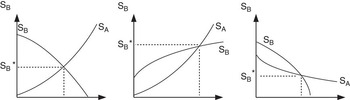
Given these observations, we are left with three main scenarios. First, it is possible that both states have increasing best responses, so that technology competition is mutual. Secondly, it is possible that neither state has an increasing best response, so that technology competition does not exist. Finally, one state may have an increasing best response, so that the technology competition is unilateral. These scenarios are illustrated in Figure 1.
Best responses
Note: on the left, only state A ascribes a high value to profits. In the center, states A and B both ascribe a high value to profits. On the right, both states A and B ascribe a low value to profits.

These observations yield the following comparative statics.
Claim 1 (technology subsidies): If state j's market valuation αj is high enough, an increase in state i's market valuation αi or a decrease in subsidy cost βi yields an increase in technology subsidies
 $$$s_{i}^{\ast}, s_{j}^{\ast} $$$
. If state j's market valuation αj is low enough, an increase in state i's market valuation αi or a decrease in subsidy cost βi yields an increase in technology subsidy
 $$$s_{i}^{\ast} $$$
and a decrease in technology subsidy
 $$$s_{j}^{\ast} $$$
.
The effects of changing the market value αi or the technology cost βi depend only on the foreign state's best response. If the foreign state has a positive best response, increasing αi or decreasing βi will induce both states to increase subsidies, generating a ‘race to the top’. If the foreign state has a negative best response, increasing αi or decreasing βi will induce state i to increase subsidies, whereas the foreign state j will respond by selecting a lower subsidy.
The case studies below illustrate this notion. In the case of ozone depletion, both the American and British chemical industries were confident that they would be able to develop profitable substitutes for ozone-depleting chlorofluorocarbons (CFCs), and each invested heavily in R&D.Footnote 50 In the case of European renewable policy, countries with little initial interest in renewable energy (such as Italy and France) did not react to the EU's Kyoto commitments by subsidizing renewables, while the enthusiasts (notably Germany and Denmark) did so. Through industrial policy, these enthusiasts were able to build internationally competitive export industries that benefited from the expansion in demand caused by the Kyoto Protocol.
What about the payoffs from the technology competition subgame?
Claim 2 (domestic market valuation): Suppose state i's market valuation αi increases slightly. If state i's subsidy cost βi is low (high) enough while foreign state j's subsidy cost βj is high (low) enough, state i's payoff in the technology competition subgame increases (decreases).
If state i becomes increasingly interested in the profits of domestic companies, its payoff in the technology competition subgame increases (decreases) whenever the foreign state is (not) competitive. Since state i suddenly becomes more interested in profits, the value of international co-operation for it depends on whether it is profitable to co-operate internationally. If it is technologically competitive, it will be more keen to engage in international co-operation. Otherwise, international co-operation will face increasing opposition from domestic industries. Next we consider the foreign state's market valuation.
Claim 3 (foreign market valuation). Suppose foreign state j's market value αj increases or subsidy cost βj decreases slightly. When state i's market value αi is low (high) enough, it obtains a higher (lower) payoff in the technology competition subgame.
This proposition shows that if the foreign state j's technology competitiveness or incentive to capture market share increases, state i benefits when it is primarily interested in consumer price. In this case, state i has nothing to lose from the resulting increase in foreign subsidies: consumer prices decrease, and the loss of market share is hardly of interest to state i, so the net effect is unambiguously beneficial.
Possibility of Co-operation
In the previous subsection, we characterized the technology competition subgame. Given that technology competition inevitably follows mutual acceptance of co-operation, the nature of technology competition will also affect the probability of co-operation. How do changes in the relevant parameters, such as the subsidy cost βi , influence the possibility of co-operation? We approach this question by first focusing on technologically symmetric states: if both are equally competitive, what are the conditions for successful co-operation? Next we examine the case of technologically asymmetric states: if one of them dominates the technology competition subgame, is co-operation easier or more difficult?Footnote 51 First we consider the simple case of symmetric countries.
Proposition 1 (symmetric co-operation): Suppose the states are technologically symmetric, so that αi = αj = α and βi = βj = β. When market valuations α and subsidy costs β are low (high) enough, co-operation is possible (impossible). When market valuations α are high enough and subsidy costs β are low enough, co-operation is possible if and only if profits π(s,s) are high enough for sufficiently large subsidies s.
Under conditions of approximately equal competitiveness, international co-operation is possible so long as both states are primarily interested in consumer prices and technology subsidies are inexpensive but efficacious. Since both states invest heavily in the new technology, the cost of co-operation decreases.
The consequences of techno-nationalism are less obvious. When two symmetric states are interested in national profits, the possibility of co-operation depends on the nature of technology competition. When market profits are equal and positive, international co-operation is mutually profitable. When equal market profits are negative, international co-operation will be too costly for domestic companies, and so it fails. Contravening previous research,Footnote 52 the fact that states are techno-nationalist and concerned about relative market share need not impede co-operation.
Pesticide regulation offers a useful illustration of this proposition. The 2001 Stockholm Convention bans a ‘dirty dozen’ of older pesticides that are rarely used in industrialized countries. Consistent with the proposition, the chemical and biotechnology industries in the United States and Europe lobbied for the convention in negotiations, and later pushed their national governments to ratify it. The convention created markets for advanced chemical pesticides and their biotechnological alternatives in developing countries.Footnote 53 Given that both the United States (Monsanto, Dow Chemicals) and Europe (Bayer, Syngenta) had major agrochemical companies, the model correctly predicts industry support from both sides of the Atlantic.Footnote 54 We next consider asymmetric states.
Proposition 2 (asymmetric co-operation): Suppose state i's subsidy cost βi is high enough, while state j's subsidy cost βj is low enough. Co-operation is possible if and only if state i's market valuation αi is low enough.
Co-operation is possible whenever the technological underdog is not interested in market profits. When it is not interested, it engages in international co-operation because it expects the other state to reduce the consumer price to an acceptable level. When it is very interested, exactly the opposite is true: the prospect of losing in the technology competition induces a state to refrain from co-operation.
This proposition thus captures the idea of juste retour in technology competition. As Sandholtz argues, a key requirement for technology co-operation between states is that they can expect their fair share of the profits.Footnote 55 The proposition shows that this is also true when technology competition is a consequence of co-operation on a related problem, such as environmental pollution. The expectation of technology competition may induce countries to reject a treaty because they worry about the distributional effects of co-operation on technology markets.
Tucker offers an interesting illustration from European defense co-operation.Footnote 56 As long as the French aeronautics industry dominated its West German competitors, Franco-German co-operation on new fighter aircrafts was possible because neither side was concerned about unfavorable shifts in their international competitiveness. The 1968–1975 Alpha Jet project – led by the French manufacturer Dassault – was an important success, whereas the 1983–1985 European fighter aircraft project failed, because the West Germans demanded a larger share of gains while the French worried that collaboration would allow the rapidly advancing Messerschmitt-Bölkow-Blohm to reach technological parity with Dassault.
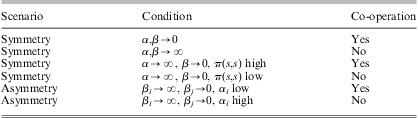
These findings are summarized in Table 1, which shows that under symmetry, both states must expect substantial benefits from co-operation, either because (i) each acquires substantial profits from new technology markets or (ii) they are not concerned about technology competition but rather focus on consumer prices. Under asymmetry, however, it suffices that more competitive states are also interested in profits from the new technology markets.
The Possibility of Co-operation for Various Parameter Values

Note: under symmetry, both states must expect substantial benefits from (i) eradicating the negative externality or (ii) enhanced profits. Under asymmetry, the less competitive state must be willing to accept low profits.
Model Extensions
In the main model, (i) states select the technology subsidies, (ii) both of them must approve the treaty for co-operation to begin and (iii) neither state can threaten to act unilaterally to solve the collective action problem. What if we relax these three assumptions?
First, suppose private companies are fully responsible for new technologies, so that the state is passive. In this modified model, a private company in each state i would select a technology investment – a private equivalent to a subsidy in the main model – denoted by
 $$${{s}_i} \in [0,\infty ) $$$
. The private company in state i would maximize some payoff function
 $$${{F}^i} ({{s}_i},{{s}_j})$$$
, which we leave implicit for generality. In equilibrium, the private companies would obtain payoffs
 $$${{F}^i} (s_{i}^{\ast}, s_{j}^{\ast} ) $$$
. The expected payoff to state i would be represented by Expression 2 (above). The only difference would be that the states are no longer in direct control of the technology competition outcomes after the treaty enters into force. Thus the model is fully applicable even if states are expected to adopt a ‘hands-off’ approach to technology innovation in the private sector.
Secondly, assume that state A can impose co-operation on state B, for example because it is much more powerful than state B. Alternatively, states A and B could represent country coalitions within a multilateral organization. In this case, voting rules other than unanimity could favor one of the coalitions, perhaps because it has more members. This extension would not compromise the main results, because the competition subgame would remain unchanged. The sole difference would be that at the co-operation stage, only state A would have to select
 $$$c_{A}^{\ast} = 1 $$$
for the treaty to enter into force. It would suffice to verify that state A may expect to benefit from co-operation.
Thirdly, consider the possibility of unilateral action. Suppose that by paying a fee F > 0, state A could unilaterally enact a policy that is de facto equivalent to a treaty. For example, the United States could unilaterally regulate fisheries imports from foreign countries, and the new regulations could diffuse to foreign countries through trade channels.Footnote 57 In this case, the outcome of the game would obviously be unchanged if international co-operation were possible in the first place, as state A would not benefit from unilateral action. But if the fee F were low enough, state A could force state B to engage in collective action if co-operation were failing, because state B alone would expect a negative payoff from the technology competition subgame. Thus the effects of unilateral action would be largely identical to the power asymmetry case examined above.Footnote 58
Limiting Technology Competition
Technology competition may present a commitment problem: if states could somehow credibly commit to higher or lower subsidies – more or less competitive industrial policy – would international co-operation again be feasible? We now consider the possibility that states can credibly commit to specific technology subsidies
 $$$s_{A}^{\ast}, s_{B}^{\ast} $$$
before they decide on a treaty. Thus they are able to select the technology subsidies ex ante. Formally, the order of moves is reversed.
Could this help achieve co-operation? Let us first consider an symmetric case whereby
 $$$s_{A}^{\ast} \: = \:s_{B}^{\ast} $$$
is in equilibrium and both states obtain identical payoffs. In this case a mutually agreed upon symmetric decrease in technology subsidies would not be helpful, because it would (i) increase the consumer price P and (ii) reduce market profits π. If anything, the states would thus have to credibly commit to increase their technology subsidies.
Proposition 3 (symmetric technology contracts): Suppose the states are symmetric. If market valuations α are low enough, a slight increase in technology subsidies will produce a strictly higher payoff for both states in the technology competition subgame.
A credible commitment to higher subsidies could increase state payoffs from co-operation, and thus facilitate treaty formation. If neither state is very interested in the commercialization profits (low α), they choose very low technology subsidies. Thus consumer prices remain high, and the cost of complying with the treaty will be high. But what about the asymmetric case?
Proposition 4 (asymmetric technology contracts): Suppose the states are asymmetric, and assume state A is originally unwilling to co-operate. If state A's market valuation αA islow (high) enough, an increase (decrease) in state B's subsidy
 $$$s_{B}^{\ast} $$$
increases the payoff to state A from the technology competition subgame.
 $$$s_{B}^{\ast} $$$
A credible commitment could help in two ways. When an advantaged state B reduces its technology subsidy, state A obtains a higher market share. This is beneficial whenever αA is high enough. But with a low enough αB , state A prefers state B to provde higher technology subsidies to produce a decrease in the consumer price P.
These results are relevant to WTO rules. The WTO constrains technology (and other) subsidies to the extent that they provide an ‘unfair’ competitive advantage to domestic producers. Such constraints may prove harmful to regulatory co-operation if countries are mostly worried about consumer prices, but they may be helpful if they help mitigate asymmetric competition effects. As such, WTO rules will probably have different effects on various environmental regimes. Those that suffer from underinvestment in environmental technology may suffer from constraints on subsidization, whereas those that suffer from concerns about unfair competition in new product markets will benefit.
Case Studies
To illustrate, we examine three cases: the Montreal Protocol, the Luxembourg Compromise of 1985 and European co-operation in renewable energy. All three cases are related to the environment, focus on industrialized countries and are relatively recent.
The case of the Montreal Protocol shows that the United States and Great Britain, two important players during the bargaining process, reached an agreement as their technological capabilities in CFC substitutes became increasingly symmetric. The next two cases focus on technologically asymmetric countries. In the case of the Luxembourg Compromise of 1985, European nations initially achieved little co-operation due to their asymmetric technological abilities. It was only after the introduction of a qualified majority and Germany's threat to act unilaterally that a compromise was achieved. The case of the European Union bubble shows that countries can co-operate despite asymmetric levels of technological development.
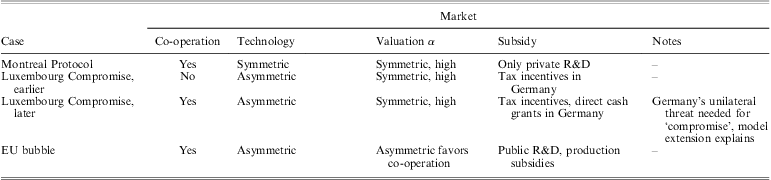
Table 2 summarizes our findings. Co-operation outcomes are in line with technological symmetry and government interests in industry profits. The only exception is the latter stage of the Luxembourg Compromise, which our model extension to unilateral action by a dominant country (Germany) can explain. We also evaluate the role of public subsidies.
Summary of Cases

For each case, we consider two alternative explanations: wealth and environmental interests. First, the economic wealth of negotiating countries – not their technology level per se – might explain diverging attitudes toward international co-operation. Economically wealthier countries might have a stronger interest in environmental co-operation, as proponents of the environmental Kuznets curve have argued.Footnote 59 Secondly, environmental interests might provide an overarching explanation for these cases, since reaching environmental co-operation might be easier among countries with higher environmental interest.
Symmetric Agreement: The Montreal Protocol
Symmetric technological development of CFC substitutes played a major role in the successful conclusion of the Montreal Protocol. States were concerned about the effect of the ozone regime on the market share and considered their technology development level during the bargaining process.
The negotiations, which officially began at a United Nations Environment Programme Governing Council meeting in 1981, resulted in the signing of the Montreal Protocol in September 1987. The agreement called for a 50 per cent reduction in the consumption of certain CFCs by 2000. Although the negotiations were complicated by disputes over scientific uncertainties surrounding the impact of CFCs on ozone depletion, and by the chemical industry's opposition, the level of co-operation went beyond what had previously been deemed possible. In 1990 the signatories enhanced the level of co-operation to phase out all CFCs by 2000, and in 1992 they rolled back the target year to 1996.Footnote 60
The United States and Great Britain both played an important role in bargaining during the Protocol negotiations.Footnote 61 The United States was the world's largest producer of CFCs, accounting for 44 per cent of all CFC production in 1974, followed by Western Europe, which was responsible for about one-third of worldwide production.Footnote 62 DuPont (the largest CFC producer in the United States) and Imperial Chemical Industries (ICI), the largest enterprise in Great Britain, were also influential in the negotiation process because their respective countries were particularly attentive to their national firms.
Before the Montreal Protocol, neither DuPont nor ICI had developed alternative chemicals to CFCs. However both companies were interested in the future market profits from developing CFC substitutes because they had ‘the necessary financial and organizational resources to invest in new technologies’ and could ‘build on the experiences of the 1970s, when the first ozone controversy prompted them to look into the potential for substituting CFCs’.Footnote 63 In the late 1970s, DuPont invested about US$70 million into developing substitutes. It revived its research program in 1986, one year before the protocol was signed,Footnote 64 and announced that year that CFC substitutes would be available within five years.Footnote 65
Although Western European companies, including ICI, did not invest in new substitutes to the same extent, it was clear that ICI also had a comparable capacity to develop new substitutes. For instance, according to patent applications and publications from the mid-1980s, ICI and DuPont both developed synthesis processes and catalysts to produce HFC-134a, one potential alternative to CFC.Footnote 66 ICI also resumed a research program into CFC alternatives that it had abandoned in the early 1980s.Footnote 67 Due to industrial secrecy, it is difficult to determine how advanced DuPont and ICI technologies were prior to the Montreal Protocol, but we can conclude from the subsequent developments that they had quite symmetric capacities to formulate new substitutes. DuPont announced in 1989 that it would begin commercial production by the end of 1990, and ICI was expected to bring its first HFC-134a facility on stream a few months later.Footnote 68
The United States pushed for an international treaty to reduce CFC emissions, but hoped to limit the scope of that treaty to purely non-essential aerosol uses of CFCs. The European Community (EC) was initially reluctant to embrace any international measures to ban CFC emissions, but shifted its position in 1984 by calling for an international production capacity cap and a 30 per cent cut in non-essential aerosol use of CFCs. Each proposal reflected the respective economic interests of the United States and Western Europe: the United States had already begun regulating non-essential uses, and the EC had capped production capacity for CFCs at the 1980 level. Although some measures restricting CFC use were already in place in the United States and Europe, the strongest opposition to creating an international ozone regime came from industry.
Significant progress was made in 1986 when the American industry first acknowledged a connection between CFCs and ozone depletion and when DuPont announced the feasibility of manufacturing substitutes.Footnote 69 As the development of CFC substitutes became more feasible, by 1986, industrial representatives significantly softened their opposition against to an international ban on CFCs. The Alliance for Responsible CFC Policy, an industry lobby group, announced that its members were willing to endorse a global ozone regime. DuPont also called for a worldwide limit on CFC emissions.Footnote 70 From that point on, the United States assumed a more ambitious position, calling for a long-term reduction of up to 95 per cent of all CFC and halon consumption.Footnote 71 In addition, the European CommunityEC shifted its position in the summer of 1987 as large European companies recognized the projected market profits from developing new substitutes.Footnote 72 A shift in industry position, accompanied with by technologicaly innovation, led the United States and Great Britain to endorse co-operation. As a result, countries were finally able to come to agreement to reduce CFC consumption by 50 per cent.
The successful conclusion of the agreement was due at least in part to the industries’ symmetric ability to develop new substitutes. While the conventional wisdom holds that the American industry was in a superior position, other leading European chemical companies, especially ICI, had sufficient resources and previous experience in developing substitutes. Furthermore, the current scholarly consensus is that ICI came to support CFC regulation because of the expected long-term profits from CFC substitutes.Footnote 73 Davenport also acknowledges that ‘European chemicals industry giants also faced the promise of expanding profits from marketing substitutes’ because ‘new substitutes could be marketed as high-margin specialty chemicals, would thus command higher prices, and ensure a substantial competitive advantage to a few leading international firms that could make that investment’.Footnote 74 Jordan writes that Britain's shift in position stemmed from ‘ICI's eagerness not to be excluded from the post-CFC market in substitute chemicals’.Footnote 75
Counterfactually, had there been a wide technology gap between DuPont and ICI, Britain would not have ignored ICI's position and would have opposed the signing of the Montreal Protocol. Britain was concerned about ICI's market share (high αi ) because it was the largest industrial firm as well as the largest CFC producer in Britain.Footnote 76 Therefore the British industry's comparable capacity to develop new substitutes was critical for Britain's support. This case shows that the symmetric level of technological development was conducive to international co-operation in the reduction of CFCs. Since American and British industries had similar capacities, major companies expected to benefit from new regulations rather than lose out to competition from rivals.
Neither economic wealth nor environmental interests account for the bargaining outcomes. First, wealth cannot explain why the United States and Britain shifted their negotiating positions in the mid-1980s. Both countries initially provided only limited support for the international ban on CFCs, but they fully endorsed the creation of the ozone regime from the mid-1980s. This shift occurred without any significant change in their economic power. Secondly, the environmental justification also falls short of explaining the timing of the position shift. Sprinz and Vaahtoranta explain why the United States (Great Britain) was more (less) supportive of an international agreement due to its high (low) ecological vulnerability.Footnote 77 However, a focus on environmental interests does not explain why Britain changed its position to support the ozone regime during the bargaining process.
Asymmetric Disagreement: The Luxembourg Compromise of 1985
This case study shows that technology competition impeded European co-operation on automobile emission standards. While Germany had developed advanced technology for controlling automobile emissions, Great Britain and France had immature technology. The subsidy cost βi was low for Germany and high for Great Britain and France. But Great Britain and France still greatly valued market profits (high αi ) from the automobile industry and refrained from co-operation due to expected losses in a technology competition with Germany.
The debate over automobile emission standards within the EC began in the early 1980s as Germany – together with the Netherlands, Denmark and Greece – pressed for a European bill to adopt stringent limits. Their proposal was opposed by the British, French and Italian governments due to concerns over the technology gap between the German automotive industry and their own. The German industry held advantages on tough emission standards, partly due to tax incentives established by the German federal government. British and French firms lacked such advanced technology, which led them to oppose any European-wide agreement limiting automobile emissions. Due to asymmetries in technology, the European countries at first failed to adopt stringent standards and instead reached a compromise to require three-way catalytic converters to be initially imposed on larger cars with two-liter or greater engines. The EC was only able to slowly expand the scope of co-operation, as British and French car companies attempted to buy the time they needed to develop technology to compete with the German auto industry.Footnote 78 Therefore this case illustrates how a technology gap between nations impeded international co-operation.
In the early 1980s, Germany was a leader in engineering technology for controlling automobile emissions. This know-how was unavailable to other national automobile industries in Europe, notably those in Great Britain and France. The German industry had developed an advanced device, the three-way catalytic converter, in order to meet the automotive emission standards of the United States, a key export market for German firms.Footnote 79 In addition, the German government's introduction of tax rebates for less-polluting cars had encouraged technological expansion.Footnote 80 Wurzel notes that the adoption of tax incentives in Germany played a crucial role in compelling the motor industry to produce vehicles equipped with three-way catalytic converters.Footnote 81 In constrast, the British and French industries were pursuing an alternative approach, the lean-burn engine technology.Footnote 82
Against this backdrop, Germany proposed stringent emission standards for passenger cars.Footnote 83 However, other nations were concerned about the projected impact on their automobile industries, and generally ascribed a greater weight to these concerns, αi , than to the expected environmental benefits of the proposal, Vi . Since stringent standards required the adoption of a three-way catalytic converter, key players in the German automotive industry such as Mercedes, BMW and Volkswagen were expected to adapt more easily to a tightening of standards.
Competitors in Britain and France were expected to suffer.Footnote 84 The British and French governments expressed their suspicions about Germany's motivations and accused Germany of ‘trying to give its car industry a comparative advantage under a cover of environmental concerns’.Footnote 85 In Britain, the German government was viewed as ‘having been persuaded by their manufacturers, on competitive grounds, to press for the catalysts’, and as ‘wanting to achieve a technological hegemony within the automobile sector in Europe’.Footnote 86 French car manufacturers also claimed that Germany was ‘saying forest and meaning Mercedes’.Footnote 87 Germany threatened to unilaterally require cars sold in Germany to be equipped with three-way catalytic converters.
The fierce British and French resistance stems from the national importance of the car industries (high αi ) and their technological disadvantage vis-à-vis the Germans. If market profits from the automotive industries had not been important to the British and French economies, they would have co-operated more readily, despite their technological handicap. However, Britain and France had significant interests in automotive market profits. In 1980, road vehicles constituted 8.9 per cent and 8.4 per cent of total exports in Britain and France, respectively.Footnote 88 Due to the significant impact of the car industries on their national economies, asymmetric technology magnified their concerns about competition with the German car industry. Also, they argued that the relative costs of adopting the three-way catalytic converter were higher for smaller cars compared to larger cars (on which German manufacturers tended to concentrate), because purchasers of smaller vehicles were more sensitive to price increases than were other consumers.Footnote 89
The arduous negotiations at the EC level initially resulted in limited co-operation, the Luxembourg Compromise of 1985, which established distinct emission limit values for three categories of automobiles and required the adoption of a three-way catalytic converter only for large cars with engine displacements over two liters. Emission standards for smaller cars became more stringent, yet remained achievable without a three-way catalytic converter.Footnote 90 This outcome reflected the interests of the British and French car manufacturers, which tended to concentrate on the production of small and medium-sized cars. Denmark and Greece vetoed the directive in 1985 because Denmark supported stricter standards for all cars and Greece hoped to receive additional funds for environmental protection. The directive was passed in 1987 following the introduction of the Single European Act, which allowed qualified majority voting.Footnote 91 This outcome is consistent with our model extension that allows a more enthusiastic country to impose co-operation on others.
Even after the Luxembourg Compromise, the German government continued to support catalytic conversion technology. The federal government introduced tax differentials in favor of unleaded gasoline and low- or reduced-emission vehicles. The government offered tax exemption for anyone registering a new catalytic-converter-equipped car up to DM 3,000 until 1987 and up to DM 1,100 until July 1991. Direct cash subsidies were also offered for retrofitting existing cars with catalytic converters, which operated from January 1986 to July 1992.Footnote 92 These measures are consistent with our model's predictions. In 1989, member states agreed to require the adoption of a three-way catalytic converter for small cars under 1.4 liters (the 1989 Small Car Directive) and further expanded the agreement to apply to all new cars by 1992 (the 1990 Consolidated Directive). This path toward broader co-operation faced fewer obstacles because British and French catalytic-converter technologies had grown relatively more symmetrical. Although German manufacturers continued to hold a lead, the British and French industries were now developing proprietary technologies. In fact, the British and French car manufacturers had already begun to develop their technologies prior to the Luxembourg Compromise. For instance, the Financial Times reported in May 1983 that Ford Europe had launched a crash program, investing US$ 200 million and dedicating 400 of its 5,000 European engineers. At the time of the Compromise, however, their technologies were unable to compete with the German industry. The technology gap had narrowed by 1989, and the British and French industries were thus less opposed to new agreements. One British industry representative remarked that they prefer ‘slightly more stringent standards which give us more lead time compared to more lenient standards which stipulate short implementation deadline’.Footnote 93
This case illustrates the impact of technology development on international co-operation. We have argued that the EC's failure to impose stringent emission standards for all cars was due to the asymmetric technology situation and certain member states’ salient interests in market profits from their automotive industries. Had Great Britain and France already possessed more advanced technology analogous to the three-way catalytic converter, the EC would have been able to reach a more profound agreement much earlier. Alternatively, had they held only marginal interests in profits from the automotive industries, the scope of the agreement would have been more expansive. Over time, the EC was able to expand the level of co-operation as the technology gap closed.
As for alternative explanations, the wealth-based explanation fails to account for why wealthy France and Great Britain were hesitant to adopt a European automobile emission standard while economically poorer nations, such as Greece, supported it. Our model can explain this pattern. First, France, Great Britain and Greece were all technology underdogs, but France and Great Britain were highly interested in market profits (high αi ) while Greece had little interest (low αi ). Secondly, environmental interests alone are not sufficient to explain this case. While the German public was more concerned about the environment due to the acid rain issue, this view cannot explain why Great Britain and France gradually began to support co-operation, as there was no significant change in terms of environmental interests. Indeed, both Great Britain and France did offer fuel efficiency as an alternative approach to environmental conservation.
Asymmetric Agreement: The European Union Bubble
This case demonstrates the possibility of asymmetric co-operation: European nations were asymmetric in terms of renewable energy technology, but successfully concluded a climate BSA. Denmark, Sweden and Germany possessed advanced renewable energy technology and were leading the industry (high αi and low βi ). Other countries, such as Britain and France, were latecomers and had little interest in market profits from renewables (low αj and high βj ). European co-operation was possible despite asymmetric technology because technology underdogs had low market valuations.
Under the Kyoto Protocol, the EU agreed to reduce its total greenhouse emissions by at least 8 per cent below 1990 levels by 2012. Before and after the Kyoto conference, EU member states negotiated over how to share the burden of emissions reductions within the union, and reached a burden sharing agreement (BSA) in March 1997 (pre-Kyoto) and again in June 1998 (post-Kyoto). While long-term burden sharing remains, to a certain extent, an ‘unsettled’ issue, this positive negotiation of a BSA is a rare example of success in distributional bargaining within the environmental realm.Footnote 94 A key contributing factor for reaching the BSA, as we show, was the ambitious commitments undertaken by countries with a strong interest in renewable energy technology. Denmark and Germany committed to reducing greenhouse emissions by 21 per cent. At the same time, countries such as Portugal and Greece were allowed to increase their emissions by up to 27 and 25 per cent, respectively. Our model makes sense of this outcome by providing a previously unrecognized explanation for the stark asymmetries that characterized the BSA, which are inexplicable from either a purely economic or environmental perspective.
Remarkable variation across member states characterized their varied abilities to deploy renewables. Denmark and Germany led the European renewable energy market in the 1990s. Since the 1970s, the Danish government has promoted wind energy, and to a lesser extent biomass, using a variety of instruments including investment subsidies, public R&D, tax exemptions and a feed-in tariff to private turbine owners.Footnote 95 Owing to this support, Danish manufacturers have been the most successful wind turbine producers since the early 1980s. In 1990, Danish wind turbines accounted for some 45 per cent of total worldwide capacity.Footnote 96 Germany came to wind power later than Denmark, but it emerged as number two in the world in installed capacity in 1994 and was already number one by 1996.Footnote 97 While German industry benefited from the substantial domestic electricity market, government support was also crucial in fostering the solar and wind industries. In 1991, in an attempt to stabilize the market for wind power, the German government passed the Electricity Feed-in Law, which required utilities to purchase renewable electricity and dictated its price.Footnote 98 Consistent with our model, (i) public subsidies for renewable energy in Germany and Denmark continued in the implementation stage and (ii) resulted in decreased consumer prices.Footnote 99
On the other hand, countries such as Great Britain and France were not particularly interested in renewables. Great Britain had provided R&D support for new energy technologies in the late 1970s, but the government was not pressured to seek alternatives due to abundant hydrocarbon resources and minimal public opposition to nuclear energy.Footnote 100 Also, the French energy sector was dominated by the nuclear industry, and notably the de facto monopoly Electricité de France, created by President de Gaulle's ambitious nuclear program.Footnote 101 During the Kyoto negotiations, many other countries, from Italy and Belgium to Spain and Portugal, held little commercial interest in renewable energy, as indicated by the data analyzed below. In this context, EU member states understood that some differentiation would be necessary to reach a BSA. The EU had been involved in the global climate negotiations of the early 1990s, but it was not until January 1997 that it introduced a specific proposal for an EU-wide abatement target and individual national goals. The Dutch government suggested a ‘Triptych Approach’, which divided each national economy into three broad sectors: the light domestic sector, the energy-intensive export-oriented sector, and the electricity-generation sector.Footnote 102 The idea of the Triptych was to develop an objective and economically sound foundation for burden sharing.
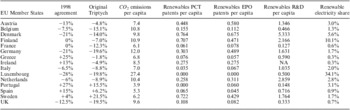
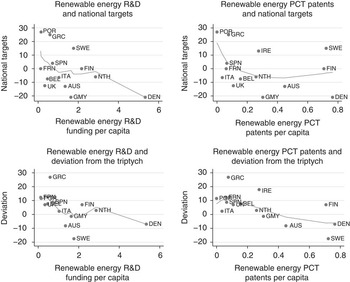
The BSA finalized by the EU in 1998 differed from the original Triptych. The commitments, along with other descriptive statistics, are provided in Table 3. Higher per capita numbers of patent applications and larger R&D investment are indicators of a greater ability to commercialize renewable energy. If our hypothesis is correct, countries with high prior per capita patenting rates and R&D investment should accept more ambitious commitments. Using prior patents and R&D allows us to measure each country's interest αi and cost βi . High prior patenting and R&D rates suggest both ability and interest, so they map into high αi and low βi . In contrast, we cannot use subsequent patents and R&D investment, because our model shows that they are endogenous to co-operation.
The European Burden Sharing Scheme, the Triptych and Other Statistics

Note: the data on the number of patent applications filed at the Patent Co-operation Treaty (PCT) and the European Patents Office (EPO) can be acquired from the Organisation for Economic Co-operation and Development Patent Statistics Portal. For patents data, we averaged per capital patent applications for 1993–7. The data on public funding for R&D are available from the International Energy Agency (IEA) database. We only included non-hydropower renewable energy technologies, as defined by the IEA and averaged per capita R&D for 1993–7.
For the test, we fitted a locally smoothed regression (lowess) in the data. First we examined the absolute national commitments. Next we examined deviations from the Triptych. The former approach offers a clean baseline test, whereas the latter approach ensures that the results are robust. The results are reported in Figure 2. Each country's commitment – and the corresponding deviation from the original Triptych – are negatively related to the country's commercial ability in renewable energy. Nations with high patenting rates and large annual investments in R&D into renewables were willing to accept a higher cost for implementing the Kyoto Protocol.
Locally smoothed regression (LOWESS) results
Note: the upper panels show that the national targets agreed in the EU BSA are negatively related to patents filed at PCT and renewable energy R&D funding. The lower panels show that the deviation from the original Triptych is also negatively related with these measures of prowess in renewables. In each figure, the lines are the non-parametric lowess fits to the data.

The negotiations tell a similar story. Germany was a key player in the negotiation process and showed a willingness to assume an ambitious reduction target from the very beginning. To facilitate the negotiations, in March 1996 Germany proposed a reduction target of 10 per cent by 2005 and 15–20 per cent by 2010 and declared that it would reduce its emissions by 20 per cent. Since Germany's dramatic reductions alone would cover approximately 80 per cent of the EU's overall target, its position played a significant role in the success of negotiations within the EU.Footnote 103 In addition to Germany, other ‘rich and green’ countries such as Austria, Denmark and the Netherlands, which had all been investing substantial public funding in renewable energy R&D, contributed to the success of the negotiations by setting their own ambitious targets.Footnote 104 Technological forerunners expected to benefit from international environmental co-operation, because such efforts would increase demand for renewable energy.
While technological underdogs, such as Greece and Portugal, worried about the cost of emissions reductions, they were not opposed to the agreement as long as they could assume a lighter burden.Footnote 105 Members of the Cohesion Fund (Greece, Ireland, Portugal and Spain) asserted their right to increase their domestic CO2 emissions,Footnote 106 and other members acknowledged the need for differentiated responsibilities.
In sum, technological asymmetry need not cause co-operation failure. If technological leaders are willing to assume a heavier burden, co-operation remains within reach. Germany enthusiastically propelled the negotiation process even at the cost of assuming a considerable burden, and Denmark followed suit. Other countries participated in environmental co-operation because they expected to lose little from the expansion of co-operation. German and Danish enthusiasm would bring about dramatic reductions in the cost of renewable electricity, which would then allow other European countries to comply with the EU BSA at a lower cost.Footnote 107
Neither wealth nor environmental interests are plausible alternative explanations. First, while economic wealth can explain North-South differences, it cannot explain variation in emission reduction targets among the Northern members. For instance, France and the Netherlands did not deviate significantly from the Triptych, in spite of their wealth. This is also true of Finland and Italy. Secondly, environmental interest cannot explain why some countries assumed a heavier burden than others. According to a 1995 Special Eurobarometer, for example, 82 per cent of surveyed Europeans viewed protecting the environment as an immediate and urgent problem. The variation amongst member states was relatively small and does not capture the different stringencies of nations’ emission reduction targets. For instance, the figure appeared to be highest in Greece (97 per cent) and lowest in Belgium (63 per cent), but Greece assumed a light burden of +25 per cent while Belgium assumed a heavier burden of −7.5 per cent.Footnote 108
Conclusion
Is technology competition an impediment to international co-operation, or could it help states achieve co-operation? While technology co-operation can impede co-operation when states hold strong techno-nationalist preferences and possess asymmetric technological capacities, we have shown that technology competition can facilitate co-operation if it induces states to implement industrial policies that reduce the consumer price of new technology. From pollution abatement and biotechnology promotion to defense collaboration, these findings can shed light on the dynamics of co-operation in a wide variety of issue areas.
We offer at least two important broader conclusions. First, we draw attention to the endogenous nature of the cost of treaty compliance, which depends on state behavior in complex ways: for example, technology competition may aggravate concerns about relative gains but also reduce consumer prices, so that the expectation of technology competition has different effects on the compliance costs of different states. Secondly, we note that even though the origins of technology competition are in national self-interest, such self-interest may nonetheless allow states to credibly commit to international co-operation. Even if states play a zero-sum technology game, a by-product of their rivalry is a reduction in consumer prices.
The theoretical model can also help policy makers make treaties work. In treaty negotiations, the most acrimonious debates often pertain to ancillary issues, such as commercial rivalry. Institutional designs that ensure a juste retour for pivotal states are key to successful co-operation. For example, explicitly agreeing on the use of different technologies – from nuclear to wind and clean coal – could allow major emitters to secure profits from climate co-operation.
Appendix: Equilibrium Analysis
In this appendix, we characterize the technology competition subgame. First, consider the maximization problem in regard to the subsidy choice si . In equilibrium, the following first-order conditions must hold:
 $${\rm{ - }}\frac{{\partial {{P}_i}( \cdot )}}{{\partial {{s}_i}}}\, + \,{{\alpha }_i}\frac{{\partial \pi ( \cdot )}}{{\partial {{s}_i}}}\: = \:{{\beta }_i}{{s}_i}$$
The left-hand side of this expression is strictly concave, so the best response si to any foreign subsidy sj is unique.
We now show that each player i's payoff is quasiconcave, so that at least one stable equilibrium in pure strategies exists. Our comparative statics will hold for any stable equilibrium of the technology competition subgame. By applying Kakutani's fixed-point theorem, it suffices to show that each player i's subgame payoff,
 $$${{V}_i}\: + \:\alpha {{\pi }_i}\:{\rm\, { - }}\, \:{{P}_i} $$$
, is quasiconcave in her own strategy si
. With π strictly concave in si
and −Pi
strictly concave in si
, the claim follows immediately. Next we characterize the regularity conditions for a locally stable equilibrium:
 $$ \frac{{\partial U_{A}^{2} \left( {s_{A}^{\ast}, s_{B}^{\ast} } \right)}}{{\partial s_{A}^{2} }}\frac{{\partial U_{B}^{2} \left( {s_{A}^{\ast}, s_{B}^{\ast} } \right)}}{{\partial s_{B}^{2} }} \, \gt \, \frac{{\partial U_{A}^{2} \left( {s_{A}^{\ast}, s_{B}^{\ast} } \right)}}{{\partial {{s}_A}\partial {{s}_B}}}\frac{{\partial U_{B}^{2} \left( {s_{A}^{\ast}, s_{B}^{\ast} } \right)}}{{\partial {{s}_A}\partial {{s}_B}}} $$
These conditions are clearly met as long as the cross derivative of π is low enough.
Appendix: PROOFS
Proof of Claim 1. Consider any stable equilibrium of the game. First, let αj
be high enough. The best response
 $$$s_{j}^{\sigma } $$$
is strictly increasing in si
. If αi
increases or βi
decreases slightly, the best response
 $$$s_{i}^{\sigma } $$$
shifts upward for any given sj
. In some ε neighborhood of the stable equilibrium, where ε→+0, the best responses meet exactly once. An upward shift in
 $$$s_{i}^{\sigma } $$$
must induce an increase in the location of the intersection
 $$$s_{A}^{\ast}, s_{B}^{\ast} $$$
, regardless of whether
 $$$s_{i}^{\sigma } $$$
is increasing or decreasing in the ε neighborhood in focus.
Secondly, let αj
be low enough. The best response
 $$$s_{\,j}^{\sigma } $$$
is strictly decreasing in si
. If αi
increases or βi
decreases slightly, the best response
 $$$s_{i}^{\sigma } $$$
shifts upward for any given sj
. In some ε neighborhood of the stable equilibrium, where ε→+0, the best responses meet exactly once. Thus an upward shift in
 $$$s_{i}^{\sigma } $$$
must induce an increase in c and a decrease in
 $$$s_{j}^{\ast} $$$
, regardless of whether
 $$$s_{i}^{\sigma } $$$
is increasing or decreasing.
Proof of Claim 2. Suppose first that βi
→0, βj
→∞. In this case,
 $$${{\pi }_i}( {s_{i}^{\ast}, s_{j}^{\ast} } \right)\,\gt\,0 $$$
. Holding all other parameters constant, we may write
 $$$s_{i}^{\ast} \left( {{{\alpha }_i}} \right) $$$
and
 $$$s_{j}^{\ast} \left( {{{\alpha }_i}} \right) $$$
. Totally differentiating the left side of Expression 2 with respect to αi
yields the change:
 $$ {\rm{ - }}\frac{{\partial P\left( {s_{i}^{\ast} + s_{j}^{\ast} } \right)}}{{\partial \left( {s_{i}^{\ast} + s_{j}^{\ast} } \right)}}\left( {\frac{{ds_{i}^{\ast} }}{{d{{\alpha }_i}}} + \frac{{ds_{j}^{\ast} }}{{d{{\alpha }_i}}}} \right) + {{\alpha }_i}\left( {\frac{{\partial {{\pi }_i}}}{{\partial s_{i}^{\ast} }}\frac{{ds_{i}^{\ast} }}{{d{{\alpha }_i}}} + \frac{{\partial {{\pi }_i}}}{{\partial s_{j}^{\ast} }}\frac{{ds_{j}^{\ast} }}{{d{{\alpha }_i}}}} \right){\rm{ - }}{{\beta }_i}s_{i}^{\ast} \frac{{ds_{i}^{\ast} }}{{d{{\alpha }_i}}} + {{\pi }_i}\left( {s_{i}^{\ast}, s_{j}^{\ast} } \right). $$
By the envelope theorem, in equilibrium we must have:
 $$ {\rm{ - }}\frac{{\partial P\left( {s_{i}^{\ast} + s_{j}^{\ast} } \right)}}{{\partial \left( {s_{i}^{\ast} + s_{j}^{\ast} } \right)}}\: + \:{{\alpha }_i}\frac{{\partial {{\pi }_i}}}{{\partial s_{i}^{\ast} }}\:{\rm{ - }}\:{{\beta }_i}s_{i}^{\ast} \, = \,0. $$
Given βj
→∞, in any stable equilibrium we also have
 $$$\frac{{ds_{j}^{\ast} }}{{d{{\alpha }_i}}} \rightarrow 0 $$$
. Thus the total differential can be written as
 $$${{\pi }_i}( {s_{i}^{\ast}, s_{j}^{\ast} } \right) $$$
. This expression is strictly positive, given that
 $$${{\beta }_i} \rightarrow 0,{{\beta }_j} \rightarrow \infty $$$
.
Suppose next that βi
→∞ and βj
→0. We now have
 $$${{\pi }_i}( {s_{i}^{\ast}, s_{j}^{\ast} } \right) \, \lt\, 0 $$$
by assumption. We also have
 $$$\frac{{ds_{j}^{\ast} }}{{d{{\alpha }_i}}} \rightarrow 0 $$$
, given that αi
only enters state j's best response through
 $$$s_{i}^{\ast} $$$
, and
 $$$\frac{{ds_{i}^{\ast} }}{{d{{\alpha }_i}}} \rightarrow 0 $$$
because βi
→∞. Thus the total differential can again be written as
 $$${{\pi }_i}( {s_{i}^{\ast}, s_{j}^{\ast} } \right) $$$
. However, this expression is strictly negative, given that βi
→∞.
Proof of Claim 3. Suppose αj
increases or βj
decreases slightly. Let αi
→0. The best response
 $$$s_{i}^{\sigma } $$$
to any given
 $$${{\tilde{s}}_j} $$$
is strictly decreasing by Equation 3 and obviously remains unchanged. The payoff to state i is strictly increasing in
 $$$s_{j}^{\ast} $$$
because P is a strictly decreasing function. In any stable equilibrium of the game, we must obtain an increase in
 $$$s_{j}^{\ast} $$$
. Thus the payoff to state i must increase. Suppose now αi
→∞. The best response
 $$$s_{i}^{\sigma } $$$
to any given
 $$${{\tilde{s}}_j} $$$
is strictly increasing by Equation 3 and obviously remains unchanged. The payoff to state i is strictly decreasing in
 $$$s_{j}^{\ast} $$$
because πi
is strictly decreasing in
 $$$s_{j}^{\ast} $$$
. Totally differentiating the left side of Expression 2 with respect to βj
yields:
 $$ {\rm{ - }}\frac{{\partial P\left( {s_{i}^{\ast} + s_{j}^{\ast} } \right)}}{{\partial \left( {s_{i}^{\ast} + s_{j}^{\ast} } \right)}}\left( {\frac{{ds_{i}^{\ast} }}{{d{{\beta }_j}}}\: + \:\frac{{ds_{j}^{\ast} }}{{d{{\beta }_j}}}} \right)\: + \:{{\alpha }_i}\left( {\frac{{\partial {{\pi }_i}}}{{\partial s_{i}^{\ast} }}\frac{{ds_{i}^{\ast} }}{{d{{\beta }_j}}}\: + \:\frac{{\partial {{\pi }_i}}}{{\partial s_{j}^{\ast} }}\frac{{ds_{j}^{\ast} }}{{d{{\beta }_j}}}} \right){\rm{ - }}{{\beta }_i}s_{i}^{\ast} \frac{{ds_{i}^{\ast} }}{{d{{\beta }_j}}}. $$
By the envelope theorem, we can write this expression as:
 $$ {\rm{ - }}\frac{{\partial P\left( {s_{i}^{\ast} + s_{j}^{\ast} } \right)}}{{\partial \left( {s_{i}^{\ast} + s_{j}^{\ast} } \right)}}\frac{{ds_{j}^{\ast} }}{{d{{\beta }_j}}} + {{\alpha }_i}\frac{{\partial {{\pi }_i}}}{{\partial s_{j}^{\ast} }}\frac{{ds_{j}^{\ast} }}{{d{{\beta }_j}}}. $$
With αi →∞, this expression is strictly negative.
Proof of Proposition 1. First, let α,β→0. In equilibrium, the payoff to state i is
 $$${{V}_i}\:{\rm{ - }}\:P( {s_{i}^{\ast} \: + \:s_{j}^{\ast} } \right)\: + \:\alpha {{\pi }_i}( {s_{i}^{\ast}, s_{j}^{\ast} } \right){\rm{ - }}\frac{1}{2}{{\beta }_i}{{( {s_{i}^{\ast} } \right)}^2} $$$
. It can be approximated by
 $$${{V}_i}\: - \:P( {s_{i}^{\ast} \: + \:s_{j}^{\ast} } \right) $$$
. With
 $$$s_{i}^{\ast}, s_{j}^{\ast} \rightarrow \infty $$$
, this expression is strictly positive.
Suppose now that α→∞, β→0. The equilibrium payoff to state i is approximately
 $$$\alpha {{\pi }_i}( {s_{i}^{\ast}, s_{j}^{\ast} } \right) - \frac{1}{2}{{\beta }_i}{{( {s_{i}^{\ast} } \right)}^2} $$$
. This payoff is strictly positive if and only if
 $$${{\pi }_i}( {s_{i}^{\ast}, s_{j}^{\ast} } \right) $$$
exceeds
 $$$\frac{1}{2}{{\beta }_i}{{( {s_{i}^{\ast} } \right)}^2} $$$
. This condition holds if and only if πi
(s,s) is high enough when s→∞.
Proof of Proposition 2. Let βi
→∞, βj
→0. Thus we have in equilibrium
 $$$s_{j}^{\ast} \gt s_{i}^{\ast} $$$
and
 $$$U_{j}^{\ast} \geq 0 $$$
. To investigate the existence of a co-operative equilibrium, we must only verify that
 $$$U_{i}^{\ast} \geq 0 $$$
. With βi
→∞, βj
→0, we clearly have
 $$${{V}_i}\: - \:P \gt 0 $$$
and
 $$${{\pi }_i} \lt 0 $$$
and
 $$$ \minus \frac{1}{2}{{\beta }_i}{{\left( {s_{i}^{\ast} } \right)}^2} \approx 0 $$$
. The total payoff to state i is approximately
 $$${{V}_i}\: - \:P \, +\, {{\alpha }_i}{{\pi }_i} $$$
, an expression that is weakly positive (strictly negative) if and only if αi
is low (high) enough.
Proof of Proposition 3. Consider the symmetric case and set α low enough. For each country i, the equilibrium subsidy
 $$$s_{i}^{\ast} $$$
maximizes the value of
 $$${\rm{ - }}P( {s_{i}^{\ast} + s_{j}^{\ast} } \right){\rm{ - }}\frac{1}{2}\beta {{( {s_{i}^{\ast} } \right)}^2} $$$
with an arbitrarily high degree of accuracy. With P strictly decreasing, a symmetric increase of Δ in
 $$$s_{i}^{\ast}, s_{j}^{\ast} $$$
will thus increase the payoff to both countries as long as Δ is low enough.
Proof of Proposition 4. Suppose first αA
is low enough. Now the payoff state A is
 $$${\rm{ - }}P( {s_{A}^{\ast} \: + \:s_{B}^{\ast} } \right)\:{\rm{ - }}\:\frac{1}{2}\beta {{( {s_{A}^{\ast} } \right)}^2} $$$
. As
 $$$s_{B}^{\ast} $$$
increases, the payoff to state A increases strictly for a given
 $$$s_{A}^{\ast} $$$
. By changing sA
, state A obtains an even higher payoff, so the total effect must be strictly positive. If αA
is high enough, the payoff to state A is
 $$${\rm{ - }}P( {s_{A}^{\ast} \: + \:s_{B}^{\ast} } \right)\: + \:\alpha \pi ( {s_{A}^{\ast}, s_{B}^{\ast} } \right)\:{\rm{ - }}\:\frac{1}{2}\beta {{( {s_{A}^{\ast} } \right)}^2} $$$
. With α high enough, a decrease in
 $$$s_{B}^{\ast} $$$
must provide a strict increase for state A. By changing sA
, state A can obtain an even higher payoff.