





Celiac disease (CD) is a common chronic gastrointestinal disorder with a ∼1 % global prevalence affecting all age groups(Reference Kurppa, Mulder and Stordal1). Genetically predisposed individuals experience an immune-mediated mucosal injury upon gluten intake (from wheat, rye and barley), typically presenting as villous atrophy and crypt hyperplasia(Reference Kemppainen, Albo and Kaunisto2). CD is clinically heterogeneous, manifesting as gastrointestinal, extraintestinal (e.g. anemia, osteoporosis) or asymptomatic phenotypes(Reference Blom, Gidrewicz and Turner3).
Currently, strict adherence to a gluten-free diet (GFD) remains the only definitive treatment. Beyond controlling symptoms and reversing pathophysiological abnormalities, the GFD requires a comprehensive behavioural shift toward a gluten-free (GF) lifestyle(Reference Mehtab, Agarwal and Chauhan4). Although GFD is considered safe, it presents multifaceted challenges. Firstly, the social and emotional significance of GFD often results in an impaired quality of life(Reference Bouery, Attieh and Sacca5,Reference Serin, Andruskiene and Verma6) . Secondly, the increased processing requirements of GF alternatives render them significantly more expensive than their gluten-containing counterparts(Reference Fry, Madden and Fallaize7). Finally, since many industrially produced products contain gluten, it is difficult to adhere strictly to GFD(Reference D’Heedene, Vanuytsel and Wauters8). Furthermore, the nutritional profile of GF products which often contain higher carbohydrate and Na, and lower protein may predispose patients to unhealthy nutrition(Reference Marmol-Soler, Matias and Miranda9).
GFD imposes a multifaceted burden encompassing social, economic and psychological dimensions, particularly when patients dine out(Reference Abdi, Zuberi and Blom10–Reference Rose, Law and Howard12). While qualitative research has explored the experiences of children and their caregivers, as well as general adult populations(Reference Rose, Law and Howard12–Reference Kutahyalioglu and Kas Alay14), certain subgroups remain under-researched.
University students, specifically, constitute a vulnerable population as they transition to independent living. This developmental stage is characterised by the shift from parental supervision to self-managed care(Reference Vagadori, Trojanowski and Keenan15,Reference Laheri, Soon and Dillon16) . Students living away from home face heightened risks due to limited financial resources and inadequate facilities for safe meal preparation. However, qualitative studies on the specific difficulties faced by this demographic remain scarce. This study examined the social and economic impacts of CD among university students living away from home. It explored how students experience diagnosis and adapt to living with the disease independently, how the GFD shapes their social relationships and participation, the economic burden they perceive and navigate and their expectations of institutional and societal support.
Methods
Design and methodology
A qualitative research design using semi-structured interviews was employed to explore the experiences of university students diagnosed with CD living independently (alone, with peers or in dormitories) in Konya, Türkiye. Semi-structured interviews were selected to facilitate a systematic yet flexible dialogue, allowing for the acquisition of rich, in-depth data through open-ended questioning(Reference DeJonckheere and Vaughn17). The Consolidated Criteria for Reporting Qualitative Research (COREQ) guidelines were used to analyse and report the data(Reference Tong, Sainsbury and Craig18).
Research team
The team comprised two academics: a faculty member in Health Management and a lecturer in Nutrition and Dietetics. Participants were informed that participation was voluntary. They were told that their decision to participate or the opinions they expressed would not affect their academic evaluations or their relationships with the researchers. As professionals in nutrition and health management, the researchers held prior assumptions about CD and the GFD. These were discussed before and during analysis and bracketed, through ongoing analytic discussion between the two researchers, so that participants’ own meanings rather than the researchers’ expectations guided the formulation of meanings.
Participant and setting
Participants comprised university students (≥18 years) with confirmed CD diagnosis of ≥1 year, recruited via purposive sampling(Reference Patton19). Sample size was determined based on data and code saturation, defined as the point at which no new themes, codes or conceptual relationships emerge from the data(Reference Rahimi and Khatooni20). Data collection and thematic analysis were conducted concurrently, with code matrices updated immediately following each interview. Primary themes and coding structures were fully established by the sixth interview. To rigorously confirm saturation, three additional interviews (7th, 8th and 9th) were conducted; as these interviews yielded no novel themes or conceptual shifts, saturation was confirmed. Consequently, data collection was concluded with a total of nine participants. Face-to-face interviews were conducted with the participants in the researchers’ office. Informed consent was obtained from all participants prior to data collection. There were no instances of refusal or withdrawal.
Data collection and procedure
Semi-structured survey questions were developed by the researchers. Feedback on the survey questions was obtained from two academics specialising in qualitative research. The data were collected between October 2024 and April 2025. The questionnaire comprised two sections: the first covering socio-demographic and disease-related information and the second consisting of open-ended questions. During the interviews, one researcher asked the students the questions, while the other researcher recorded the responses verbatim in writing. The interviews lasted approximately sixty minutes.
Data analysis
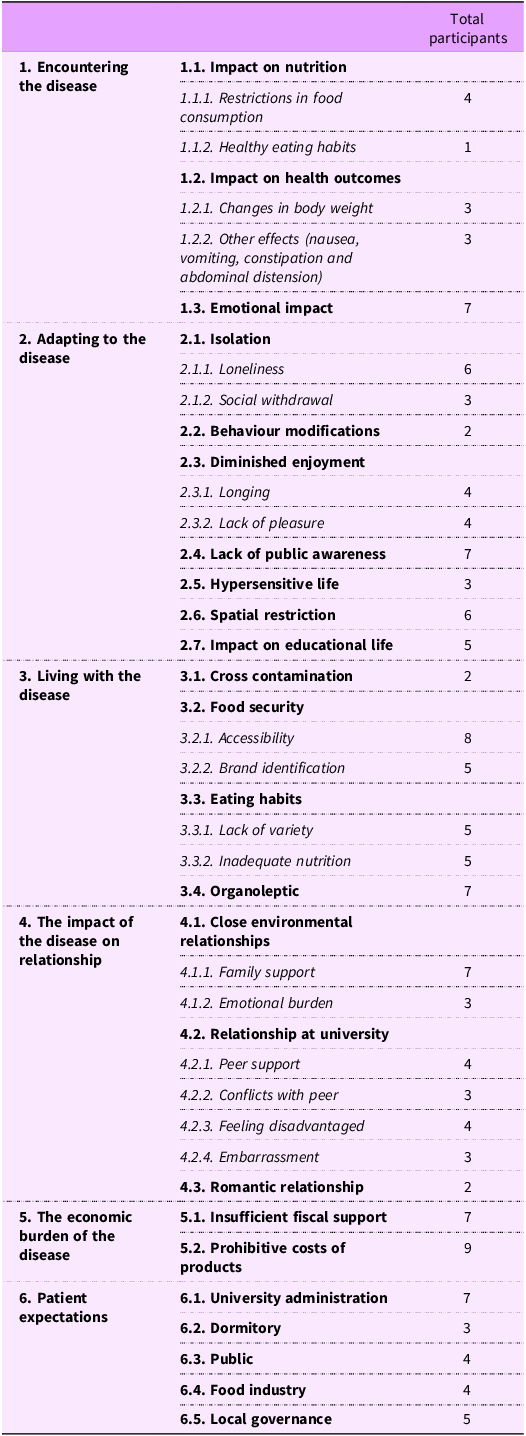
The data were analysed using Colaizzi’s seven-stage strategy(Reference Colaizzi, Valle and King21). Both researchers first read each transcript several times to gain an in-depth understanding. Significant statements relevant to the phenomenon were extracted, and a formulated meaning was derived from each. For example, the statement ‘I remember going to bed hungry for three days… eating normal food would cause problems for the attack’ was formulated as the scarcity of accessible GF food forcing a choice between hunger and symptom-triggering food; this and related meanings were clustered into the sub-theme ‘eating habits’, within the theme ‘living with the disease’. Formulated meanings were grouped into theme clusters, integrated into an exhaustive description of the phenomenon and reduced to its fundamental structure. The two researchers coded independently and then met to compare their interpretations; where these diverged, they re-examined the relevant quotes in context and discussed them until full consensus was reached, consulting an independent qualitative expert where necessary. Table 1 presents the number of participants contributing to each theme, for transparency regarding the distribution of accounts. This is not a measure of a theme’s significance, which in phenomenological analysis derives from its contribution to the structure of the experience rather than its frequency.
Themes, sub-themes and categories, with participant contribution (n 9)

Table 1. Long description
A table categorizing themes, sub-themes, and participant contributions related to living with a disease. The table has 6 rows and 3 columns. The columns are labeled as follows: 1. Themes, 2. Sub-themes, 3. Total participants. The themes include Encountering the disease, Adapting to the disease, Living with the disease, The impact of the disease on relationship, The economic burden of the disease, and Patient expectations. Each theme is further divided into sub-themes with corresponding participant contributions. For example, under Encountering the disease, sub-themes include Impact on nutrition, Impact on health outcomes, and Emotional impact with participant contributions ranging from 1 to 7. The table provides a detailed breakdown of how participants contribute to each sub-theme within the broader themes.
Trustworthiness of qualitative data/analysis
In this study, the reliability of the qualitative data collection and analysis process was examined within the framework of Lincoln and Guba’s criteria of credibility, transferability, consistency and verifiability(Reference Lincoln and Guba22). Credibility was ensured by conducting in-depth semi-structured interviews with nine participants who had medically confirmed CD diagnoses and who varied in terms of age, gender, duration of diagnosis and adherence to GFD, by conducting member checks and by supporting the findings with direct quotations. Credibility was further supported by transcript validation. At the end of each interview, the written interview was read back to the participant, who confirmed that it accurately reflected what they had expressed. Participants could contact the researchers by phone if they preferred to provide feedback verbally or had questions about the research. Transferability was enhanced by detailed reporting of the study context and participant characteristics, while consistency was reinforced by following Colaizzi’s seven-stage phenomenological analysis approach in a standardised and documented manner. Verifiability was ensured by systematically recording analytical decisions and the coding scheme in Microsoft Excel and clearly linking this process to the raw data, supported by discussions between researchers.
Results
Characteristics of the participants
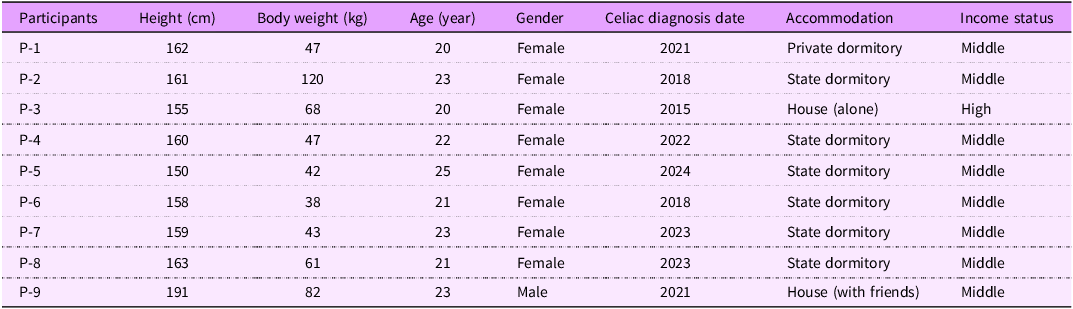
The study population comprised nine university students (eight female, one male; mean age 22 ± 1·6 years), diagnosed with CD between 2015 and 2023. All attended state universities and lived in state dormitories (n 6), a private dormitory (n 1), shared housing (n 1) or alone (n 1). Most described their family income as middle class (Table 2).
Social-demographic characteristics of participants

Table 2. Long description
The table presents the social-demographic characteristics of nine university students diagnosed with celiac disease. It includes nine rows and eight columns. The columns are labeled Participants, Height (cm), Body weight (kg), Age (year), Gender, Celiac diagnosis date, Accommodation, and Income status. Each row provides specific details for each participant. For example, Row 1: Participant P-1, Height 162 cm, Body weight 47 kg, Age 20 years, Female, Celiac diagnosis date 2021, Accommodation Private dormitory, Income status Middle. Row 2: Participant P-2, Height 161 cm, Body weight 120 kg, Age 23 years, Female, Celiac diagnosis date 2018, Accommodation State dormitory, Income status Middle. Row 3: Participant P-3, Height 155 cm, Body weight 68 kg, Age 20 years, Female, Celiac diagnosis date 2015, Accommodation House (alone), Income status High. Row 4: Participant P-4, Height 160 cm, Body weight 47 kg, Age 22 years, Female, Celiac diagnosis date 2022, Accommodation State dormitory, Income status Middle. Row 5: Participant P-5, Height 150 cm, Body weight 42 kg, Age 25 years, Female, Celiac diagnosis date 2024, Accommodation State dormitory, Income status Middle. Row 6: Participant P-6, Height 158 cm, Body weight 38 kg, Age 21 years, Female, Celiac diagnosis date 2018, Accommodation State dormitory, Income status Middle. Row 7: Participant P-7, Height 159 cm, Body weight 43 kg, Age 23 years, Female, Celiac diagnosis date 2023, Accommodation State dormitory, Income status Middle. Row 8: Participant P-8, Height 163 cm, Body weight 61 kg, Age 21 years, Female, Celiac diagnosis date 2023, Accommodation State dormitory, Income status Middle. Row 9: Participant P-9, Height 191 cm, Body weight 82 kg, Age 23 years, Male, Celiac diagnosis date 2021, Accommodation House (with friends), Income status Middle.
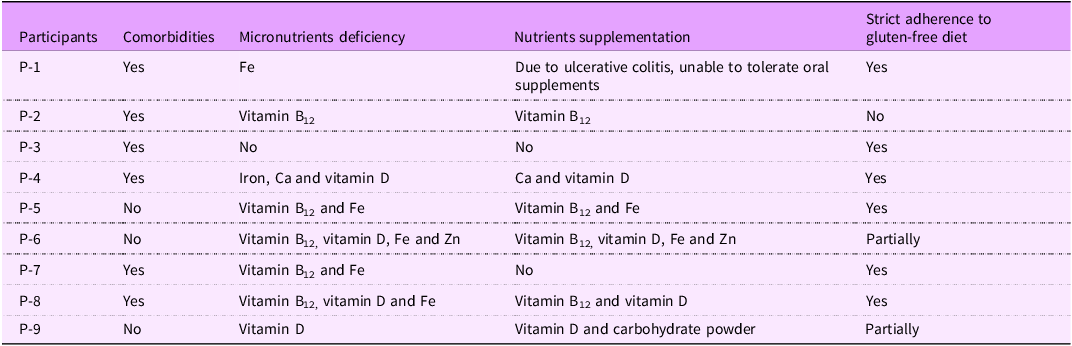
Comorbidities and nutritional deficiencies were common, including ulcerative colitis (n 2), gastritis (n 2) and deficiencies in Fe (n 6), vitamin B12 (n 5) and vitamin D (n 4). Six participants self-reported strict GFD adherence, while two reported partial adherence and one reported non-adherence (Table 3).
Health information of participants

Table 3. Long description
A table comparing health information of participants, including comorbidities, micronutrient deficiencies, nutrient supplementation, and adherence to gluten-free diet. The table has 9 rows and 4 columns. Column headers are Participants, Comorbidities, Micronutrients deficiency, Nutrients supplementation, and Strict adherence to gluten-free diet. Row 1: P-1, Yes, Fe, Due to ulcerative colitis, unable to tolerate oral supplements, Yes. Row 2: P-2, Yes, Vitamin B12, Vitamin B12, No. Row 3: P-3, Yes, No, No, Yes. Row 4: P-4, Yes, Iron, Ca and vitamin D, Ca and vitamin D, Yes. Row 5: P-5, No, Vitamin B12 and Fe, Vitamin B12 and Fe, Yes. Row 6: P-6, No, Vitamin B12, vitamin D, Fe and Zn, Vitamin B12, vitamin D, Fe and Zn, Partially. Row 7: P-7, Yes, Vitamin B12 and Fe, No, Yes. Row 8: P-8, Yes, Vitamin B12, vitamin D and Fe, Vitamin B12 and vitamin D, Yes. Row 9: P-9, No, Vitamin D, Vitamin D and carbohydrate powder, Partially.
As a result of interviews, six main themes were identified: ‘encountering the disease’, ‘adapting to the disease’, ‘living with the disease’, ‘the impact of the disease on relationships’, ‘the economic burden of the disease’ and ‘patient expectations’ (Figure 1).
Themes, subthemes and categories.

Theme 1: Encountering the disease
The first theme, encountering the disease, reflects participants’ experiences during diagnosis and their immediate encounter with the condition. It comprises three sub-themes: impact on nutrition, impact on health outcomes and emotional impact. The impact on nutrition fell into two categories: four participants described restrictions on eating what they wanted, while one felt CD had helped her develop healthier eating habits. This latter view is striking, given that CD is more often experienced as negative and restrictive (Table 4):
‘When I think of celiac disease, both a healthy and comfortable life and prohibitions come to my mind.’(P8)
Prominent quotes by theme

Table 4. Long description
The table has 10 rows and 3 columns. The columns are labeled Theme, Subtheme, and Quotes. The themes include Encountering the disease, Adapting to the disease, Living with the disease, The impact of the disease on relationships, The economic burden of the disease, and Patient expectations. Each theme is further divided into subthemes with corresponding quotes. For example, under Encountering the disease, subthemes include Impact on nutrition and Impact on health outcomes. The quotes provide insights into the experiences and challenges faced by individuals with the disease.
And another participant stated her craving for gluten-containing foods as below:
‘Wheat and bulgur come to mind immediately. I used to love them very much, but when I can’t eat them, I always think of them.’(P5)
The sub-theme of impact on health outcomes was divided into two categories: body weight change and other effects. Two participants reported involuntary weight loss, while one experienced involuntary weight gain. Additionally, three participants provided statements regarding acute gastrointestinal distress:
‘When I was first diagnosed, I was vomiting a lot, and my weight dropped from 46 kg to 41 kg. When I vomited blood, my oesophagus was damaged, and I could not eat for a week.’(P7)
In the emotional impact sub-theme, participants described difficulties that accompanied diagnosis, beyond the demands of the diet. Several noted feeling panicked and afraid when first diagnosed:
‘It’s become a way of life for me now. Because I’ve been through a difficult time, the name of the disease instils fear more than the disease itself…. When I was first diagnosed, I had nightmares about breaking my diet, but now I don’t have them as often. I cry in my dreams about my disease. I don’t cry in normal life because I think I must be strong. I’m afraid it will continue. I clench my teeth so hard to keep from crying.’(P7)
One participant also stated that, considering there are younger patients who also have CD, she developed her own coping mechanisms to overcome the psychological effects.
Theme 2: Adapting to the disease
This theme identifies the complexities of adapting to CD diagnosis. Seven sub-themes were identified: isolation, behaviour changes, enjoyment, lack of societal awareness, hypersensitive life, spatial restriction and impact on educational life. Isolation was a predominant experience, categorised into feelings of loneliness (n 6) and social withdrawal (n 3). Participants reported being precluded from communal dining with family and peers, often describing a sense of peripheral presence during social gatherings. This isolation was attributed to both the physiological symptoms of the disease and the economic burden of GFD:
‘I can’t go to social spaces because of the toilet and gas problems I experience due to celiac, and this makes me lonely…. When I go to places that serve gluten-free food, my friends don’t want to come because it’s expensive. When I go to places where they eat, I have to sit at the side without eating…. I can’t sit at the same table with my family; I eat at a separate table to avoid cravings.’(P2)
Furthermore, the need for separate kitchenware at home created physical and symbolic barrier between the participants and their families:
‘When I first started the diet, having separate items at home (pots, plates, etc.) made me feel isolated. While everyone else at home ate together, my plate was on the side…. There were times when I only drank tea when I went out with friends. Because of this, I isolated myself from my social life.’(P4)
Two participants reported behaviour changes due to CD. The diminished enjoyment sub-theme comprised two categories: longing and lack of pleasure. Four participants described craving gluten-containing foods, and four said they no longer took pleasure in eating, eating only to survive, with few alternatives and often the same foods. One participant added that even when she gave in and ate gluten-containing food, fear of becoming ill prevented her from enjoying it:
‘I don’t enjoy eating gluten-free food, I have to consume them…. Even when I consume gluten, I don’t enjoy it anymore, I’m afraid I’ll feel uncomfortable.’(P3)
Under the sub-theme of lack of societal awareness seven participants complained that CD is completely unknown to a large part of society and that gluten is often confused with ‘glucose’. They even mentioned that restaurant workers in the food industry are unaware of CD:
‘Most people don’t know about gluten, they confuse it with glucose…. It’s hard to find employees in restaurants who know about celiac disease.’(P3)
Under the sub-theme of hypersensitive life, participants (n 3) described experiencing extreme sensitivity to the ingredients in food and the cooking environment, stating that this makes their lives difficult.
Five participants stated that CD influenced their university and department choices, and that they preferred cities where they could easily access GF foods. They also stated that CD affected their attendance, academic success and study habits.
Theme 3: Living with the disease
The main theme of living with disease consists of four sub-themes: cross-contamination, food security, eating habits and organoleptic. Two participants highlighted the risk of cross-contamination. One of these students stayed in a private dormitory, and the other resided in a state-run dormitory. Additionally, a participant living at home with peers said he was having trouble with adherence to the diet due to cross-contamination. The food security sub-theme comprised two categories: accessibility and brand identification. Participants identified systemic barriers to obtaining GF food across multiple settings. Institutional barriers were prominent, including a lack of GF options in university cafeterias and canteens (n 2) and limited or absent GF meals in dormitories (n 4). Commercial access was also limited: six participants noted the difficulty of sourcing GF products in local markets, and five reported too few restaurants and cafes able to provide safe GF meals. Regardless of income level, housing situation or adherence to the diet, participants reported that access to GF foods was limited. Three participants associated GF products with a specific brand, whereas three others did so with a specific supermarket. The prominent statements in this category are given below:
‘Because there are no gluten-free meals in the university cafeteria or dining hall, I can’t eat during lunch. Because I live in a dormitory, I can’t adhere to the diet, and I am exposed to gluten.’(P2)
‘When we go out, my friends suggest we eat çiğ köfte (raw meatballs) or pizza, but I can’t. My options are limited; I can eat meat. Even gluten-free chocolate is very expensive. It bores me to return to the same products and brands.’(P3)
Dietary habits were characterised by limited food variety and nutritional inadequacy. Three participants reported a cycle of ‘dietary monotony’, consistently consuming only chicken, rice or kumpir (baked potato) due to a lack of safe alternatives. Five participants made statements in the category of limited food variety and inadequate nutrition. Among them were those living in private dorms, state-run dorms and at home. In addition, four of them stated that they followed the diet, while one said they followed it only partially. Participants generally mentioned experiencing prolonged hunger due to the inability to find GF food, posing a direct risk of malnutrition:
‘I remember going to bed hungry for three days, and I could only eat fruit. Sometimes I couldn’t find gluten-free food, and eating normal food would cause problems for the attack.’(P7)
‘I only have the option of chicken and rice or kumpir. When I go out with friends, eating becomes a problem; I always have to eat chicken and rice. It’s hard to choose a common option with my friends. Our options for eating out are limited.’(P8)
In the organoleptic sub-theme, seven participants said they disliked GF foods, finding them bland and lacking flavour. Three described GF bread and pasta as having a poor texture that crumbled easily.
Theme 4: The impact of the disease on relationships
Under the theme, three sub-themes were identified: Close environmental relationships, relationships at university and romantic relationships. In close environmental relationships, two categories were identified: family support and emotional burden. Seven participants reported family support, while three reported emotional burden on their close relationships:
‘My mother developed a feeling of inadequacy, which affected her more, and the emotional burden fell on her. The lack of treatment for the disease upset her even more.’(P1)
While several participants reported receiving support from their peers, others experienced conflict with them, felt disadvantaged and felt embarrassed:
‘While my friends are thinking about their appearance and make-up when they go out, I’m thinking about whether I’ll have dinner when the evening comes.’(P3)
‘My friends want me to join their plans. When I don’t want to join, we have conflict; they expect me to make sacrifices regarding my diet. This problem has now taken over my entire life.’(P7)
Theme 5: The economic burden of the disease
The fifth theme concerns the economic burden of managing CD, comprising two sub-themes: insufficient fiscal support and prohibitive product costs. A substantial majority of participants (n 7) reported that current governmental financial aid is insufficient to offset the higher cost of living associated with the disease. Participants noted that state subsidies don’t reflect the actual market prices of GF staples, leaving a significant affordability gap. All participants emphasised the high cost of GF alternatives. Notably, one participant conceptualised the condition as a ‘disease of the wealthy’, suggesting that strict dietary adherence is a privilege inaccessible to those without significant financial resources. This is particularly problematic for students living in dormitories who, due to the lack of institutional GF provisions, are forced to rely on expensive external services:
‘I live in a dormitory, and since gluten-free food isn’t readily available, I have to constantly order takeout. This is causing financial hardship. I’m experiencing all sorts of financial difficulties due to celiac disease. It’s disease of the wealthy anyway.’(P6)
Theme 6: Patient expectations
This was categorised into five sub-themes: university administration, dormitories, the public, the food industry and local governance. Participants expressed significant expectations for university administration to reduce the logistical burden of dietary management. Regarding universities (n 7), the primary demand was the integration of GF menus within campus cafeterias (n 6) and the provision of GF products in canteens (n 3):
‘I expect the university to provide gluten-free meals and guide us in accessing gluten-free products.’(P1)
For dormitories (n 3), participants similarly expected broader provision of GF meal plans and an increase in the number of residences equipped to support students. Four participants emphasised the urgent need for enhanced public literacy regarding CD. A recurring concern was the pervasive confusion between ‘gluten’ and ‘glucose’, which often leads to dangerous practices in the food service sector. Participants advocated for public awareness campaigns to shift the social narrative from ‘pity’ to ‘understanding and safety’:
‘We, those with celiac disease, want to be understood, not pitied. We face psychological and social challenges. Just as diabetes and glucose are well-known, celiac and gluten should also be recognized. Once I ordered a meat dish without bread at a restaurant, but it is served with bread. After I warned him, I observed the waiter. He removed the bread and brought the same dish. Unfortunately, there’s no awareness about the contamination. I’ve encountered vendors who claim to sell gluten-free chickpeas and beans.’(P3)
Expectations for the food industry (n 4) focused on three pillars: the development of locally sourced, nutrient-dense GF products; transparent labelling and price stabilisation to ensure affordability. Furthermore, participants looked toward local governments (n 5) to incentivise the establishment of GF-certified cafes and restaurants:
‘The products on the market are generally of foreign origin; I recommend that they be produced with more local and healthy ingredients and delivered to patients.’(P2)
Discussion
This study identified the socio-economic burdens and expectations of university students diagnosed with CD who live independently from their families. As a result of the interviews, six main themes were identified: ‘encountering the disease’, ‘adapting to the disease’, ‘living with the disease’, ‘the impact of the disease on relationships’, ‘the economic burden of the disease’ and ‘patient expectations’.
For individuals with CD, the GFD is not a lifestyle preference but a medical necessity, and this involuntary quality shaped how participants experienced it(Reference Herrera-Quintana, Navajas-Porras and Vazquez-Lorente23). Even among the six students who self-reported adhering to the diet, the restriction described under the sub-theme ‘impact on nutrition’ was felt less as a dietary adjustment than as a loss of ordinary food freedoms. As qualitative evidence puts it, patients with CD ‘lose more than just gluten’, with significant impacts on food preferences, social eating and personal time(Reference Rose, Law and Howard12). This experiential framing may help explain why our participants’ perceptions were predominantly negative, in contrast to population surveys in which the GFD is more often viewed as a healthy lifestyle choice(Reference Crespo-Escobar, Vazquez-Polo and van der Hofstadt24). For a student for whom the diet is compulsory and socially constraining, its ‘healthfulness’ may be beside the point. However, this negative framing is not inevitable. Where the diet is reconceived not merely as gluten avoidance but as a sufficient and balanced one, post-diagnosis nutritional education may reframe CD as an opportunity for healthier eating(Reference Rinninella, Cintoni and Raoul25,Reference Perez-Junkera, Simon and Calvo26) . The involuntary weight changes and gastrointestinal problems reported under ‘impact on health outcomes’ are consistent with the persistence of symptoms despite treatment, or with difficulties in adherence to the diet(Reference Galli, Carabotti and Pilozzi27).
Our study reflects the social problems of the disease, as students encounter isolation, loneliness and social withdrawal during their adjustment process. This supports the view that a large proportion of patients are socially isolated or feel ashamed due to GFD or certain needs(Reference Lee, Lebwohl and Lebovits28). In the Turkish context, however, these difficulties carry particular weight. The dining table is a central site of Turkish family and social life, where meals sustain emotional connection and communication as much as nourishment. For our participants, obstacles to eating with friends in the dormitory, at home or outside were not a mere inconvenience but a form of exclusion from a key setting of belonging. This was compounded by distance from family, their main source of support in managing the disease and diet, leaving students without that support when they most needed it. Furthermore, the participants described a shift from ‘hedonic consumption’ to ‘utilitarian consumption.’ This aligns with the observation that CD can lead to a loss of connections with food and enjoyment(Reference Dalton and Castellanos29).
In our study, participants frequently reported that ‘celiac disease’ and ‘gluten’ are not well known by the public. They emphasised that the public confuses the concepts of ‘gluten’ and ‘glucose’. Although this confusion may appear minor, it is revealing: participants could not assume their condition would be recognised or believed and were repeatedly required to explain and justify it in everyday situations. Lack of awareness of CD among restaurant staff may limit students’ opportunities for social dining and increase their risk of cross-contamination, which often leads to unintended gluten exposure above recommended thresholds(Reference Stout, Austin and Bonnes30). Indeed, previous literature in Türkiye similarly underscores that public awareness and sensitivity toward CD remain markedly insufficient(Reference Taşkın and Savlak31). Efforts to raise public awareness of CD and the GFD may therefore do more than inform the public; by reducing the constant need for self-advocacy, they may also improve quality of life(Reference Milman, Patel and Modi32).
Interviews revealed that CD influenced participants’ choice of university and department. In addition, recently diagnosed students and those with lower dietary adherence reported more frequent visits to healthcare facilities as their symptoms worsened. They are often forced to return to parental home for specialized care. Such returns carried significance beyond their practical implications, reversing the movement toward independence that university represents and drawing students back into the family environment they had begun to leave. Managing a chronic disease alongside higher education thus imposed a considerable physical and emotional burden, which for several students led to interruptions, delays and changes to their education(Reference Doris and Morrissey33).
The theme of ‘living with disease’ covers the specific challenges students face in achieving adequate and balanced nutrition. Although state-run halls of residence in Konya provide GF menus, several participants did not choose them because of their distance from campus. The inadequacy of GF options in university canteens, cafeterias and dormitories is an indicator of food insecurity. Students faced obstacles physically accessing GF food and even went hungry for long periods. A recent review reported that food insecurity is common among patients and is closely related to adherence to GFD(Reference Ribeiro, Pratesi and Zandonadi34). Our study identified another issue that constantly worries participants, namely ‘cross-contamination’, which is a concern ever-present for individuals diagnosed with CD. Constantly checking the contents and preparation of food can foster an overly sensitive lifestyle. Participants stated that when dining out, they only have few safe options. Consistently consuming similar foods and the inability to ensure dietary diversity negatively impacts diet quality. Poor diet quality is associated with food insecurity(Reference Wang, Anders and Jiang35). However, participants’ perception of GF foods as organoleptically inadequate is another factor that makes adherence to the diet difficult.
In our research, the social dimension of the disease was examined under the theme of ‘the impact of the disease on relationships’. Most participants drew substantial support from their families in managing the condition, consistent with guidance for patients with CD emphasising that the whole family should share responsibility for maintaining the GFD(Reference Satherley, Francois-Walcott and Tallentire36). However, studies have shown that mothers feel a greater burden because they assume primary responsibility, such as researching safe products, shopping and cooking(Reference Kutahyalioglu and Kas Alay14,Reference Russo, Wolf and Leichter37) . Similarly, in our study, the participants stated that the disease placed a particular emotional burden on their mothers. The dependence of disease management on the family, and particularly on mothers, suggests that the family continued to play a close role in an area the students were otherwise expected to manage independently.
Peers occupied a dual position in participants’ accounts, appearing as both a source of difficulty and a source of relief. While several students reported receiving support from their friends, others stated their friendships were negatively affected by CD. Similarly, previous studies have shown that individuals with CD receive negative reactions from others, feel ashamed and experience anxiety about how others perceive them because of their disease and GFD(Reference Ho, Atkinson and David38,Reference Sahin, Tasdelen and Kutahyalioglu39) . Receiving support from peers is vital to cope with this psychological burden. Peer support, such as awareness of the disease, showing empathy and choosing appropriate restaurants, is important for celiac patients(Reference Aktas and Unlu Kaynakci40). The well-being of the students depends on their peers recognising and showing understanding of their circumstances. Living with CD involves not only managing a diet but also managing the reactions and understanding of those around them.
In the theme on ‘the economic burden of the disease’, participants stated that GF products are expensive and government support is insufficient. The participants’ description of CD as a ‘disease of the wealthy’ accurately reflects the economic burden. GF foods are more expensive than their gluten-containing alternatives, and this is a common problem worldwide(Reference Herrera-Quintana, Navajas-Porras and Vazquez-Lorente23,Reference Bozorg, Lee and Marild41) . As university students living away from home, participants had to allocate a substantial budget to food as well as to accommodation, transport and study expenses. This situation is further complicated by the fact that university students, due to their already limited incomes, constitute a vulnerable population group to food insecurity. Consequently, the ‘Luxury’ framework results in adherence to the diet becoming dependent on financial means rather than being a guaranteed health benefit. The economic burden, among other challenges, may be recognised as a defining characteristic of how participants made sense of living with the disease.
The theme of ‘patient expectations’ reflects the support participants want to see from society, universities, dormitories, local governments and the food industry. Similarly, research with CD patients has identified common expectations, including greater public awareness, supportive institutional policies, affordable and varied GF products and financial support(Reference Mehtab, Agarwal and Chauhan4,Reference Bathrellou, Georgopoulou and Kontogianni42,Reference Qashqari, Shakweer and Alzaben43) . The lack of GF meals in campus cafeterias and the few dormitories offering GF food make dietary adherence difficult. A study in Chicago found that, although campuses meet the minimum requirements for students with CD, the variety and accessibility of GF products need improvement (Reference Khan, Keenan and Jericho44). Furthermore, in our study, most participants stay in state-run dormitories because it is more economical. Enhancing the variety and quality of provided meals is essential to meeting the nutritional needs of this population. A recent US expert-consensus framework recommends 24 accommodations for students with CD, spanning reliable GF dining, staff training on cross-contact, meal-plan exemptions and psychosocial support(Reference Weisbrod, Donnelly McKeon and Kowzun45). Comparable consensus-based frameworks, developed in collaboration with healthcare professionals, are not yet available in Türkiye; their development and implementation would be an important step toward safeguarding the well-being of university students with CD.
Limitations and strengths
The rigor of the study is supported by a descriptive phenomenological design, its use of Colaizzi’s seven-stage analysis and strategies to improve reliability. Purposive sampling and in-depth interviews lasting approximately 60 minutes provided comprehensive data on the experience of living with CD. The small sample of nine participants from a single city, only one male participant, together with the exclusive focus on patients’ own perspectives, may limit the transferability of the findings to other groups. The reliance on self-reported data also carries a risk of recall and social desirability bias. A further limitation concerns the interview guide, which focused predominantly on the challenges of living with CD. This framing may have led participants to emphasise negative aspects of their experience, contributing to the predominance of challenges in the findings. Future studies using more balanced or positively framed questions, addressing coping, resilience and sources of support or enjoyment, may yield a more comprehensive account of the experience. Despite these limitations, these findings can be used by institutes to improve quality of life in university students diagnosed with CD.
Conclusion
This study reveals a shared experiential structure among participants. For university students living away from home, CD represents an ongoing negotiation of financial cost, peer acceptance and the credibility of their condition at a critical stage of development. Barriers such as social isolation, limited awareness and the high cost of GF alternatives are already well documented in the literature. What distinguishes this group is that these barriers coincide with the transition to independent adulthood, when disease management disrupts core developmental tasks: becoming nutritionally self-sufficient, managing a limited budget, building social networks and separating from family. To our knowledge, this is the first study to examine CD specifically among university students living independently. This study therefore offers more than a confirmation of known barriers. It shows how managing a chronic nutritional disorder reshapes students’ autonomy and psychosocial adjustment as they enter university. For participants, the condition was not a matter of diet alone, but was bound up with their psychological well-being, social relationships and food security.
Supplementary material
For supplementary material accompanying this paper visit https://doi.org/10.1017/S1368980026103760
Data availability statement
The datasets of the current study are available from the corresponding author on reasonable request.
Author contributions
Şenay Burçin Alkan: Conceptualisation; Data curation; Formal analysis; Investigation; Writing – Original draft preparation, review, editing. Lütfiye Tekpınar: Conceptualisation; Data curation; Formal analysis; Investigation; Methodology; Software; Supervision; Writing – Original draft preparation, review, editing. The authors read and approved the final manuscript.
Financial support
This research did not receive any specific grant from funding agencies in the public, commercial or not-for-profit sectors.
Competing interests
The authors declare no competing interests.
Ethical standards
Ethical approval was granted by the Necmettin Erbakan University Health Sciences Research Ethics Committee (No: 2024/743). Adhering to the Declaration of Helsinki, the researchers obtained written and verbal informed consent from all participants. The students were informed that the data would be used solely for scientific purposes and would not be shared with third parties, and they could withdraw from the study at any time without any consequences. Data confidentiality was maintained using participant pseudonyms (e.g. P1).
Consent for publication
Participants consented to having their data published.


 Open access

