I. INTRODUCTION
The instant WiMAX parameters relies nowadays only on information available at the base station (BS). Adaptation of parameters like channel state information (CSI), carrier frequency offset (CFO) modulation type, frequency index, antenna gain, or beamforming is only possible within a predefined set of configuration values and is not influenced by any feedback of the subscribers. Recent research proposed to increase the performance and quality of service by adding a processor to the physical layer of the subscriber [Reference Liu, Nilsson, Tell, Wu and Eilert1] or the BS [Reference Minden2]. The proposed BS processor allows to adapt the parameters dynamically but the decision process depends furthermore only on information accessible at the BS. Limberg et al. [Reference Limberg3] presented a technical description of a fully programmable multi-core baseband processor for LTE/WiMAX terminal, which has a dedicated run-time scheduler hardware unit. The intelligence knowledge-based system (IKBS) proposed in this paper extends the baseband processor role to send feedback from the subscribers to the BS. The BS will use this additional information to further increase the quality of service. A particle swarm optimization (PSO) is shown as an example of the optimization technique for fixed WiMAX-OFDM parameters.
An OFDM technology, supported by both WirelessMAN-OFDM and WirelessMAN-OFDMA WiMAX modes prompts to adapt several basic radio parameters. For example, the power of individual subcarriers and modulation order can be adapted to actual channel state. Besides the standard bit loading methods represented by a greedy algorithm [Reference Papandreou and Antonakopoulos4], the adaptation of the OFDM system parameters can be done with the use of global optimization methods. A discrete form PSO [Reference Kennedy and Eberhart5] has been proposed for the use in cognitive radios by Zhao et al. in [Reference Zhao, Xu, Zheng and Shang6]. In that paper, the maximization of data throughput and the minimization of bit error rate and total transmitted power have been considered as the adaptation criteria. As the simulated results have demonstrated, it is not easy to fulfill all these criteria in the same time, so a new criterion of desired data rate is defined in this paper. Moreover, the possibility of switching-off the subcarriers has been added, depending on the actual radio channel conditions and user needs.
The rest of the paper is organized as follows. Section II illustrates WiMAX-OFDM frame structure in frequency and time domain and shows how the frequency index relates to an OFDM symbol. Section III describes the proposed IKBS that works cooperatively between the BS and the subscribers by incorporating processors into the physical layers of WiMAX. Section IV describes the PSO, which has been chosen as an example of the optimization technique that could be applied in the IKBS. Section V shows the simulation results of the PSO and greedy algorithm in the WIMAX-OFDM-256.
II. WiMAX – OFDM – FRAME STRUCTURE
A frame-based transmission has been used in the WiMAX-OFDM. The frame duration is a central periodic time based on the frame start preamble, which has been selected by the BS, and which should not be changed. The allowed specific frame durations are 2.5, 4, 8, 10, 12.5 and 20 ms. A frame consists of a downlink and an uplink subframe.
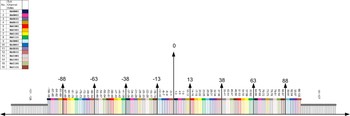
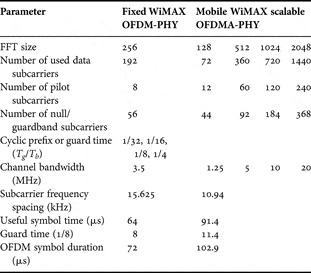
As shown in Fig. 1, the OFDM symbol is made up from 256 subcarriers which are classified to three subcarrier types: data subcarriers, pilot subcarriers, and null subcarriers. The basic structure of a WiMAX-OFDM frequency domain has 256 subcarriers (N FFT) spread over 3.5 MHz bandwidth with 15.625 kHz subcarrier spacing as determined by the IEEE 802.16 WirelessMAN-OFDM [7]. In the WiMAX-OFDM the data subcarriers are dedicated for data transmission and 200 out of 256 subcarriers are used. The eight pilot subcarriers are dedicated for various estimation purposes. The null subcarriers are not used for transmission at all, such as the lower 28 frequency guard subcarriers, the higher 27 frequency guard subcarriers, and the one and only one DC subcarrier (center frequency).
WiMAX-OFDM-256 sub-channel index diagram.

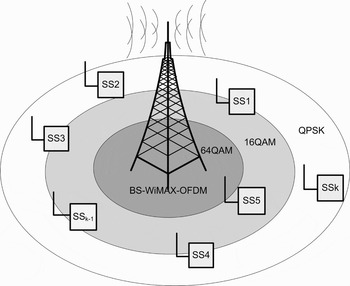
WiMAX is a point-to-multipoint protocol (PMP) providing equipment manufactures and operators with a standard for access profiles as well as known interoperability levels allowing for multi-vendor environments. PMP is a concept where multiple subscribers, Fig. 2, can access the same radio platform using multiplexing methods as well as queuing. The PMP protocol used is a connection-oriented system that can take on a star or mesh configuration using frequency division duplex or time division duplex. Forward error correction operations are combined with quadrature phase shift keying (QPSK), 16-state quadrature amplitude modulation (16QAM), and 64-state QAM (64-QAM); therefore, radio link quality is a function of coverage and interference couple with modulation format used in an allotted bandwidth and spectrum as shown in Fig. 1 [7].
WiMAX PMP topology.

Figure 1 shows the sub-channel frequency index consisting of three categories. The data subcarrier index range is −100 ≤ k ≤ +100, exempt the pilot subcarrier indices (−88, −63, −38, −13, 13, 38, 63, 88), and the DC subcarrier index (k = 0). The other two null subcarrier ranges are the lower (−128 ≤ k ≤ −101) and the higher (+101 ≤ k ≤ +127) frequency guard subcarrier bands.
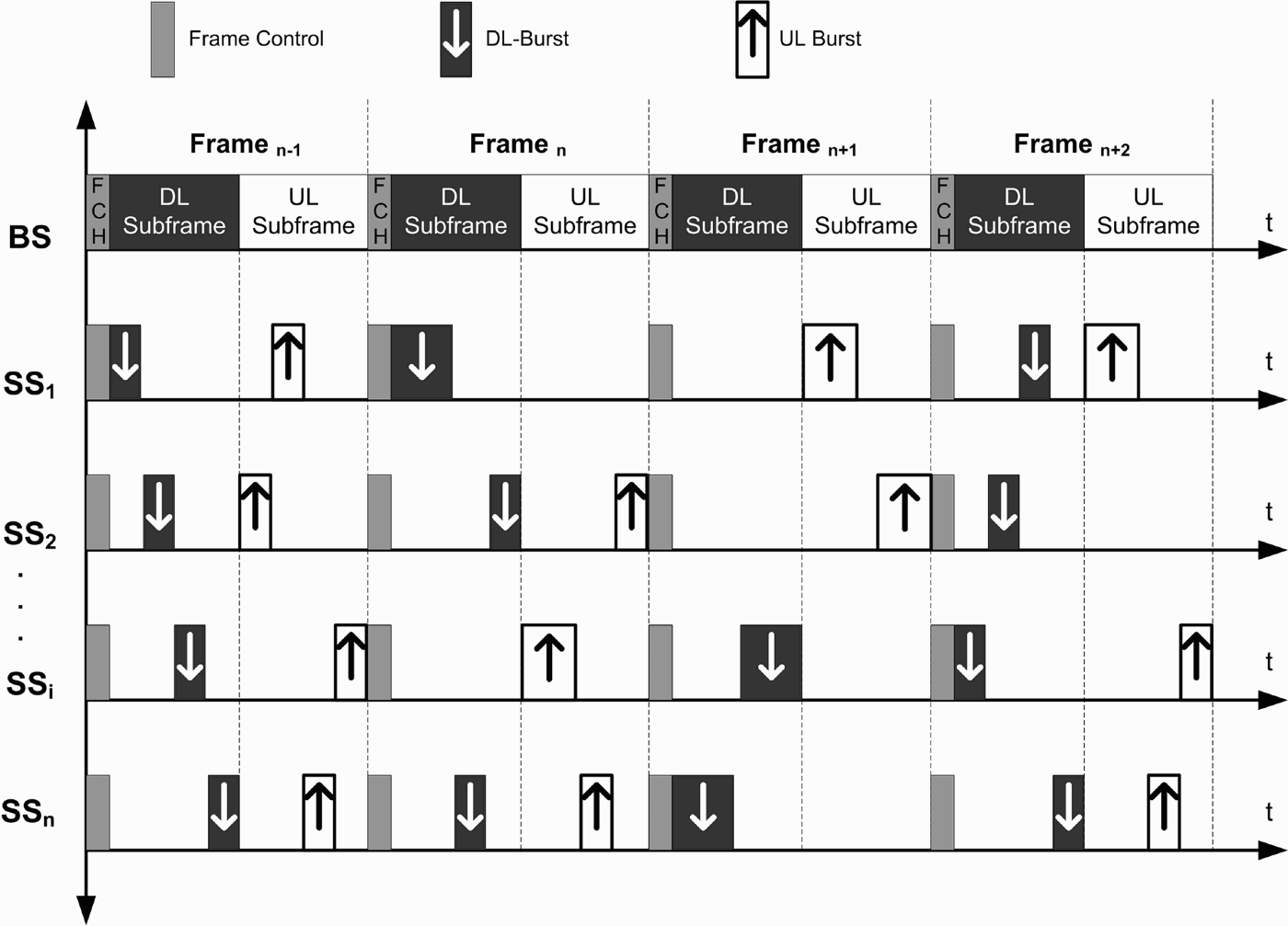
Figure 3 illustrates a WiMAX frame-based timing diagram. In Framen−1, the BS periodically broadcasts the frame control header (FCH), which includes a downlink (DL-MAP) and uplink (UL-MAP) map. All subscribers obtain the DL-MAP for the current frame and the UL-MAP for the current or future frames. The subscribers on receipt of the DL-MAP and UL-MAP are ready to calculate their downlink and uplink burst times (frequency index and time slots) depending on the offsets. For instance, in the downlink subframe time, SS 1 gets the first burst data then SS i and followed by the last burst data, which is for the SS n station. In the uplink subframe time, the data bursts sequence is SS 2, SS 1, SS n then SS i. The BS has planed these bursts.
WiMAX frame-based timing diagram.
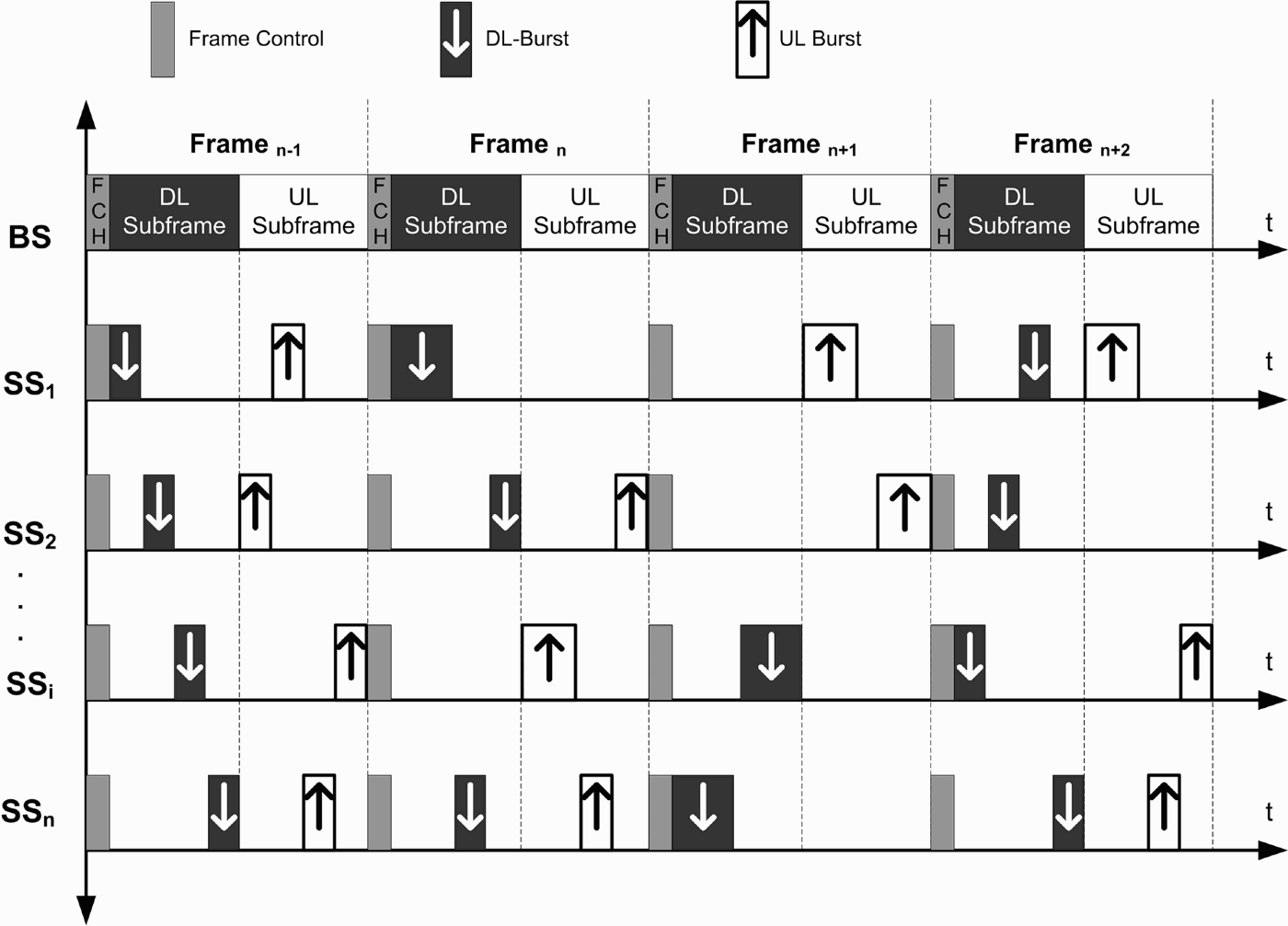
In Framen, a different map has been broadcasted as an FCH, for the downlink subframe time. SS 1 gets the first burst data with more bandwidth than in the previous frame. SS n has not got a chance to receive data in this downlink subframe due to contention. For the same reason, SS 1 cannot send information in the uplink subframe, whereas SS n gets a possibility for both, downlink and uplink, subframes.
In an UL-subframe, all subscribers usually ask for bandwidth request for download/upload bursts. IKBS proposes that all subscribers could additionally use the UL-burst time slot to send a feedback to the BS. This feedback contains instant information about the channel parameters, which could be useful to create an efficient FCH (DL-MAP and UL-MAP).
III. IKBS PROCESSOR
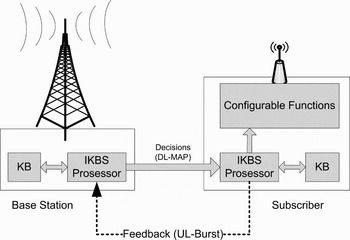
The proposed IKBS works cooperatively between the BS and the subscribers by incorporating processors into the physical layers of each side. Figure 4 shows the IKBS is acting as a close-loop system whereas the broadcasted FCH (DL-MAP+UL-MAP) content depends on a BS pre-knowledge and an additional feedback of the subscribers through a previous uplink subframe (UL-burst). The feedback contains instantly measured parameters, which could be considered from the subscriber in the current frame like e.g. signal-to-noise ratio, error rate, CSI or CFO. The IKBS controls instantly the parameter of the configurable functions, which are already available in the WiMAX physical layer [7].
The proposed IKBS processors.

IV. PARTICLE SWARM OPTIMIZATION BASICS
PSO has been initially proposed as an optimization technique for the use in real number spaces [Reference Eberhart and Kennedy8]. A new potential solution is represented as a particle having position x id and velocity v id in a D-dimensional space. Each ith particle keeps a record of the position of its previous best performance in vector p id (personal best). The velocity v id is adjusted according to the best previous position of ith particle and the best previous position from any other particles in the neighborhood (p gd) (global best). The velocity of the ith particle is adapted according to the iterative expression [Reference Eberhart and Kennedy8]

where r 1 and r 2 are random positive numbers from interval 〈0,1〉. Variables c 1 and c 2 denote acceleration coefficients (personal and global scaling factor), index d corresponds to the dimension index of the solved problem and t represents the iteration index. After the velocity iteration, a new position of ith particle is calculated as

A discrete binary version of PSO has been proposed in [Reference Kennedy and Eberhart5] in order to apply the method to problems with parameters better represented in the form of discrete binary variables instead of real ones. Two basic differences between continuous and discrete PSO are:
– The particles are represented as variables in binary form instead of the real numbers.
– Velocity has been transformed into the change of probability. It means chance of the binary variable taking the value 1.
Details about the method itself are out of scope of this paper and can be found in the original work [Reference Kennedy and Eberhart5] or in the recent paper dealing with its use in cognitive radios [Reference Zhao, Xu, Zheng and Shang6]. In discrete PSO, a position of ith particle at iteration t is described by a vector  , where D (solution space dimension) is the number of bits to represent a particle x it. This number of bits is determined by the range and the necessary precision of the optimized parameters.
The performance of each particle is evaluated through the fitness function f. The fitness function can be expressed as the combination of several objective functions f k:
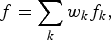
where w k are the weighting coefficients. In our experiments two objective functions have been used. All the objective functions have been set up to approach value 1 in the optimal situation. The first objective function is minimizing the bit error rate (BER) as used in [Reference Zhao, Xu, Zheng and Shang6]:

where  denotes the average BER over N subcarriers. To achieve the constant data rate, we have defined second objective function:

where T is a duration of OFDM symbol, M n denotes the modulation order on nth subcarrier and constant R d is a total desired user defined data rate. As the data rate allocated on the OFDM subcarriers approaches desired data rate R d, the objective function tends to 1. According to our simulation results, this criterion relaxed the requirements in contrast with data rate maximization criterion. As a result, the data rate assigned to subcarriers corresponds better to the subcarrier channel gains as will be presented in the result section.
V. APPLICATION TO FIXED WiMAX
A) Simulation setup
The PSO adaptation method according to the above-described algorithm has been applied to WirelessMAN-OFDM physical layer (fixed WiMAX), [7]. The fast Fourier transform (FFT) of length 256 is performed in this case. Some the most important physical layer parameters are summarized in Table 1. The PSO algorithm has been tailored to specific properties of fixed WiMAX. The data subcarriers (192 in total) are divided into 16 subchannels. There are thus 12 subcarriers in each subchannel. The positions of subcarriers in the subchannels are non-contiguous, and are defined in standard [7] as shown in Fig. 1.
OFDM parameters used in WiMAX.

The adaptation has been performed individually for each subchannel. In each run of the PSO, 12 non-contiguously placed subcarriers have thus been adapted. The possibility to assign zero power on the subcarriers with low SNR was used in order to exclude the deep-faded subcarriers from the transmission. The vector x it, describing the ith particle thus contains 1 bit per subcarrier to store the information about the actual use of the corresponding subcarrier. The modulation types used in the simulations were BPSK, QPSK, 16QAM, and 64QAM. Two bits per subcarrier are necessary to represent the information about the used modulation type. The searching space dimension is equal to 36 bits per each subchannel. The number of particles equal to 50 has been found optimal for this setup as the compromise between a convergence and complexity. The particle's positions in vectors x it have been initialized randomly. The weighting coefficients in the fitness function have been set equally: w 1 = 0.5, w 2 = 0.5. After approximately 20 iterations, the fitness function converged to the desired value 1 and the optimization has been terminated. The global optimum is preferred (global scaling factor c 2 = 4, personal scaling factor c 1 = 0.8).
As the BPSK and M-QAM modulations on the subcarriers have been expected, the bit error rates that enter equation (4) have been calculated using one of the well-known equations [Reference Haykin9]:
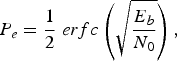

where E b denotes the energy of signal with the lowest amplitude, N 0 is a channel noise power spectral density, and M the modulation order for the case of M-QAM.
In order to estimate the optimization performance, the Stanford University Interim (SUI) frequency selective models [10] for fixed wireless applications have been considered. As the duration of OFDM cyclic prefix is 8 µs, the SUI-4 and SUI-3 models have been used thorough the simulations with maximum delay spread of 4 and 1 µs and with K factor 1. The additive white Gaussian noise with constant power spectral density in the whole frequency band of operation has been expected.
The optimization using the PSO has been also compared to greedy method [Reference Papandreou and Antonakopoulos4], the one of the standards bit loading algorithms. Its basic function can be described as follows. If nth subcarrier already carries b n bits, the power needed to transmit one additional bit is
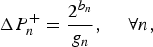
where g n is the channel gain to noise ratio of nth subcarrier. The bit-filling method then assigns additional bit to the subcarrier with the lowest ΔP n+ needed. An important conclusion from this is that a basic greedy algorithm always moves in one direction – the bits can be added (bit-filling) or removed (bit-removal) only. As the radio frequency channel varies with time, the greedy algorithm has to be reset to the initial state. On the contrary, employing global optimization methods represented by the PSO, the particles can use their previous state for a re-adaptation.
B) Results
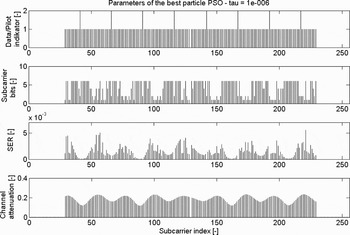
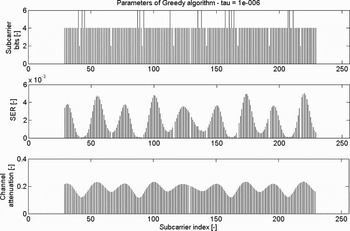
The maximum number of bits (no channel coding assumed for simplicity) per one WirelessMAN-OFDM symbol is equal to 192 × 6 = 1152 bits (all subcarriers in all subchannels used with 64QAM). The optimization goal has been to minimize the BER and to achieve a data rate corresponding to 800 allocated bits in one OFDM symbol (approximately 70% of maximum data rate). The results for single realization of the SUI-3 channel and both the PSO and greedy method are presented in Figs 5 and 6, respectively. Corresponding channel attenuation, symbol error rate (SER) and assigned subcarrier bits are shown for each subcarrier. Moreover, the data/pilot indicator (1 for data, 2 for pilot) is added to Fig. 5 in order to emphasize different uses of the subcarriers. As can be seen from these figures, the number of bits allocated to individual subcarriers correspond inversely to the channel attenuation.
PSO optimization results for SUI-3 channel. Channel attenuation, SER, assigned subcarrier bits, and data/pilot indicator as a function of subcarrier index.

Greedy algorithm results for SUI-3 channel. Channel attenuation, SER, and assigned subcarrier bits as a function of subcarrier index.

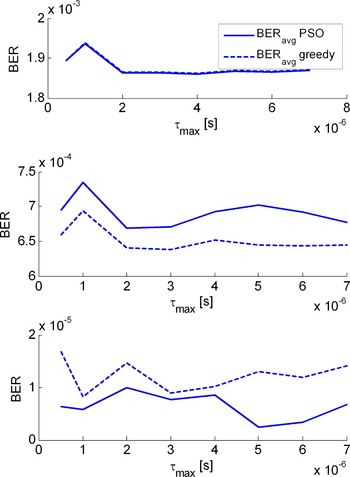
In the next experiment, the performance of PSO and greedy bit allocation has been compared for varying channel maximal delay spread. The delay spread has been varied from 0.5 to 7 µs and both methods were used to adapt the OFDM parameters. The simulations have been carried out for three different percentages of maximum data rate −25, 70, and 100%. The average BER's for both greedy and PSO are shown in Fig. 7. The PSO outperforms the greedy algorithm for lower required data throughputs. Inversely, the use of the greedy algorithm results in lower BER for 70% of maximum data rate. The both methods perform the same in the case of maximum data throughput required, as there is no other option than to assign 64-QAM on all subcarriers. Performance of both used methods almost does not depend on the maximal channel delay spread (in condition that delay spread does not exceed the guard interval duration 8 µs).
Average BER performance of PSO and greedy method as a function of maximum channel delay spread for different loading percentage (25% bottom, 70% middle, and 100% top figure).

VI. CONCLUSION AND FUTURE WORK
Of the possible control mechanisms an IKBS processors have been proposed, which work cooperatively between the BS and subscribers by incorporating processors into the physical layers. The proposed system will be based on simple network management techniques, using remote procedure calls, whereas the processor is mainly used for management tasks. Signal-to-noise ratio, error rate, CSI, CFO, and dynamic spectrum allocations are the main parameters, which could be improved using baseband processors (IKBS processors). As an example of the suitable technologies, the application of PSO to fixed WiMAX OFDM parameter adaptation has been presented.
A new objective function – difference between user-defined data rate and actual data rate has been proposed. The performance of particle optimization in the RF channel has been compared to the performance of greedy algorithm. As the real radio frequency channel varies with time, the greedy algorithm has to be reset to the initial state, while using global optimization methods, represented by the PSO, the particles can use their previous state for a re-adaptation. Moreover, the additional objective functions can be defined. The experiments with bandwidth minimization are currently investigated (inner subcarriers can be preferred against the outermost), etc.
The system will be implemented on an FPGA for WiMAX-OFDM-256. FPGA technology allows configuring physical layer functions through a baseband processor in real time according to BS decisions. In future work the proposed idea of an IKBS processors using PSO could be extended to mobile WiMAX, MIMO, or LTE technologies.
ACKNOWLEDGEMENTS
The work described in this paper was financially supported by the COST Action IC0803 “RF/Microwave Communication Subsystems for Emerging Wireless Technologies,” (RFCSET) and partially by the Czech Science Foundation under grants No. 102/09/0776, 102/08/4027 and the research program “MSM 0021630513 ELCOM.”
 Ali Al-Sherbaz received a B.S. degree in electrical engineering from the University of Baghdad, Iraq, in 1993, Faculty of Electrical Engineering and M.Sc. degree in electronic and communication engineering from the same university in 1998. His Ph.D. degree from the University of Buckingham, UK, in 2010 focused on WiFi-WiMAX (IEEE 802.x standards) convergence with nanosecond PHY and MAC level synchronization, field-programmable gate array (FPGA) support for OFDM bridges for mixed network standards, and network routing strategies using ad hoc mechanisms in a predominantly wireless environment.
 Torben Kuseler received a diploma degree in Information Technology with Business from Applied University of Wedel, Germany, in 2003 and M.S. degree in computer science from the same University in 2005. His Ph.D. research is focused on System-On-Chip design for mobile applications using FPGA technologies.
 Professor Chris Adams holds the chair of computer science in the Department and is mostly involved in research and the teaching of postgraduate students, both M.Sc. and Ph.D. He holds a joint appointment with the Rutherford Laboratory where he works in the area of high speed computer networks, video compression, and radio frequency broadcast networks. In recent years work has focused on a number of EU projects, which have included CHARISMA (workflow and electronic documents), INK (video and TV on demand), and currently EMBRACE (broadband radio frequency networks). This work has been done in collaboration with a number of groups from different countries. One relationship with a particular group at the Technical University Graz (Austria) has grown into a close partnership with his working and teaching in Graz during the autumn.
 Roman Marsalek received an M.Sc. degree from Brno University of Technology, Czech Republic in 1999 and a Ph.D. degree in electronics and signal processing from Université de Marne la Vallée, France in 2003. He is currently associated professor at Department of Radio electronics, Brno University of Technology.
 Karel Povalac received a B.Sc. degree in electrical engineering from the Brno University of Technology, Faculty of Electrical Engineering and Communication, Czech Republic in 2006 and an M.Sc. degree in electrical engineering from the same university in 2008. His Ph.D. research is focused on Cognitive Radio applications and Optimization Techniques.