1. Introduction
Sexual assault victims are a special group among crime victims. By law, they are meant to receive special treatment in their contact with the legal system. They are constantly mentioned apart from all other crime victims as deserving special consideration and unusual sensitivity.Footnote 1 The literature relates extensively to the fact that sexual assault and recovery from it differ from other offences tackled by criminal law, and the encounter between these two worlds is often accompanied by discord and further injury to the victim.Footnote 2
In addition to this progressive legislation, the professionals in the legal system seek, and receive, training specifically designed to help them in their handling of sexual assault cases.Footnote 3 This action rests on the same assumption – the tools that are available to the legal system's representatives are not effective in coping with these victims and, when applied, may easily lead them to relive or aggravate the trauma.
Sexual assault victims include an additional sub-group: women who choose to implement their right of the presence of an escort during proceedings involving investigations by the police or by the court.Footnote 4 The presence of an escort is accepted today at meetings with the prosecution also, despite the absence of a legal obligation in this regard. Escorts who have received broad (legal and psychological) training at the sexual assault crisis centres are usually those who accompany victims.Footnote 5 Beyond the information and the psychological support they give to victims, their presence may affect the course of these encounters in their function as another pair of eyes in the room.Footnote 6 Unlike untrained escorts, those trained at the crisis centres have the organisational backing of respected, long-standing settings that are in close contact with the system and enjoy its trust.
The combination of special legislation that singles out these victims, together with the presence of a professional escort, leads to the assumption that these victims enjoy the best service the legal system can provide to crime victims generally.
A focus on this specific population of crime victims may point to many steps that the current system could take for the benefit of crime victims in general, and even for additional populations who crave for better conditions, such as suspects and defendants.
Moves designed to make victims of sexual assault a special case have been adopted in Israel, and in the world generally, since the 1970s.Footnote 7 Legal systems everywhere, and particularly in the context of sexual violence, are perceived as bodies that systematically silence the female narrative through various means – from legislation that reflects male attitudes on a matter perceived as fundamentally female,Footnote 8 through the structure and constraints of proceedings that can hardly contend with these complex issues,Footnote 9 to the staff who deal with these cases, among whom are many men and women without suitable training.Footnote 10 Behind the demand to enable women to speak out in criminal proceedings is the expectation that, with regard to experiences unique to women, social institutions will adapt themselves to the absorption and processing of this experience without trying to subject it to the way in which men might live through it.Footnote 11
Although many years have elapsed, there are no studies reporting actual change in the conduct of legal proceedings in Israel. From a review of the available research, we might conclude that extensive changes are confined to laws and ordinances, or are meaningless to the victims.
Systemic action in Israel is described at length in the book by Esther Eillam,Footnote 12 which relates mainly to developments until the mid-1990s. Most of the later studies, however, have hardly reported any changes in this approach since then.Footnote 13 Eillam's findings present an alarming picture, which is validated by the many testimonies of victims interviewed over the years. Her study points to stereotypical attitudes towards sexual offences in general and their victims in particular, as well as blatant expressions of contempt for, and humiliation of, victims who approach the legal system.
However, is it indeed possible that, after forty years of wide-ranging legal, educational and media activities conducted by state institutions and non-governmental organisations in formal and informal channels, nothing has changed in the encounter between victims of sexual offences and the criminal legal system except for the legislation that regulates it?Footnote 14
This is the question that led to the current study. During the 2010s, I served as an escort in criminal proceedings on behalf of the sexual assault crisis centre in Tel Aviv. At the time, I was also writing a dissertation on the subject and found a serious gap between the reality presented in (and missing from) the research, and the reality that was revealed to me and my escort colleagues in our encounters with representatives of the law enforcement and judicial systems. Many phenomena that Eillam described in her book either never occurred in the many cases with which I was involved or were entirely negligible.
As an experienced escort who has also facilitated workshops and taught courses on this topic, I had access to all the coordinators in the field and to other experienced escorts in crisis centres throughout the country. These contacts enabled me to examine whether my personal feelings about this perceived gap reflected the reality and also prevailed in other centres.
In this article, I will show that one element in the proceedings did indeed change significantly for the better: the interpersonal encounter of the victims with representatives of the law enforcement and judicial systems. The term ‘interpersonal encounter’ refers here to a meeting between people, mostly for the purpose of submitting and processing a complaint. I favoured this term over ‘encounter’ or ‘conversation’ in order to emphasise the human and informal aspects that characterise these meetings.
Interpersonal encounters take place at the police station, when the victim arrives to submit a complaint and to be interrogated about it. They also take place at the prosecutor's office, when the victim comes for an encounter to decide on the continuation of the proceedings. Interpersonal encounters also take place when the victim is questioned on the witness stand and faces the judges, despite the spectators.
The key test touches on the victim's ability to speak out in an authentic voice and tell the full story of the offence in the course of the interpersonal encounter. In most cases, the system urges the victim to speak out in a legal, evidentiary voice, which serves the needs of the system as they are perceived at that moment by its representatives. Feelings, intuition, the broader context of the event, tortuous explanations and other complicated elements – all of these are asked to remain outside even though without them the full story can hardly be understood and remains thin and insipid.Footnote 15 Careful listening and full permission to tell the whole story may serve to explain the crime, give the victim a positive feeling, and allow the professionals to proceed with cases that appear hard to understand without these various contextual details.
A positive interpersonal encounter, then, is one that encourages the victim to speak out and present a rich, multi-layered story, contrary to the filtering and the silencing known from the past treatment of sexual crimes.
For many years, interpersonal encounters were studied in the general context of dealing with the offence rather than as an independent event subject to rules of its own. The impression from them is always part of a broader framework that includes, for example, relevant legislation, judicial rulings, sentencing and professional decisions taken along the way (closing a case, proceeding with it on the basis of suspicions far narrower than those raised by the victim, or attempts to reach a plea bargain). All of these together have supported, over the years, the widespread view that the systemic treatment of victims is generally offensive.Footnote 16 As a result, some of the subtle processes of change unfolding in the system are consistently missed, thereby precluding the possibility of detecting them as well as strengthening them as a leverage for additional changes.Footnote 17
Interpersonal encounters are located at the lowest level – the level that creates the ‘story’, the raw material spinning from the police to the prosecution and finally to the courtroom. These encounters, where the story is told, represent the least tidy part of the proceedings, the part that has almost no anchor in the legislation and relies mostly on the professionals' discretion. As such, it entails the greatest potential for harm, but also the greatest potential for change.Footnote 18
Before presenting the actual change, I dwell on two important processes that made a significant contribution to its occurrence since it is those that dealt with the interpersonal encounter. Obviously, many factors contributed to this change, from legislative amendments to the expansion of media coverage. What seems important, however, is to direct attention to the crossroads, when processes focus specifically on the interpersonal encounter that, as noted, is never studied as an independent topic. The first of these processes is the Escorts Project, established at the sexual assault crisis centres. The second is the enactment of the Rights of Victims of Crime Law (2001), which now includes four sections that reflect unusual legislative intervention into the conduct of interpersonal encounters in the legal system, when adults rather than minors are involved.
The criminal legal system in Israel is a particularly interesting case study in these contexts because, given its ongoing interaction with various feminist trends, it reflects well (even though with a slight delay) the changing voices in local and global feminist thought. This situation is conveyed in changes in primary legislation touching on sexual offences,Footnote 19 and also in the enactment of the Law for the Prevention of Sexual Harassment (1998)Footnote 20 and the Rights of Victims of Crime Law (2001). Many organisations with a distinct feminist agenda participated in the drafting of these laws.Footnote 21
Ties between the establishment organisations and the crisis centres have deepened significantly since the enactment of the Rights of Victims of Crime Law. The institutionalisation of these ties is evident in the increasing involvement of escorts in criminal proceedings in all the sexual assault crisis centres in the country.Footnote 22 This is a development that simultaneously shapes and reflects the changes, and has evoked great interest in the study of the Israeli reality.
The next section describes the methodology of the study and delves at length into the reasons for choosing the specific interviewees, followed by a detailed discussion of the contribution to the actual change made by the Escorts Project and the Rights of Victims of Crime Law.
The change itself will be presented through the five core themes that were identified in this study as significant in encouraging victims to speak out. The current situation, which differs from the position known from earlier studies, is then described using these themes. The summary will suggest research and practical implications of the study's conclusions.
2. Methodology
The central instrument used in the study is the in-depth interview that provides primary information, meaning information that is received directly from the participants and focuses on rich descriptions of their experience, on the way they perceive it and on its meaning.Footnote 23 Note that the study deals with an experience that is methodologically complex, since it involves observation as well as limited participation in the field that is the object of the study. The leading participants are the system's representatives and the victims of sexual assault. The interviewees, who represent the crisis centres, are only secondary participants observing an interaction wherein they have a limited and restricted share. On the one hand, it could be claimed that their experience does not necessarily describe the phenomenon at the focus of the study – an interpersonal interaction between two parties. On the other hand, their role in the field provides them with a unique perspective of highly significant value.Footnote 24
The decision not to interview the victims also left outside the ‘subjects’ population the representatives of the system, whose impressions are equal in value to those of the victims. A study that focused on both of these groups found that, despite relatively broad agreement on the facts, serious disputes emerged concerning their interpretation. In other words, the parties to the encounter experienced the same events differently.Footnote 25 In the future, it may be desirable to plan a similar study in Israel as well, in order to complete the information provided by the crisis centres' representatives in the current study.
The participants in this study are not interviewed frequently and they were chosen for several reasons, beyond their being the only organised group allowed to take part in encounters of an investigative character. First, the size of the population made it possible to design a study without a sample. All the women who had specialised in this area in the 2010s were interviewed, significantly strengthening the validity of the study's conclusions. Second, the spread of the crisis centres in Israel means that every single police station, prosecutor's office and court receives a response from a centre. The study's population is thus a good representation of the national spread of the care for sexual assault victims, both in geographical terms and in its coverage of the country's various population groups. Third, the interviewees have an extremely broad perspective of the activity in the field, given that their impression is based on the hundreds of victims whom they themselves escort every year, as well as on thousands of additional cases where escorts that they have trained are involved. Fourth, an important balance prevails in this population between a critical approach, which leads them to discern the system's flaws, and a desire to succeed, which leads them also to discern positive processes of change.
2.1. Analysing the Data
The raw data represents about a hundred hours of recorded interviews. The first processing step was a content analysisFootnote 26 in an attempt to identify the central elements affecting the conduct of the encounter in general as well as the victim's ability to tell a full story, rich in details. Five key elements (core themes) were identified at this stage:Footnote 27
• escorting: enabling the option of an escort (and the attitude to the escort);
• disruptions: preserving quiet and privacy;
• sensitivity: sensitively coping with questions that evoke guilt or shame;
• trauma: effectively coping with post-traumatic symptoms that hinder the ability to tell the story;
• representative's gender: enabling an encounter with a system representative from a specific sex.
After identifying the core themes, the material underwent further processing within each theme. Each of the quotations representing the reference of a specific interviewee to a given theme was placed in a table in one of the three following categories:
• positive reference – describing basically positive experiences regarding the issue;
• negative reference – describing basically negative experiences regarding the issue;
• mixed reference – positive and negative descriptions without characterising the prevalent situation.
This classification enabled a quantitative presentation of the qualitative findings,Footnote 28 after counting all the references (positive, negative or mixed) to each theme in each organisation (police/prosecution/court).
Expressions and phrases in the interviewees' accounts attesting to a time perception – once, today, now, before, long ago, after, and so forth – were located along a timeline in order to examine perceptions of changes in all the themes in the three organisations.
3. The Interpersonal Encounter: Crisis Centres and the Rights of Victims of Crime Law
As I noted at the opening, two parallel and intertwining processes simultaneously reflected and created a spirit of change. Although these processes are over twenty years old and are now perceived almost as history, they are in truth very dynamic and continue to influence the interpersonal encounter.
The older of the two processes was initiated by the crisis centres, which sought to cope with the challenges facing victims who choose to start criminal proceedings. It is known as the Escorts Project, and some of its actions focused on the distress caused by the interpersonal encounter. The second project, which took shape in 2001, concerns three interesting sections in the Rights of Victims of Crime Law that touch directly on the conduct of the interpersonal encounter. A new section, in a similar spirit, was added at the end of 2014.
3.1. The Escorts Project in Criminal Proceedings
The project was launched in 1996. Implemented first in the Tel Aviv area and then extended (first in the centre of the country and from there to the periphery), this project reflects the insights of the crisis centres concerning their available options for change. The most significant insight was that the two forms of discourse – the therapeutic and the legal – could not operate simultaneously without ongoing mediation.Footnote 29
The need for bridging the various types of discourse led to cooperation between the Israel Women's Network and the Association of Rape Crisis Centres in Israel. The cooperation was based on a survey that examined the needs of victims facing the law enforcement system.Footnote 30 The survey sampled a broad range of victims (including some who had chosen not to complain to the police) and also members of the caring professions. The victims' reports matched the descriptions in the research literature of the time: alienation, disappointment, humiliation and helplessness. By contrast, victims who had encountered a serious and caring response emphasised the strengthening effect of the proceedings, even when they were unhappy with the results.Footnote 31
In light of these findings, the tasks of the Escorts Project were defined as follows: to provide the victims with information, give them emotional support, coordinate their expectations with the reality, improve their physical condition during the criminal proceedings, train the professionals, collect data and represent victims vis-à-vis the system, and strengthen communication channels between the various bodies involved.Footnote 32 The first five goals touch directly on the interpersonal encounter and are sometimes implemented in its course.
As for the contact between the crisis centres' representatives and the professionals working within the system, great emphasis was placed on clarifying the uniqueness of sexual assault victims and on sharpening sensitivity to their special needs. One interviewee reported:
There's a file ready, with articles arranged by topic. Every single topic that prosecutors might raise. One judge asked the plaintiff: ‘But you'd already been raped once, didn't you see it coming?’ And I immediately made a note to myself to give the prosecutor the article dealing with repeated victimization so that he could give it to the judge, and she would truly understand how it is that this woman didn't see it coming.
The delivery of this message relied on the professionals in the field, on the collection of relevant literature, and on the professionalism of the women working in the crisis centres in ongoing contact with the system. Another interviewee reported:
I give a lecture about sexual assault victims at the prosecutor's regional office. Almost the entire office, except perhaps for two who are on duty, sit in and listen to me. They listen very attentively and participate and speak and raise problems and call me up afterwards to consult.
The shared learning of new practices, when sponsored and encouraged by the system, further legitimises the body of knowledge supplied by the crisis centres and the tools that are derived from it.
Training sessions open up an additional channel of communication between the professionals and the crisis centres, not necessarily focused on the victim's needs. Participating professionals can discuss their fears and the trauma they themselves experience while regularly exposed to matters so charged and so hard to digest. One interviewee claimed: ‘A prosecutor who can see her own secondary trauma can also see the trauma of the victim’.
This project, then, signalled not only the new insights gained at the crisis centres but also an ability to forsake the desire for a specific type of change and make adaptations that would promote another type. In this case, it meant forsaking the desire for drastic revolutionary change and shifting to other paths of action and other types of relationship with the system's representatives.Footnote 33 Many interviewees offered variations of the following insight (reported by one of them):
I feel I have abandoned the accuser's stance, that of the representative confronting evil, aggressive, and ignorant enemies, and see them instead as professionals. I give them credit because I think I really don't know how to do what they do. In other words, I can't replace them.
The crisis centres began to work with the system. They chose ways of action that would not require the system's representatives to breach unwritten rules solely in order to improve their service to the victims in conducting investigations. Instead of demanding behavioural changes, the centres directed attention to a broad area where no compelling rules prevailed, and promoted setting up appointments for submitting complaints, using words that do not evoke feelings of humiliation and mistrust and preventing disruptions during the encounter. None of these arrangements contradicts procedures or laws or denies the rights of suspects or defendants, and all convey humaneness, sensitivity and goodwill.
Crisis centres did not confine themselves to directing attention to this range of options; they went on to supply ideas and concrete tools, as well as supporting new choices:
We didn't come and say, ‘you must realize that they're a mess and it's hard for them to talk’. Instead, we said, ‘if you want to get better cooperation in the investigation, you should know one, two, three, four – that's the way. Because you're trying to get information by putting pressure and that might be appropriate for other things, other people, and other offences, but it's really inappropriate in the present situation.
The hope of the centres was that with time the victim's well-being would shift from being an instrument chosen only for so long as it did not exact too high a price or when it was useful to the system's representatives, to become an aim in itself. Their endeavour was to bring about changes in the interpersonal encounter and, for this purpose, they engaged in varied and extensive activities intended to highlight the uniqueness of sexual assault victims and their special needs.
The interviewees noted that the emphasis on promoting the victims' cooperation with the system's representatives was intended to prevent a sense of threat to the professionals' authority, evoked by the creation of the centres. Instead, the centres sought to stress the common interests of all parties rather than interests that had not yet been perceived as such:
The crisis centres today are less involved in these colossal wars. Rather than waging wars against them we try to bring them closer, to fight together against a common enemy. Put on the table that each one of us has interests – interests is not a bad word and we can really help one another a lot.
What the centres actually offered was help, based on their long experience in coping with victims. The big challenge posed by the day-to-day need to cope with the victims led the system to agree to a kind of deal – the centres would contribute their experience, their time and their resources, while the system, in exchange, would allow them to be part of the institutional setting, caring for the victims during the criminal proceedings.
3.2. The Rights of Victims of Crime Law and the Interpersonal Encounter in Criminal Proceedings
The Rights of Victims of Crime Law (2001) is a milestone in the way in which the law enforcement system deals with crime victims in general and with sexual assault victims in particular. Its goals are stated in its aims section: ‘The aim of this law is to determine the rights of crime victims and to protect their dignity as human beings’.Footnote 34 The section on the principles of the law contains a clear reference to the crime victim as a subject: ‘Rights will be granted to a victim of crime taking into account his needs, the defence of his dignity, the protection of his privacy, and within a reasonable time’.Footnote 35
This law deals with the regulation of rights and, in its concrete sections, promotes the implementation of these declarations to ensure that they become a prevalent reality and are no longer dependent solely on the goodwill of the system's representatives. One interviewee reports:
It was not easy before the law. Escorting was a matter of luck and of a kind officer allowing it. Entering the investigation depended on the officer's kindness. Sometimes an escort went in but at some stage was taken out, or they only let her in if the police needed her.
With regard to interpersonal encounters, the law validates the right to have an escort during investigative proceedings both at the police station and in court,Footnote 36 encourages the police to provide victims with a female officer if they ask for one,Footnote 37 and forbids – as is already the case during the police investigation – asking questions about the victim's sexual history.Footnote 38 Support for these principles is designed to promote the victim's well-being as an end in itself rather than simply as a means for the benefit of the system.Footnote 39
The relevant sections of the law attest to a genuine effort to highlight important concepts such as dignity, privacy and choice. In addition, however, are reservations which state that the right may not be granted should the agencies responsible find that the needs of the system are more urgent. This approach may point to the hierarchy envisaged by the legislator – the victim's needs are important and worthy of attention, but the needs of the system come first. Even if the crisis centre representatives may not be happy with this approach, it still constitutes a definite improvement over the previous position. The victim's needs were granted independent standing and their violation now has to be justified, as opposed to the past described by the interviewees, where the victim's needs were attended to only if they served the needs of the system.
In 1988 any inquiry, during examination in court as a witness, into the victim's sexual past was forbidden,Footnote 40 while the police and the prosecutor were allowed to conduct such inquiries without any need for explanation or justification. Only in court, after these materials had been disclosed at the early stages of the proceedings to the suspect's or the defendant's lawyers were the judges supposed to prevent any further discussion. The relevant section includes a caveat stating that the judge will be allowed to approve such an inquiry if special reasons are found for it, among them, that refraining from it would hinder the case for the defence. The plausible assumption, however, is that raising such questions critically hinders the victim's ability to tell her story and evokes in her mainly guilt and shame. We may also assume that, in the absence of other good claims, the defendant's lawyers will find ways of making this information relevant and present it as central to the case, thereby requiring renewed discussion of the prohibition.
In the Rights of Victims of Crime Law, the prohibition was expanded to include the investigating body – the police – in order to prevent repeated mentions of this issue at later stages of the proceedings.Footnote 41 In this version, the prohibition relates to the system's representatives and limits the range of their questions. Through this section, legislators perhaps sought to provide a hint to the system's representatives of the potential scope of legislative intervention into the regulation of the interpersonal encounter, including even the topics that could be discussed in it:
Today, with the law, the woman knows beforehand it is forbidden to ask her, and then only if it is truly relevant. She no longer needs me in order to insist on her rights and I don't need to complain to anyone after the investigation. The woman is ready and knows, and she can say that those questions are not pertinent and ask to understand why they are raised.
Another significant intervention is evident in the sections that establish the victim's right to an escort in encounters where investigations take place – at the police station and in court.Footnote 42 Although not its main or declared intention, by its very nature escorting creates a certain measure of supervision.
The law does not explicitly state who is to escort the victim and it allows her to choose an escort as she wishes. According to the interviewees, this arrangement anchored an existing situation whereby professionals had agreed to allow the presence of properly trained crisis centre escorts long before the enactment of the Rights of Victims of Crime Law. The right to an escort is reserved for the victim but, by exercising it, she enables the legislator to compel the system's representatives to accept the presence of a strange woman with a distinct agenda and easy access to authority figures:
We're not props. If the victim's rights are breached, we intervene. If the breach is flagrant, we intervene during the event, and if it can be postponed so as not to disturb – then afterwards. But it is inconceivable that their rights will be flagrantly breached and we'll ignore that. We're there for that too.
Through this section, legislators have intervened in the encounters even further and, in one sweep, have turned what had been a goodwill gesture into an obligation:
In the past, I had to smile sweetly and be nice and polite to go in with the victim. Now there's a law.
At the end of 2014, a further amendment in the shape of section 14a was added to the Rights of Victims of Crime Law, instructing the police to have a male or female officer at the investigation according to the victim's request. As in the two previous sections, this section also included caveats allowing the authorities to refrain from its implementation under certain conditions. Yet, the detailed conditions lead the system's representatives to consider requests regarding the person investigating the victim and to pay attention to the victim's needs. As in the section that establishes the right to an escort, in this case also the section legally anchors a situation that had prevailed for many years:
She wanted a female officer, it was important to her, and no one was available. I asked the officer to at least explain to her what would be the price of waiting for a woman that would have to come especially from home and to let her choose. They explained, she chose to wait, and they brought a woman.
The women from the crisis centres often arrange appointments for the police investigations and therefore ask, if necessary, for a male or female officer according to the victim's request:
A lot depends on the arrangements. If the meeting is set up beforehand and if it is important to the victim, there will probably be a female officer if the woman has asked. If it's not arranged, we mostly make do with whoever is there. Sometimes, the woman who is available is someone without any training in the investigation of sex offences and that also has a price.
As is also true of the inquiry into the victim's sexual past, the choice of the officer's gender is not intended to serve the system's needs but rather to address the needs of the victim and help her to exhaust the potential of the criminal proceedings. In other words, these sections clearly recognise that the interpersonal encounter could inflict further damage and the need to prevent that as far as possible. Unlike the situation in the past, when all had been left to the goodwill of the system's representatives (with the support of the crisis centres’ representatives and the escorts), these sections of the law strongly limit their discretion and demand explanations for every situation where its application departs from the letter of the law.
The enactment of a law that itself promotes the victim's well-being has greatly facilitated the centres' attempts to deepen this process. The interviewees, however, attested that they viewed the law as the starting point rather than the culmination of their pursuit, and the law has traced the course worth taking, but not its ending. One interviewee stated:
Now there are things she is entitled to by law and no longer need to be fought over, or begged for, and be terribly nice in order to get. This leaves the arguments for what the law does not give but should have given because it all leads to the same thing – it leads to her talking and truly being heard.
The Rights of Victims of Crime Law has changed the actual conduct of interpersonal encounters only slightly, given that the guidelines leading to its enactment had been part of a long ongoing dialogue between the crisis centres and the system. When the law was enacted, the significant change was declarative. For the first time in decades, the legislator intervenes in the conduct of the encounter between the system's representatives and the victim, compels the presence of an outside escort, subjects the system's staff to the victim's will, and restricts the questions that may be asked in its context. The very act of anchoring in law the long-established practices of the crisis centres has created open support for them and sent a clear message from the legislator, limiting the scope of discretion and the need for reliance on goodwill, and replacing them with a compelling law that draws attention to the needs of the victim beside those of the system.
Representatives of the crisis centres could now continue on their course in the spirit of the law, strengthening additional elements beyond those stated in the law and suggesting new ones. The action of the crisis centres, together with the Rights of Victims of Crime Law (which is a dynamic construct), create a feedback circle – the special attention devoted to interpersonal encounters over time increases the chances of actual change in them, possibly also through legislation.
4. The Five Core Themes: Factors That Affect Speaking Out in the Encounter
The core themes organise in behavioural categories how the system's representatives can encourage victims to speak out, thereby recognising their special needs. Speaking out – the choice to tell a full, rich, authentic, and multi-layered story – requires basic conditions. The system's representatives can easily provide – or prevent – some of these conditions from their attitude to the escort chosen by the victim, through their choice of words and their ability to create a safe space respectful of the victim's dignity, to their way of coping with post-traumatic symptoms.
This section presents the conditions that promote speaking out, as they are perceived by the escorts and as reflected in the broader activity of the crisis centres and in the sections of the law presented above. The importance of the themes is presented through quotations from the interviewees. In addition are examples of positive situations that provided favourable conditions for speaking out, examples of negative situations where speaking out was prevented, and situations illustrating a mixed attitude towards speaking out.
4.1. First Theme: Escorting
This theme deals with offering the victim the opportunity to have an escort during her encounter with the system's representatives. The importance of the escort is conveyed in the Rights of Victims of Crime Law (2001), which states in sections 14 and 15 that victims of sex or violence offences may choose to be escorted during the police investigation and at court sessions held in chambers.
As for encounters with the prosecutor, the law does not regulate this arrangement and the organisation's varying records are therefore extremely interesting.Footnote 43 The victim's first meeting with the representatives of the prosecution is referred to as an ‘impression meeting’. Its aim is to assist in coming to a decision on whether to press charges (and for which offences) or close the case.Footnote 44 Although it is not defined as such, this meeting constitutes a kind of investigation where the story of the crime emerges, and particularly those points in it that are legally challenging.Footnote 45 Precisely for this reason, I have focused on this meeting rather than on other meetings of the prosecution with the victim, such as those considering plea bargains or closing cases.Footnote 46
As the interviewees excelled at describing:
Not only the police officer hears her. Someone else hears and is exposed to the story. There is someone else there that contains it at that moment, someone on her side, not only the police officer. This also validates for her that she really experienced what she experienced because the question is always there, especially in incest cases – did it happen?
Another explanation points to the active aspects of escorting, beyond the escort's very presence:
In many senses, the discourse takes place above the victim's head. She doesn't really understand and sometimes my role is to explain to her. A bit like translation. She feels she is being hosted. A guest in a foreign country. It has happened that the victim didn't understand why she should answer those questions. She adopted a hostile attitude towards the officer and it was then necessary to translate the police conduct in a way that would clarify this to her and enable her to carry on starting from another position.
The findings on escorting describe the attitude of the system's representatives towards the victim's desire for an escort and towards the escort she chose.
A positive attitude will come through, for example, in the way the escort is addressed:
At the police, the officer can approach me and shake my hand in front of the victim and give her a feeling that she is in good hands.
One judge would say whenever I'd go in, ‘Oh! Hello’ to the escort and ask ‘How are you there at the centre?’ And I think that, in this way, he also tried to make things easier for the plaintiff who came to testify.
A negative attitude will be seen in attempts to force the escort out and hint to the victim that opting for escorting is not a good choice:
At the police, the officer speaks with her – who are you, what are you, where do you live – and all very nicely as it were, and then she says to her – do you feel OK with me already? So no problem for you if the volunteer waits outside, right?
The message of the prosecution is that there is no right to an escort and there's no need for one either. One simply said to her, ‘What is this nonsense, what do you need an escort for, do me a favour’.
A mixed attitude will be evident, for example, in letting the escort in under protest or based on a clear need of the system:
At the police they let us in easily but sometimes it's because they've learned that when a woman sits next to her, it's easier to put pressure because there's someone who comforts.
There was a judge that, if the defence lawyer insisted that I should leave, she'd say, “I don't like it either but she can sit here”.
4.2. Second Theme: Disruptions
Telling a story, and certainly in the context of an encounter with an investigating body, is obviously easier when a quiet environment and privacy are protected. Such conditions enable the narrator to expand on the details, to tell the story chronologically and to keep up a logical sequence of events. In cases of sexual assault, such conditions can at times determine the difference between the ability to tell any story at all and silence: ‘She won't talk if someone comes in. As it is, she finds it hard to say this aloud, and suddenly a man walks in and starts mulling around and taking things – she just won't go on’.
In the investigation, they encourage chronological accounts and the preservation of a logical sequence, with an emphasis on detail that is relatively greater than in other cases:
There were cases when, in the course of the investigation, the woman began a sentence, and she needs great emotional resources in order to say this, and she's precisely there and the door opens and we all turn around to see who's there. And even if he goes out immediately and says, ‘OK, bye,’ and the officer says, ‘Yes, go on,’ – well, what do you mean go on? Whatever was about to come out a second ago, no longer will – something else will.
The scientific explanation of this phenomenon lies in the well-known symptoms of post-trauma, which include memory impairment, difficulties in retrieving details and problems organising information chronologically.Footnote 47 Sexual injuries are also characterised by an over-awareness of surrounding events as well as a loss of trust in people.Footnote 48 The interviewees' cumulative experience showed that protecting privacy at the time of listening to the story is critical, since disturbing it could lead the victim to relive the injury.Footnote 49 Preventing disruptions sends a message of importance and attention. Given that the victim's most common experience is suppression (together with the contradictory desire to expose the secret),Footnote 50 disruptions that delay attention could lead her to relive the hard part of coping with the injury. Topics raised in the context of this theme include the degree of privacy, the number of disruptions, how the system's representatives cope with disruptions, and their provisions for lessening their number.
Positive descriptions focused on a respectful attitude to time and space:
Mostly, the prosecutor sits in a room of her own, and there's no such thing as someone just walking in to take a fax.
Some judges are very strict. If someone enters in the midst of a session they immediately stop and don't allow another word to be said before clarifying who it is and whether he really needs to sit in.
Negative descriptions focused on the invasive nature of the surroundings of the encounter without eliciting reactions on the professional representative's part:
We were at the police, the woman is in the middle of the story, and not once or twice, all the time, these disruptions of opening and closing doors are going on. Or there are two people sitting in the same room, one here one there, and one is talking on the phone while the woman's investigation is going on just next to him.
People entered the room in the middle of our conversation with the prosecutor and she didn't ask them to leave. She didn't say, ‘Just a moment, we're in the middle of something’. It was simply that it really really didn't bother her.
Mixed descriptions pointed to a late or minor reaction to breaches of privacy:
Often, at the police, other people were in the room at the beginning and I asked them to leave and they did. This is a beginning, not great, but it does create a sense of respect for the victim.
Some defence lawyers, when the defendants are afraid of exposure, insist on strict privacy. So it's in chambers, but it's not because of the court but rather because of the other side.
4.3. Third Theme: Sensitivity
An investigation is a fundamentally uncomfortable situation, even when the person under investigation is a plaintiff with a real interest in pursuing it. Moreover, when sexual assaults are concerned, some questions can be expected to evoke significant discomfort,Footnote 51 and three specific kinds in particular:
1. Questions conveying mistrust in the victim's story:
They ask her the same question many times in different ways. Someone who doesn't understand these techniques at some point begins to ask herself whether what she's telling actually happened. In other words, she begins to doubt even what she said and what she went through and she herself grows weaker.
2. Questions hinting at flaws in the victim's behaviour before, during or after the assault:
And she asks – so why did you go back? Why did you go there again? What were you looking for there? And so forth. Faced with questions like this, the victim generally remains silent. Simply remains silent. This is a question with so much guilt that it's really hard to answer, because she too knows that she shouldn't have gone back. But she only knows this after the fact.
3. Questions dealing with the body and deriving from the need to describe the assault in great detail:
When they ask about the physical details of the assault, you see how the victim's body language changes. This is the body language of a frightened person, a terrified person – they close up and sit in this deep silence.
A positive attitude emerges mainly in awareness of the discomfort evoked by the questions or in the relinquishment of investigation techniques that make the victim uncomfortable:
I've seen prosecutors who knew how to pose questions showing mistrust but in inoffensive ways. For example: ‘Look, I need to check this up with you. There are questions here that I don't know how to answer and only you can answer’. It's even empowering.
Generally, at the court, questions on the same issue are endlessly repeated from every possible angle time and again. The defence lawyer tried to ask the same question a third time and the court wouldn't allow it.
A negative attitude will come through in the absence of such awareness. The words may sound similar, but it is the way they are presented that makes the difference:
There were times when there was no apology for blaming questions, and all the questions were why why why why. Without explaining anything at all.
There are the prosecutors who say: ‘Listen, I know this is hard for you but you must’. What does it mean to say it's hard but you must? It means that I have absolutely no respect for the fact that it's hard for you and I actually don't intend to make room for this difficulty.
A mixed attitude lets the hard questions surface without tenderness but also without aggression:
She thinks that the prosecutor protects her, but what is this protection? She asks difficult questions. She asks the same questions that they had asked at the police. If no one explains to her what is behind this, she comes out all confused.
The defence lawyer did not ask questions about the victim's sexual past but hinted at it instead, and she actually treaded a very thin line. Usually, the judges told her that was irrelevant, but the questions had already been asked.
4.4. Fourth Theme: Trauma
The return to the event, particularly given the degree of detail required, can evoke great distress. Distress can be expressed in crying, in difficulty speaking, or in problems focusing on the details of the event that are considered legally relevant. Greater distress, attesting at times to post-traumatic stress, can manifest in memory loss, in problems in arranging the details chronologically, in very long silences (detachment from the conversation and from the surroundings), and so forth.Footnote 52 From the experience of the interviewees, these situations hinder the conversation with the victim, but coping with them incorrectly may bring the entire investigation to an end. According to the interviewees, coping well with situations of this kind may simply require a display of basic empathy, whereas refraining from empathy and showing rigidity or inflexibility could aggravate the situation and widen the rift between the victim and the professionals.
A positive attitude to post-traumatic symptoms will be manifest in displays of kindness and humaneness:
Faced with her hardship, the officer began looking at the woman, to smile at her or shake his head, ‘Yes, I'm with you’, meaning that he reacted more emotionally.
I had a case where the judges, a man and a woman, sat and cried with the victim. Yes, yes. They are human beings and yes, I'm telling you that I saw a judge cry.
A negative attitude comes out in expressions of anger or rigidity:
I've seen female officers who are angry at the victim, saying to her OK, but I didn't ask you that. OK, you've already talked about that. OK, but that's irrelevant, why do you keep going back to it?
A mixed attitude acknowledges the need for empathy, but has difficulty in displaying it:
You explain to them what dissociative situations are and they'll still be annoyed with victims who seem to contradict themselves.
The other way is simply to sit and remain silent in the courtroom for a few minutes until she feels better. To let her cry without offering her tissues and water and a recess – just cry and cry.
4.5. Fifth Theme: The Officer's Gender
The commonly held assumption is that a female officer is preferable for a victim of a sexual assault. This assumption relies on familiar reasons – a woman will be able to understand a female victim better, and will therefore be able to give her better care:Footnote 53
I have absolutely no doubt that an investigation with a female officer is different. I remember the experience of going in with a victim for an investigation with a male as opposed to a female officer. The anxiety and the tension are entirely different because even before the investigation begins there's already something to deal with. And even if the male officer is excellent and sensitive, you still need to overcome this hurdle to discover that.
A study in New Zealand found this assumption to be both mistaken and problematic. Its findings showed that generally the training of investigating officers is more important than their gender, and that there are many women without the appropriate training (or qualities) whose suitability for the task is questionable.Footnote 54 Some of the interviewees conveyed a similar view:
The most important variable is the training. You can immediately feel who's been properly trained to investigate sexual offences and who hasn't. You can also feel who has received proper training at the crisis centres and who hasn't. And this determines the quality of the investigation and the victim's feeling far more than the sex of the professional.
Nevertheless, it is worth noting that a group of women in the mentioned study claimed they would never have told the story of their cases to a man and, seeing a man, they would have closed up or left. The interviewees pointed out that they too know of such victims: ‘Often, some women will indeed say: under no circumstances, under no circumstances could I tell this to a man. I'm not prepared to do that’; or ‘[w]hen she stands before a man, she might not tell half of the truth’.
Optimally, an appropriate pool of properly trained female officers should be available, so that women who ask for a female officer can receive an appropriate response. The objective is for the system to recognise the need to have a woman conduct the investigation, and for this need to find some expression even in the absence of suitable staff. Recognising this need means that when a male officer meets a victim, he will be aware that she may wish for a female officer and will understand the victim's problem in exposing the story to him simply because he is a man: ‘Being a man in this encounter is very very hard, that's it. The assailant is a man. I think they have to work very hard to escape this ascription and evoke the victim's trust’.
This theme elicited hardly any reactions from the interviewees with regard to the courtroom experience. The reasons could be varied – from the fact that encounters at court usually involve system's representatives of both sexes, through the lack of expectation to influence in any way the gender of the representatives in encounters at the court (unlike the options available at the police station and at the prosecutor's office), to the most technical layer – the limited scope of escorting to the courts, since most cases never reach the stage of evidence because they are dropped midway or end in a plea bargain.Footnote 55
A positive attitude comes through in efforts to consent to the victim's wish to have a female officer or in displays of special sensitivity by male officers:
In most cases, the investigating officers were women. And if no female officers are available and the woman insists, you wait and they bring one from somewhere else. It helps to set it up beforehand.
Another interviewee compared the male and female officers she had met:
I've worked with sensitive male officers who were really, really patient. Male officers are much better for the victim. I mean, they've learned our language. They're much kinder and gentler, they use a rich language that is less piercing, domineering, and invasive. It really has a different music.
A negative attitude was evidence by pressure to give up the request for a female officer or in setting up a meeting with an untrained, aggressive female officer:
She says she wants a female officer but they don't have one. So they convince her that the male officer is OK. They try nicely until she ends up agreeing.
There are some female officers that, after she goes in, happy that the officer is a woman, she finds that she's being investigated as by the least understanding of men.
A mixed attitude is expressed in the fact that the gender of the officer was not a significant element in the encounter, or it functioned contrary to expectations:
I've seen all kinds of men. Some are super-sensitive and you see they are cautious, and some show absolutely no awareness that they are sitting across a woman in such a situation.
The sex is a shared basis but not every female prosecutor wants a shared basis with the victim of a sexual assault. So sometimes this leads to a great deal of empathy and sometimes it leads to a very judgmental attitude.
4.6. A Quantitative Perspective: The Themes in Numbers
The different attitudes to the core themes can be counted and quantified. This section presents a basic descriptive statistic of the interviewees' reports, according to their references to each theme in each organisation. For each theme and for each organisation, each interviewee was counted only once. An interviewee who related positively to the theme in a specific organisation was counted as a positive reaction. An interviewee who related negatively to the theme in a specific organisation was counted as a negative reaction. An interviewee who related in a mixed way to the theme in a specific organisation was counted as a mixed reaction.
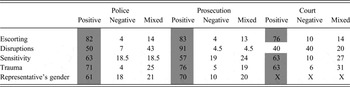
The figures represent the percentages who referred to the theme in the organisation out of all interviewees (in all cases, at least 75 per cent).
Responses on each theme in each of the three organisations (percentages)

Note: Cells where responses exceeded 50 per cent are shaded. Clearly, then, in none of the organisations do we find such a cell in the columns of mixed or negative responses, and in all three organisations a decisive majority had positive reactions on all themes except one.
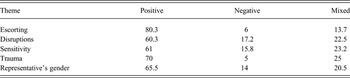
Average of responses on the five themes in all three organisations (percentages)

Note: All the core themes receive an average of 60 per cent or more positive reactions. Two of them receive an average of 70 per cent or more positive reactions. For all the core themes, the average of negative answers is less than 20 per cent and, for two of them, even less than 10 per cent.
The quantitative presentation of the findings reveals that the interviewees have a very positive impression of the efforts that the system's representatives have invested in enabling victims to speak out. Despite prominent systemic vulnerabilities, these weaknesses are not the norm. In most cases, the interviewees attest that the system copes well with the victim's need to speak out, together with a minority of cases which illustrate mixed or negative forms of coping.
4.7. Winds of Change
The raw data gathered in this study easily shows that the interviewees perceive the reality in terms different from those used to describe it before the 2000s.Footnote 56 All interviewees dealt with the sense of change. Some made general statements about it and some included time references in their descriptions of specific behaviour. When I highlighted these statements and these time references, I found that there were hundreds of them. All the themes that surfaced in the raw data are perceived by the interviewees as changing in a positive direction, and they hardly ever referred to the deliberate humiliation, contempt and abuse that appeared in the testimonies presented in Eillam's book. Negative events from the 2010s that the interviewees did mention are seldom as serious as those from the more distant past.
Citing many examples would exceed the scope of this article and I will confine myself to a few salient quotes for purposes of illustration. The examples are presented chronologically. They open with those describing the interviewees' most distant memories of the way in which victims were treated and end with examples touching on the change in the 2000s:
Once, the dynamic in police stations was like this: a woman walks in and says ‘rape’. Then all the men choose the biggest room at the station and sit around the table, and this is how they obtain evidence from her. And I'm not exaggerating. And all the questions that today are absolutely forbidden, such as ‘did you come?’ or ‘did you enjoy it?’ would be thrown at the victim without any problem. There was no closed room, no obligation to make a female officer available, not one officer – all the officers who wanted could participate. They could ask any question in the world. The police today is light years away from that. Everything is different now.
Once, officers thought they ran the world. Twenty years ago, an officer said to a victim, ‘if you can't remember the colour of his underpants, you weren't raped.’ That is, if you don't remember a specific item that the policeman has now decided is the important one, it couldn't have happened. They used to talk like that once, a lot. He would try to be the investigating officer as well as the judge. We're living in another time, when such things are inconceivable.
Once, if it happened that you sat at an investigation or escorted someone, it was because you were lucky and because there was a very nice guy there who agreed, and it was very very unusual. Then there were times you sat in, but at some stage he decided that now you have to leave. Without any reason, now you have to leave. Today we are in a different situation. These things hardly happen and, if they do, someone is asked to answer for it, both because things have changed and because there's a law.
The perception today is that she's a victim and not a suspect. Once I would sit and ask myself, just a minute, who am I escorting here? They would relate to her as if she had perpetrated the crime, she's not OK, she's the suspect. Today you already feel that much less and there's also a greater ability to show empathy and ask questions that are neutral and not judgmental.
In 1999, 2000, when I'd escort someone they'd look at her like, what are you escorting, why does she need an escort? What are you, her translator? Today it couldn't happen. Things are also more deeply engraved in them. Sensitivity and empathy come far more naturally than when we started.
The last five years have been much better, more humane. The modes of expression, the asking of the questions, the atmosphere in the room … Everything is completely different today, there's no comparison, and I think these are the main things that make the difference. My gut feeling is that even when the victim is alone with the officer they do not do things they used to do ten years ago.
Today, you hear less and less questions beginning with ‘why’, kind of accusatory. It's true there's still a lot to do, I'm not saying there isn't or that it's disappeared, but I see they think twice. Sometimes they look for another word and sometimes they really come out with a different formulation because of the courses and the workshops where we never stopped telling them that.
I think that they've come a long way in the last few years and that today there are more positive than negative experiences. The female officers are generally much more sensitive today, they give a lot more room to the victims, and are more aware of the offence.
Every time, after a period of work with a police station, the investigations get better – more respectful, gentler regarding the language, and also the behaviour. And so, every now and then I go in and tell myself – wow, it was hard, but they obtained evidence from the victim and I can't say anything bad about it.
4.8. Summary: Change through the Core Themes
This article presents five central themes that the interviewees perceived as most strongly affecting the ability of sexual assault victims to speak out authentically in criminal proceedings and tell the full story of the offence.
Each theme was examined as it plays out in the systemic care arrangements as a whole, and also separately in each of the three central organisations that handle the victims. The findings point to a very positive picture of the attitude to victims who chose to be escorted in every aspect that concerns encouraging them to speak out in interpersonal encounters, which is unquestionably a significant result. As I showed at the opening of the article, studies in this field tend to highlight negative aspects of the victim's encounter with the system, and to sum up their findings critically and with calls for broad changes meant to percolate down to the interpersonal encounter as well. Previous studies have hardly ever described a positive or changing picture of these encounters.
Contrary to most of the studies in the field, the current findings suggest that, despite the system's potential for harm, in most of the encounters between victims and representatives of the system conducted in the presence of an escort, efforts were made to enable victims, at the very least, to speak out.Footnote 57
The focus on the prevalent experience, together with a full account of less frequent ones, trace a complex picture. Instead of sweeping claims about the responsibility of professionals for the victim's distress during criminal proceedings, the current findings are that professionals can certainly create good conditions to enable victims to speak out at the interpersonal encounters they are in charge of. And indeed they do, at least in most of the cases where an escort was present.
In most studies, as noted, the interpersonal encounter is examined as one of several tested variables rather than by itself. When most variables lead to the conclusion that care arrangements are offensive, the encounter is coloured in the hues of the general conclusions and it is hard to see that it has actually changed and, on its own, has painted another picture. In my dissertation, which also provided a broad review of the other variables, it became clearly visible how, when the interpersonal encounter is considered on its own, its evaluation differs from that of the systemic treatment as a whole.Footnote 58
Despite the winds of change, many flaws should still be pointed out as part of a general call for changes in the criminal law system. They are clearly and prominently presented in this article through the interviewees' negative and mixed quotations and through the quantitative summary that exposes the vulnerabilities of the system.
Another topic exposed through the analysis of the data is the strength of the sense of change. Beyond the positive impression that the interviewees reported on each theme in each of the organisations, this impression is clearly part of a general sense of positive change in the interpersonal encounter. They presented their position in comparative terms and showed specific changes in the interpersonal encounter itself over the last twenty years.
5. Summary
The findings presented in this study leave no room for doubt: in the early 2000s in Israel, at least from the perspective of the crisis centres, the representatives of the criminal law system cope in fundamentally positive ways with sexual assault victims who choose to be escorted. This finding represents a real change from the situation in the past.
Two important caveats must be added to this sweeping conclusion. First, it relates to interpersonal encounters between the system's representatives and the victims and does not necessarily cover the victims' treatment in general. Second, it relates to victims who chose to be escorted by representatives of crisis centres.
Ostensibly, these two caveats significantly limit the effect of the conclusions, given that they are relevant to a limited segment of the system's activity, and are meant for a small sector in its charge. In fact, it is precisely this focus that enables it to make a significant statement about the findings because it represents a kind of ‘nature reserve’ within the systemic treatment of crime victims.
This article has tried to tease out various layers of systemic activity. The first is fundamentally public and formal (legislation and procedures), whereas the other occurs between two individuals, away from the public gaze and almost without formal rules. The second layer, which is represented by the interpersonal encounter, relies on people's beliefs, their attitudes, their goodwill, their interpretation of the rules, their training, and even their mood. This activity, which is so exposed to the influence of whims and personal baggage, is extremely limited on the one hand, but decisive on the other. In the area of sexual assault, where obtaining legal evidence is truly difficult, almost every decision is based on this interpersonal communication where the victim is given a chance to tell her story, to persuade, to evoke trust, to give evidence to the best of her ability, and to pledge that she is sufficiently resilient to conclude the proceedings. A significant positive change in the communication between the parties to the encounter is therefore the cornerstone of a deeper change in the system's overall handling of sexual offences as a social phenomenon.
The positive aspects of the system, as revealed in this study, should not be taken lightly. Besides the final result and its benefit to victims who turn to criminal proceedings, this is a process of change: in other words, a conservative, bureaucratic, hierarchical and risk-adverse system embarked on a positive change with clear-cut results that are recognised by representatives of the organisation most critical of the system.
Contrary to changes in legislation and in proceedings imposed on practitioners by outsiders who are not directly involved in their work, the change discussed here is different. It occurs at a deep level and relies on the goodwill of people within the system who seek a better understanding of the phenomenon they cope with, and wish to limit potential damages as far as possible. To ensure that goodwill would not be the decisive factor, the legislator joined in the spirit of characterising the activity of the crisis centres (which, as noted, were among the bill's proponents) by means of several innovative sections in the Rights of Victims of Crime Law. Beyond the general messages of the law and the rights it awards at the conclusion or after the proceedings, its prominent feature is a direct and unequivocal involvement in the conduct of these encounters (the right to have an escort and the right to choose the gender of the investigating officer) as well as in their smallest details (prohibiting questions about the victim's sexual past).
In this article, I could deal only with victims who chose to be escorted by a crisis centre representative, and these encouraging conclusions thus ostensibly apply only to those victims. However, the plausible assumption is that a broader examination will reveal that changes, though very possibly less pronounced, have also occurred in the treatment of unescorted victims. This hypothesis relies on the character of the communication between the system's representatives and those providing them with the tools to create the change.
The creation of the Escorts Project has significantly expanded communication between the system's representatives and the crisis centres. According to the interviewees, the crisis centres are vital to the training of police officers who deal with sexual assault victims, and they arrange workshops, courses and in-service training on this topic. Prosecutors throughout the country participate in courses and in-service training arranged by the crisis centres, and even the judicial system has recently begun to deal with these topics more systematically, aided by crisis centre professionals.
The crisis centres, in addition to focused professional encounters, maintain contacts with the professionals within the system to follow up on cases (if requested to do so by the victims) and to counsel and support the various agencies dealing with these difficult issues. These contacts, ongoing for over a decade, will probably lead to a deeper change than that affecting only victims who opt for escorting.
Escorted victims represent the system's potential for change at a given moment because they come to the encounters with the system's representatives together with a woman who has been properly trained, is well acquainted with the law and with the victim's rights, and will presumably report on the encounter to the professional coordinator at the crisis centre. Professionals at the centres frequently contact senior figures in the system when victims are not properly cared for and their rights are violated, which probably encourages people within the system to ensure optimal care for these victims. When many cases receive such care, however, we may expect working procedures to change accordingly and habits to become entrenched in ways that extend to other victims too.
The clear improvement in the situation of the escorted victims group makes it possible to set a goal that can be reached in the treatment of other groups as well, be they unescorted victims of sexual assault or other sections of the population that could benefit from more sensitive care. Included among these could be members of minority groups whose access to the legal system to tell their own stories of injury is hampered by a foreign language or by cultural estrangement, and even suspects and defendants who at times suffer from rigid attitudes or from violation of their rights. A follow-up study to examine the treatment received by other groups could provide answers to the question about the breadth and depth of the change, which so far remains open.