Introduction
Based on the results of the United Nations World Summit on Sustainable Development (ONU, 2015), it is important to generate more knowledge about the factors influencing poverty and to develop adequate public interventions (Cheng et al., Reference Cheng, Shuai, Wang, Li, Shuai and Liu2018), especially in rural areas where poverty is the main barrier to achieving sustainable development (Padda and Hameed, Reference Padda and Hameed2018). Poverty critically impacts livelihoods in a variety of ways (Li et al., Reference Li, Deng and Zhou2019), affecting the health and development of children (Holland and Rammohan, Reference Holland and Rammohan2019) and the food security of families (FAO, 2019).
Furthermore, the United Nations in 2019 has highlighted the importance of studying rural women given that 60% of those with chronic hunger are women and girls. Pham et al. (Reference Pham, Doneys and Doane2016) further demonstrated the existence of gender inequality in rural areas, with women being the most vulnerable. Meanwhile, Shinbrot et al. (Reference Shinbrot, Wilkins, Gretzel and Bowseer2019) indicated that female leaders face major barriers, including the existing patriarchal hierarchy, gender norms, and lack of balance between work and family as well as internal barriers, such as lack of self-confidence and differences between women.
Given the connection between rural poverty and women, Tyler and Fairbrother (Reference Tyler and Fairbrother2013) indicated the importance of including gender in the analysis of rural livelihoods in order to better understand the cultural and individual constructs influencing gender roles and, accordingly, to generate more effective developmental policies. Larson et al. (Reference Larson, Castellanos and Jensen2019) found that individuals in homes where women have access to credit and control over income have a more diverse diet and lower risk of food insecurity. Finally, Han et al. (Reference Han, Zhang and Zhang2019) highlighted that the empowerment of women in rural areas can improve the economic security of female-headed households.
In recent years, an increase in female-headed family farms has occurred in rural areas of Latin America due to migration and the shifting tendency of men to accept salaried work. However, gender equality is far from being a reality. In addition, few public policies in rural areas of Latin America have been geared toward family agriculture as a means of reducing poverty or food insecurity. However, family production systems can be one option for combating poverty and promoting the food security of households (FAO, 2019). In Mexico, family production systems generate between 30 and 40% of the gross domestic product and more than 60% of employment in rural areas in addition to representing nearly 80% of total farms. Also, they are the main suppliers of the basic food basket for households (RMAFyC, 2014).
In central Mexico, small-scale dairy production systems are considered as a viable option for rural development (Espinoza-Ortega et al., Reference Espinoza-Ortega, Espinosa-Ayala, Bastida-López, Castañeda-Martínez and Arriaga-Jordán2007). However, factors such as herd size, resource management, adoption of agricultural and livestock innovations (Martínez-García et al., Reference Martínez-García, Dorward and Rehman2016; Martínez-García et al., Reference Martínez-García, Arriaga-Jordán, Dorward P, Rehman and Rayas-Amor2018), and dependence on external inputs (Prospero-Bernal et al., Reference Prospero-Bernal, Martínez-García, Olea-Pérez, López-González and Arriaga-Jordán2017) directly influence the profitability of these systems, often placing their economic sustainability at risk.
Several studies have been carried out to characterize the small-scale dairy production systems in central Mexico and to determine their income (Espinoza-Ortega et al., Reference Espinoza-Ortega, Espinosa-Ayala, Bastida-López, Castañeda-Martínez and Arriaga-Jordán2007), adoption of agricultural and livestock technologies (Martínez-García et al., Reference Martínez-García, Dorward and Rehman2012; Martínez-García et al., Reference Martínez-García, Ugoretz, Arriaga-Jordán and Wattiaux2015a), and livestock feeding strategies (Martínez-García et al., Reference Martínez-García, Rayas-Amor, Anaya-Ortega, Martínez-Castañeda, Espinoza-Ortega, Prospero-Bernal and Arriaga-Jordán2015b), for example. However, no studies have addressed economic or food security from a gender perspective. Therefore, in the present study, the following question was addressed: What is the role of female-headed and male-headed farms in combating poverty in rural areas of central Mexico?. To answer this question, the aim of the study was to analyze the role of small-scale dairy farms in central Mexico in tackling rural poverty from a gender perspective.
Materials and Methods
Study area
The study was carried out in the municipality of Aculco in the northwestern region of the State of Mexico. The region is known for its gastronomy and production of dairy products (SECTUR, 2019), which has resulted a symbiosis between dairy and artisanal cheese producers (Crespo et al., Reference Crespo, Réquier-Desjardins and Vicente2014). The small-scale dairy production systems in the area are characterized for having a herd size of 3–35 cows in addition to replacements and a feeding regime based on local forages. Also, farmers rely on dairy farming as the main source of income (Juárez-Morales et al., Reference Juárez-Morales, Arriaga-Jordan, Sánchez-Vera, García-Villegas, Rayas-Amor, Rehman, Dorward and Martínez-García2017). In the area, four physical spaces with clearly defined gender roles interact: The stable and productive lands are associated with masculine roles, whereas the house and milpa (cultivated field) are associated with feminine roles (Ruiz-Torres et al., Reference Ruiz-Torres, Moctezuma-Pérez, Arriaga-Jordán and Martínez-Castañeda2017).
Selection of farmers and data collection
Sainz-Sánchez et al. (Reference Sainz-Sánchez, López-González, Estrada-Flores, Martínez-García and Arriaga-Jordán2014) reported a total of 900 small-scale dairy production farms in the study area. Snowball sampling method was used to identify the 212 participants. This method has been used for finding research subjects, where one subject gives the researcher the name of another subject, who in turn provides the name of a third, and so on. This is a useful technique when the researcher wants to contact people with characteristics who are likely to know one another. This non-probability method is also called networking sample (Vogt and Johnson, Reference Vogt and Johnson2016). Therefore, data were collected from 212 small-scale dairy farmers, through surveys directed to the heads of the production farms regardless of gender. The survey was conducted between August 2018 and February 2019. The sample size represented 24% of farmers in the study area. According to Palella-Stracuzzi and Martins-Pestana (Reference Palella Stracuzzi and Martins Pestana2012), this sample size is valid for qualitative and quantitative studies when the characteristics of the population are universal.
Data analysis
Characterization of farms
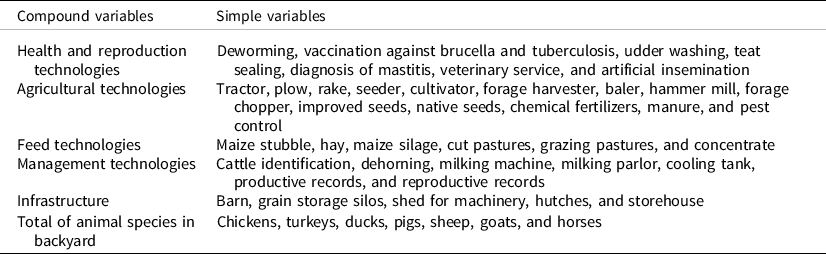
From the total sample (n = 212), the female-headed (n = 28) and male-headed (n = 184) farms were separated. The female-headed farms were considered as an independent group, whereas the male-headed farms were grouped according to multivariate statistics to identify groups with similar characteristics of female-headed farms. First, the database (n = 212) was organized as recommended by Broman and Woo (Reference Broman and Woo2018). Second, study cases with lost or atypical data were identified through box plots (Martínez-García et al., Reference Martínez-García, Ugoretz, Arriaga-Jordán and Wattiaux2015a), no atypical data were identified. Third, a factor analysis (FA) was carried out (n = 184) using the principal component extraction method with 12 discrete variables (Table 2), which were selected from previous studies (Espinoza-Ortega et al., Reference Espinoza-Ortega, Espinosa-Ayala, Bastida-López, Castañeda-Martínez and Arriaga-Jordán2007; Martínez-García et al., Reference Martínez-García, Ugoretz, Arriaga-Jordán and Wattiaux2015a; Martínez-García et al., Reference Martínez-García, Arriaga-Jordán, Dorward P, Rehman and Rayas-Amor2018) and based on a communality analysis in which variables with a value greater than 0.5 were considered (Field, Reference Field2013). Six of the analyzed variables were compound (Table 1). The Kaiser–Meyer–Olkin (KMO) index was used to test whether the parsimony and interpretability criteria of the principal components were fulfilled, which is indicated by a value of 0.5 or higher. Finally, the Bartlett sphericity test (p < 0.05) was used to test that the variables were non-correlated. To simplify the interpretation of the factors, the Varimax orthogonal rotation method was used (Field, Reference Field2013).
Compound variables used in the factor analysis

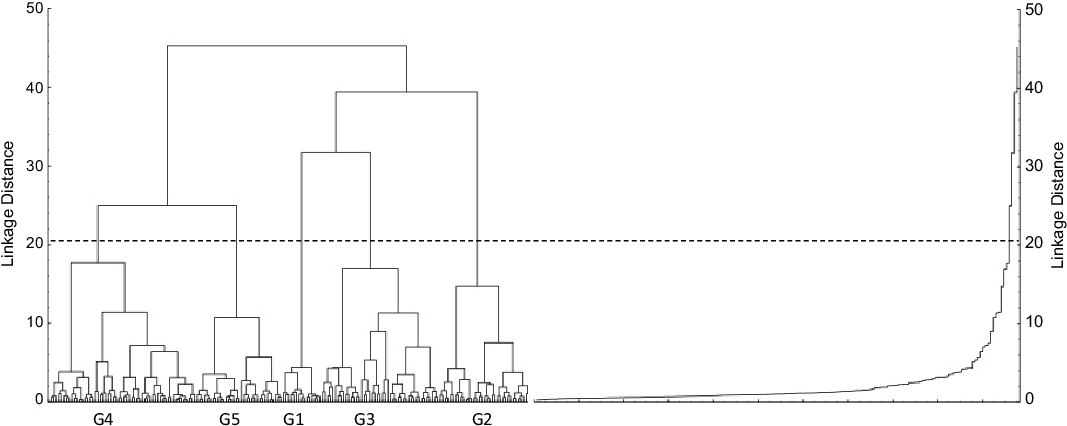
Fourth, the factorial loadings obtained from the principal component analysis were used to carry out a hierarchical cluster analysis (Manly and Navarro, Reference Manly and Navarro2017). The Ward method was used based on Euclidian distance to measure the similarity among farmers and group them (Hair et al., Reference Hair, Black, Babin and Anderson2018). Fifth, to identify the groups of farmers, the dendrogram and graph of linkage distances were used (Figure 1). The selected cut-off point to group the male-headed farms was based on the biggest linkage distances (Kuivanen et al., Reference Kuivanen, Alvarez, Michalscheck, Adjei-Nsiah, Descheemaeker, Mellon-Bedi and Groot2016). Sixth, to identify differences between female-headed group vs male-headed farms groups, a non-parametrical pairwise Kruskal–Wallis test was performed because the analyzed variables had a non-normal distribution (Field, Reference Field2013). The results were presented as the averages and their standard deviations (Van Hulst and Posthumus, Reference Van Hulst and Posthumus2016). Seventh, to identify differences between female-headed group vs male-headed farms groups with respect to the percentage of farmers and farmers’ preference of backyard animal species diversity, a chi-square test was carried out along with the z-test and Bonferroni correction (Field, Reference Field2013).
Dendrogram (left) and graph of linkage distance (right).

Economic analysis of farms
The number of family members, daily gross income (obtained from the selling price per liter of milk, multiplied for the total milk sold per day), and monthly gross income (estimated from price per liter of milk, multiplied for the 30 days of the month) were considered for the economic analysis. The economic variables such as selling price per liter of milk, daily gross income, and monthly gross income were expressed in United States dollars (USD) for the months of August 2018 to February 2019, considering the exchange rate of the central Bank of Mexico (average exchange rate of 19.64 Mexican pesos [MXD] per dollar) (Banco de México, 2019). To identify differences between groups, a pairwise Kruskal–Wallis test was carried out (Field, Reference Field2013). The results are presented as averages and their standard deviations (Van Hulst and Posthumus, Reference Van Hulst and Posthumus2016).
Daily gross income was compared with two official poverty indicators of the National Council for the Evaluation of Social Development Policy (Consejo Nacional de Evaluación de la Política de Desarrollo Social [CONEVAL]): i) indicator of income that corresponds with the minimum salary per person for one day of work in the central region of Mexico ($5.23 USD), and ii) Line of extreme poverty by income that corresponds with the cost of the basic food basket per person per month in rural areas ($56.9 USD) (CONEVAL, 2019). Fifty-two percent and 70% of the income were considered as production costs for feeding the herd (Martínez-García et al., Reference Martínez-García, Rayas-Amor, Anaya-Ortega, Martínez-Castañeda, Espinoza-Ortega, Prospero-Bernal and Arriaga-Jordán2015b) and were subtracted to identify whether the gross daily income covered the cost of the basic food basket.
Results
Factor analysis
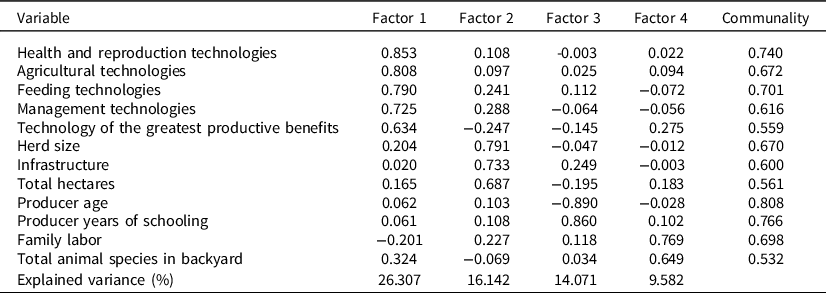
The FA identified four factors (Table 2) that explained 66.10% of the accumulated variance, with a KMO coefficient of 0.750. The Bartlett value was significant (p < 0.001), confirming the reliability of the analysis.
Factor 1 (technological level) indicated a positive relationship between the variables that describe the level of technology used on the farm. Factor 2 (characteristics of the farm) described a positive relationship between the characteristics of herd size, infrastructure, and total hectares, that is, the larger the herd size and the more the infrastructure, the higher availability of hectares on the farm. Factor 3 (framer’s characteristics) indicated a negative relationship between farmers’ age and years of schooling, that is, the younger the farmers, the more years of schooling. Factor 4 (backyard animal species diversity) indicated a direct relationship between family labor and total number of species in the backyard; therefore, the greater the participation of family labor, the greater the diversity of backyard animals on the farm.
Association of variables resulting from the factor analysis

Extraction method: Principal component analysis. Rotation method: Varimax with KMO normalization.
Cluster analysis
The conglomerate analysis identified five groups of male-headed farms (Figure 1).
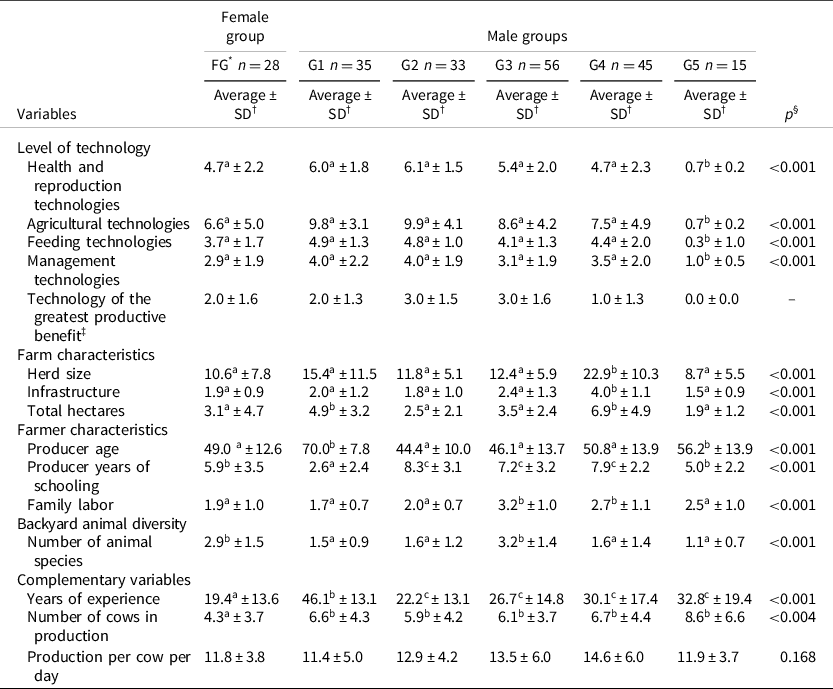
The general characteristics of the female-headed group (FG) and male-headed groups are shown in Table 3. Significant differences are observed among groups (p < 0.05). The level of technology employed by the FG was similar (p > 0.05) to the groups 1, 2, 3, and 4, while group 5 showed the lowest level of technological adoption. Groups 2 and 3 indicated that health and reproduction technologies were the most beneficial and group 4 stated management technologies. The FG and group 1 stated that the technological advances that provide the greatest benefits to their farms are feeding technologies. However, in Table 3, a generally low adoption of agricultural and management technologies is ultimately observed among the six studied groups.
General characteristics of small-scale dairy production units in central Mexico

* FG = Female group.
† SD = Standard deviation.
‡ 1 = management technologies, 2=feeding technologies, 3=health and reproduction technologies, 4=agricultural technologies.
§ p values of the Kruskal–Wallis test (p < 0.05). Different superscripts (a, b, and c) indicate significant differences between groups according to pairwise comparison tests (p < 0.05).
The variables describing farm characteristics differed significantly between groups (p < 0.05; Table 3). Although the FG presented a herd size and infrastructure similar to groups 1, 2, 3, and 5 and a total number of hectares similar to groups 2, 3, and 5, group 4 was significantly different (p < 0.05) with respect to the other groups: It had the largest herd size and more infrastructure but had a similar number of available hectares as group 1.
The variables describing farmer characteristics also showed significant differences (p < 0.05; Table 3). The FG had a similar age as groups 2, 3, and 4, whereas the farmers of groups 1 and 5 were older. The FG had a primary education level (similar to group 5), yet the farmers of group 1 had achieved the fewest years of schooling despite having 46 years of work experience. Meanwhile, the farmers of groups 2, 3, and 4 had a secondary education level. The availability of family labor was highest in groups 3 and 4. In the case of backyard animal species diversity, the FG had the second highest level of diversity (similar to group 3) but had the least experience in dairy production and lowest number of cows in production. Notably, with respect to milk production per cow per day, the groups did not present significant differences (p > 0.05).
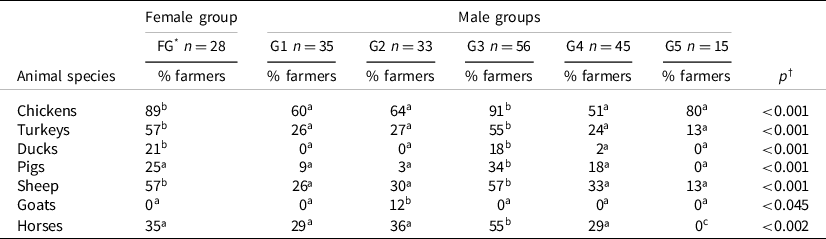
Significant differences (p < 0.05) were found among groups with respect to the diversity of species in backyard, as shown in Table 4. In the six groups, the majority of farmers have chickens; however, ducks and goats were the less accepted. The FG and group 3 had the highest percentage of farmers with chickens, turkeys, and sheep. Meanwhile, group 3 registered the highest percentage of pigs and horses. Finally, group 5 had the less diversity array of species in their backyard.
Percentage of farmers and diversity of animal species in backyards per group

* FG = female group.
† p value of the chi-squared test (p < 0.05). Different superscripts (a, b, and c) indicate significant differences among groups according to the z-test with Bonferroni adjustment (p < 0.05).
Economic analysis
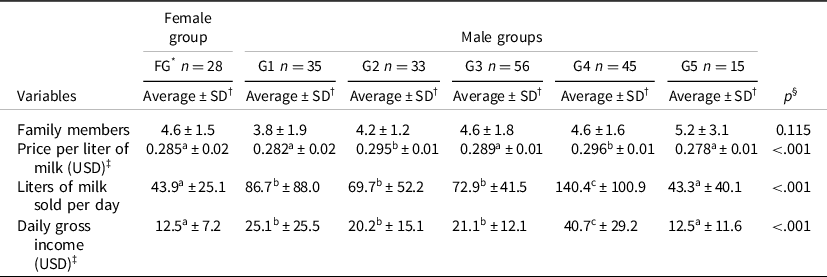
Table 5 describes the variables considered in the economic analysis of the female-headed and male-headed groups. The groups did not present differences (p > 0.05) with respect to the number of members in the family. The best price per liter was obtained by groups 2 and 4. Group 4 presented the highest sale of liters of milk per day and the highest gross income per day. Groups 1, 2, and 3 did not show significant differences (p > 0.05); however, the FG and group 5 presented the lowest sale of liters of milk per day and the lowest gross income.
Economic analysis of female- and male-headed farms

* FG = female group.
† SD = standard deviation.
‡ 1USD = 19.64MXN.
§ p value of the Kruskal–Wallis test (p < 0.05). Differences superscripts (a, b, and c) indicate significant differences among groups according to pairwise comparison tests (p < 0.05).
The income of the FG was equivalent to 2 minimum salaries ($375 USD). For its average 4.6 family members, $261.70 USD per month are required to purchase the products of the basic food basket for rural area. Meanwhile, group 1 had an income of 4.8 minimum salaries ($753 USD). For its average 3.8 family members, $216.20 USD per month are required to purchase the basic food basket. Group 2 had a gross income of 3.8 minimum salaries ($606 USD). For its average 4.2 family members, $238.9 USD per month are required to purchase the basic food basket. Group 3 had an income equal to 4 minimum salaries ($633 USD) and group 4 to 7.8 minimum salaries ($1,221 USD). Both groups have an average of 4.6 family members, requiring $261.7 USD per month to purchase the basic food basket. Finally, group 5 had a monthly income of 2.4 minimum salaries ($375 USD). Notably, group 5 has the largest family size (5.2 members) and is characterized by only relying on family labor. For this group, $295.8 USD per month are required to purchase the basic food basket.
Discussion
Characterization of farms
Agricultural and livestock production systems have generally struggled to accomplish two main goals: improve productive performance and reduce costs (Micheels and Nolan, Reference Micheels and Nolan2016). In central Mexico, these struggles are highly visible. However, addressing them is a challenge mostly because farms dedicated to small-scale dairy production are heterogeneous (Espinoza-Ortega et al., Reference Espinoza-Ortega, Espinosa-Ayala, Bastida-López, Castañeda-Martínez and Arriaga-Jordán2007; Martinez-García et al., Reference Palella Stracuzzi and Martins Pestana2012), as confirmed by the characterization of farms in the present study, which showed differences among farms with respect to level of technology, farm characteristics, farmer characteristics, and diversity of animal species.
The FG adopted technology at a rate like that of groups 1, 2, 3, and 4 and had also similar number of hectares of groups 2, 3, and 5; this suggest that FG does not have constraints in terms of technology access and availability of land; however, Ransom and Bain (Reference Ransom and Bain2011) pointed out that women typically have less access to key agricultural resources such as land, labor, technology, livestock, education, and training. Moreover, in developing countries, most women who are engaged in agriculture have limited access to agricultural assets, including large livestock, land, labor, market, and credit (Bain et al., Reference Bain, Ransom and Halimatusa’diyah2018).
It is important to note that, in the study zone, women often assume leadership temporarily, for example, in cases where their husbands have salaried work, have migrated, suffer from chronic or degenerative diseases, or have experienced accidents. In these cases, decision making with respect to productive activities is still made by women’s husbands, and women are only limited to implementing these decisions (Ruiz-Torres et al., Reference Ruiz-Torres, Arriaga-Jordán, Herrera-Tapia, Martínez-Castañeda and Cavallotti-Vázquez2013). Although the role of female in farm activities for groups 1–5 was not shown in this study, Espinoza-Ortega et al. (Reference Espinoza-Ortega, Espinosa-Ayala, Bastida-López, Castañeda-Martínez and Arriaga-Jordán2007) and Martinez-García et al. (Reference Palella Stracuzzi and Martins Pestana2012) indicated that the activities carried out by women in male-headed dairy farms focus on animal feeding, milking cows, and management of poultry and sheep. In addition, women contribute to the agricultural activities such as maize crop cultivation, weeding, harvesting, and corn shelling by hand. Based on this reality, it is suggested that different extension services can be offered to the groups. A greater participation of women in training courses is recommended to enable them to become the carriers and spreaders of knowledge regarding productive activities, which would hopefully create a synergic effect that would eventually lead to the greater adoption of technologies.
The farmers’ perceptions of the most beneficial technologies could be considered in extension services, which could then promote and spread the use of these technologies. For example, the FG and group 1 indicated that feed technologies provided the most benefits. Previously, Prospero-Bernal et al. (Reference Prospero-Bernal, Martínez-García, Olea-Pérez, López-González and Arriaga-Jordán2017) suggested the incorporation of intensive grazing and maize silage in cattle diets because these were found to improve the economic sustainability of small-scale dairy production farms. However, such techniques have been adopted at a low rate because they require substantial initial investment and, importantly, producers do not have the necessary knowledge for handling the required machinery or producers may simply have small herds (Martínez-García et al., Reference Martínez-García, Rayas-Amor, Anaya-Ortega, Martínez-Castañeda, Espinoza-Ortega, Prospero-Bernal and Arriaga-Jordán2015b). Therefore, it is suggested that extension policies are developed to aid producers in obtaining credits, subsidies, or the technical support required to adopt feed technologies.
The farmers of groups 2 and 3 indicated that the technologies of the greatest benefit for their farm were health and reproduction technologies. In small-scale dairy production farms, the price received per liter of milk is generally not based on quality. However, the use of health technologies such as washing udders, sealing teats, and promptly diagnosing mastitis would allow for better quality control of milk and could potentially lead to a better price per liter, as was observed for groups 2 and 4. An increase in income of farms from milk sales at better prices would allow greater profitability. It is recommended that extension services promote and train producers in the use of health technologies to create a milk production culture oriented toward quality. Kebebe (Reference Kebebe2019) evidenced that increasing the productivity and profitability of farms requires the use of technological inputs, including good milking practices, livestock improvement, nutritional improvements, and veterinary attention.
The farmers of group 4 presented a greater rate of technological adoption, which can be attributed to the larger size of their farms. Makate et al. (Reference Makate, Makate and Mango2018) indicated that farm size and availability of labor are closely related to the use of technologies. Similarly, Martínez-García et al. (Reference Martínez-García, Dorward and Rehman2012) stated that the economic stratum of farms plays an important role in the adoption of technologies: Farms from a high economic stratum use up to 13 different technologies, whereas those from a middle and low stratum use five or fewer technologies. In addition, the producers of group 4 indicated that they obtain benefits from management technologies. In this context, useful policies might include access to credits and subsidies, which would enable producers at this level to acquire further technologies, such as a milking machine, to adapt a space for a milking parlor, and to acquire a cooling tank. These measures require follow-up and support from veterinary services to identify cows and implement productive and reproductive records.
On the other hand, the farmers of group 5 had the lowest rate of technological adoption. This was reflected in farmers’ perceptions that technologies do not provide benefits to the farm. This can be associated that these farmers’ had the smaller herd size, lower availability of hectares, poorer production infrastructure, higher age of producers (55 years), and fewer years of schooling (primary school). Donkor et al. (Reference Donkor, Onakuse, Bogue and de los Rios2019) found that education, experience, farm characteristics, subsidies, and access to credits play an important role in the adoption of technologies. Despite the low adoption of technologies in this group, the producers presented a similar milk production per day per cow as the other groups. This suggests that these producers make an efficient use of the technologies or production techniques used on their farms. However, extension services should aim to integrate older producers or the new generation of producers so that they are able to insert themselves within newly emerging production dynamics and adopt new technologies that are appropriate for and compatible with the characteristics of their farms.
Economic analysis of farms
Martínez-García et al. (Reference Martínez-García, Rayas-Amor, Anaya-Ortega, Martínez-Castañeda, Espinoza-Ortega, Prospero-Bernal and Arriaga-Jordán2015b) previously found that production costs in the study area were equivalent to 52–70% of total farm income. Largely, the production cost depends on the management and feed strategies used by producers to feed their livestock. If 52% of income is considered as production costs, groups 1, 2, 3, and 4 generated sufficient income to purchase the basic food basket; however, the FG and group 5 did not. On the other hand, considering 70% of income as production costs, only the farms of groups 1 and 4 generated sufficient income to purchase the basic food basket.
Espinoza-Ortega et al. (Reference Espinoza-Ortega, Espinosa-Ayala, Bastida-López, Castañeda-Martínez and Arriaga-Jordán2007) proposed that small-scale dairy production in the study area was a profitable and attractive activity because it represented a regular, secure income for families. Little more than a decade later, the results of the present study show that small-scale milk production continues to generate sufficient daily income in rural areas, allowing families to maintain themselves and purchase the basic food basket. However, this is only possible under certain conditions or, specifically, for farmers with a herd size of 15 and 23 cows, an average production of 11.4 and 14.6 liters per cow per day, a minimum of 5 and 7 hectares destined to production, a sales of 86 and 140 liters of milk per day generating a net income of $25 and $47 USD per day, and families with no more than 4 members, as was observed for groups 1 and 4.
Padda and Hameed (Reference Padda and Hameed2018) found that female-headed households in Pakistan are less poor than those headed by men because the government has developed social welfare programs focused on women. In the present study, the opposite was observed: Under the two evaluated production cost scenarios (52 and 70%), the FG farms did not generate the necessary income to purchase the basic food basket. This could be attributed to the fact that the development programs promoted in central Mexico have not contemplated that female leadership is often temporary (Ruiz-Torres et al., Reference Ruiz-Torres, Arriaga-Jordán, Herrera-Tapia, Martínez-Castañeda and Cavallotti-Vázquez2013). Likewise, existing norms and gender roles limit women regarding the complete control of productive assets (property titles, productive herds, and machinery) and directly influence decision making about income (Larson et al., Reference Larson, Castellanos and Jensen2019), which significantly suppresses women’s empowerment (Han et al., Reference Han, Zhang and Zhang2019). To enhance women’s empowerment, agricultural development agencies are focused on efforts to increase women’s incomes, often through access to assets, such as livestock (Ransom and Bain, Reference Ransom and Bain2011).
It has been reported that the main income of the most small-scale dairy farmers (80%) comes from milk yield (Martínez-García et al., Reference Martínez-García, Dorward and Rehman2012) and 1 or 2 liters is destined for self-consumption. Studies such as Guzmán-González et al. (Reference Guzmán-González, Santiago-Cruz, Leos-Rodríguez, González-López, Martínez-Damian and Salas-González2005), Jarquín Sánchez et al. (Reference Jarquín-Sánchez, Castellanos-Suárez and Sangerman-Jarquín2017), and Di Pillo et al. (Reference Di Pillo, Anríquez, Alarcón, Jímenez-Bluhm, Nieto, Schultz-Cherry and Hamilton-West2019) indicated that families in rural zones compensate for the low profitability of productive systems through the diversification of activities, including salaried, non-agricultural jobs, and the rearing of animals in the backyard. Both strategies are used by the FG and groups 2, 3, and 5 to supplement income for purchasing the food basket. In addition, the main economic activity in the FG was the milk sales although they have other income like cheese sales, poultry, and cattle sales. Martin and Lorenzen (Reference Martin and Lorenzen2016) described the diversification of activities as a survival strategy that is characteristic of rural families in numerous countries. This strategy allows producers to deal with the inherent risks of agriculture associated with natural or economic disasters. Finally, according to Jarquín Sánchez et al. (Reference Jarquín-Sánchez, Castellanos-Suárez and Sangerman-Jarquín2017), the diversification of activities in communities should be viewed as a developmental strategy that favors women, who often clearly suffer discrimination in the labor market in terms of salaries and labor conditions (FAO, 2013).
As mentioned, the backyard is one strategy for supplementing the basic food basket. Backyard may be characterized as an asset storage strategy or as a living pantry that provides vegetables, fruits, and animal protein such as meat and eggs (Ruiz-Torres et al., Reference Ruiz-Torres, Moctezuma-Pérez, Arriaga-Jordán and Martínez-Castañeda2017). The animal diversity present in farms is related to families’ perceptions of the utility of animals and the number of animals that families can feed. Backyard has four main functions: self-consumption, complement to agricultural activities, variable income buffer, and insurance against unpredictable financial demands (Dorward et al., Reference Dorward, Anderson, Nava, Sánchez, Rushton, Pattison and Paz2009). In the present study, the strategy of backyard was used by all producers, especially the FG and group 3. The species with the greatest importance were poultry (chickens and turkeys). In this regard, Di Pillo et al. (Reference Di Pillo, Anríquez, Alarcón, Jímenez-Bluhm, Nieto, Schultz-Cherry and Hamilton-West2019) previously stated that poultry raised in backyard is a good way of improving the food security of families in rural areas and alleviating poverty in addition to contributing toward female empowerment.
Finally, in the present study, it is important to note that in all groups (female- and male-headed groups), women were in charge of administrating and taking care of the backyard, confirming the contribution of these backyards toward female empowerment. According to Holland and Rammohan (Reference Holland and Rammohan2019), women’s empowerment translates to better nutritional results and is positively associated with the food diversity of households as well as a lower probability of delayed growth in children. It is recommended that developmental policies be designed to encourage backyards not only as a strategy for supplementing the basic food basket but also as an element of female empowerment that can contribute to food security in rural areas.
Conclusions
Small-scale dairy production systems with a gross daily income between $25 and $47 USD per day with families of 4 or fewer members are able to purchase the basic food basket, as was the case for producers in groups 1 and 4. Therefore, under certain conditions, these systems serve to counteract poverty in rural areas. However, on the other hand, the gross income generated by farms headed by women (FG) and groups 2, 3, and 5 was not sufficient for the purchase of the daily food basket and for alleviating poverty. Despite this finding, milk production along with the diversification of activities in backyard allows rural families to maintain their livelihoods. For these latter groups, the promotion of feed, health, reproduction, and management technologies is recommended with the aim of improving the economic viability of the farms. Finally, it should be taken into consideration that the FG requires special attention because decision making does not depend on the women heading these farms but rather on their husbands.
Limitations and suggestions for future research studies
The main limitation of the present study is the lack of more detailed economic data for the economic analysis. Originally, the use of a partial budget methodology was proposed. However, due to the insecurity affecting Mexico, producers are unwilling to provide detailed information about economic topics (e.g., specific production costs, net income, presence of productive assets), for which it is suggested that future research studies reconsider this methodology and combine it with qualitative strategies in the field to obtain the data necessary for more in-depth analyses.
Acknowledgements
The authors thank all farmers who participated in the study for their hospitality and full support.
Financial support
The work was conducted thanks to founding by Consejo Nacional de Ciencia y Tecnología-CONACYT (grant: PN-2016-1-2323) and the postdoctoral grant for the first author. The authors also express gratitude to the Universidad Autónoma del Estado de México for supporting in the realization of the research.
Conflicts of interest
The authors declare no conflicts of interest.