





Introduction
In the modern world, which is increasingly characterised by globalisation, secularisation, and cultural pluralism, there is growing scientific interest in the role of religion in political processes, particularly in the development of national ideologies. Of particular relevance is a comparative study of countries in East and Southeast Asia, where religion has not only retained its significance but has also become a valuable instrument of political legitimisation, social integration, and the formation of civic consciousness. The examples of Japan and Singapore demonstrate how, in the context of modernisation, ethno-religious diversity, and geopolitical challenges, the religious factor has not lost its relevance but has been transformed according to political and socio-cultural conditions. Japan and Singapore are good examples of how religious traditions — Shintoism, Confucianism, Buddhism, Islam, Christianity — interact with state policy. Despite its official secularism, Japan still uses a sacred model of statehood rooted in the Shinto tradition, whereas in Singapore, a multi-ethnic and multi-religious society, a model of institutional regulation of religious life has been developed to maintain social stability. A comparative analysis of the role of religion in both countries is therefore essential for a deeper understanding of contemporary mechanisms of political legitimisation and national identity in post-traditional societies. More broadly, analysing the interaction between religion and the state allows for a better understanding of the mechanisms of social consolidation and political regulation in multiethnic and semi-peripheral societies.
In this study, religious ethos is understood as a system of values, norms, and symbolic meanings derived from religious traditions that shape political discourse, collective identity, and the moral foundations of governance. In the contexts of Japan and Singapore, it functions not only as a cultural element but also as a mechanism of political legitimisation and social integration.
In scientific literature, the issue of the interaction between religion and politics has been explored from various angles. Cavalcanti Junqueira et al. (Reference Cavalcanti Junqueira, Cruz and Gratton2023) focused on the influence of the religious environment on decision-making in the field of entrepreneurship, demonstrating how religious ethics permeates even economic decisions. The researchers showed that religious logic did not contradict rationality but, on the contrary, shaped it through the lens of moral duty and social responsibility. This emphasised the value of the religious context in socio-political processes. Milerski and Zieliński (Reference Milerski and Zieliński2023) revealed a conflict between the secular nature of education and the dominance of Catholic religious education in Poland. The researchers highlighted the tension between the ideological neutrality of the state and the cultural hegemony of the religious majority. This study emphasised how religion can become a political instrument of identity even in formally secular states. Anesaki (Reference Anesaki2024) examined the unique model of Japanese religious syncretism as the foundation of national identity. The researcher revealed the harmonious combination of Shintoism, Buddhism, and Confucianism in Japanese civilisation through the metaphor of a tree, where Shintoism represented the roots, Confucianism — the trunk of social institutions, while Buddhism — the branches of spiritual life. This model allowed developing an ideologically stable and flexible system of interaction between religion and the state.
Yerekesheva (Reference Yerekesheva2020) explored the role of religion in nation-building processes, analysing its integration through cultural values, institutional mechanisms, and interaction with the state. Sharipova (Reference Sharipova2020) analysed Kazakhstan’s national identity from the bottom up, revealing its hybrid nature — a combination of Soviet heritage, ethno-cultural revival, and weak integration of linguistic and religious factors into the modern civic project. Buribayev et al. (Reference Buribayev, Turlykhankyzy, Kalkayeva, Shakenov and Khamzina2024) analysed Kazakhstan’s state policy in the religious sphere, focusing on its goals, mechanisms, and impact on social stability. The researchers offered recommendations for improving legislation, protecting freedoms, and strengthening interfaith dialogue, which may be useful for other countries facing analogous challenges.
Yew et al. (Reference Yew, Awang, Selvadurai, Noor and Chang2021) provided a comparative analysis of Islam and Buddhism in the context of multicultural Malaysia. The researchers highlighted the shared moral foundations of the two religions, which contributed to understanding between the faiths. An analysis of these religions as ethical systems demonstrated the potential of religion to stabilise a multicultural society. Phua (Reference Phua2022) analysed the adaptation of the Shinnyo-en Buddhist group to the political and social context of Singapore. The researcher showed how the religious organisation transformed its practices while preserving its spiritual authenticity but adapting to state requirements. This demonstrated the flexibility of religious forms in the context of authoritarian regulation of the religious sphere. Chao (Reference Chao2021) compared approaches to the protection of religious feelings in Southeast Asia. The researcher identified a gap between legal norms and their application, which was conditioned by the prevalence of the idea of harmony over the liberal concept of freedom of speech. This highlighted the specificity of the religious-political culture in the Asian region. Devi (Reference Devi2025) overviewed the religious landscape of Southeast Asia, describing the historical and cultural paths of the four major religions of the region. The researcher highlighted contemporary trends, particularly the social activism of Buddhist communities, which demonstrated the growing public role of religion. Finally, Zhang (Reference Zhang2021) covered the political function of Confucianism in the Chinese tradition. Drawing on Marxist cultural criticism, the researcher analysed the internal contradictions of Confucian thought and its influence on the legitimisation of the political hierarchy. This study offered a deeper understanding of how philosophical traditions shape political culture.
Despite the breadth of existing research, the role of religion in the development of national ideologies in the comparative context of Japan and Singapore remains insufficiently explored. Much of the existing work focuses either on religious ethics and its influence on social practices or on individual religious movements and denominations, without a comprehensive analysis of their functioning within political discourse. In addition, the ways in which religion adapts to the challenges of modernisation and globalisation across different socio-cultural contexts remain underexamined. In particular, the role of religious ethos as a structuring element of political discourse has not been sufficiently conceptualised in comparative studies. This gap is addressed through an analysis of how religious traditions are embedded in state narratives and governance practices in Japan and Singapore.
The study aims to examine the mechanisms through which religious ethos shapes political discourse in Japan and Singapore and to clarify its role in broader socio-political processes. The objectives are to analyse the historical preconditions of religious-political models in these countries, to explore the role of major religious traditions in shaping national identity, and to compare state approaches to regulating the religious sphere and their implications for social stability.
Materials and Methods
The study of religious and ideological systems in Japan and Singapore was conducted at the intersection of cultural, political, and religious studies to identify the logic of the functioning of religions in political discourse and the shaping of national identity. Both countries are examples of the successful combination of religious ethos and technocratic development, which makes them suitable cases for analysing the interaction between religion and politics. The methodological framework of the study was based on an interdisciplinary principle that allowed the integration of elements of social, political, historical, and symbolic analysis. The study employed conceptual constructs that combined institutional, semiotic, and discursive levels of interpretation of religion as a social phenomenon that performed ideological, legitimising, and integrative functions. Particular attention was paid to the civilisational approach, which allows religion to be viewed not as an isolated system of beliefs, but as an element of a broader cultural paradigm embedded in political and historical structures.
A comparative reconstruction of two national models — Japanese and Singaporean — was aimed at identifying the mechanisms of religion’s functionalisation in the development of a legitimate political order. The analytical modelling strategy helped to describe empirical manifestations and to conceptualise typical features and structures inherent in religious-political interactions in these countries. Religion was examined as a factor providing symbolic and regulatory support for state power.
To explore religion as an element of political culture, the study applied qualitative content analysis of historically documented religious practices, state narratives, and legal and ideological frameworks related to religion and national identity. The empirical basis of the study included legislative documents (Constitution of Japan 1947; Constitution of the Republic of Singapore 1965; Maintenance of Religious Harmony Act 1990/2019), as well as official policy statements, educational materials, and publicly available political speeches and media content related to religion and national identity. The analysis focused on the identification of recurring themes, symbolic representations, and discursive patterns related to religion in political narratives. Comparative analysis was used to identify similarities and differences between the two national models.
For example, in the case of Japan, the study focused on state-related rituals (such as imperial ceremonies) and historical policy documents to identify patterns of sacralisation of political authority. In Singapore, the analysis examined legislative frameworks, educational policies, and official discourse to assess how religious diversity is managed through institutional regulation. The concepts of institutional pluralism and state regulation were operationalised through the analysis of legal provisions, policy instruments, and their role in structuring religion-state relations, including mechanisms of institutionalisation in educational policy, legislation, political rhetoric, and the activities of state structures.
To systematise the data, techniques of chronological analysis, tabular modelling, and conceptual mapping were employed, which helped to structure the stages of development of religious-political interaction and trace the transformation of the role of religion in the relevant contexts. A comparative-typological approach ensured effective comparison of models according to a series of parameters, including the degree of centralisation of religion, forms of its use in political discourse, models of religious tolerance, and mechanisms for managing religious diversity. The historical-genetic approach helped to retrospectively trace the key milestones in the development of religious-political models, starting from the colonial and imperial periods to the current stage of globalisation. The analysis covered the period from the late 19th century (Meiji Restoration in Japan) to the early 21st century, including key stages such as the imperial period, post-World War II transformations, and contemporary globalisation processes. In the case of Singapore, particular attention was paid to the post-colonial period from independence in 1965 to the present.
The regulatory framework was analysed with a focus on the legal provisions governing religion-state relations, particularly in terms of religious freedom, state intervention, and mechanisms for maintaining interfaith harmony. These legal norms were examined in conjunction with political practice to identify not only formal regulations but also their implementation in the political process.
Results
Religion and national ideology in Japan: Interconnection and influence on society
The concept of religious ethos is interdisciplinary in nature and encompasses the fields of religious studies, sociology, cultural studies, and political philosophy. It was first systematically analysed in the works of Max Weber, particularly in the context of Protestant ethics and its influence on the formation of the capitalist spirit (Vermeer Reference Vermeer2022). In a broad sense, religious ethos is a set of norms, values, beliefs, and behavior patterns based on religious beliefs that determine the worldview and moral guidelines of a particular community (Rashid Reference Rashid2023). It includes both ritual and normative components, forming deeply rooted cultural codes that influence institutional mechanisms, social practices, and political ideas. Religious ethos is not limited to the beliefs of individuals or ritual traditions. It can penetrate the sphere of collective identity, legitimisation of power, and perceptions of social order. In this context, it becomes the basis for the development of political culture, types of loyalty to the state, models of citizenship, and perceptions of the moral foundations of politics.
The concept of political discourse encompasses a system of linguistic, symbolic, and communicative practices that shape and reproduce meaning in the political sphere (Horbenko Reference Horbenko2023). In Foucauldian terms, discourse is not merely speech, but also the practice of power that constructs objects and subjects of knowledge (Khan and MacEachen Reference Khan and MacEachen2021). Political discourse determines how society understands power, hierarchy, law, and national identity, including how religion is embedded in the political sphere. In this sense, religious ethos can be one of the key sources of political discourse, while political discourse itself can be a means of selectively interpreting religious symbols and meanings in a political context.
The question of the interaction between religion and politics is at the centre of a series of theoretical paradigms that interpret this dynamic differently. These include secularisation theory, civil religion theory, functionalism, and post-secular approaches. Classical secularisation theory assumes the gradual displacement of religion from public life through modernisation (Ogar et al. Reference Ogar, Onah, Objantoro and Ikhwan2023). Proponents of this theory believed that with the development of science, education, and rationality, religion would lose its social significance and influence on politics. However, since the second half of the 20th century, it has become clear that secularisation is not a universal and irreversible process. On the contrary, religion adapts to modern conditions, transforms, and re-emerges in the form of new religious movements, ethnic identity, traditionalist and nationalist narratives. In contrast, the theory of civil religion developed by Robert Bellah offers a different approach to understanding the role of religion in politics (Armayanto and Salim Reference Armayanto and Salim2023). According to this concept, a symbolic system of beliefs and rituals can exist in modern society that performs a religious function without being a religion in the classical sense. Civil religion integrates society around shared values, symbols (flags, national heroes, historical myths), and rituals (national holidays, public ceremonies), forming a collective understanding of the nation, power, and moral order. In this context, religion performs not so much a theological as a socio-cultural and political function, becoming the basis for the development of a legitimate national discourse.
The functionalist approach views religion as an essential social institution that performs the functions of integration, legitimisation of norms, and regulation of behavior (Baykal Reference Baykal2021). In the political dimension, religion contributes to the development of the legitimacy of power, the stability of the social order, and the maintenance of national unity. This is particularly evident in societies where religion is deeply integrated into historical memory and cultural heritage. Post-secular approaches emphasise that in a globalised world where multiple identities, confessions, and cultures are the norm, religion is regaining political significance (Gillin Reference Gillin2023). It becomes an arena for the struggle for authenticity, tradition, and moral purity, especially in post-colonial or transitional societies. In such contexts, religion is often not an archaic remnant, but a resource for modern nation-building, symbolic mobilisation, or cultural resistance.
Religion is a powerful factor in the shaping of national identity, as it provides society with a system of symbols, myths, moral norms, and values that unite people into a collective imagined community. In Benedict Anderson’s concepts, a nation is understood as something that is “imagined” through cultural practices and symbolic constructions, among which religion plays a prominent role (Bjelić Reference Bjelić2021). In many cultures, religion is a source of narratives that serve as the basis for historical memory, ideas about the nation’s origins, its mission, moral superiority, or divine election. It is these narratives that are actively used by states when constructing national ideology. Ideology is a system of beliefs that substantiates political legitimacy and defines national goals (Federico and Malka Reference Federico, Malka, Huddy, Sears, Levy and Jerit2021). The religious legitimisation of ideology can be direct (through sacred texts, institutions of the clergy) or indirect — through moral ideas, metaphysical foundations of the social order, and the sacralisation of history (Hammond Reference Hammond2022).
In the Japanese socio-cultural context, religion plays a role that is not so much orthodox and dogmatic as deeply integrated into the cultural, moral, and political structure. Its functions are not limited to the sphere of private faith — on the contrary, religion in Japan has been a crucial factor in the construction of collective identity, social harmony, symbolic legitimisation of power, and the development of national ideology. A distinctive feature of Japanese religiosity is its syncretism. Shintoism, Buddhism, Confucianism and, to a certain extent, Taoism have formed a complex system of intertwined traditions that did not compete directly with each other but often performed complementary functions. This religious pluralism contributed not only to a tolerant attitude towards different forms of belief, but also to the flexible use of religious symbols in political practice. When forming Japanese national ideology, religion served as a means of symbolic integration of society around the figure of the emperor, sacralisation of the state system, and mobilisation of citizens to fulfil their patriotic duties. In this context, Shintoism played a key role, which, despite its internal fragmentation, became an instrument of state policy and the embodiment of the unique Japanese path, both cultural and political.
Shintoism is a native religion of Japan, which has no founder, canonical texts, or a single dogmatic system, but is rooted in a culture of worship of nature, ancestors, and deities (kami), which embody both cosmic and local forces (Hartmann-Kottek Reference Hartmann-Kottek and Hartmann-Kottek2022). The Shinto faith developed as a set of ritual practices intricately linked to public life, family structure, and relations with the authorities. One of the crucial aspects of Shinto is the cult of the emperor as the divine descendant of the sun goddess Amaterasu. It was this belief that became the basis for the later sacralisation of imperial power in the national ideology. Buddhism arrived in Japan in the 6th century from China and Korea and gradually became one of the central religious forces in Japanese society (Fitzgerald Reference Fitzgerald2022). Unlike Shintoism, Buddhism had a systematic philosophical basis, ethical teachings, and a well-developed institutional structure. The Mahayana schools, specifically Zen Buddhism, which emphasised self-discipline, meditation, and inner transformation, became particularly significant. In the Middle Ages, Zen Buddhism was actively supported by the military aristocracy, with its aesthetic and ethical ideals becoming part of the samurai code (bushido).
At the same time, Japan’s religious system was not based on a rigid opposition between Shintoism and Buddhism. There was a phenomenon called shinbutsu-shugo, a syncretism of Shinto and Buddhist beliefs, where temples combined the cult of kami and Buddhas, and believers could take part in the rituals of both traditions (Park Reference Park2021). This flexible religious landscape contributed to cultural enrichment and strengthened the symbolic resource of religion as a factor in the formation of national consciousness. However, with the beginning of the Meiji period (1868), the Shinto Hanreitsu campaign began — the separation of Shinto from Buddhism, which aimed to create an ideologically pure, autochthonous, and politically controlled religious system. The modernisation period was marked by Japan’s active attempt to transform itself into a modern nation-state modelled on Western countries without losing its cultural identity. In this process, religion played not only a symbolic but also a directly political role. It was during this period that Shinto was institutionalised as the state religion. Central religious institutions were established, and religious ethics became the basis of state moral education. Imperial power was declared sacred, and the emperor himself was given the status of a living deity (ara-hitogami), which was substantiated by his hereditary connection with the goddess Amaterasu. State Shintoism was not only a religion in the narrow sense, but also a tool for shaping civic loyalty, patriotism, and social mobilisation. The school system taught moral principles based on respect for the emperor, ancestors, the community, and labor. These values were prescribed in the Imperial Rescript on Education of 1890, which became an ideological document combining religious and moral-political principles into a single whole (Anzai Reference Anzai2024).
In the 20th century, especially during the militarisation of Japan, state Shintoism became the basis of a nationalist ideology that justified expansionist policies and the cult of self-sacrifice for the empire. Religious symbols, rituals, and practices were integrated into the military system, as exemplified by the cult of fallen soldiers at the Yasukuni Shrine (Kozarsky Reference Kozarsky2021). In this way, religious legitimation took on a political and ideological dimension, becoming an instrument of centralised control over mass consciousness. After Japan’s defeat in World War II, state Shintoism was officially abolished following the directives of the occupation administration. Emperor Hirohito lost his divine status, and religion was separated from the state. However, even in the post-war period, the religious ethos, specifically the ethics of harmony, duty, hard work, and collectivism, continued to be a prominent element of Japanese national identity. State institutions, although officially secular, continued to use religious symbols in public discourse, celebrations, and ceremonies.
Religious factors and national ideology in Singapore
In modern Singapore, religion plays a key role in shaping national ideology, social stability, and political strategy for managing a multicultural society. This Asian metropolis, which combines a prominent level of modernisation, economic openness, and authoritarian democracy, has developed a unique model of interaction between the state and religion based on the principles of institutional pluralism, limited secularism, and political pragmatism. Singapore’s national ideology was shaped by ethnic and religious heterogeneity, which posed a potential threat to the internal unity of the state. In response, the political leadership headed by Lee Kuan Yew built a system of “managed harmony,” where religion is recognised as a valuable component of citizens’ identity but is subject to strict state regulation (Barr Reference Barr and Murfett2023). This approach does not imply secularism in the Western sense (that is, the radical separation of church and state), but rather the integration of religion into the public sphere, subject to interfaith harmony and loyalty to the political regime. In Singapore’s national discourse, religion is often presented as the moral foundation of society, a source of social responsibility, harmony, and work ethic. The government actively supports religious institutions as agents of social education and as partners in the implementation of public initiatives. This process is embodied through numerous channels: educational policy (including teaching about world religions in schools), interfaith forums, national unity programmes, cultural festivals, etc.)
Singapore’s national ideology is largely based on the principles of communitarianism, which are opposed to Western individualism. In this context, religion is not a private matter but an element of public identity with political significance. The state itself recognises several religions that have historical, ethnocultural, and demographic significance, and ensures equal access to the public sphere for each of them, while maintaining control over the content of religious discourse. The political doctrine of “racial and religious harmony,” prescribed in legislation, notably in the Maintenance of Religious Harmony Act (1990), provides a broad state mandate to intervene in the activities of religious organisations in case of a threat to public order or inter-ethnic harmony. The state reserves the right to prohibit the politicisation of religion, control sermons, and activities that may cause social tension.
Singapore is a model of high religious and ethno-cultural diversity, which can be loosely described as a “religious mosaic.” Buddhism is the most widespread religion among the population, followed by Christianity, Islam, and Hinduism. A considerable portion of citizens do not identify with any religious movement. At the same time, religion is closely intertwined with ethnic identity: the Chinese are predominantly Buddhists or Taoists, the Malays are Muslims, and the Indians are Hindus or Sikhs (Koh Reference Koh2023). This makes religion not only an individual belief but also a form of collective, ethno-cultural belonging. In response to this complex religious structure, the state pursues a policy of official multiculturalism, which is based on the premise that it is impossible to create a “monolingual” or “monoreligious” nation in conditions of real social diversity. In Singapore, multiculturalism is not limited to declarative support for diversity but has a clear institutional and ideological implementation.
Firstly, multiculturalism in Singapore is part of education policy. Schools teach the basics of religious studies, interfaith forums are held, and national holidays factor in the religious calendars of all major groups. There are also ethnic quotas in the allocation of public housing, which prevents the development of monoethnic and monoreligious ghettos and promotes everyday interfaith interaction (Yap Reference Yap2024). Secondly, there is an official Inter-Religious Organisation, which promotes dialogue between religious communities, prevents religious conflicts, and creates platforms for joint discussion of social challenges. Religious leaders of diverse faiths regularly take part in state events, issue calls for harmony, and sign joint declarations. Thirdly, the legislative framework imposes strict restrictions on religiously motivated hate speech, the political use of religion, and aggressive proselytism. The Maintenance of Religious Harmony Act (1990) allows the Minister of Home Affairs to issue warnings or bans on activities that the government believes threaten interreligious peace. Although this model is often criticised by Western human rights activists as restricting freedom of speech, it is perceived by the local population as an effective mechanism for containing religious tensions. In the political and ideological sphere, religion in Singapore is used to legitimise values necessary for maintaining national unity: family norms, work ethic, loyalty, and social order. For example, Muslim communities receive state support in the form of religious institutions such as the Islamic Religious Council of Singapore, but at the same time are required to follow state policy in the field of education, control the content of sermons, and coordinate the activities of mosques with government agencies (Zulkifli et al. Reference Zulkifli, Mubarak, Khitam and Helmi2023).
Despite its non-confessional nature, Confucianism stayed a fundamental component of the social and political order in many East Asian countries, particularly China, Korea, and Japan, as well as in modern multicultural states such as Singapore. As a philosophical and ethical system encompassing ethics, political philosophy, pedagogy, rituals and social hierarchy, Confucianism has played a special role in legitimising authority, shaping loyalty to the state and modelling social relations. Unlike religions based on belief in the supernatural (theism, polytheism), Confucianism functions as a normative moral code that defines patterns of behavior not only at the individual level but also in political governance. Its basic principles — ren (humanity), li (ritual, order), xiao (filial piety), zhong (loyalty), and yi (righteousness) form the basis of an ideal political system where harmony between the ruler and the ruled is achieved not through coercion but through moral authority (Guo Reference Guo2024). In a political context, Confucianism offers a model of paternalistic governance, where the ruler is viewed as the “father of the people” and the social hierarchy is considered a natural and necessary condition for stability. This model envisages the concentration of power in the hands of morally perfect individuals who are guided by virtue rather than personal interests. According to Confucianism, ideal governance is based not on laws as formal sanctions, but on the moral self-improvement of the elite, personal behaviour, and social education.
In the case of Japan and Singapore, Confucian ideas were adapted to specific historical and cultural circumstances. In Japan, Confucianism, especially its neo-Confucian form (predominantly during the Edo period), became the ideological foundation of the Tokugawa hierarchical system, which maintained a balance between imperial legitimacy and shogunal rule. In the modern era, these ideas became part of the nationalist discourse, in which duty to the emperor was equivalent to xiao, filial piety. In Singapore, Confucianism was reinterpreted as an instrument of social order in a multicultural environment. In the early 1980s, the government actively promoted the concept of “Asian values,” contrasting them with Western individualism. Confucianism in this context became a resource for the development of a national ethical code aimed at reinforcing discipline, respect for authority, loyalty to the state, and the priority of the collective good. Confucian ethics were introduced into schools, Confucian institutes were established, and campaigns to promote moral norms were conducted. Singapore’s model of governance, although combining elements of a liberal economy with political authoritarianism, is based on the Confucian ideal of a wise ruler who acts in the interests of the people and maintains order, discipline, and social harmony. This model has enabled the creation of an effective administrative system with a strong level of trust in government institutions and low levels of corruption.
Comparative analysis of religious and ideological systems in Japan and Singapore
A comparative analysis of the religious and ideological systems of Japan and Singapore revealed both the specific features of national models of interaction between religion and politics and universal patterns in the use of religious resources to legitimise power and shape collective identity. Despite major cultural, historical, demographic, and religious differences, both countries demonstrate comparable approaches to the instrumentalisation of religion in public discourse. Both Japan and Singapore use religion as a component of the national narrative, a channel of social regulation, and a source of moral and political norms that shape social cohesion. The shared features of the religious and ideological systems of Japan and Singapore are presented in Table 1.
Shared features of religion in legitimising power and shaping national identity

Table 1. Long description
The table consists of three columns: Parameter, Japan, and Singapore.
* Historical source of religious influence: Japan lists Shintoism (state religion since the 19th century), Buddhism, and Confucianism. Singapore lists Islam, Christianity, Buddhism, Hinduism, Taoism, and Confucianism.
* Type of religious system: Japan has single-religion dominance (Shintoism as an ethnic religion). Singapore is a multi-ethnic, multi-religious mosaic.
* Form of legitimisation of power: Japan relies on the divine origin of the emperor and the cult of the state. Singapore uses moral authority and multicultural balance.
* Religion and state ideology: Japan focuses on sacralisation of the nation and rituals of imperial loyalty. Singapore focuses on moral and ethical foundations for interethnic harmony.
* Role of Confucianism: In Japan, it regulates social hierarchy, subordination, and harmony. In Singapore, it is the basis of state ethics and Asian values.
* Religious policy: Japan maintains separation of religion after World War I I but preserves rituals. Singapore uses active regulation, interfaith councils, and restrictions on political use.
* Religion as an element of identity: Shintoism is a symbol of Japanese-ness. In Singapore, religious affiliation is linked to ethnic identity.
* Sphere of influence of religion: Japan includes cultural rituals, imperial traditions, and social morality. Singapore includes public policy, education, regulation, and interethnic integration.
The table shows that both countries, despite substantial differences in religious structure and historical contexts, view religion as a tool for political stabilisation, cultural codification, and strengthening national identity. In Japan, the religious ethos is centred around the Shinto tradition, which serves as a source of sacralisation of imperial power and the development of ethno-cultural unity. The sacredness of the emperor, elevated to the rank of state ideology during the Meiji period, ensured the legitimacy of modernisation processes through continuity with the “divine past.” Singapore operates in a context of religious pluralism, which creates an institutional need not for unification but for managed harmonisation. Here, religion appears as an instrument for shaping social balance: it is supported by the state within the framework of official multiculturalism policy but is subject to close administrative supervision. The authorities actively articulate religious values — through Confucian morality and traditional ethical norms — to shape the desired image of a disciplined and loyal citizen. Confucian ideas are the crossroads that connect both models. In Japan, they were integrated into the Shinto-Buddhist discourse as an ideology of hierarchy and subordination. In Singapore, Confucianism became the normative basis for justifying the disciplinary nature of the state and the priority of collective values over individual rights.
A comparative study of the religious and ideological systems of Japan and Singapore revealed not only common features related to the functionalisation of religion in the public sphere, but also profound structural differences that determine the nature of political governance, cultural identity, and models of social integration. Central to this difference is the opposition between the centralised traditionalism of the Japanese approach and the pluralistic, institutionally organised multiculturalism of the Singaporean model. The Japanese system is characterised by the integration of religion into a formula of national exceptionalism, where Shintoism serves not only as a religion but also as an ethno-cultural paradigm that legitimises the continuity of state identity. Singapore, on the other hand, operates in the context of a post-colonial, multi-religious society where the state does not appropriate any religion but actively regulates their coexistence within a policy of harmony and national interest. These two approaches — monoethnic sacralism and pluralistic pragmatism — have their unique internal logic, which shapes distinct strategies for mobilising religious resources within the political discourse. These differences are illustrated in greater detail in Table 2.
Differences between Japan’s centralised tradition and Singapore’s pluralistic approach
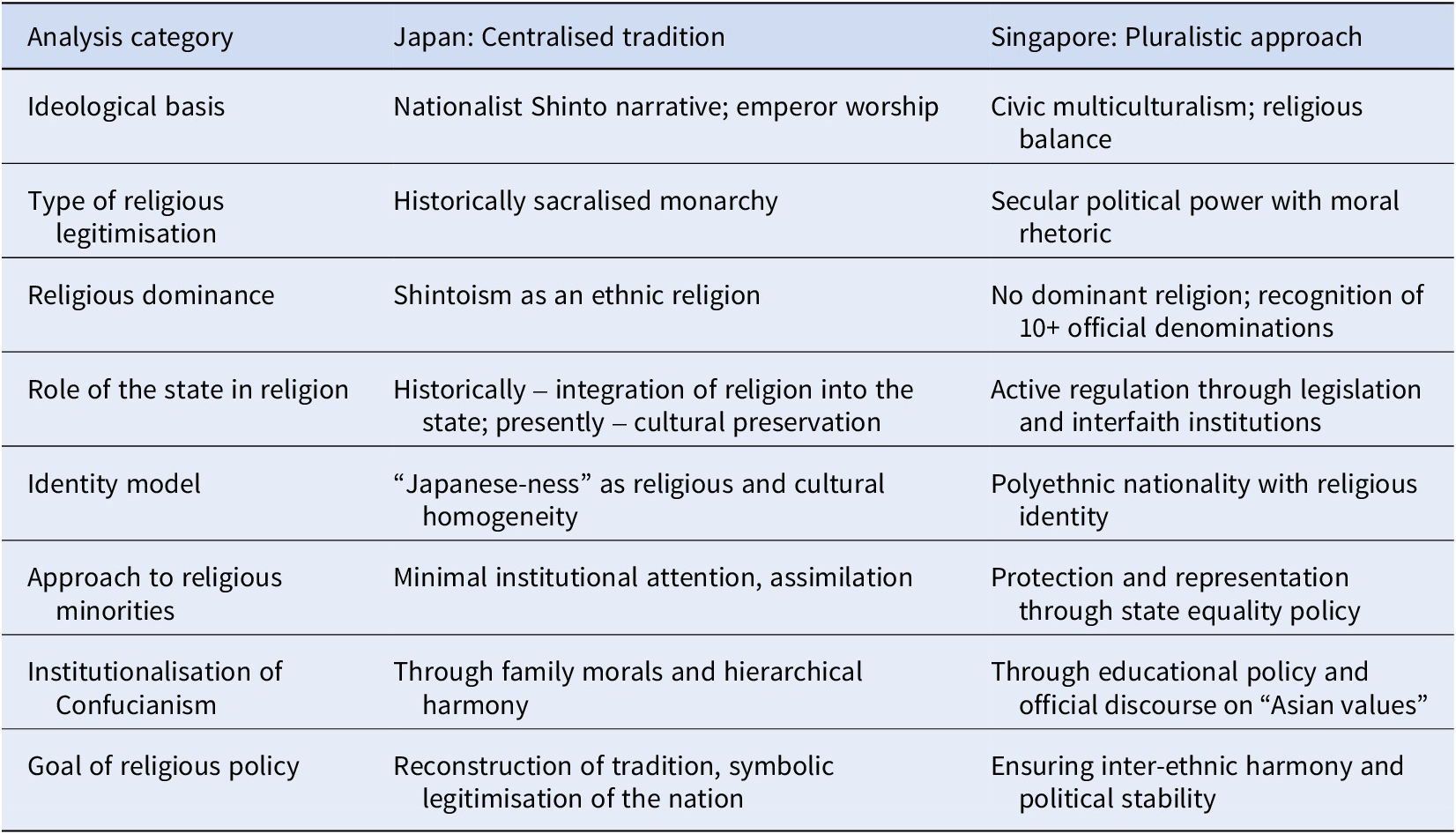
Table 2. Long description
The table consists of three columns: Analysis category, Japan: Centralised tradition, and Singapore: Pluralistic approach.
* Ideological basis: Japan uses a Nationalist Shinto narrative and emperor worship, while Singapore uses civic multiculturalism and religious balance.
* Type of religious legitimisation: Japan features a historically sacralised monarchy, whereas Singapore uses secular political power with moral rhetoric.
* Religious dominance: Japan has Shintoism as an ethnic religion. Singapore has no dominant religion and recognizes 10 plus official denominations.
* Role of the state in religion: In Japan, it was historically the integration of religion into the state and is presently cultural preservation. In Singapore, there is active regulation through legislation and interfaith institutions.
* Identity model: Japan defines Japanese-ness as religious and cultural homogeneity. Singapore uses a polyethnic nationality with religious identity.
* Approach to religious minorities: Japan provides minimal institutional attention and assimilation. Singapore provides protection and representation through state equality policy.
* Institutionalisation of Confucianism: Japan implements this through family morals and hierarchical harmony. Singapore implements it through educational policy and official discourse on Asian values.
* Goal of religious policy: Japan focuses on the reconstruction of tradition and symbolic legitimisation of the nation. Singapore focuses on ensuring inter-ethnic harmony and political stability.
The table illustrates the fundamental conceptual differences between the two models of integrating religion into the political system. Japanese centralised traditionalism functions through the reproduction of a sacred centre linked to the imperial line and Shinto rituals, which shape the national narrative as unitary and homogeneous. At the heart of this model is the assumption of a deep unity between the people, culture, and religion, where religion is not just a belief but a form of historical memory and ideological cement. Singapore, on the other hand, demonstrates an institutionally rationalised approach, where the state acts as an arbiter between confessions, promoting religion not as a source of ideological mobilisation but as an instrument of social management. Multiconfessionalism is not only recognised but also systematically organised through legislation, educational policy, and interfaith councils. Religion here is depoliticised but morally exploited within the official discourse of harmony. Confucianism, which is present in both countries, takes on various roles: in Japan, it is an invisible norm of behavior and hierarchical roles; in Singapore, it is the ideological basis for the development of the national idea, embedded in state ethics.
The Constitution of Japan of 1947 (specifically, Article 20) guarantees freedom of religion and the separation of religion from the state, which has greatly influenced the formation of the modern secular nature of Japanese society. In contrast, the Constitution of Singapore (1965), although it proclaims freedom of religion (Article 15), also prescribes a more active role for the state in regulating religious matters, reflecting the government’s desire to balance religious rights with the need to maintain social harmony in a multi-religious society. This contrast in constitutional approaches to religion demonstrates distinct models of interaction between the state and religious institutions in these Asian countries.
The formation of models of religious-political interaction is the result of a complex and lengthy historical and cultural process where religion emerged not only as a spiritual phenomenon but also as a structural element of the civilisational order. By integrating into the political culture of society, religion acquires functional multidimensionality: it simultaneously serves as a means of legitimising power, a channel of social control, a source of collective identity, and a symbolic matrix of political thinking. In this sense, the historical and cultural context determines not only the nature of the religious landscape but also the framework for acceptable interaction between religious and political discourses. Japan’s historical narrative was built around the sacralisation of imperial power as the direct successor to the goddess Amaterasu, which established Shinto cosmogony as the basis of statehood. As a result, religious belief in the divine origin of the Japanese people became an ideological doctrine that ensured the integrity of the social order and justified the vertical power relations. This was particularly evident during the Meiji Restoration, when the impulse for modernisation was synthesised with the conservative sacralisation of the nation — the empire was conceived as an organic body with a spiritual mission, where religion not only supported political mobilisation but also normalised expansionist policies. A unique form of Japanese cultural nationalism, combining modernisation with traditionalism, was formed precisely thanks to the historical and cultural context, where religion was not supplanted by a secular project but, on the contrary, was reinterpreted in new conditions. This created the conditions for the deep integration of religious elements into political culture, even despite the formal separation of church and state after World War II. Religion in Japan has retained its presence in the form of cultural memory, ritual practice, and symbolic legitimisation of state tradition.
By contrast, Singapore presents a completely different paradigm of religious-political interaction, shaped by its colonial past, multi-ethnic demographics, and the need for institutional stability in a context of socio-cultural pluralism. Singapore’s religious mosaic, which includes Buddhism, Christianity, Islam, Hinduism, Sikhism, Confucianism, and Taoism, did not allow for the creation of a unified religious narrative that could become the basis of state ideology. Therefore, the political elite chose the path of strategic pragmatism, where religion was transformed into an instrument of moral regulation and intergroup harmonisation, rather than a source of sacred legitimacy for the authorities. Singapore’s historical and cultural context called for post-colonial modernisation, which required centralised administration and social control in a culturally diverse environment. Here, religion functioned not within the coordinates of national exclusivity, but within the framework of constructive regulation of pluralism. A special model of secular statehood was formed with limited use of religious discourse in the political sphere — religion stayed a private matter for citizens, but with clearly defined boundaries for public representation. This ensured a balance between freedom of conscience and the political demands of unity and stability.
The results show that religion functions as a flexible and context-dependent element of political discourse in both Japan and Singapore. In Japan, religious ethos is embedded in a historically rooted model of sacralised statehood and cultural continuity, whereas in Singapore it operates within a framework of institutional regulation and managed multiculturalism. At the same time, both cases highlight the instrumental role of religion in legitimising power, shaping national identity, and maintaining social cohesion under conditions of modernisation and globalisation.
Discussion
The findings indicate two distinct models of religious-political interaction. In Japan, religion is embedded in a historically rooted system of sacralised statehood and national identity, whereas in Singapore it operates within a framework of institutional regulation aimed at maintaining interethnic and interfaith harmony. These differences reflect broader variations in political governance and approaches to legitimacy. These results are consistent with Afrilsah (Reference Afrilsah2024), who analysed religion as a source of ethical norms and social cohesion. In Japan, this function is realised through Shinto and Confucian concepts of harmony and hierarchy, whereas in Singapore religion contributes to balancing interethnic and interfaith relations through regulated public expression. In this context, the findings suggest that religion is not a unified source of morality but functions within specific social mechanisms that shape its influence according to political needs.
Afrianti and Andreastuti (Reference Afrianti and Andreastuti2024) analysed the Indonesian experience of integrating religious values into public ethics, confirming the advisability of combining religious principles with national cultural traditions as a factor in enhancing social cohesion. Analogous mechanisms were observed in the Singaporean model, where the concept of multiculturalism was supported by institutionalising religious tolerance and normative ethics based on Confucian principles of mutual responsibility and loyalty to the state. Unlike Indonesia, where the emphasis was on self-reflection and internal ethics, Singapore was dominated by a strategy of external regulation of behavior, which manifested itself in a policy of preventive control of religious influence on public life. In this context, it is worth mentioning the study by Jezierski and Michałowski (Reference Jezierski, Michałowski, Jezierski, Orning and Turnhout2024), which compared the processes of Christianisation in Norway and Poland. Despite the different geographical and historical contexts, this study highlighted comparable mechanisms of sacralisation of power through religious narratives, which were also observed in the Japanese case. Specifically, the process of legitimising political power through a symbolic religious figure — the Emperor of Japan — was analogous to that of sacralised monarchs in medieval Europe. However, while European models emphasised the integration of the church into the power structure, Japan saw an institutional merger of the sacred and the secular at the level of state ideology. This created a unique case where national identity was built around a religious-state synthesis, while in European countries religion stayed an autonomous institution.
The findings of the study confirmed that religion in Japan performed not only a spiritual but also a political function, actively shaping national identity. This position is consistent with the conclusions of Sumimoto (Reference Sumimoto2023), who showed that the religious ethos, particularly Shintoism, in Japan became an element of state ideology, ensuring the sacralisation of power and the cultural homogenisation of society. The present study complemented these findings by pointing to the central role of Shintoism during the Meiji period, when it was transformed into a state religion and became the basis for the legitimisation of imperial power. Ghimire (Reference Ghimire2022) also emphasised the profound influence of Buddhism on Japanese identity, which does not contradict the conclusions of the present study but rather broadens the picture of religious pluralism in Japan, where Buddhism, despite the dominance of Shintoism, continued to be a crucial source of moral norms and values. This testified to the complex, multi-layered religious structure of Japanese society, where diverse traditions interacted in the shaping of a unified national narrative.
In terms of Singapore, the study confirmed that due to ethnic and religious diversity, religion could not be the direct basis of national ideology, but it gained significance as an object of institutional regulation. In this respect, the findings corresponded to the conclusions of Afrianti and Andreastuti (Reference Afrianti and Andreastuti2024), who emphasised that it is precisely the combination of religious and cultural values in public ethics that can be an effective means of social transformation in a multicultural environment. In the case of Singapore, this combination was implemented through a policy of “managed harmony,” which made it possible to avoid interfaith conflicts and ensure stability. In this context, it is also essential to refer to the ideological legacy of Wu Teh-yao, analysed by Kung (Reference Kung2025). His concept of “Asian values” created the ideological foundation for the development of Singapore’s political system, where Confucian ethics were used as a mechanism for consolidating society and, at the same time, as an alternative to Western liberalism.
In both contexts, Confucian ethics were reflected not only at the level of abstract values but also in concrete governance and social practices. In Japan, Confucian principles of hierarchy, duty, and loyalty were historically and institutionally embedded in administrative culture and educational frameworks, reinforcing social order and collective responsibility. In Singapore, these principles were institutionalised more explicitly through state-led policies promoting meritocracy, discipline, and respect for authority, particularly within the education system and public administration. This demonstrates that Confucian thought functioned as a practical normative framework shaping governance rather than merely a cultural or philosophical tradition (Bai Reference Bai2025; Kung Reference Kung2025).
The comparative aspect of the study revealed that both countries, despite their fundamentally different religious configurations, managed to use religion as a tool for national integration and ideological stabilisation. In Japan, a centralised, historically legitimised synthesis of religion and statehood was observed, which corresponded to the observations of Jezierski and Michałowski (Reference Jezierski, Michałowski, Jezierski, Orning and Turnhout2024) regarding European Christianisation processes: there, as in Japan, religion served as a source of legitimacy for power, but in the Japanese case it had autochthonous, Shinto roots, which ensured its deep cultural integration. Unlike Poland or Norway, where the sacralisation of political power was achieved through the institutions of the Christian Church, in Japan it was achieved through the cultivation of the imperial cult, which combined religious and national identity. The findings of the present study were consistent with the conclusions of Afrilsah (Reference Afrilsah2024), who emphasised that religion has a considerable influence on the development of moral norms, social behaviour, and pro-social attitudes, but that this influence depends on the socio-cultural context. In the case of Singapore, religion acted not so much as a source of political legitimacy as an instrument of social cohesion through the legally regulated regulation of the religious sphere. Unlike the Japanese model, this model did not allow for the dominance of one religion but used elements of Confucianism as a common moral code suitable for a multicultural environment.
Warraich and Kokab (Reference Warraich and Kokab2023) emphasised the universality of religious values such as compassion, justice, and love, which are inherent in different traditions. This approach, which focused on the cross-cultural shared ground of spirituality, made it possible to view religion as a means of moral integration. Considering this, the Japanese example of the synthesis of Shintoism and state ideology demonstrated the transformation of religion into a political constant that contributed to the integration of society based on a common moral and symbolic system. In contrast, in Singapore, despite the pluralistic nature of the religious field, Confucian ethics, adapted to the social context, became an instrument for normalising interfaith relations, which was consistent with the assertion of common moral foundations identified by Warraich and Kokab. Bai (Reference Bai2025) viewed religion as a factor interacting with the processes of globalisation and deglobalisation, under the influence of transformational challenges, particularly in East Asian countries. Within this conceptual framework, the Japanese case illustrated how sacralised elements of national identity, rooted in pre-industrial tradition, retained their influence in modern society even under official secularism after 1945. This phenomenon confirmed the thesis that modernisation does not necessarily mean the suppression of religion but is often accompanied by its adaptation to new political and cultural realities. In Singapore, according to Bai’s logic, modernisation processes were aimed not at marginalising religion, but at its rational regulation within the national project of multicultural harmony. Thus, both countries demonstrated varying responses to global transformations in the religious sphere, confirming Bai’s hypothesis about the multiplicity of trajectories of religious adaptation in post-traditional societies.
At the same time, this perspective highlights the complex functioning of secularism in both contexts. In Japan, formal secularism established after World War II did not eliminate the influence of religious traditions but rather reconfigured it, allowing religious symbolism to persist at the level of cultural identity and state rituals. In Singapore, secularism operates as a regulatory principle aimed at maintaining neutrality and social balance, while simultaneously permitting the controlled incorporation of religious values into public policy. This suggests that secularism in both cases does not imply the absence of religion from the political sphere but instead reflects different modes of managing the interaction between religious influence and state authority (Bai Reference Bai2025).
Cornelio (Reference Cornelio, Wyn, Cahill and Cuervo2024) focused on religious dynamics among young people in East and Southeast Asia, where there were signs of increased religiosity, changes in religious affiliation, identity searches, and political activity. The findings obtained in this context reinforced observations about the continuing relevance of religion as a factor in social mobilisation and self-identification. In the Japanese context, this manifested itself in the development of a collective national identity through historically entrenched religious symbols and rituals, despite formal secularism. In Singapore, according to the trends described by Cornelio, religious activity among young people took place within a strictly controlled space of public discourse, where any religious expression had to follow the principles of interethnic tolerance. This confirmed the existence of a controlled transformation of religious behavior that was consistent with the policy of “managed harmony” and emphasised the functional use of religion to maintain stability.
Thus, a comparison with the above-mentioned works helped to highlight the specific features of the functioning of religion in the political context of Japan and Singapore. All the studies considered confirmed the view that religion in modern society does not lose its political significance but only transforms according to socio-cultural conditions and the needs of public administration. In Japan, religion stayed a source of collective identity even under official secularism, indicating the deep integration of the religious narrative into the national consciousness. In Singapore, religion functioned as a controlled resource used to maintain balance in a multi-religious environment. These findings further demonstrate that religion plays a central role in shaping national identity by providing a shared symbolic framework through which collective values, historical memory, and social cohesion are constructed and maintained. Both models proved that religion, regardless of its formal presence in the political system, can be an effective tool for shaping the normative space, legitimising power, and strengthening social order.
Conclusions
The study revealed substantial differences in the functioning of the religious factor in the national ideologies of Japan and Singapore. In Japan, a historically formed synthesis of religion and statehood was observed, where Shintoism has become not only a religious system but also the basis of national identity and political legitimacy. This was particularly evident during the Meiji period, when state Shintoism became a powerful tool for national consolidation and modernisation. The sacralisation of imperial power and the integration of religious symbols into state ideology created a unique model in which religion served not only as a spiritual but also as a political unifying force for society. In Singapore, in contrast, a fundamentally different model of interaction between religion and the state emerged, conditioned by the country’s ethno-confessional diversity. Here, religion could not become the basis of national ideology due to its pluralistic nature, and therefore the state chose the path of institutional regulation of the religious sphere. The policy of “managed harmony,” consolidated in legislation, prescribed active state intervention in religious processes to prevent conflicts and maintain social stability. Confucian ethics, adapted to modern conditions, became a crucial tool for shaping civic consciousness and social cohesion.
A comparative analysis revealed that both countries, despite their distinct historical paths and cultural traditions, effectively used the religious factor to achieve political goals. In Japan, this was expressed in the creation of a single national narrative based on the Shinto tradition, while in Singapore, religion became a tool for balancing the interests of different ethnic and religious groups. Both models demonstrated that religion can be a key factor in the development of modern statehood, but the nature of its influence depends substantially on the historical context and socio-cultural characteristics of each country. The study also found that the Confucian tradition played an essential role in both cases, but with distinct emphases. In Japan, Confucianism was integrated into the system of social hierarchy and subordination, while in Singapore it became the basis for the formation of the concept of “Asian values” as an alternative to Western individualism. This confirmed the thesis about the adaptability of Confucian ethics to different political conditions. The current state of religious and political relations in both countries demonstrated differing ways of overcoming the challenges of modernisation. The Japanese model, despite official secularism after 1945, has retained the considerable influence of religious traditions on national consciousness. The Singaporean approach, based on the principles of multiculturalism and state regulation, has proven effective in maintaining stability in conditions of social diversity. Both cases demonstrate that religion continues to be a significant factor in shaping modern national ideologies, even in the highly modernised societies of East and Southeast Asia.
The findings of this study may also be applicable to other contemporary contexts characterised by post-colonial legacies and increasing religious diversity. In particular, the models identified in Japan and Singapore provide a useful framework for analysing how religion can be integrated into state governance either through cultural legitimation or institutional regulation in other multiethnic and globalised societies. The study was limited to an analysis of only two countries (Japan and Singapore), which did not allow for generalisations about all East Asian societies and did not account for the influence of contemporary global trends on religious and political processes. Further research could expand the comparative analysis by including other countries in the region, such as South Korea or China, and explore the effects of digitalisation and migration processes on the transformation of the religious factor in national ideologies.
Disclosure
None.


 Open access

