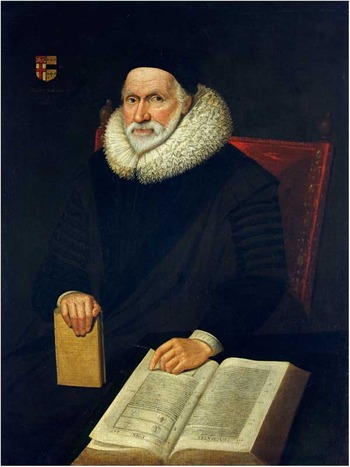
Since its first publication in 1586, William Camden’s Britannia has been recognised as the bedrock of antiquarian scholarship in the British Isles. Accolades to its seminal importance have been countless, from Thomas Fuller’s ‘never was so large a text more briefly, so dark a text more plainly expounded’, to George Boon’s comment of 1986 – the book’s quatercentenary year – that it ‘still fundamentally colours the way in which we, as antiquaries, look at our country’.Footnote 1Britannia’s story has been told more than once and from a variety of perspectives, but one chapter that has never been investigated to any depth is the making of the 1610 English translation by Philemon Holland (fig 1).Footnote 2
William Camden (1551–1623): a portrait of 1622. Artist unknown. On the table lies Philemon Holland’s translation of Britannia, open at the chapter on Essex. Photograph © The Provost and Fellows of Worcester College, Oxford

Yet Holland’s is probably the edition most frequently quoted in modern scholarship. It was the last revision to have appeared in Camden’s lifetime, the first in the vernacular, and is written in an accessible and engaging style. Sir Maurice Powicke considered that it preserved the merits of Camden’s Latin, ‘pleasant and easy, free from rhetoric’; for Graham Parry it is ‘spirited’; while for Robert Mayhew, it ‘brings the reader closer to the sense of excitement and sheer pleasure in multiplicity, both factual and linguistic, of Renaissance geographic culture at Camden’s time than does any of his successors’ translations’.Footnote 3 Other readers, however, have offered more circumspect judgements. For Stuart Piggott, although Holland’s style is ‘enthusiastic’, it is also ‘wayward’; for Gwyn Walters, it is ‘lively’, but the text is ‘here and there expanded ... with seemingly unauthorised and often unnecessary elaboration’; and Boon, while again acknowledging the work’s ‘vigour and intensity’, considers that it is wrong to quote from Holland, ‘as if that were Camden’s ipsissima verba in point of style or ... in point of detailed comment’.Footnote 4
The present enquiry therefore has three aims: first, to review the story behind the 1610 translation, and to clarify the roles played by the several agents in its creation; second, to examine the translation itself, in order to address the doubts that have been raised over its reliability and authority; and finally, to consider some of the wider implications of the transition from Latin to English against a backdrop of evolving national and scholarly identities.
THE MAKING OF BRITANNIA
The project for an authoritative synopsis of Britain’s topography and antiquities may be seen as having its roots in the agenda presented to Henry viii by John Leland in 1543–4 for an engraved table-top map of the realm, written topographical description and set of county histories.Footnote 5 Leland’s plans were curtailed by his descent into insanity, and the baton passed to Laurence Nowell, who began to gather material in association with William Lambarde. However, Nowell disappeared overseas in 1567, and Lambarde decided to focus on a single county, Kent, while calling on others to work collaboratively, ‘by the union of many parts and papers’, towards the larger project.Footnote 6 There were few immediate responses to his appeal, and instead it was left to Camden, under-master at Westminster School, to produce the first serious attempt at a comprehensive survey of Britain.
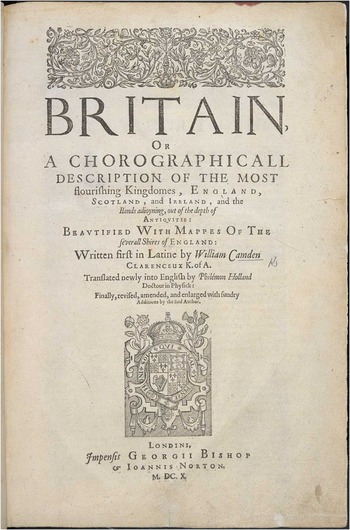
A modest octavo in Latin, the 1586 Britannia contained some 180,000 words and a single crude woodcut. Five further Latin editions followed (in 1587, 1590, 1594, 1600 and 1607), each expanded from its predecessor in both textual and graphic content, the new material drawn from Camden’s own reading and field excursions, and from information supplied by a network of correspondents and readers. By 1607 the text had almost tripled to over half a million words contained in a thick folio volume, with fifty-eight maps (including a full set of English county maps), eleven engravings, eighteen woodcuts, and 116 Roman and other inscriptions typeset in quasi-facsimile. Three years later, in 1610, Holland’s English translation appeared (fig 2). All subsequent revisions and expansions – two in the seventeenth century (1637 and 1695), four in the eighteenth (1722, 1753, 1772 and 1789) and one in the early nineteenth (1806) – were also in English.Footnote 7
William Camden, Britain (1610), title page. The English title was used only in 1610 and 1637; later translations reverted to Britannia. Photograph © The British Library Board (BL, Maps C.7.b.2)

That, at any rate, is one Britannia story. It is also a very English story (even Scotland and Ireland being peripheral to the project). An alternative story sets Britannia in an international context as a product of humanist ideals, and as the British strand of a pan-European scholarly campaign to recover the classical past. Camden’s own account was that he was prompted to undertake the project by the Flemish scholar, Abraham Ortelius, who met him on a visit to London in 1577, and famously urged him to ‘restore antiquity to Britaine, and Britain to his antiquity’ – in other words, to allocate Britain its due place in the annals of European civilisation.Footnote 8 Ortelius’s aim was to compile a gazetteer and set of maps of the ancient world, and he had been seeking a collaborator to help elucidate the British material.Footnote 9 Camden, however, developed a more ambitious vision of a survey of all the literary and material evidence for ancient Britain, his exemplars being the De Roma instaurata (1444–6) and Italia illustrata (1474) of Flavio Biondo, the unfinished Germania illustrata project of Conrad Celtis and his circle, and Leandro Alberti’s Descrittione di tutta Italia (1550). Other continental models inspired him to include Roman inscriptions.Footnote 10
Camden stressed the value of his having ‘had conference with learned men in other parts of Christendome’.Footnote 11 He maintained contact with Ortelius, Gerardus Mercator and others, seeking from them, for example, reliable copies of such primary sources as the Antonine Itinerary and Peutinger Table.Footnote 12 Godfrey Goodman, a pupil at Westminster in the 1590s, recalled how ‘we heard news continually that our master had letters from beyond seas, and we his scholars were wont to brag in what esteem he was beyond seas’.Footnote 13 Camden seriously considered having the 1586 Britannia published in the Low Countries (Ortelius offered to mediate with the printer Christophe Plantin), before settling on a London printer for the ease of making corrections.Footnote 14 The various editions were acquired and acclaimed by leading continental humanists, including Justus Lipsius, Janus Dousa, Joseph Scaliger, Jan Gruter, Isaac Casaubon, Jacques Auguste de Thou, Nicolas de Peiresc and Jean Hotman: Scaliger called it an ‘extraordinary work’ (opus eximium).Footnote 15 The third edition of 1590, in addition to its London imprint, was published the same year in Frankfurt – and was condemned in parts, in 1612, by the Spanish Inquisition.Footnote 16 The Roman inscriptions Camden had recorded were entered into Gruter’s Europe-wide survey, Inscriptiones antiquae totius orbis Romani, published in Heidelberg in 1602–3.Footnote 17 The Frankfurt edition was reprinted in 1616, and an abridgement by Reinier Telle was published in Amsterdam in 1617 and reprinted in 1639. The 1607 text, omitting Scotland and Ireland, was republished in Amsterdam in 1645 within the fourth volume of Joan Blaeu’s Theatrum Orbis Terrarum, translations subsequently appearing in French, German, Dutch and Spanish.Footnote 18 The following year the same text, this time in its entirety but rearranged, appeared in the fourth volume of the rival Novus Atlas of Jan Jansson, again followed by French, German and Dutch versions.Footnote 19 There was some truth in Edmund Gibson’s later remark that the Latin Britannia had been ‘chiefly intended for the Instruction of Foreigners’.Footnote 20
1610 can therefore be seen as a parting of the ways in Britannia’s story. On the one hand the work survived, and continued to evolve, within the world of international Renaissance scholarship, communicating Britain’s heritage as a province of the Roman empire to the republic of letters. But on the other it was reborn in a new indigenous incarnation, embodying English and British pride and identity, or what Patrick Collinson characterises as ‘apartness, exceptionality, and self-discovery’.Footnote 21
PUBLISHERS, TRANSLATORS AND PATRONAGE
The 1610 Britannia was in the first instance a business proposition. The 1590, 1594 and 1600 editions had all been published by the bookseller George Bishop, and printed, like many of his books, by the syndicate known as the Eliot’s Court Press. The 1607 folio edition required greater capital investment (Camden’s preface acknowledges the cost of the county maps), and Bishop entered into a partnership with the wealthy John Norton, another Eliot’s Court client.Footnote 22 The proposal for an English edition was more ambitious still – in part because of additional content, but mainly because an English text would inevitably be bulkier than its Latin counterpart – and of untested commercial viability. As was not unusual in such cases, further partners were therefore recruited to spread the risk and divide the work between printing-houses. Although Bishop and Norton remained the names on the imprint, the eventual division of shares was one-third to Norton, one-sixth to Bishop, another sixth split between Richard Bankworth and William Aspley, and the final third split between Thomas Adams and Edward Bishop.Footnote 23
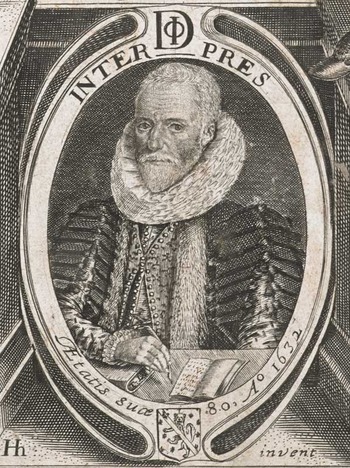
For the past decade, Norton had had among his apprentices Henry Holland, who took up his freedom of the Stationers’ Company in December 1608.Footnote 24 It is likely that Henry, who had keen antiquarian interests, was instrumental in introducing his father, Dr Philemon Holland of Coventry, to the enterprise (fig 3). Philemon was a physician and, like Camden, a schoolmaster; but he was also a prolific and well-regarded translator, who since 1600 had published substantial translations from Livy, Pliny, Plutarch, Suetonius and Ammianus Marcellinus, and was later dubbed by Thomas Fuller ‘the Translator General in his Age’.Footnote 25 The fact that he had appended to his Livy a translation of Bartolomeo Marliani’s 1534 handbook to the topography of ancient Rome may also have commended him as a writer sympathetic to Britannia’s themes.
Philemon Holland (1552–1637) in later life. A portrait published in his translation of Xenophon’s Cyrupaedia (1632), engraved by William Marshall after an original by Henry Holland, Philemon’s son. Photograph © The British Library Board (BL, 10605.g.18)

What none of these parties may have suspected was that another scholar, Richard Knolles – a respected historian of the Ottoman Empire, and the translator, in 1606, of an edition of Jean Bodin’s La république – had meanwhile taken it upon himself to translate Britannia. This seems to have become known only when he presented Camden with a completed copy in manuscript, by which time Holland’s work was perhaps too far advanced for collaboration to be feasible. Knolles died in the summer of 1610, a few weeks after Holland’s edition reached publication; and although his manuscript was said in retrospect to have been ‘a tresuer [Camden] much estemed’, it was never made public, being found thirteen years later, following Camden’s own death, locked in a cupboard in his library.Footnote 26
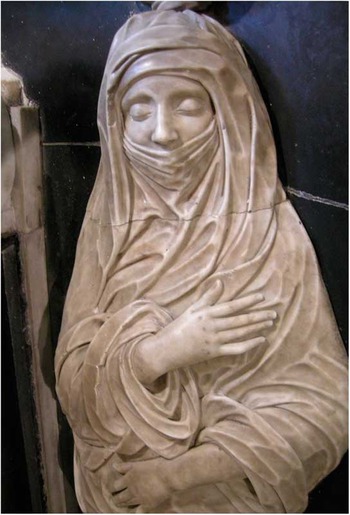
Another desirable contributor to the success of the enterprise would be a patron, and one was found in Elizabeth, Lady Berkeley, kinswoman and goddaughter of Elizabeth i (fig 4).Footnote 27 There can be little doubt that she was recruited through Philemon Holland’s agency, one of her homes being at Caludon Castle, near Coventry.Footnote 28 Holland was probably already a member of her coterie (two or three years earlier, he had referred to visiting the home of another aristocratic patron as ‘a dutie that ... the vicinitie of our aboad did require’), and she later entrusted him with the education of her young son, George.Footnote 29 The sum mentioned for her subvention was £20. She seems to have been sufficiently enthused by the project to have considered doubling this to a lavish £40, but may afterwards have had reason to change her mind.Footnote 30
Elizabeth, Lady Berkeley (1576–1635): her tomb effigy by Nicholas Stone in Cranford church (Middlesex; now Greater London). Photograph: author

In a commendatory sonnet composed for the new volume, Henry Stanford alluded to Holland working ‘at suite of learned dame’, adding, ‘I like his pen and judgement eke no lesse / for making choise of such a patronesse’.Footnote 31 Thomas Muriell similarly praised Lady Berkeley as the ‘rare Phoenix cause of this translation’.Footnote 32 While much of this can be taken as conventional flattery (both men were associated with the household of her mother, Lady Hunsdon, another literary patron, and Stanford acted as the daughter’s tutor), it does seem likely that her support was fuelled by a genuine interest in the project. Possessed of a ‘sharpe Wit’, she was intelligent, educated and of a literary bent, being found in her teens translating Petrarch from the Italian, subsequently donating volumes in Latin, Greek, French, Italian and English to Coventry’s school and city library, and in later years living among ‘thousands of books’.Footnote 33 However, despite her regard for Latin, her facility in the tongue was probably limited: quoting an epigram of Virgil to her, Stanford cautiously adds, ‘which I thinke your skill will serve to construe or els you may borrow the help of your daughter who I hope is cunning in that poete being commended to the reading of ladies by Ovide’.Footnote 34 Indeed, for a girl of Lady Berkeley’s generation, educated at a time when knowledge of the language carried a residual taint of popery, early training in Latin would have been unlikely; and it may well have been a sense of her own exclusion from a major body of literature that persuaded her of the value of helping disseminate an important work to a wider audience through translation.Footnote 35
This notion of Holland’s translation liberating Britannia from the exclusivity of the literati was celebrated by Muriell in verse:
Camden unto the learned did discover,
What Holland to the Whol-land doth recite;
Who can but read an English Author over,
May thereby reap much profit with delight.
And similarly by John Davies of Hereford, within a longer eulogy in praise of Holland: the translation ‘to all doth it [Camden’s text] impart, /And makst them learn’d that almost are untaught’.Footnote 36
Yet the published volume was not dedicated to Lady Berkeley, her patronage was not mentioned, nor were the commendatory poems used.Footnote 37 It seems possible that she had an eleventh-hour change of heart about the project. Early in 1610, when the first unbound sheets were perhaps beginning to circulate, Stanford paid a call on Camden (since 1597 Clarenceux King of Arms) in London. The purpose of the meeting was to discuss Lady Berkeley’s motto, but the topic of Britannia was also raised, and Stanford reported back to his mistress that Holland’s efforts had met with a frosty reception:
Your Doctours translation is here hardly censured by our Critickes & Camden himself misliketh it & thinketh he hath don him wrong, this I write to you only & you nede not be aknown of it to any, Mr Bland talketh of 40l. reward, that is your overlashing humour [ie your extravagant whim] I thinke 20l. which was your first proportion were sufficient.Footnote 38
Stanford now described his own sonnet as ‘a thing that rellisheth more of duty & love then of wit’, that had been ‘wrong out’ of him. His comments may have prompted Lady Berkeley to reconsider the matter of her subsidy. On 30 May Coventry Corporation contributed £5 towards the publication.Footnote 39 This was three weeks after Stanford, in another letter, had reported to Lady Berkeley that ‘your englishe Cambden [is] printed’, but shortly before the book was formally entered at Stationers’ Hall on 4 June, and may reflect a last-minute initiative by Holland to make up an unexpected shortfall in funding.Footnote 40 Nevertheless, the fact that Stanford still felt able to refer to ‘your englishe Cambden’ suggests that Lady Berkeley had not turned her back on the project entirely, and certainly there was no long-term souring in her relationship with Holland, who continued to tutor her son.
CAMDEN AND THE TRANSLATION
In this venture of booksellers, printers, translators and patrons, Camden, the author, appears somewhat marginalised. Several factors may help explain this. Now in his late fifties, he was not enjoying good health. In September 1607 he injured his leg in a riding accident, which laid him up for ten months. On his fifty-eighth birthday (2 May 1609), he was seized with what he called a ‘most grievous disease’: his blood was twice let, and five weeks later he lamented that ‘neyther my head, nor my hand can as yet performe that which they should, and would’.Footnote 41 When well, he had other calls on his time: his official duties as Clarenceux, and the composition of his Annales of the reign of Elizabeth, a project he had accepted reluctantly at the urging of Lord Burghley and later the insistence of King James himself.Footnote 42 But it is also distinctly possible that, as a proud citizen of the republic of letters, Camden failed to feel any real engagement with the proposal for an English Britannia.
The most significant piece of evidence to cast light on his involvement is a letter written to him by Holland on 25 August 1609, when the work was well in hand, and when the first batch of printed sheets had been submitted for his approval.Footnote 43 ‘It appereth now’, begins Holland, ‘that my Translation of your Britannia is under the presse; that yow have taken paines in perusing the written sheetes; & that they mean to use yow still in that kind.’ Camden’s response to what he saw had been to contact Holland to challenge his translation of a Greek couplet from the topographical poet Dionysius Periegetes, quoted in the introduction. Holland apologised (in fact unnecessarily, as his rendition was perfectly sound), blaming his confusion on a missing comma.Footnote 44 He then took the opportunity to consult Camden on eight further points of detail. These eight points all lie within (approximately) the second quarter of the volume, although Holland also mentions difficulties with the account of the earls of Richmond in the third.Footnote 45 We may conjecture, therefore, that the work had been divided for translation into four parts: the first was already at the press, the second was approaching completion with just a few queries outstanding, the third was in progress and the fourth perhaps largely untouched.
Sir Henry Ellis, who published Holland’s letter in 1843, saw in it evidence that Camden ‘took the pains to revise the sheets of Holland’s translation as they gradually issued from the press, and that Holland consulted Camden upon every difficult passage’; but a more critical reading draws one to almost precisely the opposite conclusion.Footnote 46 The pages received by Camden had not been a set of proofs for revision: rather – although apparently his first sight of any part of the translation – they represented a final copy, too far advanced for any changes to be made. He had spotted the supposed infelicity in Dionysius, and Holland conceded the point; but the lines were not amended in the published volume, merely noted in the corrigenda at the end.Footnote 47 Not until a quarter of a century later, when he revised his work for the 1637 edition, did Holland change the body of the text.Footnote 48 Nor is there evidence that Camden dealt with Holland’s new queries. One, for example, was to question Camden’s implausible description of Ely as urbs ... non exigua (‘not a small town’), in which ‘I suspect “non”’. Yet the phrase was allowed to stand in the translation (‘it is no small Citie’), and only in 1637 did Holland make the correction to ‘it is a small Cittie’, which is surely what Camden had meant.Footnote 49 Another problem was how to translate Banna Leuca, the name given to the territorial franchise of Bury St Edmunds Abbey. Elsewhere (in reference to Tonbridge, Kent) Camden had glossed Leuca as ‘The Lowy’: ‘But what,’ asked Holland, ‘is Banna?’ No answer appears to have been forthcoming, and in the published text the term was left untranslated.Footnote 50 Given that he seems to have translated the first quarter of the volume without consulting Camden, and that in the second quarter his consultation was limited to a handful of details, mostly unresolved, the impression given is not of the two men working in collaboration, but of Holland carrying out his task as an independent agent.
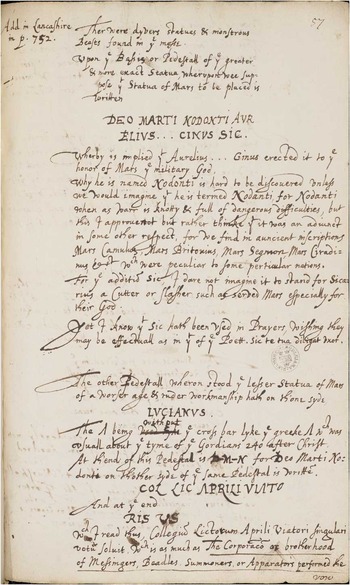
All this provides some context for Camden’s reported belief that Holland had ‘don him wrong’. True, a portrait of 1622 shows Camden resting his hand proprietorially on a copy of the translation (see fig 1); but this is supposed to have been painted covertly during his final illness, and he is unlikely to have overseen its details.Footnote 51 Elsewhere, in a note probably intended for publication, he emphasised that he still regarded the Latin as definitive: it is ‘my Lattin copie which I desire ye reader to hold onely for autentiq’ (see fig 7b).Footnote 52
There are echoes here of his earlier vitriolic feud with Ralph Brooke, York Herald, over factual inaccuracies in Britannia, when Brooke had criticised Camden’s choice of the ‘scholler-like language’ of Latin as implicitly unpatriotic: ‘the goodly Britannia, Mother of us all, is become his daughter, trayned up, and taught to speake Latine in his Schoole’.Footnote 53 Brooke’s complaints were made in English, but Camden responded in Latin, pleading the legal maxim of per linguae medietatem (that a jury should be half-composed of the accused’s co-linguists or compatriots), and so appealing to the judgement of the learned. Brooke, he sneered, was plane peregrinus (‘altogether a stranger’) to the Latin tongue.Footnote 54 Brooke allowed that his adversary could ‘pose me and outface me in Latine’, but protested that Camden’s aim had been ‘to conceale your meaning from the ignorant, and that none might read this Controversie, but such as could iudge of it, (that is) belike onlye Latinists’.Footnote 55
Camden had no objection in principle to writing in the vernacular. In 1605 he had published his Remaines Concerning Britaine, an English-language companion to Britannia, in which he proudly affirmed his commitment to ‘plaine English’.Footnote 56 Nevertheless, it seems that, while he was willing to tolerate and even facilitate an English Britannia, he was neither inspired to take a close interest in its details nor impressed by what emerged, and it is probably not what he himself would have chosen. It is perhaps telling that although, for another decade or so, he continued to collect information that augmented or corrected the book’s contents, eventually amounting to nearly 100 new or extended entries, he appears to have abandoned any idea of a further revised edition. Instead, he envisaged publishing this material as a separate English-language ‘Suplement’ (figs 5 and 7b).Footnote 57 The fact that Knolles’s alternative translation, ‘much estemed’ though it may have been, had simply been locked away in his library similarly leaves us with a sense of indifference.
Camden’s ‘Suplement of the Topographicall Description of Britain’, compiled c 1610–21: a page recording two Roman statuettes (RIB 616 and 617) found in Cockersand Moss (Lancashire), and acquired by Thomas, Earl of Arundel. Photograph: Bodleian Library, University of Oxford (Bodl, Smith 19, p 57)

CRITICISMS
Criticism of the 1610 translation can be placed under three heads: that it contains inaccuracies; that its style is unduly free; and that it incorporates significant interpolations of new material which should be attributed to Holland rather than Camden. We may examine these charges in turn.
Accuracy
Shortly before his death in 1637, and blaming the fact that he had been ‘farre absent from the Presse’, Holland himself stated that the 1610 edition had contained, ‘beside ordinary and literal Errata, many grosse and absurd mistakings and alterations of my translation ... in above a hundred places’ – though he instanced only four (the rendition, for example, of aer insalubris as ‘wholesome’ rather than ‘unwholesome’ air).Footnote 58 In about 1694, an unidentified correspondent of Edmund Gibson highlighted another four cases of ‘Omissions, & false Translation’ in Holland’s Leicestershire and Warwickshire chapters.Footnote 59
It is hardly surprising in so large a work that occasional slips should have occurred. For his 2004 hypertext edition (which collates Camden’s Reference Arber1607 Latin with Holland’s translation), Dana Sutton has identified and corrected nearly 500 textual irregularities.Footnote 60 However, almost without exception these are typographical and trivial; and although a handful do corrupt Camden’s meaning to the point of incoherence (the Isle of Wight is said to lie ‘in an old forme’ instead of ‘in ovall forme’; the sixth earl of Hereford died ‘with’ rather than ‘without’ issue), none represents a material mistranslation by Holland.Footnote 61 Indeed, in at least one case the fault lies with his critic. In reference to the burial of Robert, Earl Ferrers, Gibson’s correspondent had disputed Holland’s translation of corio bubalino iniectus as ‘enwrapped in an Ox-hide for a shrouding sheet’, claiming that ‘[t]he true meaning is onely, that he was buryed in Buffe’ (ie naked); but in fact the translation is perfectly valid.Footnote 62 The technical accuracy of Holland’s work need not, in general, be called into question.
Style
Translation style is a more subjective matter. Boon gives an example of why he thinks it unwise to quote from Holland’s text: ‘The celebrated passage about the Roman Wall, “Verily I have seen the tract of it over the high pitches and steep descents of hills, wonderfully rising and falling” may be close to the Latin; but it is Holland, not Camden, and is poetry.’Footnote 63 Excessive freedom may be implied in the first proposals of 1692–3 for a new English edition, where Holland’s is described as ‘a very bad one, and the Translation very ill’.Footnote 64
Holland did not contribute any sort of translator’s preface to Britannia, but he had done to some of his classical translations, and his remarks illuminate his philosophy of the translator’s role. In the interests of comprehension, he explained, he had avoided using ‘any affected phrase’, but had rather chosen ‘a meane and popular stile’, sometimes ‘call[ing] again into use some old words’, and adopting ‘that Dialect or Idiome which [is] familiar to the basest clowne’. He had, in other words, aimed to be colloquial and accessible. Sometimes he had opted to elaborate on his source: ‘if the sentence be not so concise, couched and knit togither, as the originall, loth I was to be obscure and darke’.Footnote 65
There is no doubt that Holland’s English could often be more prolix than Camden’s economical Latin. Thus, Camden’s description of the Port of London – sylvam interlucatam dicas, tot navium malis, velisque undique obumbratur (literally, ‘you would call it a thinned-out wood, it is overshadowed on all sides with so many masts and sails of ships’) – becomes Holland’s: ‘A man would say that seeth the shipping there, that it is, as it were, a very wood of trees disbranched to make glades and let in light: So shaded it is with masts and sailes’.Footnote 66 A characterisation of Maud de St Valery as foemina procacissima (‘a most impudent woman’) becomes ‘a very shrewd, stout, and malapert stomackfull woman’.Footnote 67 A technique he favoured was the ‘doubling’ of words (using two in English in place of one in Latin): ‘forged & fained’, ‘lofty and arrogant’, ‘most fat and battle’, ‘roberies and roveries’.Footnote 68 His vocabulary was wide-ranging and often colourful: ‘hackster’ (cutthroat); ‘nocke hole’ (anus); ‘lig-by’ (mistress); ‘over-tipled’ (intoxicated).Footnote 69 Some expressions he may have coined himself (‘word-trap’, ‘fouresquarewise’ or ‘Praise-Prater’);Footnote 70 others were dialect terms probably already on the verge of extinction (‘weally’ (barren), ‘quavemire’ (quagmire), ‘hawm’d’ (crooked) or ‘vale water’ (ebb tide)).Footnote 71 Only a generation later, in the 1640s, the young John Aubrey was sufficiently struck by the idiosyncrasies of Holland’s language – not in Britannia, which he had not yet read, but in his Livy and Pliny – to compile lists of what he perceived as archaisms and provincialisms.Footnote 72
This was the real reason that, by the end of the century, Holland’s language appeared unpalatable to those behind the proposals for a fresh translation: it was out of date. In 1686, criticising Holland’s translation of Livy, Edmund Bohun observed that ‘our English Language is much refined within the last fourscore years’.Footnote 73 Edmund Gibson was undoubtedly of the same mind. He was sensitive to matters of style: early in 1694, one of his conditions for accepting the editorship of the new edition (the publishers’ first choice, James Harrington, having unexpectedly died) was that the translations made so far, which he found ‘harsh and uneven’, should be abandoned; and in a later statement he emphasised the problem of stylistic consistency, ‘considering the Translations are done by several pens’.Footnote 74 By the time the work was finished, he could describe the English as ‘soe manag’d as to answer the Text, I think accurately enough, and to smell something of the present Idiom’, if wanting in ‘nice cadencies and turns’.Footnote 75 Yet for all Gibson’s claims of improvement, a close comparison reveals that much of Holland’s wording was in fact carried over verbatim into the 1695 translation, with only fairly minor adjustments. And for all his conviction that his own style was ‘plain and natural’, it too soon dated.Footnote 76 Barely seventy years later Richard Gough was insisting that yet another translation was necessary, on the grounds that ‘[a]ll the last century people wrote strange uncooth language’.Footnote 77
To the modern reader, much of the appeal of Holland’s language lies in the very fact that it is so immediately redolent of the Jacobean age. Whether we choose to quote it must remain a matter of taste, and certainly any researcher wishing to build an argument on Camden’s exact wording would be advised to consult his original Latin. Only very rarely, however, need there be concern that Holland’s English is such a departure as to have distorted Camden’s meaning.
Interpolations
The gravest charge against Holland is that of unwarranted interpolations. There are significant additions to the text, and reservations over their authorship and authority can be traced back to about 1660, when Thomas Fuller noted that, while he himself believed them to have been added in consultation with Camden, ‘with some Antiquaries [they] obtain not equal Authenticalness with the rest’.Footnote 78 These concerns were expressed more forcefully in 1691 by Anthony à Wood, who commented that Holland had inserted ‘many things that were not written by Camden’;Footnote 79 and again in 1695 by Gibson, who deplored their ‘very ill’ consequences, particularly to those ‘who have urg’d the authority of Mr. Camden with a great deal of assurance, when all the while they repeated nothing but an interpolation of Dr. Holland’s’. Nevertheless, Gibson conceded that some of the new material was ‘not amiss’, and reported a rumour that Holland had consulted Camden ‘where any thing appear’d obscure or capable of a double meaning’.Footnote 80 This sliver of uncertainty meant that, while basing his own translation firmly on the 1607 text, Gibson preserved the additions as footnotes, relegated in later editions to endnotes.
Holland introduced, by Gibson’s count, some 1,200 interpolations to Camden’s text. Many are minor insertions of single words (200 or so consist merely of the style ‘Sir’ before a knight’s name); but they also include numerous more substantive phrases and passages, updating or augmenting the Latin, which extend in several cases to two or three hundred words, and in one to almost a thousand.Footnote 81 However, close inspection reveals that a significant proportion can only have been contributed by Camden.
More than seventy, for example, are phrased, at least partially, in the first person, and frequently the voice is unquestionably Camden’s. The interpolator identifies Oxford as ‘my deare nourse-mother’: Camden had studied at Oxford, Holland at Cambridge.Footnote 82 Landscapes, buildings and monuments are described from personal observation: at Cadbury Castle (Somerset), ‘there appeare about the hill five or six ditches, so steepe, that a man shall sooner slide downe, than goe downe’; at Luton (Bedfordshire), ‘I saw a faire church but the Quier then roofelesse, and overgrowen with weedes’; a tomb in the Temple Church, London, had borne an inscription that ‘I some yeares since read’.Footnote 83 The traveller who had doggedly sought to locate places named in the Antonine Itinerary and Notitia Dignitatum was Camden, and in Kent he identified the site of an engagement between Julius Caesar and the Britons, ‘as I have observed travailing lately in these parts’.Footnote 84 Some reports can be tied to specific excursions, notably Camden’s 1599 northern trip with Robert Cotton: thus, to his record of a Roman altar which the pair had encountered at Melkridge (Northumberland), the interpolator adds the recollection, ‘where now women beat their buckes on it’.Footnote 85 He demonstrates a keen archaeological eye, as when he characterises the hillfort at Keston (Kent) as ‘strange for the height of double rampiers, and depth of double ditches, of all that I have seene’; when at diverse locations he identifies ‘long Britan brickes’ (Roman bricks); and when he judges the chamber tomb of Kit’s Coty House (Kent) to be constructed in a similar manner to Stonehenge, ‘but not so artificially with mortis and tenents’.Footnote 86 Elsewhere, he cites documentary evidence he has consulted: a charter of Humphrey, duke of Gloucester, a 1386 grant of an augmentation of arms and details of a mortuary urn unearthed at Coggeshall (Essex), which ‘I incidentlie happened upon in a private note, while I was inquisitive heere-about’.Footnote 87
Two of the most substantial new passages are based on information supplied by antiquarian contacts: Francis Godwin, Bishop of Llandaff, and Sir John Davies, attorney-general for Ireland – Camden’s contacts, not Holland’s.Footnote 88 A handful take the form of editorial opinion, unlikely to have been Holland’s: a mention of the illegitimate Sir Thomas Poynings, who died without heirs, prompts the comment ‘as bastardly slips seldome take deepe root’; another of Sir Everard Digby’s implication in the Gunpowder Plot: ‘I grieve to utter it, but all men know it’.Footnote 89 The reader is referred on four occasions to reports of recent events and personalities in ‘my Annals’ – Camden’s Annales, drafted largely between 1608 and 1611, but not published until 1615 in part, and 1625 in its entirety.Footnote 90 Even Gibson recognised that these references must owe something to Camden.Footnote 91
By contrast, there are really no interpolations that can be attributed, even tentatively, to Holland. Regarding his adoptive home of Coventry, for example, there is just one minor addition, noting Edward iii’s grant of a licence to crenellate the city walls, an archival detail from the 1363 patent roll in the Tower of London almost certainly supplied by Camden.Footnote 92
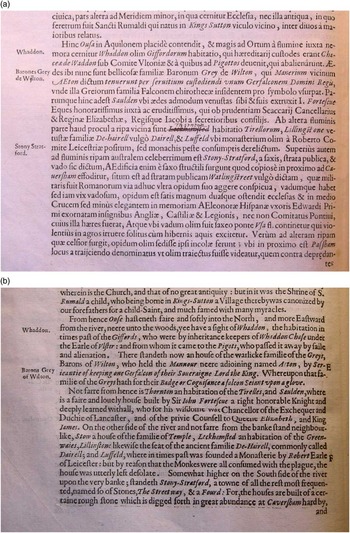
Holland’s 1609 letter provides further clues, albeit elusively phrased, into how the new material had reached him. Referring to Camden’s account of gentry residences in north Buckinghamshire, he writes: ‘ffor “Leckhamsted” I find written in my Latin Copie over head, “Thornton”, by whose hand I know not, but it hath made me to Doubt therof’.Footnote 93 Precisely this amendment appears in the copy of the 1607 Britannia presented by Camden to the Bodleian Library, made in what seems to be his hand (fig 6a).Footnote 94 There may well have been further correspondence on this passage, for not only does Holland’s translation respect the correction by changing the Tyrell residence from Leckhampstead to Thornton, it also places the Greenway family at Leckhampstead, and introduces a new mention of the Temple family residence at Stowe (fig 6b).Footnote 95 Holland continues: ‘And in truth that Latin Copie which I followed in perusing my Translation, differeth ffrom that which I went by in my Translation: but especially in that Passage of Th’Earles of Richmond, which did put me to a new labour.’ Again, the distinction between the two texts he had drawn on is far from clear, but certainly in his translation the passage on the earls is greatly reworked and expanded from the Latin.Footnote 96
(a) Detail from the copy of the 1607 Latin Britannia presented by Camden to the Bodleian Library, Oxford, showing amendments apparently in his hand; (b) the corresponding passage in Holland’s translation. Photographs: Bodleian Library, University of Oxford (Bodl, C 8.1 Art, p 280; Bodl, Gough Gen. top. 50, p 396)

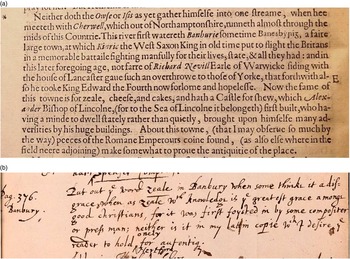
Two final points may be made regarding the interpolations. The first is that a tiny number may have been introduced in the printing-house. One example lies in the account of Banbury (Oxfordshire), which Camden had reported was famed for its cheese, but which the translation expands to ‘zeale, cheese, and cakes’ (fig 7a).Footnote 97 Camden later penned an irritated note, claiming that this insertion had been ‘foysted in by some compositer or press man’ (fig 7b).Footnote 98 Second, we may mention, if only to dismiss, a suggestion that emerged at the end of the seventeenth century and became entrenched in the eighteenth: that, although the 1610 edition had been undertaken in consultation with Camden, in the 1637 revision (published well after Camden’s death) Holland had ‘frequently turn[ed] Antiquary, taking upon him to correct, add and explode what he pleases’.Footnote 99 In fact there are no substantive changes in 1637: Holland’s amendments, although numerous, all comprise quite minor corrections and refinements to his translation.
(a) The description of Banbury (Oxfordshire) in the 1610 translation, which claims that the town is famous for its ‘zeale, cheese, and cakes’; (b) Camden’s later correction of this passage in his ‘Suplement’. Photographs: Bodleian Library, University of Oxford (Bodl, Gough Gen. top. 50, p 376; Bodl, Smith 19, p 53)

In conclusion, there seems no good reason to question the division of editorial labour indicated by the 1610 title page (see fig 2): that the translation ‘newly into English’ had been Holland’s, working substantially alone; but that the content had been ‘revised, amended, and enlarged with sundry Additions’ by Camden. The only dubious detail is the inclusion of the adverb ‘finally’ to describe Camden’s contributions: it is evident that he did not see the translation until it was effectively complete, and that his additions were accrued using the 1607 Latin as his base text.
NATIONHOOD
Britannia had always been an intensely patriotic work. Camden’s 1586 preface included five distinct mentions of his having been motivated by ‘the love of my Country’ or ‘the glory of the British name’, or some kindred concept: by 1607 that total had risen to nine.Footnote 100 ‘Nature tooke a pleasure in the framing [of Britain]’, he wrote in another passage, ‘and seemeth to have made it as a second world, sequestred from the other, to delight mankinde withall.’Footnote 101 He scorned those content to be ‘strangers in their owne soile, and forrainers in their owne City’.Footnote 102 The 1607 edition, published four years after James vi of Scotland had ascended the throne of England, was additionally able to celebrate the fact that Britain, for ‘so many ages disioigned in it selfe and unsociable’, might now ‘by a blessed Union bee conjoyned in one entire bodie’.Footnote 103 Denys Hay has even proposed that Camden ‘did more to unite Britain in the long run than did King James’: a bold suggestion, but one that seems less extraordinary when we recall the part played by Britannia in restoring the half-forgotten name of ‘Britain’ to public consciousness, and consider that it was Camden’s friend and collaborator, Robert Cotton, who, only two days after the death of Elizabeth, urged James to adopt the style ‘Kinge of great Brittayne, Fraunce, Ireland, and the adjacent Islandes’.Footnote 104
This patriotic agenda was reinforced by Holland’s translation. If the Latin work’s primary purpose had been to show that Britain could stand proud among the nations of Europe in their common heritage, the translation was able to show that Britain could stand proud on its own terms apart from Europe. John Davies’s commendatory verse sees Holland redeeming Camden’s words from their foreign readership, and restoring them to their own people:
Camden, whose Fame, nor Seas, nor Lands can bound
(Yet they best know him furthest from our ken;
For, English least do knowe his voyces sound)
Is made more famous by thy famous Pen.
For, now the English knowes his worthinesse:
His Countrymen now see him as he is:
Before, they at his Vertue could but guesse;
And guesse by Artlesse Aymes, that often misse.Footnote 105
With these sentiments Gibson could only agree, declaring in 1695 that ‘[t]he Dress wherein [Britain] appears, is true Native English. She has been a great Sufferer by foreign Modes and Fopperies; but now resolves to quit them all, and convince the World that she has every thing within her self and can live without borrowing’.Footnote 106
Nevertheless, Latin remained a vital medium of scholarly discourse, and the transition between Latin and English by no means ran in one direction only. A case in point is John Speed’s atlas, The Theatre of the Empire of Great Britaine, published with an English-language text (which drew heavily on Britannia) in 1611–12, followed by a Latin edition, aimed at the international market, published in London and Amsterdam in 1616 – the translation undertaken by none other than Philemon Holland.Footnote 107 Nor, for many years, did the desire for an updated Latin Britannia subside. In about 1693, when plans were first being aired for what would become Gibson’s translation, Edward Bernard opined that ‘it would be more for the honor of Mr Cambden & the use of Scholars to have that immortal worke represented again in his Latine & with his additions’.Footnote 108 In May 1694, Gibson dined with Samuel Pepys, who approved of (and would contribute to) the English edition, but was opposed by ‘a certain Doctor in company that insisted upon a Latin one’.Footnote 109 In 1708, when another edition was in contemplation, Thomas Hearne – who had ‘but a very indifferent, mean opinion’ of Gibson’s translation, believing ‘Old Phil. Holland’s’ to be far better – observed that, this time, ‘what is most desirable is that the work were done in Latin’.Footnote 110 Thomas Smith offered to lend his copy of the 1607 edition with Camden’s autograph annotations, and for almost a decade Hearne continued to project this new and ‘altogether Requisite’ Latin edition.Footnote 111 However, he never found time to give the task the attention it demanded.
There was one other, rather different, type of international connection fostered by Britannia, namely a sense of Germanic or Gothic identity. The antiquarian recovery of Old English from the 1560s onwards had contributed to a new pride in the English language and the nation’s Anglo-Saxon roots; and Camden played no small part in this process. In Britannia, he wrote of the Angles, Saxons and Jutes as ‘our originall, and first cradles’, a theme elaborated on in his Remaines: ‘This English tongue is extracted, as the nation, from the Germans the most glorious of all now extant in Europe for their morall, and martiall vertues, and preserving the libertie entire’.Footnote 112 A map of the Anglo-Saxon heptarchy entered Britannia in 1600, and continued to feature prominently in later editions.Footnote 113 This is not the place for a detailed discussion of Britannia as a cornerstone of seventeenth-century Gothicism, but we may conclude with a quotation from Gibson’s second edition of 1722, by which date, of course, a Hanoverian monarch sat on the British throne. Gibson, a staunch Whig loyalist, dedicated the edition to George i, and went on to sketch out the ancestral, ethnic and cultural links, ‘of a far more Ancient Date’, between the king and his new realms. In short, he concluded,
the main Body of your People in both Nations, are really descended from one and the same common Stock; and now, after a Disunion of so many Ages, they live again under the Protection and Influence of the same common Parent.Footnote 114
Perhaps Britain was a part of Europe after all.
ACKNOWLEDGEMENTS
I am indebted to Dana Sutton and to the Journal’s anonymous referees for their comments on earlier drafts of this article; to Jan Broadway and Jane Lightfoot for assistance with points of detail; to David Smith, FSA, archivist at Berkeley Castle, for help in identifying relevant documents; and to numerous librarians and archivists (too many to name individually) for facilitating access to items in their collections. An earlier version of this paper was delivered to the Early Modern Exchanges Conference at University College London in September 2011.
ABBREVIATIONS AND BIBLIOGRAPHY
- BCM
Berkeley Castle Muniments, Gloucestershire
- BL
British Library, London
- Bodl
Bodleian Library, Oxford
- CHC
Coventry History Centre, Coventry
- CUL
Cambridge University Library, Cambridge
- RIB
Collingwood, R G, Wright, R P and Tomlin, R S O 1995. The Roman Inscriptions of Britain. Vol I: Inscriptions on Stone, 2nd edn, Alan Sutton, Stroud
- TNA
The National Archives, Kew
 4. Here and elsewhere, I have quoted from the 1610 edition, while also citing the appropriate Latin edition.
 1; Camden