At the time of this writing (early August, 2008), the political landscape would appear to bode well for Barack Obama and spell almost certain disaster for John McCain. With presidential approval hovering in the high-20 and low-30% range for more than a year, and levels of economic satisfaction bottoming out, it “should” be a terrible year for the Republican Party in general and the Republican presidential nominee, John McCain, in particular, at least if the retrospective model holds. One factor that could mitigate the impact of negative retrospections, however, is that George W. Bush himself is not on the ballot to absorb the full impact of the national angst; in fact, for the first time since 1952, neither the president nor vice president is on the ballot.
Although the impact of incumbency has been largely ignored in forecasting models (but see Abramowitz Reference Abramowitz2008), there has been some speculation about the decreased applicability of the retrospective model when the president himself is not on the ticket, leaving the somewhat-harder-to-blame-or-reward vice president to represent the administration. The difficult-to-predict 2000 presidential election generated some discussion on this point. Although I and others (Campbell Reference Campbell2001; Holbrook Reference Holbrook2001; Wlezien Reference Wlezien2001) argued that at least part of the explanation for the forecasting error in 2000 lies with Al Gore's failure to embrace the Bill Clinton-Al Gore record and reinforce retrospective voting, a case has also been made that the retrospective cue may generally be weaker when the president himself is not on the ticket (Campbell Reference Campbell2001; Nadeau and Lewis-Beck Reference Nadeau and Lewis-Beck2001; Lewis-Beck and Tien Reference Lewis-Beck and Tien2001). Indeed, Campbell (Reference Campbell2001; Reference Campbell2008) argues in favor of only giving half weight to presidential performance variables when the vice president rather than president is representing the incumbent administration. The logic here is quite simple: absent the president himself on the ticket, it is more difficult to frame the election as a referendum, leading voters to attach less weight to incumbency-oriented considerations. This is not to say that factors such as presidential approval and economic performance are unimportant when incumbents don't run, only that they might matter less.
Rather than assuming the in-party candidate only gets half-blame (or credit) for presidential performance when the president is not running, it is better to let the data decide the appropriate weighting. As a means of assessing the importance of controlling for incumbency, I test a simple forecasting model based on my own work (Holbrook Reference Holbrook2001; Reference Holbrook2004) that controls for whether the contests involve an incumbent president. I use two variables, the average rate of presidential approval and the average level of satisfaction with personal financesFootnote 1 in the summer before the presidential election, as predictors of the incumbent-party share of the two-party vote from 1952–2004.
Following the logic articulated above, the expectation is that the relationships between presidential approval, personal finances, and the vote are weaker in non-incumbent years than in years when the incumbent is running. The potential for these asymmetric effects is illustrated in Figure 1, where the left panel shows the relationship between presidential approval (summer) and the percent of the vote for the incumbent presidential party in years when an incumbent is running, and the right panel shows the same relationship in years with no incumbent running. There appears to be a meaningful difference in the impact of approval on vote shares, with approval translating more readily into votes in incumbent contests than in open contests; the correlation between approval and vote share is 0.88 in incumbent races and 0.67 in non-incumbent races.
Presidential Approval and Presidential Elections, 1952–2004

Figure 2 illustrates the same pattern for the relationship between personal finances and vote shares. Again, this scatterplot suggests a somewhat lower level of accountability for the incumbent party in years in which the president is not on the ticket; the correlation between aggregated personal finances and vote share drops slightly from 0.90 in incumbent races to 0.83 in races without incumbents.
Aggregated Personal Finances and Presidential Elections, 1952–2004

Finally, we can combine both approval and personal finances to get an overall picture of the national climate at the time of the election. To do this, approval and personal finances are transformed so that each observation is expressed as a percentage of its highest value in the dataset, and then the two series are averaged together to provide a measure of national conditions that reflects both presidential approval and satisfaction with personal finances. The relationship between this measure and presidential vote shares is presented in Figure 3, which once again shows the familiar patterns identified in the first two figures: somewhat lower levels of accountability in non-incumbent races than in incumbent races.
National Conditions and Presidential Elections, 1952–2004

The Forecasting Model
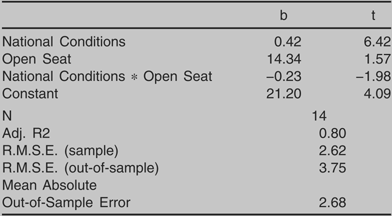
These visual patterns are put to the test in Table 1, which displays the results of a regression analysis in which the dependent variable is the percent of the two-party vote going to the incumbent presidential party and the independent variable is interacted with a dichotomous variable scored 0 for incumbent contests and 1 for open-seat contests. Lamentably, with only 14 observations, collinearity is a major concern and it is not possible to enter approval, personal finances, and their separate interactions with incumbency in the same model.Footnote 2 Instead, I present in Table 1 the results of the national conditions model, which combines both approval and personal finances into a single variable, as described above, and requires only one interaction term. If there is really less accountability during open-seat contests, the interaction slope should be negative and significant; and, indeed, the results in Table 1 do indicate less accountability in years in which no incumbent is running. The impact of personal finances and presidential approval is much greater in incumbent races than in open-seat contests. And despite the high level of collinearity (tolerance = .026), the interaction term is significant at the 0.05 level (one-tailed).
Incumbency-based Forecasting Model for Presidential Elections, 1952–2004

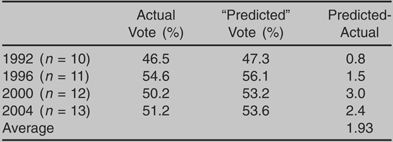
One important question is whether these findings are robust, or if they are due to just one or two influential data points. One way of assessing this is to focus on the out-of-sample predictions, derived for each year by dropping that observation and predicting the outcome based on data from the other 13 years. Doing so for this model generates an average absolute out-of-sample error of 2.68 percentage points. Another way of evaluating the expected accuracy of the model is by looking at pseudo a priori predictions from the last several elections based on estimates that would have been generated at the time from previous elections. So, for instance, the predicted outcome for 1992 is based on slopes generated from data from 1952 to 1988. The accuracy of these “predictions” is displayed in Table 2, where we see that the model estimates are, on average, within just less than 2 percentage points of the actual outcome.Footnote 3
Pseudo Predictions from 1992 to 2004

Note: Cell entries are actual and predicted percent of the two-party vote for the incumbent presidential party.
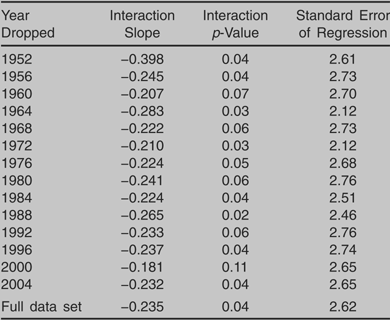
Also important, however, is whether the model overall, and the interaction term in particular, change very much when single years are dropped. Table 3 provides some evidence on this point. Here we see that for the most part the magnitude and significance of the interaction slope do not change much as cases are dropped. Two cases stand out as having the greatest impact on the interaction effect, 1952 and 2000. The interaction coefficient becomes much stronger if 1952 is dropped and slightly weaker if the 2000 election is dropped. The 2000 election also represents the case whose deletion has the greatest impact on the significance of the slope. It is worth pointing out, though, that even with the 2000 election excluded, the model predicts an outcome for the 2008 election that is within 1 percentage point of the prediction generated by the full model.
The Sensitivity of the Incumbency Interaction Term to Case Deletion

The 2008 Forecast
With the 2008 values of presidential approval (30.8%) and consumer satisfaction (71.3), the national conditions index stands at 47.6, which generates a predicted 2008 outcome of 44.3% of the two-party vote for John McCain and 55.7% for Barack Obama. Using the out-of-sample standard error and the t-distribution, the estimated probability of a McCain victory stands at 0.08. These are long odds and do not auger well for the McCain camp.
Caveats
While the model has a high level of predictive accuracy and there is every reason to expect the actual outcome will be close to the predicted outcome, there are also reasons to exercise caution. First, there is no way for the model to incorporate factors such as candidate characteristics that are truly unique and important to individual elections. The assumption I make is that these factors are usually given relatively little weight by voters, in part because candidates are usually drawn from the same pool of relatively well-off, White, male politicians. The 2008 election, of course, is the first in which an African American candidate is representing one of the two major political parties. Will this matter in the end? Will it help or hurt McCain? It's hard to tell what role race will play in the end but, given that there is evidence (Kinder and Sanders Reference Kinder and Sanders1996) that racial attitudes played an important role if the 1988 election (Willie Horton), when two white men opposed each other, it would be naïve to think race will not play a role in 2008. The problem for forecasters is that there are no data points (no mixed-race presidential contests) and, hence, no real way to model the expected impact of race.
Another possibility is that Obama will “Gore” the forecasting model by ignoring the George W. Bush/Dick Cheney Record and give McCain a free pass. Based on the savvy demonstrated by his campaign staff during the primary season, I don't see this as a real possibility, but it could have an impact if he does. If there is a lesson for the Obama campaign to take from past elections it is that presidential performance matters, but it may require greater effort to frame the contest as a referendum when the president is not on the ticket. And, of course, this means that the McCain campaign's best strategy is to distance their candidate from President Bush and, first and foremost, avoid having the election turn into a referendum on the Bush presidency. The fact that campaigns generally act strategically usually means that voters get the referendum cue (more strongly I would suggest when the president is on the ticket) and election outcomes are fairly predictable. In this way, a “campaigns matter” perspective is entirely consistent with predictable elections. If either McCain's or Obama's assumed strategies dominate this fall, then the actual outcome could differ substantially from the predicted outcome.
Finally, this forecast is based on a single model from a relatively small number of years, and the findings might not hold with other retrospective variables. In fact, when percentage change in GDP over the first two quarters is substituted for aggregated personal finances in the model presented here, the incumbency interaction is not significant. This may indicate that the conditional effects from incumbency are more likely to emerge when using survey-based economic measures, such as economic perceptions, which may capture some political as well as economic content. Even with this important caveat, however, the bottom line is that forecasters should check to see if the reward-punishment aspects of their models are sensitive to the conditioning influence of incumbency.
Conclusion
The results of this analysis fit quite nicely with Campbell's (Reference Campbell2008) contention that forecasting models need to control for incumbency when using “accountability” variables. It also reflects the same sentiment found in Nadeau and Lewis-Beck's (Reference Nadeau and Lewis-Beck2001) individual-level work, which found that voters generally assigned less blame or credit to the incumbent party during open-seat contests. The upshot for the 2008 election is that although McCain's non-incumbent status should soften the impact of the current political environment somewhat, he is still expected to bear enough responsibility that victory will be out of reach.