1. Introduction
As countries experience economic growth, one key environmental challenge that arises is the maintenance of ambient air quality. In 2013, among Organisation for Economic Co-operation and Development (OECD) member countries, South Korea was reported to have the highest average concentration of particulate matter (PM),Footnote 1 and such environmental conditions have increased concerns about the adverse effect of exposure to PM pollution among South Korean citizens. However, reducing air pollution in Korea poses a complex health policy problem due to its transboundary nature in the East Asian region; the air quality of South Korea is determined not only by local emissions but also by persistent westerlies carrying air pollution from China, which is located west of South Korea. For example, in 2014, the daily fine PM ($\text {PM}_{2.5}$ ) concentration in Seoul abruptly reached 86 $\mu \text {g} /\text {m}^{3}$
 on February 25, which occurred after Beijing's daily $\text {PM}_{2.5}$
 level reached 13 times the World Health Organization (WHO) safe limit of 25 $\mu \text {g} /\text {m}^{3}$
 from February 20 to 25 (figure A1, online appendix). In fact, most high PM episodes, during which PM levels exceeded the national air quality standards in South Korea, were identified as pollution increases caused by mass air flow through an external pollution source, e.g., eastern mainland China (Lee et al., Reference Lee, Ho and Choi2011; Lee et al., Reference Lee, Koo, Hong, Choi, Kim, Lim, Holben, Eck, Ahn, Park and Kim2017).Footnote 2
Given that a measurable proportion of the pollution to which South Koreans are exposed is attributable to transboundary pollutants from China, what impact does this exposure have on the understudied South Korean population, especially with regard to fetal health? Moreover, do the effects on Korea have meaningful implications for understanding the potential health effects on China? These questions are important but difficult to answer, particularly in this regional setting.
While outdoor air pollution in South Korea is not entirely due to pollution from China, the transboundary air pollution provides a unique setting to analyze the population health implications; due to the atmospheric condition, there are certain days of high PM episodes in Korea soon after high PM episodes in China. The analysis of health effects from such high PM episodes, using the rich micro-data from South Korea, can provide evidence on socioeconomic implications of outdoor air pollution to policymakers and also potential health effects on China, where availability of micro-level health data may differ across regions. Despite such transboundary setting that is amenable for analysis, there are key remaining challenges to overcome, not only the non-random assignment of pollution among the public due to residential sorting and avoidance behaviors (Chay and Greenstone, Reference Chay and Greenstone2005; Banzhaf and Walsh, Reference Banzhaf and Walsh2008; Graff Zivin and Neidell, Reference Graff Zivin and Neidell2013; Currie et al., Reference Currie, Davis, Greenstone and Walker2015), but also the credible disentanglement of the contributions via transboundary pollution and locally emitted pollution.
To circumvent these empirical challenges, we directly link ‘daily’ variations in the $\text {PM}_{2.5}$ concentration measured in Beijing, China, with ‘daily’ fetal mortality rates in different cities and regions in South Korea to estimate the reduced-form impact of high PM episodes on fetal death, measured in the period from 2009 to 2013. We take advantage of daily variations in PM concentrations in Beijing, which are substantial enough to be the primary source for transboundary pollution and are also arguably orthogonal to the daily determinants of health for residents in neighboring countries. In particular, day-to-day changes in Chinese pollution can be expected to have an immediate impact on the health of the South Korean population, whereas the socioeconomic characteristics of the population at risk or local economic activities may not be the channel through which pollution interacts with health in such a short time.
Importantly, we examine the impact of pollution on fetal health using rare microdata on fetal deaths in South Korea. Fetal mortality can be a noteworthy metric to study along with infant mortality for two reasons. First, exposure to pollution can be more precisely identified by considering only indirect exposure through the mother, whereas examining the effect on infants requires further consideration regarding the direct exposure of newborns to pollution in addition to the in utero exposure to pollution (Chay and Greenstone, Reference Chay and Greenstone2003). In other words, postnatal outcomes of fetal health, such as birth weight averages and mortality rates, are inevitably subject to selection bias because those metrics can be calculated only with infants who are born (Sanders and Stoecker, Reference Sanders and Stoecker2015). Furthermore, in the context of developed countries, where low fertility rates tend to be more common and is a pressing societal issue, the fetal mortality rate is an important public health agenda to pursue for policymakers (Woods, Reference Woods2008).
We begin our analysis to confirm the first-stage associations between the pollution levels of China and those of Korea. We find that one standard deviation increase in Beijing's daily $\text {PM}_{2.5}$ is correlated with an increase in South Korea's daily levels of four pollutants ($\text {PM}_{10}$
 , CO, $\text {NO}_{2}$
 , $\text {SO}_{2}$
 ) by 6.3 per cent of a standard deviation on average after controlling for local weather conditions.Footnote 3 Next, we study the influence of pollution from China on fetal deaths in South Korea. Our analysis shows that one standard deviation increase in Beijing's $\text {PM}_{2.5}$
 during the previous day ($t-1$
 ) is associated with 1.1 per cent of the standard deviation of daily fetal mortality rates at 16 weeks or more of gestational age across cities in South Korea.
Lastly, we further explore how daily fetal mortality rates in South Korea respond to high PM events in Beijing because severe air pollution might have nonlinear effects on health above certain thresholds. Our event-study analysis indicates that one day after a high PM event in Beijing, there are, on average, 0.91 more fetal demises per 1,000 daily live births, which is mostly driven by the effects found in the region closer to Beijing.
Among several new avenues pursued in this study, one notable contribution to the existing literature is the direct investigation of negative spillovers between countries. In this study, we focus on how usual economic activities can exert negative externalities on the health of neighboring countries’ populations, whereas Almond et al. (Reference Almond, Edlund and Palme2009b) and Jayachandran (Reference Jayachandran2009) exploit rather unusual events that caused long-range transport of hazardous matter from the source regions of Chernobyl in Ukraine and Indonesia, respectively. In particular, our analysis of rare micro-level health census data from South Korea can enhance the understanding of the mortality effects of air pollution as manifested by fetal health, providing lower-bound estimates for the health costs not only for South Korean population but also for Chinese population. In contrast to Jia and Ku (Reference Jia and Ku2019), who also assessed the impact of Chinese pollution carried by Asian dust on monthly mortality rates in South Korea, we focus on a narrower window for mortality to react to daily pollution, providing further informative evidence on the adverse impacts of air pollution spillovers.Footnote 4
Second, our study contributes to the literature that studies the impact of pollution on fetuses at various development stages, whereas a vast majority of the existing literature on both more and less developed countries focuses on infant mortality.Footnote 5 By using information on fetal deaths at different gestational ages, we provide evidence on the short-term impact of air pollution on fetal deaths by precisely matching fetal exposure to pollution at any given pregnancy week. Thus, our findings complement prior studies suggesting that in utero exposure to ambient air pollution can be of critical importance in determining not only infant health but also labor market outcomes in the long run (Isen et al., Reference Isen, Rossin-Slater and Walker2017; Lavaine and Neidell, Reference Lavaine and Neidell2017).
Finally, this study contributes to a burgeoning strand of the literature using a variety of novel instruments for ambient air pollution to address the endogeneity problem from residential sorting. Some scholars have accounted for wind direction and wind speed (Schlenker and Walker, Reference Schlenker and Walker2016) or the distance from pollution (Moretti and Neidell, Reference Moretti and Neidell2011; Knittel et al., Reference Knittel, Miller and Sanders2016), since pollutants travel across space. Furthermore, a number of studies on the Chinese setting also provide quasi-experimental evidence on a significant health impact of $\text {PM}_{10}$ . Chen et al. (Reference Chen, Ebenstein, Greenstone and Li2013) and Ebenstein et al. (Reference Ebenstein, Fan, Greenstone, He and Zhou2017) exploit the variation in $\text {PM}_{10}$
 concentrations due to the Huai River Policy and find a significant decline in life expectancy at birth and an increase in cardiorespiratory mortality rates. He et al. (Reference He, Fan and Zhou2016) focus on the 2008 Beijing Olympic Games and find that a 10 per cent decline in $\text {PM}_{10}$
 levels causes all-cause monthly mortality rates to drop by 8 per cent. Meanwhile, other settings that have been explored include legislative or social changes leading to temporal or spatial discontinuity of pollution levels (Chay and Greenstone, Reference Chay and Greenstone2003; Almond et al., Reference Almond, Chen, Greenstone and Li2009a; Ito and Zhang, Reference Ito and Zhang2016; Isen et al., Reference Isen, Rossin-Slater and Walker2017; Lavaine and Neidell, Reference Lavaine and Neidell2017; Gehrsitz, Reference Gehrsitz2017). By exploiting daily variations of pollution in China and given that persistent westerly winds travel from China to Korea, we contribute to the literature through our analysis of the short-term health effects of acute air pollution exposure on fetal mortality rates in Korea.
The rest of the paper is organized as follows. Section 2 discusses the association between air pollution and fetal deaths and provides background knowledge on the transboundary transport of pollution in the East Asian region. Section 3 describes the data. Sections 4 and 5 present our empirical methodologies and the results. We conclude in section 6.
2. Background
2.1. Transboundary transport of pollutants
The transboundary transfer of pollutants from China to South Korea can be explained by characteristics of pollutants and regional meteorological conditions. First, because of its small size, $\text {PM}_{2.5}$ can remain in the atmosphere for days or even weeks and thus can be subject to long-range transboundary transport (National Research Council, 2010). Measurable amounts of pollutants are produced primarily in eastern mainland China and are available to be transported to Korea via consistent air flows and even to the United States (Lin et al., Reference Lin, Pan, Davis, Zhang, He, Wang, Streets, Wuebbles and Guan2014). According to field studies on air quality conducted through international cooperation among East Asian countries (KORUS-AQ, 2017), domestic factors accounted for 52 per cent of Korean pollution, while Chinese sources accounted for 34 per cent. Other miscellaneous factors accounted for 14 per cent of the $\text {PM}_{2.5}$
 levels in Seoul from May 2 to June 12, 2016. In addition to the transported primary particles affecting PM concentrations in South Korea, precursor particles, such as sulfate or nitrate, are also transported and form secondary PM or gaseous pollutants when chemicals from remote and local sources react in the atmosphere (KORUS-AQ, 2017).
Second, seasonal winds in the East Asian region influence the eastward movement of pollutants from China. In conjunction with the westerlies, the prevailing wind in the mid-latitudes, seasonal variations in high- and low-pressure systems in the region can either strengthen or weaken such wind patterns.Footnote 6 For example, during the winter season, high-pressure systems located over northwest China with lows in the Pacific Ocean create the strongest of all seasonal winds that blow from China to Korea. The direction rarely changes unless local geography such as basin terrain and mountain ranges serves to change the prevailing direction (figure A2, online appendix). However, during the summer, the wind speed attenuates, and its direction changes as highs over the southern Pacific become stronger. In sum, this seasonal wind pattern allows pollution emitted from the heavily industrialized eastern region of ChinaFootnote 7 to be transported to regions in the East, including Korea, for all months except for the summer. Moreover, it takes approximately one day on average for pollutants from Beijing to arrive in South Korean cities (Lee et al., Reference Lee, Ho and Choi2011). The identification of transboundary sources and air flows can be more clearly illustrated by conducting the wind back-trajectory analysis, as shown in figure A3 (online appendix). China's eastern region can be identified as the source region for the high PM events in November and January, whereas local emissions are likely to be the source for high $\text {PM}_{2.5}$ levels in July. Using this back-trajectory analysis, among 254 high-$\text {PM}_{10}$
 episodes ($\geq$
 100 $\mu \text {g} /\text {m}^{3}$
 for 24-h mean of $\text {PM}_{10}$
 ) in South Korea in 2001–2008, 178 events could be identified as air pollution events occurring due to an external source of pollution (Lee et al., Reference Lee, Ho and Choi2011).
2.2. Air pollution and fetal health
The adverse health effects of exposure to PM have been documented by an extensive body of epidemiological studies. Numerous studies delve into the relationship between ambient air pollution and adverse postnatal outcomes, such as infant mortality, low birth weight, or preterm birth (Chay and Greenstone, Reference Chay and Greenstone2003; Currie and Neidell, Reference Currie and Neidell2005; Ritz et al., Reference Ritz, Wilhelm, Hoggatt and Ghosh2007; Currie et al., Reference Currie, Neidell and Schmieder2009; Currie and Walker, Reference Currie and Walker2011; Ha et al., Reference Ha, Hu, Roussos-Ross, Haidong, Roth and Xu2014; Arceo et al., Reference Arceo, Hanna and Oliva2016; Knittel et al., Reference Knittel, Miller and Sanders2016). In particular, recent studies using state-level stillbirth data suggest that even short-term exposure to PM pollutants can lead to fetal deaths in utero (Faiz et al., Reference Faiz, Rhoads, Demissie, Lin, Kruse and Rich2013; DeFranco et al., Reference DeFranco, Hall, Hossain, Chen, Haynes, Jones, Ren, Lu and Muglia2015; Green et al., Reference Green, Sarovar, Malig and Basu2015) and thus affect the sex ratio of livebirths in the United States (Sanders and Stoecker, Reference Sanders and Stoecker2015).
Despite the accumulating evidence on the effects of air pollution on fetal deaths, only a few studies have elucidated the biological pathways through which PM affects fetuses in utero. By observing the levels of carboxyhemoglobin that were sampled from the umbilical cord and ambient CO levels in children delivered by nonsmoking pregnant women, high pollutant concentrations, including PM, were found to be adversely associated with fetal health (Pereira et al., Reference Pereira, Loomis, Conceicao, Braga, Arcas, Kishi, Singer, Boehm and Saldiva1998). Clemens et al. (Reference Clemens, Turner and Dibben2017) found a link between an increase in PM exposure ($\text {PM}_{10}$ , $\text {PM}_{2.5}$
 and $\text {NO}_{2}$
 ) and significant reductions in fetal growth, namely, biparietal diameter, from the late second trimester, even in regions with typically lower average PM concentrations. PM can have an even more detrimental effect on pregnant women due to an increase in the alveolar ventilation rate during pregnancy, which leads to an increased intake of pollutants in the body (Hackley et al., Reference Hackley, Feinstein and Dixon2007). Although most of these studies do not imply a direct causal link between PM exposure and fetal and maternal health, recent research examined placental cells from pregnant women and found the first direct evidence that carbon particles in polluted air can reach the placenta via the bloodstream (Liu et al., Reference Liu, Miyashita, Mcphail, Thangaratinam and Grigg2018).
3. Data
3.1. Pollution in South Korea
For five major pollutants ($\text {PM}_{10}$ , CO, $\text {NO}_{2}$
 , $\text {SO}_{2}$
 , and $\text {O}_{3}$
 ), the hourly readings are retrieved from Air Korea, the information center in charge of real-time ambient air pollution readings from monitors across the country.Footnote 8 Each district in a city has at least one monitor, which is usually located in a residential area. This richness in spatial resolution minimizes measurement errors arising from remedial procedures to interpolate residents’ potential exposure to pollution (Lleras-Muney, Reference Lleras-Muney2010). We focus on 140 monitors located in 140 districts of 21 cities with a high population density ($\geq$
 3,000 people/$\text {km}^{2}$
 ) because the likelihood of having adverse pregnancy outcomes is also influenced by unobservable characteristics of pregnant women's location, such as the distance between a hospital and her residence or the intensity of locally emitted pollution.Footnote 9
The locations of the district-level pollution monitors are marked in figure A4 in the online appendix. The daily mean of each pollutant is the duration-weighted average of hourly readings following Schlenker and Walker (Reference Schlenker and Walker2016). Because PM measurements from monitors in South Korea have a high frequency of missing values compared with other pollutants and weather covariates, we keep daily observations only if a monitor has at least five hourly readings per day.Footnote 10
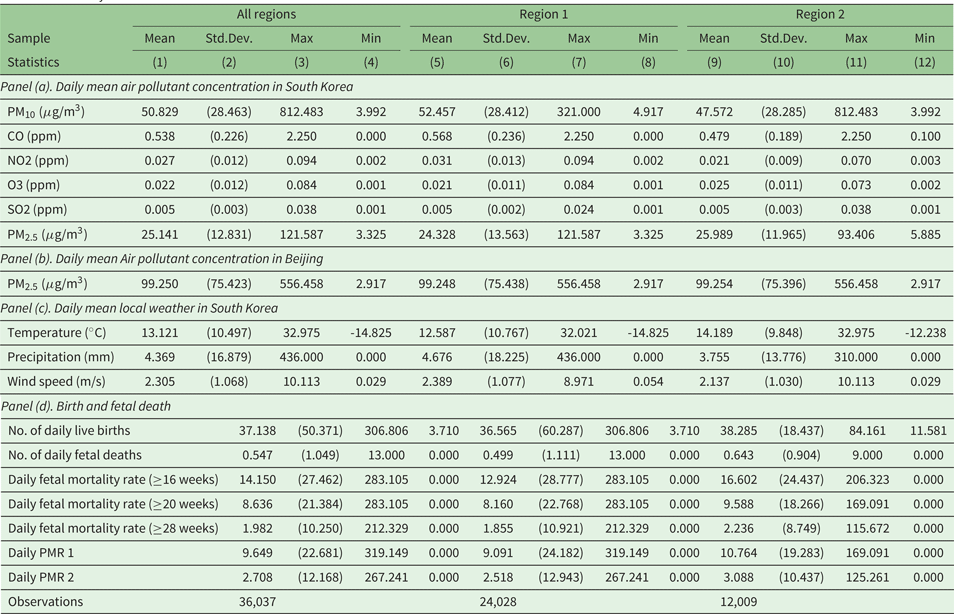
In our empirical analysis, we group cities into two regions based on their distance from Beijing. Although local ambient air pollution levels in South Korean cities can differ depending on a variety of characteristics, such as geography, topography, and road networks, the distance from eastern mainland China can be one of the most influential factors determining the intensity of city-level exposure to transboundary air pollution. Specifically, Region 1 includes Seoul and 13 metropolitan areas that are economically interdependent. This is the closest region to Beijing (approximately 950 km) and also has the highest population density in the country. Region 2 includes the remaining cities in South Korea, which are approximately 1,030–1,200 km away from Beijing. Since this categorization depends solely on a city's distance from Beijing, if there is no impact of the transboundary pollution, then the effects of Beijing's air pollution on health in South Korea will not differ by distance from China after controlling for weather variables and a host of fixed effects. The summary statistics of daily pollution levels for each region are provided in panel (a) of table 1.
Summary statistics

Notes: This table reports summary statistics of selected city-day-level pollution in South Korea, Beijing, and local weather conditions and birth and fetal death information in South Korea. Column (1), (2), (3), (4) represent the mean, standard deviation, maximum and minimum value of the variables for all regions. Summary statistics for Region 1 are presented in columns (5) to (8), and those for Region 2 are presented in columns (9) to (12). $\text {PM}_{2.5}$ observations in Region 1 and Region 2 come from Seoul and Busan in 2010--2013, respectively. Daily fetal mortality rates are presented for gestation weeks at 16 weeks or more (FMR (${\geq}16$
 weeks)), at 20 weeks or more (FMR (${\geq}20$
 weeks)), and at 28 weeks or more (FMR (${\geq}28$
 weeks)). Perinatal mortality rate 1 (PMR1) uses the fetal deaths at gestational age at 20 weeks or more and the infant deaths within 28 days after birth. Perinatal mortality rate 2 (PMR2) uses the fetal deaths at gestational age at 28 weeks or more and the infant deaths within 7 days after birth.
3.2. Pollution in China
Given the nature of the westerlies and the location of cities in South Korea, the pollution concentrations in China's northeastern region, which is heavily polluted, are considered to be the major source location of transboundary pollutants. Although the Chinese government operates numerous pollution monitors and releases real-time readings to the public, it is challenging to use data from these stations, since there are access restrictions to historical data from the Chinese government and the possibility of non-classical measurement error caused by underreporting or bunching at the thresholds (Chen et al., Reference Chen, Jin, Kumar and Shi2012; Ghanem and Zhang, Reference Ghanem and Zhang2014).
Consequently, we use the $\text {PM}_{2.5}$ readings from the monitor located at the U.S. embassy in Beijing, which is administered by the U.S. Department of State Air Quality Monitoring program, because this fully covers our study period from 2009 to 2013.Footnote 11 We assume that the Beijing monitor's readings are a credible proxy for the average pollution level in Northeastern China, where most of the transboundary air pollution originates. In our analysis, duration-weighted daily averages available for more than five hourly readings per day are used because PM readings in Beijing also have a high frequency of missing values. The summary statistics of the daily $\text {PM}_{2.5}$
 pollution levels in Beijing are presented in panel (b) of table 1. Panel (a) in figure A5 in the online appendix shows that the $\text {PM}_{2.5}$
 level in Beijing is so high to the extent that daily average $\text {PM}_{2.5}$
 levels rarely drop below the WHO guideline for daily $\text {PM}_{2.5}$
 exposure, which is 25 $\mu \text {g} /\text {m}^{3}$
 per day. In particular, the period between November and March is salient with regard to Chinese pollution, because this period is the season during which the Chinese government provides heating in northern Chinese cities. Inefficient combustion of coal occurs during the heating season, so PM pollution may increase discontinuously throughout the heating season (Almond et al., Reference Almond, Chen, Greenstone and Li2009a; Xiao et al., Reference Xiao, Ma, Li and Liu2015). However, we find that the pollution level in Beijing is consistently high, irrespective of the season, along with the high variability in day-to-day concentrations (panel (a) in figure A5).
3.3. Weather in South Korea
South Korean weather information is collected at stations administered by the Korea Meteorological Administration (KMA). Each station reports hourly observations of the temperature, wet-bulb temperature, wind direction and speed, precipitation, pressure, absolute and relative humidity, and sun hours. Because local weather conditions critically affect the formation or deposition of pollutants (U.S. EPA, 2009) and can directly influence health (Deschenes and Moretti, Reference Deschenes and Moretti2009; Deschenes et al., Reference Deschenes, Greenstone and Guryan2009), flexible controls of all observable weather variables are included to focus on the contemporaneous effects of transboundary pollution. Seven metropolitan areas and four cities use weather observations from their own weather stations, whereas observations from the nearest cities are used for cities that lack weather stations within the city boundary. In total, hourly observations from 11 weather stations are matched to hourly readings of pollution in 21 cities. The daily weather observation values are calculated using the duration-weighted average, and, in most cases, very few values are missing. The summary statistics for the city-level weather data are provided in panel (c) of table 1.
3.4. Fetal mortality
Statistics Korea has provided a census of fetal deaths since 2009 by merging information from the hospitals that store cremation certificates. All fetal deaths at or after a gestational age of 16 weeks in South Korea are reported with the cause of deathFootnote 12, sex, and maternal characteristics, such as age, weight, pregnancy history, smoking status, marital status, and education. We use these fetus level data matched with the mother's information from 2009 to 2013.Footnote 13
The outcome of interest is the city-level daily fetal mortality rate, which is the day-level count of fetal deaths at 16 weeks or more of gestational age weighted by 1,000 average daily live births and daily fetal deaths in a city. Since publicly available birth census data do not contain the exact birth date, we estimate average daily births by dividing the number of births in a month by the number of days in that month.Footnote 14 Additionally, we use (1) city-day-level fetal mortality rates at 20 and 28 weeks or more of gestational age, and (2) perinatal mortality rates, which incorporate fetal deaths at 20 weeks or more within 28 days after birth (PMR1), along with fetal deaths at gestational age at 28 weeks or more and infant deaths within 7 days after birth (PMR2) on a given day to examine the effects of pollution on fetuses and newborns (MacDorman and Kirmeyer, Reference MacDorman and Kirmeyer2009). Because data on fetal losses before 16 weeks of gestational age are not provided, the estimates of the effect of pollution on fetuses may be biased due to truncated samples. However, although the majority of fetal losses occur within the first trimester, miscarriages during the first trimester and early second trimester can be mostly identified as sporadic losses, which are primarily associated with chromosomal abnormalities (Johnson et al., Reference Johnson, Hallock, Bienstock, Fox, Wallach and University2015). Thus, confining the sample to later stages of pregnancy can be more relevant to studies investigating the effects of pollution as a key external stressor for fetal health. The summary statistics regarding fetal deaths are presented in panel (d) of table 1. Region 2 has a higher average daily fetal mortality rate than Region 1. For both regions, the daily fetal mortality rate is the highest for 16 weeks or more and decreases with more weeks of gestation. In addition, figure A7 in the online appendix illustrates little evidence of seasonal trends in fetal deaths.
4. Empirical methodology
This study aims to provide an analysis of the adverse effect of Chinese $\text {PM}_{2.5}$ pollution on fetal health in South Korea. First, whether South Korea's ambient air pollution is associated with pollution from the northeastern region of China is investigated. After this estimation, the main analysis entails understanding how much of daily fetal mortality can be explained by the day-to-day variations in transboundary pollution from China.
4.1. Chinese PM level and local pollution levels
To establish the relationship between Chinese and South Korean pollution levels, we link the intensity of pollution in the source region, proxied by readings in Beijing, with pollution levels in the receptor location along with a vector of atmospheric variables and temporal controls. We estimate the association using the following equation:

where $Pollution_{ct}$ , which stands for one of five primary pollutants ($\text {PM}_{10}$
 , CO, $\text {NO}_{2}$
 , $\text {SO}_{2}$
 , and $\text {O}_{3}$
 ) in city $c$
 in South Korea on day $t$
 , is a function of a lead or lag of up to 5 days of the daily mean $\text {PM}_{2.5}$
 level in Beijing conditional on weather, temporal controls, and time trends. First, weather controls are included as flexible polynomials, and cross-terms interact with year, month, and day of the week dummies because the estimation can be sensitive to the inclusion of higher-order terms of temperature and precipitation and second-order terms of other weather variables (Knittel et al., Reference Knittel, Miller and Sanders2016).Footnote 15 Second, temporal controls $\mathbf {Z}_t$
 include year, month, and day of the week fixed effects to indirectly control for pollution-generating activities in a city. Third, city-level fixed effects control for time-invariant unobserved determinants of pollution. In addition, given that not only the city's geography and topography but also its infrastructure and economic characteristics largely determine the daily pollution level (U.S. EPA, 2009), city-specific linear and quadratic time trends are included in the main specification. To minimize concerns regarding serial correlation of the variables depending on the locations of cities in a given year, robust-standard errors clustered at the city level are used.Footnote 16
The coefficient of our primary interest is $\alpha _1$ , which quantifies the contribution of Beijing's $\text {PM}_{2.5}$
 from five-day lags ($t-5$
 ) to five-day leads ($t+5$
 ) on the level of five pollutants in a city $c$
 on day $t$
 in South Korea. In fact, analyzing the coefficient $\alpha _1$
 on Beijing's $\text {PM}_{2.5}$
 from an one-day lead ($t+1$
 ) to a five-day lead ($t + 5$
 ) can confirm whether the transboundary transport of pollution occurs in one direction, i.e., from China to South Korea, and not in the other direction, i.e., from South Korea to China.
4.2. Daily PM level in Beijing and fetal mortality in South Korea
To estimate the link between Beijing's daily average $\text {PM}_{2.5}$ levels and South Korea's daily fetal mortality rates (‘reduced-form’), we follow the same approach as in equation (1):

where $Fetrate_{dt}$ is the daily fetal mortality rate in city $c$
 in South Korea on day $t$
 . Fetal deaths after 16 weeks of gestational age is the main focus and used as the baseline, but diverse measures of fetal mortality rates are also used to examine heterogeneous effects of pollution on different stages of fetal development. To focus on the transboundary effects of ${PM}_{2.5t}$
 in Beijing, $R_{c,t-l}$
 , a vector that represents local $\text {PM}_{10}$
 levels up to five-day lags ($L=\{0,1,2,3,4,5\}$
 ), is included in the equation to control for the potential effects of local pollution levels. In equation (2), our primary parameter of interest is $\beta _1$
 , which captures the effect of exposure to transboundary pollution on fetal deaths. A consistent estimation of $\beta _1$
 requires $\mathbb {E}[\text {PM}_{2.5t} \cdot e_{ct}|\mathbf {Weather}_{ct},\mathbf {Z}_{t},R_{c,t-l},\mathbf {Trend}_{ct},v_{c}] =0$
 , indicating that the daily variation in PM in Beijing is orthogonal to the unobserved determinants of the daily fetal mortality in South Korea after controlling for local weather and pollution conditions, city fixed effects, and time trends. We cluster robust-standard errors at the city level and weight all estimates using the count of newborns in each city.
5. Results
5.1. Effects of Beijing's daily $\text {PM}_{2.5}$ on daily local pollution levels in South Korea

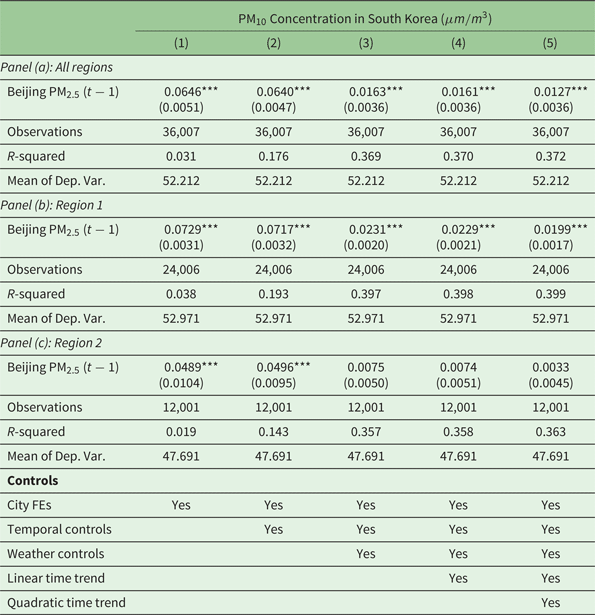
The first set of results presents the extent to which pollution in Beijing can explain daily local pollution levels in cities in South Korea. Table 2 displays the first-stage estimates using equation (1), describing how much the previous day's ($t-1$ ) $\text {PM}_{2.5}$
 level in Beijing can be associated with the current day ($t$
 )'s $\text {PM}_{10}$
 levels in cities in South Korea. Although $\text {PM}_{2.5}$
 in South Korea can be a more suitable pollutant to ascertain transboundary transport, we consider $\text {PM}_{10}$
 as baseline estimates due to its nationwide monitor coverage.Footnote 17 The parameter of our primary interest is shown in column (5), panel (a) of table 2, indicating that one standard deviation increase in Beijing's $\text {PM}_{2.5}$
 level on an one-day lag ($t-1$
 ) can explain approximately 3.4 per cent of the standard deviation in daily $\text {PM}_{10}$
 levels in $t$
 in 21 South Korean cities after controlling for a host of temporal and weather controls. This is driven primarily by the effect found in Region 1 (panel (b)), which explains approximately 5.3 per cent of one standard deviation of daily $\text {PM}_{10}$
 in $t$
 in Region 1. However, panel (c) shows that the coefficient in the other region is not significant at any conventional level of significance.
Effects of Beijing's $\text {PM}_{2.5}$ level in $_{t-1}$
 on local $\text {PM}_{10}$
 level in $t$
 in South Korea

Notes: This table contains results from equation (1). Panel (a) presents results from the entire sample, while panel (b) uses a sample of Region 1, and panel (c) for Region 2. Regressions are weighted by the number of live births in a city. Robust standard errors are shown in parentheses and clustered at the city level. *** Significant at the 1 per cent level. ** Significant at the 5 per cent level. * Significant at the 10 per cent level.
Since the small size of $\text {PM}_{2.5}$ allows for easier transboundary transport, we estimate the effect of Beijing's $\text {PM}_{2.5}$
 on an one-day lag ($t-1$
 ) upon $\text {PM}_{2.5}$
 on $t$
 in Seoul (Region 1) and Busan (Region 2) using $\text {PM}_{2.5}$
 readings during the period between 2010 and 2013. In panel (b) of table A2 (online appendix), we find that one standard deviation increase in Beijing's $\text {PM}_{2.5}$
 on an one-day lag ($t-1$
 ) leads to a 1.079 $\mu \text {g} /\text {m}^{3}$
 increase in Seoul's current day $\text {PM}_{2.5}$
 level, which is approximately an 8 per cent increase of a standard deviation of Seoul's daily $\text {PM}_{2.5}$
 level on day $t$
 . This means that the more minuscule the particle size, the higher is the likelihood of that pollutant reaching neighboring countries. Consequently, if we find any adverse effects of transboundary pollution, then $\text {PM}_{2.5}$
 is highly likely to be responsible for the effect. In addition, if we exclude observations from July to September, when the wind direction does not favor pollution transport from China to South Korea, as illustrated in figure A2, one standard deviation of Beijing's $\text {PM}_{2.5}$
 on one-day lag ($t-1$
 ) can explain 9.6 per cent of a standard deviation of Seoul's daily $\text {PM}_{2.5}$
 level on day t (panel (d) of table A2). Our first-stage results are also in line with findings from prior scientific studies demonstrating that $\text {PM}_{10}$
 is more relevant to local sources, such as emissions from vehicles, rather than external sources, which are the originators of long-range pollutants (U.S. EPA, 2009).
Next, we estimate the coefficients on five-day lags and leads of Beijing's $\text {PM}_{2.5}$ level using the specification of equation (1). This analysis aims to identify the exact arrival time of transboundary pollutants from Beijing to cities in South Korea and allows us to investigate whether the transboundary effects work in only one direction. In addition to $\text {PM}_{10}$
 , we check how daily variations in Beijing's $\text {PM}_{2.5}$
 levels affect other gaseous pollution levels (CO, $\text {NO}_{2}$
 , $\text {SO}_{2}$
 , and $\text {O}_{3}$
 ) in South Korea. In particular, CO, $\text {NO}_{2}$
 , and $\text {SO}_{2}$
 can provide precursor particles for PM pollution, such as sulfate or nitrate, under certain local atmospheric conditions. Figure A8 in the online appendix presents the estimated standardized coefficients along with their 95 per cent confidence bands from the respective regressions of the level of five pollutants on day $t$
 in South Korea on five-day lags and leads of Beijing's $\text {PM}_{2.5}$
 level. This examines how one standard deviation increase in five-day lags and leads of Beijing's $\text {PM}_{2.5}$
 levels is associated with changes in local pollution levels on day $t$
 in South Korea relative to the day-to-day standard deviation.
In general, panel (a) shows that one-day lag ($t-1$ ) of Beijing's $\text {PM}_{2.5}$
 is the most influential point in time that explains the pollution levels in South Korea, conditional on weather and temporal covariates. One standard deviation of Beijing's $\text {PM}_{2.5}$
 on one-day lag ($t-1$
 ) explains 3.2, 7.8, 10.0, 4.0, and -5.5 per cent of a standard deviation of $\text {PM}_{10}$
 , CO, $\text {NO}_{2}$
 , $\text {SO}_{2}$
 , and $\text {O}_{3}$
 , respectively.Footnote 18 For $\text {PM}_{10}$
 (red circle), panel (a) shows that Beijing's $\text {PM}_{2.5}$
 on two-day lag ($t-2$
 ) also has comparable impacts on PM levels in South Korea as Beijing's pollution on $t-1$
 does. At the regional level, however, the coefficient on two-day lag ($t-2$
 ) is the highest for Region 2, whereas the coefficient on Beijing's $\text {PM}_{2.5}$
 level on one-day lag ($t-1$
 ) has the largest magnitude for cities in Region 1. These results are in line with our knowledge that the farther away cities are from the source region (Beijing), the longer it takes for pollutants to affect their pollution level.
Therefore, even though we use fine PM pollution in Beijing as a proxy for the primary source of transboundary pollution, we do not claim that the adverse impacts on fetal health are entirely attributable to $\text {PM}_{2.5}$ levels in Beijing. As shown in our first-stage results as well as evidence from a handful of scientific studies, Beijing's $\text {PM}_{2.5}$
 levels can also contribute to a measurable amount of precursor elements for the secondary reactions in South Korea, not only for PM but also for other types of gaseous pollution (U.S. EPA, 2009). Thus, we aim to explore the combined effects of transboundary pollution on fetuses rather than narrowly defined health effects of PM.
5.2. Effects of Beijing's daily $\text {PM}_{2.5}$ level on daily fetal mortality in South Korea

Based on the findings from the previous section, the relationship between Beijing's $\text {PM}_{2.5}$ on one-day lag ($t -1$
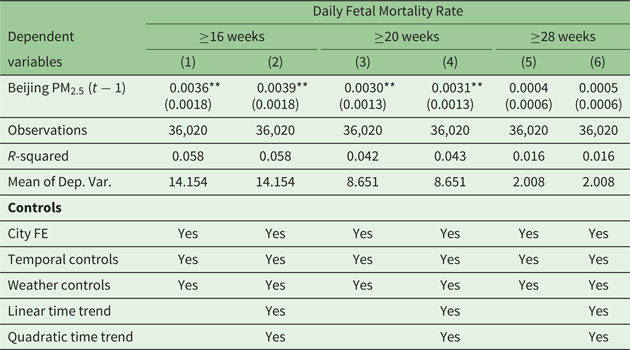
 ) and daily fetal mortality rates across 21 cities in South Korea is investigated. Table 3 presents the regression estimates of equation (2), showing the effect of Beijing's previous-day $\text {PM}_{2.5}$
 on daily fetal mortality rates in South Korea. The result using our main specification in column (2) indicates that one standard deviation increase in Beijing's $\text {PM}_{2.5}$
 level on one-day lag ($t-1$
 ) (approximately 75.423 $\mu \text {g} /\text {m}^{3}$
 ) leads to an additional 0.294 daily fetal deaths per 1,000 daily live births across all regions in South Korea, which is 1.1 per cent of the standard deviation of daily fetal mortality rates ($\geq$
 16 weeks).Footnote 19
Effects of Beijing $\text {PM}_{2.5}$ $_{t-1}$
 on daily fetal mortality rates in South Korea

Notes: This table contains results from equation (2). Regressions are weighted by the number of live births in a city. Robust standard errors are shown in parentheses and clustered at the city level. *** Significant at the 1 per cent level. ** Significant at the 5 per cent level. * Significant at the 10 per cent level.
Moreover, we further explore the contemporaneous response of fetal mortality at or after 20 and 28 gestational weeks and perinatal mortality to provide results comparable to those reported in the literature (MacDorman and Kirmeyer, Reference MacDorman and Kirmeyer2009). For example, using the number of fetal deaths occurring at 28 weeks of gestational age or older is helpful to analyze the effect of transboundary pollution on fetuses in the third trimester. Our estimation results indicate that the impact of Beijing's one-day lagged $\text {PM}_{2.5}$ level on daily fetal mortality rate is significant at or after 20 weeks, as shown in columns (3) and (4). These results are robust after controlling for both linear and quadratic time trends, and the magnitudes of the coefficient are similar for both specifications. However, the effect is not sustained to the extent of the third trimester, as shown by the insignificant results for 28 weeks (see columns (5) and (6)). Furthermore, table A3 (online appendix) shows the imprecisely estimated effects on daily perinatal mortality rates, suggesting little evidence of detrimental effects on infants.
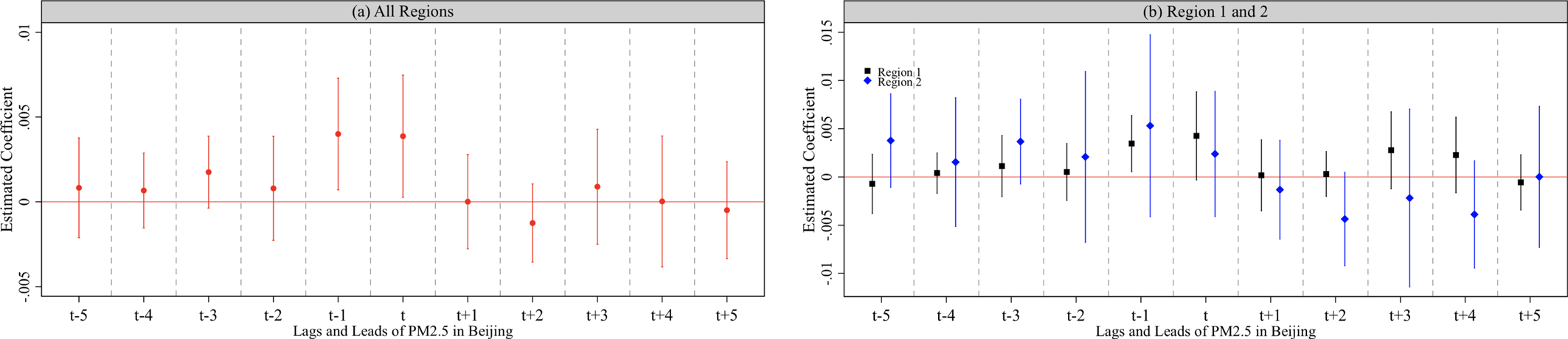
Moreover, we also estimate the effects of transboundary air pollution on fetal deaths using a series of time lags and leads for Beijing's $\text {PM}_{2.5}$ values. Figure 1 illustrates the effects of five-day lags and leads of Beijing's $\text {PM}_{2.5}$
 levels on the daily fetal mortality rate ($\geq$
 16 weeks) in South Korea after they are scaled by one standard deviation of pollution levels and the fetal mortality rate, respectively. First, panel (a) demonstrates that in all regions of South Korea, the impact of transboundary pollution on fetal deaths is statistically significant only for the one-day lag ($t-1$
 ) and $t$
 , with a slightly greater estimate for the one-day lag ($t-1$
 ) than for $t$
 . Two or more days of lags and leads of Beijing's $\text {PM}_{2.5}$
 levels do not have a significant impact on the daily fetal mortality rate in South Korea. According to panel (b), the effect is statistically significant only for the one-day lag ($t-1$
 ) in Region 1. The results are insignificant for Region 2, but the overall pattern of estimates from five-day lags to five-day leads are similar for both regions. The estimated coefficients for both Region 1 and Region 2 become greater around one-day lag ($t-1$
 ) and $t$
 , and then, the effect diminishes as the number of lagged days increases towards five-day lags ($t-5$
 ). In addition, most coefficients on forwarded values of Beijing's $\text {PM}_{2.5}$
 are not significantly different from zero, confirming that previous pollution levels in Beijing can adversely affect fetuses in South Korea but not the other way around.Footnote 20
Effects of Beijing's $\text {PM}_{2.5}$ on daily fetal mortality rate ($\geq$
 16 weeks) in South Korea Notes: Each panel provides the point estimates and the corresponding 95 per cent confidence intervals from linear regressions of daily fetal mortality rate ($\geq$
 16 weeks) in South Korea on lags and leads of Beijing $\text {PM}_{2.5}$
 level from $t-5$
 to $t+5$
 using equation (2). Panel (a) shows the effects on all regions and panel (b) shows the effects by the two regions-black squares for Region 1 and blue diamonds for Region 2 in South Korea.

We conduct a similar analysis for daily fetal mortality rates at 20 gestation weeks or greater to check whether the pattern is consistent. The patterns are similar for all regions, as shown in panel (a) of figure A9 (online appendix). A number of possible confounding factors have been addressed in our estimation. Since we use day-to-day variations, it is unlikely that local activities in those cities in South Korea are able to anticipate and respond to the transboundary pollution differently within a day depending on the location. Therefore, our results indicate possible negative spillover effects of air pollution from one country to the other, and these estimates are derived using the wind and meteorological patterns that are exogenous to the local or mother-level determinants of fetal deaths.
Lastly, we split the sample and run the same regressions to examine whether fetal mortality in South Korea reacts differently to pollution levels during the public heating season in northeastern China (from November to March). Figure A10 in the online appendix shows that the impact of pollution on daily fetal mortality rates ($\geq$ 16 weeks) can be explained primarily by fetal deaths occurring in the non-heating season.Footnote 21 This result is somewhat surprising because local pollution levels in Korea are higher on average during the heating season, as shown in panels (b) and (c) of figure A5 in the online appendix. There may be two main reasons why the effect is more conspicuous during the non-heating season. First, air pollution in Beijing is not low, on average, during the non-heating season. In our sample from 2009 to 2013, during the non-heating season, 416 out of 1,070 days experienced a $\text {PM}_{2.5}$
 level of greater than 100 $\mu \text {g} /\text {m}^{3}$
 . In comparison, during the heating season, 267 out of 765 days were reported to have a $\text {PM}_{2.5}$
 level greater than 100 $\mu \text {g} /\text {m}^{3}$
 . Thus, the number of days with a $\text {PM}_{2.5}$
 level greater than 100 $\mu \text {g} /\text {m}^{3}$
 is comparable in percentage terms, at 38.9 per cent for the non-heating season and 35.5 per cent for the heating season. Moreover, high PM events in Korea could occur more frequently during the non-heating season, when we account for the wind direction. For example, if we were to count the number of days, during which $\text {PM}_{2.5}$
 levels were greater than 100 $\mu$
 g/m$^{3}$
 in Beijing, and the winds in Seoul blew between 180–270 degreesFootnote 22, then the number of days per month, during our study period, are as followed: January (2), February (9), March (22), April (14), May (18), June (31), July (32), August (21), September (8), October (6), November (8), and December (2).Second, more outdoor activities occur during the non-heating season and result in varying degree of avoidance behaviors of pregnant women, depending on the ambient temperature and public awareness of pollution levels. Using the Time Use Survey of Korean Statistics (KOSTAT) for married women living in metropolitan areas between the ages of 20 and 55, women spent on average 40 minutes less at their home or someone else's home in July and September. compared to time measured in November and December. Furthermore, Lee and Lee (Reference Lee and Lee2017) found that Seoul residents spent significantly more time indoors at home and less time walking outdoors during winter compared to summer and fall. The non-heating season coincides with warmer periods, when it is plausibly easier for pregnant women to be mobile outside compared to the winter period.Footnote 23
5.3. Nonlinear effects of pollution on fetal deaths
Although we have analyzed the effect of PM pollution on daily fetal mortality rates primarily using linear specifications, there has been emerging research on the nonlinear relationship between air pollution and health. A nonlinear relationship between $\text {PM}_{2.5}$ and premature mortalities was found in Beijing (Zhao et al., Reference Zhao, Wang, Ding, Wu, Chang, Wang, Xing, Jang, Fu, Zhu, Zheng and Wang2019), Hangzhou (Zhang et al., Reference Zhang, Hong and Liu2017) and nation-wide China (Li et al., Reference Li, Guo, Liu, Wang, Wang, Sun, He and Shi2019). Moreover, DeFranco et al. (Reference DeFranco, Hall, Hossain, Chen, Haynes, Jones, Ren, Lu and Muglia2015) suggest that there may be a certain threshold of $\text {PM}_{2.5}$
 levels above which the risk of fetal deaths increases. Since most of the high PM episodes in South Korea are associated with a rise in $\text {PM}_{2.5}$
 levels in Beijing (Lee et al., Reference Lee, Ho and Choi2011), the nonlinear relationship between high PM levels in Beijing and adverse effects on fetuses warrants further investigation.
First, we analyze whether higher PM concentrations in Beijing lead to more transboundary transport of pollutants to cities in South Korea. In other words, certain weather conditions that give rise to extremely high levels of pollution in Beijing may create unfavorable conditions for the transboundary transport of pollutants simultaneously. For example, an extremely stable atmosphere not only discourages the dispersion of pollutants in China but also can be associated with weak westerlies (Zeng and Zhang, Reference Zeng and Zhang2017). To determine the most relevant high PM episodes in Beijing that can influence local pollution levels in Korea, we replace $\text {PM}_{2.5}$ in equation (2) with multiple binned indicators, which are equal to one if the daily $\text {PM}_{2.5}$
 levels on a one-day lag ($t-1$
 ) in Beijing fall within every 10th percentile of the historical distribution and zero otherwise. The first indicator is the omitted category.Footnote 24 The estimated coefficients on each indicator using daily $\text {PM}_{2.5}$
 levels from Beijing with a one-day lag ($t-1$
 ) are presented in figure A11 in the online appendix. In panel (a), the coefficients on deciles greater than the first decile are positive and statistically significant, implying that $\text {PM}_{10}$
 pollution levels in Korean cities were higher than those in the 1st decile if $\text {PM}_{2.5}$
 levels in Beijing with a one-day lag were above the 1st decile. For other major pollutants that may be precursors to PM levels, such as CO in panel (b), $\text {NO}_{2}$
 in panel (c) and $\text {SO}_{2}$
 in panel (d), such trends are even more pronounced, with steeper slopes in the higher deciles; this finding suggests that the higher the pollution level in Beijing, the greater is the impact on local pollution levels in South Korea. For $\text {O}_{3}$
 in panel (e), the pattern is the opposite of that of other pollutants; this result is in line with the finding that $\text {O}_{3}$
 has a negative correlation with other major pollutants (Currie and Neidell, Reference Currie and Neidell2005).
In conclusion, if we expect the impact of one-day lag $\text {PM}_{2.5}$ levels in Beijing to have a nonlinear effect on the fetal mortality rate in South Korea, the 10th-decile $\text {PM}_{2.5}$
 events in Beijing with a one-day lag is the most likely to lead to the highest fetal mortality rates. However, in panel (f) of figure A11, we find that Beijing's $\text {PM}_{2.5}$
 level in the 9th decile of the distribution leads to a higher rate of daily fetal deaths (approximately one more fetal death per 1,000 live births) than the effect of $\text {PM}_{2.5}$
 levels in the first decile. Such results may be due to greater avoidance behavior among pregnant women during 10th-decile events compared to 9th-decile events, as mentioned in section 5.2 with regards to the heating and non-heating seasons. In fact, figure A12 in the online appendix illustrates that the meteorological optical range estimated from weather monitoring stations among the three major cities, Seoul, Incheon, and Suwon, located in Region 1 precipitously worsens only in the 10th decile; compared to the 5th decile, the optical range drops by 1.6 km at the 99 per cent significance level. Therefore, if pregnant women refrain from going outside based on optical range estimates and visual inspection of the air quality, it is highly plausible that most of the insignificant impact is due to avoidance behavior in the 10th decile and not the 9th decile.Footnote 25
Using an event-study specification, we conducted another check for nonlinearity through the analysis of lagged impacts of the most relevant high PM events, i.e., the 9th-decile event in Beijing, on fetal deaths in Korea. This exercise can better capture the additional fetal deaths attributable to transboundary air pollution by exploiting the different time lags for transboundary pollutants to arrive in a region, and we find that there is a lagged response in local pollution after high PM events. The continuous variable $\text {PM}_{2.5}$ in equation (2) is once again replaced with indicators that become one if a day is $n$
 days before or after a high-$\text {PM}_{2.5}$
 incident in Beijing. Coefficients on the indicators with their 95 per cent confidence intervals from this analysis are shown in figure A13 (online appendix). In panel (a), the standardized local pollution levels of five major pollutants in South Korea are plotted along with the $\text {PM}_{2.5}$
 levels in Beijing with respect to the leads and lags of high-pollution episodes in Beijing. The gray line indicates daily average $\text {PM}_{2.5}$
 concentration levels in Beijing from 5 days before and after the 9th-decile $\text {PM}_{2.5}$
 event in Beijing on day 0.Footnote 26 The five colored markers depict how daily concentrations of five major pollutants, $\text {PM}_{10}$
 , CO, $\text {NO}_{2}$
 , $\text {SO}_{2}$
 and $\text {O}_{3}$
 , change with respect to high $\text {PM}_{2.5}$
 events in Beijing. For example, $\text {NO}_{2}$
 levels in South Korea increased at the 95 per cent significance level by 7 per cent of the standard deviation one day after a high-$\text {PM}_{2.5}$
 event in Beijing, compared with the average of daily observations that are not included in those five days of lags and leads. Although the effects of high PM events in Beijing on $\text {PM}_{10}$
 , CO and $\text {SO}_{2}$
 levels in South Korea on day 1 are not precisely estimated, lagged effects of Beijing's pollution can be clearly depicted by the response of local pollution with a one-day lag; i.e., the highest mean concentrations of $\text {NO}_{2}$
 , $\text {SO}_{2}$
 and CO are observed on day 1 and of $\text {PM}_{10}$
 on day 2.
Turning to the health impacts, in panel (b) of figure A13 (online appendix), high $\text {PM}_{2.5}$ events in Beijing are shown to have lagged effects on fetal deaths in South Korea. We find statistically significant positive point estimates on the one- and two-day lagged indicators for fetal mortality rates ($\geq$
 16 weeks) after the 9th-decile event, i.e., 80th–90th percentile in Beijing's daily mean $\text {PM}_{2.5}$
 distribution. In particular, estimates on a one-day lag indicator are primarily driven by the effects found in Region 1, as shown in panel (b) of figure A14 in the online appendix. In Region 1, one day after a high PM event in Beijing leads to, on average, 0.94 more fetal deaths per 1,000 daily live births at a statistically significant level, with an increase of approximately 7.4 per cent in comparison to the mean of daily fetal deaths not within the five days of lags and leads. By the second day after a high PM event, approximately 0.71 more fetal deaths occur, but these results lack statistical significance. In Region 2, as shown in panel (b) of figure A15 (online appendix), compared to the average number of daily fetal deaths, 0.86 and 1.04 more fetal deaths occur one and two days after high PM events, respectively. However, these results for Region 2 are not statistically significant.
6. Conclusion
We exploit a unique transboundary setting to study the impact of increased PM concentrations in China upon fetal health in South Korea, where rare large-sample microdata on fetal deaths are available at a daily level. Due to the westerly winds blowing from China to Korea, residents in South Korea are intermittently exposed to high pollution levels, depending on wind and pressure patterns. We find that pollution in China, measured using Beijing's $\text {PM}_{2.5}$ level, is associated with an increased daily fetal mortality rate in South Korea, conditional on weather conditions and local pollution trends. Moreover, we find that adverse effects of transboundary air pollution on fetal deaths are stronger in cities that are closer to Beijing and find lagged responses of fetal mortality after high PM episodes in Beijing.
Our findings complement the literature regarding the effects of in utero exposure to ambient air pollution on fetal or infant deaths. While Faiz et al. (Reference Faiz, Rhoads, Demissie, Lin, Kruse and Rich2013) and DeFranco et al. (Reference DeFranco, Hall, Hossain, Chen, Haynes, Jones, Ren, Lu and Muglia2015) find that the exposure to high levels of air pollution in the third trimester of pregnancy is significantly associated with the risk of stillbirth, we show that the effects of pollution on fetuses appear to be concentrated during the second trimester. Our findings also contribute to the growing literature on transboundary air pollution between countries, drawing attention to the need for more accurate cost estimations of negative externalities of air pollution. In particular, these findings can serve as a stepping stone to initiate environmental discussions in the East Asian region. For example, the estimated cost of the burden of transboundary pollution may be used as concrete evidence for whether South Korea should invest in emission control technologies for coal-fired power plants in China (beneficiary pays) or negotiate an agreement with China to do so (polluter pays). In addition, quantifying the magnitude of health impacts is crucial not only for reshaping domestic health policies but also for providing lower-bound estimates for the impact of pollution on the Chinese population.
Supplementary material
The supplementary material for this article can be found at https://doi.org/10.1017/S1355770X21000115.
Acknowledgments
We thank Douglas Almond, Cristian Pop-Eleches, Rodrigo Soares, Matt Neidell, two anonymous referees, and seminar participants at Columbia University. This work was supported by the Yonsei University Research Grant of 2020 [2020-22-0466]. The authors confirm that there are no known conflicts of interest associated with this publication. All views expressed are ours, and all errors are our own.