


INTRODUCTION
An expansion of international trade regimes has increased the cost of employing protectionist measures. States have resorted to nontariff barriers (NTBs) as an alternative to raising tariffs (Mansfield and Busch Reference Mansfield and Busch1995), but the World Trade Organization (WTO) has strengthened its regulations over NTBs under the core principle of national treatment (i.e., an equal treatment of local and foreign products). Nonetheless, many member states continue to exhibit interest in protecting domestic industries and seek out more veiled and indirect means of supporting their national industries. What measures can states employ when traditional measures become costly?
This article argues that the news media can serve as one means of protecting domestic industries. In countries where the government controls the media, it can influence media coverage to present domestic firms in a more favorable light than their foreign counterparts. By influencing a major source of product-related information, governments can indirectly shape consumption patterns. Yet, governments can circumvent possible disputes at the WTO due to the absence of explicit regulations and the difficulty of verifying government involvement.
In fact, firms doing business in foreign markets have repeatedly expressed concerns over unfavorable coverage they receive in the local media. The Wall Street Journal, for instance, reported that “companies such as retailer Wal-Mart and energy giant ConocoPhilips face[d] a wave of critical coverage by state media of grievances against foreign companies.”Footnote 1 A series of empirical anecdotes alone, however, neither substantiates the existence of home bias (i.e., a systematic tendency to favor domestic firms over foreign ones) nor identifies whether media bias, if any, is driven by governments’ protectionist incentives or demand-side factors such as the nationalist sentiment.
To explore the magnitude of media bias and its sources, I utilize a set of inferential strategies with an empirical focus on Chinese newspapers. I focus on one sector and examine instances of faulty production in the same sector to account for differences in product quality between domestic versus foreign firms. Examining news coverage of automobile recalls is an ideal test because product recalls have obvious negative implications on the products’ quality, and their characteristics are comparable across different cases. Focusing on Chinese newspapers allows me to pin down government influence due to the variation in the level of government control over different newspapers. I further delineate the effect of protectionist interest by exploiting subnational variations in regional governments’ ownership of automotive industries.
My analysis of auto recall coverage by 121 Chinese newspapers between 2005 and 2013 reveals a systematic home bias in government-controlled media. Official newspapers controlled by the central government are nearly twice as likely to cover recalls by foreign automakers and publish lengthier and more negative stories about such events when compared to similar recalls involving domestic automakers. Further, a subnational analysis corroborates that the bias is driven by government interest in supporting the domestic industry. Official regional newspapers in provinces where the local governments own automotive enterprises exhibit a home bias, but this tendency is less pronounced in nonofficial newspapers located in the same provinces and among official newspapers in provinces without any direct stake in the automotive industry.
I also provide evidence for the effect of home bias on consumer behavior. Through the analysis of recall-related web searches, I find that recalls of foreign cars receive more public attention than those of domestic cars. The effect of recalls on automobile sales is also negative for foreign automakers, while the recall effect for domestic firms is ambiguous. My analysis demonstrates that news coverage largely accounts for why foreign firms face more negative consequences from their recalls.
The finding has direct implications for challenges faced by automakers in the world’s largest automobile market. China’s accession to the WTO in 2001 attracted keen interest from global automakers due to its enormous and fast-growing market. Despite its commitment to tempering its protectionist policies, however, the Chinese government has demonstrated a continued interest in promoting its automobile industry (Gerth Reference Gerth2012). In fact, opening its market resulted only in a sluggish increase in automobile imports, from 2.2% of total car sales in 1998 to 5.9% in 2012, despite the reduction of Chinese tariffs on vehicles from 101.1% (1996) to 25.0% (since 2007).Footnote 2 This is partly due to the presence of joint ventures, but my findings also provide a potential explanation for this phenomenon, namely that encouraging Chinese consumers to purchase Chinese products “violate[s] neither the WTO rules nor the market economic rules,” as asserted by the former chief negotiator for China’s WTO accession (Gerth Reference Gerth2012, 213). The utilization of government-controlled media provides one such channel for influencing consumer decisions.
More broadly, this article contributes to the study of international political economy by expanding the discussion of NTBs. While previous research has focused on ways governments can directly affect demand, supply, and prices of domestic and foreign goods (Naoi Reference Naoi2009; Rickard Reference Rickard2012), this article illuminates an indirect protectionist mechanism through which governments affect the flow of product-related information. Individual consumers play a significant role in international trade relations, since their demand for domestic and foreign products ultimately determines the trade flow. Government’s attempts to indirectly foster a consumer preference for domestic products could constitute a serious barrier to trade.
This article also provides an implication for the effectiveness of international trade institutions. The findings suggest that states can pursue concealed measures to protect domestic industries when trade policy is otherwise constrained. Indirect measures might not be as effective as direct measures such as tariffs or quotas. However, they may exacerbate the difficulties of monitoring and regulating protectionist behavior by international institutions, which are not particularly effective at addressing indirect or disguised protectionism (Kim Reference Kim2016; Rickard and Kono Reference Rickard and Kono2014). Compared to government procurement or health and safety policies, the use of news media is even more opaque, hindering effective regulation. Even if governments were to make an unlikely commitment to ensure equal treatment of foreign goods in media coverage, it would be almost impossible for international institutions to enforce.
The next section further discusses the broader literature on protectionism and outlines theoretical expectations regarding the sources of home bias in the media. I then describe my empirical strategy and dataset. The following section presents the findings and a series of robustness tests, followed by an analysis on the possible effects of home bias on consumer behavior. The final section discusses the applicability of my findings beyond China, as well as related implications for the study of regime type and trade policy.
EXPLAINING HOME BIAS IN THE MEDIA
Building on the literature on protectionism, I provide the government-centered explanation of the home bias in the media. Namely, the media bias reflects the government’s incentive to employ less visible trade barriers without violating the rules of international trade institutions. Alternatively, the home bias may reflect the nationalist sentiment of readers. I discuss these two potential sources of media bias, in turn, and derive observable implications for testing the existence of government-driven bias.
The Argument: News Media as a Protectionist Measure
International trade agreements have made imposing tariffs costly, and the use of NTBs as substitutes has become more pervasive over the past few decades (Kono Reference Kono2006; Mansfield and Busch Reference Mansfield and Busch1995). Those alternative strategies have themselves become costlier, however, as the WTO and other international trade agreements have caught on to this trend (Rickard and Kono Reference Rickard and Kono2014; Staiger Reference Staiger2012). For instance, the WTO significantly strengthened national treatment obligations through the Technical Barriers to Trade Agreement and the Sanitary and Phytosanitary Measures Agreement, both of which require member states to treat imported and locally produced goods equally (Staiger Reference Staiger2012).
The costs of violating these rules may not be prohibitive, but member states are certainly discouraged from employing visible protectionist instruments. Since the inception of the WTO, the use of a dispute settlement mechanism has become very common, especially with regard to subsidies, countervailing measures, and antidumping duties. The accused country needs to correct its protectionist practices once they are ruled WTO-inconsistent, and it also pays a reputational cost when its violations become widely known (Maggi Reference Maggi1999), on top of the monetary cost of engaging in formal litigation (Davis and Bermeo Reference Davis and Bermeo2009). These costs deter member countries from implementing trade barriers that may be disputed (Chaudoin, Kucik, and Pelc Reference Chaudoin, Kucik and Pelc2016). With increasing restrictions on the use of protectionist instruments, member countries are forced to abandon their traditional protectionist policies, at the cost of forgoing domestic political benefits, or to risk being challenged at the WTO.
Another option is to find alternative protectionist instruments that evade WTO restrictions, which can help governments gain domestic political benefits with minimal risk. Aside from restricting the flow of imports or offering subsidies, governments can favor domestic firms by promoting the consumption of local products. Government procurement is one useful instrument, but governments can also encourage their citizens to buy domestic goods by changing how consumers think about national versus foreign products by disseminating favorable (unfavorable) information about domestic (foreign) products. Consumers exposed to biased information in favor of domestic products may consume more domestic products and fewer foreign goods than they normally would, creating “voluntary” protectionist effects.
As the media represents a key channel through which consumers gain product-related information, media outlets serve as potential targets of influence for protectionist governments. I suggest two mechanisms by which governments can exert influence over product-related news coverage. The first is through direct censorship. In places where press freedom is limited, and especially when governments have direct stakes in domestic industries, they can directly suppress negative stories about domestic companies and products, or indirectly influence news content by providing news reporting guidelines. For instance, China’s central news agency issued directives to state media to focus on strengthening economic propaganda and promoting bright economic futures to guide public opinion.Footnote 3
The second mechanism is by maintaining a “cozy” relationship with the media. Even when formal press freedom is guaranteed, journalists and editors may have financial and political incentives to abstain from undermining governmental interests. Some governments have the authority to appoint top-level managers of media companies, so journalists may find it beneficial to maintain a good relationship with the government for the sake of their career prospects. Colluding with the government can also be profitable for media firms, ranging from direct monetary payments to administrative decisions or legislative interventions that reward more compliant news companies (Besley and Prat Reference Besley and Prat2006).Footnote 4
One important qualifier warrants a brief discussion. A state with strong control over civil society can use the media as a protectionist tool more effectively than states with weaker control over civil society. For instance, liberal democracies have a marketplace of ideas where government-issued information is thoroughly tested and challenged. Governments in such countries are less able to collude with the media to hide negative information about domestic firms. Therefore, attempts to use media as a protectionist instrument would be observed more often in states with a weak civil society.
Alternative Explanation: Nationalist Sentiments
An alternative explanation can be drawn from the demand-side perspective: the media’s home bias simply reflects economic nationalism among newspaper readers. The demand-side theory of media bias suggests that newspapers, as profit-maximizing firms, have incentives to offer consumers what they want by distorting stories according to reader preferences (Gentzkow and Shapiro Reference Gentzkow and Shapiro2010). According to this perspective, newspapers may exhibit bias against foreign firms when their readers embrace economic nationalism and hold negative views about foreign economic influence. These readers would prefer to read negative stories about foreign firms than about domestic firms, and thus newspapers would be incentivized to provide such coverage to satisfy reader demand.
This conjecture is consistent with Friebel and Heinz’s (Reference Friebel and Heinz2014) finding that German newspapers tend to cover the downsizing of foreign firms more intensely and negatively than local ones. They suggested that this pattern is driven by consumers’ discontent toward the effects of globalization. Their conclusion was derived from the biases found in all the newspapers they examined. However, their analysis only examined commercial newspapers; it thus does not provide guidance for determining how a government’s protectionist attitudes might affect news coverage. To better test this demand-driven perspective against my own, I outline the following hypotheses and test them using a sample of both government-owned and commercial newspapers.
Hypotheses on Media’s Home Bias
The two explanations above suggest the existence of home bias in the media but diverge on the sources of this bias. The two pressures may influence media concurrently, which makes it difficult to isolate one source from another, but the degree of influence should vary, depending on the relative strength of each source. I delineate observable implications from the two perspectives: one that attributes home bias to government influence, and the other that points to reader preferences as the primary source of home bias.
My argument is centered on governments’ protectionist incentives as a driver of media bias. The presence of government-driven bias does not necessarily imply the lack of demand-driven bias, but we should expect a different pattern of bias across different newspapers when governments exert significant influence on home bias, compared to cases when such influence is limited. In the former case, where government influence is an important driver of media bias, media outlets under tighter government control would be expected to exhibit more bias. But in the latter case, where nationalist sentiment is the principal driver of media’s home bias, commercial newspapers should exhibit more bias than government-controlled media due to the former’s profit structure.
I expect more bias in government-controlled newspapers, because the costs of controlling those papers are significantly lower than those for controlling commercial newspapers. When media outlets are financially dependent on or directly owned by the government, they have incentives to represent government interests through their news reporting. In many cases, top-level editors and managers of newspapers, appointed by the government, tend to have similar perspectives on the broad direction of government policy. The government can thus easily persuade like-minded individuals to publish news stories according to its guidelines. Even when these individuals personally disagree with a specific government directive, they are under greater pressure to follow the directive because the government has direct influence over their career prospects. Commercial newspapers, on the other hand, have far less financial or career incentives to follow government directives.
Moreover, the government may expect significant benefits from influencing government-controlled media. The effects of home bias are larger when the source has a broader readership and is regarded as more credible by readers. In terms of readership, a few government-controlled newspapers (e.g., Reference News and People’s Daily) enjoy the largest circulation in China. While regional party papers are often less dominant than commercial newspapers in many regions, they have nevertheless managed to maintain fairly broad readership, despite the tradeoff between the level of political bias and the size of readership.Footnote 5 They are made freely available at government departments, SOEs, and factories, which improves their brand recognition and circulation. In terms of credibility, government-controlled media are not significantly disadvantaged compared to commercial media. While government-controlled media are expected to be less credible due to their well-known biases, such a “credibility deficit” is more likely to be found in their coverage of government policies or foreign affairs (where the pro-government tendency is more obvious), rather than in their coverage of commercial products. Moreover, recent findings suggest that tightly controlled media are deemed highly credible by Chinese citizens even when their potential slant is recognized (Zhang, Zhou, and Shen Reference Zhang, Zhou and Shen2014; Truex Reference Truex2016).Footnote 6 From this discussion, we can infer that governments would, on balance, find it beneficial enough to use government-controlled media when they seek to achieve protectionist goals through media control. We can thus draw the following hypothesis based on the expected costs and benefits of controlling the two types of media:
Hypothesis 1. (Government-driven bias.) Government-controlled newspapers are more likely than nongovernment media to exhibit bias in favor of domestic companies.
Alternatively, the media’s home bias may reflect popular discontent toward foreign companies. If economic nationalism represents the main source of media’s home bias, we should expect commercial media to exhibit a greater degree of home bias than government-controlled media. As commercial newspapers are more reliant on circulation numbers and advertising sales than government-controlled media, they have stronger incentives to satisfy reader demand. Thus, commercial newspapers would be more likely to slant their contents against foreign companies when anti-globalization sentiments are prevalent among their readers. On the other hand, government-controlled newspapers have weaker incentives to slant news stories according to popular discontent. They may exhibit bias to pander to nationalist sentiments, but only when doing so is congruent with government interests. From this discussion, we can draw the following hypothesis.
Hypothesis 2. (Demand-driven bias.) Commercial newspapers are more likely than government-controlled newspapers to exhibit bias in favor of domestic companies.
These two hypotheses can be tested by comparing the degree of bias exhibited by each type of newspaper. An empirical finding of greater bias in government-controlled newspapers would be consistent with the first hypothesis, indicating a strong presence of government influence. With commercial newspapers as a baseline for comparison, the difference in the degree of bias can be attributed to the effects of government influence. Yet, this is based on the assumption that government-controlled newspapers are no more sensitive to demand-side pressures than commercial newspapers. This is a reasonable assumption as government-controlled newspapers are no more reliant on reader demand than commercial newspapers, and readers of official newspapers are no more nationalistic than those of commercial newspapers, as will be elaborated later in the section on different readership. Contrary to the first potential outcome, an empirical finding of greater bias in commercial newspapers would provide support for the second hypothesis. In this case, the difference in the degree of bias would be attributable to demand-side pressures, given that commercial newspapers are no more subject to government pressure than government-controlled newspapers.Footnote 7
EMPIRICAL STRATEGY
Measuring Media Bias: News Coverage on Auto Recalls
A key consideration in assessing the degree of media bias is to establish an objective benchmark for unbiased reporting. While it is relatively straightforward to compare newspapers’ favorability toward a given party, it is challenging to set up the standard by which a newspaper can be considered as biased and to what extent. Yet, establishing the standard is imperative because this article aims to assess the degree of home bias exhibited by newspapers, rather than simply comparing their favorability toward domestic versus foreign firms.
I address this challenge by examining a newspaper’s selective reporting behavior: How likely is a newspaper to cover the story when a similar type of negative or positive event affects a domestic versus a foreign firm? While an unbiased newspaper would be equally likely to cover negative or positive events involving domestic or foreign firms, a newspaper with a home bias might selectively omit coverage of negative events affecting domestic firms while covering positive events, and vice versa for foreign firms. It is worth emphasizing that the events that serve as a basis for comparison should be similar to each other. Otherwise, one cannot determine whether the difference in reporting pattern is due to bias or other characteristics of the events, unless they are adequately accounted for.
Based on these considerations, I assess the degree of home bias by examining the frequency of news reporting devoted to domestic car recalls relative to foreign ones. Product recalls have obvious negative implications for the quality of the products in question, and their characteristics are comparable across different cases. A newspaper’s omission of such a negative event involving a certain party would indicate its bias toward that party. When a newspaper is found to discriminate between domestic and foreign firms in its reporting of otherwise similar recall events, one can consider it as evidence of bias. Auto recalls are particularly well suited to this study’s purpose because they happen frequently and get more media attention than other product recalls, allowing an empirical examination of reporting patterns over various time periods. I also examine the intensity and the tone of news reporting on auto recalls as supplementary measures.
Empirical Scope: News Coverage by Chinese Newspapers
I examine the degree of home bias exhibited by the Chinese news media. The empirical focus on China provides unique opportunities for exploring the sources of media’s home bias. Newspapers in China are under the varying degrees of government control, while operating within common economic, social and political environment. All newspapers in China are ultimately under state control, yet the degree of control varies substantially across newspapers. While official newspapers are tightly controlled by party organizations, commercially oriented newspapers enjoy a greater space for news reporting than official papers (Stockmann Reference Stockmann2013, 68–73). Also, the highly localized nature of the Chinese news industry enables a subnational comparison of news reporting. All regional governments have their own official newspapers as well as commercial newspapers operating in their localities. These local governments differ in their level of interests in the automobile industry, which allows me to pin down the effects of governmental economic interests on news reporting.
In essence, my empirical strategy has three basic components: I compare news coverage of auto recalls (1) by foreign versus domestic producers, (2) across official and commercial newspapers operating in the same province, and (3) across provinces with and without their own automotive state-owned enterprises (SOEs). By comparing news coverage of foreign versus domestic car recalls, I examine the effects of being foreign while controlling for the type of news content. Newspapers may vary with respect to the types of news content (e.g., hard news versus soft news), but I focus on one type of recall-related news and compare a given newspaper’s relative tendency to cover foreign versus domestic recalls.Footnote 8 Further, I examine the effects of government influence by comparing official and commercial newspapers. In so doing, I can effectively control for other national- or regional-level sources of bias because the sample includes both official and commercial newspapers in the same province. Lastly, I compare official newspapers in regions with and without auto SOEs to uncover the effects of economic interests on media’s home bias. This comparison also helps in mitigating the potential issue of merely comparing official and commercial newspapers that may vary in their reporting patterns.
Data
I utilize an original dataset containing information on 472 auto recalls announced in China and news reports on these recalls by 121 newspapers.
Auto Recalls
I collected information on passenger car recalls announced in China between 2005 and 2013,Footnote 9 including the name of the manufacturer, the estimated number of affected cars, and the reason for recall. I classified recalls into three categories according to the manufacturer: domestic, joint venture, or foreign. The joint-venture category, accounting for 26% of passenger car recalls, includes cars produced in China by foreign investors in partnership with Chinese companies (foreign automakers investing in China are allowed to produce vehicles only through a 50-50 split ownership with Chinese partners). The foreign category, accounting for 62% of recalls, exclusively captures imported vehicles produced abroad by foreign automakers.Footnote 10 Table A1 in the Appendix compares the characteristics of recalls across the three types of manufacturers.
A particularly high share of recalls for the imported category is notable especially given their limited market share in China. While systematic information on the recall process is unavailable, foreign firms might be under higher pressure to recall their products than domestic firms due to uneven enforcement of the quality control.Footnote 11 My analysis cannot control for unobservable discrimination in the recall process, but the existence of such discrimination would indicate that recalls of imported products involve less serious problems, which should receive less media attention. This implies that my estimates of home bias would be a lower estimate of the true effects of home bias.
Newspapers
I examine news coverage of 121 daily general-interest newspapers, including the state press agency, the Xinhua News Agency. I exclude newspapers with a narrow scope, such as International Finance News or China Construction Newspaper. I also restrict the sample to daily newspapers since nondailies tend to have different reporting patterns.Footnote 12
For all newspapers, I collected their ownership information and classified them into two categories: official newspapers and nonofficial newspapers.Footnote 13 Official newspapers are owned and strictly controlled by party committees at different administrative levels, CCP divisions, or party-sponsored mass organizations. They rely on indirect government subsidies through mandatory subscription by government departments, government-affiliated organizations, and SOEs, and are consumed in offices, classrooms, and factories. Nonofficial newspapers include evening newspapers that are allowed more managerial autonomy despite sponsorship from party committees, as well as commercial newspapers that are subsidiaries of other newspapers or press groups. Nonofficial newspapers are distinguished from official newspapers by their reliance on advertising revenues and street vendors for circulation. They also have greater editorial autonomy than official newspapers, as shown in Qin, Strömberg, and Wu’s (Reference Qin, Strömberg and Wu2016) study on political bias of Chinese newspapers. The list of newspapers along with their classification is available in Appendix Table A2.
I then collected newspaper articles published by these newspapers that mention an auto recall event,Footnote 14 and constructed the dataset with newspaper recall as a unit of observation. For each observation, I created a binary indicator Report, scored as 1 if a newspaper published an article on a given recall event within two weeks of the recall announcement and 0 otherwise, matching the name of the newspaper, the name of the automaker, the date of publication and the date of recall.
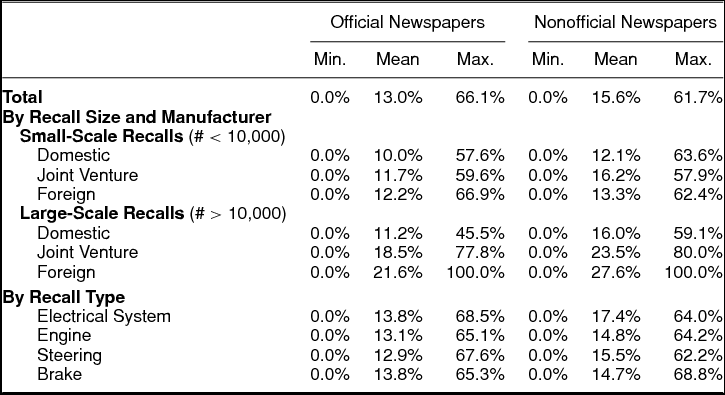
Table 1 provides an overview of auto-recall reporting patterns by official and nonofficial newspapers across different types of recalls. On average, official newspapers tend to write recall-related articles less frequently (13.0%) than nonofficial newspapers (15.6%). Reporting patterns also vary widely across different types of recalls. Large-scale recalls receive more media attention than small-scale recalls across newspapers. Reasons for recalls (e.g., defects in engine, steering, or electrical system) may also account for some variations in the reporting pattern. On the crucial question of whether newspapers distinguish between domestic and foreign automakers, both official and nonofficial newspapers seem to pay more attention to recalls by foreign automakers than the ones by domestic or joint-venture producers. For the case of large-scale recalls, official newspapers report 11.2% of domestic car recalls on average, but the figure is double for foreign car recalls (21.6%). Likewise, nonofficial newspapers on average report more on foreign car recalls (27.6%) than domestic ones (16.0%).
Summary Statistics of Auto-Recall Reporting

Note: Entries indicate the statistics for the proportion of recalls covered by a newspaper out of all recalls. The statistics are based on the observations of 121 newspapers.
This comparison between official and nonofficial newspapers may lead one to conclude that both types of newspapers exhibit bias toward domestic companies by underreporting their recalls. Nonetheless, a few considerations should be made prior to drawing such a conclusion. First, one should account for confounding factors (e.g., severity of recalls, reasons for recalls, or temporal trend) that may explain such underreporting of domestic recalls. These factors may account for the seeming domestic-foreign distinction by either or both types of newspapers. The next section will examine which type of newspapers exhibit a biased tendency, if any, even when these factors are controlled. Second, one should note the substantial variation of reporting patterns even within the same type of newspapers. As will be discussed, some official newspapers have a significantly greater incentive to protect the domestic automobile industry than other official newspapers. The next section will examine whether such a difference in protectionist incentives can account for reporting patterns across official newspapers, in a way consistent with the theoretical expectation.
EMPIRICAL ANALYSIS
Media Bias against Foreign Firms: Government-Driven versus Demand-Driven
I first examine whether newspapers are more likely to cover recalls involving foreign automakers than recalls involving domestic ones. In this analysis, the dependent variable Y ijkt is a binary indicator Report that is coded 1 if the newspaper i located in a province j published a news story about the recall event k announced in a time period t, and 0 otherwise. I use the binary indicator because most recall events are covered only once by each newspaper. The binary probit models are specified as follows:
 $$\begin{eqnarray*}
\text{Pr}(Y_{ijkt}=1) &=& \Phi (\alpha + \beta _{1}\text{{\it Foreign}}_{k} + \beta _{2}\text{{\it Official}}_{i} \\
& + & \beta _{3}\text{{\it Official*Foreign}}_{ik} \\
& + & \delta {\bf Z}_{k} + \mu _{j} + \tau _{t}),
\end{eqnarray*}$$
where Foreign is a binary indicator for imported foreign cars; Official is a binary indicator for official newspapers; vector Z denotes recall-level control variables; μ is a vector of province fixed effects; and τ is a vector of half-year fixed effects. In constructing the binary indicator Foreign, I treat both domestic firms and domestic-foreign joint ventures as nonforeign automakers because domestic companies have at least a 50% stake in the operation of joint ventures.Footnote 15
The main parameters of interest are β1, the coefficient for Foreign, denoting a degree of bias exhibited by commercial newspapers, and β3, the coefficient for the interaction term of Official and Foreign, indicating an additional degree of bias exhibited by official newspapers. If the media’s home bias simply reflects economic nationalism of readers, we should observe the bias primarily in nonofficial newspapers (positive and statistically significant β1), but there is no reason to expect official newspapers to exhibit an additional degree of bias, meaning that β3 should not appear to be positive and statistically significant. In contrast, if the media’s home bias primarily reflects the government’s interest in protecting domestic industry, we should observe the bias more from official newspapers, meaning that β3 should be positive and statistically significant. This would imply that official newspapers tend to selectively report recalls of imported cars to a greater extent than commercial newspapers.
The specification controls for Recall Size (Logged), the logged number of affected cars in each recall incident, since a recall involving more cars would attract more media attention, and seven binary indicators of recall types (e.g., engine, brake, or electrical system), because some types may receive more coverage than others. Across the models, I either include province-specific or newspaper-specific fixed effects. I also include either half-year-specific or recall-specific fixed effects. Standard error is clustered by recall to account for the dependence between different newspapers’ observations of the same recall event. As a robustness test, I employ a two-way clustering by province and recall (see Appendix Table A15).
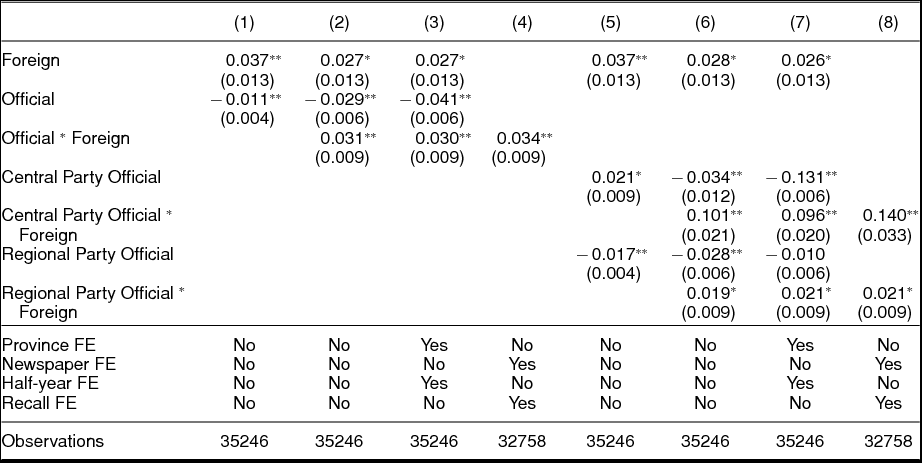
Table 2 presents the estimation results with marginal effects in the main entries and standard errors in parentheses.Footnote 16 The results suggest that foreign recalls generally receive more media coverage, and official newspapers drive this tendency. Foreign appears to be positive and significant at the 0.01 level in the first model, yet its significance becomes weaker when its interaction term with the Official variable is added in models 2–4. The interaction term is always positive and statistically significant at the 0.01 level. This suggests that official newspapers are more likely to report foreign recalls than domestic recalls, while such a tendency is far less pronounced in nonofficial papers.
Probit Models Estimating News Coverage Probability of Auto Recalls

Marginal effects; standard errors clustered by recalls in parentheses.
All models include recall-level controls: the logarithm of recall size and binary indicators of recall types.
+ p < 0.10, * p < 0.05, ** p < 0.01
To further investigate the mechanism by which home bias occurs, I estimate additional models presented in columns 5–8, where I include separate indicators for Central Party Official and Regional Party Official and their interaction terms with Foreign. Official newspapers have different sponsoring institutions, from the central party to various province or municipal-level parties. As the central party is the main decision-maker dealing with trade liberalization, it would be under more pressure from interest groups seeking protection. Also, the Chinese automobile industry is dominated by state-owned companies, majority of which are owned by the central party.Footnote 17 According to the government-driven bias hypothesis, then, central-party-controlled newspapers would exhibit more bias against foreign automakers than regional official newspapers.
The estimation results in columns 5–8 are consistent with this hypothesis: central-party-controlled newspapers are more likely to cover foreign recalls than domestic ones. The estimated coefficient for the variable Central Party Official * Foreign is always statistically significant at the 0.01 level and substantively meaningful in the expected direction. The estimated coefficient for the variable Regional Party Officials * Foreign is positive and statistically significant, but its magnitude is much smaller.Footnote 18
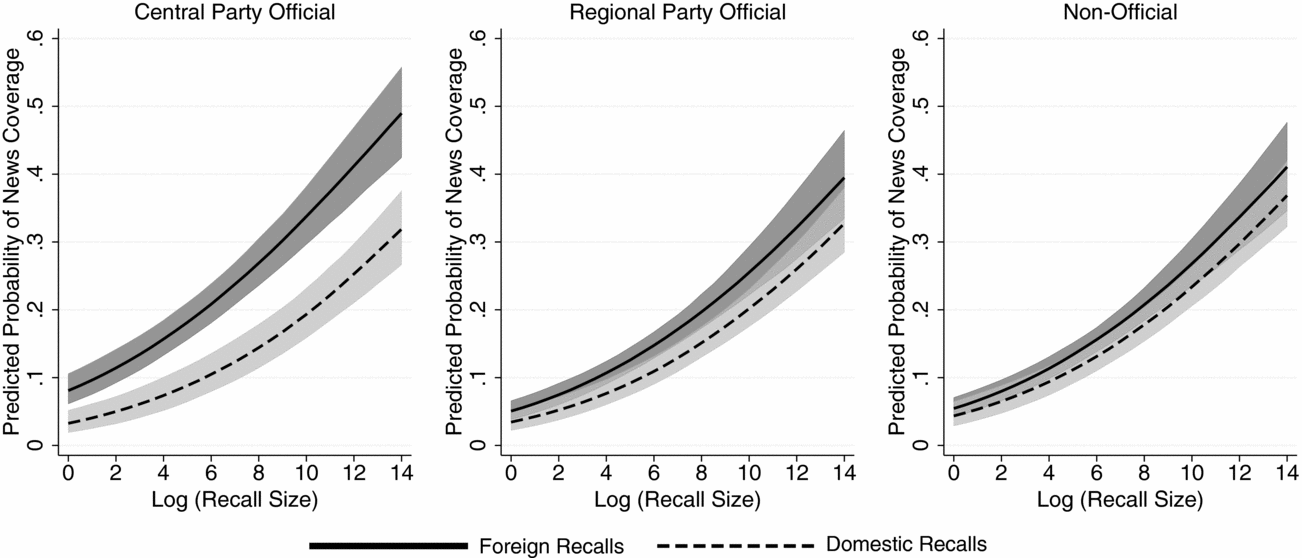
I assess the substantive effects of an automaker being foreign across three types of newspapers. Figure 1 describes the predicted probability that each type of newspaper covers a recall event depending on the recall size and the domestic/foreign classification.Footnote 19 Holding the size of a recall and other factors constant, all three types are more likely to report foreign recalls, but the substantive effect appears to be the largest for central party officials, followed by regional party officials. For example, consider a recall involving 1,100 cars (ln(1, 100) ≈ 7). While a central-party-sponsored newspaper has a 12.5% probability of reporting the recall by a domestic automaker, this probability almost doubles to 23.9% for a foreign automaker. A regional official newspaper has, on average, a 13.0% probability of reporting a domestic recall and a 17.1% probability of reporting a foreign recall. The substantive effect of an automaker being foreign is marginal in a commercial newspaper that has, on average, a 15.4% of probability of covering a domestic recall and a 20.0% probability of covering a foreign one, holding all other characteristics constant.Footnote 20
Predicted Probability of Reporting a Recall Event by Newspaper Type

Next, I employ two additional measures of media bias, intensity and tone of reporting. Newspapers with a home bias would provide more intensive coverage of recalls involving foreign cars and may report them in a more negative light. For instance, Guangzhou Daily published a lengthy news report on BMW’s recall announcement in August 2010, questioning whether the delay in the announcement is due to their unfair treatment of Chinese consumers. This contrasts with Beijing Daily’s brief coverage of the domestic car company Dongfeng’s recall decision in May 2009. This report simply covered factual information on the affected models and recall procedures (see Appendix Section A1.3 for the full texts).
I test whether such a biased tendency is systematically observed in the collected data. Focusing on those cases in which newspapers covered a recall event,Footnote 21 I estimate the effects of being Foreign on two dependent variables: (1) the number of words per article (Article Length) and (2) the difference between negative and positive words as a proportion of the article (Negative).Footnote 22 Specifically, I estimate the following model:
 $$\begin{eqnarray*}
&& \text{{\it Article Length}}_{ikt} \text{ ({\it Negative}}_{ikt}) \\
&&\quad = \alpha + \beta _{1} \text{{\it Foreign}}_{k} + \delta {\bf Z}_{k} + \mu _{i} + \tau _{t}+ \epsilon _{ikt,}
\end{eqnarray*}$$
where Z denotes recall-level control variables. A vector of newspaper fixed effects, μ, and a vector of half-year fixed effects, τ, are also included.
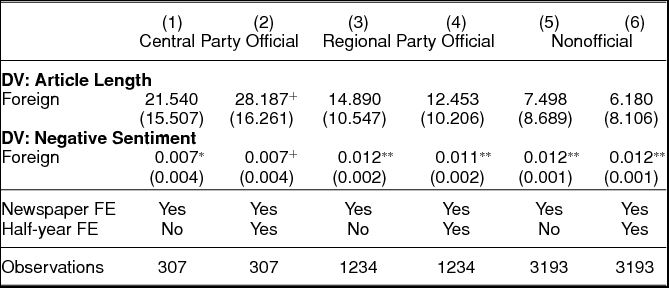
Table 3 presents the results, separately, for each type of newspaper. Central party officials tend to publish significantly longer stories on foreign auto recalls. According to the second model, they write on average about 28 more words per article on foreign recalls than on domestic recalls (about 13% longer than their average length). For other newspapers, the effect of foreignness is positive, but its magnitude is smaller and not statistically significant at the conventional level.
Length and Sentiment of Article as Dependent Variable

Marginal effects; standard errors clustered by reporting weeks in parentheses.
All models include recall-related controls.
+ p < 0.10, * p < 0.05, ** p < 0.01
With regard to sentiment, the results indicate that all types of newspapers report foreign recalls in a more negative light, although to a marginal degree. For central party officials, the sentiment score for foreign recall reports is on average higher by 0.007 than domestic recall reports. The estimated coefficient is 0.012 for regional party officials and nonofficials. While all types of newspapers cover foreign recalls more negatively than domestic ones, the substantive effects are marginal. The difference of 0.01 in the score indicates 1% more negative words. In part, this reflects that recall-related news articles are usually not emotionally charged. A recall-related article on average contains only 3.8% (4.4%) of negative (positive) words. This implies that home bias is expressed in a subtle way, which may work better than an explicit discrimination because (1) readers may not buy into emotionally charged articles especially when they are aware of potential bias, and (2) newspapers can discriminate against foreign companies without leaving concrete evidence of bias, which might be of more concerns for central party newspapers that receive more attention from foreign audience.
On the whole, I find evidence of a home bias in official newspapers, especially those controlled by the central party, and limited evidence for bias among nonofficial newspapers. An auto recall does not always make it into the newspaper headlines, yet whether the firm in question is domestic or foreign appears to have a considerable effect on whether the recall receives news coverage, especially by official newspapers. In addition to bias in the news selection stage, foreign firms are subject to additional forms of home bias as they receive lengthier and more negative coverage, albeit in a subtle way. The evidence presented here is consistent with the government-driven bias hypothesis. Although the finding does not completely rule out the influence of demand-side pressures, the additional degree of bias found in official newspapers compared to commercial newspapers suggests the presence of government influence in shaping the biased coverage.
State-Owned Enterprises and Party-Controlled Papers
The previous section demonstrated that regional official newspapers are less biased. However, some regional governments have a greater interest in the automobile industry than others because they own automobile companies (domestic or joint venture). If the government’s protectionist interest explains the presence of a home bias in media, regional governments with a greater interest in the automobile industry should exhibit more bias. This section conducts an empirical investigation of this expectation.
One key sub-national variation this article exploits is differences in the level of economic interest regional governments have in the automotive industry, which I measure with the ownership of automotive SOEs. Regional governments with their own automotive SOEs have a direct stake in the operation of their local enterprises and have devised various protectionist measures to favor local companies. This protectionism has continued even after China’s entry into the WTO.Footnote 23 In this context, one would expect to observe a higher degree of home bias among newspapers controlled by these regional governments.
I test this expectation by analyzing the reporting patterns of regional newspapers. I would expect official newspapers in provinces where the regional government has its own automotive SOE to exhibit a higher degree of bias compared to both nonofficial newspapers located in the same provinces and official newspapers located in other provinces. Taking the same empirical approach used in the previous section, I estimate the following model:
 $$\begin{eqnarray*}
\text{Pr}(Y_{ijkt}=1) &=& \Phi (\alpha + \beta _{1}\text{{\it Foreign}}_{k} \\
& + & \beta _{2}\text{{\it Officials with Auto}}_{i} \\
& + & \beta _{3}\text{{\it Officials without Auto}}_{i} \\
& + & \beta _{4}\text{{\it Officials with Auto*Foreign}}_{ik} \\
& + & \beta _{5}\text{{\it Officials without Auto*Foreign}}_{ik}\\
& + & \delta {\bf Z}_{k} + \gamma {\bf X}_{j} + \mu _{j} + \tau _{t}).
\end{eqnarray*}$$
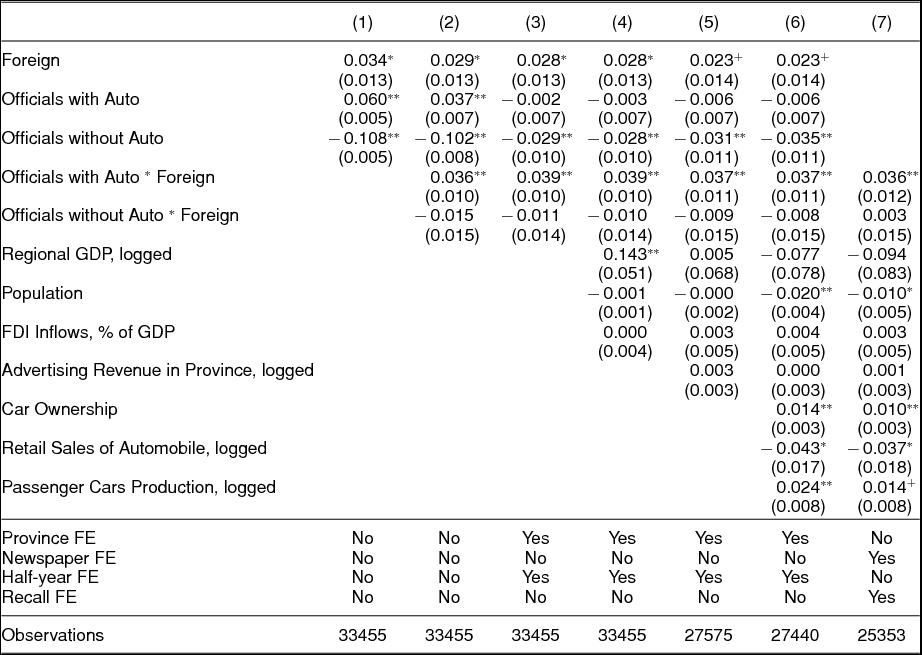
This specification is similar to the one estimated in the previous section, except that here I focus on regional newspapers and include two indicators of newspaper type, Officials with Auto and Officials without Auto, and their respective interaction terms with Foreign. Officials with Auto is a binary indicator, scoring 1 if newspaper i is an official newspaper in a province j where the provincial or municipal government manages an auto SOE, and 0 otherwise. Officials without Auto is a binary indicator coded 1 for official newspapers located in a province j where the provincial or municipal government does not own automobile enterprises and 0 for others.
In addition to the control variables included in the previous analysis, I include a vector X denoting province-level control variables. First, I control for the log of the regional GDP and population by the million because auto SOEs might be located in provinces with more wealth and larger populations. Second, I include the foreign direct investment (FDI) inflows as a percentage of the province’s GDP, since provinces that have attracted more foreign investment might be more positive towards foreign companies. Alternatively, provinces exposed to more foreign influences might be under more pressure to protect domestic industries. Either way, this factor may influence newspapers’ coverage of foreign to domestic recalls. Third, the logged value of advertising revenue is included. The media environment in Chinese provinces varies, especially with regard to the level of commercialization, which can be an important determinant of news coverage. I include advertising revenue reported by industry, which is a more accurate estimate than figures reported by the media (Stockmann Reference Stockmann2013, 223). I also control for car ownership and the logged value of automobile retail sales, because newspapers might cover auto recall incidents more frequently if their readers are interested in the automobile market. Lastly, I control for the logged value of passenger car production because auto SOEs are likely to be located in provinces where the automotive industry plays a larger role in the regional economy.
Table 4 presents the estimation results. I first estimate the model without adding the interaction terms. Official newspapers in provinces where local governments have auto SOEs appear to cover more auto recalls in general compared to official newspapers in other provinces. To examine these newspapers’ relative coverage of foreign and domestic recalls, I add the interaction terms in models 2–7. Across the estimations, the interaction term Officials with Auto * Foreign appears to be positive and statistically significant at the 0.01 level, but Officials without Auto * Foreign is negative and far from statistically significant. In other words, regional newspapers under the control of local governments seeking to protect the domestic automotive industry exhibit anti-foreign bias. This tendency, however, is not observed in official newspapers controlled by governments with lower economic interest in the automotive industry.
Probit Models Estimating Effect of Auto SOE Ownership on Recall News Coverage

Marginal effects; standard errors by recalls in parentheses.
All models include recall-level controls.
+ p < 0.10, * p < 0.05, ** p < 0.01
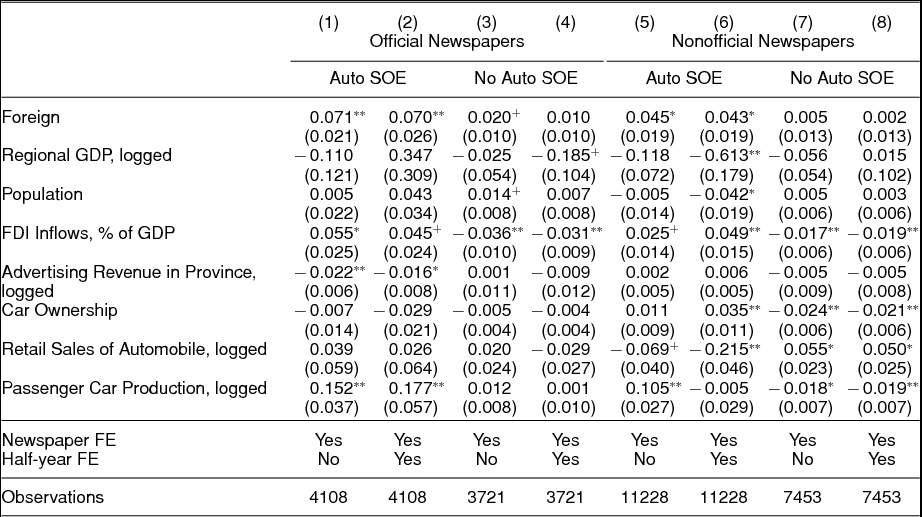
To further investigate the effects of automotive SOEs ownership on commercial newspapers as well as official newspapers, I additionally estimate the models by splitting the sample by newspaper types and automotive SOEs ownership. As regional governments can influence the coverage of commercial newspapers to a certain extent (although to a lesser extent than official newspapers), commercial newspapers in provinces with auto SOEs may exhibit bias in favor of domestic automakers. I test this expectation by estimating the effect of Foreign on news reporting, separately for regional official and commercial newspapers in provinces with automotive SOEs, and regional official and commercial newspapers in other provinces without automotive SOEs.
Table 5 presents the results. The degree of home bias, as indicated by the coefficient on Foreign, appears to be the highest for official newspapers in provinces with automotive SOEs, followed by commercial newspapers in the same provinces. Newspapers in other provinces without any direct stakes in the automotive industry do not exhibit any bias in favor of domestic automakers. The results provide additional evidence for government influence on home bias in news reporting. A systematic bias found in commercial newspapers in provinces with automotive SOEs suggests that regional governments may also encourage commercial newspapers to favor domestic automakers when they have direct stakes in the industry.
Split-Sample Analysis by Newspaper Types and Automotive SOEs Ownership

Marginal effects; standard errors clustered by recalls in parentheses.
All models include recall-level controls.
+ p < 0.10, * p < 0.05, ** p < 0.01
Additional Tests
I subject my results to a series of robustness checks. The substantive findings remain strong across various specifications. First, I account for automobile prices and frequency of recalls that may account for differences between domestic and imported cars (Appendix Tables A10 and A11). Second, I ensure that the results are not driven by a small set of observations. I exclude major provinces one by one, recalls by manufacturers of specific countries one by one from the analysis, and central party newspapers one by one (Appendix Tables A12-A14). Lastly, I ensure that the results are not sensitive to a classification rule for newspaper type (Appendix Table A16).
Also, I conduct an additional test to examine how increasing constraints from trade regimes affect the media’s home bias. While my dataset focusing on the post-WTO accession period does not allow testing the effects of China’s WTO accession, we can examine whether China’s first loss in a WTO dispute has led to more extensive uses of media as a protectionist tool. The first case that successfully challenged China’s indirect protectionist measures was targeted at its legal measures to impose tariffs on imported auto parts. The court ruled in favor of the complaints, and China agreed to implement its recommendations in January 2009. As my theory expects increasing constraints on NTBs to influence governments’ incentives to induce home bias, we can test this expectation by comparing the degree of home bias before and after the ruling. The results indeed indicate an increased overall tendency of home bias after the decision, especially in regional official newspapers with a direct stake in the automobile industry, as elaborated in Appendix Section A8.
ALTERNATIVE MECHANISM: DIFFERENT READERSHIP
One may question whether official newspapers’ home bias could be explained by their readers’ nationalistic attitudes. However, official newspaper readers do not appear to differ from nonofficial newspaper readers in their nationalistic sentiments. According to the 2004 Beijing Area Studies survey, their responses are very similar with respect to two questions related to nationalistic attitudes. When asked if they would like to be born again as a Chinese citizen and if they think China is a better country than others, a great majority of both official and nonofficial readers answered “strongly agree” or “somewhat agree” (98.2% and 86.0% of official newspaper readers, 94.2% and 81.6% of nonofficial newspaper readers, and 94.4% and 80.0% of readers of both types of newspapers to the first and second questions, respectively; see Appendix Table A18). As nonofficial newspaper readers are as nationalistic as official newspaper readers, this should not account for the difference in the degree of bias between the two types of newspapers.
MEDIA BIAS BEYOND RECALL REPORTING
I further explore the existence of media bias beyond auto recall reporting. By including other automobile-related news articles, I analyze whether newspapers are less likely to cover positive or neutral stories on foreign automakers. While we do not have a benchmark of unbiased reporting, we can understand a general pattern of news reporting for domestic and foreign automakers.
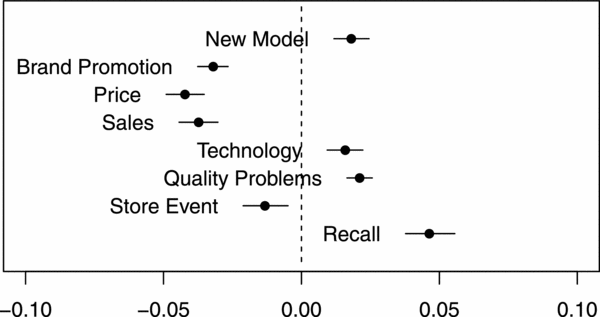
With 15,141 news articles on automakers by four newspapers in Beijing (Beijing Daily, Beijing Youth Daily, Beijing Morning Post, and Beijing Evening News) from 2000 to 2014, I estimated the Structural Topic Model (STM) that classifies texts into a given number of categories incorporating structural information about the texts (Roberts et al. Reference Roberts, Stewart, Tingley, Lucas, Leder-Luis, Gadarian, Albertson and Rand2014). I estimated a 25-topic STM and examined the effect of being foreign on topic proportion. Figure 2 illustrates the difference in topic proportion between foreign and domestic automobiles. I present the results for substantively meaningful topics while excluding topics irrelevant to automobile products. The figure demonstrates that newspapers are more likely to report on quality problems and recalls, and less likely to write about brand promotion, price, sales-related information, or store events for foreign cars (for details, see Appendix Section A9). The results imply that foreign firms may find it harder to deliver positive stories through the news media compared to domestic counterparts.
Difference in Topic Proportions: Domestic (−) versus Foreign (+)

MEDIA COVERAGE AND CONSUMER BEHAVIOR
Having demonstrated the presence of home bias in the news media, I next examine its effects on consumer behavior by focusing on recall-related web searches and automobile sales.
Recall-Related Web Searches
I examine how the biased news reporting pattern is associated with individual awareness of recalls by relying on web-query data provided by Baidu, the largest search engine in China. If the media’s home bias were to affect consumer behavior, we should first observe that information provided through the news reaches individuals. As a way of measuring individuals’ awareness of information, I examine web-query data because individuals who become aware of product recalls through the news may search for more information on the web. The Baidu Index provides the province-level daily volume of web searches for selected keywords from 2011. I collected this data for recall-related web searches for different automakers (e.g., Great Wall recall, FAW-Volkswagen recall, or BMW recall).Footnote 24
Focusing on the 2-week period, including the date of recall announcement and a week prior and after the announcement, I examine if news coverage of recalls is associated with the search volume. I estimate the following model with the average query volume for each recall i in each province j as the main dependent variable:
 $$\begin{eqnarray*}
\text{{\it Log(Baidu Index)}}_{ijt} &=& \alpha + \beta _{1}\text{{\it Foreign}}_{i} \\
& + & \beta _{2}\text{{\it Central News Coverage}}_{i} \\
& + & \beta _{3}\text{{\it Regional News Coverage}}_{ij} \\
& + & \mu _{j} + \tau _{t} + \epsilon _{ij},
\end{eqnarray*}$$
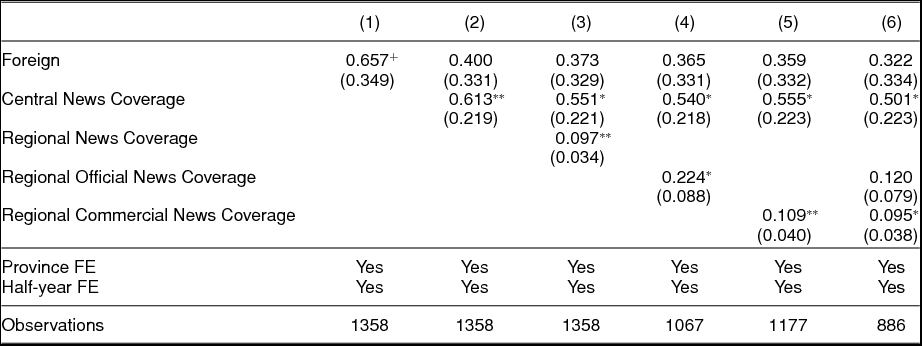
where Foreign indicates whether recall i involves imported vehicles, Central News Coverage denotes the number of central-party-controlled newspapers that covered the recall event i, Regional News Coverage denotes the number of regional official and commercial newspapers that covered the recall event i in province j. I also separately estimate the effects of regional official and commercial newspapers in some models. All models include province fixed effects (μ) and half-year fixed effects (τ) to control for province-specific and time-specific factors that may influence the web-querying volume.
The estimation results are presented in Table 6. In the first model, I begin by including Foreign as the only right-hand-side variable. Foreign appears positive and statistically significant, suggesting that recalls of imported products attract more public attention on the web. Since recalls of imported products tend to receive more media attention than those of domestic products, this discriminatory pattern of media coverage may account for the difference in search volumes between domestic and foreign automakers. To investigate this possibility, I include Central News Coverage and Regional News Coverage in the second and third models. Not only do Central News Coverage and Regional News Coverage have substantial and statistically significant effects on the web-query volume, they also account for the effect of Foreign to some extent. When they are added in the models, the estimated coefficient of Foreign becomes smaller, and no longer statistically significant at the conventional level. I also separately estimate the effects of news coverage by regional official and commercial newspapers in models 4–6. The coefficients of Regional Official News Coverage and Regional Commercial News Coverage appear positive, suggesting that regional news coverage is associated with individuals’ awareness of recall-related information.Footnote 25
Regression Models Examining Recall-Related Web-Query Data

Standard errors clustered by recalls in parentheses
+ p < 0.10, * p < 0.05, ** p < 0.01
The results are consistent with an expectation that the news media’s home bias may negatively affect consumer perception of imported products. A key finding to highlight is that recalls of imported cars receive more public attention, because those recalls receive more media attention especially from central-party-controlled newspapers. While my analysis cannot directly examine the effects of news coverage on consumer perception at the individual-level, the analysis provides suggestive evidence for the link between news coverage of recalls and individuals’ awareness of them. When negative events occur, individuals are disproportionally more aware of those involving imported products, which is mainly accounted by the news reporting pattern. While this analysis cannot rule out the possibility of reverse causality, whereby a higher level of individual attention for foreign recalls leading to more news coverage, this concern can be mitigated by the finding that a biased reporting pattern is more pronounced in official newspapers, especially the ones with direct stakes in the automobile industry, than commercial newspapers, that are more responsive to their readers’ interests. Also, I next examine the effects of news coverage on automobile sales, which is less subject to the concerns of endogeneity and reverse causality.
Automobile Sales
A number of studies demonstrated the negative effect of automobile recalls on sales and stock prices of the automakers (e.g., Grafton, Hoffer, and Reilly Reference Grafton, Hoffer and Reilly1981). One key mechanism underlying this finding is information: when an individual receives information about an automaker’s recall decision, one’s impression of the automaker’s products shifts negatively, becoming less likely to purchase its products. However, the effect of automobile recalls on sales is expected to be limited for domestic automakers in the context of China because their recalls are less likely to be reported and thus, less known among consumers.
I test this expectation by analyzing the effect of recall announcements on sales of domestic and foreign automakers in China from 2007 to 2013.Footnote 26 More importantly, I also examine to what extent the news reporting pattern accounts for the differential recall effects for domestic and foreign automakers. My analysis focuses on the yearly sales data for different automakers due to the lack of province-level sales data at the automaker level. I estimate the following model:
 $$\begin{eqnarray*}
\text{{\it $\Delta $ Sales}}_{it} &=& \alpha + \beta _{1} \text{{\it Number of Recalls}}_{i,t-1} \\
& + & \beta _{2}\text{{\it Foreign*Number of Recalls}}_{i,t-1}\\
& + & \beta _{3} \text{{\it Central News Coverage}}_{i,t-1} + \mu _{i} \\
& + & \tau _{t} + \tau _{t}^{2} + \tau _{t}^{3} + \upsilon _{it} + \epsilon _{it}.
\end{eqnarray*}$$
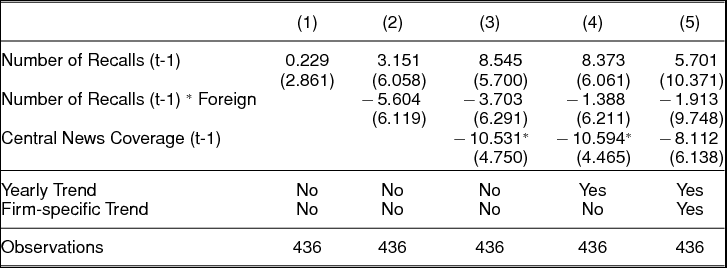
The dependent variable is the yearly change in sales, measured as the number of cars sold or imported for an automaker i.Footnote 27 The unit is 1,000 cars. The main independent variables are the number of recalls announced by each firm i in year t-1, its interaction term with the binary indicator Foreign, and the number of recall news coverage by central official newspapers for an automaker i in year t-1. The binary variable Foreign is not separately estimated because I include a vector of firm fixed effects, μ, throughout the models. A yearly time trend τ, its squared and cubed terms along with a firm-specific time trend υ are added to some models to account for any firm-specific temporal factors.
Table 7 presents the estimation results. From the first model, the overall effects of recall announcements appear to be limited. The coefficient on Number of Recalls is positive, yet marginal and statistically indistinguishable from zero. In the second model where an interaction term is added, the coefficient on Number of Recalls is still positive, but its interaction with Foreign yields a negative coefficient, suggesting the possibility that only foreign firms experience a negative effect of recalls on sales. From the third model, I add the key variable of interest, Central News Coverage, which appears to have a substantially negative effect on sales throughout the models. This suggests that news coverage exerts a more significant effect on sales than recall decision itself. Also, adding this news coverage variable significantly reduces the size of coefficient on the interaction term. This implies that the negative effects of recalls on foreign automakers are in part accounted by the news reporting pattern, whereby foreign recalls receive more news coverage than domestic ones.
Regression Models Estimating Effect of News Coverage on Sales

Standard errors clustered by firms in parentheses.
+ p < 0.10, * p < 0.05, ** p < 0.01
The analysis presented here is far from a complete analysis of automobile sales, which are influenced by many factors including price, advertising, or other marketing strategies. While uncovering a causal effect of media coverage on consumer behavior would require a fine-grained data at the micro-level, my analysis of national-level sales trends provides suggestive evidence that foreign automakers are disadvantaged in the market due to the biased coverage of news media.
CONCLUSION
This article has demonstrated that newspapers under strong government control in China, especially those controlled by the central government and local governments with direct interests in the automobile industry, exhibit systematic bias against foreign automakers. The disadvantage of being foreign is substantial: auto recalls by foreign companies are more than twice as likely to be reported by central-government-controlled newspapers, and those news reports tend to be more intense compared to those involving domestic automakers. This article has also found suggestive evidence on the effect of such bias: foreign recalls become more widely known than domestic recalls and foreign firms experience the negative effect of recalls on their market share, while such effects are limited for domestic firms.
This article’s empirical analysis pertains to China, but its implications for international trade have broad applicability. Government ownership of news media is pervasive in other countries as well. A survey of media ownership in 97 countries by Djankov et al. (Reference Djankov, McLiesh, Nenova and Shleifer2003) finds that the state, on average, controls about 29% of newspapers, 60% of television stations, and 72% of top radio stations. This suggests that news media in other countries may also face political pressure to portray domestic firms in a more positive light. One extension of this study would be to examine how the effect of WTO membership on import flows varies depending on the media environment of member countries. Some governments can utilize news media to protect their domestic industries when their trade policy is constrained by the rules of the WTO. Thus, WTO accession may have limited influence on increasing imports, especially for consumer goods, in countries with tight media control. Exploring this question is timely and important given that recent members of the WTO include authoritarian countries with limited press freedom such as Russia, Saudi Arabia, and Vietnam.
Relatedly, this article contributes to the study of regime type and trade policy. Previous works show that democracy leads to more free trade agreements (Mansfield, Milner, and Rosendorff Reference Mansfield, Milner and Rosendorff2002) and lower tariffs (Milner and Kubota Reference Milner and Kubota2005), but democratic countries protect their markets through “behind-the-door” measures such as nontariff quality barriers (Kono and Rickard Reference Kono and Rickard2014). As these studies suggest, democratic leaders have greater incentives to use opaque measures to avoid the electoral costs of employing visible protectionist measures. Despite these leaders’ preferences for using opaque measures, however, my finding suggests that they may be less able to do so in some areas, including the realm of news media, where government influence is limited. In contrast, autocratic leaders, while having less incentive to employ opaque instruments, are better able to do so because their political systems are less transparent than democratic systems. Thus, a full understanding of the impact of regime type on trade policy requires a careful assessment of diverse policy options at the disposal of different regimes.
SUPPLEMENTARY MATERIAL
To view supplementary material for this article, please visit https://doi.org/10.1017/S0003055418000242.
Replication materials can be found on Dataverse at: https://doi.org/10.7910/DVN/JSR0OE.




Comments
No Comments have been published for this article.