Recent research implicates puberty, more so than age, in the emergent sex difference in adolescent depression (Conley & Rudolph, Reference Conley and Rudolph2009; Hayward, Gotlib, Schraedley, & Litt, Reference Hayward, Gotlib, Schraedley and Litt1999). Yet, very little research explores why or how puberty influences depression, and the resulting sex difference that emerges in adolescence. The complex processes underlying the development of psychopathology necessitate research examining contributions from multiple systems (biological, psychological, and interpersonal) and the dynamic transactions between developing adolescents and their social contexts (Cicchetti & Rogosch, Reference Cicchetti and Rogosch2002; Lerner, Reference Lerner, Lerner and Foch1987; Sroufe & Rutter, Reference Sroufe and Rutter1984). Following recent developments in research on the psychosocial context and effects of puberty (Compian, Gowen, & Hayward, Reference Compian, Gowen and Hayward2009; Conley & Rudolph, Reference Conley and Rudolph2009; Graber, Brooks-Gunn, & Archibald, Reference Graber, Brooks-Gunn, Archibald, Stoff and Susman2005), the present study investigated sex differences in one possible pathway through which puberty contributes to adolescent depression, namely, exposure to heightened peer stress.
Pubertal Development and the Sex Difference in Depression
Research on pubertal development has revealed, beyond mere physical and biological changes, many psychological and social implications of puberty (Graber, Reference Graber and Hayward2003; Haynie & Piquero, Reference Haynie and Piquero2006). There are several ways in which pubertal development might heighten risk for depression in particular. On a psychosocial level, pubertal changes confer negative psychological (e.g., poor body image) and social (e.g., exclusion, victimization) risks, which in turn predict depression. On a physical level, puberty entails bodily changes that mark a physical transition to adulthood at a time when adolescents are socially unprepared. On a biological level, puberty brings hormonal changes linked to depression (Angold, Costello, Erkanli, & Worthman, Reference Angold, Costello, Erkanli and Worthman1999; Susman, Dorn, & Chrousos, Reference Susman, Dorn and Chrousos1991). Just as pubertal hormones differ for girls and boys, the psychological and social effects of puberty vary by sex, which might influence the emerging sex difference in adolescent depression.
Pubertal status, one's stage of physical maturation, has been implicated in rising adolescent depression and the sex difference therein. More mature pubertal status in girls, but not in boys, is linked to higher rates of depressive disorders (Angold, Costello, & Worthman, Reference Angold, Costello and Worthman1998), as well as to higher levels of depressive symptoms and mood (Ge, Elder, Regnerus, & Cox, Reference Ge, Elder, Regnerus and Cox2001; Hayward et al., Reference Hayward, Gotlib, Schraedley and Litt1999; Wichstrom, Reference Wichstrom1999). In one study, pubertal status fully accounted for the sex difference in adolescent depression (Ge, Conger, & Elder, Reference Ge, Conger and Elder2001). Other research reveals that pubertal status, but not age, accounts for the sex difference in depression (Angold et al., Reference Angold, Costello and Worthman1998; Conley & Rudolph, Reference Conley and Rudolph2009).
Pubertal timing (pubertal status relative to age) might have even stronger links with psychosocial adjustment (Negriff, Fung, & Trickett, Reference Negriff, Fung and Trickett2008). Earlier-developing adolescents might be underprepared for these changes, feel deviant and insecure about their difference, and lack social support from peers experiencing similar changes (Petersen, Reference Petersen and Golub1983; Ruble & Brooks-Gunn, Reference Ruble and Brooks-Gunn1982). On the other end of the spectrum, youth who develop later than their peers might feel left behind as their more-developed peers transition into adolescence. Thus, both earlier and later pubertal timing can heighten risk for psychosocial distress (Natsuaki, Biehl, & Ge, Reference Natsuaki, Biehl and Ge2009; Weichold, Silbereisen, & Schmitt-Rodermund, Reference Weichold, Silbereisen, Schmitt-Rodermund and Hayward2003). Indeed, research links pubertal timing with depression, particularly in girls. Most consistently, earlier-maturing girls exhibit more depressive disorders, symptoms, and mood than their on-time or later-maturing peers (e.g., Conley & Rudolph, Reference Conley and Rudolph2009; Ge et al., Reference Ge, Kim, Brody, Conger, Simons and Gibbons2003; Negriff et al., Reference Negriff, Fung and Trickett2008; Patton et al., Reference Patton, Olsson, Bond, Toumbourou, Carlin and Hemphill2008). Later-maturing girls also experience psychological difficulties (Carter, Jaccard, Silverman, & Pina, Reference Carter, Jaccard, Silverman and Pina2009; Dorn, Susman, & Ponirakis, Reference Dorn, Susman and Ponirakis2003; Natsuaki, Biehl, et al., Reference Natsuaki, Klimes-Dougan, Ge, Shirtcliff, Hastings and Zahn-Waxler2009). Among boys, later maturation is associated with elevated depressive symptoms (Benjet & Hernández-Guzmán, Reference Benjet and Hernández-Guzmán2002; Dorn et al., Reference Dorn, Susman and Ponirakis2003; Huddleston & Ge, Reference Huddleston, Ge and Hayward2003; Weichold et al., Reference Weichold, Silbereisen, Schmitt-Rodermund and Hayward2003), and there is increasing evidence that earlier-maturing boys also exhibit more depression (Kaltiala-Heino, Kosunen, & Rimpela, Reference Kaltiala-Heino, Kosunen and Rimpela2003; Natsuaki, Biehl, et al., Reference Natsuaki, Klimes-Dougan, Ge, Shirtcliff, Hastings and Zahn-Waxler2009; Negriff et al., Reference Negriff, Fung and Trickett2008). These findings suggest a curvilinear association between pubertal timing and depression for both girls and boys (Conley & Rudolph, Reference Conley and Rudolph2009; for reviews, see Huddleston & Ge, Reference Huddleston, Ge and Hayward2003; Weichold et al., Reference Weichold, Silbereisen, Schmitt-Rodermund and Hayward2003).
Social Processes Linking Puberty to Depression
Puberty is likely to affect adolescents’ social worlds because it occurs within a social context. Pubertal development entails bodily changes that are held to close scrutiny by peers, amplified by the focus on social comparison and conformity in adolescence (Brooks-Gunn & Warren, Reference Brooks-Gunn and Warren1989; Ruble & Brooks-Gunn, Reference Ruble and Brooks-Gunn1982). Further, many of the psychological effects of puberty depend on adolescents’ reference to their peer group. In many Western cultures, for boys it is socially desirable to have the postpubertal physical form, whereas for girls it is not (Petersen & Crockett, Reference Petersen and Crockett1985); thus, pubertal maturation has more negative psychological and social effects for girls compared to boys in general, and for earlier-developing girls and later-developing boys in particular (Felson & Haynie, Reference Felson and Haynie2002; Simmons, Blyth, & McKinney, Reference Simmons, Blyth, McKinney, Brooks-Gunn and Petersen1983; Taga, Markey, & Friedman, Reference Taga, Markey and Friedman2006; Tobin-Richards, Boxer, & Petersen, Reference Tobin-Richards, Boxer, Petersen, Brooks-Gunn and Petersen1983). For example, more advanced status and earlier timing are linked to girls’ quantity and quality of friendships, friendship group composition (e.g., deviant peers, opposite-sex peers), and involvement in romantic and sexual relationships (Cavanagh, Reference Cavanagh2004; Haynie, Reference Haynie2003). A growing body of research links girls’ off-time development in both directions (earlier and later) to social disadvantages and stressors, including lack of close friendships (earlier and later puberty; Brooks-Gunn, Warren, Samelson, & Fox, Reference Brooks-Gunn, Warren, Samelson and Fox1986), low social support, acceptance, and popularity (later puberty; Brooks-Gunn & Warren, Reference Brooks-Gunn and Warren1988; Michael & Eccles, Reference Michael, Eccles and Hayward2003), and greater physiological reactivity to interpersonal conflict (earlier puberty; Smith & Powers, Reference Smith and Powers2009). Furthermore, girls typically have a stronger depressive response to peer stress, or more broadly to interpersonal stress (Leadbeater, Blatt, & Quinlan, Reference Leadbeater, Blatt and Quinlan1995; Oldenburg & Kerns, Reference Oldenburg and Kerns1997; Rudolph, Reference Rudolph2002; Rudolph & Hammen, Reference Rudolph and Hammen1999; Schraedley, Gotlib, & Hayward, Reference Schraedley, Gotlib and Hayward1999). In sum, this research suggests a curvilinear association between pubertal timing and stress in the peer domain, such that off-time development confers social disadvantages for girls, more so than for boys, which in turn might contribute to the sex difference in adolescent depression (Rudolph, Reference Rudolph2009).
Although direct tests of such mediation pathways are limited, some research suggests that the impact of puberty on depression is at least in part due to psychosocial influences. For example, a recent study (Natsuaki, Klimes-Dougan, et al., Reference Natsuaki, Klimes-Dougan, Ge, Shirtcliff, Hastings and Zahn-Waxler2009) revealed that earlier-maturing girls displayed heightened internalizing symptoms, in part because of their elevated sensitivity to interpersonal stress. In contrast, this mediation pathway did not hold up in boys because the association between interpersonal sensitivity and internalizing symptoms was nonsignificant. Other research found that earlier pubertal timing in girls predicted less adaptive responses to peer stress, which in turn predicted higher levels of aggression, but this model did not hold up for internalizing symptoms (Sontag, Graber, Brooks-Gunn, & Warren, Reference Sontag, Graber, Brooks-Gunn and Warren2008). A similar study (Graber, Brooks-Gunn, & Warren, Reference Graber, Brooks-Gunn and Warren2006) revealed that the association between girls’ earlier pubertal timing and depressive symptoms was mediated by emotional arousal.
Despite these important contributions, prior research examining mediational pathways linking puberty to adjustment suffers from several methodological limitations, including (a) concurrent designs; (b) the predominant use of symptom checklists to assess depression, which may not provide optimal discrimination among different types of psychopathology; and (c) limited assessment and operationalization of pubertal development (e.g., single-item assessments, dichotomous categories rather than continuous variables of pubertal timing; for two exceptions, see Lindberg, Grabe, & Hyde, Reference Lindberg, Grabe and Hyde2007; Natsuaki, Klimes-Dougan, et al., Reference Natsuaki, Klimes-Dougan, Ge, Shirtcliff, Hastings and Zahn-Waxler2009). The present study aimed to address these limitations and thus illuminate the longitudinal process linking puberty to depression in adolescence.
Study Overview
A large body of research suggests that puberty contributes to adolescents’ peer contexts and depression. Research also shows that peer stressors contribute to depression among adolescents, particularly girls (Hankin, Mermelstein, & Roesch, Reference Hankin, Mermelstein and Roesch2007; Rudolph, Flynn, Abaied, Groot, & Thompson, Reference Rudolph, Flynn, Abaied, Groot and Thompson2009). Furthermore, the psychosocial effects of puberty appear to be more devastating for girls than for boys. This study extends prior research by examining whether puberty contributes to adolescent depression through heightened stress in the peer domain, differentially for girls and boys. Specifically, we hypothesized the following:
1. Sex would moderate the pathway from puberty to peer stress to depression.
2. Puberty would predict both peer stress and depression in the following ways:
a. More advanced pubertal status was expected to predict heightened subsequent peer stress and depression in girls (i.e., a positive linear association) but either to have no association, or to predict less subsequent peer stress and depression, in boys (i.e., a null or negative linear association).
b. In girls, both positive linear and positive curvilinear associations were expected from pubertal timing to subsequent peer stress and depression. In other words, earlier pubertal timing, and to a lesser extent, later timing, would predict more peer stress and depression over time. In boys, the opposite pattern was expected: later timing, and to a lesser extent, earlier timing, would predict more peer stress and depression over time (i.e., negative linear and positive curvilinear associations).
3. Peer stress would predict depression, above and beyond the contribution of puberty, in both girls and boys (but more strongly in girls).
4. The inclusion of peer stress in the longitudinal models would reduce the effects of puberty on depression, more strongly in girls than in boys.
Method
Participants
The present study involved the first two waves (Wave 1 and Wave 2) of a longitudinal investigation examining the development of depression during the adolescent transition (e.g., Conley & Rudolph, Reference Conley and Rudolph2009; Rudolph et al., Reference Rudolph, Flynn, Abaied, Groot and Thompson2009; Rudolph & Troop-Gordon, Reference Rudolph and Troop-Gordon2010). Participants in the longitudinal study included 167 families drawn from a midsized midwestern city and several rural towns. Recruited youth for the longitudinal study had participated in schoolwide screenings using the Children's Depression Inventory (CDI; Kovacs, Reference Kovacs1992). Youth who participated in these screenings represented approximately 80% of targeted participants. From the screening sample (n = 1,985), we selected potential participants (n = 468) along the range of the CDI, oversampling slightly at the high end without regard to sex (i.e., whereas 15.8% of the screening sample had CDI scores above 18, 20.3% of the participants we targeted for recruitment fell into this category). Participants from the screening sample were recruited for the longitudinal study based on CDI scores, a maternal caregiver in the home, and proximity to the university, until the targeted sample was successfully recruited. Participants and nonparticipants in the longitudinal study did not differ in sex, χ2 (1) = 0.39, r = .04, p = .53, ethnicity (White vs. minority), χ2 (1) = 0.02, r = .01, p = .89, or depressive symptoms, t (280) = 1.11, r = .07, p = .13. Participants (M = 12.41) were slightly younger than nonparticipants (M = 12.65), t (275) = 2.28, r = .14, p = .012.
This research focused on a subsample of 149 youth (78 girls, 71 boys) who had relevant data on pubertal development, peer stress, and depression.Footnote 1 Among this subsample (M age = 12.38, SD = 1.24, range = 9.6–14.8; 77.2% White, 22.8% minority), socioeconomic status was diverse, with total family income below $30,000 for 16.4% of the sample, and above $75,000 for 18.5% of the sample. Of the original 167 participants, youth with complete data did not differ from those with missing data, in sex, χ2 (1) = 0.40, r = .08, p = .53, ethnicity (White vs. minority), χ2 (1) = 0.35, r = .07, p = .55, or any of the puberty, stress, or depression variables (ts < 1.63, rs < .20, ps > .05), but those with complete data were slightly younger than those with missing data, t (165) = 2.18, r = .26, p = .015.
Procedure
Youth and primary female caregivers completed 3- to 4-hr assessments with two interviewers, at baseline and 1 year later. At each assessment, families received a cash stipend, and youth received a gift certificate.
Measures
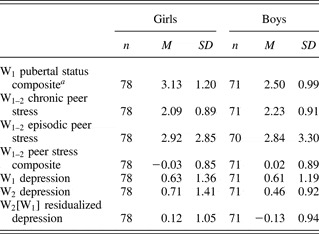
Table 1 presents descriptive information for the measures.
Descriptive statistics and comparisons by sex

Note: W1–2 peer stress consists of peer stress occurring between Wave 1 (W1) and Wave 2 (W2). W2 [W1] residualized depression consists of W2 depression, adjusting for W1 depression (both measures over the past month).
aVariable differed significantly between sexes.
Assessment of pubertal status and timing
Given this study's focus on how somatic changes associated with puberty influence depression, we followed precedent from past research by assessing secondary sex characteristics and other physical changes of puberty (Dubas, Graber, & Petersen, Reference Dubas, Graber and Petersen1991; Ge, Elder, et al., 2001; Hayward, Reference Hayward and Hayward2003; Petersen, Crockett, Richards, & Boxer, Reference Petersen, Crockett, Richards and Boxer1988). Participants completed two assessments of youths’ pubertal status at Wave 1. The first measure consisted of a series of drawings illustrating the stages of pubertal development specified by Tanner (Reference Tanner and Gardner1969), and adapted by Morris and Udry (Reference Morris and Udry1980). Informants indicated which of the drawings in each group most closely matched youths’ current stage of development.
Youths’ self-ratings on the Tanner stages are significantly associated with clinician ratings on physical exams (Dorn, Susman, Nottelmann, Inoff-Germain, & Chrousos, Reference Dorn, Susman, Nottelmann, Inoff-Germain and Chrousos1990; Schlossberger, Turner, & Irwin, Reference Schlossberger, Turner and Irwin1992; Shirtcliff, Dahl, & Pollak, Reference Shirtcliff, Dahl and Pollak2009). In the present sample, youth and caregiver reports correlated well for girls’ breast (r = .83, p < .001; 97% agreement within one category) and pubic hair (r = .68, p < .001; 84% agreement within one category) development, and moderately well for boys’ genital (r = .46, p < .01; 78% agreement within one category) and pubic hair (r = .66, p < .001; 79% agreement within one category) development, similar to other studies (e.g., Dorn et al., Reference Dorn, Susman, Nottelmann, Inoff-Germain and Chrousos1990). Youth and caregiver reports were averaged into consensual ratings, and then combined to form a single index of pubertal development (αs > 0.91 for girls and boys; ps < .001). The present sample included youth across the full range of Tanner stages: 31.4% of girls and 35.8% of boys fell between 1 and 2, 41.5% of girls and 46.2% of boys fell between 2 and 4, and 27.1% of girls and 18% of boys fell between 4 and 5.
The second measure, the Pubertal Development Scale (PDS; Petersen et al., Reference Petersen, Crockett, Richards and Boxer1988) assesses five physical aspects of pubertal development with Likert ratings (1 = no development, 2 = development has just begun, 3 = development is definitely underway, 4 = development is complete). The PDS has been well validated, with interitem reliability ranging from the 0.50s to the 0.80s (median α = 0.71 across three studies; Brooks-Gunn, Warren, Rosso, & Gargiulo, Reference Brooks-Gunn, Warren, Rosso and Gargiulo1987; Petersen et al., Reference Petersen, Crockett, Richards and Boxer1988; Tobin-Richards et al., Reference Tobin-Richards, Boxer, Petersen, Brooks-Gunn and Petersen1983). The PDS also is moderately correlated with clinician ratings of the Tanner stages (Brooks-Gunn et al., Reference Brooks-Gunn, Warren, Rosso and Gargiulo1987; Shirtcliff et al., Reference Shirtcliff, Dahl and Pollak2009).
We scored the PDS using an established method that maps the measure's five pubertal indicators onto two pubertal indexes: adrenal and gonadal maturation. These two scores map onto clinician-rated Tanner stages, using a parallel 5-point scale, and correlate well with the underlying hormonal processes of puberty (see Shirtcliff et al., Reference Shirtcliff, Dahl and Pollak2009). Youth and caregiver reports on these two PDS indexes were moderately correlated in the present sample (rs > .77 for girls and > .57 for boys; ps < .001), and were averaged into consensual ratings. Following Shirtcliff et al. (Reference Shirtcliff, Dahl and Pollak2009), these two scores were then averaged to form a single index of pubertal development (αs > 0.85 for girls and boys; ps < .001).
Creation of pubertal status and timing variables
Pubertal status
Confirming the validity of Shirtcliff and colleagues’ method (2009), scores from the Tanner ratings and the PDS correlated strongly with one another (rs = .86 for girls and .72 for boys; p < .001), and thus were averaged to form an overall composite index of pubertal maturation (α = 0.94 for girls and 0.86 for boys; ps < .001). Higher scores reflected more advanced pubertal status.
Pubertal timing
To create an index of pubertal timing, residualized scores were computed separately for girls and boys by regressing pubertal status onto chronological age. Higher scores reflected earlier maturation relative to one's age mates. This conceptualization and operationalization of pubertal timing (i.e., level of maturation relative to age) is consistent with a large body of theory and research on pubertal timing (e.g., Dorn et al., Reference Dorn, Susman and Ponirakis2003; Steinberg, Reference Steinberg1987; Susman & Rogol, Reference Susman, Rogol, Lerner and Steinberg2004; Weichold et al., Reference Weichold, Silbereisen, Schmitt-Rodermund and Hayward2003).
Assessment and coding of peer stress
The Youth Life Stress Interview (Rudolph & Flynn, Reference Rudolph and Flynn2007), a revised version of the Child Episodic Life Stress and Chronic Strain Interviews (Rudolph & Hammen, Reference Rudolph and Hammen1999; Rudolph et al., Reference Rudolph, Hammen, Burge, Lindberg, Herzberg and Daley2000), assessed peer stress occurring between Wave 1 and Wave 2. This semistructured interview elicits information from youth and their caregivers about the nature and intensity of chronic and episodic stress youth experienced over the past year.
Interviewers presented narrative information to a team of trained coders who had no knowledge of youths’ diagnostic status or subjective response to the stress. Coders provided consensual ratings based on youth and caregiver reports. For chronic stress, coders rated the severity of stress on a 5-point scale: 1 = no stress, 2 = mild stress, 3 = isolated stress, 4 = serious stress, 5 = severe stress.Footnote 2 For episodic stress, coders rated the stressfulness or negative impact of each event, from 1 (none) to 5 (severe),Footnote 3 reflecting how stressful the event would be for a typical child in the described circumstances. Episodic peer stress scores were calculated as the total of the objective stress ratings for each peer event with a stress rating above 1.
To determine reliability, information from 41 interviews (including 160 episodic stress events) was presented to two teams of coders, who gave independent ratings. One-way random-effects intraclass correlation coefficients (ICCs) evidenced high reliability for the chronic peer stress rating (ICC = 0.96) and the objective episodic stress rating (ICC = 0.90). The Cohen κ value for agreement on whether an event was peer-related was 1.00. As might be expected, stability was strong for chronic stress (r = .67, p < .001) and moderate for episodic stress (r = .37, p < .001). Confirming that chronic and episodic peer stress assess closely related aspects of peer stress, these two scores were moderately correlated (rs = .53 and .48, respectively, for Wave 1 and Wave 2, ps < .001). Thus, we computed a composite score of peer stress by averaging standardized scores on the two measures.
Assessment and coding of depression
Interviewers administered the Schedule for Affective Disorders and Schizophrenia for School-Age Children—Epidemiologic Version 5 (Orvaschel, Reference Orvaschel1995) to youth and their caregivers, to assess youth depression at Wave 1 and Wave 2. Consensual diagnoses were assigned using a best-estimate approach (Klein, Lewinsohn, Rohde, Seeley, & Olino, Reference Klein, Lewinsohn, Rohde, Seeley and Olino2005; Klein, Ouimette, Kelly, Ferro, & Riso, Reference Klein, Ouimette, Kelly, Ferro and Riso1994) to combine youth and caregiver reports.
For each period and type (e.g., major depression, dysthymia) of depression (both diagnosable episodes and subclinical symptoms), interviewers used the Diagnostic and Statistical Manual of Mental Disorders (4th ed., text revision; DSM-IV-TR; American Psychiatric Association, 2000) to assign ratings of depressive symptoms on a 5-point scale: 0 = no symptoms, 1 = mild symptoms, 2 = moderate symptoms, 3 = diagnosis with mild impairment, 4 = diagnosis with severe impairment. Based on DSM-IV criteria, these ratings considered the number, severity, frequency, duration, and resulting impairment of the reported symptoms. Thus, subclinical symptoms (i.e., mild or moderate) reflected the presence of symptoms that failed to meet one or more of the DSM-IV criteria (e.g., the youth had fewer than the required number of symptoms or had the required number of symptoms for less than the required duration). These ratings were then summed to create separate continuous depression scores for youths’ level of depression at the time of each assessment (i.e., during the past month). Higher ratings reflect more severe symptoms within a single diagnostic category and/or the presence of symptoms from multiple categories (for similar rating approaches, see Davila, Hammen, Burge, Paley, & Daley, Reference Davila, Hammen, Burge, Paley and Daley1995; Hammen, Shih, Altman, & Brennan, Reference Hammen, Shih, Altman and Brennan2003; Hammen, Shih, & Brennan, Reference Hammen, Shih and Brennan2004; Rudolph et al., Reference Rudolph, Hammen, Burge, Lindberg, Herzberg and Daley2000). Thus, these scores represent composite indexes of several different markers of depression severity. This continuous index of depression is consistent with contemporary conceptualizations, derived in part from taxometric analyses, that view depression as best represented by a dimensional continuum rather than a discrete category (Fergusson, Horwood, Ridder, & Beautrais, Reference Fergusson, Horwood, Ridder and Beautrais2005; Hankin, Fraley, Lahey, & Waldman, Reference Hankin, Fraley, Lahey and Waldman2005; Shih, Eberhart, Hammen, & Brennan, Reference Shih, Eberhart, Hammen and Brennan2006). Depression ratings demonstrated strong interrater reliability (one-way random-effects ICC = 0.97, based on independent coding of 42 interviews) and high stability over time (r = .67, p < .001).
At Wave 1, 37 youth (24.8%) had some depression (i.e., a score above 0 for at least one type of depression), and 15 of these youth (10.1%) had a clinical diagnosis of depression or dysthymia. At Wave 2, 40 youth (26.8%) had some depression, and 12 of these youth (8.1%) had a diagnosis. Scores on the depression summary index ranged from 0 to 7 at Wave 1, and 0 to 6 at Wave 2.
Results
As reflected in Table 1, girls’ pubertal status was significantly more advanced than boys’, t (147) = 3.47, r = .28, p < .001. This difference, along with the absence of a sex difference in age, t (147) = .23, r = .02, p = .82, is consistent with the fact that pubertal maturation occurs earlier in girls than in boys. There were no sex differences in any other variables (ts < 1.52, rs < .12, ps > .065). The absence of sex differences in depression and peer stress is likely due to the fact that these sex differences tend to emerge during middle adolescence (about age 13; e.g., Costello, Mustillo, Erkanli, Keeler, & Angold, Reference Costello, Mustillo, Erkanli, Keeler and Angold2003; Ge, Lorenz, Conger, Elder, & Simons, Reference Ge, Lorenz, Conger, Elder and Simons1994; Rudolph & Hammen, Reference Rudolph and Hammen1999), and nearly two-thirds of the present sample was younger than 13 years old.
Table 2 presents intercorrelations among the study variables. As expected, more advanced pubertal status and earlier pubertal timing generally correlated with peer stress and depression in girls. In contrast, this pattern was not as strong or consistent in boys. Furthermore, among both girls and boys, peer stress was strongly associated with depression. Notably, however, residualized depression was more strongly associated with peer stress in girls than in boys.
Correlations among puberty, peer stress, and depression in girls and boys

Note: Correlations in girls are presented above the diagonal, and correlations in boys are presented below the diagonal. Ns = 78 girls and 71 boys. W1–2 peer stress consists of peer stress occurring between Wave 1 (W1) and Wave 2 (W2). W2[W1] residualized depression consists of W2 depression, adjusting for W1 depression (both measures over the past month).
†p < .10. *p < .05. **p < .01. ***p < .001.
Overview: Data analysis strategy
Structural equation modeling analyses were conducted via LISREL 8 (Jöreskog & Sörbom, Reference Jöreskog and Sörbom1996) to examine sex differences in the pathway from puberty to peer stress to depression across a 1-year period. All path models used covariance matrices as input with maximum likelihood estimation, which is robust to moderate violations of nonnormality (Bollen, Reference Bollen1989). Path models were estimated separately for pubertal status and timing. Residualized depression (Wave 2 adjusting for Wave 1) was used as the final outcome variable to examine changes in depression over the past year. This allowed for a rigorous test of longitudinal effects, while also conserving degrees of freedom and increasing statistical power (Cohen & Cohen, Reference Cohen and Cohen1975). Two steps were taken for each analysis.
First, to test hypotheses about differences in mediation between girls and boys, we used multigroup path analysis to impose cross-group equality constraints on the magnitude of path coefficients across groups (Jöreskog & Sörbom, Reference Jöreskog and Sörbom1996). We also used a cross-group algebraic constraint to provide a direct test of sex-moderated mediation by constraining the product of the path coefficients composing the indirect effect to be equal in girls and boys. Given a “saturated” baseline model with perfect goodness of fit, a significant multigroup chi-square value signified that the coefficients being constrained equal were in fact different across groups, whereas a nonsignificant multigroup chi-square value signified that the coefficients being compared did not differ across groups.
Second, when evidence was found for significant sex-moderated mediation, mediation was tested within girls and boys based on the parameters obtained from each single-group path model. Several indicators were examined to evaluate the degree of mediation (Baron & Kenny, Reference Baron and Kenny1986; MacKinnon, Lockwood, Hoffman, West, & Sheets, Reference MacKinnon, Lockwood, Hoffman, West and Sheets2002; Shrout & Bolger, Reference Shrout and Bolger2002). Each total effect (i.e., puberty to depression, without peer stress in the model) was compared to the corresponding direct effect (i.e., puberty to depression, with peer stress in the model). To quantify the strength of mediation, each indirect effect was examined for size, significance (Sobel, Reference Sobel and Leinhardt1982, Reference Sobel and Tuma1986), and ratio to the total effect (i.e., effect proportion mediated [PM], using standardized estimates). When the total effect was smaller than the direct effect (i.e., suppression), the effect proportion was not calculated. Finally, the strength of the paths from puberty to peer stress, and peer stress to depression, was examined.Footnote 4
Pubertal status
The model for pubertal status predicted 18% of the variance in depression in girls (medium effect size) but only 9% in boys (small effect size; see Figure 1). Confirming the a priori hypothesis, a test of sex-moderated mediation indicated that the indirect effect of pubertal status on depression via peer stress was significantly different in girls (β = 0.08, p = .10) and boys (β = −0.05, p = .17), χ2 (1, N = 149) = 6.04, r = .20, p = .014. Multigroup path analysis using equality constraints revealed that the path coefficient linking pubertal status to peer stress significantly differed in girls and boys, χ2 (1, N = 149) = 5.95, r = .20, p = .015. Although the effects within sex did not reach significance, more advanced pubertal status predicted more peer stress in girls (β = 0.20, p = .069) but less peer stress in boys (β = −0.20, p = .089). There was no significant sex difference in the strength of the path coefficient linking peer stress to depression, χ2 (1, N = 149) = 1.52, r = .10, p = .22.
Peer stress as a mediator of the effect of pubertal status on subsequent depression in girls and boys. *p < .05. ***p < .001. N = 149 (78 girls, 71 boys).

Within girls, pubertal status had a stronger effect on depression when stress was not included (total effect β = 0.12, p = .27) than when it was included (direct effect β = 0.04, p = .70) in the model; this indirect effect explained 67% of the total effect (P M = 67%). Within boys, pubertal status had a stronger effect on depression when stress was included (direct effect β = 0.20, p = .094) than when it was not included (total effect β = 0.15, p = .23) in the model, suggesting that peer stress slightly suppressed the effect of pubertal status on depression.Footnote 5
Pubertal timing
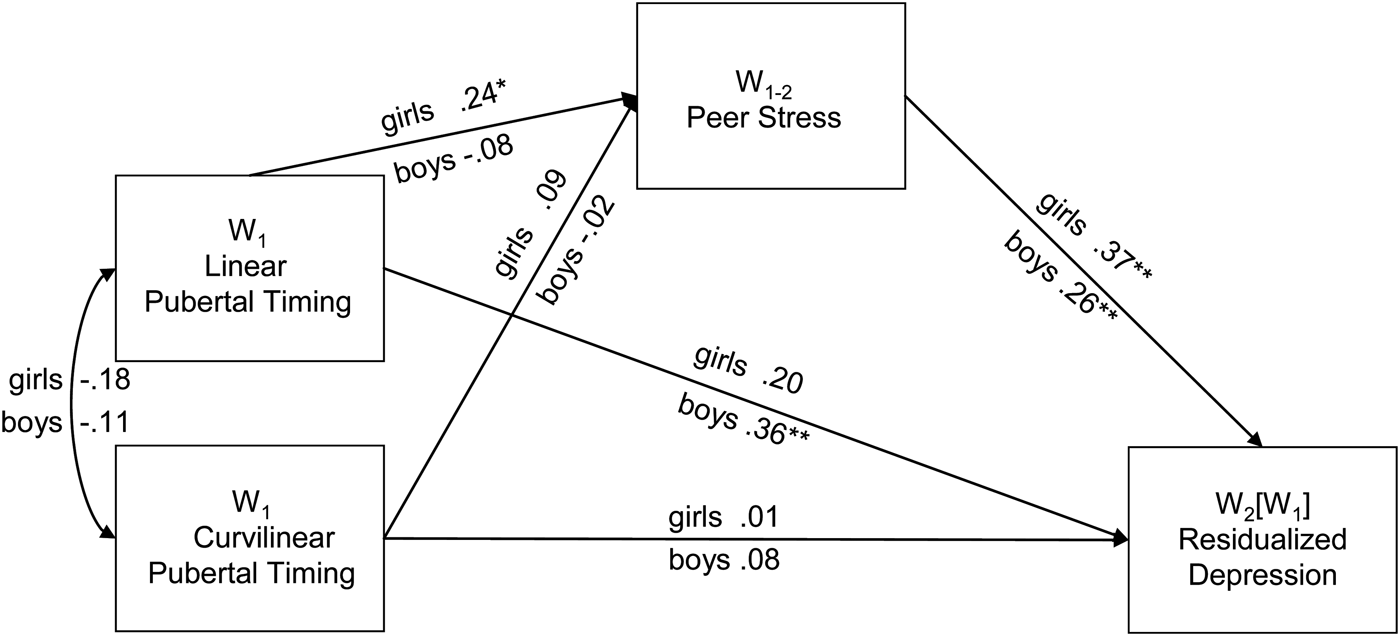
The model for pubertal timing predicted 21% of the variance in depression in girls (medium effect size) and 18% in boys (medium effect size; see Figure 2). Confirming the a priori hypothesis, a test of sex-moderated mediation indicated that the indirect effect of linear timing on depression via peer stress was significantly different in girls (β = 0.09, p = .071) and boys (β = −0.02, p = .53), χ2 (1, N = 149) = 4.35, r = .17, p = .038. Contrary to predictions, a test of sex-moderated mediation indicated that the indirect effect of curvilinear timing on depression via peer stress was nonsignificant, χ 2 (1, N = 149) = 0.52, r = .04, p = .47. Thus, we did not test for mediation in the path from curvilinear timing to peer stress to depression.
Peer stress as a mediator of the linear and curvilinear effects of pubertal timing on subsequent depression in girls and boys. *p < .05. **p < .01. N = 149 (78 girls, 71 boys).
Multigroup path analysis using equality constraints revealed that the path coefficient linking linear timing to peer stress marginally differed in girls and boys, χ 2 (1, N = 149) = 3.57, r = .15, p = .059. Notably, earlier pubertal timing predicted more peer stress in girls (β = 0.24, p = .037) but the association was nonsignificant, and in the opposite direction, in boys (β = −0.08, p = .52). There was no significant sex difference in the strength of the path coefficient linking peer stress to depression, χ2 (1, N = 149) = 1.21, r = .12, p = .14.
Within girls, linear pubertal timing had a stronger effect on depression when stress was not included (total effect β = 0.29, p = .011) than when it was included (direct effect β = 0.20, p = .067) in the model; this indirect effect explained 31% of the total effect (P M = 31%). Within boys, pubertal timing had a stronger effect on depression when stress was included (direct effect β = 0.36, p = .001) than when it was not included (total effect β = 0.34, p = .004) in the model, suggesting that peer stress slightly suppressed the effect of pubertal timing on depression.
Discussion
Following the principles of developmental psychopathology and recommendations of developmental scientists (Cicchetti, Rogosch, & Toth, Reference Cicchetti, Rogosch, Toth, Reynolds and Johnston1994; Graber, Reference Graber and Hayward2003; Hayward & Sanborn, Reference Hayward and Sanborn2002; Susman & Rogol, Reference Susman, Rogol, Lerner and Steinberg2004), this research took a contextualized approach to understanding the developmental processes linking sex and puberty to depression. Consistent with predictions, structural equation modeling analyses confirmed that (a) sex moderated the pathway from puberty to peer stress to depression; (b) the associations between puberty (status and linear timing) and depression were in opposite directions for girls and boys; (c) peer stress predicted depression, above and beyond the contribution of puberty, in both girls and boys; although they did not significantly differ, these paths were consistently stronger in girls than in boys; (d) consequently, the indirect effects of puberty and depression were in opposite directions in girls and boys; and (e) in girls, peer stress accounted for 67% of the effect of pubertal status on depression, and 31% of the effect of pubertal timing on depression; in contrast, the mediated effect proportions were not calculated in boys due to suppression effects. In sum, this research elucidated sex differences in one pathway through which puberty influences depression, via heightened stress in the peer domain.
Peer stress as a mediator between puberty and depression
The present research provides evidence that peer stress partially accounts for the association between puberty and depression in girls but not in boys. In models of pubertal status and timing, the longitudinal association between puberty and depression was more strongly mediated by peer stress in girls than in boys. Specifically, peer stress accounted for a moderate to large amount (i.e., 31% to 67%) of the association between puberty and depression in girls but not in boys. Furthermore, puberty and peer stress together explained a moderate proportion of the variance in depression in girls, and a smaller proportion of the variance in boys. These findings provide evidence that, at least in girls, puberty partially contributes to depression in adolescents because it triggers stress in peer relationships, which in turn heightens depression. The pattern of stronger findings in girls is consistent with research highlighting girls’ tendencies toward interpersonal sensitivity, social-evaluative concerns, and social approval-based self-evaluations, which often contribute to psychological distress (Crocker & Wolfe, Reference Crocker and Wolfe2001; Cross & Madson, Reference Cross and Madson1997; La Greca & Lopez, Reference La Greca and Lopez1998; Rudolph, Caldwell, & Conley, Reference Rudolph, Caldwell and Conley2005; Rudolph & Conley, Reference Rudolph and Conley2005).
The observed pathways in the present study suggest the developmental unfolding of transactions between adolescents and their social contexts (Cicchetti & Toth, Reference Cicchetti and Toth1994; Lerner, Reference Lerner1985; Sameroff, Reference Sameroff and Eisenberg1987). Specifically, adolescents’ personal and physical characteristics (including sex, pubertal status, and pubertal timing) hold particular values and meanings, and evoke certain social responses. Depending on particular personal characteristics (e.g., being an earlier-developing girl), these social consequences can take the form of social exclusion, teasing, lowered social status, restricted friendships, or other forms of peer stress. These stressful peer experiences, in turn, feed back into the developing adolescent's adjustment, reflected in the depressive reactions that often accompany stress in the peer domain (Rudolph et al., Reference Rudolph, Hammen, Burge, Lindberg, Herzberg and Daley2000). Furthermore, by virtue of their pubertal development and timing, adolescents also seek out particular social relationships and environments (Brooks-Gunn et al., Reference Brooks-Gunn, Warren, Samelson and Fox1986; Magnusson, Reference Magnusson1988). Thus, adolescents both select and shape their social contexts in ways that contribute to their subsequent developmental trajectories (Lerner, Reference Lerner, Lerner and Foch1987; Scarr & McCartney, Reference Scarr and McCartney1983; Steinberg, Reference Steinberg, Crockett and Crouter1995).
Contributions and future directions
The present study contributes to our growing understanding of the interplay among physical, psychological, and social processes involved in the sex difference in adolescent depression. This research also offered various methodological strengths in comparison to past research in this area. At the same time, there are areas for improvement in future research. An important contribution of the present study is its longitudinal design, which is particularly significant in testing mediational models and for tracking development over time. The study's sample included a broad age range. However, many of the youth were still undergoing pubertal changes at Wave 2. This is particularly true for boys, who develop later than girls (Tanner, Reference Tanner and Gardner1969). Future research with even broader age ranges can establish whether the current pattern of findings continues to hold later in adolescence.
Further, this study used a multiple-informant assessment approach and interview methods that are less subject to informant bias (Rudolph & Hammen, Reference Rudolph and Hammen1999; Rudolph et al., Reference Rudolph, Hammen, Burge, Lindberg, Herzberg and Daley2000). First, as recommended by Hayward (Reference Hayward and Hayward2003), we assessed multiple aspects of pubertal development. Two separate measures of pubertal development, from two informants, were converted into a composite index that has demonstrated reliability with both clinician-rated assessments and the underlying hormonal processes of puberty (Shirtcliff et al., Reference Shirtcliff, Dahl and Pollak2009). However, future research is needed to determine whether the same pattern of findings would emerge for other assessments of puberty, such as hormone levels. Second, the in-depth semistructured life stress interview assessed both chronic and episodic peer stress, both of which are important contributors to psychological adjustment (Compas, Reference Compas1987). Third, depression was assessed with a semistructured diagnostic interview, which provides optimal discrimination among different types of psychopathology. Despite recent emphasis on continuous assessments of psychopathology (Brown & Barlow, Reference Brown and Barlow2005; Hankin et al., Reference Hankin, Fraley, Lahey and Waldman2005), and evidence that stress–depression links are similar for clinical and subclinical levels of depression (Shih et al., Reference Shih, Eberhart, Hammen and Brennan2006), additional research with larger samples should confirm whether the present findings can be replicated when predicting categorical diagnoses of depression.
Finally, although this study confirmed significant contributions of puberty and peer stress to adolescent depression, many of the effect sizes were medium, or even small. Given the complex and dynamic nature of adolescent development, there are likely several other contributors to the emergence of sex differences in depression. For example, theory and research underscore the value of integrative models that consider physical and biological, cognitive, affective, and contextual processes (Cyranowski, Frank, Young, & Shear, Reference Cyranowski, Frank, Young and Shear2000; DeRose, Wright, & Brooks-Gunn, Reference DeRose, Wright, Brooks-Gunn, Keyes and Goodman2006; Graber et al., Reference Graber, Brooks-Gunn, Archibald, Stoff and Susman2005; Hilt & Nolen-Hoeksema, Reference Hilt, Nolen-Hoeksema, Hilt and Nolen-Hoeksema2009; Hyde, Mezulis, & Abramson, Reference Hyde, Mezulis and Abramson2008; Rudolph, Reference Rudolph2009). The present research focused specifically on physical and social contributions within the peer domain. Future research is still needed to integrate various theoretical perspectives and research findings into a comprehensive developmental model of the sex difference in depression.
Summary and implications
These findings contribute to a growing body of research that demonstrates the role of social context in the sex-differentiated pathway between puberty and depression. Specifically, puberty and peer stress are two aspects of adolescent development that have a powerful influence on the development of depression, particularly in girls. More broadly, these findings suggest that there are longitudinal, transactional associations between developing adolescents and their social contexts, ultimately contributing to the rising rates of depression, and the sex difference therein, during adolescence.
These findings also have important implications for the prevention and treatment of depression in adolescence. Given that the peer context plays an important role in the developmental progression of adolescent depression, particularly in girls, both treatment planning for clinical populations and positive youth development programming for healthy populations should aim to ameliorate stressors and enhance adolescents’ effective coping skills in the peer domain. Such efforts could reduce both the onset and persistence of adolescent depression at this key developmental transition. Given the consistent and perplexing problem of heightened depression in females starting in adolescence (Hankin & Abramson, Reference Hankin and Abramson1999), and evidence that interpersonal stress and depression might form a self-perpetuating cycle in adolescent girls (Rudolph et al., Reference Rudolph, Flynn, Abaied, Groot and Thompson2009), such efforts have the potential for large-scale impact.