INTRODUCTION
Communities of fish inhabiting estuaries are a combination of freshwater and marine species. A relatively low diversity but high abundance of few dominant species characterizes these communities. Most species exhibit wide tolerance to fluctuating environmental conditions typical of these systems (Whitfield, Reference Whitfield1999).
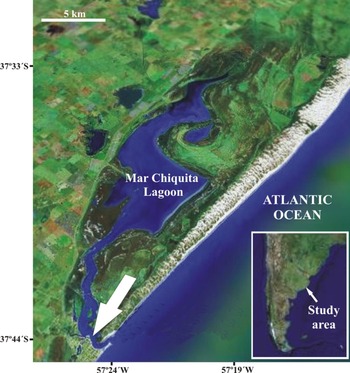
Mar Chiquita coastal lagoon is located in Buenos Aires province (37°32′–37°45′S 57°19′–57°26′W) (Figure 1). Since 1996, it has been considered as a World Biosphere Reserve by UNESCO (Iribarne, Reference Iribarne2001). This lagoon is a temperate shallow estuary, with a mean depth of approximately 1.2 m. It has an area of 50 km2 and runs parallel to the coast 25 km long. It is separated from the sea by a littoral line of dunes and the connection is through an inlet channel of about 6 km length, 200 m width and 0.5–3 m depth (Reta et al., Reference Reta, Martos, Perillo, Piccolo, Ferrante and Iribarne2001). The lagoon receives freshwater from small streams, artificial channels and subterranean water (Azpelicueta et al., Reference Azpelicueta, Figueroa, Diaz de Astarloa and Cousseau1998). The salinity has a horizontal gradient and fluctuates between 0 and 36, depending on tide and wind (Cousseau et al., Reference Cousseau, Díaz de Astarloa, Figueroa and Iribarne2001; Reta et al., Reference Reta, Martos, Perillo, Piccolo, Ferrante and Iribarne2001).
Map of Mar Chiquita coastal lagoon (Argentina) with the location where Trachurus lathami and Callorhinchus callorynchus were found.

The order of Chimaeriformes is represented by three families of chimaera: Rinochimaeridae, Chimaeridae and Callorhinchidae. The former includes six genera and at least 33 species (Nelson, Reference Nelson2006). Only one species of Callorhinchidae inhabits Argentinean waters, Callorhinchus callorynchus (Linnaeus, 1758). The elephant fish inhabits both coasts of South America, from 23°S in the Atlantic and from 18°S in the Pacific southwards, occurring in coastal waters to a maximum depth of 200 m (Cousseau & Perrota, Reference Cousseau and Perrota2004).
The rough scad, Trachurus lathami (Nichols, 1920), is the only carangid of the genus Trachurus known in the western Atlantic (Pacheco Tack & Cousseau, Reference Pacheco Tack and Cousseau1994), from the Gulf of Maine, in the United States of America (43°N), to the north of the Gulf San Matías in Argentina (41°30′S) (Cousseau & Perrota, Reference Cousseau and Perrota2004). It is a coastal–pelagic fish, occurring in waters from 50–100 m in depth, at temperatures between 15° and 17°C and salinity of 35.5 (Saccardo & Katsuragawa, Reference Saccardo and Katsuragawa1995). Trachurus lathami is an abundant species on the coastal waters of Mar del Plata during all seasons of the year, and also is abundant in the common area with Uruguay, in front of Rio de la Plata estuary (Ciechomski & Cassia, Reference Ciechomski and Cassia1980). The present record constitutes a new record for estuarine incursion, since five juvenile specimens of T. lathami were captured in Chesapeake Bay, Maryland, in July 1958; salinity and temperatures values recorded at this station were: 11 and 27°C (Mansueti, Reference Mansueti1960).
We report here on the occurrence of T. lathami and C. callorynchus in the inlet channel (37°44′S 57°25′W) approximately 2000 m from the mouth of Mar Chiquita coastal lagoon (Buenos Aires, Argentina; see Figure 1). The capture of both specimens apparently represents the first record in a coastal lagoon.
MATERIALS AND METHODS
One specimen of Callorhinchus callorynchus was collected on 10 October 2006, with a 25 m long, 2 m high-monofilament-gill net with 120 mm mesh size at a depth of 1.5 m. A T. lathami specimen was captured on 25 February 2008, using an 18 m long, 1.8 m wide-nylon-beach-seine net with a 12 mm stretch mesh size and 4 m cod-end.
The collected specimens were identified, dissected, sexed and measured with an ichthyometer and digital calliper. At the moment of collection, water temperature was recorded using a tick thermometer with 0.5°C precision and salinity was measured with an Hydrobios refractometer.
RESULTS
At the moment of collection of Trachurus lathami, the water temperature was 19°C and salinity was 30. This specimen showed typical features cited by Pacheco Tack & Cousseau (Reference Pacheco Tack and Cousseau1994); with standard length: 44.94 mm and total length: 54.96 mm; first dorsal-fin rays: VIII; second dorsal-fin rays: I–31; anal-fin rays: II–26; scales in lateral line: 72. Because the specimen was a small juvenile, dissection did not allow sex identification.
The specimen of Callorhinchus callorynchus showed features cited by Cousseau & Perrota (Reference Cousseau and Perrota2004) and a total length of 545 mm. The individual was an immature female. At the moment of collection the water temperature was 11°C and salinity was 33.
DISCUSSION
The capture of Callorhinchus callorynchus is the fourth documented occurrence of a condrichthyan species in Mar Chiquita coastal lagoon. Only the angel shark Squatina guggenheim (Cousseau et al., Reference Cousseau, Díaz de Astarloa, Figueroa and Iribarne2001), one juvenile specimen of the porbeagle shark Lamna nasus (Lucifora & Menni, Reference Lucifora and Menni1998) and a dead Torpedo puelcha specimen (Belleggia et al., Reference Belleggia, Barbini, Scenna, Figueroa and Díaz de Astarloa2008) were reported in recent years at the nearby mouth of the lagoon. The absence of sharks in the inner part of Mar Chiquita lagoon may be related to the scarce depth of the mouth and sharp fluctuations of temperature and salinity in the lagoon. The small dimensions of the mouth may be an important barrier for larger elasmobranchs species (Lucifora, Reference Lucifora and Iribarne2001).
Salinity range in Mar Chiquita coastal lagoon, shows a variable pattern, depending on wave tide, speed and direction of wind and freshwater volume belonging to the streams. Winds from the oceanic region, allow marine water to enter several kilometres in the inner channel, increasing salinity levels (Reta et al., Reference Reta, Martos, Perillo, Piccolo, Ferrante and Iribarne2001). Diel wind recorded during 10 June 2006 by the meteorological station of Mar del Plata, showed wind direction from east–south with speed of 18.5–22.2 km/h, phenomena that could explain the occurrence of a C. callorynchus specimen in the inlet channel.
The occasional presence of tropical or subtropical teleost fish in this lagoon has been attributed to the incursion of warm neritic waters to the Argentine continental shelf (Díaz de Astarloa et al., Reference Díaz de Astarloa, Figueroa, Cousseau and Barragán2000; Figueroa et al., Reference Figueroa, Díaz de Astarloa and Cousseau2000; Gonzalez Castro et al., Reference Gonzalez Castro, Díaz de Astarloa and Cousseau2006). The presence of T. lathami in the nearby mouth of the Mar Chiquita coastal lagoon, could be due to high salinity in the area in response to both a 1.45 m high tide at the moment of capture and an important dry season in the whole region.
Jaureguizar et al. (Reference Jaureguizar, Menni, Guerrero and Lasta2004) established the presence in the Rio de la Plata estuary, of T. lathami and C. callorynchus, in low density and only in the deepest zone of the estuary, with salinities between 25 and 34. This zone was characterized by the presence of just marine species. This is the only previous study from the south-western Atlantic that showed the presence of both species in estuarine waters.
The presence of these two new species for Mar Chiquita coastal lagoon, suggests that fluctuating characteristics of environmental factors in estuaries, present proper scenarios for incursions of estuarine-non-dependent marine fish.