





Lithium is considered a first-line maintenance treatment for bipolar disorder, associated with substantial reductions in symptomatology, relapse, hospitalisation and suicide risk. Reference Berk, Daglas, Dandash, Yücel, Henry and Hallam1–Reference Severus, Taylor, Sauer, Pfennig, Ritter and Bauer3 Despite its established efficacy, delays in lithium initiation are common, with a recent analysis of the South London and Maudsley (SLaM) data used in the present study identifying a delay of 1.8 years between first assessment and lithium initiation. Reference Perez-Rodriguez, Nguyen, Beck, Butler, Patel and Strawbridge4 Diagnostic inaccuracy, such as misdiagnosing young women with borderline personality disorder rather than bipolar disorder or misinterpreting differential presentations of affective symptoms between ethnic groups, Reference Haeri, Williams, Kopeykina, Johnson, Newmark and Cohen5 is thought to contribute to bipolar disorder diagnosis delays, with estimates ranging from 6 to 10 years. Reference Scott, Graham, Yung, Morgan, Bellivier and Etain6,Reference Drancourt, Etain, Lajnef, Henry, Raust and Cochet7 This study investigated whether time to bipolar disorder diagnosis and lithium initiation differ by gender, ethnicity or age.
Method
This sub-analysis of Perez-Rodriguez and colleagues Reference Perez-Rodriguez, Nguyen, Beck, Butler, Patel and Strawbridge4 used equivalent methods and sample (see original paper). The study was approved by the Clinical Records Interactive Search (CRIS) Oversight Committee in November 2020. CRIS has ethical approval from the South Central – Oxford C Research Ethics Committee (REC) as a database for secondary research. The REC reference is: 23/SC/0257. Briefly, this is a retrospective observational cohort study utilising routinely collected data within SLaM. Delay was defined as time from first SLaM assessment to recorded bipolar disorder or lithium initiation.
Delay distributions were assessed using Shapiro–Wilk tests. As outcomes were non-normally distributed, Mann–Whitney U tests, Kruskal–Wallis tests and Spearman’s correlations examined associations with gender, ethnicity and age, respectively. Ethnicity was subsequently collapsed into White versus non-White categories. Univariate linear regressions were performed using log-transformed delay outcomes, followed by adjusted models incorporating age, gender, in-patient initiation and substance use. Analyses were repeated after outlier removal, and post hoc power was assessed. All analyses were conducted in R (version 4.6.1 for macOS, Posit Software, PBC, Boston, USA, https://posit.co/downloads) with α = 0.05.
Results
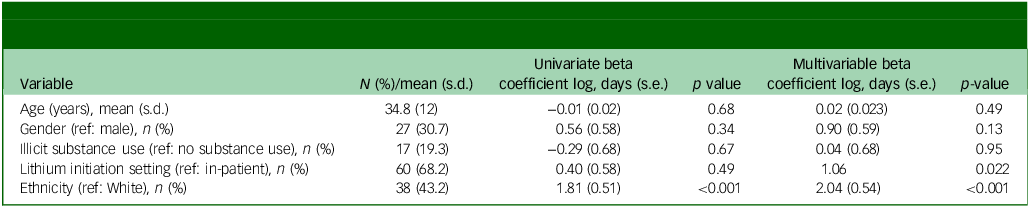
Time to diagnosis was the only outcome significantly associated with ethnicity (Kruskal–Wallis: χ2 = 12.70, p = 0.026, effect size = 0.094). Given small subgroup sizes (White n = 38, Black n = 25, Asian n = 9, Mixed n = 5), ethnicity was collapsed into a binary variable (White v. non-White). Although the authors are aware that research should avoid broad ethnic categories that minimise within-group heterogeneity, this collapsing was required to facilitate analyses. Reference Sharghi, Khalatbari, Laird, Lapidus, Enders and Meinzen-Derr8 Non-White patients were diagnosed significantly later (median 556 v. 50.5 days, IQR (89.8, 1342) v. (6.25, 222); β = 1.81, s.e. = 0.51, t = 3.60, p < 0.001).
In the fully adjusted model (covariates: age, gender, illicit substance use, in-patient/out-patient prescribing), ethnicity remained the sole significant predictor (β = 2.04, s.e. = 0.54, t = 3.80, p < 0.001). The model explained 16.7% of variance overall (R 2 = 0.167, adjusted R 2 = 0.117, F(5, 82) = 3.30, p = 0.009). A post hoc power calculation confirmed 90% power to detect the observed effect (f 2 = 0.20) at α = 0.05.
Outlier removal (n = 12, identified via Cook’s distance, leverage and standardised residuals) strengthened the ethnicity effect and the model explained substantially more variance (β = 2.58, p < 0.001; R 2 = 0.367). In-patient versus out-patient setting of lithium prescribing also emerged as a significant predictor in the sensitivity model (β = 1.06, p = 0.022), with out-patients experiencing longer diagnostic delays.
Moreover, patients with an initial schizophrenia-spectrum disorder (SSD) diagnosis were disproportionately non-White: 9 of 11 (81.8%) were non-White compared with 41 of 77 (53.2%) without an initial SSD diagnosis. Given the small subgroup, findings are presented descriptively and should be interpreted cautiously.
Discussion
This study found that non-White individuals experienced significantly longer delays to bipolar disorder diagnosis than White individuals, an effect that remained after covariate adjustment and outlier removal (Table 1). The modest R 2 values are consistent with the multifactorial nature of diagnostic delay and noise in routinely collected clinical data, thus residual confounding from unmeasured factors cannot be excluded.
General barriers to bipolar disorder diagnosis, including misdiagnosis, healthcare access challenges, stigma and mistrust of services, Reference Mehra, Bhatia, Ayis, Kordowicz, Hack-Polay and Akilan9 may be amplified in non-White individuals. Misinterpretation of affective symptoms within psychotic rather than bipolar frameworks may contribute, alongside documented overdiagnosis of schizophrenia and greater diagnostic instability in Black populations. Reference Haeri, Williams, Kopeykina, Johnson, Newmark and Cohen5,Reference Akinhanmi, Biernacka, Strakowski, McElroy, Balls Berry and Merikangas10,Reference Barry, Jarskog, Xia, Torpunuri, Wu and Zeng11 Supporting this possibility, non-White individuals disproportionately received SSD diagnoses before their bipolar disorder diagnosis, suggesting that diagnostic delay may represent a downstream consequence of misdiagnosis.
The absence of an ethnicity effect on time to lithium prescription may indicate that treatment decisions become more equitable once bipolar disorder is diagnosed. However, previous studies report less lithium and more antipsychotic prescribing among people of African ancestry. Reference Akinhanmi, El-Amin, Balls-Berry, Vallender, Ladner and Geske12–Reference Taylor-Desir, Sanchez-Ruiz, Vallender, Singh, Meagher and Frye14 This null finding may reflect sampling bias, as all participants received lithium. Therefore, future research should expand the sample to individuals who are not administered lithium at all.
Age and gender did not significantly influence delay outcomes. Females nevertheless had descriptively longer delays to bipolar disorder diagnosis (M = 742.38 days) compared with males (M = 514.93 days). The predominantly female sample may be limiting the detection of gender effects. Other limitations, including limited sample size, insufficient documentation and broad ethnic classifications, have been reported previously and may obscure within-group heterogeneity.
These findings align with the evidence of under-recognition of bipolar disorder in non-White populations. Reference Haeri, Williams, Kopeykina, Johnson, Newmark and Cohen5,Reference Akinhanmi, Biernacka, Strakowski, McElroy, Balls Berry and Merikangas10 Clinically, this emphasises the need for culturally informed diagnostic practices and reduced diagnostic overshadowing by psychotic disorder frameworks in non-White populations. Future studies should examine these findings in larger, representative samples while accounting for socioeconomic status.
Lived experience commentary (4th author)
I write as someone from a White British background who has lived with bipolar disorder type 1 throughout my adult life (first manic episode aged 18), with a lithium treatment delay of 14 years (first prescribed lithium aged 32). In the 5 years prior to commencing lithium, I had four manic episodes, but in the 5 years following lithium initiation, just one. My episodes have been devastating in their impact on my ability to function, maintain relationships and sustain employment. Happily, I am now functioning very well.
I was offered lithium aged 19 but declined due to reluctance to have blood tests. I feel my consultant psychiatrist should have made a stronger case for the drug. A later psychiatrist stated lithium was not a good fit because it would make me feel ‘sluggish’ (it doesn’t). I was only started on lithium after a lengthy hospital admission, where I was given the options of either lithium or electroconvulsive therapy. I responded quickly to lithium and have only had one more minor manic episode since.
Lithium has been absolutely transformative for me and I only wish I had been prescribed it earlier. I’m sure it has also saved the National Health Service (NHS) significant costs. I commend this research into inequalities in lithium initiation, and while my story does not speak to the ethnic inequalities found in this paper, they are no doubt worthy of further exploration.
Model statistics from unadjusted and adjusted regressions examining demographic and clinical characteristics associated with time to diagnosis

Table 1 Long description
The table presents data on demographic and clinical characteristics associated with time to diagnosis. It has six rows and five columns. The columns are labeled: Variable, N (%)/mean (s.d.), Univariate beta coefficient log (days), (s.e.), p value, Multivariable beta coefficient log (days), s.e., and p value. Row 1: Age (years), 234.8 (12), 0.01 (0.02), 0.68, 0.02 (0.023), 0.49. Row 2: Gender (ref: male), 127 (30.7%), 0.56 (0.58), 0.34, 0.90 (0.59), 0.13. Row 3: Illicit substance use (ref: no substance use), 17 (19.3%), 0.29 (0.68), 0.67, 0.04 (0.68), 0.95. Row 4: Lithium Initiation Setting (ref: in-patient), 60 (68.2%), 0.40 (0.58), 0.49, 1.06, 0.022. Row 5: Ethnicity (ref: White), 38 (43.2%), 1.81 (0.51), 0.001, 2.04 (0.54), 0.001.
Data availability
The data that support the findings of this study are available on request from the corresponding author (M.R.-B.).
Acknowledgement
No artificial intelligence tools have been used in the research or writing process for this manuscript.
Author contributions
M.R.-B. contributed to conceptualisation, methodology, formal analysis, project administration, visualisation, writing – original draft preparation and writing – review and editing. V.P.R. contributed to conceptualisation, data curation, methodology, investigation, project administration, resources and writing – review and editing. E.B. contributed to conceptualisation, methodology, formal analysis and writing – review and editing. S.M.A. contributed to methodology and writing – original draft preparation. R.P. contributed to methodology, resources, validation, visualisation and writing – review and editing. R.S. contributed to methodology, validation and writing – review and editing. K.B. contributed to supervision and writing – review and editing. A.H.Y. contributed to funding acquisition, resources, supervision and writing – review and editing. O.D.H. contributed to funding acquisition, resources, supervision and writing – review and editing. S.J. contributed to funding acquisition, resources, supervision and writing – review and editing.
Funding
The authors disclosed receipt of the following financial support for the research, authorship and/or publication of this article. This paper represents independent research funded by the National Institute for Health and Care Research (NIHR) Maudsley Biomedical Research Centre at South London and Maudsley NHS Foundation Trust and King’s College London. V.P.R.’s salary is funded by the Rosetrees Trust. K.B. is supported by the Early Intervention Mission study (IRAS Ref: 333754), NIHR Mental Health Translational Research Collaboration Mission, hosted by the NIHR Oxford Health Biomedical Research Centre (NIHR203316) and the Rosetrees Trust. R.P. has received grant funding from the National Institute for Health and Care Research (NIHR301690). O.D.H. has received funding by Medical Research Council-UK (no. MC_A656_5QD30_2135), Maudsley Charity (no. 666) and Wellcome Trust (no. 094849/Z/10/Z) grants to O.D.H. and the NIHR Biomedical Research Centre at South London and Maudsley NHS Foundation Trust and King’s College London.
Declaration of interest
E.B. currently holds an unpaid secondment with Akrivia Health, but has no financial relationship with the company and the duties are distinct from the included work. R.P. has participated in scientific advisory boards for Boehringer Ingelheim and Teva, has received grant funding from Janssen and has received consulting fees from Akrivia Health, Boehringer Ingelheim, Bristol Myers Squibb, Clinilabs, Columbia Data Analytics, Eisai, Holmusk, Otsuka, Social Finance, Supernus and Teva. R.S. has received honoraria for educational lectures from Janssen. K.B. provides consultancy services to Bristol Myers Squibb. O.D.H. has received investigator-initiated research funding from and/or participated in advisory/speaker meetings organised by Alkermes, Angellini, Autifony, Biogen, Boehringer Ingelheim, Bristol Myers Squib, Eli Lilly, Elysium, Heptares, Global Medical Education, Invicro, Janssen, Karuna, Lundbeck, Merck, Minerva, Neurocrine, Ontrack/ Pangea, Otsuka, Ovid, Pasithea, QCell, Sunovion, Recordati, Roche, Rovi, Teva and Viatris/Mylan. He was previously a part-time employee of Lundbeck A/S. O.D.H. has a patent for the use of dopaminergic imaging. The views expressed are those of the author(s) and not necessarily those of H Lundbeck A/S, the NHS/NIHR or the Department of Health. A.H.Y. is employed by Imperial College London and is an honorary consultant at South London and Maudsley NHS Foundation Trust (NHS UK). A.H.Y. is the editor of Journal of Psychopharmacology and deputy editor of BJPsych Open. A.H.Y. gives paid lectures and serves on advisory boards for the following companies with drugs used in affective and related disorders: Flow Neuroscience, Novartis, Roche, Janssen, Takeda, Noema pharma, Compass, AstraZeneca, Boehringer Ingelheim, Eli Lilly, LivaNova, Lundbeck, Sunovion, Servier, Allegan, Bionomics, Sumitomo Dainippon Pharma, Sage, Neurocentrx and Otsuka. A.H.Y. is principal investigator in the Restore-Life Vagus Nerve Stimulation registry study funded by LivaNova. A.H.Y. is principal investigator on ESKETINTRD3004: ‘An Open-label, Long-term, Safety and Efficacy Study of Intranasal Esketamine in Treatment-resistant Depression.’ A.H.Y. is principal investigator on ‘The Effects of Psilocybin on Cognitive Function in Healthy Participants’. A.H.Y. is principal investigator on ‘The Safety and Efficacy of Psilocybin in Participants with Treatment-Resistant Depression (P-TRD)’. A.H.Y. is principal investigator on ‘A Double-Blind, Randomized, Parallel-Group Study with Quetiapine Extended Release as Comparator to Evaluate the Efficacy and Safety of Seltorexant 20 mg as Adjunctive Therapy to Antidepressants in Adult and Elderly Patients with Major Depressive Disorder with Insomnia Symptoms Who Have Responded Inadequately to Antidepressant Therapy.’ (Janssen). A.H.Y. is principal investigator on ‘An Open-label, Long-term, Safety and Efficacy Study of Aticaprant as Adjunctive Therapy in Adult and Elderly Participants with Major Depressive Disorder (MDD).’ (Janssen). A.H.Y. is principal investigator on ‘A Randomized, Double-blind, Multicentre, Parallel-group, Placebo-controlled Study to Evaluate the Efficacy, Safety, and Tolerability of Aticaprant 10 mg as Adjunctive Therapy in Adult Participants with Major Depressive Disorder (MDD) with Moderate-to-severe Anhedonia and Inadequate Response to Current Antidepressant Therapy’. A.H.Y. is principal investigator on ‘A Study of Disease Characteristics and Real-life Standard of Care Effectiveness in Patients with Major Depressive Disorder (MDD) With Anhedonia and Inadequate Response to Current Antidepressant Therapy Including an SSRI or SNR.’ (Janssen). A.H.Y. is the UK chief investigator for Compass; COMP006 & COMP007 studies (Compass). A.H.Y. is the UK chief investigator for Novartis MDD study MIJ821A12201. A.H.Y. has no shareholdings in pharmaceutical companies. Grant funding (past and present): National Institute of Mental Health, USA; Canadian Institutes of Health Research, Canada; National Alliance for Research on Schizophrenia and Depression, USA; Stanley Medical Research Institute, USA; Medical Research Council, UK; Wellcome Trust, UK; Royal College of Physicians of Edinburgh; British Medical Association, UK; University of British Columbia – Vancouver General Hospital Foundation, Canada; Women’s Economic Development Council, Canada; Coast Capital Savings Depression Research Fund, Canada; Medical Services Foundation of British Columbia, Canada; NIHR, UK; Janssen (UK) and European Union Horizon 2020. S.J. has received personal fees or honoraria from Recordati, LB Pharmaceuticals, Boehringer Ingelheim, Accord Pharmaceuticals, Lundbeck, Janssen and Sunovion. He has served on an advisory board for Boehringer Ingelheim and has undertaken consultancy work for LB Pharmaceuticals. He has received personal fees from the Wellcome Trust and has served on panels or undertaken non-financial professional work for the Wellcome Trust, the National Institute for Health and Care Excellence, the British Association for Psychopharmacology and the Royal College of Psychiatrists. All interests were outside the submitted work. It should be noted that R.S., A.H.Y. and S.J. are members of the BJPsych Open Editorial Board; however, they did not take part in the review or decision-making process for this paper. All other authors (M.R.-B., V.P.R. and S.M.A.) had no declarations.

 Open access


eLetters
No eLetters have been published for this article.